Showing posts sorted by relevance for query Attaché. Sort by date Show all posts

Wednesday, October 26, 2022

Attaché

Attaché (pronounced a-ta-shey, at-uh-shey or uh-tash-ey)

(1) A diplomatic official attached to an embassy or legation, especially in a technical capacity (often as a commercial attaché, cultural attaché etc).

(2) A military officer who is assigned to a diplomatic post in a foreign country in order to gather military information (historically usually as air attaché; army attaché; naval attaché, military attaché).

(3) As attaché case, a type of briefcase intended for carrying documents.

1825–1835: From the French attaché (plural attachés, feminine attachée), (junior officer attached to the staff of an ambassador (literally “attached”)), noun use of the past participle of attacher (to attach), from the Old French atachier, a variant of estachier (bind), from estache (stick), from the Frankish stakka (stick) (which was cognate with the Old Occitan estacha, the Italian stacca and the Spanish estaca, from the Gothic stakka).  The attaché case (small leather case for carrying papers) dates from circa 1900.  English, typically, picked up attaché unaltered from the French (although the spelling attache is now common) as did German, Polish and Swedish but other languages adapted as was suited by tradition or pronunciation including Georgian (ატაშე (aṭaše)), Russian (атташе́ (attašé)), Serbo-Croatian (ataše) and Turkish (ataşe).  In sardonic diplomatic humor, attaché was long regarded as a euphemism for “spy” and that, the humor and the practice, remains afoot.  Attaché is a noun and the noun plural is attachés (use in attaché case is not adjectival).

The attaché case and the briefcase.

Meme of Lindsay Lohan in court, Los Angeles, 2013.

A Lindsay Lohan court appearance in Los Angeles in 2013 attracted the usual commentary (choice of hairstyle, clothes, shoes etc) but the attaché case carried by her lawyer inspired the meme-makes to create a spoof Louis Vuitton advertisement.  The mock-up, which appeared on the now defunct danielpianetti.com, used a courtroom image in which Ms Lohan’s seemed transfixed, eyes focused on the attaché case recumbent on the defense table.  Fond of handbags and with a famously large collection, doubtlessly she can cast an expert eye. 

Lawyer Mark Jay Heller with attaché case and rabbit’s foot.

Ms Lohan was represented by celebrity lawyer Mark Jay Heller (b 1945) who gained fame from representing “Son of Sam” serial killer David Berkowitz (b 1953) before becoming a staple of the paparazzi business and he recently resigned from the New York bar due to professional misconduct.  In 2013, his attaché case was notable for the white rabbit's foot key chain attached to the handle which Mr Heller said brought him good luck.  On 17 March 2022, a New York state appeals court accepted his resignation from the bar after he admitted several counts of misconduct including failing to communicate with one client and neglecting another.  The subject of a disciplinary investigation, he acknowledged to the court he had no defense to offer.  Luck had run out.  Mr Heller’s attaché case was a Louis Vuitton Serviette Conseiller Monogram Robusto, fabricated with a cross grain calf leather interior & a natural cowhide handle (part-number M53331).  It's no longer available but a similar item, suitable for tablets and smaller laptops is the Porte-Documents Voyage PM Monogram Macassar Canvas (part-number M52005) at US$1950.

The attaché case and briefcase have not dissimilar histories.  In the diplomatic establishment, attachés were originally junior members of staff (their dual role as covers for spying swiftly a parallel career path) who fulfilled administrative duties which included carrying the ambassador’s papers in as slim case which came to be known as an attaché case.  In the legal community, a brief was a summary of facts and legal positions supporting arguments in judicial proceedings, prepared by a solicitor and provided to the advocate who was to appear in court.  The “brief case” was originally a wooden box in the chambers of barristers in which the bound briefs were deposited but by the early twentieth century it had come to be used to describe the small, rigid bags which had become the usual device used by lawyers to carry stuff to court.  These quickly became an almost obligatory accessory for businessmen either successful or wishing to appear so and they remained part of the informal uniform until the 1990s when laptops and later tablets & smartphones began to supplant paper.  The look remains admired however and high-end laptop bags use many of the design cues from the briefcase, even down to that signature touch of the 1970s, the dual combination locks.

Between manufacturers, there’s no agreement on when the attaché case ends and the briefcase begins but it seems the attaché case is a small, slender suitcase which opens into two distinct and usually symmetrical compartments, made from leather or metal and definitely without a shoulder strap.  By contrast, a briefcase is a flat, rectangular container which opens to reveal one large compartment although the “lid” is likely to have pockets or gussets that expand to accommodate pens, phones and such, generating flexible storage functionality.  Historically a briefcase would not include a shoulder strap but many are now so equipped suggesting the laptop bag is a descendent of the briefcase rather than the attaché case.  For that reason, the attaché case would seem to be thought something slim and stylish while a briefcase must be bigger to accommodate not only documents but also the electronic devices of the modern age including accessories such as charges, power cords and cables.  Other manufactures however claim an attaché case is actually bigger than a briefcase and always includes a shoulder strap but this view seems unfashionable and may relate more to their product differentiation and naming conventions.  However, for those not bothered by fine distinctions in such matters, using the terms interchangeably will likely confuse few.

Although probably thought by many to be something which exists only in the imagination of spy novels, briefcase guns really have been a thing and along with other innovations like the poison-tipped umbrella, there are documented cases of them being used by Warsaw Pact counter-intelligence services.  Remarkably, though unsurprisingly, briefcase guns are available for purchase in the US and can in some jurisdictions lawfully be carried (being luggage this is most literal) provided it’s first registered under the National Firearms Act as an Any Other Weapon (AOW), the relevant clause being 26 U.S.C. § 5845(E): Any weapon or device capable of being concealed on the person from which a shot can be discharged through the energy of an explosive.

In this example, the weapon is a Heckler & Koch MP5 (Maschinenpistole 5), a 9x19mm Parabellum submachine gun, developed in the 1960s and there have been dozens of versions, both automatic and semi-automatic.  Widely used around the world by both the military and in law enforcement, the MP5 has survived the introduction of its supposed successor (the UMP) and remain popular, a familiar tale in military hardware.  The MP5K (the K stands for kurz (short)) is locked into a claw mount with the muzzle connected to a tubular firing port.  Loading a magazine is said to be a clumsy operation with the MP5 in place but is possible although it’s noted the recommended 30-round clip is a tight fit, barely clearing the bottom of the case.  The trigger is conveniently located in the handle and connected with a mechanical linkage.  There’s a knurled button on the handle which functions as a kind of external safety catch because the fire mode is set prior to closing the case and spent shells are deflected downward so they can’t cause a malfunction by bouncing into the action.  Within, there’s a holder for a spare magazine and the briefcase is lockable (which seems a sensible feature).  It’s said to take some practice to achieve anything like the accuracy one could attain with a conventionally held MP5 but for the section of the target market which wants a sudden, rapid fire over a wide field, it’s presumably ideal.


Friday, September 18, 2026

Ambassador

Ambassador (pronounced am-bas-uh-dawr)

(1) A diplomatic official of the highest rank, sent by one sovereign or state to another as its resident representative (ambassador extraordinary and plenipotentiary).

(2) A diplomatic official of the highest rank sent by a government to represent it on a temporary mission, as for negotiating a treaty.

(3) A diplomatic official serving as permanent head of a country's mission to the United Nations or some other international organization.

(4) An authorized messenger or representative.

(5) A term for a corporate representative, often the public face(s) of the company, mush favoured by fashion houses etc.

1325-1375: From the Middle English ambassadore, from the Anglo-Norman ambassadeur & ambassateur, from the Old Italian ambassatore (ambassador in the dialectal Italian), from the Old Occitan ambaisador (ambassador), a derivative of ambaissa (service, mission, errand), from the Medieval Latin ambasiator, from the andbahti (service, function), from the Proto-Germanic ambahtiją (service, office), a derivative of the Proto-Germanic ambahtaz (servant), from the Gaulish ambaxtos (servant) which was the source also of the Classical Latin ambactus (vassal, servant, dependent).  The early Proto-Celtic ambaxtos (servant), was from the primitive Indo-European ambhi (drive around), from ambi- (around) + ag- (to drive).  The adjective ambassadorial (of or belonging to an ambassador) dates from 1759.  The spellings ambassador and embassador were used indiscriminately until the nineteenth century, the OED (Oxford English Dictionary) curiously continuing, well into the twentieth century, to insist the later was the preferred form in US English long after it had there been abandoned everywhere except in the halls of the State Department.  In diplomatic use, the US government had an interesting history of nomenclature, neither sending nor accrediting foreign ambassadors, having only “ministers”.  The reason for this lies in the origins of the United States as a revolutionary state freeing itself from monarchical tyranny; it thus insisted only on ministers who represented states, not ambassadors who historically were the personal emissaries of sovereigns.  Functionally there was no difference and not infrequently, in in casual use ministers were styled as ambassadors with neither offence or declaration of war following and, having made the political point for a century, after 1893, every minister became instead an ambassador.  Ambassador, ambassadress, ambassadry & ambassadrship are nouns, ambassadorial & ambassadorless are  adjectives and ambassadorially is an adverb; the noun plural is ambassadors.

Kylie Jenner (b 1997), a most glam glambassador.

The neologism ambassadonor was coined to describe those appointed to ambassadorships on the basis of the size of their donations to whichever party has the embassy in their gift.  A common practice of long-standing in the US, it’s a way not only of conferring prestige on the appointee but also grants them a title, the convention being an entitlement for life to be addressed as Mr or Madam Ambassador.  For doners, the appointments can be good value for money because (1) traditionally they’re skewed towards desirable locations (a nice (non-shithole) country with a pleasant climate and a majority white population) and (2) they’re effectively sinecures during which one can wine & dine (the US taxpayer picking up the tab), network and pursue business opportunities with any real work handled by the professional staff appointed by the State Department.  That’s just how politics works and it’s a better gig than being something like secretary of state for agriculture.  The nouns ambassadress & ambassadrix are now rare and did double duty as (1) a female ambassador or (2) the wife of an ambassador.  In the modern age, either may make a comeback because when a female ambassador is appointed, if she has a wife the forms may be thought useful but should she have a husband, there’s no equivalent honorific; he’s just an unacknowledged appendage.  Tempting though the thought may be, embassador & embassadress are not two embarrassing appointees (possibly ambassadonors) to an embassy but just now archaic alternative spellings of ambassador & ambassadress.  The informal noun glambassador describes a glamorous public figure (especially a female celebrity) who uses (or licences) her personal brand & image to promote some product or cause.  Kylie Jenner’s role in the promotion of Meta Glasses (camera glasses) may be thought a glambassadorship.

Diplomatic ranks since 1961

Margaret Qualley (b 1994), Venice Film Festival, August 2019, Brand Ambassador for French fashion house Chanel.

Diplomatic rank is the system of professional and social rank used in the world of diplomacy and international relations. A diplomat's rank determines many ceremonial details, such as the order of precedence at official processions, the seat at the table at state dinners, the person to whom diplomatic credentials should be presented and the title by which they should be addressed.  The current system of diplomatic ranks was established by the Vienna Convention on Diplomatic Relations (1961) and the modern list is a simplified version of the more elaborate system established by the Congress of Vienna (1814-1815).  There are now three senior ranks, two of which remain in use:

Ambassador. An ambassador is a head of mission who is accredited to the receiving country's head of state. They head a diplomatic mission known as an embassy, which usually is headquartered in a chancery in the receiving state's capital, often clustered with others is what’s often styled a “diplomatic quarter”, a feature of town-planning especially associated with cities where physical security is a concern.  A papal nuncio is considered to have ambassadorial rank, and they preside over a nunciature; often, in predominantly Roman Catholic countries the nuncio is, ex officio, appointed dean of the diplomatic corps.  Between Commonwealth countries, high commissioners are exchanged; they preside over a high commission and enjoy the same diplomatic rank as an ambassador.

Minister. A Minister is a head of mission who is accredited to the receiving country's head of state. A Minister heads a legation rather than an embassy. However, the last legations were upgraded to embassies in the late 1960s, and the rank of Minister is now functionally obsolete although any country may at any time appoint them.  An envoy or an internuncio was also considered to have the rank of Minister; they’re now granted status ad-hoc but tend to be regarded as being on the level of consular appointments.  None of this should be confused with the long and tangled history of the resident minister, appointments sometimes political, sometimes diplomatic and sometime administrative.  At different times and in different places, it has meant different things, used essentially to mean whatever the immediate situation demanded and, being outside any formal rules or conventions of diplomacy, flexibility was possible.

A chargé d'affaires en pied (usually styled as chargé d'affairs in everyday use) is a permanent head of mission, accredited by his country's foreign minister to the receiving nation's foreign minister, in cases where the two governments have not reached an agreement to exchange ambassadors.  A chargé d'affaires ad interim is a diplomat who temporarily heads a diplomatic mission in the absence of an ambassador.

A variety of titles exist beneath the formal three such as counsellor, first secretary, second secretary, third secretary, attaché and assistant attaché.  The actual roles discharged vary, indeed, some of these jobs are actually covers for spies or other political operatives and, just as ambassadorships are used often as a rewards for helpful services (such as large campaign donations) or as a temptingly lucrative sinecure to get a potential rival out of the country, the lower appointments have been a dumping ground for troublesome public servants when, for whatever reason, they can’t be sacked.  The diplomatic appointment also determines the description of the architecture.  An ambassador works from (and usually lives in) an embassy whereas other diplomats (except Commonwealth high commissioners who operate from high commissions) tend to be housed in consulates.  Like ambassador and embassador, the terms ambassy and embassy used to be interchangeable but in each case one prevailed and the other went extinct.  Etymology has no explanation for either case except it was just a pattern of use which emerged and that’s how English evolves.  The word embassy evolved in another way.  It now, institutionally and architecturally, refers to something permanent but, until the late nineteenth century was more often a temporary mission and described a delegation which would return home when its business concluded.  The history is reflected in some terms still used in diplomacy such as "Head of Mission".

Uncle Otto and nephew Eric

Uncle Otto, taking the salute, Paris 1940.

Because the Third Reich (1933-1945) never concluded a peace treaty with Vichy France, diplomatic recognition was not possible so no ambassador was accredited.  There was however a de-facto ambassador, Adolf Hitler (1889-1945; Führer (leader) and German head of government 1933-1945 & head of state 1934-1945) in November 1940 appointing Otto Abetz (1903-1958) to the German Embassy in Paris, a post he held until July 1944 when diplomatic conditions changed a bit.  As the letters patent made clear, he acted with full ambassadorial powers and, genuinely a Francophile, he certainly attempted to use his authority in a way he thought would be conducive to making France a central element in a Europe under Berlin's benign hegemony.  These proto-EU (European Union (1993)), the multi-national aggregation which evolved from the EEC (European Economic Community), the Zollverein formed in 1957) gestures didn't much impress his colleagues from the Nazi's "loot & pillage" school of thought with Hermann Göring (1893–1946; leading Nazi 1922-1945, Hitler's designated successor & Reichsmarschall 1940-1945) openly contemptuous of "Herr Abetz's" earnestness.  Hitler, who applied "divide and conquer" tactics to enemies, allies & associates alike, seldom attempted to mediate in such squabbles.  In July 1949 a French court handed Abetz a 20 year sentence for crimes against humanity; released in 1954, he died in 1958 in a traffic accident on the Cologne-Ruhr Autobahn and there are conspiracy theorists who suspect the death was an "assassination", the French in the era not above administering some ex post facto justice.

Nephew Eric, taking tea, Canberra 2018.

Otto Abetz was the great uncle of Eric Abetz (b 1958; Liberal Party senator for Tasmania, Australia 1994-2022, member of the Tasmanian House of assembly since 2024).  Because of the coincidence of one being born in the same year death visited the other, there was speculation about the transmigration of uncle Otto’s soul to nephew Eric.  Spiritualists however generally agree this would have been impossible because the former senator was born on 25 January, his old Nazi relative living until 5 May the same year.  Transmigration was known also as metempsychosis and was an idea most associated in the West with pre-Ancient (archaic) Greece but which may (perhaps concurrently) have origins in Egypt and India.  Mr Abetz is now Tasmania's treasurer, a perhaps thankless task given the level of the state exchequer's indebtedness but despite his reputation as a conservative, he has a history of innovation, proudly telling one interviewer his law firm was in the 1980s the first in Hobart to include a splash of color on the firm's letterhead.  At the time, that would have seen some think him a troublesome radical but clearly he's a problem-solver and that's good because in his new role there are problems to solve.  Encouragingly, despite the unpromising family background, no evidence has ever emerged linking Eric Abetz to the Freemasons co there's that.

Lindsay Lohan: Allbirds Ambassador         

Lindsay Logan, nueva embajadora de Allbirds (the new Allbirds ambassador), possibly on a Wednesday.

In 2022, Allbirds appointed Lindsay Lohan as an ambassador for its "Unexpected Athlete" campaign, focusing on her for the new limited edition of its most successful running shoe to date, the Tree Flyer.  The promotional video issued for the announcement was nicely scripted, beginning with Ms Lohan’s perhaps superfluous admission that as an ambassador for running “I am a little unexpected" before working in a few references to her career in film (showing again a rare sense of comedic timing), fondness for peanut butter cookies and the odd social media faux-pas, many of which she's over the years embraced.  It wasn't disclosed if the photo-shoot happened on a Wednesday but the featured shoe (Lux Pink) was said to include no plastics but Allbirds didn't respond to enquiries about the material used for the laces' aglets.  

Lindsay Lohan, Allbirds “Unexpected Athlete Ambassador”.

As a well-known car driver and frequent flyer who has for years lived in an air-conditioned cocoon in Dubai, it’s not clear how far up the chart of conspicuous consumption Ms Lohan has stamped her environmental footprint but US-based footwear and apparel company Allbirds claims its design, production & distribution processes are designed to make its products as eco-friendly as possible.  It is a certified “B Corporation”, a system of private certification of for-profit companies of their "social and environmental performance" conferred by B Lab, a non-profit organization which claims to provide consumers with a way reliably to distinguish the genuinely environmentally active from those who cynically “greenwash”.

The AMC Ambassador's footnote in the history of automotive AC

The AMC (American Motors Corporation) Ambassador was between 1957-1974 produced in eight generations although the name had since 1927 been used by a company that would become part of the ultimately doomed AMC conglomerate.  Emblematic of the company's unsuccessful attempt consistently to compete with Detroit's big three (GM (General Motors), Ford and Chrysler), the Ambassador was in those years offered variously as an intermediate and full-sized model but unfortunately, this culminated in its largest ever iteration being sold as the first oil crisis struck in 1973; the universe shifted and the Ambassador was axed in little more than year.  One footnote in the story is that in 1968, the advertising made much of the Ambassador being the only car in the world (other than those from Rolls-Royce) with AC (air-conditioning) as standard equipment.  That was a bit of a fudge in that at the time a number of European manufacturers fitted AC (optional in Europe) to all of at least some of the models they shipped to the US but technically, AMC was correct.

1974 Rolls-Royce Phantom VI (1968-1990) Formal Limousine (coachwork by Mulliner Park Ward).

Originally, this Phantom VI was delivered to Moscow to serve as official car of British Ambassador to Russia; symbolism was of great significance during the high Cold War.  When supplied, it was in traditional diplomatic black but, after being acquired by a US collector, this was changed to two-tone black over garnet, close to the hues associated with some of the Rolls-Royces in the Royal Mews.  By the time the last left the factory in 1990, it probably remained true Rolls-Royce was "the best-built car in the world" but in many ways the Phantom VI was a relic with the engineering of some of the underpinnings dating from the inter-war years (1919-1939).  The sole virtue of the four-wheel drum brakes was their silence in operation and the solid rear axle's semi-elliptic springs (the nickname "cart springs" gained from them for centuries appearing on horse-drawn carts, carriages, buggies and such) were wrapped in leather gaiters, ensuring the ambassador would never be troubled by tiresomely intrusive squeaks.

The Rolls-Royce "best car in the world" cliché  was in the 1960s still a powerful cultural message and a couple of seasons earlier Ford had spent a lot of money on an advertising campaign asserting their then new range of full-sized Fords was "quieter than a Rolls-Royce", a claim that must have seemed audacious given the English company's hook: “At 60 mph (100 km/h) the loudest noise in a Rolls-Royce comes from the electric clock”.  That shtick had been verified (at least in ideal conditions) by sceptical journalists although one did note it was possible to make electric clocks function silently, concluding the company deliberately fitted time-pieces emitting an untypically loud “tick-tock”, just to ensure the claim was true.  Still, true it was and to ensure they couldn't be accused of “mere puffery”, Ford spent a lot of money, J. Walter Thompson (then Ford’s advertising agency) commissioning acoustical consultants Boldt, Beranek and Neuman to run tests, two brand new Rolls-Royce Silver Cloud (1955-1966) III (1963-1966) saloons purchased for the project.  What the engineer’s dB (decibel) meters revealed was that, under conditions that were controlled but representative of much of the driving experience in the US, the Fords were indeed quieter.

1964 Chrysler New Yorker Salon advertising.

AMC's marketing budget didn't stretch to hiring consultants of buying a brace of Roll-Royces but to verity its claim, all it required was a Rolls-Royce brochure or specification sheet, free from the closest distributer.  In a sense it was a bold move for AMC to include AC as standard in the Ambassador because it was in 1968 still far from a commonly ordered option and even Cadillacs, Lincolns and Imperials sometimes were ordered without the buyer ticking the box for what was then an expensive choice (well into four figures in 2026 US$ values).  Nor was the commercial history encouraging.  Chrysler in 1963-1964 had tried the approach of bundling almost all available options (including AC) into a top-of-the-range New Yorker it dubbed the “Salon”, daringly offering it at a price-point above some of the (less well-equipped) models in the Imperial line, nominally the corporation’s flagship brand.  Salon was from the French salon (reception room) and although the word was associated with gatherings of literary and artistic circles, most Americans were probably more familiar with the “beauty salon” (eyelashes, hair, nails and such) so how well the “associative messaging” would have cut through is uncertain but the imagery used for marketing certainly had a “European theme” with English society photographer Cecil Beaton (1904-1980) hired to do a few “artistic” shots.  Alas, at almost US$5,900 it was some 30% more expensive than the standard New Yorker and at that price was intruding not only on Imperial’s territory but also that of Cadillac and Lincoln, all with more “brand cachet” than Chrysler although, to be fair, on the basis of cost-breakdown, the value was there because it was still cheaper than any of them similarly equipped from their (long) option lists.  The salon lasted in the catalogue less than two seasons with a disappointing 2,214 sold (593 of the in 1963; 1,621 in 1964) and that was the last time the US industry dabbled with “standard AC” until AMC’s venture with the Ambassador for 1968. 

Tuesday, April 16, 2024

MRDA

MRDA (pronounced emm-ahr-dee-ey)

The abbreviation of “Mandy Rice-Davies Applies”, an aphorism used in law and politics to refer to any denial which is transparently self-interested.

1963: An allusion to the statement “Well he would, wouldn't he?”, said by Welsh model Mandy Rice-Davies (1944-2004) during cross-examination in a trial at the Old Bailey (the central criminal court for England & Wales) associated with the Profumo affair.

Lord Astor, Mandy Rice-Davies and the Profumo Affair

The context of Ms Rice-Davies’s answer was the question: “Are you aware that Lord Astor denies any impropriety in his relationship with you?” and the answer “Well he would, wouldn't he?” elicited from those in the court “some amusement”.  MDRA (Mandy Rice-Davies Applies) thus became in law and politics an aphorism used as “verbal shorthand” to refer to any denial which is transparently self-interested although it doesn’t of necessity imply a denial is untrue.  In general use, the fragment from the trial is often misquoted as “Well he would say that, wouldn't he?” because that better encapsulates the meaning without being misleading.

Mandy Rice-Davies (left) and Christine Keeler (right), London, 1963.  Note the leopard-print seat covers.

The Profumo affair was one of those fits of morality which from time-to-time would afflict English society in the twentieth century and was a marvellous mix of class, sex, spying & money, all things which make a good scandal especially juicy.  John Profumo (1915-2006) was the UK’s Minister for War (the UK cabinet retained the position until 1964 although it was disestablished in the US in 1947) who, then 46, was found to be conducting an adulterous affair with 19 year old topless model Christine Keeler (1942-2017) at the same time she was also enjoying trysts with a Russian spy, attached to the Soviet embassy with the cover of naval attaché.  Although there are to this day differing interpretations of the scandal, there have never been any doubts this potential Cold-War conduit between a KGB spy and Her Majesty’s Secretary of State for War represented at least a potential conflict of interest.

Dr Evatt (left), comrade Molotov (centre) and Soviet translator Alexei Pavlov, exchanging MRDAs in Russian & English, London, 1942.

MRDAs are common in courtrooms and among politicians but some became legends.  In 1954, Dr HV Evatt (1894–1965; Australian attorney-general & foreign minister 1941-1949, and leader of opposition 1951-1960), in the midst of a particularly febrile period during the Cold War, wrote a letter to comrade Vyacheslav Molotov (1890–1986; Soviet foreign minister 1939-1949 & 1953-1956) asking if allegations of Soviet espionage in Australia were true.  Comrade Molotov of course wrote back, politely denying the USSR engaged in spying anywhere.  Assured, Evatt read the letter to the parliament and the members sat for a moment stunned until, on both sides, loudly laughing.  It was a MRDA before there were MRDAs.

The Profumo affair is noted also for being at least an influence in the end of the “age of deference” in England and while that’s often probably overstated, the immediate reaction and the aftermath proved it wasn’t only across colonial Africa that a “wind of change” was blowing.  The second Lord Astor (1907–1966) was emblematic of the upper classes of England who once would have expected deference from someone like Ms Rice-Davies, someone “not of the better classes” as his lordship might have put it.  Although what came to be known as the “swinging sixties” didn’t really begin until a couple of years after the Profumo affair when the baby-boomers began to come of age, the generational shift had by then become apparent and it was something surprisingly sudden as the interest of the young switched from pop music to politics.  As recently as the 1959 election campaign, the patrician Harold Macmillan (1894–1986; UK prime-minister 1957-1963) had told the working classes “most of you have never had it so good” and for the last time they would express their gratitude to their betters, delivering the Tories an increased majority, an impressive achievement for "the last of the old Edwardians" who, upon assuming the premiership in 1957 in the wake of the Suez debacle, had told the Queen he doubted his administration would last six weeks.

In the matter of Lehrmann v Network Ten Pty Limited [2024] FCA 369

Mr Justice Lee.

Justice Michael Lee (b 1965) in April 2024 handed down one of the more anticipated judgments of recent years, finding Bruce Lehrmann (b 1995), on the civil law test of the balance of probabilities, had raped Brittany Higgins (b 1993) on the sofa in a ministerial suite in Parliament House while the victim was affected by strong drink.  Apart from the heightened public interest in the verdict, lawyers were watching closely to see if there would be encouragement for those defending themselves in defamation cases, something which had been lent unexpected strength by an earlier judgment; although the matter of rape was central to the facts, Lehrmann v Network Ten was a defamation case.  However, for those who appreciate judicial findings for their use of language, Justice Lee didn’t disappoint and although neither Ms Rice-Davies nor MRDA were mentioned in his text, as he assessed the conduct and evidence of Mr Lehrmann, they may have come to mind.

Janet Albrechtsen in her study.

In his opening remarks, the judge acknowledged the case had become a cause celebre for many and that it was best described as “an omnishambles”, the construct being the Latin omni(s) (all) + shambles, from the Middle English schamels (plural of schamel), from the Old English sċeamol & sċamul (bench, stool), from the Proto-West Germanic skamul & skamil (stool, bench), from the Vulgar Latin scamellum, from the Classical Latin scamillum (little bench, ridge), from scamnum (bench, ridge, breadth of a field).  In English, shambles enjoyed a number of meanings including “a scene of great disorder or ruin”, “a cluttered or disorganized mess”, “a scene of bloodshed, carnage or devastation” or (most evocatively), “a slaughterhouse”.  As one read the judgement one could see why the judge was drawn to the word although, in the quiet of his chambers, “clusterfuck” may have been in his thoughts as he pondered the best euphemism.  Helpfully, one of the Murdoch press’s legal commentators, The Australian’s Janet Albrechtsen (b 1966; by Barry Goldwater out of Ayn Rand) who had been one of the journalists most interested in the case, informed the word nerds omnishambles (1) dated from 2009 when it was coined for the BBC political satire The Thick Of It and (2) had endured well enough to be named the Oxford English Dictionary’s (OED) 2021 Word of the Year.  The judge's linguistic flourish was a hint of things to come in what was one of the more readable recent judgments.

Noting Mr Lehrmann’s original criminal trial on the rape charge had been aborted (after having already been delayed for reasons related to the defamation matter) because of jury misconduct with a subsequent retrial not pursued because of the prosecution’s concern about the fragile mental state of the complainant, the judge observed “Having escaped the lion’s den, Mr Lehrmann made the mistake of coming back for his hat.”  In other words, Mr Lehrmann who could have walked away with no findings against him, lured by the millions of dollars to be gained, rolled the legal dice and was found to have committed rape.  He is of course not the first to fall victim to suffer self-inflicted legal injury in not dissimilar circumstances; the writers (from different literary traditions) Oscar Wilde (1854–1900) and Jeffrey Archer (b 1940) both were convicted and imprisoned as a consequence of them having initiated libel actions.  Whether Mr Lehrmann will now face a retrial in the matter of rape is in the hands of the Australian Capital Territory’s (ACT) Director of Public Prosecutions (DPP).  In such a case, it would be necessary to prove the event happened under the usual test in criminal law: beyond reasonable doubt.  Even if that isn’t pursued by the DPP, his time in courtrooms may not be over because it’s possible he may face action because of his conduct in this trial with the handling of certain documents and another unrelated matter is pending in Queensland.

In considering the evidence offered by Mr Lehrmann, the judge appears to have found some great moments in the history of MRDAs:

Commenting on his claim to having returned (after midnight following Friday evening’s hours of convivial drinking) to his Parliament House office to write papers about the French submarines and related government matters, he observed Mr Lehrmann “…hitherto had demonstrated no outward signs of being a workaholic.”  “To remark that Mr Lehrmann was a poor witness is an exercise in understatement.”

Regarding the claim Mr Lehrmann had made to someone to whom he’d just been introduced that he was “…waiting on a clearance to come through so that he could go and work at Asis.” (the Australian Security Intelligence Service; the external intelligence service al la the UK SIS (MI6) or the US CIA (although without the assassinations… as far as is known)), the judge observed she “…kept her well-founded incredulity to herself.”, such “Walter Mitty-like imaginings” demonstrating he “…had no compunction about departing from the truth if he thought it expedient.”

Lindsay Lohan and her lawyer in court, Los Angeles, December, 2011.

The reading of the judgement was live-streamed and the passage which got the loudest chuckle was in the discussion of Mr Lehrmann’s deciding whether he found Ms Higgins attractive.  In an interview on commercial television broadcast in 2023, he’d denied finding the young lady attractive, despite the existence of comments dating from 2019 indicating the opposite.  Pausing only briefly, Justice Lee delivered this news with an arched eyebrow:  “When confronted by this inconsistency, his attempt to explain it away by suggesting the attraction he felt for Ms Higgins was ‘just like [the attraction] I can find [in] anybody else in this [court]room, irrespective of gender’ was as disconcerting as it was unconvincing.”  The judge ordered to audience to suppress their laughter.

Even regarding submarines as a likely topic over drinks, his honour was sceptical: “With the exception of Mr Lehrmann, no one who gave evidence as to their time at The Dock could recall discussing Australia’s submarine contracts with France at either table. The lack of recollection of any discussion of this topic is intuitively unsurprising.  Declaiming on the topics of who was building submarines and where they were being built was not quite the repartee one would usually expect to hear over a convivial drink on a Friday night between 20 [something]-year-olds out for a good time – even if (with respect) one would not expect the badinage of the Algonquin Round Table.” (an early twentieth century, shifting aggregation of men & women of letters who met over lunch in New York’s Algonquin Hotel, their barbs and thoughts often appearing in their newspaper & magazine columns; they dubbed themselves “The Vicious Circle” and were a sort of Cliveden set without the politics.  Cliveden was a stately home in Buckinghamshire, the country seat of Lord Astor and the scene of many of the events central to the Profumo affair).

The judge was forensic in his deconstruction of Mt Lehrmann’s MRDA he returned to Parliament House after being out drinking with Ms Higgins and others in order to retrieve his keys: “If the reason Mr Lehrmann needed to return to Parliament House was to collect his keys, he could have texted his girlfriend to have her meet him at the door or called her.  Mr Lehrmann asks me to accept the proposition that it was ‘a process to get in’ to his shared flat and that to avoid this complication, he preferred to: (a) go out of his way to go back to work in the early hours; (b) lie to Parliament House security; (c) sign the necessary register; (d) be issued with a pass; (e) go through a metal detector; (f) be escorted by a security guard to his office; (g) obtain his keys from his office; (h) book another Uber; (i) go back through a Parliamentary exit; (j) meet the ride-share car; and then (k) ride home.”

Bruce Lehrmann leaving the court after the verdict was delivered.

In psychiatry, distinction is made between the “habitual” and “compulsive” liar and while this wasn’t something Justice Lee explored, he did in one passage sum up his assessment of the likely relationship to truth in anything Mr Lehrmann might say: “I do not think Mr Lehrmann is a compulsive liar, and some of the untruths he told during his evidence may sometimes have been due to carelessness and confusion, but I am satisfied that in important respects he told deliberate lies. I would not accept anything he said except where it amounted to an admission, accorded with the inherent probabilities, or was corroborated by a contemporaneous document or a witness whose evidence I accept.”

One fun footnote from the case was a non-substantive matter, Ms Lisa Wilkinson (b 1959), the Network 10 journalist at the centre of the defamation claim, objecting to being characterized as a “tabloid journalist”.  It transpired her employment history included stints with Dolly, the Australian Women’s Weekly and commercial television including the Beauty & the Beast show.  Unfortunately, she wasn’t asked to define what she thought “tabloid journalism” meant; perhaps Justice Lee decided he’d heard enough MRDAs that day.

On the basis that, on the balance of probabilities, Mr Lehrmann did rape Ms Higgins, his claim for damages against Network Ten for defamatory material earlier broadcast was dismissed.  The judge found the material indeed had the capacity to defame but because the imputations substantially were true, their defense was sustained.  So, the only millions of dollars now to be discussed concern the legal costs: who is to pay whom, the judge asking the party’s submission be handed to the court by 22 April.  Mr Lehrmann’s legal team has not indicated if they’re contemplating an appeal.

Despite many opportunities, Peter Dutton (b 1970; leader of the opposition and leader of the Australian Liberal Party since May 2022) has never denied being a Freemason.

Monday, September 5, 2022

Sabotage

Sabotage (pronounced sab-uh-tahzh (U) or sab-oh-tahzh (non-U))

(1) Any underhand interference with production, work etc, in a plant, factory etc, as by enemy agents during wartime or by employees during a trade dispute; any similar action or behavior.

(2) In military use, an act or acts with intent to injure, interfere with, or obstruct the national defense of a country by willfully injuring or destroying, or attempting to injure or destroy, any national defense or war materiel, premises, or utilities, to include human and natural resources.

(3) Any undermining of a cause.

(4) To injure or attack by sabotage.

1907: From the French sabotage from saboter (to botch; to spoil through clumsiness (originally, to strike, shake up, harry and literally “to clatter in sabots (clog-like wooden soled shoes)”).

The noun sabotage is said to have been absorbed by English in 1907, having been used as a French borrowing since at least 1903.  The sense of the French usage was “malicious damaging or destruction of an employer's property by workmen", a development from the original idea of mere deliberate bungling and inefficiency as a form of ad-hoc industrial action.  Contemporary commentators in England noted "malicious mischief" was likely the “nearest explicit definition” of sabotage before point out “this new force in industry and morals” was definitely something associated with the continent.  As the meaning quickly shifted from mere lethargy in the means to physically damaging the tools of production, the story began to circulate that the origin of the word was related to instances of disgruntled strikers (something the English were apt to ascribe as habitual to French labour) tactic of throwing their sabots (clog-like wooden-soled shoes) into machinery.  There is no evidence this ever happened although it was such a vivid image that the tale spread widely and even enjoyed some currency as actual etymology but it was fake news.  Instead it was in the tradition of the French use in a variety of "bungling" senses including the poor delivery of a speech or a poorly played piece of music, the idea of a job botched or a discordant sound, like the clatter of many sabots on as a group walked on a hardwood floor.  The noun savate (a French method of fighting with the feet) from French savate (literally "a kind of shoe") is attested from 1862 and although linked to footwear, is unrelated to sabotage.

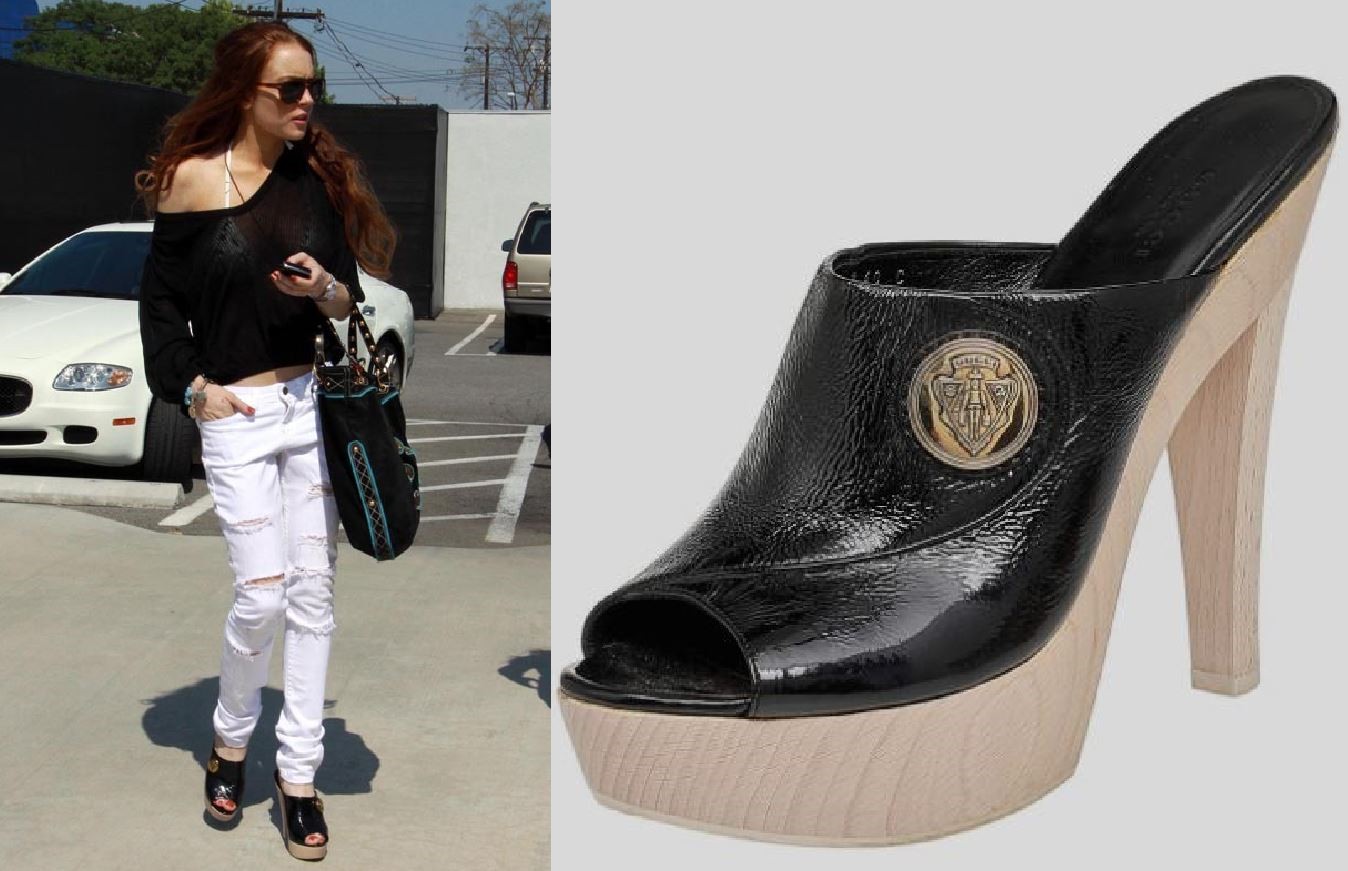
Prepared for sabotage: Lindsay Lohan in Gucci Black Patent Leather Hysteria Platform Clogs with wooden soles, Los Angeles, 2009.  The car is a 2009 (fifth generation) Maserati Quattroporte leased by her father.

What sabotage was depended also from where it was viewed.  In industry it was thought to be a substitute for striking in which the workers stayed in his place but proceeded to do his work slowly and badly, the aim being ultimately to displease his employer's customers and cause loss to his employer.  To the still embryonic unions seeking to organize labour, it was a reciprocal act of industrial democracy, going slow about the means of production and distribution in response to organized capital going slow in the matter of wages.  The extension by the military to describe the damage inflicted (especially clandestinely) to disrupt in some way the economy by damaging military or civilian infrastructure emerged during World War I (1914-1918).  The verb sabotage (to ruin or disable deliberately and maliciously) dates from 1912 and the noun saboteur (one who commits sabotage) was also first noted in the same year (although it had been used in English since 1909 as a French word); it was from the French agent noun from saboter and the feminine form was saboteuse.

The word exists in many European languages including Catalan (sabotatge), Czech (sabotáž), Danish (sabotage), Dutch (sabotage), Galician (sabotaxe), German (Sabotage), Hungarian (szabotázs), Italian (sabotaggio), Polish (sabotaż), Portuguese (sabotagem), Russian (сабота́ж) (sabotáž), Spanish (sabotaje), Swedish (sabotage) & Turkish (sabotaj).  Sabotage is so specific that it has no direct single-word synonym although, depending on context, related words include destruction, disruption, subversion, treachery, treason, vandalism, cripple, destroy, disrupt, hamper, hinder, obstruct, subvert, torpedo, undermine, vandalize, wreck, demolition, impairment, injury & disable.  Sabotage is a noun & verb, sabotaged is a verb & adjective, saboteur is a noun, sabotaging is a verb and sabotagable is an adjectival conjecture; some sources maintain there is no plural of sabotage and the correct form is “acts of sabotage” while others list the third-person singular simple present indicative form as sabotages.

Franz von Papen.

Although his activities as German Military Attaché for Washington DC during 1914-1915 would be overshadowed by his later adventures, Franz von Papen’s (1879–1969) inept attempts at sabotaging the Allied war effort would help introduce the word to the military vocabulary.  He attempted to disrupt the supply of arms to the British, even setting up a munitions factory with the intension of buying up scare commodities to deny their use by the Allies, only to find the enemy had contracted ample quantities so his expensive activities had no appreciable effect on the shipments.  Then his closest aide, after falling asleep on a train, left behind a briefcase full of letters compromising Papen for his activities on behalf of the central powers.  Within days, a New York newspaper published details of Papen’s amateurish cloak & dagger operations including his attempt to induce workers of Austrian & German descent employed in plants engaged in war production for the Allies to slow down their output or damage the goods.  Also in the briefcase were copies of letters he sent revealing shipping movements.

Even this wasn’t enough for the US to expel him so he expanded his operations, setting up a spy network to conduct a sabotage and bombing campaign against businesses in New York owned by citizens from the Allied nations.  That absorbed much money for little benefit but, undeterred, he became involved with Indian nationalists living in the US, arranging with them for arms to be shipped to India where he hoped a revolt against the Raj might be fermented, a strategy he pursued also with the Irish nationalists.  Thinking big, he planned an invasion of Canada and tried to enlist Mexico as an ally of the Central Powers in the event of the US entering the war with the promise California and Arizona would be returned.  More practically, early in 1915 he hired agents to blow up the Vanceboro international rail bridge which linked the US and Canada between New Brunswick and Maine.  That wasn’t a success but of greater impact was that Papen had departed from the usual practices of espionage by paying the bombers by cheque.  It was only his diplomatic immunity which protected him from arrest but British intelligence had been monitoring his activities and provided a file to the US State Department which in December 1915 declared him persona non grata and expelled him.  Upon his arrival in Berlin, he was awarded the Iron Cross.

Hopelessly ineffective though his efforts had proved, by the time Papen left the US, the words sabotage and saboteur had come into common use including in warning posters and other propaganda.  Papen went on greater things, serving briefly as chancellor and even Hitler’s deputy, quite an illustrious career for one described as “uniquely, taken seriously by neither his opponents nor his supporters”.  When one of the Weimar Republic's many scheming king-makers suggested Papen as chancellor, others thought the noting absurd, pointing out: "Papen has no head for politics."  The response was: "He doesn't need a head, his job is to be a hat".  Despite his known limitations, he proved one of the Third Reich’s great survivors, escaping purges and assassination and, despite being held in contempt by Hitler, served the regime to the end.  Even its coda he survived, being one of the few defendants at the main Nuremberg trial (1945-1946) to be acquitted (to be fair he was one of the few Nazis with the odd redeeming feature and his sins were those of cynical opportunism rather than evil intent) although the German courts did briefly imprison him, albeit under rather pleasant conditions.

The Simple Sabotage Field Manual (SSFM) was published in 1944 by the US Office of Strategic Services (OSS), the predecessor of the Central Intelligence Agency (CIA).  Its original purpose was as a resource for OSS field agents to use in motivating or recruiting potential foreign saboteurs and permission was granted permission to print and disseminate portions of the document as needed.  The idea was to provide tools and instructions so just about any member of society could inflict some degree of damage of a society and its economy, the rationale being that of a “death of a thousand cuts”.  In contrast, the more dramatic and violent acts of sabotage (high-risk activities like killings or blowing stuff up) were only ever practiced by a handful of citizens.  The SSFM was aimed at US sympathizers keen to disrupt war efforts against the allies during World War II (1939-1945) in ways that were barely detectable but, in cumulative effect, measurable and thus contains instructions for destabilizing or reducing progress and productivity by non-violent means. The booklet is separated into headings that correspond to specific audiences, including: Managers and Supervisors, Employees, Organizations and Conferences, Communications, Transportation (Railways, Automotive, and Water), General Devices for Lowering Morale and Creating Confusion & Electric Power.  The simplicity of approach was later adopted by the CIA when it distributed its Book of Dirty Tricks.

Of great amusement to students (amateur and professional) of corporate organizational behavior was that a number of the tactics the SSFM lists as being disruptive and tending to reduce efficiency are exactly those familiar to anyone working in a modern Western corporation.

Middle Management

(1) Insist on doing everything through “channels.” Never permit short-cuts to be taken in order to expedite decisions.

(2) Make “speeches.” Talk as frequently as possible and at great length. Illustrate your “points” by long anecdotes and accounts of personal experiences.

(3) When possible, refer all matters to committees, for “further study and consideration.” Attempt to make the committee as large as possible — never less than five.

(4) Bring up irrelevant issues as frequently as possible.

(5) Haggle over precise wordings of communications, minutes, resolutions.

(6) Refer back to matters decided upon at the last meeting and attempt to re-open the question of the advisability of that decision.

(7) Advocate “caution.” Be “reasonable” and urge your fellow-conferees to be “reasonable” and avoid haste which might result in embarrassments or difficulties later on.

Senior Management

(8) In making work assignments, always sign out the unimportant jobs first. See that important jobs are assigned to inefficient workers.

(9) Insist on perfect work in relatively unimportant products; send back for refinishing those which have the least flaw.

(10) To lower morale and with it, production, be pleasant to inefficient workers; give them undeserved promotions.

(11) Hold conferences when there is more critical work to be done.

(12) Multiply the procedures and clearances involved in issuing instructions, pay checks, and so on. See that three people have to approve everything where one would do.

Employees

(13) Work slowly.

(14) Contrive as many interruptions to your work as you can.

(15) Do your work poorly and blame it on bad tools, machinery, or equipment. Complain that these things are preventing you from doing your job right.

(16) Never pass on your skill and experience to a new or less skillful worker.