Wednesday, November 8, 2023

Rimbellisher

Rimbellisher (pronounced rhim-bell-lysh)

A decorative ring attached to the rim of a car's wheel.

1940s: A portmanteau word, the construct being rim +‎ (em)bellish + -er and originally a trademarked brand of the Ace company (a division of Crornercraft).  Rim was from the tenth century Middle English rim, rym & rime, from the Old English rima (rim, edge, border, bank, coast), from the Proto-Germanic rimô & rembô (edge, border), from the primitive Indo-European rem- & remə- (to rest, support, be based).   It was cognate with the Saterland Frisian Rim (plank, wooden cross, trellis), the Old Saxon rimi (edge; border; trim) and the Old Norse rimi (raised strip of land, ridge).  Rim generally means “an edge around something, especially when circular” and is used in fields a different as engineering and vulcanology.  The use in political geography is an extension of the idea, something like “PacRim” (Pac(ific) + rim) used to group the nations with coastlines along the Pacific Ocean.  The use in print journalism referred to “a semicircular copydesk”.   The special use in metallurgy described the outer layer of metal in an ingot where the composition was different from that of the centre.  The word rim is an especially frustrating one for golfers to hear because it describes the ball rolling around the rim of the hole but declining to go in.  Rim is a noun & verb, rimmer is a noun, rimming is a noun & verb, rimmed is a verb & adjective and rimless is an adjective; the noun plural is rims.

1966 Jaguar Mark X (1961-1970 and badged as 420G between 1966-1970) with factory rimbellishers.  Rimbellishers do exactly what is said on the tin: They embellish a wheel's naked rim.

Embellish dates from the early fourteenth century and was from the Middle English embelisshen from the Anglo-French, from the Middle French embeliss- (stem of embelir), the construct being em- (The form taken by en- before the labial consonants “b” & “p”, as it assimilates place of articulation).  The en- prefix was from the Middle English en- & in-.  In the Old French it existed as en- & an-, from the Latin in- (in, into); it was also from an alteration of in-, from the Middle English in-, from the Old English in- (in, into), from the Proto-Germanic in (in).  Both the Latin and Germanic forms were from the primitive Indo-European en (in, into) and the frequency of use in the Old French is because of the confluence with the Frankish an- intensive prefix, related to the Old English on-.) + bel-, from the Latin bellus (pretty) + -ish.  The –ish suffix was from the Middle English –ish & -isch, from the Old English –isċ, from the Proto-West Germanic -isk, from the Proto-Germanic –iskaz, from the primitive Indo-European -iskos.  It was cognate with the Dutch -s; the German -isch (from which Dutch gained -isch), the Norwegian, Danish, and Swedish -isk & -sk, the Lithuanian –iškas, the Russian -ский (-skij) and the Ancient Greek diminutive suffix -ίσκος (-ískos); a doublet of -esque and -ski.  There exists a welter of synonyms and companion phrases such as decorate, grace, prettify, bedeck, dress up, exaggerate, gild, overstate, festoon, embroider, adorn, spiff up, trim, magnify, deck, color, enrich, elaborate, ornament, beautify, enhance, array & garnish.  Embellish is a verb, embellishing is a noun & verb, embellished is a verb & adjective and embellisher & embellishment are nouns; the noun plural is embellishments.

The –er suffix was from the Middle English –er & -ere, from the Old English -ere, from the Proto-Germanic -ārijaz, thought most likely to have been borrowed from the Latin –ārius where, as a suffix, it was used to form adjectives from nouns or numerals.  In English, the –er suffix, when added to a verb, created an agent noun: the person or thing that doing the action indicated by the root verb.   The use in English was reinforced by the synonymous but unrelated Old French –or & -eor (the Anglo-Norman variant -our), from the Latin -ātor & -tor, from the primitive Indo-European -tōr.  When appended to a noun, it created the noun denoting an occupation or describing the person whose occupation is the noun.  Rimbellisher is a noun and the noun plural is rimbellishers.  All other forms are non-standard but a wheel to which a rimbellisher has been fitted could be said to be rimbellished (adjective) white the person doing the fitting would be a rimbellisher (noun), the process an act of rimbellishing (verb) and the result a rimbellishment (noun).

Jaguar XK120 with wire wheels (left), with hubcaps (centre) and with hubcaps and rimbellishers (right).

The Jaguar XK range (1948-1961) was available either with solid or wire wheels and while the choice often was one of aesthetics (or economics, the wires an additional cost), those using the things in competition sometimes had to assess the trade-offs.  The wire wheels were lighter and provided better cooling of the brakes (especially those connected to the rear wheels covered by fender skirts (spats) when the steel wheels were fitted).  In many forms of motor sport that was of course a great advantage but the spokes and the deletion of the skirts came at an aerodynamic cost, the additional drag induced by the combination reducing top speed by a up to 5 mph (8 km/h) and increasing fuel consumption.  It was thus a question of working out what was most valued and in the early days, where regulations permitted, some drivers used wire-wheels at the front and retained the skirts at the rear, attempting to get as much as possible of the best of both worlds (the protrusion of the hubs used on the wire wheels precluded them from fitting behind the skirts).  Jaguar XK owners would never refer to their wheels as “rims” although there may be some who have added “rims” to their modern (post Tata ownership) Jaguars.

Hofit Golan (b 1985) and Lindsay Lohan (b 1986) attending Summer Tour Maserati in Porto Cervo, Sardinia, July 2016.  The Maserati Quattroporte is a 1964 Series I, fitted with steel wheels and rimbellishers.

Among certain classes, it’s now common to refer to wheels as rims, and the flashier the product, the more likely it is to be called a “rim”.  Good taste is of course subjective but as a general rule, the greater the propensity to being described as a rim, the more likely it is to be something eye catching (for better or worse).  That’s unless it actually is a rim, some wheels being of multi-part construction in which the rim is a separate piece (and composed sometimes from a different metal).  In the early days of motoring this was the almost universal method of construction and it persisted in trucks until relatively recently (although still used in heavy, earth-moving equipment and such).  Specialists dealing with the high-priced, multi-pieced wheels correctly call the assembled construction a "wheel" with "rim" reserved for the actual rim component.

1937 Rolls-Royce Phantom III (1936-1939) four-door cabriolet with coachwork by German house Voll Ruhrbeck, fitted with the standard factory wire wheels (left) and 1937 Rolls-Royce Phantom III fixed head coupé (FHC) with coachwork by Belgium house Vesters et Neirinck, fitted with the “Ace Deluxe” wheel discs, fitted atop the wire wheels (right).  The coupé, fabricated in Brussels, was unusual in pre-war coachbuilding in that there was no B-pillar, the style which would become popular in the US between the 1950s-1970s where in two & four-door form it would be described as a “hardtop”, nomenclature that would over the years be sometimes confused with the “hard-tops” often supplied with convertibles as a more secure alternative to the usual “soft-top”.

According to the Oxford English Dictionary (OED), the first known instance of rimbellisher in print was in The Motor (1903-1988) magazine in 1949 although they seem first to have been so-described when on sale in England in 1948.  The rimbellishers were a new product for the Ace Company that in the 1930s had specialized in producing disk-like covers for wire-wheels.  That might seem strange because wire wheels are now much admired but in the 1930s many regarded them as old-fashioned although their light-weight construction meant they were often still used.  What Ace’s aluminium covers provided was the advantage of the lighter weight combined with a shiny, modernist look and they were also easy to keep clean, unlike wire wheels that could each month demand a couple of hours to maintain their "shininess".

The Ace company's publicity material from the 1950s.

In the post-war years the rimbellishers became popular because they were a detail adding a “finished” look emulating the increasingly elaborate wheel-covers appearing on US-built cars.  They were a chromed ring, attached inside the rim of the wheel, providing a contrasting band between the tyre and the wheel's centre (usually partially covered by a hubcap).  Ace’s original Rimbellishers were secured using a worm-drive type of fastening that ensured the metal of the wheel suffered no damage but as other manufacturers entered the market, the trend became to use a cheaper method of construction using nothing more than multiple sprung tags; with the devices push-fitted into the well of the wheel, some scraping of the paint became inevitable.  Rimbellisher (always with an initial capital) was a registered trademark of the Ace company but the word quickly became generic and was in the 1950s & 1960s used to describe any similar device.  Interestingly, by the mid 1950s, Ace ceased to use “rimbellisher” in its advertising copy and described the two ranges as “wheel discs” and “wheel trims”.  The early versions did nothing more than produce a visual effect but the stylists couldn’t resist the opportunities and some rimbellishers grew to the extent they completely blocked the flow of air through the vents in the wheels and that adversely affected the cooling of the brakes, the use of some of the new generation of full-wheel covers also having this consequence.  The solution was to ensure there was some airflow but to maintain as much as possible of the visual effect so often added were little "fins" and for these to work properly, they needed to catch the airflow so there were left and right-side versions, an idea used to this day in the alloy wheels of some high-price machinery.

1969 Pontiac GTO with standard trim rings (left) and 1969 Pontiac GTO Judge supplied without trim rings (right).

Ace in the early 1950s had distributers in the US and both their rimbellishers and full-wheel covers were offered.  They took advantage of the design which enabled the same basic units to be used, made specific only the substitution of a centre emblem (varied to suit different manufacturers).  Ace’s market penetration for domestic vehicles didn’t last because Detroit soon began producing their own and, within a short time, they were elaborate and often garish, a look that would last into the twenty-first century.  The Americans soon forgot about the rimbellisher, calling them "trim-rings" and they became a feature of the steel “sports wheels” manufacturers offered on their high-performance ranges in the years before aluminium units became mainstream products.  The trim-rings of course had a manufacturing cost and this was built into the price when the wheels were listed as an option.  The cost of production wouldn’t have been great but interestingly, when GM's (General Motors) PMD (Pontiac Motor Division) developed the “Judge” option for its GTO to compete with the low-cost Plymouth Road Runner, the trim-rings were among the items deleted.  However, the Judge package evolved to the point where it became an extra-cost option for the GTO with the missing trim-rings about the only visible concession to economy.

Mercedes-Benz W111s: 1959 220 SE with 8-slot rimbellishers (left), 1967 250 SE with the briefly used solid rimbellishers (centre) and 1971 280 SE 3.5 with the later 12-slot rimbellishers that lacked the elegance of the 8-slots.

Like many companies, Mercedes-Benz used wheel covers as a class identifier.  When the W111 saloons (1959-1968) were released in 1959, the entry-level 220 was fitted with just hubcaps while the up market twin-carburetor 220 S and the fuel-injected 220 SE had rimbellishers (made by the factory, not Ace).  Within a few years, the use of rimbellishers was expanded but by the mid-1960s, the elegant 8-slot units mostly had been replaced with a less-pleasing solid metal pressing (albeit one which provided a gap for brake cooling).  That didn’t last and phased-in between 1967-1968, the company switched from the hubcap / rimbellisher combination to a one-piece wheel cover which included the emulation of a 12-slot rimbellisher.  There were no objections to the adoption of one-piece construction but few found the new design as attractive as the earlier 8-slot and this was especially the case with the big 600 Grosser (1963-1981).  Designers explained this by distinguishing between the two, the 8-slot "frowning" and the 12-slot "smiling".  The 600 definitely is a "frowning" sort of car.

MG publicity photograph (left) showing MGA and Magnettes, the former fitted with the Cornercroft's Ace Rimbellishers (a factory option).  The MGA (right) uses a different third-party rimbellisher that physically was bigger and overlapped the edge of the rim to a greater degree.  The factory-option is preferred by most because it better suits the MGA's delicate lines.

1958 Jaguar 3.4 (top) and 1960 MGA Coupé (bottom) with the relevant Ace-Mercury wheel discs.

As well as an after-market product sold through retail outlets and offered as a dealer-fitted accessory, the Ace-Mercury wheel discs were at various times a factory option, MG sometimes listing them for the MGA (1955-1962), ZA-ZB Magnettes (1953-1958) and early versions of both the MGB (1962-1980) & Midget (1961-1979).  For Coventry-based Cornercroft (manufacturer of the Ace Mercury range), the attraction was the (more or less) standardized shape of steel wheels meant it was possible to use the one basic design in a variety of diameters (13, 14 & 15 inch), able to be marketed for use with vehicles from different makers simply by changing the centre-cap to a fitting with the name of the relevant marque (others would also use the same technique).  Cornercraft also offered a (fake) eared spinner in the style of a knockoff nut but these seem never to have been factory options.

1962 MG Midget with Ace-Mercury wheel discs.  Although the model will of course be statuesque, the Midget (and Austin-Healey Sprite (1958-1971) on which it was based) truly was small.  The LWD (little white dress) is a Joanna from Madeleine's Daughter's Adora collection.

The Ace-Mercury was made from bright anodized aluminium and thus was both lightweight and corrosion-resistant but somewhat fragile if subjected to stresses that steel would resist.  Additionally, like many “big” wheel-covers, they could be prone to “popping-off” during hard cornering, a phenomenon familiar to students of the car chases in Hollywood movies between the 1960 and 1990s, the film pedants (of which there seem to be many) documenting instances where the “continuity girl” either failed to notice or ignored a wheel-cover inexplicably becoming re-attached, mid-chase.  All of this meant the survival rate of Ace-Mercury is low and many were anyway discarded as subsequent owners preferred the sexier look of wire, alloy or styled-steel wheels.  That makes them now a valuable period-piece and it’s not unusual to see an MG, Riley or Jaguar driven to a show with bare wheels, the Ace-Mercurys put on only for the duration of the exhibition.

Crornercraft advertisement, 1957.

One difference from the usual practice was that unlike most hub-caps or wheel covers that tended to be the same for all four wheels, the Ace-Mercury’s small louvers operated as air scoops when the wheels were in rotation, ducting cooling air through the ventilation holes in the wheel to assist in cooling the brakes.  A set for four was thus supplied in left & right-hand pairs and needed to be installed with the louvers’ open edge “facing the breeze”.  That wasn’t unique but was untypical and the concept was sometimes made more intricate still, such as when the fourth-generation Chevrolet Corvette (C4, 1983-1996) was introduced with alloy wheels of a different width front & rear, meaning that for the cooling ducts to work there were four different (non-interchangeable) wheels.  Another quirk of the Ace-Mercury was that although the visual similarities make them all barely distinguishable except for the diameter, in January 1959, MG changed the design of the MGA’s disc wheels, competing Cornercroft to re-design to the internal structure (the MGA version’s left/right part numbers changing from 97H675/97H676 to BHA4165/BHA4166).  Details like this litter the car restoration business which is why replicating exactly what was done decades ago can be both challenging and expensive.

Tuesday, November 7, 2023

Misspeak

Misspeak (pronounced mis-speek)

(1) To speak, utter, or pronounce incorrectly.

(2) To speak inaccurately, inappropriately, or too hastily.

(3) A euphemism for a lie, usually deployed after one is caught.

1150–1200: The construct was mis- + speak.  Mis was from the Middle English mis-, from the Old English mis-, from the Proto-Germanic missa- (wrongly, badly), from the primitive Indo-European mitto (mutual, reciprocal), from the primitive Indo-European meyth- (to replace, switch, exchange, swap).  It was cognate with the Scots, Dutch, Swedish & Icelandic mis and the German mis & miss.  Related too was the French més- & mé- (mis-), from the Old French mes- (mis-), from the Frankish mis- & missa- (mis-), all from the same Proto-Germanic source.  Speak was from the Middle English speken (to speak), from the Old English specan (to speak), an alteration of the earlier sprecan (to speak), from the Proto-West Germanic sprekan, from the Proto-Germanic sprekaną (to speak, make a sound), from the primitive Indo-European spreg- (to make a sound, utter, speak).  The spelling misspeken was used in the fourteenth century to convey the meaning “say amiss", “to say sinful things” & "speak insultingly (of)”.  From the 1590s, it acquired also the meaning “to pronounce wrongly” and by 1890, to "speak otherwise than according to one's intentions”.  Related also was the Old English missprecan (to grumble; murmur).  The derived forms are misspoke, misspoken & misspeaking.

Speak, misspeak and damned misspeak

Misspeak exists in two senses.  The first is to use mispronounce something or use an incorrect word or phrase.  An example was when Warren Harding (1865-1921; US President 1921-1923), during the 1920 presidential campaign, used “normalcy” instead of “normality”.  The section of the speech with the offending word was almost aggressively alliterative…

“America’s present need is not heroics, but healing; not nostrums, but normalcy; not revolution, but restoration; not agitation, but adjustment; not surgery, but serenity; not the dramatic, but the dispassionate; not experiment, but equipoise; not submergence in internationality, but sustainment in triumphant nationality.”

… so in saying "normalcy" he may have misspoken or perhaps Harding liked the word; questioned afterwards he said he found it in a dictionary which probably was true although whether his discovery came before or after the speech wasn't explored.  Although Harding’s choice was much-derided at the time, normalcy had certainly existed since at least 1857, originally as a technical term from geometry meaning the "mathematical condition of being at right angles, state or fact of being normal in geometry" but subsequently it had appeared in print as a synonym of normality on several occasions.  Still, it was hardly in general use though Harding gave it a boost and it’s not since gone extinct, now with little complaint except from the most linguistically fastidious who insist the use in geometry remains the only meaning and all subsequent uses are mistakes.

Lindsay Lohan and her lawyer in court, Los Angeles, December 2011.  

The other meaning of misspeak is as a euphemism for a lie, usually deployed after one is caught and, for politicians, it’s a handy way technically to admit mendacity without actually having to use the distasteful word "lie".  Crooked Hillary Clinton, after years of fudging, was forced to admit she “misspoke” when claiming that to avoid sniper-fire, she and her entourage “…just ran with our heads down to get into the vehicles to get to our base” when landing at a Bosnian airport in 1996.  She admitted she “misspoke” only after a video was released of her walking down the airplane’s stairs to be greeted by a little girl who presented her with a bouquet of flowers.  Even her admission was constructed with weasel words: “…if I misspoke, that was just a misstatement”.  That seemed to clear things up and the matter is now recorded in the long history of crooked Hillary Clinton's untruthfulness as "snipergate".

Crooked Hillary in the Balkans, 1996.

Monday, November 6, 2023

Fastigiate

Fastigiate (pronounced fa-stij-ee-it or fa-stij-yet)

(1) In zoology, joined together in a tapering adhering group.

(2) In botany, erect and parallel (as in branches) or having such branches; having erect branches, often appearing to form a single column with the stem.

(3) In palynology (the study of pollen grains and other spores, especially those found in archaeological or geological deposits), characterized by a fastigium, a cavity separating the intexine from the sexine near the endoaperture of a colporate pollen grain.

(4) A structure or design rising or tapering to a point (now rare and restricted mostly to technical use in various forms of architecture, including at the micro level).

1655–1665: From the from Medieval Latin fastīgātus (high, lofty; peaked), the construct being the Classical Latin fastīgi(um) (height, highest point, peak) + -ate.  The suffix -ate was a word-forming element used in forming nouns from Latin words ending in -ātus, -āta, & -ātum (such as estate, primate & senate).  Those that came to English via French often began with -at, but an -e was added in the fifteenth century or later to indicate the long vowel.  It can also mark adjectives formed from Latin perfect passive participle suffixes of first conjugation verbs -ātus, -āta, & -ātum (such as desolate, moderate & separate).  Again, often they were adopted in Middle English with an –at suffix, the -e appended after circa 1400; a doublet of –ee.  Fastigiate is a noun & adjective, fastigiation is a noun and fastigiated is an adjective; the noun plural is fastigiates.

Royal Arsenal, Woolwich, London.

In botany, fastigiated shrubs or trees are those with an upright, columnar growth habit, usually with branches growing almost parallel to the main stem, a shape which makes them popular for use in smaller areas with limited lateral space, such as streetscapes, car-parks, and public recreation areas.  The Royal Arsenal sits on the south bank of the River Thames in Woolwich in south-east London and beginning in the seventeenth century, it served as the headquarters of the Office of Ordnance and was until the 1960s a factory site where munitions were manufactured.  For much of that time it was also a research & development (R&D) centre for armor, ammunition & armaments (until in the twentieth century the explosions became too large and the civilian population began to encroach on the surrounding area).  The Ministry of Defence finally moved the last of its operations to other places in 1994 and now the site is in the throes of being re-developed for housing and community use.  Because of the location conveniently close to the city of London, Royal Arsenal has become a desirable residential area and as part of the plan for the open space, 24 English oak trees (Quercus robur (Fastigiata)) were planted in the public square, each up to 30 feet (9 m) in height.  The slender fastigiate form of oak selected is a popular variety among landscape architects who choose it because it provides so much foliage with a very small footprint and it’s ideal for locations where the desire is to retain a high proportion of the available sunlight.  The architects also note that being a former military site, the characteristic upright aspect of the Quercus robur recalls soldiers on parade.

Foliage of the liriodendron tulipifera Fastigiata (the common names including Upright Tulip Tree, Tulip Poplar & Whitewood) (left) and Lindsay Lohan in a floral maxi dress, London, 2016 (right).  Flower arrangers like fastigiated (upright) blooms because they can be interlaced into constructions to produce a three dimensional effect without the need for any underlying framework.  Clothing designers use fastigiates less than they do the big, open blooms like roses or carnations because when used in isolation, it’s easier with the latter to produce a more dramatic effect.  Lindsay Lohan has often worn floral fabrics but seldom were they fastigiates, the maxi dress in which she was photographed in London in 2016 a rare showing.  Upon publication however, most comment was about the fake tan and the fabric was neglected.

The cable-stayed Uddevalla Bridge crossing Sunninge sound near Uddevalla, Bohuslän, Sweden (left).  Pylons are inherently fastigitated structures and the two which support the roadway in a semi-fan arrangement are each 489 feet (149 m) high.  The Stonehenge-like structure in Windsor, Brisbane, Australia (right) is a part of the freeway architecture, the uprights essentially decorative but are said to play a part in sound reduction.

GM-X Stiletto (1964, left), GM Runabout (1964, centre) and Pontiac Grand Am (1973, right).  The Grand Am pictured is a factory one-off which was fitted with the 455 cubic inch (7.5 litre) Super Duty (SD) Pontiac V8.  The prototype used the original 310 horsepower version of the 455 SD which was declared unlawful by the Environmental Protection Agency (EPA) because the manufacturer blatantly cheated during the certification process.  Consequently, during its two seasons of availability (1973-1974), the 455 SD offered in Pontiac’s Firebird and Trans Am was rated at a compliant 290 hp with plans to offer it in the Grand Am and GTO cancelled, the two prototypes scrapped.

Historically, fastigiated was used to describe a structure or design rising or tapering to a point.  It still occasionally appears in the context of architecture but now it seems a fixture only in the technical journals of those discussing the very big (cosmology) or the very small (anything microscopic or smaller still).  The sharp-central point was a feature of a number of automobiles before governments started passing safety laws in the post-war years but General Motors (GM) which had during the 1950s built many bizarre (some frankly absurd) “show cars” with a prominent point couldn’t resist the motif and at the New York World's Fair in 1964 displayed the Runabout and the GM-X Stiletto.  The Runabout was genuinely thoughtful, a 3-wheeled “city car” with a front wheel which could turn 180o, enabling a tight turning circle and an ease of parking which was astonishing by the standards of the era.  The tail-end contained two detachable shopping trolleys with wheels which folded-away when they were stored as an integral part of the rear compartment; remarkably, the little machine had space for two adults and three children.  Reflecting the spirit of the age, GM’s promotional material noted it was an ideal design for women shopping at the still quite novel supermarkets but that men could use it too because easily it would accommodate a set of golf clubs.  The fastigiated nose made a final appearance (although they’re seen still on racing cars) on the 1973 Pontiac Grand Am but it was lawful only because it was made from a closed-cell urethane foam, bonded to a steel frame, a clever (if for years troublesome to manufacture) design introduced on the 1968 GTO and called “Endura”.  The attraction of Endura was that at the time it convinced the regulators it was harmless to others, thus the survival of the sharp point for a few more years.

Sunday, November 5, 2023

Guy

Guy (pronounced gahy)

(1) In informal use, historically, a man or boy; a fellow.

(2) In modern informal use, in the plural, people (especially if younger), regardless of their sex (although if the group referenced is mixed, it can be used exclusively of males (ie a term such as “guys & girls”).

(3) In historic UK Slang, a grotesquely dressed person; ) A person of eccentric appearance or dress.

(4) A grotesque, deliberately crude effigy of Guy Fawkes, made usually of old clothes stuffed with straw or rags, paraded through the streets and that is burnt on top of a bonfire on Guy Fawkes Day (5 November; the anniversary of the Gunpowder Plot); now mostly UK use and often with an initial capita).

(5) A male given name, from a Germanic word meaning “woods” and used mostly in France or Francophone countries (in the French pronounced gahy); the use as a surname began as a patronymic.

(6) A rope, cable, or appliance used to guide and steady an object (widely used in nautical matters but also of radio transmission masts etc) being hoisted or lowered, or to secure anything likely to shift its position.  It’s often use as “guy wire”, “guy rope” etc.

(7) A guide; a leader or conductor (obsolete).

(8) To guide, steady, or anchor with a guy wire (or rope, cable etc) or guys.

(9) To jeer at or make fun of; to ridicule with wit or innuendo.

(10) In live theatre, to play in a comedic manner.

(11) As “give the guy to” a mostly UK slang form meaning “to escape from (someone): or “give (someone) the slip”.

(12) In international standards (ISO 3166-1) as the translingual GUY, the alpha-3 country code for Guyana. (GY the alpha-2).

1300–1350: From the Middle English gye, from the Old French guie (a guide (also “a crane, derrick”)), from guier (to guide), from a Germanic source (probably Low German or the Frankish witan (show the way), ultimately from the Proto-Germanic wītaną (know) or witanan (to look after, guard, ascribe to, reproach) and the source also of the German weisen (to show, point out), the Old English witan (to reproach) & wite (fine, penalty) and the Dutch gei brail & geiblok (pulley), from the primitive Indo-European root weid (to see) (although some etymologists maintain it’s not impossible it was from a related word in the North Sea Germanic.  The use to describe a “small rope, chain or wire” emerged in the 1620s in nautical use, replacing the mid-fourteenth century “leader”, from the Old French guie "a guide," also "a crane, derrick," from guier, from Frankish witan "show the way" or a similar Germanic source, from Proto-Germanic witanan "to look after, guard, ascribe to, reproach" (the source also of German weisen (to show, point out), the Old English witan (to reproach) & wite (fine, penalty).  Guy is a noun, proper noun & verb, guyed & guying are verbs; the noun plural is guys (the historic guies has long been listed as non-standard).

Promotional poster for an amateur production of Guys & Dolls (1950), West Genesee High School (Camillus, New York).

The uses referencing Guy Fawkes emerged in the first years of the nineteenth century (most sources cite 1806 or 1806).  The male given name Guy (cognate with the Italian Guido) was from the Old French Gui, a form of the Proto-Germanic Wido, a short form of names beginning with the element witu (wood), from the Proto-Germanic widuz (such as Witold & Widukind).  Guy is used mostly in France or Francophone countries (in the French pronounced gahy) and the use as a surname began as a patronymic.  Guy Fawkes (1570–1606) was an English Roman Catholic who maintained his allegiance to the pope.  He was hanged, drawn and quartered for his role in the Gunpowder Plot (5 November 1605), the more romantic (if misleading) label for which was “the Jesuit Treason” which was an act of attempted regicide against King James VI and I (1566–1625) and King of Scotland as James VI (1567-1625) & King of England and Ireland as James I (1603-1625).  The domestic terrorists (as they would now be called) considered their actions attempted tyrannicide, their object being regime change in England to end the decades of religious discrimination and persecution.  Experts long ago concluded that had the plot been brought to fruition, the 36 barrels of gunpowder placed directly under the debating chamber of the House of Lords would have been more than enough to destroy the building.  In England, the burning of bonfires on the anniversary became a tradition almost immediately after the plot was foiled but it wasn’t until the early nineteenth century it became the practice to burn Guy Fawkes in effigy, the figure constructed usually in a deliberately crude manner using rags and old clothes, stuffed with combustible dry straw.  The tradition became established in many parts of the British Empire but as fireworks became increasingly powerful ordnance, local authorities restricted their sale (for example most Australian jurisdictions have banned the once popular "cracker night") thereby saving many eyes and fingers of children) and beyond the UK, Guy Fawkes day persists only in parts of New Zealand, South Africa and Canada. 

The use of “guy" to describe “a grotesquely or poorly dressed man” began in England in the mid 1830s and came into use in the US about a decade later although there it seems either immediately or within a short time to mean “a man”, rather as “fellow” or “chap” might be used.  GK Chesterton (1874–1936) noted for English audiences that in the US to be called “a regular guy” was “the most graceful of compliments” although that meaning has by now shifted to mean “someone average; unexceptional”.  In mixed company, guys are male while women variously (depending on the region, social class etc) are girls, chicks etc but sometimes, in the plural, guys may not be completely gender-neutral but may refer to people of any gender in certain circumstances and forms (such as “hey guys”).  Indeed, so adaptable is the word that a group of guys may be wholly female.  Nor is guy always the preferred form for men, young generations often preferring “dude” and the companion feminine coining “dudette” is occasionally heard though unusually only when dude is used in the same context.  When used of animals, guy usually refers to either a male or one whose gender is not known; it is rarely if ever used of an animal that is known to be female (the matching term for a female being “gal”) and it’s often used as “little guy”, “big guy” etc.  The form in which the use of guy most annoys the pedants seems to be as “youse guys” which really seems to offend although, under the conventions of English plural constructions, “youse” should be correct.

Lindsay Lohan provides an authoritative ruling of meaning in context: When in a relationship, a “guy” is a man whereas her former special friend Samantha Ronson was not; she was a girl.

In idiomatic use, guy often appears including “… as the next guy” (indicating that one holds typical or mainstream views), “cable guy” (the technician who connects cable TV services to the home (or one who deals with cables in some way though probably not a professional who would usually be called a “cabler”)), “cis-guy” (a male (though this can’t be guaranteed in contemporary use because women may use the form) who uses the gender assigned at birth (ie conventional biological sex) and thus distinct from “trans guy”), one on use, “fall guy” (one who takes the blame for something). “family guy” (a conventional husband & father), “go to guy” (one who by virtue of knowledge, skills etc is the first sought for an opinion etc), “guy friend” (a nuanced term which varies in exactitude but always means some sort of platonic relationship), “nice guys finish last” (in life one needs to be ruthless to succeed), “you should see the other guy” (indicating the injuries one has suffered in a fight are minor compared with those inflicted on the opponent), “wise guy” (not exactly an ironic use but closer to “a smart-ass”).  General value modifiers are appended as needed including “good guy”, “bad guy”, “big guy” (which like “little guy” is often figurative), “nice guy”, “tough guy” etc.  Guy is handy because it’s pretty much neutral and can in most cases be used instead of buster, fella, man, bud, dude, fellow, bro, bloke, chap.  For women it can substitute for girl, woman or the many archaic forms (gal, broad, dame, jane, bird, sheila & chick).  Strangely, in colloquial use, it’s come to be widely used of things and the use is common in IT, among mechanics and others working with distinct bits & pieces.  While not overt, there is something of the anthropomorphic about this because as mechanics and IT techs know, one can have a dozen identical part-numbers which truly are functionally indistinguishable under any objective examination yet in use one or two might exhibit characteristics which will be described in terms used usually of personalities such as "troublesome", "inconsistent" or "un-cooperative".  Some guys are like that.   

Saturday, November 4, 2023

Phenomenology

Phenomenology (pronounced fi-nom-uh-nol-uh-jee)

(1) The study of phenomena.

(2) In philosophy, the system of German philosopher Edmund Husserl (1859–1938) stressing the description of phenomena; the study of structures of consciousness as experienced from the first-person point of view; developed later as existential phenomenology, in the work of Husserl's student, the one-time Nazi, Martin Heidegger (1889–1976).

(3) In the philosophy of science, the science of phenomena as opposed to the science of being.

(4) In architecture, a school of design based on the experience of building materials and their sensory properties.

(5) In archaeology, a set of theories based upon understanding cultural landscapes from a sensory perspective.

(6) In physics, a branch which deals with the application of theory to experiments.

(7) In empirical psychology, the study of subjective experiences or the experience itself.

(8) In the study of comparative religions, a field of research concerning the experiential aspect of religion in terms consistent with the orientation of the worshippers.

1764: A compound word phenomen(on) (from the Late Latin phaenomenon (appearance) from the Ancient Greek φαινόμενον (phainómenon) (thing appearing to view), the neuter present passive participle of φαίνω (phaínō) (I show) + logy.  In English the logy suffix originates with loanwords from the Greek, usually via Latin and French, where the suffix (λογία) is an integral part of the word loaned.  Within English, the suffix became productive, forming names of sciences or departments of study and original compositions with no link to Greek or Latin forms were common by the late eighteenth century.  Phenomenology & phenomenologist are nouns phenomenological is an adjective and phenomenologically is an adverb; the noun plural is phenomenologies.

The road to Hegel

Portrait of the philosopher as a young man: Georg Wilhelm Friedrich Hegel (1770-1831).

Phenomenology was a created philosophical system that was intended to be free of presupposition, the notion being that objects and events should be observed and described from the position of the observer(s) a process supposedly free from claims about any objective reality. Anything not immediately conscious is to be excluded and rather than deductive or empirical methods, there was a reliance on the information gathered by the senses; all scientific or metaphysical knowledge or belief was discarded.  Phenomenology is not an essentially theoretical exercise like idealism which claimed the only thing truly to exist is the mind.  Phenomenology instead takes the position that that can be known is subjective reality, thus the pointlessness of an attempt to seek out some objective reality.  The focus is on the subjective.  That didn’t mean existentialism and phenomenology were the same.  Phenomenology was a toolbox of processes with which to view metaphysics and knowledge; existentialism, ultimately, was about generating the normative ethics to make a worthwhile life.  Phenomenology’s core method was the investigation and description of phenomena as consciously experienced, devoid from any theoretical framework, and, to whatever extent was possible, undertaken without preconceptions and presuppositions.

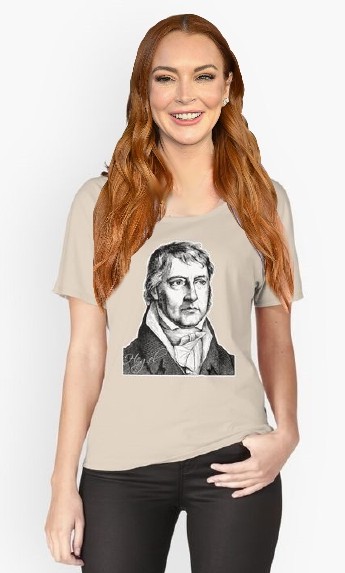
Lindsay Lohan capturing Hegel's phenomenology of spirit in a T-shirt.

The word, though without quite its modern meaning, seems first to have been used in 1764 by Swiss philosopher and mathematician, Johann Heinrich Lambert (1728–1777) in his work Neues Organon, a treatise on logic, the title (New Organon), a nod to The Organon (Ὄργανον in the Ancient Greek meaning “instrument, tool, organ"), the collection of Aristotle's (384-322 BC) six works on logic assembled (circa 40 BC) by a group of disciples known as the Peripatetics.  In the reductionist spirit of logic, Lambert applied the word to his particular exploration of the systemic use of knowledge to differentiate truth falsehood but it wasn’t until the publication in 1807 of Phänomenologie des Geistes (Phenomenology of Spirit) by German philosopher GWF Hegel that lineal paths to the twentieth century phenomenological can be traced.  Hegel was impenetrable even by the standards of German philosophers so the discursive output of the new phenomenologists of the new century seems hardly surprising.  As many students discovered, one can find one's way to Hegel but it's hard to find one's way back.