Sunday, October 17, 2021

Lava

Lava (pronounced lah-vuh or lav-uh)

(1) The molten, fluid rock that issues from a volcano or volcanic vent (sometimes accumulating, occasionally permanently) in a volcano’s “lava lake”.

(2) The rock formed when this solidifies, occurring in many varieties differing greatly in structure and constitution.

(3) In fashion, as “lava dress” (sometimes volcano dress), a long, flowing gown, classically in orange and black fabric, styled to recall a vertiginous lava flow.

(4) A shade of red which tends to orange, recalling the color of red-hot, molten lava.

(5) As Lava Lamp, the trademarked name of a electric decorative lamp made of a transparent, (usually tapered) cylinder containing a liquid in which a colored wax (or wax-like substance) is stimulated by the heat of the light bulb to change into randomly separating, seemingly luminous shapes which constantly rise and descend.

1740–1750: From the Italian lava (molten rock issuing from a volcano), from the Neapolitan or Calabrian dialectal lava (avalanche, torrent or stream; downpour overflowing the streets).  The original use in Italian was to describe flash flood rivulets after downpours and only later to the streams of molten rock from Mount Vesuvius.  The once commonly supposed link with the Latin lavāre (to wash) (from the primitive Indo-European root leue- (to wash) was based on the idea of “a liquid flowing” but is now thought one of those creations of the medieval imagination and it’s just as unlikely there’s was any relationship with the Arabic لابة‎ (lāba) (black volcanic rock).  Lava is also wholly unrelated to larva (an early stage of growth for some insects and amphibians) which was from the Latin larva (ghost-like, masked) which may have been from the Etruscan Lār (Etruscan praenomen; titulary god) which appeared usually as Lares (guardian deities).  The alternative etymology is from the Latin labes (sliding down, falling), which influenced lābī (to slide, fall or slip) (a labina an “avalanche or landslide”).  The only adjective in modern use is lavalike (or lava-like).  The old adjectives lavatic (1805), lavic (1822) & laval (1883) all fell into disuse by the twentieth century (although their occasional revival in the technical literature would not be unsurprising) and lavaesque seems never to have been coined.  The palindromic Laval did endure in France as both a locality name and surname and is remembered because of Pierre Laval (1883–1945), prime minister of France 1931-1932, 1935-1936 & de facto prime minister in the Vichy Government 1942-1944, executed by a French firing squad in 1945.  Lava is a noun and the obsolete lavatic, lavic & lavalike were adjectives; the noun plural is lavas.

Lindsay Lohan in Pucci triangle lava-print bikini, The Bahamas, May 2007.  Pucci are noted for the shapes and colors printed on their fabric but their minimalist website is worth visiting as a reminder of how good Italian design can be.

What Pucci did for their "Lava" range was take the shapes and curves assumed by a lava flow and render it with colors sometimes never seen in volcanology.  The terms lava and magma (from the Ancient Greek μάγμα (mágma) (paste)) are sometimes used interchangeably but to geologists and volcanologists the distinction is that Magma is molten rock which exists beneath a planet’s surface and become lava only when it flows from a volcano or volcanic vent.  Magma thus does not always become lava, sometimes cooling and solidifying as rock beneath the surface and sometimes collecting in a magma chamber.  A magma chamber differs from a lava lake in that the pleasingly alliterative latter describes the (usually large) large pool of molten lava that forms in a volcanic crater (although volcanologists do use the term also of lava which “sticks” to a volcano’s surface and doesn’t flow further.  They also in some cases call the extrusive igneous rock formed when it hardens and cools “lava” although this is not in general use, laypeople associating both “magma” and “lava” with the material in its molten state.

1976 Lincoln Continental Mark IV, Pucci Edition (left) and the opera windows of the designer series Mark IVs (right), into which was etched the house's name.  The other designers were Bill Blass, Cartier & Givenchy and presumably something of an owner's character could be determined by their choice.  The ownership of the Mark IVs was overwhelmingly male and if a young lady heard one suggest she "come and see my etching", on the basis of what she saw on the opera window, she could elect to proceed or decline, fashion choices as good a criterion as any in such decisions. 

Although there was little else in the cars which suggested much influence from Italy, Pucci was one of four fashion houses chosen by the Ford Motor Company (FoMoCo) to provide “touches” for “designer” editions of the 1976 Lincoln Continental Mark IV and the Pucci package (in “vintage burgendy with a loose pillow velvety burgendy velour interior”) added US$2000 to the MRP (manufacturer’s recommended price) of US$11,060.  The creation of the designer editions was an attempt to stimulate demand because the sales numbers in 1974-1975 had proved disappointing, something attributed both the downturn in the economy and the Mark IV having been on the market since late 1971, the only changes since the addition of (1) emission controls which reduced power & impaired drivability and (2) huge, heavy, impact resistant bumpers, neither of which much engaged potential buyers.  The economy improved somewhat in 1976 but the “touches” of the fashion houses must have helped because after sinking to 47,145 in 1975, sales the next year for the Mark IV’s final season rebounded to 56,110.  The designer editions accounted for almost a third of that volume, FoMoCo so pleased the contracts were renewed and those who want a classic Pucci Lincoln can choose a Mark IV (1976), Mark V (1977-1979) or Mark VI (1980-1983), the detailing changing with each version although the Pucci name was always etched into the opera windows on the C-pillar.  Now part of the LVMH (Moët Hennessy Louis Vuitton) multinational conglomerate, in their corporate history there seems to be no mention of Pucci’s involvement with Lincoln’s “land yachts” but it must at the time have seemed a good idea.

Lava flowing over snow and ice, demonstrating the “Leidenfrost effect”.  The Leidenfrost effect (known also as “film boiling”) describes the phenomenon in which a liquid, close to a solid surface of another body that is significantly hotter than the liquid's boiling point, produces an insulating vapor layer that prevents liquid rapidly from boiling.  This happens because of “repulsive force”; droplets hovering over the surface, rather than making physical contact.  In a charming linguistic coincidence, the “frost” element in the word is not a reference to frozen water but from the name of German physician Johann Gottlob Leidenfrost (1715—1794), who first documented the phenomenon in De aquae communes nonnullis qualitatibus tractatus (Tract about some qualities of common water, 1756).  The son of a preacher, Dr Leidenfrost began his academic career studying theology before switching to medicine.  Until modernity overtook the twentieth century, the church was a source of many scientists, not all of whom abandoned their faith.  The German Leiden can be both a noun and verb; as a verb (leiden) it means “to endure” or “to suffer” but in idiomatic use it’s used in that sense also to mean “to tolerate” although most often in the negative (such as “Ich kann ihn nicht leiden” (I can't stand him.))  As a noun (das Leiden), it means “pain”, “suffering” or “affliction”.  The German Frost means “frost or freezing temperatures”.  Thus the surface analysis of the surname “Leidenfrost” is “enduring frost” or “suffering from frost” and onomasticians (or onomatologists, those who study surnames, a sub-branch of anthroponymy (the study of proper names) suspect the origin was something to do with those who live in cold or icy places although it may also be toponymic, referring to individuals from specific locations in Germany Leidenfrost in Thuringia or Leidenfrosten in Saxony-Anhalt.

Lava lake, Mount Erebus, Antarctica.  Some 60 m (200 feet) in diameter, it sits within a small pit crater within the post-caldera summit and is phonolite in composition.  It may or may not remain a permanent feature.

The rock formations created by cooled magma at Mount Erebus proved especially interesting to those researching the history of the Earth’s magnetic field.  Geophysicist Dr Catherine Constable (b 1958) was studying the data used to refine a model explaining the mechanism of the earth’s occasional magnetic field reverses (from the familiar north & south polarity to the reverse where they swap) and found lava to be a substance keeping a perfect recorder of the field.  All magmas contain enough iron-rich minerals to detect the field and these align themselves toward the field as the lava freezes. As a result, the magnetic field at that moment is recorded: set in time and set in stone.  Over geological time, quite what the frequency (or the rapidity) of the shift isn’t clear and while studies suggest historically there’s be a swap every few hundred thousand years, it’s been almost a million years since the last so while one “might” be (over)due, Dr Constable says there’s no available evidence one is in progress or even imminent.

Catriona Gray (b 1994; Miss Universe 2018) in lava dress by Filipino designer Mak Tumang (b 1986) which used a image of lava flowing down Mayon Volcano, rendered in Swarovski crystals, Bangkok’s Impact Arena, Thailand, December 2018 (left) and lava flow on Tungurahua volcano, Huambalo, Ecuador (right).

Catriona Gray on the catwalk, lava flowing.

Lava cup-cakes

Lava cakes can pay tributes to volcanologists in different ways.  They can feature a magna chamber which, upon slicing can feed a lava flow or they can formed with an exposed crater in which sits a lava lake.  Professional chefs can produce the effects with room-temperature “lava” but usually these are for display and the cakes work best with hot, melted chocolate and obsessives use a variety of ingredients (peanut butter, raspberries, orange colored icing etc) to attempt to emulate the variegated colors of the real stuff.  They work best with dark chocolate but sweeter types can be used (or a blend).  Lava cakes can be made at larger scales but the laws of physics (both thermal and structural) mean full-sized constructions can be challenging (and messy) so most produce lava cup-cakes.  Because, in a sense, lava cakes are a kind of civil engineering, some very complex recipes have been created but the following will make 6-8 cup-cakes (depending on the size of the muffin tins) and it has the virtue of simplicity:

Ingredients

4 tablespoons of unsalted butter at room temperature (plus some with which to grease the muffin tray).

A third of a cup of granulated sugar (plus some to sprinkle in the muffin tray).

3 large eggs.

A third of a cup of all-purpose flour.

A quarter teaspoon of salt.

8 ounces of dark chocolate, melted (for best results, delay the melt process until ready to blend (step (8) below).

6-8 squares (from the standard blocks) of dark chocolate.

Icing (confectioners') sugar, for dusting.

Whipped cream or ice cream, for serving (optional).

Fruit for serving (optional and most choose a red or orange variety).

Instructions

(1) Preheat oven to 400°F (205°C).

(2) Grease the cups of muffin tray with butter, ensuring the coasting is light and consistent.

(3) Sprinkle some granulated sugar over the muffin tray and ensure each has buttered cup has a consistent coating.  Shake off any excess grains.

(4) Spoon some granulated sugar into each cup, swirling to make sure the cup is completely lined.

(5) Blend the butter and granulated sugar until the mix is creamy.

(6) To this mix, as the eggs, one at a time, blending them in after each addition.

(7) To this mix, beat in flour and salt (on a low speed) until combined.

(8) To this mix, add the molten chocolate, and beat until combined.  Don’t be off-put if the mix seems either more or less viscous that you might expect.

(9) Pour mix into the greased cups. Fill only to half-way.

(10) In the centre of each cup, place one of the chocolate squares.

(11) Add the remaining mix to each cup but, because the mix will expand, don’t fill higher than three-quarters.

(12) Put tray into the heated oven, baking until the middle of the cakes no longer jiggle (should be no more than 8-12 minutes and if left too long, they’ll cease to be lava cup-cakes and become chocolate cup-cakes).  Because there’s some risk of spillage, place baking paper underneath the tray.

(13) Remove tray from oven and allow it to sit for 7-8 minutes.

(14) Up turn tray on a plate or other suitable flat surface and remove cup-cakes so the conical aspect resembles volcano.

(15) Dust with the icing (confectioner's) sugar and serve with vanilla ice cream or whipped cream, adding some sort of fruit if desired.  Upon being sliced, the magma should ooze out, lava-like.

The Lava Lamp

The decorative lava lamp was invented in 1963 by Edward Craven Walker (1918-2000), a Word War II (1939-1945) RAF (Royal Air Force) pilot who was inspired by a rigged-up egg-timer he saw in a pub, the device made with oil and water in a bottle.  Oil and water being two immiscible (unable to mix) fluids, the timer worked by shaking the bottle, the egg deemed to be ready when the resulting blobs of oil had re-coagulated.  Knowing the world was well-supplied with cheap, reliable egg-timers, Craven saw little point in “making a better mousetrap” but he found the behavior of the blobs a pleasing piece of art and in his garage experimented with different fluids until he found a pleasing combination which produced just the effect he’d envisaged.  The characteristic shape of the lamp came about because the one seen in the pub used a standard cocktail shaker and the container in which Craven undertook his early research was an orange-squash bottle which was made in a similar shape; it proved ideal.

Although associated with psychedelia, as well as lurid colors (the range expanded since the introduction of LEDs), lava lamps with plain black blobs in clear fluid are available.

The first lava lamp patent (Lava Lamp is a registered trademark in some jurisdictions) was applied for in 1963 and they were first displayed in 1965.  Very popular in the early-mid 1970s, by the 1980s the fad had passed, not because of the popular association of them with stoners imagined sitting staring at one for hours while the Grateful Dead played on the turntable (endlessly on repeat) but because they’d come to be thought of as plastic kitsch.  However, they never quite went away and while there are spikes in demand (associated usually with some appearance in some prominent piece of popular culture), there is clearly a constant demand for those who just like the look while others furnish according to retro schemes or like the odd ironic piece among their conspicuous good taste.

An application of physics of thermodynamics and fluid mechanics, the lava lamps once so admired by stoned hippies work by exploiting differences in density, thermal expansion, and buoyancy within two immiscible fluids (ie they do not mix), the dynamics driven by a localized heat source and the construction is simple; in a variously shaped glass vessel, there is a wax-based compound (the “lava”, which typically is paraffin wax mixed with additives to adjust density and melting point), floating in a liquid (usually water or a water-based solution with salts or alcohols to achieve the desired density).  At the base of the vessel there is a source of light and heat which traditionally was an incandescent bulb, the heat a product of the inefficiency with which the energy was converted into light; when the bulb is switched on, the liquid becomes heated and as the wax absorbs some of this heat, it melts and thermally expands, density thereby decreasing to the point it’s slightly less dense than the surrounding liquid.  Buoyant force then causes the wax to rise through the liquid in blobs, randomness meaning tiny variations in surface tension and viscosity create infinitely different shapes of the rounded forms which cool as they move away from the heat source, meaning the wax contracts, increasing its density beyond that of the liquid, causing it to sink back toward the bottom.  Because it’s a closed system working on a continuous cycle, the heating & cooling repeats continuously and, component failure and material decay aside, in theory a lava lamp could run forever.

Kitsch at work: Lava Lamps and Random Number Generation

Some may have dismissed the Lava Lamp as "kitsch" but the movement of the blobs possesses properties which have proved useful in a way their inventor could never have anticipated.  The US-based Cloudflare is a “nuts & bolts” internet company which provides various services including content delivery, DNS (Domain Name Service), domain registration and cybersecurity; in some aspects of the internet, Cloudflare’s services underpin as many as one in five websites so when Cloudflare has a problem, the world has a problem.  For many reasons, the generation of truly random numbers is essential for encryption and other purposes but to create them continuously and at scale is a challenge.  It’s a challenge even for home decorators who want a random pattern for their tiles, their difficulty being that however a large number of tiles in two or more colors are arranged, more often than not, at least one pattern will be perceived.  That doesn’t mean the tiles are not in a random arrangement, just that people’s expectation of “randomness” is a shape with no discernible pattern whereas in something like a floor laid with tiles, in a random distribution of colors, it would be normal to see patterns; they too are a product of randomness in the same way there’s no reason why if tossing a coin ten times, it cannot all ten times fall as a head.  What interior decorators want is not necessarily randomness but a depiction of randomness as it exists in the popular imagination.

Useful kitsch: Wall of Entropy, Cloudflare, San Francisco.  Had this been in an installation in a New York gallery circa 1972, it would have been called art.  

For most purposes, computers can be good enough at generating random numbers but in the field of cryptography, they’re used to create encryption keys and the concern is that what one computer can construct, another computer might be able to deconstruct because both digital devices are working in ways which are in some ways identical.  For this reason, using a machine alone has come to be regarded as a Pseudo-Random Number Generator (PRNG) simply because they are deterministic.  A True Random Number Generator (TRNG) uses something genuinely random and unpredictable and this can be as simple as the tiny movements of the mouse in a user’s hand or elaborate as a system of lasers interacting with particles.

One of Cloudflare’s devices encapsulating unpredictability (and thus randomness) is an installation of 100 lava lamps, prominently displayed on a wall in their San Francisco office.  Dubbed Cloudflare’s “Wall of Entropy”, it uses an idea proposed as long ago as 1996 which exploited the fluid movements in an array of lava lamps being truly random; as far as is known, it remains impossible to model (and thus predict) the flow.  What Cloudflare does is every few milliseconds take a photograph of the lamps, the shifts in movement converted into numeric values.  As well as the familiar electrical mechanism, the movement of the blobs is influenced by external random events such as temperature, vibration and light, the minute variations in each creating a multiplier effect which is translated into random numbers, 16,384 bits of entropy each time.

Wall of Entropy, Cloudflare, San Francisco.

The arrangement of colors which avoids any two being together, in the horizontal or vertical, was a deliberate choice rather than randomness although, there's no reason why, had the selection truly been random, this wouldn't have been the result.  Were there an infinite number of Walls of Entropy, every combination would exist including ones which avoid color paring and ones in which the colors are clustered to the extent of perfectly matching rows, colums or sides.  What Cloudflare have done in San Francisco is make the lamps conform to the popular perception of randomness and that's fine because the colors have no (thus far observed) effect on the function.  In art and for other purposes, what's truly random is sometimes modified so it conforms to the popular idea of randomness.

Saturday, October 16, 2021

Punt

Punt (pronounced puhnt or poont)

(1) In various football codes, a kick in which the ball is dropped and then kicked before it touches the ground (as opposed to the drop kick or place kick); in some codes used casually of any long, high kick.

(2) In nautical use, a small, shallow boat having a flat bottom and square ends, usually used for short outings on rivers or lakes and propelled by the use of a pole pivoted against the waterway’s bottom.

(3) The monetary unit (100 pence; the Irish pound) of the Republic of Ireland until the adoption of the Euro in 2002.

(4) An ancient Egyptian name of an area in north-east Africa, believed to be in the region of modern-day Somaliland.

(5) In ichthyology, the action of certain fish which “walk” along the seafloor, using their fins as limbs; a fish so “walking” is said to be “a punter, punting”. .

(6) In glassblowing (as both punt & punty), a thin glass or iron rod which temporarily is attached to a larger piece in order better to manipulate the larger piece.

(7) An indentation in the base of a wine bottle.

(8) In the game of faro, a point; to play basset, baccara, faro etc.

(9) To propel a small boat by thrusting against the bottom of a lake, stream, canal or other suitable waterway, especially with a pole.

(10) To convey in or as if in a punt.

(11) To punt a football by means of the kick.

(12) To travel in a punt.

(13) In informal use, to equivocate, or delay (based on the idea of kicking a ball away).

(14) In gambling slang, to gamble place a bet, historically most used in horse racing but use has spread with the proliferation of betting on other sporting events; in certain card games, to lay a stake against the bank; in financial trading (a form of gambling), to make a highly speculative investment, if based on intuition (guesswork) rather than insider trading.

(15) In colloquial use (1) to retreat from one's objective; to abandon an effort one still notionally supports, (2) to make the best choice from a set of non-ideal alternatives or (3) a (usually speculative) guess.

Pre 1000: From the late Old English punt (flat or shallow-bottomed, square-ended, mastless river boat), from the Latin pontō (Gaulish flat-bottomed boat, pontoon (in the sense of “floating bridge”)) an the so-called “British Latin” ponto was re-adopted from the Middle Low German punte (ferry boat) or the Middle Dutch ponte (ferry boat) of the same origin and not attested in Middle English.  The use in Latin to describe the "floating bridges" built ad-hoc by the military for river crossings was from the Latin pontem (nominative pons) (bridge), from the primitive Indo-European root pent- (to tread, to go) but it may also have been influenced by the Old French cognate pont (large, flat boat).  The verb forms describing movement was base on the idea of "to propel as a punt is moved by pushing with a pole against the bed of the body of water” dates from 1816.  The use of the noun punter in US football dates from 1888 (based on the nautical use) and was by the early twentieth century in the UK, Australia & New Zealand applied to gamblers.  This connection in the 1960s was extended to the term “the average punter”, a synonym for “the average person” and was a classist notion based on the idea the typical working class individual gambled (as well as smoked and drank) and in that vein, it became popular police slang to describe s prostitute's clients.  Punter also picked up specialized meanings including (1) in rock-climbing a beginner or unskilled climber. In Scotland one who trades with a gang but is not a gang member and (3) in internet slang, a program used forcibly to disconnect another user from a chat room or other multi-user environment.  Punt is a noun & verb, punter is a noun and punting & punted are verbs; the noun plural is punts.

Ready for a punt: Lindsay & Ali Lohan, Melbourne Cup, Flemington Racecourse, November 2019.

In various football codes, a punt kick is a kick in which the ball is dropped and then kicked before it touches the ground (as opposed to the drop kick or place kick although in some codes it’s used casually of any long, high kick (often as “punted it down the field).  The use dates from 1845 in rugby (now called rugby union) and is though derived from either (1) from the notion of “propelling a boat by shoving” or (2) a variant of the Midlands dialect bunt (to push; butt with the head) which is of unknown origin but may be echoic (compare bunt).  The slang use in US universities and colleges meaning “give up, withdraw from a course or subject to avoid receiving a failing grade) was based on the use of the punt-kick in American football when used as a tactic when the ball can’t be advanced.  The term appears in the rugby codes, American football, Australian Rules football (AFL), Gaelic football and describes kicking a ball dropped from the hands before it hits the ground.  In the rugby codes, the mode of kick is a matter of importance because the alternative “drop kick” involves a player dropping the ball in front of them, allowing its slightly to bounce before taking the kick.  Under the rules of these codes, dropping the ball in front is a “knock on” and subject to a penalty unless done as a prelude to a dropkick.  A player, having inadvertently dropped the ball will sometimes attempt a kick to disguise the error and thus avoid the penalty so in such cases it’s a matter of judgment for the referee whether it was a drop kick or a knock on.  The special form “torpedo punt” was from AFL and referred to a flat, long kick.  A “punt protector” was a team member whose role was to negate the opposition’s use of the punt kick, the “punt returner” a similar (sometimes identical) role.  The “checkside punt” (the banana punt in Australia) describes a kick which makes the ball spin and bend away from the player's body (they can be intentional or an error).  The use in sport also influenced the figurative use in the sense of “to equivocate, or delay” and was based on the kicking a ball away and is related to the idea of “kicking the can down the road”.  It’s sometimes appears in the phrase “punted it into the long grass) (ie “make it disappear or go away”).

In glassblowing, a punt or a punty was a “thin glass (or in certain cases an iron substitute) rod used in manipulating hot glass”, temporarily attached to a larger piece in order better to handle the larger piece.  Dating from the 1660s, it was from the French pontil, a diminutive form from the Latin punctum (a point), from a nasalized form of the primitive Indo-European root peuk- (to prick).  The use to describe various forms of betting dates seems first to have been used in the early eighteenth century and was from the French ponter (to punt), from ponte (bet laid against the banker; point in faro), from the Spanish punto (point), from the Latin punctum.

Depiction of a mounted punt gun.

The punt gun was a large scale shotgun used in the nineteenth and early twentieth centuries in the large-scale, commercial harvesting of water birds.  Too large to (safely or accurately) be fired if held by an individual, the weapons were solidly mounted on the punts (although other vessels were also used) hunters used to achieve close proximity to their targets.  The earliest versions were literally up-scaled shotguns including the obviously superfluous shoulder-stock and were supplied without any mounting hardware, owners fabricating their own or adapting other devices but specialized designs quickly emerged.  These were sold with the mounting hardware fixed to the gun and were supplied with a kit which included a platform for the boat, most offering some adjustments to suit different dimensions.

Illustrative photograph of punt gun.  Some 12 feet (3.7 m) in length, they weren't actually used like this.

Punt guns were usually custom-designed and varied widely, but could have bore diameters exceeding 2 inches (51 mm) and the load could be as much as 1 lb (.45 kg), a single discharge able to kill some four dozen birds on the water’s surface.  Because of the power of the weapon, they were solidly mounted so the aiming was achieved by aligning the bow of the punt with the intended line of fire and such was the force exerted that in still water a punt would move backwards by several inches with every discharge.  Punts equipped with a punt gun can thus be thought of as small-scale monitors, the class of warship which carried a single, large bore canon although on monitors, the gun was in a turret and could thus be aimed independently of the direction the of the hull.  To maximize the slaughter, hunters would sometimes assemble punts in a flotilla of up to a dozen punts, their formation arranged to provide a wild field of fire and one optimized to limit the wastage (ie there being no need to kill a bird more than once).  One barrage could thus kill hundreds.

Take aim and fire.

Punt guns were usually muzzle-loaded and double and even triple barrelled versions were built and they allowed a method of hunting which was so shockingly efficient that in the US, by the mid nineteenth century, waterfowl stocks had been depleted to such an extent that almost all state governments their use.  Punts guns are prized by collectors and at exhibitions a firing is a popular part of the show and in the UK, they are occasionally still used by the military for ceremonial purposes although the loads are now optimized for volume rather than lethality.

Friday, October 15, 2021

Enshrine

Enshrine (pronounced en-shrahyn)

(1) To enclose (a sacred relic etc) in a shrine or chest.

(2) To cherish as sacred or venerated, someone, an idea or an institution.

(3) In statute or constitutional law, to protect (a concept, ideal, or philosophy) within a law or treaty.

(4) Figuratively, to make permanent.

1575–1585: The construct was en- + shrine.  The en- prefix was from the Middle English en- (en-, in-), from the Old French en- (also an-), from the Latin in- (in, into).  It was also an alteration of in-, from the Middle English in-, from the Old English in- (in, into), from the Proto-Germanic in (in).  Both the Latin & Germanic forms were from the primitive Indo-European en (in, into).  The intensive use of the Old French en- & an- was due to confluence with Frankish intensive prefix an- which was related to the Old English intensive prefix -on.  It formed a transitive verb whose meaning is to make the attached adjective (1) in, into, (2) on, onto or (3) covered.  It was used also to denote “caused” or as an intensifier.  The prefix em- was (and still is) used before certain consonants, notably the labials b and p.  Shrine ((1) a holy or sacred place dedicated to a specific deity, ancestor, hero, martyr, saint, or similar figure of awe and respect, at which said figure is venerated or worshipped, (2) a case, box, or receptacle, especially one in which are deposited sacred relics, as the bones of a saint & (3) figuratively a place or object hallowed from its history or associations) was from the Middle English shryne, from the Old English scrīn (reliquary, ark of the covenant), from the Medieval Latin scrīnium (reliquary (“case or chest for books or papers” in Classical Latin)) and ultimately from the primitive Indo-European sker & ker- (to turn, bend).  It was linked with the Old Norse skrín and the Old High German skrīni (which survives in Modern German as Schrein).  In the sixteenth century enshrine & inshrine were used in parallel, both in the sense of “enclose in or as in a shrine; deposit for safe-keeping”.  The (rare) alternative form inshrine is listed (like the verb enshrineth as obsolete for all but the odd ceremonial use in religious rituals.  Enshrine & enshrined are verbs, enshriner, enshrinee & enshrinement are nouns, enshrined is verb & adjective and enshrining is a verb.

Implausibly, the White House tries to suggest Joe Biden is "cool".

October 3 has become enshrined as Mean Girls Day which is good but the White House for the last two years (2023 (left) & 2022 (right)) has tweeted memes on the theme, apparently in an attempt to make Joe Biden (b 1942; US president since 2021) seem somehow relevant (al last to the early twentieth century).  On both occasions, the reaction has been such that one might hope it stops but the next Mean Girls Day falls a few weeks before the 2024 presidential election and if Mr Biden doesn’t die (God forbid) and really does again run, the temptation may be too great.

The Aboriginal and Torres Strait Islander Voice (TheVoice)

In October 2014, the Australian government submitted to the voters by means of referendum (the only way to modify the nation’s constitution):

A Proposed Law: To alter the Constitution to recognise the First Peoples of Australia by establishing an Aboriginal and Torres Strait Islander Voice. Do you approve this proposed alteration?

The insertion of the following chapter:

Chapter IX Recognition of Aboriginal and Torres Strait Islander Peoples.

Aboriginal and Torres Strait Islander Voice.

In recognition of Aboriginal and Torres Strait Islander peoples as the First Peoples of Australia:

There shall be a body, to be called the Aboriginal and Torres Strait Islander Voice;

The Aboriginal and Torres Strait Islander Voice may make representations to the Parliament and the Executive Government of the Commonwealth on matters relating to Aboriginal and Torres Strait Islander peoples;

The Parliament shall, subject to this Constitution, have power to make laws with respect to matters relating to the Aboriginal and Torres Strait Islander Voice, including its composition, functions, powers and procedures.

The “No” case assembled a number of arguments in opposition but one, although it seemed of fundamental importance, seemed to attract little comment and the “Yes” proponents made little attempt to refute its implications.  What the “No” case alleged, inter alia, was:

Putting a Voice in the Constitution means it’s permanent.  Enshrining in our Constitution a body for only one group of Australians means… once it is in the Constitution it won’t be undone.

In a literal sense that was of course almost certainly true but given the vagueness of the wording and the latitude afforded to the parliament in framing the parameters of “The Voice”, there seems no reason why things shouldn’t have gone the way of the Interstate Commission, a creature of Section 101 of the Constitution of Australia (1901):

There shall be an Inter-State Commission, with such powers of adjudication and administration as the Parliament deems necessary for the execution and maintenance, within the Commonwealth, of the provisions of this Constitution relating to trade and commerce, and of all laws made thereunder.

In terms of both legal theory and the usual constitutional practice the words “There shall be an Inter-State Commission seem unambiguous but the Inter-State Commission wasn’t established until 1912 and became dormant after 1920 because the High Court of Australia (HCA) in 1915 has found the judicial powers granted to the commission by the parliament were invalid.  The bench held a “separation of powers” was implicit in the constitution which demanded judicial power be vested only in the judiciary and that on technical grounds the commission was not a judicial body.  Rendered therefore merely investigative and deliberative, the government allowed the commission to become defunct and it wasn’t revived until the 1980s and even then, after a brief existence as a stand-alone body, it was absorbed by what eventually became the Productivity Commission.

So, even had the words “There shall be a body, to be called the Aboriginal and Torres Strait Islander Voice had been enshrined in the Constitution, that alone would not seem to prevent a parliament at some point passing a law defining “The Voice” as one (suitably accommodative) indigenous person attached to the Department of Prime-Minister & Cabinet (PM&C) or just about any other model.  Because of the wording, it might be the High Court would have been generous in their view of who would have standing to challenge a model but the clause “The Parliament shall, subject to this Constitution, have power to make laws with respect to matters relating to the Aboriginal and Torres Strait Islander Voice, including its composition, functions, powers and procedureswould seem to offer little scope.  Lord Denning (1899-1999; English judge 1944-1982) himself would have struggled to find an “indigenous peoples’ equity” in all that.  Mere enshrinement of “The Voice” in the Constitution would not in itself have guaranteed any sort of legal or political dynamic because, as the tale of the Inter-State Commission demonstrated, words can be dead letters.

Wednesday, October 13, 2021

Disheveled

Disheveled (pronounced dih-shev-uhld)

(1) Hanging loosely or in disorder; unkempt.

(2) Untidy in appearance; disarranged.

1375–1425: From the Late Middle English discheveled (without dressed hair), replacing the earlier form dishevely which ran in parallel with dischevele (bare-headed), from the Old French deschevelé (bare-headed, with shaven head), past -participle adjective from descheveler (to disarrange the hair), the construct being des- (apart (the prefix indicating negation of a verb)) + -cheveler (derivative of chevel (hair; a hair) (cheveu in Modern French)) from the Latin capillus (a diminutive form from the root of caput (head), thought perhaps cognate with the Persian کوپله‎ (kūple) (hair of the head).  The Modern French forms are déchevelé & échevelé.  As applied to the hair itself in the sense of “hanging loose and throw about in disorder, having a disordered or neglected appearance”, use dated from the mid-fifteenth century while the general sense of “with disordered dress” emerged around the turn of the seventeenth.  The verb dishevel is interesting in that it came centuries later; a back formation from disheveled, used to mean “to loosen and throw about in disorder, cause to have a disordered or neglected appearance” it applied first to the hair in the 1590s and later to clothing and other aspects of appearance.  Synonyms include messy, scraggly, tousled, unkempt, untidy, crumpled, slovenly and sloppy.  The alternative spelling is dishevelled.  Disheveled is a verb & adjective, dishevelment is a noun and dishevelledly is an adverb.

Instances of dishevelment can be caused by (1) prevailing wind conditions, (2) a stylist preparing an actor or model or (3) other causes.  Lindsay Lohan in Confessions of a Teenage Drama Queen (2004, left) illustrates the stylist's craft while the other states of disarray (centre & right) would have been induced by "other causes".  Stylists preparing models for static shoots sometimes use remarkably simple tricks and equipment, hair held in a wind-blown look using nothing more than strips of cardboard, bulldog clips and some strategically placed scotch tape.  It takes less time and produces a more natural result than post-production digital editing.     

Donald Trump (b 1946; US president 2017-2021) seems prone to dishevelment in conditions above 2 on the Beaufort scale.  For perfectionists, the comparative form is "more disheveled" and the superlative "most disheveled".

Lindsay Lohan and her lawyer in court, Los Angeles, January 2012.

Hair apparent: Boris Johnson (b 1964; UK prime-minister 2019-2022) was known to have "weaponized" his hair as part of his image as (1) a toff who didn't care and (2) an English eccentric.  However just as Dolly Parton (b 1946) revealed that "it takes a lot of money to look this cheap", Mr Johnson's studied untidiness took a bit of work to maintain and credit must rightly be accorded to Ms Kelly Jo Dodge MBE.

Corruption is probably a permanent part of politics although it does ebb and flow and exists in different forms in different places.  In the UK, the honours system with its intricate hierarchy and consequent determination on one’s place in the pecking order on the Order of Precedence has real world consequences such as determining whether one sits at dinners with the eldest son of a duke or finds one’s self relegated to a table with the surviving wife of a deceased baronet.  Under some prime-ministers the system was famously corrupt and while things improved in the nineteenth century, under David Lloyd George (1863–1945; UK prime-minister 1916-1922) honours were effectively for sale in a truly scandalous way.  None of his successors were anywhere near as bad although Harold Wilson’s (1916–1995; UK prime minister 1964-1970 & 1974-1976) resignation honours list attracted much comment and did his reputation no good but in recent years it’s been relatively quiet on the honours front.  That was until the resignation list of Boris Johnson was published.  It included some names unknown to all but a handful of political insiders and many others which were controversial for their own reasons but at the bottom of the list was one entry which all agreed was well deserved: Ms Kelly Jo Dodge, for 27 years the parliamentary hairdresser, was created a Member of the Most Excellent Order of the British Empire (MBE).  In those decades, she can have faced few challenges more onerous than Boris Johnson’s hair yet never once failed to make it an extraordinary example in the (actually technically difficult) “not one hair in place” style.  The citation on her award read "for parliamentary service" but insiders all knew it really was for "services to dishevelment".

Tuesday, October 12, 2021

Gap

Gap (pronounced gap)

(1) A break or opening, as in a fence, wall, or military line; breach; an opening that implies a breach or defect (vacancy, deficit, absence, or lack).

(2) An empty space or interval; interruption in continuity; hiatus.

(3) A wide divergence or difference; disparity

(4) A difference or disparity in attitudes, perceptions, character, or development, or a lack of confidence or understanding, perceived as creating a problem.

(5) A deep, sloping ravine or cleft through a mountain ridge.

(6) In regional use (in most of the English-speaking world and especially prominent in the US), a mountain pass, gorge, ravine, valley or similar geographical feature (also in some places used of a sheltered area of coast between two cliffs and often applied in locality names).

(7) In aeronautics, the distance between one supporting surface of an airplane and another above or below it.

(8) In electronics, a break in a magnetic circuit that increases the inductance and saturation point of the circuit.

(9) In various field sports (baseball, cricket, the football codes etc), those spaces between players which afford some opportunity to the opposition.

(10) In genetics, an un-sequenced region in a sequence alignment.

(11) In slang (New Zealand), suddenly to depart.

(12) To make a gap, opening, or breach in.

(13) To come open or apart; form or show a gap.

1350–1400: From the Middle English gap & gappe (an opening in a wall or hedge; a break, a breach), from Old Norse gap (gap, empty space, chasm) akin to the Old Norse gapa (to open the mouth wide; to gape; to scream), from the Proto-Germanic gapōną, from the primitive Indo-European root ghieh (to open wide; to yawn, gape, be wide open) and related to the Middle Dutch & Dutch gapen, the German gaffen (to gape, stare), the Danish gab (an expanse, space, gap; open mouth, opening), the Swedish gap & gapa and the Old English ġeap (open space, expanse).  Synonyms for gap can include pause, interstice, break, interlude, lull but probably not lacuna (which is associated specifically with holes).  Gap is a noun & verb, gapped & gapping are verbs, Gapless & gappy are adjectives; the noun plural is gaps.

Lindsay Lohan demonstrates a startled gape, MTV Movie-Awards, Gibson Amphitheatre, Universal City, California, June 2010.

The use to describe natural geographical formations (“a break or opening between mountains” which later extended to “an unfilled space or interval, any hiatus or interruption”) emerged in the late fifteenth century and became prevalent in the US, used of deep breaks or passes in a long mountain chain (especially one through which a waterway flows) and often used in locality names.  The use as a transitive verb (to make gaps; to gap) evolved from the noun and became common in the early nineteenth century as the phrases became part of the jargon of mechanical engineering and metalworking (although in oral use the forms may long have existed).  The intransitive verb (to have gaps) is documented only since 1948.  The verb gape dates from the early thirteenth century and may be from the Old English ġeap (open space, expanse) but most etymologists seem to prefer a link with the Old Norse gapa (to open the mouth wide; to gape; to scream); it was long a favorite way of alluding to the expressions thought stereotypical of “idle curiosity, listlessness, or ignorant wonder of bumpkins and other rustics” and is synonymous with “slack-jawed yokels”).  The adjective gappy (full of gaps; inclined to be susceptible to gaps opening) dates from 1846.  The adjectival use gap-toothed (having teeth set wide apart) has been in use since at least the 1570s, but earlier, Geoffrey Chaucer (circa 1344-1400) had used “gat-toothed” for the same purpose, gat from the Middle English noun gat (opening, passage) from the Old Norse gat and cognate with gate.

Lindsay Lohan demonstrates her admirable thigh gap, November 2013.

The “thigh gap” seems first to have been documented in 2012 but gained critical mass on the internet in 2014 when it became of those short-lived social phenomenon which produced a minor moral panic.  “Thigh gap” described the empty space between the inner thighs of a women when standing upright with feet touching; a gap was said to be good and the lack of a gap bad.  Feminist criticism noted it was not an attribute enjoyed by a majority of mature human females and it thus constituted just another of the “beauty standards” imposed on women which were an unrealizable goal for the majority.  The pro-ana community ignored this critique and thinspiration (thinspo) bloggers quickly added annotated images and made the thigh gap and essential aspect of female physical attractiveness.  

A walking, talking credibility gap: crooked Hillary Clinton (b 1947; US secretary of state 2009-2013).

In English, gap has been prolific in the creation of phrases & expressions.  The “generation gap” sounds modern and as a phrase it came into wide use only in the 1960s in reaction to the twin constructs of “teenagers” and the “counter-culture” but the concept has been documented since antiquity and refers to a disconnect between youth and those older, based on different standards of behavior, dress, artistic taste and social mores.  The term “technology gap” was created in the early 1960s and was from economics, describing the various implications of a nation’s economy gaining a competitive advantage over others by the creation or adoption of certain technologies.  However, the concept was familiar to militaries which had long sought to quantify and rectify any specific disadvantage in personnel, planning or materiel they might suffer compared to their adversaries; these instances are described in terms like “missile gap”, “air gap”, “bomber gap”, “megaton gap” etc (and when used of materiel the general term “technology deficit” is also used).  Rearmament is the usual approach but there can also be “stop gap” solutions which are temporary (often called “quick & dirty” (Q&D)) fixes which address an immediate crisis without curing the structural problem.  For a permanent (something often illusory in military matters) remedy for a deficiency, one is said to “bridge the gap”, “gap-fill” or “close the gap”.  The phrase “stop gap” in the sense of “that which fills a hiatus, an expedient in an emergency” appears to date from the 1680s and may have been first a military term referring to a need urgently to “plug a gap” in a defensive line, “gap” used by armies in this sense since the 1540s.  The use as an adjective dates from the same time in the sense of “filling a gap or pause”.  A “credibility gap” is discrepancy between what’s presented as reality and a perception of what reality actually is; it’s applied especially to the statements of those in authority (politicians like crooked Hillary Clinton the classic but not the only examples).  “Pay gap” & “gender gap” are companion terms used most often in labor-market economics to describe the differences in aggregate or sectoral participation and income levels between a baseline group (usually white men) and others who appear disadvantaged.

“Gap theorists” (known also as “gap creationists”) are those who claim the account of the Earth and all who inhabit the place being created in six 24 hour days (as described in the Book of Genesis in the Bible’s Old Testament) literally is true but that there was a gap of time between the two distinct creations in the first and the second verses of Genesis.  What this allows is a rationalization of modern scientific observation and analysis of physical materials which have determined the age of the planet.  This hypothesis can also be used to illustrate the use of the phrase “credibility gap”.  In Australia, gap is often used to refer to the (increasingly large) shortfall between the amount health insurance funds will pay compared with what the health industry actually charges; the difference, paid by the consumer, (doctors still insist on calling them patients) is the gap (also called the “gap fee”).  In Australia, the term “the gap” has become embedded in the political lexicon to refer to the disparity in outcomes between the indigenous and non-indigenous communities in fields such as life expectancy, education, health, employment, incarceration rates etc.  By convention, it can be used only to refer to the metrics which show institutional disadvantage but not other measures where the differences are also striking (smoking rates, crime rates, prevalence of domestic violence, drug & alcohol abuse etc) and it’s thus inherently political.  Programmes have been designed and implemented with the object of “closing the gap”; the results have been mixed.

Opinion remains divided on the use of platinum-tipped spark plugs in the Mercedes-Benz M100 (6.3 & 6.9) V8.

A “spark gap” is the space between two conducting electrodes, filled usually with air (or in specialized applications some other gas) and designed to allow an electric spark to pass between the two.  One of the best known spark gaps is that in the spark (or sparking) plug which provides the point of ignition for the fuel-air mixture in internal combustion engines (ICE).  Advances in technology mean fewer today are familiar with the intricacies of spark plugs, once a familiar (and often an unwelcome) sight to many.  The gap in a spark plug is the distance between the center and ground electrode (at the tip) and the size of the gap is crucial in the efficient operation of an ICE.  The gap size, although the differences would be imperceptible to most, is not arbitrary and is determined by the interplay of the specifications of the engine and the ignition system including (1) the compression ratio (low compression units often need a larger gap to ensure a larger spark is generated), (2) the ignition system, high-energy systems usually working better with a larger gap, (3) the materials used in the plug’s construction (the most critical variable being their heat tolerance); because copper, platinum, and iridium are used variously, different gaps are specified to reflect the variations in thermal conductivity and the temperature range able to be endured and (4) application, high performance engines or those used in competition involving sustained high-speed operation often using larger gaps to ensure a stronger and larger spark.

Kennedy, Khrushchev and the missile gap

The “missile gap” was one of the most discussed threads in the campaign run by the Democratic Party’s John Kennedy (JFK, 1917–1963; US president 1961-1963) in the 1960 US presidential election in which his opponent was the Republican Richard Nixon (1913-1994; US president 1969-1974).  The idea there was a “missile gap” was based on a combination of Soviet misinformation, a precautionary attitude by military analysts in which the statistical technique of extrapolation was applied on the basis of a “worst case scenario” and blatant empire building by the US military, notably the air force (USAF), anxious not to surrender to the navy their pre-eminence in the hierarchy of nuclear weapons delivery systems.  It’s true there was at the time a missile gap but it was massively in favor of the US which possessed several dozen inter-continental ballistic missiles (ICBM) while the USSR had either four or six, depending on the definition used.  President Dwight Eisenhower (1890-1969; US president 1953-1961), a five-star general well acquainted with the intrigues of the military top brass, was always sceptical about the claims and had arranged the spy flights which confirmed the real count but was constrained from making the information public because of the need to conceal his source of intelligence.  Kennedy may actually have known his claim was incorrect but, finding it resonated with the electorate, continued to include it in his campaigning, knowing the plausibility was enhanced in a country where people were still shocked by the USSR having in 1957 launched Sputnik I, the first ever earth-orbiting satellite.  Sputnik had appeared to expose a vast gap between the scientific capabilities of the two countries, especially in the matter of big missiles. 

President Kennedy & comrade Khrushchev at their unproductive summit meeting, Vienna, June 1961.

Fake gaps in such matters were actually nothing new.  Some years earlier, before there were ICBMs so in any nuclear war the two sides would have to have used aircraft to drop bombs on each other (al la Hiroshima & Nagasaki in 1945), there’d been a political furore about the claim the US suffered a “bomber gap” and would thus be unable adequately to respond to any attack.  In truth, by a simple sleight of hand little different to that used by Nazi Germany to 1935 to convince worried British politicians that the Luftwaffe (the German air force) was already as strong as the Royal Air Force (RAF), Moscow had greatly inflated the numbers and stated capability of their strategic bombers, a perception concerned US politicians were anxious to believe.  The USAF would of course be the recipient of the funds needed to build the hundreds (the US would end up building thousands) of bombers needed to equip all those squadrons and their projections of Soviet strength were higher still.  If all of this building stuff to plug non-existent gaps had happened in isolation it would have been wasteful of money and natural resources which was bad enough but this hardware made up the building blocks of nuclear strategy; the Cold war was not an abstract exercise where on both sides technicians with clipboards walked from silo to silo counting warheads.

Instead, the variety of weapons, their different modes of delivery (from land, sea, undersea and air), their degrees of accuracy and their vulnerability to counter-measures was constantly calculated to assess their utility as (1) deterrents to an attack, (2) counter-offensive weapons to respond to an attack or (3) first-strike weapons with which to stage a pre-emptive or preventative attack.  In the Pentagon, the various high commands and the burgeoning world of the think tanks, this analysis was quite an industry and it had to also factor in the impossible: working out how the Kremlin would react.  In other words, what the planners needed to do was create a nuclear force which was strong enough to deter an attack yet not seem to be such a threat that it would encourage an attack and that only scratched the surface of the possibilities; each review (and there were many) would produce detailed study documents several inches thick.

US Navy low-level photograph spy of San Cristobal medium-range ballistic missile (MRBM) site #1, Cuba, 23 October, 1962.

In October 1962, during the Cuban Missile Crisis, the somewhat slimmer nuclear war manuals synthesized from those studies were being read with more interest than usual.  It was a tense situation and had Kennedy and comrade Nikita Khrushchev (1894–1971; Soviet leader 1953-1964) not agreed to a back-channel deal, the US would probably have attacked Cuba in some manner, not knowing three divisions of the Red Army were stationed there to protect the Soviet missiles and that would have been a state of armed conflict which could have turned into some sort of war.  As it was, under the deal, Khrushchev withdrew the missiles from Cuba in exchange for Kennedy’s commitment not to invade Cuba and withdraw 15 obsolescent nuclear missiles from Turkey, the stipulation being the Turkish component must be kept secret.  That secrecy colored for years the understanding of the Cuban Missile Crisis and the role of the US nuclear arsenal played in influencing the Kremlin.  The story was that the US stayed resolute, rattled the nuclear sabre and that was enough to force the Soviet withdrawal.  One not told the truth was Lyndon Johnson (LBJ, 1908–1973; US president 1963-1969) who became president after Kennedy was assassinated in 1963 and historians have attributed his attitude to negotiation during the Vietnam War to not wishing to be unfavorably compared to his predecessor who, as Dean Rusk (1909–1994; US secretary of state 1961-1969) put it, stood “eyeball to eyeball” with Khrushchev and “made him blink first”.  The existence of doomsday weapon of all those missiles would distort Soviet and US foreign policy for years to come.

Monday, October 11, 2021

Brink

Brink (pronounced bringk)

(1) The edge or margin of a steep place or of land bordering water.

(2) Any extreme edge; verge.

(3) A crucial or critical point, especially of a situation or state beyond which success or catastrophe occurs:

1250–1300: From the Middle English brink, from the Middle Dutch brinc from the Old Norse brink (steepness, shore, bank, grassy edge).  It was cognate with the Middle Low German brink (edge, hillside) and the Old Norse brekka (slope, hill).  Danish gained brink directly from the Old Norse but for most other languages the greater influence was the Proto-Germanic brenkon, probably from the primitive Indo-European bhreng-, a variant of bhren- (to project; edge), source also of the Lithuanian brinkti (to swell).  Brink is a noun and brinkless an adjective; the noun plural is brinks.

Brinkmanship

A coining from the early cold war, brinkmanship is forever associated with John Foster Dulles (1888-1959; US Secretary of State 1953-1959), the origin in the words he used in a 1956 interview with Time-Life’s Washington bureau chief James Shepley (1917-1988):

The ability to get to the verge without getting into the war is the necessary art. If you cannot master it, you inevitably get into war. If you try to run away from it, if you are scared to go to the brink, you are lost.”

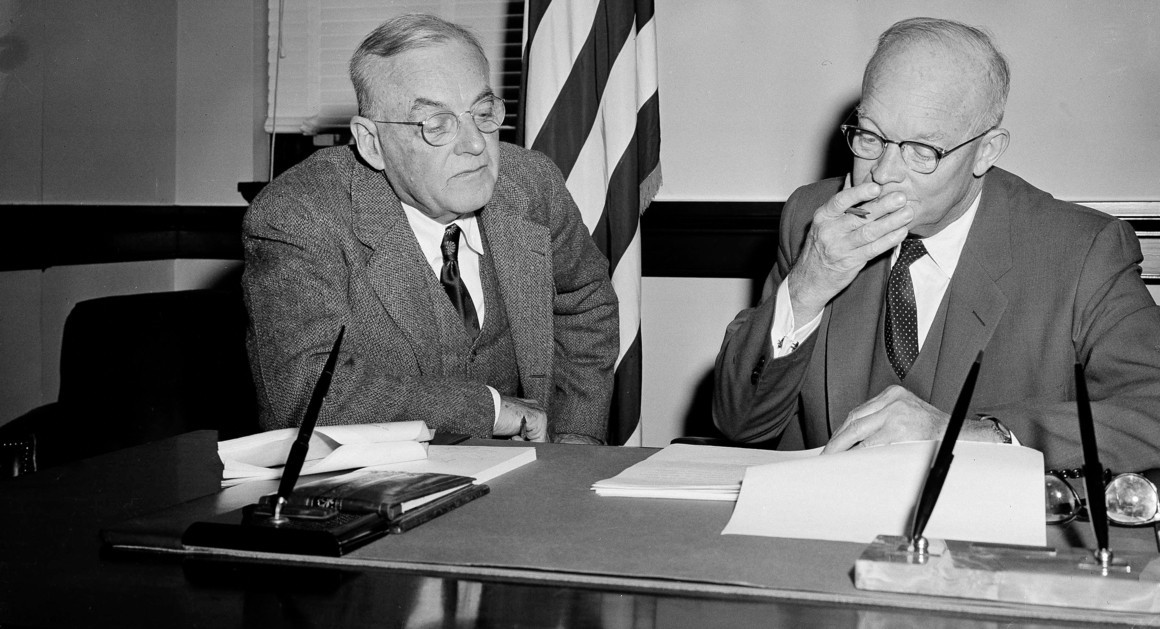
Secretary of State John Foster Dulles and President Dwight Eisenhower (1890-1969; US president 1953-1961), November 1955.

Even then, it was hardly a new notion of geopolitics and, as a strategy, doubtlessly as old as conflict itself and with some history in US political discourse, John Quincy Adams (1767-1848: US President 1825-1829) having adopted the imagery of “…the brink of war” as early as 1829.  Brinkmanship however was applied to, rather than invented by Dulles.  It was the creation of President Eisenhower’s Democratic Party opponent in the 1952 & 1956 elections, Adlai Stevenson (1900-1965), who gave an interview some weeks after Dulles in which he disparaged the secretary of state for "boasting of his brinkmanship, the art of bringing us to the edge of the nuclear abyss."  Stephenson was borrowing from the then quite novel "-manship" words which had entered the vernacular and the word quickly caught on, the Cuban Missile Crisis (October, 1962) often used as an exemplar of the policy in action although the revelations which later emerged about what actually transpired during those dramatic October days showed there were many more complexities at play.

Beyond the brink:  Foster Dulles' headstone, Arlington National Cemetery, Arlington, Virginia.

Born shortly after Stephenson’s interview was brinkmanship's illegitimate sister, the wholly unetymological brinksmanship, the added -s- a construction based on the earlier salesmanship, sportsmanship etc.  Invention of the facetious –manship formations is often attributed to the humorist Stephen Potter (1900-1969) who in 1947 published The Theory and Practice of Gamesmanship (or the Art of Winning Games without Actually Cheating) and in subsequent years added golfmanship and one-upmanship to his informal lexicon.  Gamesmanship had however been used and discussed by Ian Coster (1903-1955) in his autobiographic Friends in Aspic (1939) and he attributed it to the poet Sir Francis Meynell (1891-1975).  Coster used an amateur village cricket team to illustrate gamesmanship.  Because such teams typically contained only two or three competent fieldsmen, advantage could be gained by ensuring all were wearing identical clothing and, especially, headgear, thereby making it harder for the batsman to tell whether his shot was heading towards a good fieldsman or a dud.

Lindsay Lohan on the brink of a wardrobe malfunction, Miami, Florida, May 2011.

In the public imagination, brinkmanship remains still the enduring encapsulation of the High Cold War and the Cuban Missile Crisis in particular, the events in the Caribbean summed up in the words of Dean Rusk (1909–1994; US secretary of state 1961-1969): “We're eyeball to eyeball, and I think the other fellow just blinked.”  That narrative at the time suited the White House (and the phalanx of Kennedy family hagiographers who shaped the truths & myths of Camelot) and the various parts of the nuclear weapons establishment (a diverse crew including the Air Force, the navy, the Pentagon and the Defense Department, all with their own policy agendas to push) forged the influential idea of “calibrated brinkmanship”, an extension of the original position attributed to Dulles modified by the notion that it’s the superiority of one’s nuclear arsenal and a perception of willingness to use it which will allow one to prevail in a crisis.  It would be years before it would be revealed the crisis of 1962 unfolded rather differently but by then, the perception had done its damage.