Monday, August 3, 2020

Nexus

Nexus (pronounced nek-suhs)

(1) A means of connection, tie or link; a form or state of connection.

(2) A connected series or group (objects or concepts); a network or web.

(3) The core or center or a matter, discussion or situation.

(4) In cellular biology, a specialized area of the cell membrane involved in intercellular communication and adhesion.

(5) In digital anthropology, the world’s first web browser.

(6) In law in many North American jurisdictions, the relationship between a vendor and a jurisdiction taxation purposes.

(7) In formal grammar, a technical term in the work of Danish linguist Otto Jespersen (1860–1943) describing a group of words expressing two concepts in one unit (such as a clause or sentence).

(8) In the civil law of Ancient Rome, a person who had contracted a nexum (obligation) such that, if they failed to re-pay that obliged, a creditor could compel them to work as a servant until the debt was paid; an indentured servant.

1655-1665: From the Latin nexus (the act of binding together; bond), the perfect passive participle of nectō (bind) and past participle of nectere (to bind).  Nectō was from the primitive Indo-European gned & gnod (to bind) and was cognate with nōdus (knot), the Ancient Greek γνάθος (gnáthos) (a jaw), the Avestan naska (bundle), the Old Irish nascim (to bind), the Old Norse knútr (from which German gained knude, Norwegian knute, and Icelandic hnútur).  Related were the Old English cnotta (which survives in Modern English as knot), the Old English cnyttan (which in Modern English is knit), the Old High German knotto (knoten in modern German) and the Middle Dutch cnudde (the Modern Dutch knot).  The suffix created the Latin verb of action.  Nexus is a noun; the noun plural is nexuses, nexusses or (the very rare) nexus although the Latin plural form (written nexūs or nexûs) is used in process philosophy, a highly technical branch of the discipline which administers the school of thought that change (ie alterations in the state of relationship(s) between things) constitute the only experience of life (the alternative schools focused on the process of change being understood as inadvertent or illusory).

Australia's defeated 1967 nexus referendum

Section 24 of the Australian Constitution provides for a numerical nexus between the House of Representatives (lower house) and the Senate (upper house):

The House of Representatives shall be composed of members directly chosen by the people of the Commonwealth, and the number of such members shall be, as nearly as practicable, twice the number of the senators.

The senate chamber in the new parliament house, opened in 1988.  The scope of works given to the architects required that both chambers should be able (without major structural change) to be re-configured to accommodate up to twice the number of members.  The building is said to have an anticipated life of some two-hundred years so it would appear in the 1970s, nobody expected there was for centuries any possibility of breaking the nexus between the houses.  Despite the ominous prospect, Australians seem rarely to think the quantity of politicians is lacking although they are often sceptical about the quality.  

Lindsay Lohan in Nexxus Style Swap hair campaign, October 2024.

After an abortive attempt in 1966, a referendum was held the following year which sought to remove the nexus, thereby freezing the number of senators at ten per state (an increase from the original six triggered by the enlargement of the lower house in 1949).  The cabinet’s enthusiasm for curbing any proliferation of senators was prompted by concern an increase in the size of the upper house would make it easier for minor parties to win seats.  The referendum was defeated and the problem persists.  As the number of senators to be elected increases, the votes each needed to gain a seat (a quota) reduces and by the 1980s, a quota in a normal half-senate election was well under 20%; in a double-dissolution, less than 8%.  That, when combined with preferential voting, means votes surplus to a quota flow through the system and it’s become successively easier to succeed, a few senators having been elected with but a handful of first-preference votes.  Section 24 is not monocausal, there being many reasons for the decline in the share of the vote enjoyed by the major parties but the recent success of micro-parties would not have been possible without the operation of the clause.  For a generation, political excrement like the Democratic Labor Party (the DLP, a right-wing, predominately Roman Catholic breakaway from the Australian Labor Party (ALP)) was helped by the lower quotas demanded in a senate of sixty rather than thirty-six.  The modern senate of seventy-six is democratically more promiscuous still.

Lindsay Lohan in a lilac dress, desktop wallpaper available from Desktop Nexus.

In Australia, as in all modern Westminster systems, the major parties alternate in their roles as "His Majesty's Government" and "His Majesty's loyal opposition" but they are as one in their attempt to keep others out of the cozy little system they've designed for themselves and, ahead of the 2016 election, changes were implemented to stop preference arrangements between minor parties and independents producing results said to be "a distortion of the electoral process" (ie independents and those from minor parties being elected to seats the majors regarded as "belonging to them").  Further to advantage the majors, a form of optional preferential voting was introduced, said to have been done to assist voters but the most obvious beneficiaries were the major parties because it became harder for independents or minor party candidates to be elected to the Senate.

Sunday, August 2, 2020

Phlogiston

Phlogiston (pronounced floh-jis-ton or floh-jis-tuhn)

In chemistry, a hypothetical colorless, odorless, weightless substance once believed to be the combustible part of all flammable substances and given off as flame during burning; sometimes styled poetically as the “fiery principle”.

1610-1620: From the New Latin phlogiston, from the Ancient Greek φλογιστόν (phlogistón), neuter of φλογιστός (phlogistós), (burnt up, inflammable), from φλογίζω (phlogízō), (to set fire to), from φλόξ (phlóx) (flame).  The most familiar Greek forms were phlogizein (to set alight) and phlegein (to burn).  Root was the primitive Indo-European bhel (to shine, flash, burn (also “shining white)).  Bhel proved most productive, used especially when forming words for bright colors and was part of beluga; Beltane; black; blancmange; blanch; blank; blanket; blaze (as in "bright flame, fire)" bleach; bleak; blemish; blench; blende; blend; blind; blindfold; blitzkrieg; blond; blue; blush; conflagration; deflagration; effulgence; effulgent; flagrant; flambe; flambeau; flamboyant; flame; flamingo; flammable; Flavian; Flavius; fulgent; fulminate; inflame; inflammable; phlegm; phlegmatic; phlogiston; phlox; purblind; refulgent & riboflavin.  As well as the Ancient Greek phlegein (to burn), the word was apparently related to the Sanskrit bhrajate (shines), the Latin flamma (flame), fulmen (lightning), fulgere (to shine, flash) & flagrare (to burn, blaze, glow), the Old Church Slavonic belu (white) and the Lithuanian balnas (pale).  The related forms were phlogistic, phlogisticating, phlogistication & phlogisticated and the scientific necessity of the age also demanded the creation of the verb dephlogisticate (deprive of phlogiston), thus also dephlogisticated, dephlogisticating & dephlogistication.

Alchemy & Chemistry

As the surgeons emerged from the barber’s shop the chemists were once alchemists.  Chemistry began as alchemy, once a respectable branch of learning concerned, inter alia, with the study and purification of materials, the dubious reputation it now suffers because of the fixation in popular culture on its work in developing the chemical process chrysopoeia, the transmutation of “base metals” such as lead into "noble metals", especially gold.  That particular notion of molecular re-arrangement proved a cul-de-sac but some of the laboratory techniques and experimental models developed in medieval alchemy remain in use today.

One pioneer of modern chemistry was German chemist & physician Georg Stahl (1660–1734) who devoted much attention to the fundamental nature of combustion: What happens when stuff burns?  Developing an idea first proposed in 1667 by German physician & alchemist Joachim Becher (1635–1682), in 1702, Stahl proposed that all inflammable objects contained a material substance he called “phlogiston”, from the Greek word meaning “to set on fire”.  When something burned, it liberated its content of phlogiston into the air and Stahl believed it to be chemically inert.  Stahl’s phlogiston theory would dominate scientific thinking for a century.

Phlogiston theory for a while survived even the odd inconvenient truth.  When experiments revealed that burning (oxidizing) a piece of metal resulted in it weighing more rather than less (contrary to phlogiston theory which suggested it would be lighter by the weight of the evacuated phlogiston), the inconsistency was resolved by postulating that phlogiston was either (1) an immaterial principle rather than a material substance (2), phlogiston had a negative weight or (3), phlogiston was lighter than air.  So much did the theory become scientific orthodoxy that when chemists isolated hydrogen, it was celebrated as pure phlogiston.

The execution of Lavoisier, woodcut by unknown artist.  Antoine-Laurent de Lavoisier (1743-1794) was a nobleman and a tax collector, neither quality likely much to appeal to the mob which prevailed after the French Revolution.  In 1794 he and twenty-seven other tax-farmers were executed by guillotine in Paris at the Place de la Révolution (now the Place de la Concorde).  A fellow scientist at the time lamented: "It took them only an instant to cut off that head, and one hundred years might not be sufficient to produce another like it.”

It would be decades before those with doubts, and there were a few, systemized their objections into an alternative theory.  In 1775, French chemist Antoine-Laurent de Lavoisier delivered a paper he called Memoir on the nature of the principle which combines with metals during their calcination [oxidation] and which increases their weight to a meeting of the French Royal Academy of Sciences.  Subsequently it was published in 1778.  Lavoisier named the combustible part of air principe oxigine (acidifying principle) from the Ancient Greek, the construct being ξύς (oxús) (sharp) + γένος (génos) (birth), referring to his erroneous belief that oxygen was a vital component of all acids, this his choice of “acid producing”.  The French adopted the variant principe oxygène and in English it became oxygen.  The fraction of air that does not support combustion he called azote, (no life) from the Ancient Greek, the construct being - (a-) (without) + ζωή () (life), the idea being the substance was incapable of sustaining life.  Azote is now called “nitrogen”, from the French nitrogène, the construct being the nitro- (from the Ancient Greek νίτρον (nítron) (sodium carbonate) + the French gène (producing).  From this paper, which eventually laid to rest phlogiston theory, emerged the foundations for the understanding of chemical reactions as combinations of elements which form new materials; the birth of modern chemistry.  Lavoisier’s model was convincingly elegant but there were those in the scientific establishment with reputations vested in phlogiston theory and some would prove recalcitrant.  Even when the existence of oxygen and nitrogen had become widely accepted, some remained so inculcated they felt compelled to integrate the old with the new, oxygen and nitrogen a filter with which to view phlogiston; a construction of reality which in the post-Trumpian world would be called “alternative facts”. 

Most famous was the eminent English chemist Joseph Priestley (1733-1804) who, even after personally identifying oxygen and well after Lavoisier's paper had persuaded nearly all others, insisted oxygen was but “dephlogisticated air” and in his 1796 paper Considerations on the doctrine of phlogiston and the decomposition of water, he labeled Lavoisier's devotees as “Antiphlogistians”, objecting to the idea of some “theory so new” and based on “so very narrow and precarious a foundation” suddenly overturning “the best established chemistry”.  Two centuries later, a similarly doomed rearguard action would be fought by the “steady-staters” against the big-bang theory explaining the origins of the universe.  Until his dying day, Priestley never accepted the invalidation of phlogiston theory but the increasingly complicated modifications he, and a dwindling few others, bolted-on to make it conform with the undeniable implications of Lavoisier’s model were unconvincing and by the turn of the nineteenth century, phlogiston’s days were over.

Saturday, August 1, 2020

Alternate & Alternative

Alternate (pronounced awl-ter-neyt, or al-ter-neyt (adjective) or awl-ter-nit (noun).

(1) Repeatedly and regularly to interchange with one another in time or place; rotate (usually followed by with).

(2) To change back and forth between conditions, states, actions etc.

(3) To perform or do in succession or one after another.

(4) Being in a constant state of succession or rotation; interchanged repeatedly one for another.

(5) Reciprocal; mutual.

(6) Constituting an alternative (a historic sense in English, revived in US use (and not without controversy).

(7) In botany, placed singly at different heights on the axis, on each side in succession, or at definite angular distances from one another, as leaves; opposite to the intervals between other organs (petals alternate with sepals).

(8) In electric current, voltage etc, to reverse direction or sign at regular intervals, usually sinusoidally ((having the shape or characteristics of a sine wave)), the instantaneous value varying continuously.

(9) In mathematics, designating the members in a series, which regularly intervene between the members of another series, as the odd or even numbers of the numerals; every other; every second (eg 2, 4, 6, 8).

1505-1515: From the Latin alternō (take turns), from alternus (one after another, by turns), the construct being alter (other) + -rnus (a suffix forming adjective from the earlier -r̥inos from -(o)sinos, from -nus or from some -r- or -s- stem + -nus; metanalysis of this suffix led to its free use).  In classical Latin, alternātus was the past participle of alternāre.  Derived forms are the adverbs alternately & alternatingly, the noun alternateness and the adjective nonalternating.

Alternative (pronounced awl-tur-nuh-tiv, al-tur-nuh-tiv)

(1) A choice limited to one of two or more possibilities, as of things, propositions, or courses of action, the selection of which precludes any other possibility.

(2) One of the things, propositions, or courses of action that can be chosen.

(3) A possible or remaining course or choice.

(4) Affording a choice of two or more things, propositions, or courses of action (of two things, propositions, or courses) mutually exclusive so that if one is chosen the other must be rejected.

(5) Employing or following non-traditional or unconventional ideas, methods etc.; existing outside the establishment.

(6) In logic (of a proposition) asserting two or more choices, at least one of which is true.

1580–1590: The construct was alternat(e) + -ive (an adjective suffix signifying relating or belonging to).  The –ive suffix is from the Anglo-Norman -if (feminine -ive), from Latin -ivus. Until the fourteenth century all Middle English loanwords from Anglo-Norman ended in -if (compare actif, natif, sensitif, pensif etc) and, under the influence of literary Neolatin, both languages introduced the form -ive.  Those forms not yet replaced were subsequently changed to end in -y (compare hasty, from hastif, jolly, from jolif etc.).  Like the Latin suffix -io (genitive -ionis), Latin suffix -ivus is appended to the perfect passive participle to form an adjective of action.  Alternative was from the Middle French alternatif, from the Medieval Latin alternātīvus (alternating), from the participle stem of Latin alternō (interchange, alternate). Derived forms are the adverb alternatively, the nouns alternativeness & alternativity, the adjective quasi-alternative and the adverb quasi-alternatively.

Alternative Facts

The phrase “alternative facts” aroused interest when used in 2017 by Donald Trump’s (b 1946; US president 2017-2021) campaign strategist and counselor, Kellyanne Conway (b 1967; senior counselor to the president, 2017-2020).  Ms Conway used the words during a Meet the Press interview to describe the use of statistics quoted by Sean Spicer (b 1971; White House Press Secretary & Communications Director, 2017), numbers which, prima facie, seemed dubious.  The matter about which Spicer spoke was not a great affair of church or state; it was squabble about which president attracted the greater live audience to his inauguration, Barack Obama (b 1961; US president 2009-2017) in 2009 or Donald Trump in 2017.  All available evidence appeared to suggest Obama’s numbers were up to twice those of Trump and if Spicer hadn’t brought it up probably nobody else would have mentioned it but for Trump, who borrowed for his campaign so many of the techniques he’d learned from his career in reality television, viewer numbers were professional life and death.

Kellyanne Conway in hoodie: Miss January, Clare Boothe Luce Policy Institute's annual Conservative Women Calendar (2009).

Ms Conway sought later to clarify “alternative facts” by defining the phrase as "additional facts and alternative information" which, when deconstructed, probably did add a layer of nuance but really didn’t help.  Journalists, not a crew always entirely truthful, decided to help and called the phrase "Orwellian", provoking a spike on the search engines as folk sought out "doublethink" and "newspeak"; sales of George Orwell’s (1903–1950) Nineteen Eighty-Four (1949) said overnight to have risen several-dozen fold.  The relationship between the press and the Trump White House was never likely to be friendly but “alternative facts” meant things started badly almost from day one.  Noting journalists rarely seemed to show great energy in pursuing crooked Hillary Clinton’s evasiveness and casual relationship with truthfulness, the administration felt unfairly picked-upon.  Journalists thought “alternatives facts” was just too blatant, beyond spin and actually an expression of contempt; they knew politicians were going to lie but the lack of subtlety was just insulting.  Both sides made good cases.

Watching with amused detachment were those with as little trust in what was being reported as in those being reported.  Some observed that “alternative facts” in political discourse was little different from the arguments offered in court by prosecution and defense; law was a matter for the judge but questions of fact were for the jury and for centuries juries had been choosing between alternative facts.  This was not novel and in an era where the conduct of politics was as adversarial as what’s done in any courtroom, nor did it seem difficult.  It’s never been certain just who first said “the truth is so precious it deserves an escort of lies” but it sits well with many.

The difference

Sometimes expressed is the view that in the days before linguistic promiscuity overtook the land, "alternate" and "alternative" enjoyed quite distinct meanings.  If two things were described as alternate, it meant one came after another in a repetitive pattern; if red switches to black, then red, then black etc, red & black are said to be alternating.  If one has the choice between red & black, the two colors are alternatives.  If one declines coffee, one might be offered tea as an alternative. Thus alternate is where one comes after another and alternative is where one is the option opposed to the other.  That is for many the preferred position but in the sixteenth century the alternative did enjoy the sense pendants insist belongs properly only to alternate so there's history but in English, citing precedents from the sixteenth century to support the revival of some archaic use rarely impresses and the blurring of any distinction is just how the language evolves.  In the US alternate & alternative seem now widely accepted as synonyms and while that's perhaps unfortunate, confusion will presumably be rare because the meaning will usually be clear from the context in which the words appear.

The battle may be lost: The international reach of US English means alternate & alternative may in decades to come be universally regarded as synonyms.  

Beyond US shores, the process has already begun.  Both belong to a class of words which sound similar and have a not-unrelated meaning (like enormous and enormity) and the trend towards interchangeability in use appears usually to favor that which is phonetically preferred so alternate is more often heard.  It’s common now in much of the English-speaking world to hear an opposition leader described as the alternate rather than alternative prime minister, something which should be said only when describing alternating premierships such as those of Gladstone and Disraeli.  Where alternate & alternative went in the US the world may be destined to follow: the Oxford English Dictionary (OED) definitely blames the Americans but they would say that wouldn't they?

Alternating prime-ministers, each an alternative.  William Ewart Gladstone (1809–1898; prime-minister 1868–1874, 1880–1885, Feb-July 1886 & 1892–1894) (left) and Benjamin Disraeli (1804-1881, later First Earl of Beaconsfield; prime-minister Feb-Dec 1868 & 1874-1880) (right).

Friday, July 31, 2020

Restaurant

Restaurant (pronounced res-ter-uhnt (non-U), res-tuh-rahnt (non-U) or res-trahnt (U))

A commercial establishment where meals are prepared and served to customers.

1821: An invention of American English from the French restaurant, originally "food that restores", noun use of present participle of the verb restaurer (to restore or refresh) from the Old French restorer.  The French verb restaurer corresponded to the Latin restaurans & restaurantis, present participle of restauro (I restore), (the more familiar form in Latin being restaurāre (to restore)) from the name of the “restorative soup” served in the first establishments.  The term restaurant to describe the “restorative soup” was defined in 1507 as a "restorative beverage" and in correspondence in 1521 to mean "that which restores the strength, a fortifying food or remedy".  One who runs a restaurant is called a restaurateur; the Italian spelling ristorante was attested in English by 1925.

Modern capitalism has a proliferation of terms to describe variations of the restaurant, some ancient, some recent creations; they include bar, diner, joint, inn, outlet, saloon, cafeteria, grill, hideaway, dive, canteen, lunchroom, chophouse, eatery, pizzeria, drive-in and luncheonette.  The restaurant, in the sense now understood as a place where the public come to sit at tables and chairs and order food from a menu and are served their choices by a waiter is relatively new in culinary history, not emerging until the late eighteenth century.

One interesting (and specific) use of restaurant is to refer to hospitals.  Those who essentially starve themselves for professional reasons (models, ballerinas and others), not infrequently faint, officially "from exhaustion" but actually from their malnourished state.  Sometimes this means they get to go to "the restaurant" (hospital) where as well as relaxing, they can enjoy iv fluids and thus gain the necessary nutrition without having to eat a thing.

Origins

Lindsay Lohan in leather, arriving at Bobby Flay’s New York restaurant Gato, 2014.

Although all or some of the “official” history may be apocryphal, the story is that in 1765, a Monsieur Boulanger, (also known as Champ d'Oiseaux or Chantoiseau) opened his shop in Paris near the Louvre on either the rue des Poulies or the rue Bailleul (the history is unclear).  There he sold restaurants (or bouillons restaurants), meat-based consommés which gained their name from their intended purpose to "restore" a person's strength.  The word restaurants, rich, thick broths or soups, had since medieval times been used to describe any of a variety of rich bouillons made with chicken, beef, roots, onions, herbs, and depending on the region and season, spices, sugar, toasted bread, barley, butter, and even exotic ingredients such as dried rose petals, Damascus grapes, and amber.  Monsieur Boulanger’s bouillons proved popular but he also had a flair for advertising, placing in his window a sign saying: Venite ad me omnes qui stomacho laboratis et ego vos restaurabo (Come to me all who suffer from pain of the stomach and I will restore you.), the play on words an allusion to both the restorative quality of his broths and, from scripture, Jesus' invitation found in Matthew 11:28: "Come to me, all who labor and are heavy laden, and I will give you rest."

Seeking to expand his customer base and increase revenue, he began serving roasted leg of lamb with white sauce, thereby infringing the monopoly of the caterers' guild.  While there had long been places where customers could be served a variety of food, Monsieur Boulanger’s establishment was the first where there was a formal, printed menu, a concept previously a preserve of the guild.  The guild filed suit, and to the surprise of the Parisian legal and culinary establishments, the courts ruled in favor of Boulanger and the restaurant (établissement de restaurateur), in its modern form, emerged from this decision.  Historians usually suggest the first “real restaurant" (in the modern understanding of the word) was La Grande Taverne de Londres in Paris, founded by Antoine Beauvilliers (1754-1817) in either 1782 or 1786, combing as it did the “four essentials” of fine dining: (1) an elegant room, (2) gourmet cooking, (3) a fine cellar and (4) professional waiters.

Epicure, Le Bristol Paris, 112 Rue du Faubourg Saint-Honoré, 75008 Paris, France.

Thursday, July 30, 2020

Turkey

Turkey (pronounced tur-kee)

(1) A large, gallinaceous bird of the family Meleagrididae, especially Meleagris gallopavo, of America, typically of green, reddish-brown, and yellowish-brown plumage of a metallic luster; domesticated in most parts of the world.

(2) The flesh of this bird, used as food.

(3) Any of a number of other similar birds, so described.

(4) As Turkey, the former name of Türkiye Cumhuriyeti (Republic of Türkiye).

(5) In slang, a person or thing of little appeal; dud; loser; a naive, stupid, or inept person.

(6) In the slang of the theatre, an unsuccessful production; a flop (a synonym of “a bomb” in some countries, an antonym in others); now used beyond the theatre and applied to just about any failed product including political candidates or policies.

(7) In ten-pin bowling, three strikes in succession.

(8) In the (derogatory) slang of clinical medicine, a patient feigning symptoms, illness or injury; a malingerer.

(9) In rural slang (US & Australia), a pack carried by a lumberman; a bindle; also, a large travel bag, a suitcase (archaic).

1545–1555: A short for Turkey cock and Turkey hen (“cock of Turkey” & “hen of Turkey”), applied firstly to guinea fowl (apparently because the bird was brought through Turkish territory) and later (erroneously) to the American bird.  The noun plural is turkeys by depending on context, turkey can be a plural.  The erroneous “turkies” & “turkies” does occasionally appear because of a belief all nouns ending in "y" should form a plural ending in "ies". When a noun ends with [vowel] + y, only an appended "s" is needed to form the plural.
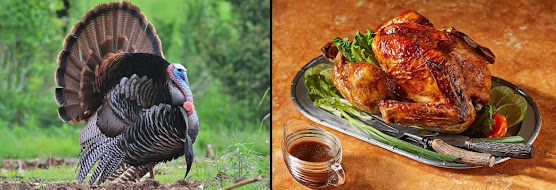
Tararind and honey-glazed roast turkey, before & after.

The clipping of turkey-cock (male) and turkey-hen (female) applied originally to the guinea fowl (Numida meleagris) which was brought to Europe (via Turkey) from Madagascar by Portuguese traders who really were called “turkey merchants”.  In English, the word turkey was first applied to the bird in the 1550s, either because it was identified with or treated as a species of the guinea fowl or because reached wider Europe from Spain by way of North Africa, then under Ottoman (Turkish) rule.  For the same reason, in English, Indian corn was originally “turkey corn” or “turkey wheat”.  The word was subsequently applied to the larger northern American fowl (Meleagris gallopavo) which conquistadors had brought to Spain in 1523 after finding the species had been domesticated by the Aztecs.  The adoption of the name (initially as “wild Turkey”), documented in North American records since 1607, wasn’t until later recognized as a taxonomical error and it’s thought it happened simply because the of the visual similarity between the birds.  There was once speculation that it may have been something more considered, either because the North American turkey was in part introduced through Ottoman territories or else to indicate it was foreign; these theories are now little supported.  It’s a strange linguistic soup because in Turkish the name is hindi (literally "Indian") a use probably influenced by early seventeenth century French dinde (contracted from poulet d'inde (literally "chicken from India", which endures in Modern French as dindon), based on the then-common misconception that the New World (the Americas) was eastern Asia (hence “Red Indians”, “West Indies” etc).  The bird from the Americas may have appeared in England as early as 1524 but documentary evidence confirms its presence in 1534.  Large, tasty, easily fattened and well adapted to the climate, turkey by the late sixteenth century had become the standard fare at an English Christmas dinner.

In an example of the way mistakes in science can linger as orthodoxy if vested with sufficient academic respectability, even after the different biology of the two birds were distinguished and the names differentiated, turkey was erroneously retained for the American bird, instead of the African.  From this confusion, Melagris, the ancient name of the African fowl, was listed as the generic name of the American bird by Carl Linnaeus (1707–1778), the Swedish physician who defined the modern system of taxonomy which applies a binomial nomenclature to botanical and zoological organisms.

Leslie Grace (b 1995) as Batgirl.

In August 2022, it was announced the release of the film Batgirl, commissioned for Warner Bros’ streaming platform HBO Max, had been cancelled.  Although never intended to show in cinemas, such was the negative feedback from test audiences it was sent to editing experts who are said to have declared it irredeemable, the turkey consigned to the Warner Bros vault.  Said to involve the write-off of what sounds a rather inflated US$90 million, cynics immediated speculated Warner Bros' accountants might have calculated the guaranteed profit offered by a tax off-set a more lucrative business model than a release on any platform.  In earlier times the odd turkey did eventually end up a cult-favorite on VCR or DVD but there's no prediction how long it'll take Batgirl to leak out.  In idiomatic use, the sense of “a turkey” meaning "inferior show, a failure" is show business slang dating from 1927, presumably because of the bird's reputation for stupidity, this meaning soon extended to just about any failed product including political candidates or policies.  In this sense, there’s also the slang meaning "stupid, ineffectual person" but surprisingly, there’s no record of use prior to 1951.

Grumman F6F Hellcat.

A turkey shoot was "something easy", slang which is listed as being of World War II-era but most seem to agree it had likely been in oral use much earlier, especially south of the Mason-Dixon Line.  The reference was to (presumably mostly informal) contests of marksmanship in which turkeys were tied behind a log, only their moving heads visible as targets; it sounds barbaric now but it was a different time and to the bird, the experience may have been little different from any other method of dispatch.  The sudden popularity of “turkey shoot” during the war was probably associated with the events in the Battle of the Philippine Sea (19-20 June 1944), the last of the conflict’s big, set-piece carrier battles and the engagement which ended the capacity of the Imperial Japanese Navy strategically to deploy carrier groups.  US Naval aviators described the air battles as “the Great Marianas Turkey Shoot” because of the disproportional loss ratio inflicted upon the Japanese and the ease with which their aircraft could be downed.  The air engagement was a classic example of the approach of the US military: Problems are not merely to be solved but overwhelmed.  It was also a example of how superior technology will tend to prevail, the combination of proximity fuses which meant American gunnery didn’t need to be especially accurate when trained on Japanese aircraft still mostly without self-sealing fuel tanks as decisive a difference as earlier advantages in hardware had been for the British in the Sudan or the Italians in Ethiopia.  To “talk turkey” dates from 1824 and, according to folklore, comes from the tale of a Yankee attempting to swindle a Native American (then called a Red Indian) in dividing a turkey and buzzard as food.

Cold turkey refers both to (1) a sudden and complete withdrawal from a dependent substance (especially narcotics) and (2) the physiological effects of such a withdrawal.  The origin of the term is murky and may date from a number of nineteenth century references to unwelcome guests being served literally cold slices of turkey at Christmas rather than the more pleasing hot, dressed dish.  In that sense it came to refer both to suffering and social ostracization, the meaning in the sense of term and the term "withdrawal from an addictive substance" (originally of heroin) dating from 1921, probably based on the idea of a meal of cold turkey being something served with little preparation.

Lindsay Lohan with president of Türkiye  (formerly Turkey) Recep Tayyip Erdoğan, his wife Emine and Syrian internally displaced person (IDP) Bana Alabed (b 2009), Ankara, January 2017.

The country formerly known as the Republic of Turkey straddles West Asia and South East Europe, the Bosporus (on the banks of which sits Istanbul (formerly known as Constantinople)), an ancient gateway between the two continents.  The Ottoman Empire emerged in Anatolia (the western portion of Asian Turkey) during the thirteenth century, surviving until 1918.  During the sixteenth century, the empire stretched from the Persian Gulf to western Algeria and included most of southeastern Europe, leaving an architectural heritage visible to this day.  Modern Turkey was created in 1923 as a secular state.  The English name of Turkey is ultimately from the Medieval Latin Turchia & Turquia (land of the Turks)but it wasn’t until as recently as the early eighteenth century that the spelling “Turkey” began to be standardized.  In the Middle English the spellings included Turkye, Torke, Turkie & Turky and those who complain about the lack of proof-reading and editing in modern documents should note that it was not unusual for more than one form to appear in the same short text.  The most common form in the Middle English was Turkye, from the Anglo-Norman Turkye, from the Medieval Latin Turcia, from Turcus (usually translated as “Turk” and of unknown origin but many suggest and original meaning of “strength”), from the Byzantine Greek Τορκος (Toûrkos), from the Persian ترک‎ (Turk), from the Middle Persian twlk' (Turk), from the Old Turkic.  The original meaning of the Persian Turk is also uncertain and may have varied with context, various documents suggesting it could be used to mean “warrior”, “beautiful youth”, “barbarian” or “robber” and how wide a net that casts may depend on one's opinion of males aged 17-25.
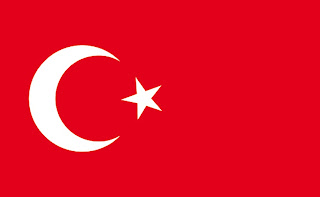
National flag of Türkiye Cumhuriyeti.

In May 2022, the office of the Secretary-General of the United Nations announced the Republic of Turkey had changed its name to Türkiye Cumhuriyeti (Republic of Türkiye).  Whether the authorities in Ankara were much concerned about sharing a name with the large gallinaceous bird native or the colloquial use to describe dud movies or stupid and inept people isn’t clear but certainly, they were no longer happy about an anglicized version of the name being used around the world.  In a press release, President Recep Tayyip Erdoğan (b 1954; prime minister of Turkey 2003-2014, president since 2014) stated “Türkiye is accepted as an umbrella brand for our country in national and international venues...” and the name “…is the best representation and expression of the Turkish people’s culture, civilization, and values.”  Effectively a national re-branding, the change will be reflected in the label “Made in Türkiye” appearing on manufactured goods and adjustments have been made to institutional names such as the nation carrier which would henceforth operate internationally under the name Türk Hava Yolları (Turkish Airlines).

Recent changes of name

2019: The Republic of Macedonia changed to Republic of North Macedonia to resolve some regional disputes.  For a time, because of earlier disputes, it had been known as the Former Yugoslav Republic of Macedonia which was usually written as FYROM (pronounced fire-rom). 

2018: The Kingdom of Swaziland became the Kingdom of Eswatini.

2016: Czechia introduced as country name although Czech Republic remains the state title.

2014: Republic of Cape Verde became Republic of Capo Verde.

2013: The Democratic Republic of Somalia became the Federal Republic of Somalia.

2011: The Great Socialist People’s Libyan Arab Jamahiriya became simply Libya.

2010: The Union of Myanmar became the Republic of the Union of Myanmar although the SLORC at the time issued some contriductory statements and Burma is still widely used.

2009: The Republic of Bolivia became the Plurinational State of Bolivia.

1997: Zaire became the Democratic Republic of Congo (DRC).

1990-1992: New country names were gazetted consequent upon the breakup of Yugoslavia: Bosnia and Herzegovina, Republic of Croatia, Republic of Macedonia, Serbia and Montenegro & Republic of Slovenia

1990-91: New country names were gazetted consequent on the dissolution of the Union of Soviet Socialist Republics (USSR): Republic of Armenia, Republic of Azerbaijan, Republic of Belarus (initially Belorussia, but adopted Belarus in 1992), Republic of Estonia, Georgia, Republic of Kazakhstan, Kyrgyz Republic, Republic of Latvia, Republic of Lithuania, Republic of Moldova (initially Moldavia, but adopted Moldova in 1992), Russian Federation, Republic of Tajikistan, Turkmenistan, Ukraine, Republic of Uzbekistan.

1990: People’s Republic of Benin became Republic of Benin.

1990: Unification of Germany; German Democratic Republic (East Germany, the GDR) absorbed by the Federal Republic of Germany (West Germany, the FRG).

1989: The Union of Burma became the Union of Myanmar, previously Union of Burma.  Confusingly, it appeared the SLORC maintained Burma as the country name for most purposes.

1984: The Republic of Upper Volta became Burkina Faso.

1981: British Honduras became Belize.

1980: Southern Rhodesia became Zimbabwe.

1979:  New Hebrides became the Republic of Vanuatu.

1979: The Imperial State of Iran became the Islamic Republic of Iran.

1972: Ceylon became Sri Lanka.

1971: East Pakistan became Bangladesh; West Pakistan became Pakistan.

1971: Bechuanaland became the Republic of Botswana.

1971: Basutoland became the Kingdom of Lesotho.

1964: Tanganyika and Zanzibar joined to form the United Republic of Tanzania.

1964: Northern Rhodesia became the Republic of Zambia.

1961: Northern Cameroons became part of Nigeria (now Federal Republic of Nigeria) & Southern Cameroons became part of the Federal Republic of Cameroon (now Republic of Cameroon).

1957: The Gold Coast became the Republic of Ghana.

1953: Formation of the Republic of Korea (South Korea, the ROC) and the Democratic People’s Republic of Korea (North Korea, the DPRK).

1949: The Republic of China became the People’s Republic of China (PRC).

1949: Formation of German Democratic Republic (East Germany, the GDR) and the Federal Republic of Germany (West Germany, the FRG).

1949: Transjordan became the Hashemite Kingdom of Jordan.

1947: India became the Republic of India; the Islamic Republic of Pakistan was created (as East Pakistan & West Pakistan).

1939: The Kingdom of Siam becomes the Kingdom of Thailand.

1935: Persia become the Imperial State of Iran.

1929: Vatican City gained independence from Italy as a city-state.

1923: Turkey; Republic of Turkey created after the dissolution of the Ottoman Empire.