Pink (pronounced pingk)
(1) A definition
of perceived color varying between a light crimson to a pale reddish purple
(sometimes described as fuchsia); any of a group of colors with a reddish hue
that are of low to moderate saturation and can usually reflect or transmit a
large amount of light; a pale reddish tint.
(2) Any
of various Old World plants of the caryophyllaceous genus Dianthus, such as D.
plumarius (garden pink), cultivated for their fragrant flowers including the
clove pink or carnation (sometimes referred to as the pink family); the flower
of such a plant; any of various plants of other genera, such as the moss pink.
(3) The
highest or best form, degree, or example of something (expressed usually as “in
the pink” or “the pink of”).
(4) As
the disparaging slang "pinko", either (1) a communist or one so suspected (US) or
(2) a socialist (UK and English-speaking Commonwealth) (both dated).
(5) In
informal use, a document provided in commerce or by government for some purpose
which was historically issued on pink tissue paper (usually a carbon copy), the
term still in some cases enduring for the modern digital analogue.
(6) In
fox hunting as “the pinks”, a coat worn by riders (although actually in a shade
of scarlet).
(7) In
military tailoring, the pinkish-tan gabardine trousers once worn in some
regiments as part of an officer’s dress uniform.
(8) In
the stone trade, the general term for marble of this color.
(9) In informal
use, of or relating to gay people or gay sexual orientation and used sometimes
as a modifier in this context (pink vote, pink dollar, pink
economy etc (many now dated)). The pink
triangle was a literal description of the fabric patch worn on the uniforms of
homosexual inmates in Nazi concentration camps.
(10) In
labour market demography, as pink collar, that part of the workforce or those
job categories predominately female (dated and now rare because it's assumed by many to be a gay slur).
(11) In
commerce, as a modifier, such products as may be discerned as being of this
color (champagne, gin, salmon, diamonds etc).
(12) To
pierce with a rapier or the like; to stab (based on the idea of a pinkish stain
appearing on the clothing of one so stabbed); figuratively, to wound by irony,
criticism, or ridicule.
(13) In
tailoring, to finish fabric at the edge with a scalloped, notched, or other
pattern, as to prevent fraying or for ornament.
(14) To
punch cloth, leather etc with small holes or figures for purposes of ornament; to
adorn or ornament, especially with scalloped edges or a punched-out pattern
(mostly UK use).
(15) As
pink disease (infantile acrodynia), a condition associated with chronic
exposure to mercury.
(16) In
nautical use, a sailing vessel with a narrow overhanging transom (historically
a vessel with a pink stern).
(17) As
pinky or pinkie, the fifth digit (little finger).
(18) In
gardening, to cut with pinking shears.
(19) In
US slang, an operative of the Pinkerton National Detective Agency (archaic but still used as a literary device of detectives generally).
(20) In
the slang of fishing, various fish according region including the common minnow
and immature Atlantic salmon, the origin of all probably the Middle Dutch pincke.
(21) In
snooker, one of the color balls (colored pink), with a value of 6 points and in
use since the nineteenth century.
(22) In
vulgar slang, sometimes as “pink bits”, the vagina or vulva.
(23) In
slang, an unlettered and uncultured, but relatively prosperous, member of the
middle classes (similar to the Australian CUB (cashed-up bogan)) (UK archaic).
(24) In
informal use, having conjunctivitis (ie pinkeye).
(25) To
turn a topaz or other gemstone pink by the application of heat.
(26) In
(spark ignition) ICEs (internal combustion engines), to
emit a high "pinking" noise, usually as a result of ill-set ignition
timing for the fuel used.
(27) Of
a musical instrument, to emit a very high-pitched, short note.
(28) In
color definition, any of various lake pigments or dyes in yellow, yellowish
green, or brown shades made with plant coloring and a metallic oxide base
(obsolete).
(29) As
pinkwashing (al la greenwashing and the figurative use of whitewashing), a fake
or superficial attempt to address issues of gay rights (though often applied to
LGBTQQIAAOP issues in general).
Circa
1200: From the Old
English pungde (to pierce, puncture,
stab with a pointed weapon) which by the early fourteenth century had acquired
the sense of "make holes in; spur a horse" the source uncertain but
perhaps from a nasalized form of the Romanic stem that also yielded French piquer (to prick, pierce) and the Spanish
picar or else from the Old English pyngan (to prick) and directly from its
source, the Latin pungere (to prick,
pierce), from a suffixed form of primitive Indo-European root peug or peuk- (to prick). By circa
1500, it had come to mean "to decorate (a garment, leather) by making
small holes in a regular pattern at the edge or elsewhere" and that sense
endures to this day in pinking shears (although they were not so-named until
1934). The English pinge, pingen, pinken, pung & pungen (to push (a door)), batter, shove; prick, stab, pierce;
punch holes in) was from the Old English pyngan
(to prick) and dates from 1275–1325 and may be from (1) the Latin pungere (to prick, pierce), (2) the Low
German pinken (hit; to peck) & Pinke (big needle) or (3) the Dutch pingelen (to do fine needlework), the
root again the primitive Indo-European peug
(to prick). Pink is a noun, verb & adjective, pinker, pinkest, pinkish and pinky are adjectives and pinkness is a noun

Lustre-Creme
shampoo “Pink is for Girls” advertising posters, 1960s.
Lustre-Crème was emphatic “pink is just for
girls” which was at the time hardly controversial for most although
the claim they produced the “only pink shampoo” might have been ambitious. It might also have seemed a bit adventurous to
suggest there exists a “pink fragrance” but there may be synesthetes who have experiences of smell associated with color and it’s not unknown to have
the sense of the senses shifted (in opera it’s common to speak of a soprano’s
voice “darkening” as she matures) and
Lustre-Crème did note that “…should a certain someone get too close, he'll notice that
we have a delightful ‘pink’ fragrance too.” Covering the market, for the practical young
lady mention was made of the “…unbreakable plastic squeeze bottle with the new Flip 'n
Tip Spout (no more cap-twisting).” A "Flip 'n Tip Spout" is one of those small innovations which made life more civilized.
The "pink is just for girls" equation is however of recent origin. In
the West, until the late nineteenth century, infants tended universally to be
dressed in white because doing the laundry was a more tiresome (and certainly
labor-intensive) task than today, thus the attraction of white fabric which
could be bleached. Until the early
twentieth century, pink tended to be thought a “strong, masculine” color, (apparently
on the basis of being a variant of red) while blue was seen as more delicate
and so suitable for girls; as well as being considered “dainty”, blue had a
strong historic association with the Virgin Mary because of the manner in which
she’d been depicted by generations of artists.
As late as 1927, department stores like Marshall Field routinely would suggest
pink for boys but within a decade the shift clearly had begun because by the
late 1930s the Nazis had (eventually) settled on pink as the color of the
identifying triangle worn by prisoners incarcerated under Paragraph 175 of the
German penal code (which criminalized homosexual activity between men). It was in the US in the post-war era of
plenty that the “blue for boys, pink for girls” thing was established and it was
a product of marketing, the attraction being that with a clear gender divide,
parents would have to buy more clothes.
From there, the idea infected just about every industry, even tool
manufacturers producing lines of pink tool kits for men dutiful to buy as gifts for Wags (wives & girlfriends).

Boys to the left, girls to the right: Toy section, Target, London, observed by commentator Feminist and the City
In
managing experiences and communications, colour often plays a role in imparting
information, creating identities and reinforcing symbolic value. The semiotics of colour is familiar in the
red & blue used on the knobs of hot & cold water taps and the traffic
flows in modern cities depend on road users respecting the red/amber/green
convention of the traffic light, adhered to almost universally despite pieces of colored glass
having no physical power to influence a vehicle’s progress. So, color can work at an emotional,
socio-economic and cultural level. Even
if, to display a corporate commitment avoiding reinforcing gender stereotypes, a department store removes the labels “Girls” and “Boys”
from toy section's signage, the desired message still can be communicated semiotically. Commentator Feminist and the City visited a Target store in London and was impressed at the dominant
colors of the packaging on the shelves in two different aisles. For the casual consumer, the contrast was not
as striking as when assembled in a photo-montage because the shelves were not placed vis-à-vis
but sat back-to-back, thus a trip down two separate aisles was needed to get the
message. The message was: “Pink is for
Girls.”

In the pink: The very
healthy Sydney Sweeney (b 1997) on the cover of Cosmopolitan's “Love Edition”,
January 2026.
In the popular Western imagination,
there’s much association with pink as the “color of love” but the construct is one
of historical development rather than anything biological though despite that, in
respectable science there are threads to explain why the link for so many feels
intuitive. From an evolutionary viewpoint,
pink may have become a signal of warmth and vitality by virtue of the hue in
skin corresponding with the flow of healthy, oxygenated blood. In humans, such an appearance, not
unreasonably, became associated with good health, youth and sexual arousal;
that tended to be empirical but it seems to have had the related cultural
effect of making pink strongly associated with which might be called “emotional
warmth”. The perceptions of pink can
also be contrasted with red: what psychologists call the “red effect” (the manifestation
best known in the used car business as “resale red”) links the color with
qualities such as “power”, “lust” & “dominance” so the speculation is that
pink (technically a “toned-down” or “diluted” red) is suggestive of softness
rather than intensity and affection rather than lust. The emotional valence of pink is thus calming,
gentle, and non-threatening, associated with tenderness, nurturance, romantic
affection rather than base passion (ie genuine love rather than lustful
desire), thus the idea of pink as the “color of love”. Anyone who finds this unconvincing can
research the matter in any shop selling Valentine’s Day cards, the
manufacturers covering all bases: red iconography for those communicating naked
lust, pink for those still at the stage of wishing to appear less threatening.
Applied
semiotics: Content creator Roya Fox explains Sinkkukori.
Finnish supermarket operators have no doubt pink is the color of love. Although on-line dating
(and related) apps have replaced many of the once-traditional ways those
seeking romance (or something more transactional) could meet, two grocery stores
(K-Supermarket & S-Market) in Finland have gone distinctly analogue, relying on nothing more than semiotics. What the
stores have done is to add to their usual black or gray shopping baskets a
stack of the things in pink, labelled Sinkkukori
(literally “single-basket: but understood as “single’s basket”), there to
be chosen by those wishing to advertise their unattached status and openness to flirtatious
approaches in the aisles. So, unusually
in the twenty-first century, there’s no account creation, logging-in, profile
editing or being at the mercy of a black box’s mysterious algorithm. Instead, it’s messaging semiotically: (1) gray
or black = partnered or contentedly not partnered and (2) pink = single and
looking for love and it seems in Scandinavia the concept wasn’t wholly new, those
walking around Norway’s many fjords long observing a “hat color convention” in
which red = taken and green = single. The
concept obviously has its attractions although some have pointed out the
dangers to mental health were some lonely, single emo to for weeks stalk the
aisles flaunting their pink basket containing nothing more than “microwave
meals for one” yet receiving not one approach suggesting courtship. In the modern parlance, the emo would be “devastated”.

Speak (2004) by Lindsay Lohan, pink vinyl edition, 2000 of which were in 2020 pressed for Urban Outfitters.
The
words "pinkie" & “pinky” were from the Dutch pinkje, a diminutive of pink (little finger) and of uncertain origin, the
earliest known used in Scotland in 1808 and common in Scottish English, US English
and elsewhere in the English-speaking world.
The nautical use dates from circa 1450, from the late Middle English pynck & pyncke, from the Middle Dutch pinke
(fishing boat). The flows were so
named in the sixteenth century and surprisingly, the use to describe the color
didn’t emerge until the eighteenth century, perhaps as a shortening of "pinkeye". The
flower family was so named in the 1570s, the common name of Dianthus, a garden
plant actually of various colors. The
family picked up the name “pink” probably because of the idea of the "perforated"
(scalloped) petals (ie “pinked” in the earlier sense) although etymologists did
suggest there might be a link to the Dutch pink
(small, narrow (in the sense of pinkie)), via the term pinck oogen (half-closed eyes (literally "small eyes), borrowed
in the 1570s, the speculative link being the Dianthus sometimes has small
dots resembling eyes. The coincidence in
the dates is interesting but there’s no documentary evidence. It was the example of the flower which, by
the 1590s, led to the figurative use of "pink" for "the flower" or highest type
or example of excellence of anything.

Ed Pink (1931-2025)
at work on a Ford 427 SOHC “Cammer” V8 mounted on his static test-bed; it was
one of the 427 cubic inch (7.0 litre) Cammers which was his last build. His corporate slogan (T-shirts, coffee mugs
etc) was “Think Pink”. Among the builders of the
big engines used in drag racing (an inventive and occasionally crazy crew) Ed
Pink (1931–2025) was a revered figure, hinted at by his nickname: “The Old
Master”; he lived to 94 and remained active almost to the end, torquing-down
the bolts on his last engine at 92. As
well as many V8s for drag-racing, Mr Pink also built engines for many other
fields in motorsport including NASCAR, Can-Am, and IndyCar but it was those
built for the uniquely extreme stresses of ¼ mile runs which most fascinated him. Very much a sport of numbers (time, speed, horsepower),
even a highly tuned big-block V8 which peaks at some 9000 rpm (crankshaft revolutions
per minute) typically will perform only around a thousand of those revolutions
between the start and end of the run but the forces being imposed (in many
directions) on that large, heavy reciprocating mass are such that catastrophic
failures are not uncommon, hence the need for precision in designing, building
and maintaining the things.

Cadillac “targeted”
advertising, gowns for mother and daughter by Jane Derby of New York, 1959 Cadillac Series
62 Convertible, body by Fisher. While long, the 1959 Cadillacs weren't quite this long.
1959 Cadillac Series 62 Convertible in non-original pink.
This (unedited) photograph may be compared with the crafted image (above) as an example of the way advertising agencies often preferred simulacrum to reality, some of the representations in the era having a similar relationship to the physical as promotional photographs of hamburgers have to what's really delivered to customers. With the US cars of the era, the finest practitioners of the era were Art Fitzpatrick (1919–2015) & Van Kaufman (1918-1995) whose best known work was the collection of memorable images for General Motors' (GM) Pontiac Motor Division (PMD) during the 1960s. What the chains do to advertise hamburgers blatantly (though not legally) is deceptive & misleading but the exaggerations in the graphical art used for the cars was less so because the distortions were so obvious and they were more in the tradition of mannerism, Fitzpatrick & Kaufman never quite becoming surrealists.

The ex-Elvis Presley 1955 Cadillac, now on display at Graceland, Memphis, Tennessee. Although "peak
dagmar" was achieved in 1955, even then the tail-fins had barely grown from those first seen on the 1949 range.
By 1959 Cadillac's advertising
had for years emphasized the power and speed of their cars or intricacies such
as air suspension or finned brakes. This
was aimed at the men who would be impressed by such things but the company also
had advertisements for women, assuring them “…one of the special delights which ladies find in Cadillac
ownership is the pleasure of being a passenger” before going on to
invite them “…to
visit your dealer soon – with the man of the house – and spend a hour in the
passenger seat of a 1959 Cadillac.”
All that probably did still accurately reflect US society in 1959 (at
least that sub-set which bought cars from Cadillac dealers) but it was in
one way misleading. Although Jane Derby’s
(1895–1965) New York fashion house surely made many pink gowns, no pink Cadillac
left the factory in 1959. There are now many,
many pink 1959 Cadillacs, the model regarded as having the most extravagant
fins available during Detroit's crazy macropterous era, the effect heightened
by the equally memorable "twin bullet" tail-lamps (although the fins on
the 1961 Imperial were just under an inch (25 mm) more vertiginous) but it was
only in 1956 Cadillac had a pink hue on the option chart (as "Mountain Laurel" (code DAL-70663-DQE)).
It was in that color the popular singer Elvis Presley (1935-1977) gifted his mother a car and the use of the phrase "pink Cadillac" in popular culture (song & film) made it a thing although Mrs Presley got a 1955 Fleetwood Sixty Special (a four door sedan) which was originally blue with a black roof.
The roof was later re-sprayed white (the sun is harsh south of the Mason-Dixon Line although the car was factory-fitted with air-conditioning) but people adopting the "Pink Cadillac" motif
usually go monochromatic and pastels ("baby pink" the best known) seem more popular than "hot pink".

Elvis Presley's pink "Guitar Car", pictured with creator Jay Ohrberg (b 1943) (left) and with model in a period promotional photograph (right).
Jay Ohrberg over the decades fabricated literally of dozens of the well-known cars
used for film and television productions but one like no other was the pink “Guitar
Car”, built as a promotional tool for Elvis Presley. Some 41 feet (12.5 metres) in length, it was
based on a 1970 Cadillac Eldorado, improbably a FWD (front-wheel-drive) machine
running a 500 cubic inch (8.2 litre) V8 rated that year at a muscle car-like
400 hp. It was the FWD configuration which
made possible the Guitar Car's unique design, the only mechanical components running within
the “fretted neck” (a tubular steel structure) things like control lines for
the steering, brakes, transmission and such; the engineering for those would
have been challenging enough. While the front end was recognizably still a 1970 Eldorado, the rear section (connected by the fretboard) featured bespoke coachwork including a pair of tail-fins (complete with the “twin bullet” taillights made famous on the fins of the 1959 Cadillac) on a scale which might be expected on an aircraft or machine built to contest the world land-speed record (LSR) with the driver sitting under a tinted Perspex dome, mounted atop the “soundhole”.

The Guitar
Car as advertised on eBay, April 2025. A restoration will be required but 1970s Eldorados are not hard to find and the bespoke bodywork is fibreglass so there will be no rust. The challenge will be fabricating the custom parts such as the canopy, fretboard and tuning keys.
Note the Guitar
Car’s registration plate (just behind the model's knees). While
registering such a machine for use on public roads might seem unlikely, there
was a time when in certain places in the US, such things were possible, Porsche in
1974 modifying a 917 race car (chassis 917-30 which qualified third in the 1971 Austrian
1000 km endurance event) to make it possible to be registered for the road by
an appropriately accommodating organ of the state. In the state of Alabama (in circumstances
still not wholly understood), Count Teofilo “Theo” Guiscardo Rossi di
Montelera, Prince of Premuda (1902–1991) found such an institution and, unlike
the humourless Germans or the French who demanded it first be subject to a crash-test,
all the authorities in Alabama stipulated was the 917 never appear on the state’s
roads. Having little business to conduct
in Alabama, the count agreed, paid however much he paid and duly received
his plate & papers. Count Rossi's connection with the Porsche factory was by virtue of his family's Martini e Rossi distillery firm which sponsored the Martini & Rossi motor racing team running Porsche 917s during the early 1970s but negotiations in Alabama presumably were conducted in the traditional way and Mr
Presley’s people must have found equally helpful staff at the Las Vegas DMV (Department
of Motor Vehicles).

Porsche
917-30 in France, now (somehow) on UK registration 959 DAK.
What the
precious Alabama papers at the time permitted was use on European roads, although
for all sorts of reasons it wouldn’t have been possible to obtain registration
in most of Western Europe, even with one’s lawyer threading clauses through
loopholes. The 917 was later registered
in Texas (as 831 ZQS), another place where things are done which never would be contemplated
in California, Massachusetts or other “red” (ie Democrat) states and
currently it exists in France on UK registration 959 DAK. There is also a road-registered 917 (917-037) in Monaco, another jurisdiction where the rich find not
only the taxation authorities friendly and before being re-converted to race-specification, 917-012 (not 917-021 as is sometimes reported) was, briefly, road-registered. A
few days before the Guitar Car was advertised, 917-30 showed up in a
teaser video from Porsche dropping the hint the factory might soon release a road-legal
version of one of its current racing cars (probably the 963 prototype) and an announcement
is promised for June, presumably to coincide with the 2025 24 Hours of Le Mans. Whatever is released will doubtless be a fine machine but what won't change is the 917 will remain the greatest Porsche ever.

Count Rossi
with Porsche 917-30 Strasse (Street) on Alabama registration 61-277 37 (1975).
Count
Rossi did sometimes take 917-30 on the roads of Germany & France and Mr Presley
really did drive the Guitar Car to a show at (of course) Las Vegas but after
that it mostly vanished from public view apart from a sighting in the Middle
East until, in April, 2025, in a dilapidated condition, it was advertised for
sale in France. The asking price was listed as €10,000 (US$11,500)
and quite what value that represents will be in the eye of the beholder
because, being unique, there’s little with which it can be compared. Overseas buyers should note the largest
standard shipping container has an external length of 40 feet (12.2 metres)
with the internal dimension slightly less so some disassembly (and subsequent
reassembly) might be required and a warehouse or aircraft hanger will provide a
more appropriate storage space than most garages.

Porsche 917
on Texas registration 831 ZQS (left) and 1967 Ferrari 330 P4 (Chassis 0585), Longford,
Tasmania, Australia, 1968 (right). The
Longford Circuit, some 14 miles (23 kilometres) south-west of Launceston, was made
using public roads closed for the duration of event and was 4½ miles (7.2
kilometres) in length. It was first laid
out in 1953 with the final meeting staged in 1968 when New Zealander Chris Amon
(1943–2016) set the lap record of 2:12.6 in a Ferrari 330 P4 (complete with
spare wheel and tyre attached).
Texas
registration rules demanded a spare tyre be carried and one can be seen on the
917, just below the license plate. Carrying
tyre on such a machine when used for its intended purpose was of course not the
usual practice but such things did happen.
What became ultimately the Commonwealth of Australia began as a convict
settlement where the British could dump their least desirable and most
recidivist troublemakers (the principle extended also to the colonial administrators). Once a source of shame, convict ancestry now
has a certain cachet and, in some suburbs, there are families for which it
remains a multi-generational tradition.
One sometimes under-estimated consequence of this origin was Australians
became habituated to following the orders of authorities and that extended to
directives from the Fédération
Internationale de l'Automobile (the FIA; the International Automobile
Federation and now world sport's dopiest regulatory body). Belying the maverick (“larrikin” the local
term) image cultivated in popular culture, Australians are a remarkable
obedient lot.

1967 Ferrari 330 P4. During the 1960s, for one brief, shining moment, Ferrari made only beautiful machines.
In 1968, long after most in
the Northern Hemisphere had found “work-arounds”, CAMS (Confederation of
Australian Motorsport, the FIA-affiliated national governing body) followed the
FIA rulebook as if had been handed down by God and one clause covering the
sports car event staged at Longford in 1968 required each car to carry a spare
wheel and tyre. The clause existed
because the rules had originally been drawn up to cover fields of MGs,
Austin-Healeys and such (ie series-production road-going sports cars) and the
intention was to ensure they competed in something close to their standard
specification. However, the world
changed while Australia’s implementation of the rule book remained static and
the Ferrari 330 P4 was classified in “Group 7: two-seater racing cars” to which
applied Article 253 (k): “Spare-wheels: all cars shall be equipped with at least one
spare wheel with its tyre occupying the position provided for by the
manufacturer which may not encroach upon the space provided for luggage. The spare wheel must be equipped with a tyre
of the same dimensions as those fitted on at least two wheels of the car.” Thus the quick fabrication of a bracket and,
bolted to the rear, the wheel certainly didn’t “encroach upon” luggage space
(there wasn’t any) and while the placement would have added somewhat to the
rearward weight-bias, racing drivers like that sort of thing and it worked well
enough for Amon to set the lap record which will stand for all time.

Pink Pig Porsche 917-20, 1971.
Although it raced only once, the “Pink Pig” (917-20) remains one of the best remembered 917s. In the never-ending quest to find the optimal compromise between the down-force needed to adhere to the road and a low-drag profile to increase speed, a collaboration between Porsche and France's Société d’Etudes et de Réalisations Automobiles (SERA, the Society for the Study of Automotive Achievement) was formed to explore a design combine the slipperiness of the 917-LH with the stability of the 917-K. Porsche actually had their internal styling staff work on the concept at the same time, the project being something of a Franco-German contest. The German work produced something streamlined & futuristic with fully enclosed wheels and a split rear wing but despite the promise, the French design was preferred. The reasons for this have never been clarified but there may have been concerns the in-house effort was too radical a departure from what had been homologated on the basis of an earlier inspection and that getting such a different shape through scrutineering, claiming it still an “evolution” of the original 917, might have been a stretch. No such problems confronted the French design; SERA's Monsieur Charles Deutsch (1911-1980) was Le Mans race director. On the day, the SERA 917 passed inspection without comment.
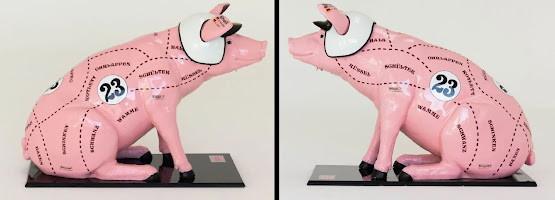
Der Trüffeljäger von Zuffenhausen (The Trufflehunter from Zuffenhausen), a fibreglass display (some 45 inches (1150 mm) in length) finished in the Pink Pig’s livery. It includes battery-operated LED (light emitting diode) fixtures within the nostrils, activated by a toggle switch under an access panel on the neck. Weighing some 50 lb (23 kg), it measures (length x width x height) 45 inches x 20 x 32 (1140 x 510 x 810 mm). In an on-line auction in 2024, it sold for US$3800.
Pink Pig Porsche 917-20, Le Mans, 1971.
At 87 vs 78 inches (2200 mm vs 2000 mm), the SERA car was much wider than a standard 917K, the additional width shaped to minimize air flow disruption across the wheel openings. The nose was shorter, as was the tail which used a deeper concave than the “fin” tail the factory had added in 1971. Whatever the aerodynamic gains, compared to the lean, purposeful 917-K, it looked fat, stubby and vaguely porcine; back in Stuttgart, the Germans, never happy about losing to the French, dubbed it Das Schwein (the pig). Initially unconvincing in testing, the design responded to a few tweaks, the factory content to enter it in a three hour event where it dominated until side-lined by electrical gremlins. Returned to the wind tunnel, the results were inconclusive although suggesting it wasn't significantly different from a 917K (Kurzheck (short tail) and suffered from a higher drag than the 917-LH (Langheck (long-tail)). It was an indication of what the engineers had long suspected: the 917K's shape was about ideal.

Pink Pig Porsche 917-20, Le Mans, 1971.
For the 1971 Le Mans race, the artist responsible for the psychedelia of 1970 applied the butcher’s chart lines to the body which had been painted pink. In the practice and qualifying sessions, the Pig ran in pink with the dotted lines but not yet the decals naming the cuts; those (in the Pretoria typeface), being applied just before the race and atop each front fender was a white pig-shaped decal announcing: Trüfel Jäger von Zuffenhausen (the truffel hunter from Zuffenhausen); the Pink Pig had arrived. Corpulent or not, in practice, it qualified a creditable seventh, two seconds slower than the 917-K that ultimately won and, in the race, ran well, running as high as third but a crash ended things. Still in the butcher's shop livery, it's now on display in the Porsche museum.
Pink Pig Porsche 917-20, 1971.
Scuttlebutt has always surrounded the Pink Pig. It's said the decals with the names of the cuts of pork and bacon were applied furtively were applied, just to avoid anyone demanding their removal. Unlike the two other factory Porsches entered under the Martini and Rossi banner, the Pink Pig carried no corporate decals, the rumor being the Martini & Rossi board, their aesthetic sensibilities appalled by the porcine lines, refused to associate the brand with the thing. Finally, although never confirmed by anyone, it's long been assumed the livery was created, not with any sense of levity but as a spiteful swipe at SERA although it may have been something light-hearted, nobody ever having proved Germans have no sense of humor.
A coffee table in Pink Pig livery built on a M28 Porsche V8 engine (introduced in 1977 for use in the new 928 and, much updated, still in production).
Coffee tables in this form are not uncommon as display or promotional pieces and are sometimes advertised as “the gift for the man who has everything”; whether the pink paint will extend the attraction to many women seems improbable but, despite the perceptions, there are women who share the stereotypically male attachment to cars and their components. Almost all coffee tables built around engine blocks use a glass top so the interesting bits are visible; if there’s thus a flat surface they are as functional as any of the same dimensions. Some however have some of the mechanical bits protruding, usually just for visual impact although there have been some V8s and V12s where the heads are not installed, the open cylinders used as somewhere to place jars of sauces, dressings and such. On this table, the intake manifold extends above the table-top through a surface cut-out so it reduces the usable area but the tubular intake rams are there to be admired. Although all-aluminium, the M28 was built for robustness and was no lightweight: the table weighs some 240 lb (110 kg) and measures (length x width x height) 43 x 20 x 32 inches (1090 x 940 x 432 mm). In an on-line auction in 2024, it sold for US$5300.

In the pink: 1983 Porsche 928S in a “rauchquarzmetallic” wrap. The 928 was the first Porsche to use the M28 V8.
In production between 1977-1995, with a front-mounted, water-cooled V8, the 928 was a radical departure from the configuration of their previous road cars, all air-cooled flat fours or sixes and mostly with a true rear engine layout (the power-plant installed aft of the rear axle). By the early 1970s the Porsche management team had come to believe (1) the fundamental limitations and compromises physics imposed on cars with so much weight at the rear extreme meant such engineering was a cul-de-sac, (2) demand for the by then decade-old 911 would continue to decline and (3) US regulators (then much in the mood to regulate) would soon outlaw rear engines and air-cooling, along with convertibles. As things turned out, by the time of the election of Ronald Reagan (1911-2004; US president 1981-1989), the decision had been taken not to outlaw convertibles but the one-time Hollywood film star (with fond memories of convertibles) had some distaste for “excessive and intrusive regulations” and was elected with the (never explicitly stated but well-understood) agenda to make America great again and a new mood prevailed in Washington, convertibles and much else surviving the expected fall of the axe. The 928 was well-received by the press but, like Toyota’s Lexus which never quite managed to achieve the reputation it deserved because it was “not a Mercedes-Benz” (actually perhaps “not what a Mercedes-Benz used to be”), the 928 suffered from being “not a 911”. Although the 928 joined the list of machines out-lived by those which they were intended to replace, it was a success and in production for some eighteen years although early in the twenty-first century depressed values in the after-market meant it became associated with drug dealers and people with maxed-out credit cards (at some points, certain used 928s were the cheapest 160 mph (260 km/h) cars on the market). The perception has now improved and around the planet there are solid 928 communities although the members display nothing like the devotional, cult-like feelings of the 911 congregation.

1968 Lamborghini Espada Series I with interior re-trimmed in hot pink leather (left) and 1974 Lamborghini
Espada Series III re-painted in baby pink (right). Neither of these colors were at the time available from the factory.
First shown
Geneva Auto Salon in March 1968, the Espada was conventionally engineered (by
the standards of exotic Italian thoroughbreds) but audaciously styled, the
design brief to create something with genuine seating for four while retaining
the dramatic lines which had become a signature of the company which was then
barely five years from having branched out from building tractors. On the prototypes, the designers had flirted with both gullwing doors and an orthodox four-door layout but the conclusion quickly was reached the former was not suited to series-production and the latter would appeal less than a two-door. It was one of
those machines which from some angles was seductively attractive yet from other
aspects could look ungainly but it did work in that although ingress and egress
was compromised, four comfortably could be accommodated and after 1974 Chrysler’s
robust and versatile TorqueFlite automatic transmission became available, further extending the appeal. In what
became a difficult era, it proved Lamborghini’s most successful model with 1226
produced in three series: (176 Espada 400 GT Series I (1968-1969), 578 Espada
400 GTE Series II (1970-1972) & 472 Espada 400 GTS Series III (1972-1978).

1967 Lamborghini Marzal.
Even
at the time some might not have agreed the Espada’s styling was “audacious”
because it verged on the restrained compared with what had the previous year been
shown as a tempting vision of a true, four-seat Lamborghini (prior to the offerings
had been strictly for two or rather cramped 2+2s and there was even a small
runs of a most unusual 2+1 arrangement).
A one-off concept car first shown at the 1967 Genera Auto Salon, the
Marzal was a marvellously impractical design by Bertone’s Marcello Gandini
(1938–2024) which featured two vast gull-wing doors to provide access to what
genuinely was a four-seat interior, noted for the thematic use of
hexagons. It was powered by a
transversely-mounted 2.0 litre (120 cubic inch) straight-six (essentially half
of the company’s V12) which was fitted behind the rear axle, making the
rear-bias in weight distribution rather pronounced. It was one of the most dramatic designs of
the decade and although production was never contemplated, traces of the
silhouette can be seen in the Espada which featured notably less glass than the
Marzal and many have expressed doubts the air-conditioning system able to be
used in the Marzal would in high temperatures have coped with the heat-soak and
build-up.

Bit of a stretch: Model Adriana Fenice (b 1994) in pink stretch top. Stretch fabrics are useful for the industry because they allow a manufacturer to produce a single garment (ie "one size fits all") able to accommodate a ranges of sizes.
Espada
is a Spanish word meaning “sword”, the reference specifically to the blade a
torero uses in bullfighting to kill the unfortunate beast and to this day
Lamborghini still uses terms from the tradition for its models. That’s perhaps surprising given bullfighting
is now not as socially respectable as it was during the 1960s although
disapprobation of the “sport” is
not new and Pius V (1504–1572; pope 1566-1572) as early as 1567 called the
practice: “alien from Christian piety and charity”, “better suited to demons rather than men” and “public slaughter and butchery” fit for paganism but not Christendom and word nerds will be delighted to note Pius V’s
ban on bullfighting was technically a “papal bull”. De
Salute Gregis Dominici (On the Salvation of the Lord’s Flock) was
issued on 1 November 1, 1567 as a formal proclamation with the papal lead seal
(bulla) attached (hence such edicts being known as the “Papal bulls”), the seal
authenticating the document and, as an official decree, it was binding upon Church
and Christian princes. Appalled by the
cruelty, Pius called bullfighting “a sin” and condemned the events as “spectacles of the
devil”, prohibiting Christians from attending or participating under
pain of excommunication. However, like
many papal though bubbles down the ages which never quite make it to the status
of doctrine, his ban was soon ignored and after his death the edict quietly was
allowed to lapse. Predictably, in Spain
and Portugal, where bullfighting had deep cultural & political roots, the bulla
was either ignored or resisted and Philip II (1527–1598; King of Spain
1556-1598), while as devout a Catholic as any man, was known as Felipe el Prudente (Philip the Prudent)
for a reason and quietly he turned the royal blind eye, allowing bullfighting
to continue. Within the Holy See, the king's disobedience of an edict from the Vicar of Christ on Earth would have been disappointing but unsurprising and it was the world-weary Benedict XIV (1675–1758; pope 1740-1758) who best summed-up the church's chain of command: “The pope
commands, his cardinals do not obey, and the people do what they wish.”

1966 Lamborghini Miura P400 re-painted in what most would probably call hot pink but professionals list as fashion fuchsia (Hex: #F400A1; RGB: 244, 0, 161; CMYK: 0,
100, 34, 4). The Miura (1966-1973) was
named after a breed of fighting bull and was the first Lamborghini to borrow an
identity from bullfighting and the first to wear the corporate logo featuring a
bull. In the film The Italian Job
(1969), a Miura is shown being crushed by a bulldozer but that was
filmic trickery using a second, pre-wrecked car and the orange Miura seen driven through the Alps still exists. In many places the film's car is referred to as "tangerine" or "orange", both of which well describe the vivid hue which the factory listed as Arancio Miura (meaning "Miura Orange" although the use in Italian of arancio to mean the color "orange" is untypical, the word used usually in the sense of "orange tree"). In a technological quirk, some film sites call the car "red" but that's a function of some prints or photographs not correctly maintaining the integrity or the original. The term “hot pink” (Hex: #FF69B4; RGB: 255,
105, 180; CMYK: 0, 59, 29, 0) is used very loosely and has become the general
term for bright shades while “baby pink” is used casually of most pastels. In theory, the color palette is infinitely variable
but the practical limitation is the range able to be perceived by the human
eye, illustrated by the announcement in April, 2025 of the “discovery” of a “new
color” (“new” in the sense no human had ever seen it although it may well be
common around the universe).

An artist's depiction of what is closest to "olo", able to be perceived by normal human vision.
Named “olo”, the “new color”
was a deeply saturated blue-green (which many would probably call “teal” or “turquoise”)
and the novelty was it was able to be seen only by test subjects who had laser
pulses fired into their eyes, stimulating specific cells in the retina (a light-sensitive
layer of tissue at the back of the eye responsible for receiving and processing
visual information; it converts light into electrical signals, which are then
transmitted to the brain via the optic nerve, enabling us to see). What the scientists did was aim the beam at
one of the retina’s three cones (there are “S”, “L” & “M” cones, each one sensitive
to different wavelengths of blue, red and green respectively). Because, in normal vision, “any light that
stimulates an M cone cell must also stimulate its neighbouring L and/or S cones
(because its function overlaps with them)”, by using a laser to stimulate
only the M cones, it became possible to “send a colour signal to the brain that never occurs in
natural vision.” Obviously, by adjusting the aim, it may be there are new hues of pink waiting to be discovered although that olo can
be perceived only if laser beams are fired into the observer's eye does limit its use in
fashion and such but the researchers note the findings suggest the
technique could be applied to research into colour blindness. The name “olo” has a marvellously nerdy
origin: It was an allusion to the binary
code “010” which signifies the specific combination of cone cells in the eye
that were stimulated to create the new color perception. Specifically, “0” represents the absence of
stimulation in the short (S) and long (L) cones, while “1” indicates full
stimulation of the medium (M) cones. Math nerds like in-jokes as much as anyone. Amusingly, although humans can't see olo, it may be other creatures can. Almost all humans possess only three types of color-sensitive photoreceptor cones (red, green, and blue, the famous RGB) but other animals have more, the most impressive set held by the obviously under-estimated mantis shrimp that has between 12 and 16. A few lucky souls have a fourth receptor so it may be some of them would be able to perceive the qualities making olo distinctive but even they would never see the color-range manta shrimps take for granted.

Antonina
Davydova in pink jump-suit.
Moscow-based pharmacy student Antonina Davydova is
founder of the BTM (Big Tits Matter) movement, an institution not without
critics in Russia but her response to adverse comments was very post-Soviet: “Let’s soak up the
spirit of tolerance, comrades! Let’s
breathe in deeply the air of equality! Those who are different from the common
standard must be free of oppression.” An expression of such Trotskyist sentiments might
once have had comrade Stalin (1878-1953; Soviet leader 1924-1953) order the
subversive (1) be taken outside, put up against a wall and shot, (2) be sent to
the Lubyanka building (KGB headquarters on Lubyanka Square, Meshchansky, Moscow)
to be tortured to death or (3) be sent to the Gulag (the Soviet Union's vast
apparatus of political prisons and forced labor camps) to be worked to death.
Antonina
Davydova watering her pink Impatiens walleriana (commonly known as impatiens or Busy
Lizzie) with pink watering
can.
The inspiration for what was originally a single
“BTM meme” intended to amuse came to her during discussions about the BLM (Black
Lives Matter) movement that began in the US and between the two there are
similarities in concept although BLM was triggered by something with serious consequences. Ms Davydova the nature of those discussions: “We came to the
conclusion that every person with features that are distinct from the majority
(be it skin color, sexuality, or any other physical feature) always ends up
having them used as a social value yardstick. In this way, my ‘pronounced biological assets’
are likewise a trigger for people. My friends joked about me becoming the
founder of an alternative movement for the rights of genetically ‘gifted’
women. And that is how that post materialized.”
Atonina
Davydova in polka-dot summer dress.While something that began modestly enough with
no thoughts of drawing any sort of equivalence with BLM, as might have been
expected in the social media age, even before BTM had gained critical mass in
Russia, her photographs went viral beyond Russia’s borders, the first vectors
the “usual suspects” Reddit and 9GAG.
The English-speaking market proved most receptive (“they welcomed me with open arms”)
and she noted many comments were in the vein of a common sentiment in the era
of “protest moment fatigue”: “Finally, a protest I can get behind!” At that point, the Russian viewership spiked
but there BTM was greeted with more restrained enthusiasm, accusations recorded
by Ms Davydova including: “self-promotion using my breasts, looking for a sugar daddy,
looking like a cow, predictions my breasts would sag as I age and that my
protest is about nothing because nobody was violating my rights.”
Where BTM began: The original meme.
She might not have been taking things too
seriously but the grievance industry was, as usual, offended. Ms Davydova
attributes unpleasant attitudes towards her to “people simply thinking in stereotypes”,
Russians and others from the nations once constituent SSRs (Soviet Socialist
Republic) of the Soviet Union having “retained a healthy dose of Soviet mentality, which compels
them to feel shame and to shame those who stand out from the crowd.” She however maintains a light-hearted view of
it all, content to think her body “…is the work of the devil” and grateful not to
have been alive in a time when she “…might have been taken for a witch and burned at the stake.”

SJP (Sarah Jessica Parker; b 1965) in "croissant dress" (left) and a HD (heavy duty) PVC (polyvinyl chloride) dishwashing glove in action (right).
Occasionally, catwalk creations escape and are seen in the wild. In 2022, the actor Sarah Jessica Parker appeared in HBO's (Home Box Office) And Just Like That (2021-2022; a revival of the Sex and the City TV series (1998-2004)), wearing an orange Valentino Haute Couture gown from the house’s spring/summer 2019 collection. It recalled a large croissant, the piece chosen presumably because the scene was set in Paris although it must have been thought viewers needed the verisimilitude laid on with a trowel because also prominent was a handbag in the shape of the Eifel Tower. A gift to the meme-makers, while comments were numerous, admiration for the dress seemed restrained although many were taken by what at first glance appeared to be a pair of PVC (also available in latex) dishwashing gloves in a fetching pink (closer to hot pink than fashion fuchsia); few critics doubted they really were opera gloves from Valentino Haute Couture.

Flamingo's Exotic Dancer's boots in baby pink are available in calf (left), ankle (centre) and thigh (right) length in a variety of heel and sole heights. Because of the commonality of design elements and interchangeability of components, there's a degree of production-line rationalization, meaning the range economically can be produced. It should be noted "exotic dancer" is a vocational euphemism so the target market is limited but there may be some demand from non-professionals who can see the potential for "home use".
Actor Florence Pugh (b 1996) in hot pink Valentino Tulle
gown with Valentino Tan-Go pink patent platform
pumps, July 2022.
The
noun meaning "pale red color, red color of low chroma but high
luminosity" was first noted in 1733 (although "pink-colored" dates from the 1680s),
developed from one of the most common and fancied of the flowers and pink had
come into use as an adjective by 1720. As a physical phenomenon, the color pink
obviously pre-dated the word "pink" as a descriptor and the earlier name for such
a color in English was the mid-fourteenth century "incarnation" (flesh-color) and, as an adjective (from the 1530s), "incarnate", from the Latin word for
"flesh". These however had
other associations and tended to drift in sense from “flesh-color” &
“blush-color” toward “crimson” & “blood color”; it is thus a specialized discipline to
“translate” even late Modern English.
Lindsay Lohan in pink
pantsuit with Valentino’s Rockstud pumps, New York, October 2019.
The
noun pink-eye (and pinkeye) (contagious eye infection) was an invention of US
English from 1882 although, dating from the 1570s, it one meant "a small
eye". The adjectival pink-collar
(jobs generally held by women or those considered characteristically feminine (1977)
or the female workforce generally (1979) was a back-formation based on the
earlier blue-collar, white-collar etc. Pinky
as an adjective (pinkish, somewhat pink) dates from 1790, building on the
earlier pinkish (somewhat pink), noted since 1784. The derogatory
adjectival slang pinko (soon also a noun in this context) was used of those
with social or political views "tending towards “red” (ie sympathetic to
communism, the Soviet Union (USSR) etc) since 1927 although as a metaphor that
had existed at least since 1837. It was
in the context of the time a euphemistic slur; a way of calling someone a
communist (or at least a fellow traveler) without actually saying so. In Australia, old Sir
Henry Bolte (1908-1990; premier of Victoria 1955-1972) would often refer to
the local broadsheet The Age as “that awful pinko rag” although
he wasn’t unique in his critique, the paper’s one-time headquarters known by
many as the “Spencer Street Soviet”.

In
idiomatic use, to be "in the pink" is to be healthy, physically fit, or in high
spirits; to be "tickled pink" dates from 1909 and is to be very happy with
something. The "pink slip" (apparently originally
a "discharge from employment notice" and historically issued on pink
tissue paper (usually as a carbon copy)),
is attested by 1915 and pink slips had various connotations in
employment early in the twentieth century, including a paper signed by a worker
attesting he would leave the labour union or else be fired. The term pink slip came to refer to a wide
variety of documents (in the US it was often the title to a car) provided in
commerce or by government for some purpose (although not all literally were
pink) the term still in some cases enduring for the modern digital analogue. To “see pink elephants”, a euphemism for
those suffering alcohol-induced hallucinations, dates from 1913 when it
appeared in Jack London's (1876-1916) autobiographical novel, John Barleycorn although such things are
not always apparitions. Some
languages such as Chuukese and German use pink but other descendants include
the Afrikaans pienk, the Finnish
pinkki, the Irish pinc, the Japanese pinku (ピンク), the Korean pingkeu
(핑크),
the Marshallese piin̄, the Samoan piniki, the Scottish Gaelic pinc, the Southern Ndebele –pinki, the Swahili -a pinki, the Tokelauan piniki,
the Tok Pisin pinkpela, the Welsh pinc and the Xhosa –pinki.

In the natural environment, pink is all around. Sexy pink orchids in Fuschia (left), an Amazon River Dolphin (Inia geoffrensis, centre) and a pink baby elephant (right).
Pink
elephants are of course hard to find in London but they're rare anywhere. On the internet, there have been claims the
creatures can be found in parts of India, the color the result of the red soil
in the environment, the creatures spraying dust on their hides to protect
themselves from biting insects. However,
it turned out to be fake news, the supporting evidence created with Photoshop
and wildlife experts that while elephants cover themselves in mud, this doesn’t
change the colour of their skin. It's
true there is a rare genetic disorder (technically a form of albinism) which
can result in the skin of young African elephants displaying a slight pink hue
but it's nothing like the vivid hot pink in the Photoshopped fake news. While in London, famous Australian concierge
Elvis Soiza (b 1959 and once a leading figure in the Secret Society of the Les Clefs d’Or)
managed, at remarkably short notice, to procure a pink (painted) elephant to be
led through the streets of Chelsea to delight one of the wives of a visiting
dignitary from the Middle East. Walking a pink elephant through the streets of London has apparently not since been done.

Flying the pink pride flag: Members of Gay Men Fighting AIDS with their pink SPG, London for Pride
Parade, 24 June 1995.
In service
with both the British and Indian armies variously between 1965-2016, Vickers built
234 of the FV433 "Abbot" 105 mm SPG (Self-Propelled Gun) FAV (Field
Artillery Vehicles), using the existing FV430 platform with the addition of a fully-rotating
turret. The factory's project code (and
informal military designation) was “Abbot”, in the World War II (1939-1945) British
tradition of using ecclesiastical titles for self-propelled artillery (following
the Bishop, Deacon & Sexton). The
official model name was “L109” but to avoid confusion with
the US-built 155 mm “M109” Howitzer, 144 of which also entered British Army
service in 1965, this rarely was used. While the sight of a
cluster of gay men atop a pink SPG might have frightened a few, the thought of
one in the hands of a pack of lesbians truly is terrifying.
Baker–Miller Pink.
One
intriguing shade of pink is “Baker–Miller Pink”, named after the USN’s (US Navy)
Captain Ron Miller & Chief Warrant Officer Gene Baker, then supervising the
Navy’s detention centre in Seattle. The link
between the color and the navy came when researchers, wanting a kind of “real-time
laboratory” in which to test their findings an environment painted in certain
colours could reduce aggression, hostility and violent behaviour, securing an
agreement with the Pentagon. The
attraction of a USN brig was the subjects (detained naval personnel) were under
military authority and, because of the way the “chain of command” operates,
once approval for the test was obtained and the relevant orders issued, the
researchers could be assured. That was an
aspect of behavioral science Dwight Eisenhower (1890-1969; US POTUS 1953-1961)
observed was the greatest single difference between heading the military and
the civilian administration: In the army, when he gave an order he was certain
it would be carried out; some subordinates would executive that order more
competently than others but it would be done.
As POTUS, he noticed his orders might be carried out. Thus the attraction of using the navy’s brig
for research; there were no troublesome bureaucracies inclined to form
committees to discuss things.

Brig was an
abbreviation of brigantine, from Italian brigantine. The link with “jail” comes from the brigantine
being a small, twin-masted sailing vessel widely used in the seventeenth &
nineteenth centuries and it ultimately gained its name from the sixteenth
century large row-boats once called brigandyns,
from the Middle French brigandin,
probably from the Italian brigante (skirmisher,
pirate, brigand), from Latin brigō (to
fight). Brigantines (predictably clipped
to “brig”) being small, cheap to build, maintain, operate and crew, were
popular with navies for “brownwater” & “whitewater” duties (ie on rivers or
close to shore rather than the “bluewater” of the open seas) and they proved
the ideal vessel in which to hold prisoners, deserters, or captured sailors. From this re-purposing, the term migrated to
the compartment on any warship used for confinement, the slang becoming
standard in English-speaking navies by the early nineteenth century. Naval slang being as conservative and
tradition-bound as the whole service, the term survived the brigantines ceasing
to be used as prison ships and was later extended to land-based detention
facilities.

Because the
original research was done in the 1970s, suitable computers were not available to create
color variants and the process was wholly empirical, the various hues achieved
with pots of paint and stirring sticks, a method that would have been recognized
by prehistoric cave painters who, some 30,000 years ago, used pigments mixed
with water, animal fat, or plant juices to create brushable liquid mixtures in
the colors desired. What came to be
called Baker–Miller Pink began as a blend of white indoor latex paint mixed with
red trim semi-gloss outdoor paint in a ration of 1:8; in the vernacular of the
trade, the process is called “mixing the
soup”. Technically, Baker–Miller
Pink is listed in the literature as “P-618” but informally it’s known also as “Schauss
pink” (named after Dr Alexander Schauss (b 1948 and later the director of the AIBR (American
Institute for Biosocial Research) who in the 1970s undertook the original
research) and “Drunk-Tank Pink”. What Dr
Schauss’s observational research revealed was that the colors surrounding a subject
could either invigorate or enervate and even influence the cardiovascular
system, thus his interest in determining if the color of prison cells could
have a “calming” effect on often stressed and sometimes violent inmates. P-618 Pink turned out to be the most
effective and this was confined in the tests in Seattle. Subsequent research has cast doubts on these
findings but many fields have experimented with colors as tools of emotional
manipulation (red, black & orange in the change rooms of football teams to
encourage aggression and the fast-food chain Subway tried yellow to discourage customers
from lingering at the tables after finishing their sub) but judicial systems in
many nations seem to have been convinced to have some pink-painted cells, the
Swiss among the better known adopters of P-618.
The Playmate-Pink Cars, 1964-1975

Hugh Hefner (1926-2017; founder and long-time editor-in-chief of Playboy magazine) in his 1955 Cadillac Series 62 Convertible. 1955 was Cadillac’s year of “peak dagmar” and
amateur psychoanalysts should make of Mr Hefner’s taste in automobiles what
they will although, sometimes, a Cadillac is just a Cadillac.
The Playboy
Motor Car Corporation was established in New York in 1947 by a pre-war car
dealer who believed there would be much demand for a smaller, less expensive
car than those in the ranges offered by the established manufacturers, almost
all of which essentially differed little from the models which abruptly had
ceased production early in 1942. Although the US's long, almost uninterrupted, post-war boom (1947-1973) is now part of economic history, in 1945-1947 it was not a universal assumption things would improve and many economists, basing their projections on the previous outcomes in economies transitioning from the essentially artificial stimulus of wartime demand, were quite gloomy. At the time, a number of concerns were established to service what was predicted to be a period of austerity and although those conditions would return, in what now seems a golden age, for a generation, fat overtook the land. What the Playboy Car Corporation planned was in many ways a most modern concept, in-house manufacturing minimized in favor of outsourcing
and, wherever possible, the use of standard, off-the-shelf parts. Conceived as a small convertible with
three-abreast seating, it offered the novelty of a multi-part, retractable hard-top,
something not new but which would not be offered by a volume manufacturer for
almost a decade (before being mostly abandoned for 40 years). Like thousands (literally) of optimistic
souls who have for more than a century succumbed to the temptation of entering
the car business, the hopes of Playboy’s founders were high but many factors
conspired against the project including the tiny size
and under-powered engine; it offered economy in an age when austerity was
becoming unfashionable and not even a hundred were built before the company
entered bankruptcy in 1951. It was an idea ahead of its time for as the success in the 1950s of smaller, more economical imports (notably the Volkswagen Beetle) proved, even in the prosperous US, demand did exist.

Not Hugh Hefner's sort of car: 1949 Playboy Convertible.
With
that, the Playboy name might have passed forgotten into the annals of the New
York Bankruptcy Court. However, not long
after the company’s demise, Hugh Hefner received a C&D (“cease and desist” letter) from counsel for Stag magazine (a
men’s adventure title), advising a trademark protection suit would be filed
were he to proceed with the release of the magazine he intended to launch with the
title Stag Party. A new name was thus required and after
pondering Pan, Sir, Top Hat, Gentleman,
Satyr & Bachelor, Hefner’s
friend (and Stag Party’s co-founder), Eldon Sellers (1921-2016) (apparently
prompted by his mother who had worked for the failed car company) suggested
it was the ideal name. Hefner agreed
although whether that had anything to do with the clever mechanism with which the little car could be made topless has never been discussed.
With Marilyn Monroe (1926-1962) on the cover, Hefner in 1953 issued the
first edition of Playboy magazine and the rest is history and one footnote in that tale is that between 1964-1975, the car gifted to the PotY (playmate
of the year) was usually pink. After
that, the gifts were for some years still given but no longer in pink.

1964:
Donna Michelle Ronne (1945-2004), Ford Mustang convertible.
The
Mustang was the industry’s big hit for 1964, setting sales records which even
now are impressive. It was also highly
profitable, most mechanical parts borrowed from existing Ford lines and the
very platform on which it was built was that of the humble Falcon, introduced a
few years earlier as a compact (in US terms), economy model.
Only the body was truly new but it was “the body from central casting”
and while it didn't (quite) invent the “pony car” segment, it certainly defined it and the linguistic connection lent the sector its name. The manufacturing seasons in the US industry ran from September-August so, being introduced in April 1964, by convention the first of the Mustangs would have been 1964½ cars but Ford's documents always listed then as "1965 models", something the breed's devoted followers like to point out; they are however fighting a losing battle because "1964½" has in the collector market become standard jargon. The lines that in 1964 a stir established the motif which would
be imitated by many and, sixty-odd years on, Mustangs, Dodge
Challengers and Chevrolet Camaros still were all variations of the originals first sold in the 1960s. That early Mustang had wide appeal, able to be
configured with relatively small six-cylinder engines (in the sexist language of the age: "secretary's cars") or larger V8s, soon to
include even highly-strung solid-lifter versions, a sign of things to come. Aged 18 at the time of her shoot, Ms Ronne (who modelled as "Donna Michelle") remains the youngest PotY.

The
1964 PotY’s car was finished in a special-order color that anyone could order
but rapidly it became known to the public as “Playmate Pink” or “Playboy Pink”
although it was only later Ford added the latter to the option list as code #WT9301. That would be one of four shades
of pink the corporation would offer between 1964-1972 including Dusk Rose (code #M0835 and offered originally on the 1957 Thunderbird), Passionate Pink (code #WT9036
which was part of a Valentine’s Day promotion in February 1968) & Hot Pink
(code #WT9036). Interestingly, regarded as niche
shades, most of the hues of pink rarely appeared on the mass-distribution
brochures and could be viewed only on DSO (Dealer Special Order) charts. Social change, workforce participation and the contraceptive pill combined in the 1960s to let women emerge as influential or even autonomous economic units and Ford was as anxious as any of the cogs of capitalism to attract what was coming to be described as the "pink dollar". The tie-in with Playboy wasn’t the only time
a pink Mustang was a promotional prop, the Tussy Lip Stick Company offering three 1967 Mustangs as prizes for contest winners, each finished in a shade
of pink matching the lipsticks Racy Pink, Shimmery Racy Pink Frosted & Defroster. Defroster sounds particularly ominous but to set minds at rest, Tussy helpfully decoded the pink portfolio thus:
Racy Pink: "A pale pink".
Shimmery Racy Pink Frosted: "Shimmers with pearl".
Defroster: "Pours on melting beige
lights when you wear it alone, or as a convertible top to another lip color".
The fate of the cars is unknown but nerds might note the three prizes were 1967 models while the model (as in the Mustang) in the advertisement was from the 1966 range. That's because the advertising copy had to be made available before the embargo had been lifted on photographs of the 1967 range. The men on Madison Avenue presumably dismissed the suggestions that might be what would now be called “deceptive and misleading” content with the familiar “she'll never know”. Ten years on from Dodge’s La Femme debacle, old habits were dying hard.
1965:
Jo Collins (b 1945), Sunbeam Tiger. Now painted red, the car still exists. Ms Collins was familiar also with other breeds of horsepower, being at the time one of the few women in Illinois with a licence to race thoroughbreds.
Although
from a different manufacturer, the 1965 PotY’s car actually had the same engine
as her predecessor’s gift. Introduced in
1961 with a capacity of 221 cubic inches (3.6 litres), Ford’s small-block V8
(known as the Windsor after the location of the foundry in the Canadian province of Ontario where first the blocks were cast), pioneered the use of “thin-wall” casting techniques and, on sale between
1961-2002, would be enlarged first to 260 cubic inches (4.2 litres), then 289
(4.7), 302 (4.9) and 351 (5.8) and installed in everything from pick-up trucks to the
GT40 (#1075) that in 1968 & 1969 the Le Mans 24 hour endurance race. AC used a 221 as a proof of concept exercise
in what (with the 260) would be released as the first Shelby American Cobras, the most
numerous of which used the 289, the most famous either the 427 or 428 cubic inch (7.0 litres) FE V8. By the time the Tigers were released, Sunbeam had pruned the Alpine's once slanted and altitudinous tail-fins.

Ms Collins with her 1965 Sunbeam Tiger Mark I.
In
England, Sunbeam (then part of Rootes Group) had been attracted by the Windsor’s light weight and
compactness, finding, with a little modification and some help from Carroll Shelby (1923–2012), it could (just) fit in the bay of their little Alpine sports car, otherwise never powered by anything larger than a 1.7 litre (105 cubic inch)
four.
Fit it did although one
modification was the inclusion of a hatch in the footwell to permit
a hand to reach one otherwise inaccessible spark plug, an indication of how tight was that fit. However, the project proved successful and
the Tiger sold well although Sunbeam never offered the high-powered versions of
the Windsor Shelby used in the Cobras, the platform really at its limit using
the more modestly tuned units. The US
was a receptive market for the little hot rod and one featured in the Get Smart
TV series, although it’s said that for technical reasons, a re-badged Alpine was
actually used, the same swap effected for the 2008 film adaptation, a V8
exhaust burble dubbed where appropriate, a not unusual trick in film-making. In 1967, after taking control of Rootes Group, Chrysler had intended to continue production of the Tiger (by then powered by
the 289) but with Chrysler’s 273 cubic inch (4.4 litre) LA V8 substituted. Unfortunately, while 4.7 Ford litres filled
it to the brim, 4.4 Chrysler litres overflowed; the Windsor truly was compact. Allowing it to remain in production until the
stock of already purchased Ford engines had been exhausted, Chrysler instead
changed the advertising from emphasizing the “…mighty Ford V8 power plant” to
the vaguely ambiguous “…an American V-8 power train”. The badges fitted to the cars reflected the change in corporate ownership, switching from "Powered by Ford 260" to "Sunbeam V8" although cars sold South Africa or certain European countries were all designated "Alpine 260" or "Alpine 289" because the names "Tigre" & "Tiger" were already trademarked by other manufacturers. Rootes were able to use the Alpine name in France because it had sold there the original Alpine a year before the French manufacturer Alpine had begin production.
1966:
Allison Parks (1943-2010), Dodge Charger.
Detroit in the 1930s had produced fastbacks because "streamlining" had become a fashion and in the 1940s even had mainstream ranges of two & four door models but the fad proved brief. However, there was a comeback because by the early 1960s experience
on the NASCAR ovals had demonstrated how much more aerodynamically efficient
were steeply sloped rear windows compared with the more upright “formal roof” (which would come to be described as “notchback”) that designers and public alike had preferred for the additional headroom the packaging
efficiency created. So buoyant was the
state of the US industry at the time, the solution sometimes was to offer both and the most
slippery form of all was the fastback, a roofline which extended in one curve
from the top of the windscreen all the way to the tail. As a generation of Italian thoroughbreds had
shown, the fastback could be a dramatic and aesthetic success on smaller machines but on
the big Americans, it was a challenge and one never really solved
on the full-sized cars although the by the late 1960s, a formula had been found for
the intermediates, necessitated by the shape delivering higher speed and lower fuel consumption on the NACSAR ovals.

Electroluminescent instruments in 1966 Dodge Charger.
In
1966, the formula was still being mixed and while the Dodge Charger’s
wind-cheating tail (after some tweaks) delivered the extra speed, the slab-sidedness
attracted criticism and, after an initial spurt, sales were never
impressive and it wouldn’t be until the revised version was released to acclaim
in 1968 that the promise was realized.
In fairness, the 1966 Charger, while not as
svelte as its successor, was
a better interpretation of the big fastback than some others, notably the truly
ghastly Rambler (later AMC) Marlin.
Mechanically, the
Charger was tempting, the top engine (though not the biggest, a tamer
440 cubic inch (7.2 litre) V8 also available) option the newly released 426 cubic inch
(7.0 litre)
Street Hemi which was a very expensive, slightly
detuned race
engine and the dashboard featured Chrysler’s intriguing electroluminescent instruments
which, rather than being lit with bulbs, deployed a
phenomenon in which a material emits light
in response to an electric field; the ethereal glow much admired.

The much admired "twin bucket rear-seats with full-length console".
It's said the 1966 PotY wanted something roomy and practical with which to take her family
to swimming practice so the spacious Charger was a good choice and the rear bucket seats, although
separated by a full-length console, could be folded flat, creating a surprisingly
capacious compartment. Wisely, the
Playboy organization didn’t give her a Hemi Charger, the dual quad monster
inclined to be noisy, thirsty and even a little cantankerous (although if running late for swimming practice there would have been advantages), the pink car instead fitted with a 383 cubic inch (6.3 litre) V8, the engine in the era nominated by Chrysler’s
engineers as the best all-round compromise, the two-barrel version
their usual recommendation, a four-barrel edition available for those prepared to sacrifice
economy for performance. The fate of the
car is unknown.
1967:
Lisa Baker (b 1944), Plymouth Barracuda fastback.
However
ungainly the fastback may have appeared on the Charger, it worked well on the
smaller Barracuda although there are students of such things who maintain the almost
Italianesque lines of the notchback version are better and there was a
convertible too, matching the coachwork by then offered on the Mustang. What all however agreed was the second series
Barracuda (1967-1969) was a vast improvement on its frumpy predecessor,
now noted mostly for the curiosity of its huge, wrap-around rear-window. Things could have been different because the
original Barracuda, using the same concept as the Mustang (a poetic form disguising a prosaic structure), was actually released a few weeks before the sexy
Ford and was in some ways a superior car but it had nothing like the appeal, being so obviously based on an economy car whereas the Mustang better hid its humble origins.

Ms Baker with Barracuda.
The
second series Barracuda looked much more attractive although, being less
changed underneath, didn’t fully emulate the “long hood, short deck” motif with
which the Mustang had created the pony car template.
Still, its reception in the market encouraged Chrysler and soon, to match the now widened Mustang, big block
engines began to appear. The Barracuda was not actually widened but this was the 1960s and though Chrysler couldn’t easily
install a big-block, they could with difficulty and so they did although the 383
was a tight fit and compromises were required, the exhaust system a little
restrictive and niceties like power steering weren’t offered; with the big
lump sitting over the front wheels, at low speed they did demand strength to
manhandle. Almost 2000 were built with the 383 V8 but
there were some who wanted more and in 1969, in a package now called ‘Cuda, a
few were fitted with the 440. At first
glance it looked a bargain, the big engine not all that expensive but having
ticked the box, the buyer then found added a number of "mandatory
options" (an oxymoron so a favorite in Detroit) so the total package did add a hefty premium to the basic
cost. The bulk of the 440 was such that
the plumbing needed for disc brakes wouldn’t fit so the monster had to be
stopped with the antiquated drum-type and again there was no space for power
steering. The prototype built with a
manual gearbox frequently snapped so many rear suspension components the
engineers were forced to insist on an automatic transmission, the fluid cushion
softening the impact between torque and tarmac. Used anywhere but a drag strip, the 440 'Cudas were a flawed device but, in a straight line, the
things were quick enough to entice almost 350 buyers. To this day the 440 remains the second biggest displacement engine Detroit put in a pony car, only the 455 (7.5 litre) Pontiac later used in the Firebird and Trans-Am was larger.The
1969 440s weren’t exactly anti-climatic but true megalomaniacs had in 1968 been
more impressed when Plymouth again took the metaphorical shoehorn used to fit the 383 and installed
the 426 Street Hemi, 50 of which were built (though one normally reliable
source claims 70) and, with fibreglass panels & much acid-dipping to reduce weight, there was no pretence the things were
intended for anywhere except a drag strip, living out sometimes brief lives in quarter mile (402 metre) chunks.
The power-to-weight ratio of the 1968 Hemi ‘Cudas was the highest of the
era but lurking behind the Sturm und Drang stirred
by the big blocks was one of the best combinations of the era: The 'Cudas
fitted with Chrysler's 340 cubic inch (5.6 litre) (LA) small block V8 were
superior machines except in straight line speed and the visceral reaction a Hemi can induce.

Dior Rouge 999.
The
Hemi ‘Cuda reached its apotheosis in 1970 when, on a unique widened (E-body) platform,
it and the companion Dodge Challenger were finally fully competitive pony cars. Unfortunately, just as the 1967 Barracuda
would likely have been a bigger success if released in 1964, so the 1970 cars were three years too late, debuting in a declining market segment and one suddenly assailed by insurance assessors and government bureaucrats. In 1970, an encouraging 650 odd Hemi ‘Cudas
were sold but the next year, under pressure from the soaring costs of insuring
the things, sales collapsed, barely reaching three figures. The smaller engined versions fared better but
the emission & safety regulations added to the negative market forces and
the first oil shock in 1973 was a death knell, both the Barracuda and
Challenger cancelled in 1974, the four-year E-body programme booking a significant financial loss. In the agonizing reappraisal undertaken in the aftermath of what was labeled "a debacle", careers were said to have suffered. It was as an extinct species the later ‘Cudas
achieved their greatest success... as used cars. In 2014, one of the twelve 1971 Hemi ‘Cuda
convertibles sold at auction for US$3.5 million and in 2021, another attracted
a bid of US$4.8 million without reaching the reserve. If it survives, the 1967 PotY’s pink
Barracuda wouldn’t benefit from quite that appreciation but it would have some
appeal and there were reputedly another ten pink cars built for the occasion,
all from the one California plant, the paint code #999, which, coincidently, is
shared with Dior’s cor Rouge 999 lip stick and nail enamel. Red rather than pink, the Dior's 999 reference was borrowed from the gold industry, a purity of 99.9-something percent as pure as gold gets. Known also as "24 karat" or "pure gold", because of the softness, it's not suitable for all decorative or industrial uses but is a required standard for investment purposes such as bars, bullion or coins. The 999 standard permits an alloying with 0.1% impurities or other metals (usually silver, copper or lead) and some metals exchanges even specify the proportion of the other metals which may be included in the 0.1%. Unfortunately, Chrysler's paint code #999 wasn't unique to the the pink Barracudas, "999" being the corporate identifier for SOP (special order paint (ie any shade not on the RPO (regular production option) chart)).
1968: Angela
Dorian (modelling name Victoria Vetri, b 1944), AMC AMX. For her film & television appearances, she appeared in the credits using her birth name.
Before
Tesla, American Motors Corporation (AMC) was the last of the "independents" (some of which formed agglomerations in an attempt to survive) which tried to compete with Detroit’s big three, GM (General Motors), Ford
& Chrysler. In the post-war years
this was mostly a struggle and AMC’s brightest years had come in the late
1950s when, then run by George Romney (1907–1995 and father of Mitt Romney (b
1947; Republican nominee for US president 2012)), the company began to
compete against small, imported cars, then a market segment in which the big
three offered no domestically produced vehicles. That however changed in the early 1960s and
AMC’s halcyon days soon ended although they continued for years along the road
to eventual extinction and one of their more interesting ventures was the
short-lived AMX (1968-1970).
The AMX
exemplified the AMC approach in that it was conjured up something new by taking
an existing model and, at low cost, modifying it to be something quite different, an
approach which, for better and worse, they were compelled to follow to the
end. The AMX was a short-wheelbase,
two-seater version of AMC’s Javelin pony car which, introduced in 1967 to
contest the then booming segment, had been well-reviewed by the press
and, despite the latter-day perception of its lack-lustre performance in the
market, sometimes out-sold the Barracuda and actually out-lived it by a few
months but unlike some Barracudas (actually the 'Cuda derivative), neither Javelins nor
AMXs command multi-million dollar prices at auction. The
corporation originally used the AMX name (standing for “American Motors
experimental”) for a “concept car” and two show cars (somewhat misleadingly at
the time referred to as “prototypes”) which toured the show circuit in
1966-1967. All were a radical departure
from the staid image associated with the economical, practical vehicles on
which the company had built its reputation (and most of its profits) but the
response was positive and with the post-war baby boom having created a large
number of males aged 17-25 who were the most affluent young generation in history,
AMC decided to enter the “sporty” car market.
In fairness, at the time, it would have seemed not only a good idea but
also an obvious one given the extraordinary success of machines like the Ford
Mustang & Chevrolet Camaro. Like
many manufacturers, AMC liked three letter designations and they also had a
trim package called “SST” which, according to internal documents, stood for “Super
Sports Touring” and not “Stainless Steel Trim” as has been suggested
(although use was made of the metal for some of the bright-work so the assumption
was not unreasonable). Doubtlessly AMC
expected some positive association in the public mind with the SST (supersonic
transport) projects several US aerospace manufacturers were in the era pondering as competition for the Anglo-French Concord(e).

AMX 36-24-35, post-restoration, 2015.
The AMX was an interesting and even a "brave" (in the sense Sir Humphrey Appleby (the fictional senior bureaucrat in the BBC's Yes Minister (1980-1984) & Yes, Prime Minister (1986-1988) series) might
have used the word) innovation, a two-seat coupé added to a market in which
there was no similar model (Chevrolet’s Corvette was a true sports car), the last attempt
at such a thing the two-seat Ford Thunderbird (1955-1957) which had been retired
and replaced by a vastly more successful four-seat version (although in 1962-1963 Ford did produce a two-seat version called "Sports Roadster" but demand was muted). That was not encouraging but AMC persisted,
able to leverage its resources and produce lines at lower cost than the big
three could manage. Like the
Javelin, the AMX was a piece of typically solid AMC engineering which enjoyed some success in
competition and quixotically, two dozen were assembled in Australia in
right-hand-drive configuration, sold under the old Rambler name which had so
well served George Romney, the marque lingering on there for a few more
years where, remarkably to Americans, it was marketed as a "prestige" product (on the basis of being "American", the big US cars enjoying a solid reputation for comfort, power and reliability). However, the costs involved in
maintaining the shorter AMX platform were too great and when a revised Javelin
was released in 1971, the AMX name was used to denote the high-performance version. The Javelin too would be axed in 1974 but AMC
continued to use the AMX name until 1980.

What George would never have allowed.
By
1968, the deeply religious George Romney was long gone from AMC, having moved
into Republican politics; like his time in the car business, his second career
had its ups and downs and (like his son and many others) he never realized his goal of reaching the White
House. Had he still been in the chair, it may be that never would he have countenanced the idea of AMC getting mixed up with Playboy magazine and,
even if persuaded, probably would have drawn the line at the PotY’s vital statistics blatantly being celebrated. As
it was, with no Mormon veto, the AMX, one of several
said to have been painted “Playmate Pink” was delivered to Ms Dorian
with a plaque on the dashboard engraved AMX 36–24–35 (the numbers verified by the staff at Playboy, experts in such matters and for those used to the metric system, it would have been expressed in a rounded 90-60-90).

Walther PPK.
Ms
Dorian too had her ups and downs, eventually parting with AMX 36-24-35 after forty-two years but keeping
the Walther (9mm) PPK handgun which had been a gift from a friend, the film-maker
Roman Polanski (b 1933), the two having met when Dorian appeared as a recovering
heroin addict in Polanski's
Rosemary's
Baby (1968). She was also a friend of
the director's then wife Sharon Tate (1943-1969) and in August 1969, after followers
of cult leader
Charles Manson (1934-2017) murdered the eight months pregnant
Tate (and four others), Polanski gave his personal Walther PPK to Dorian for
self-protection and it was with this that in 2010, after an argument, a 66 year-old Angela
Dorian shot her husband of two decades. He survived the shooting and was
quoted by the press
lamenting "
I loved her for nearly 25 years. A divorce
would have been sufficient, not a bullet...", which, in the circumstances, does seem generous. Charged with attempted
murder (later reduced to attempted voluntary manslaughter to which she pleaded
no contest), she received a nine year sentence and was released on
parole in
April 2018. AMX 36-24-35 also had its ups and
downs, repainted (like many of the playmate cars) in something less
eye-catching before being found in a dilapidated state. It’s since been restored to its original pink splendor and remains in the original configuration,
equipped
with the base (short-deck) 290 cubic inch (4.8 litre) V8, automatic
transmission, air conditioning, tilt wheel, AM radio & 8-track stereo
player and the optional rear bumper guards.
It is unique as a PotY car but the factory’s records do list one
other “Playmate Pink” AMX, “special-ordered” late in 1968 by a dealership in Potosi,
Missouri and it would have been a bit quicker, running the “AMX”
390 (6.4) (a short deck version of the AMC V8 unique to the AMX), coupled with an automatic transmission, the “GO" option (a
high-performance & dress-up package), air conditioning, and leather trim.

1969: Connie Kreski (1946-1995), Shelby American Mustang GT500. Between the NACA
ducts, there was never a finer
hood (bonnet) ornament
A pink Shelby Mustang is a rarity and Ms Kreski was of course lovely but for some, eyes will be drawn to her
bare feet and
true aficionados will admire her Morton's toe (also as Royal toe or Greek foot),
a congenital condition in which the second toe is longer than the big toe, the
consequence of a shorter first metatarsal bone. Her case was slight enough probably to have been asymptomatic but she
may have noticed increased pressure on the joint beneath the second toe if
wearing especially unsympathetic shoes (as the stilettos sometimes worn by
Playboy's models could be). The
condition was first described by US orthopedic surgeon Dudley Joy Morton
(1884–1960) in the paper Metatarsus
atavicus: the identification of a distinct type of foot disorder which
appeared in the Journal of Bone & Joint Surgery (Boston), 1927, volume 9. It was among the conditions he grouped as Morton's
triad (known also as Morton's syndrome or Morton's foot syndrome).In
their run of half a decade, Carroll Shelby’s Mustangs were transformed from barely-disguised race
cars which, conveniently, could be road-registered and driven to the track,
into elaborately embellished, luxuriously equipped cars usually just a little
more powerful than those upon which they were based yet managing still to look faster still. In 1965, Shelby was as aware as everyone of the Mustang’s
potential in competition and, looking for a profitable line to sell (the new seven litre (427 & 428 cubic inch) Cobra giving every indication it would become the
loss-making venture it proved (although they became an extraordinarily profitable investment for anyone buying at the right point), created his line of Shelby Mustangs. Coincidently, it was in 1965 that year the crusading lawyer Ralph Nader (b 1934) published his polemic Unsafe at Any Speed, a work with many consequences, one being that thinly disguised racing cars would no longer be able to be sold for use on the streets. So, some lives were saved but some freedom was sacrificed, politics being the business of trade-offs.

Connie Kreski in sensible shoes with GT500. The 1969 & 1970 Shelby Mustangs featured an impressive five NACA ducts on the hood (three to scoop air in, two to allow it to escape).
Shelby American created the first of their Mustangs in 1965, using basic, fastback cars sent by
Ford to the factory in Venice Beach, the facilities later moved to 6555 West
Imperial Highway (now the Qantas freight terminal) adjacent to Los Angeles International Airport (LAX) when more
space was required. All the cars built
in 1965-1966 used the familiar Windsor 289 in essentially the same sate of tune
as the Cobras and the drive-train was beefed-up to handle both
the additional output and the lateral forces encountered in the extremes of competition. The Cobra DNA in the early
Shelby Mustangs was thus no affectation and the “Cobra” name was often applied
to the cars, both in marketing materials and on parts prominently displayed. The cars however were as much about what was
left out as what was put in. Shelby had
been a race driver (winning the 1958 Le Mans 24 Hour) and understood the significance of lightness which improved performance, tyre wear & fuel
consumption and reduced the stresses to which mechanical components were
subject so, reflecting his philosophy that a sports car was one “with noting on
not there for the purpose of making it go faster”, the Shelby Mustangs were
stripped of whatever wasn’t essential, including carpets and sound deadening. That helped the performance on the track but
did make driving a noisy, uncomfortable experience. At the time, the 1965 Shelby Mustang GT350 memorably was described as “a brand new, clapped-out racing car”. Sometimes the weight-saving was necessitated
by the letter of the law, the rear seat removed so the things could be defined
as “two seat sports cars” and thus be eligible for competitions run by the
Sports Car Club of America (SCCA), a modification which proved handy because it
allowed the spare tyre to be kept where once the seat sat, improving weight
distribution. It was definitely not for
everyone but 562 were sold, 34 of which were the specially prepared GT350R which
for three years won its SCCA championship class.
The
retreat from rawness began in 1966, the need to homologate for competition
having been satisfied. An automatic
transmission became optional and the cars, now labelled as Shelby GT350s, were
no longer fitted with some of the suspension, exhaust and other modifications
which had distinguished the 1965 run although the rarely-ordered option of a
Paxton supercharger (a version of the old Mcculloch unit rebranded after the company was absorbed by STP) was added to a growing list. Famously too, in that year some 1000 GT350Hs
were built on order from the Hertz Rental Car Company and there are stories,
some of which may be true, of them being rented on Saturday, raced on Sunday
and returned on Monday. These days, the deal with Hertz might be called a “related party transaction", Ford (a
big holder of Hertz stock) having prevailed on their management to place the
order.
Lindsay Lohan in Michael Kors (b 1959) pink keyhole dress for the release of Speak (2004), New York City, 7 December, 2004.
In
1967, the trend towards civility continued, a prototype convertible built (although
technical problems prevented production) and all were now full-fledged road
cars, Shelby’s interest now entirely in cheque-books rather than chequered flags. Ford had given the 1967 Mustangs a wider
platform so the 390 cubic inch (6.4 litre) big-block (FE) V8 could be fitted
and this enabled Shelby to introduce the GT500 which used the 428, until then something used effortlessly and quietly to propel luxury
sedans and coupés. Shelby used the 428 in "Police Interceptor" specification, added the brace of four barrel carburetors and tuned things a little but the quest had shifted from
raw performance to making slightly faster versions of Mustangs which looked
faster still and could attract a higher price. Later GT500s used Ford's factory supplied 428 CobraJet which, with a single four-barrel carburetor was more powerful.
1967 Shelby GT500 (427), the one-off "Super Snake".
In their original production schedules, Ford had planned in 1967 to offer a Mustang with a detuned version (a single four barrel carburetor and hydraulic valve lifters) of the 427 but none ever left the line and the last of the 427s instead appeared in a run of 1968 Mercury Cougars, all with automatic transmissions. However, in a glimpse of
what might have been (and was not quite realized even when the Boss 429 Mustang later appeared), Shelby did build one
GT500 with a 427 FE. With fractionally
less displacement than the 428, the 427 was a genuine racing engine, more
oversquare in configuration with enhanced lubrication and a strengthened bottom
end; it twice won at Le Mans and had been intended as an option for the 1968 Mustangs before the accountants worked out quite how expensive that would
prove. According to them, if produced in the expected small batch, to be profitable, it would need to sell for more than the Ferrari 275 GTB/4 N.A.R.T. Spider and an indication of the commercial fate, although a run of 25 had been planned for the Italian car, demand was less than expected and only ten were built. Dubbed the "Super Snake", Shelby’s 427 GT500 was used to test tyres in high-speed use and remained a one-off, selling at auction in 2013 for US$1.3 million. That was impressive but in the same year one of the ten Ferrari 275 GTB/4 N.A.R.T. Spiders realized $US$27.5 million.
In 1968
the convertible was added as an option and from then on, the Shelby GT350s and
GT500s became less interesting and more successful, the engines sometimes growing larger
but less powerful, Ford's decisions vindicated by rising sales and healthy
profits. However, Shelby was less content and, the arrangement having served its
purpose, Ford gradually assumed control as Shelby requested the range be dis-continued; the 1969 models proved the end of the line although some cars built that year were
re-listed as 1970 models and sold in the first few months of that year. The PotY GT500 (Shelby serial #1027 & Ford vehicle identification number (VIN) 9F02R481027) was regular production item with a 428 cubic inch (7.0 litre) Cobra Jet V8, an automatic transmission and no air-conditioning. Not accounted for in the Shelby registry, its fate is unknown though one quirk of note is that it left the line finished in Pastel Grey (code M3303A) and was re-painted prior to delivery, making it the only car known to have emerged from Shelby American's facility in pink.

1970: Claudia
Jennings (1949-1979), Mercury Capri.
From a
Shelby GT500 to a Mercury Capri isn’t quite the sublime to the ridiculous but
it’s quite a change. That said, the
Capri, a product of Ford’s European operation and built in both England and
Germany, was always regarded as “Europe’s Mustang” and borrowed the same
successful and lucrative model of construction: sexy shape, basic underpinnings. So, on the uninspiring but
reliable and cheap to produce platform of the Cortina (UK) and Taunus
(Germany), a two-door fastback coupé appeared in 1968 and, over three
generations, it remained in production until 1986. In the US, sold by Mercury dealers, it enjoyed great success and was at one point the highest-selling import and although advertised as the "Mercury Capri", never did a "Mercury" badge appear. Imported from Germany, the last were sold in the US in 1978, the strengthening of the Deutsche Mark against the US dollar rendering the project unviable.
In
Europe, it was available initially with an engine as small as 1.3 litres (79
cubic inches) but the bigger sellers were 1.6 (98 cubic inch) & 2.0 litre
(122 cubic inch) fours (some of which, unusually, were V4s) and the V6s of 2.3
(140 cubic inch), 2.6 (159 cubic inch), 2.8 (170 cubic inch) & 3.0 litres
(183 cubic inches). Additionally, a few
3.1 liter (189 cubic inch) V6s were built for homologation and even some 3.4
litre (207 cubic inch) engines appeared purely for use in competition.
Ms Jennings missed out on the 2.6 which came later in the US; she was just in the right place at the wrong time. In 1970, the only engine Ford offered in the
Capri was the
2.0 litre in-line four shared with the the Pinto which would be introduced that
year. At least she didn’t get one of
them (although in the early years the Pinto didn’t carry the stigma which would be
attached by later events). What the US and most of the world also missed was the best Capri of them all, something enjoyed only by South Africans. That was the Perana, a creation of Basil Green (1937-2022) who had created his own 3.0 V6 Capris before Ford. When the factory produced their own, Green responded by slotting in the 302 cubic in (4.9 litre) Windsor V8, Basil Green Motors between 1970-1973 selling over 500 before the first oil crisis put an end to the fun.

Ford Capri RS and BMW 3.0 CSL, Spa Francorchamps, Belgium, 1974.
The
so-called Cologne Capris were among the most famous to compete in European
touring car racing during the 1970s and to counter the threat BMW produce their 3.0 CSL, the be-winged, lightweight version of their E9 coupé (dubbed the "batmobile"), the battles between the two the stuff of
legend. For many seasons sharing space on European circuits, the more unfortunate link between the two was a vulnerability to rust, E9s and Capris prone to rot at a rate bettered only south of the Dolomites, certain Fiats, Lancias & Alfa Romeos of the era crumbling more quickly still. On the road, even with
the bigger or the later turbocharged V6s, the Capri was always competent rather
than dominant and the only ones to make a serious attempt to make genuine
high-performance version were the South African Peranas which were both rapid
on the road and dominant on the track. Again, the fate of the pink car is unknown
but given the Capri's propensity to rust, hopes are not high.

1972: Sharon
Clark (b 1943), Spectra 20 Ski Boat.
That Ms
Clark received a boat (and one more red than pink) rather than a car attracted
comment. Many concluded she just liked
boats or perhaps skiing and that seems to be the case because Playboy's archives record that she met the boat’s designers after recognizing them as the
fathers of two of her high-school friends, the donation of a Spectra 20 Ski
Boat as her prize happening some months later so there’s presumably some
relationship between events. It proved synergistic,
the publicity said to have improved sales to the extent that Spectra offered
her a weekend job taking prospective customers on test rides at Long
Beach. Later she would work full-time
for Spectra. PotM (Playmate of the Month) in August 1970, upon being installed PotY, at 27, Ms Clark was then the oldest model to be granted the title, a record which stood until PotM May 1985 Kathy Shower (b 1953) became PotY 1986 at 33.
1972: Liv
Lindeland (b 1945), with De Tomaso Pantera.
The De
Tomaso Mangusta (1967-1971) was achingly lovely but adapting a race car for the
road necessitates compromises and the Mangusta had a few. The 32/68% front/rear weight distribution
delighted racing drivers but induced characteristics likely to frighten
everybody else and the interior was cramped, something tolerated in competition
vehicles but not endearing to buyers looking for something with which to
impress the bourgeoisie. However, it sold
well enough to encourage de Tomaso to pursue the concept and the better
designed (if less beautiful) replacement, the Pantera, lasted from 1971 to
1993, over seven-thousand being sold, almost all fitted with US or Australian-built versions of the Ford 351 cubic inch (5.8 litre) "Cleveland" (335-series) V8.
1969 De Tomaso Mangusta.The
Pantera was designed from the start as a road-car and was thus a far more
satisfactory experience for most drivers and the Ford Motor Company, interested
in having in their showrooms a competitor for Chevrolet’s Corvette, began US imports in 1972. Predictably,
there were quality control problems (Elvis Presley famously shot his when, once
too often, it refused to start) which compelled some investment from Ford and although
the sales volumes never challenged those of the Corvette, in the four years it
was available in the US, well over five-thousand were sold. After being withdrawn from the US market in
1975, De Tomaso maintained production on a smaller scale, the majority sold in
Europe and it enjoyed a long Indian summer, the final examples not leaving the
factory until 1993 by which time the output had reduced to a trickle.
1985 De Tomaso Pantera GT5.Disappointingly,
despite on paper appearing to possess a promising specification, there was
never a stellar career in competition although factory support was offered and
private teams ran regular campaigns.
Conspiracy theorists have long attributed the paucity of success to the
more established players like Ferrari and Porsche having undue influence on the
regulatory bodies, nudging them always in directions favoring their machines. The factory arranged small runs of Panteras
which conformed to Group 3 and Group 4 racing regulations, some of which owners
later converted to Group 5 specifications but consistent success proved
elusive. De Tomaso however knew their market. Even if their cars couldn’t often beat
the Porsches and Ferraris on the track, as the years went by the Panteras
adopted increasingly wild styling and they certainly looked the part.
The playmate-pink Pantera re-imagined, for better or worse, 2022.
Panteras
have a high survival rate and the pink car still exists, though no longer is it
recognizable as the PotY's prize. Extensively modified (as are many Panteras)
and now painted a vivid (almost a Dior 999) red, the engine has been enlarged
to 397 cubic inches (6.5 litres), the interior refinished and wheel-arch flares
added to accommodate wider, staggered-diameter wheels. It sold at auction in June 2022 for
U$110,000, a not exceptional price for the breed and it likely would have been more valuable if left in the original pink livery and in its original configuration.
1973: Marilyn
Cole (b 1949) with Volvo 1800ES, the last scion of the P1800. Doubtlessly the statuesque Ms Cole won PotY on merit but her photo-shoot was the first in which a "full-frontal nude" image appealed in the magazine so that alone may have been enough to persuade the judges.
Still one of the more admired Volvos (although, given the appearance of those produced in recent decades, that may be faint praise), the 1800ES (1972-1973) underwent an exquisitely executed conversion from a coupé (1961-1972), the re-design undertaken entirely in-house, the proposal by Pietro Frua's (1913-1983) studio in Italy thought too avant-garde for Volvo buyers. They may have had a point because Volvo owners do seem impressed more by frugality of operation and longevity than anything flashy and there are several 1800s which are documented to have covered more than a million miles (1.6 million km), the Guinness World Record (non-commercial vehicles) granted to a cherry-red, 1966 P1800 purchased new in New York by retired science teacher Irvin “Irv” Gordon (1940-2018); by October 2018 it had travelled a verified 3,260,257 miles (5,246,875 km) and was still in remarkably original condition. The coupé had been slated for discontinuation but the English Reliant Scimitar GTE (1968-1986) had demonstrated how a slow-selling coupé easily could be transformed into a highly successful shooting brake and the demand for the re-imagined Volvo meant in its final season just the ES variant was produced. Sales remained strong until the end and it was only the prohibitive cost of the engineering demanded to comply with new US safety regulations (difficult to achieve on a platform dating from 1957) which compelled an end to production. Ms Cole ultimately had her Volvo re-painted, choosing tan; eye-catching the pink may have been but it seems when Playboy models are clothed, there are times when they prefer anonymity and that's why a re-spray was the fate of more than one. Despite being involved in an accident in 2005, it’s still registered for road use in the Netherlands although it’s not known if there's been a restoration to the original pink hue.

Autographed photograph of one of the Volvos used in The Saint, signed by the star Sir Roger Moore (1927–2017), later to appear as James Bond in seven of the franchise's films.
The coupé gained much from its use in the popular UK TV series The Saint (1962-1969), a promotional opportunity made possible only because Jaguar declined to loan the production company two of its new Mark X (1961-1970 and re-badged 420G in 1966) sedans, a model that debuted in the same year as the P1800. Despite this being confirmed by those involved, to this day still often is repeated the myth the requested Jaguar was the seductive E-Type, also from the class of 1961, something that seems plausible because the P1800 had more in common with the E-Type than the big Mark X although the latter would seem more in keeping with the opulent, eight-cylinder "Hirondel" driven by character created by Leslie Charteris (born Leslie Charles Bowyer-Yin; 1907–1993) for the novels on which The Saint was based. As things worked out, Volvo's reputation gained much from the exposure and the E-Type hardly needed a spot in TV series to cement its image although it's amusing to speculate whether the association would have done much for the always disappointing sales performance of the Mark X & 420G, which might have sold better had they been more "Hirondel-like", an opportunity Jaguar had but squandered. Volvo's serendipitous years of virtually "free" advertising happened before "product-placement" in film & TV became commodified; now such exposure costs manufacturers rather more than a couple of "loaners".

Ms Cole was
the first English PotY and when she returned to the UK she took with her the pink
prize; there the 1800ES would have felt at home because the range has both Scottish
and English connections. Until 1970, the
bodies were made in Scotland by Pressed Steel and the first 6000-odd of the
coupés were assembled at Jensen’s West Bromwich Albion factory. So
it was pre-EU (European Union) micro-globalization: Designed with some input from an Italian
studio, on a commission from a Swedish company, the body panels pressed in Scotland to
be assembled in England. The early models (1961-1963) built by Jensen were called
P1800 but when production moved to Sweden, the name P1800S was used for the
first 2000 (all built in 1963) before being simplified to 1800S, changed again to
1800E (1970-1972) to mark the adoption of fuel injection. The lines of the 1800ES were much admired
though not always reverentially: In Sweden its nickname was Fiskbilen (fish van) which wasn't encouraging but in German-speaking lands it was dubbed the more charming Schneewittchensarg (Snow
White's coffin), a nod to the frameless, all-glass rear door.

The
“E” stood for Einspritzungssystem (“fuel
injection system” in German) and the Swedes used “E” because the Germans were
pioneers in the development of fuel injection (the Luftwaffe doing much of the
product development in Messerschmitts powered by Daimler-Benz DB60x inverted
V12s, many RAF (Royal Air Force) pilots of Hurricanes and Spitfires quickly learning
the advantage the system conferred over the carburetor-fed Rolls-Royce Merlin V12s); the use by
Mercedes-Benz of “E” to indicate certain models were fuel-injected had in
Europe made the letter associated with the technology. Interestingly, when BMW added fuel-injected
models, it used a lower case “i” and Volvo would have
anticipated that had they used the letter as an allusion to the Swedish injektion. For Volvo, the there were precedents for the
use of either letter because Mercedes-Benz had appended an “E” since 1958 when
the 220 SE was introduced as part of the W128 (1958-1960) range, one of the
many variants of the so-called “Pontoons” (1953-1962) and in 1968 Triumph had
added the 2.5 PI (indicating the use of Lucas mechanical petrol injection) to their 2000 range (Mark 1, 1963-1969
& Mark 2, 1969-1977). As
a footnote, BMW choose a lower case “i” (eg 3.0 CSi) because it solved the
problem in alpha-numeric designations of an upper case “I” being confused with
a numeric “1” and although creating a point of differentiation from
Mercedes-Benz may have appealed, a more significant motivation probably was the
attraction of the link between “i” and “injection” being more intuitive internationally,
especially in the vital US market. Triumph's use of the upper case “PI” was OK because the “I” clearly was remote from any numeral; still the 2.5 PI was a rare use, "I" avoided not only by bra manufacturers but also the Pentagon. Another quirk in Volvo nomenclature was it continued to be labelled "1800" even after the engine's displacement was in 1969 increased to 2.0 litres (121 cubic inches). It transpires too there are other uses for an 1800 coupé, one gifted amateur engineer, taking advantage of a similarity in dimensions and angles, using one to build his own (partial) replication of the 1967 Ferrari 275 GTB/4 NART Spyder.

Where
it all began: 1961 Volvo P1800 built by Jensen (1961-1963).
Volvo had dabbled in the “sports car” market, producing in 1956 a run of
a few dozen fibreglass-bodied roadsters although the method of construction
proved too fragile for a platform which had only ever been intended for use
with an enclosed body and the project soon was abandoned. Work on what became the P1800 had begun in
1957 but corporate arguments induced delays which meant the first cars didn’t go
on sale until 1961; even then, critics judged some of the elements in the styling
outdated. Although the contact had been
for 10,000 vehicles, Jensen’s quality control proved unequal to Volvo’s
standards and the arrangement was terminated after some 6000 has been built,
assembly of the UK-made panels transferred to Sweden. The industry legend is the contractor supplying the bodies (Pressed Steel) produced panels not individually but with multiple sheets of steel in the one press, hence the slight variations in dimensions, something which caused difficulties for Jensen when handling the assembly. The later cars included many improvements but
among Volvo collectors there’s a cult attached to those from the early run, the
curve of the front bumperettes especially adored although there seems no
consensus on how they should be described: “cow horn”, “bull horn”, “hockey stick” and “boomerang”
variously used. Surprisingly
given it was in the 1960s something of an industry, very few coach-builders
offered a convertible version of the P1800 (it is said the factory made known its
disapproval of such things) and the one of the few deviances from the standard
specification was the early option of French-made Robergel wire wheels (which
rarely were ordered but reproductions are available from Turrino).

1974: Cyndi
Wood (b 1950) in (genuine) pink gown with "pink" Mercedes-Benz 450 SL (R107).
The Mercedes-Benz
R107 (1971-1989) had a unexpectedly long life, a longevity which slightly exceeded
even the 600 (W100; 1963-1981) although across the Grosser’s eighteen years,
the only obvious change was when the two-piece hubcap & trim-ring combination (the appearance of which suited the design) was replaced with a one-piece wheel cover (which wasn't as satisfactory) whereas during much the same duration, eight different engines and several
transmissions were fitted to the R107:
280 SL:
2.7 litre (168 cubic inch) straight 6 (M110)
300 SL:
3.0 litre (183 cubic inch) straight 6 (M103)
350 SL:
3.5 litre (215 cubic inch) V8 (M116)
380 SL:
3.8 litre (231 cubic inch) V8 (M117)
420 SL:
4.2 litre (256 cubic inch) V8 (M117)
450 SL:
4.5 litre (274 cubic inch) V8 (M117 (iron-block))
500 SL:
5.0 litre (301 cubic inch) V8 (M117)
560 SL:
5.5 litre (338 cubic inch) V8 (M117)
1988 Mercedes-Benz 560 SL.Not all
versions were sold in all markets, the sixes never offered in the US, the 420 sold
mostly in Europe and the 560, an emission-controlled edition restricted mostly to Australia, Japan and the US. Some 500s
are seen in the US and Australia but all are private or grey market imports and
it remains the most powerful (and among the most toxic) engine offered in the
roadster. The labelling of the early US
versions was however confusing; although called a 350 SL (as it was in the rest
of the world where it used the 3.5) it was fitted with the 4.5 litre V8, chosen because (1) the 4.5 was certified for sale in the US, (2) the improved low-speed torque characteristics of the long-stroke 4.5 was better
suited to US driving conditions and (3) the increased displacement partially
offset the power loss caused by the early, primitive anti-emission
equipment. The US market cars were later
re-badged 450 SL, matching RoW (rest of the world) production. Fuel consumption of both the 3.5 & 4.5
was poor, even by the slight standards of the time, the larger 6.3 litre (386 cubic inch) and 6.8 litre (417 cubic inch) big-block V8s surprisingly little more thirsty when cruising despite being installed in much heavier cars. The 3.5 litre 350 SLs are notable for being among the final Mercedes-Benz V8s available with a manual
transmission, the last apparently sold as late as 1980. Not exactly Lotus-like in precision of operation, the gear-shifts can be a little clunky but, as a manual V8, those 350 SLs (there were also some fitted to 350 SLCs (C107, 1971-1980; a long wheelbase 2+2 coupé version of the SL) do enjoy a cult following among collectors. It now surprises some to learn that in Europe the four-speed manual could be ordered in the 3.5 V8 versions of the W111 coupé & cabriolet (1969-1971) and the W108 (1965-1972) & W116 (1972-1980) sedans. Remarkably, it was available even on the LWB (long wheelbase) versions of the sedans (W109 & V116).
In the optimistic world of the mid-1960, Mercedes-Benz had envisaged the next decade as an age of the mass-market (by their standards) V8 and it had then been intended the R107 exclusively would be V8 powered but, in response to the first oil shock (1973), a 280 SL returned to the line in 1974, the 2.7 litre (168 cubic inch) straight-six offering somewhat lower fuel consumption (though it was shockingly thirsty by today's standards). Never offered in Australia or the US, a
six cylinder version remained available to the end. That the end didn’t come until 1989 is
because for much of the R107’s early life, the very future of convertibles in
the US was uncertain, threatened by what was thought to be impending US
legislation which would ban the things. That
never transpired but much of the 1970s and 1980s were troubled times and there
were other priorities so the R107 remained the only convertible offered until replaced
in 1989 and a four seat drop-top didn’t return to the line until 1992. SL
actually stands for “super light” which was sort of true when first it was used of a race car in 1952 but by 1971 was misleading at least, the R107 no lightweight and a
grand tourer rather than a sports car. For
years, the factory never much discussed what the abbreviation "SL"
stood for and the assumption had long been it meant Sports Light (Sports
Leicht), based presumably on the SSKL of 1931 (Super Sports Kurz (short)
Leicht) but the factory documentation for decades used both Sports Leicht and
Super Leicht. It was only in 2017 it
published a 1952 paper discovered in the corporate archive confirming the
correct abbreviation is Super Leicht. However defined, the R107 is heavy, the
removable hard-top famously so and although that roof was fashioned in the "pagoda" shape, a la its (W113) predecessor, it was only the earlier model which picked up the nickname.

A whiff of scandal attaches to the 1974 “PoTY pink” 450 SL: it was white. Vogue's artists made their models thinner; Playboy's made their cars pinker.
Whether
Mercedes-Benz couldn’t or wouldn’t supply a pink car isn’t known and in
photographs, Ms Wood seems untroubled.
Playboy's pre-digital production staff famously were adept with the
air-brush and other editing tools so making a white car appear pink would not
have been challenging, even if the body was a little more
rectilinear than their usual fare. Whether it survives isn’t known but anyone who fancies a pink R107 should find one to paint, a remarkable 227,000-odd produced over 18 years
and they were for decades the preferred (one suspects almost obligatory) transport for types such as interior decorators, successful hairdressers, the wives of cosmetic surgeons and bare-shouldered Hollywood starlets. Had Lindsay Lohan been of age in 1974, she'd have been at the wheel of a 450 SL though perhaps not a pink one.
1975: Marilyn
Lange (b 1952) with Porsche 911S coupé. The bumper bars were fitted to the post 1974 911s (the so-called "short hood" models) to comply with US law and while disfiguring, proved an ideal height for a Playboy PoTY adopting a variation of the "flamingo pose".
Ms
Lange’s 911S proved to be the first of eight Porsches awarded over the years to subsequent PotYs. First displayed in
1963, the 911 is the improbable survivor of Europe’s rear-engined era and by
1974, even Porsche thought it was in its final days, Volkswagen and many others having long concluded the tail-heavy configuration had no place in the
modern world. Indeed, work was by then well advanced on Porsche’s new generation of front-engined cars which would
use water-cooled four & eight cylinder engines. In time, augmenting these, there would be a line of mid-engined sports cars which would benefit from the lessons learned by
Porsche in the development of machines like the 908, 914 and, of course, the famous 917. Both visions were realized but the 911 endured. It was a vision of the future which made complete sense to everyone except 911 buyers who made it clear they would accept no other configuration and regarded any quirks inherent in the layout not as insoluble problems or dangerous characteristics, but charming idiosyncrasies to be cherished in a way drivers of bland, predictable machinery would never get to experience or understand if they did.
Marilyn Lange, PotM May 1974 & PotY 1975, in sandals with cork
wedge-
soles. Ms Lange was in 1976 a fourth-round draft pick for the Chicago Sting soccer (football) team. While she didn't make the starting side, being obviously highly qualified meant she appeared in many Sting promotions.
The customer being always right, their view prevailed and the 911 survived, emerging much changed but still rear-engined and still recognizable, sixty-odd years on.
Nor have those inherent problems proved insoluble, advances in this and that permitting Porsche’s engineers to create 911s with driving characteristics usually indistinguishable from more conventional layouts. So the 911 survived but the playmate-pink tradition did not, subsequent cars finished in colors chosen seemingly at random.
Quite why this happened is speculative but may be as simple as pink becoming less fashionable (even within the Playboy organization where the hues in the publication and the clubs were tending darker) and there’s no record of a feminist critique, even though the tradition began just as second-wave
feminism was gaining critical mass. There is a bulky literature documenting the many strains of feminist criticism of pornography and it's likely the matter of pink cars, if noticed, was thought not substantive. Of course it may be that some feminists really like pink, a secret which few now dare speak.
Alternative approach: 1981 Porsche 911 SC (1978-1983, the "SC" said to stand for "Super Carrera")
Targa with 500 cubic inch (8.2 litre) Cadillac V8.
One of the criticisms of the Porsche 911 was the
rearward weight-bias induced by the engine being so far back and while the factory, with a mix of engineering, electronics and advances in tyre technology, came to make the 911 well-behaved in all but the most extreme circumstances (occurring usually at sppeds which shouldn't be attained on public roads), adding to more weight and torque would have made this one best suited to those who can remember the way things used to be done and who drive accordingly. Handled with care, the experience would be entertaining and it's not as extreme a thing as it may first appear because someone modified a
1986 Yogo by discarding the 1.1 litre (67 cubic inch) in-line four and installing two of the 500 cubic inch Cadillac V8s (one to the front, one to the rear). The engine fitted to Elvis Presley's Guitar Car was factory rated at 400 HP (that configuration unique to 1970 Eldorados) but the one in the 911
hybrid (there may be a better word) is claimed to have generated 537 on a
dynamometer (ie some three times the output of a 1981 911 SC) with only a relatively small increase in weight. Lacking power-sapping air-conditioning, the 911 would be lively and it should be noted the V8 was mounted further forward than the original flat-6 so technically it's more mid than rear-engined although the advice remains: handle with care.
Winds of change: of Rolls-Royce, colors and Paris Hilton
2021 Roll-Royce Ghost in Friskee Pink.
It is
believed that as early as the 1920s there were pink Rolls-Royces. Constructs of what the past “looked like”
must come from paintings, photographs and films and because in the inter-war
years most of the photographic record was in
monochrome (actually
gray-scale or
sepia), there’s often a perception it visually was a dull, subdued age but really
it was a quite colourful time. After
color photography in the post-war years became ubiquitous, the hues part of the
environment became recorded with increasing accuracy as the equipment improved
and with the advent of mass-market
digital devices, such is the volume stored
that it’s now likely that somewhere, accessible by someone, there’s a HD
(high-definition) color image of just about every public space. Although the Autochrome process became
available in 1907, it produced images which often can’t relied upon to be an
accurate depiction of a color and it was anyway expensive, meaning use tended
to be limited to professionals and governments (the military especially
attracted because of the possibilities offered for
aerial photography). Not until the mid-1930s when Eastman Kodak’s
Kodachrome and Agfa’s Agfacolor Neu were released as consumer products (at a
price the middle-class could afford), did color photography reach the
mass-market.
John Lennon's 1965 Rolls-Royce Phantom V.
Ordered
in 1964, it emerged the next year from coachbuilder Mulliner Park Ward in
Valentine Black over black leather with black wheels & wheel covers. The request for a black grill “politely was
refused”.
However, during
the 1920s, Rolls-Royce built only “rolling chassis” which were ordered by
customers who then choose a coachbuilder to fabricate a body, the choice of
color not limited by the factory’s charts.
That changed in the 1950s when, for a variety of reasons, Rolls-Royce
began offering their “
Standard Steel Body”,
something of a
harbinger in that within a generation the old world of
bespoke, coachbuilt
bodies on separate chassis would be driven to extinction. In this era, no pink Roll-Royce would leave
the Crewe facility (where Rolls-Royce and Bentley vehicles were built between
1938-2002) although some wild color schemes were seen in the after-market, most
famously that on the 1965 Phantom V (1959-1968) commissioned by then
The Beatles (1960-1970) member John
Lennon (1940-1980). Mr Lennon’s 1965 Phantom
V was painted during the era of psychedelia and has since habitually been dubbed
“
John Lennon’s psychedelic Rolls-Royce”
although the Beatle insisted it was all based on what he called the “
gypsy motifs” used on caravans (“
gypsy” then the common descriptor of the Romani people, known in some places
as “travellers”).
2021 Roll-Royce
Ghost in Friskee Pink: The “
Immersive Seating with Centre Console” with “
Rear Ventilated Seats” including piping in Sheida Pink.
Under new
ownership, by the twenty-first century, the factory’s old insistence on finishing
their cars only in “
dignified colors” had been sacrificed to the
demands of a new generation of rick folks with
aesthetic sensibilities drawn
from different traditions than most of the customers of yore. Like other manufacturers of cars for the
rich, Rolls-Royce now has a “
Bespoke”
division to cater to the whims of those able to pay for “
special requests” and as well as
an extensive color chart, there’s also a “P2S” (paint-to-sample) service. The P2S service is not new, Aston-Martin and
Bristol for decades offering customers the option and while, in times gone by, it
was often
ties in the color of an old school or regiment which might be provided
as the sample, sources now are more diverse.
The pictured “Friskee Pink” finish on the 2021 Rolls-Royce Ghost was
among the US$129,000-odd in “special options” the Bespoke division included in
the final invoiced price of US$473,675, the color contributing US$30,100. As well as the exterior paint, the Friskee
Pink package included some trim and accessory detailing in contrasting Sheida
Pink including the rotary controls, stitching, piping, grab handles &
indicator
stalks. In a nice touch, the
“Signature Key” was enclosed in a Sheida Pink clasp.
2021 Roll-Royce Ghost in Friskee Pink: Right-side “
Chrome-Plated Visible Exhausts”.
For a
machine with a MSRP (manufacturer’s recommended retail price) of US$339,000,
the additional $129K in options is these days not unusual and $30K for
paintwork is hardly excessive, some concerns charging twice that. It was also something obvious to those
outside (one of the reasons bespoke editions exist) so might seen as good
value, the “
Immersive
Seating with Centre Console” (US$18,875.00) able to impress only by
those inside although, if turned up, the experience of the “
Rolls-Royce
Bespoke Audio” system (US$10,800.00) could be enjoyed by those
inside and out. Given all that US$1,975
for “
Rear
Ventilated Seats” seemed conspicuously a bargain. These prices were all within the orthodoxy of
what passes for reality in the upper reaches of the market but what was
striking was the US$5,400 invoiced for “
Chrome-Plated Visible Exhausts” which sounds
expensive for a short length of piping given that in the 1960s the US manufacturers
typically would list an entire “
dual
exhaust system” for around US$30.00 (one of the bargains of the era given
the advantages gained). However, on the
Rolls-Royce the option required a different lower valance so there’s more
involved than may at first appear. The US EPA
(Environmental Protection Agency) takes an interest in exhaust pipes
(chrome-plated and visible or not) and recorded emissions of 623 grams of CO
2
per mile, meaning it received a SR (Smog Rating) of 3 (out of 10), that and the
combined city/highway fuel consumption of 14 mpg (7.1 gallons per 100 miles, a
measure unique to the US (16.8 mpg in Imperial terms or 16.8 litres/100 km)
producing a composite FE & GGR (Fuel Economy & Greenhouse Gas Rating)
of 1 (out of 10), thus the imposition of a GGT (Gas Guzzler Tax) of US$2,600.
Paris Hilton (b 1981) and a pink White House: The look has, at night, occasionally been seen, parts of the
building during October bathed in pink light for BCAM (Breast Cancer
Awareness Month).
In January 2026, Ms Hilton told NRS (normally reliable source)
Fox News she’d be prepared to run for POTUS only if she could “paint the White
House pink”. The comment was made
an aside while discussing her advocacy for the Defiance Act and was obviously
flippant because it was delivered in the voice of the “ditzy Paris Hilton”
persona, a construct she perfected for her on-screen and other
performances. What the Defiance Act
would do is grant victims of deepfake and other AI (artificial intelligence)
generated content standing to sue, filling one of the many legal lacunae in the IT industry,
some of which date from decades earlier when laws were passed to protect big
tech (although that term was not then in use) from litigation. Ms Hilton noted her work has so far assisted
in the passage of “two federal bills and almost 20 state laws to protect
children".
Architecturally, transforming the White House into the Pink House would fill an aesthetic gap
given the world has long had greenhouses, a Blue House, Blackhouses a Brown
House, Redhouses and Orangeshouses. Greenhouses
are widely used in horticulture to create microclimates, enabling crops of this
and that to be grown in climates not conducive to the activity while the Blue
House in Seoul's Jongno District (directly behind Gyeongbokgung Palace) is
again (after a brief re-purposing) the executive office and residence of the
president of RoK (Republic of Korea (South Korea)). Built with walls of doubled dry-stone walls
packed with earth, and roofed with wooden rafters covered with a thatch of turf
with cereal straw or reed, blackhouses were once common in Ireland, the Hebrides and the Scottish Highlands; in the form “Black
House”, the term was also used variously as a joke and slur (with some overlap)
when it was announced Barack Obama's (b 1961; POTUS 2009-2017) family would be moving
into the White House. The Braunes Haus (Brown House) was the Munich
headquarters of the NSDAP (Nationalsozialistische
Deutsche Arbeiterpartei (National Socialist German Workers' Party, rendered
usually as “Nazi Party”)), which was destroyed in an Allied air-raid in 1943;
on the site now sits the NSDOKU (NS-Dokumentationszentrum
(the Munich Documentation Centre for the History of National Socialism)), built
between 2011-2015. There are many
Redhouses including at least one castle and Orangehouses are also a thing, predictably,
in the Netherlands. The terms
“silverhouse” and “goldhouse” have over the centuries been used of treasuries
or other repositories of wealth and Donald Trump (b 1946; US president
2017-2021 and since 2025), in his role as IDiC (Interior Decorator in Chief)
is, bit-by-bit, doing his bit to make the White House into the “Gold House”. 
Paris Hilton with her 2008 Bentley Continental GT during a
photo-shoot to mark the release of Hold
Me Closer (2022), a variant of Tiny
Dancer (1971) by Elton John (Reginald Dwight; b 1947) & Bernie Taupin
(b 1950) and performed as a duet by Mr John and Britney Spears (b 1981), Los
Angeles, August 2022.
It's not known if
Ms Hilton was influenced in her choice of car by the Continental being
introduced at the 2002 Paris Motor Show but the color was apparently a nod to her fondness for the Barbie Doll aesthetic (it really is a thing). The first
generation Bentley Continental GT (2003-2011) was powered by Volkswagen's
twin-turbocharged 6.0 litre (363 cubic inch) WR12 which isn't very interesting
compared with the modifications Ms Hilton commissioned from WCC (West Coast Customs) including pink wheels with the PH logo in rhinestones, a pink over
black interior with a diamante-encrusted dashboard, rhinestones on the gear
shifter and a doggie (as in poodle) seat. All through the interior, there's a generous scattering of the PH logo,
all in diamante.
Paris: The Memoir (Harper Collins London, (2023), pp 336, ISBN 0-0632-2462-3). Note pink-themed cover and dual images of subject. Ms Hilton does of course need logos because Paris Hilton (the blonde flesh & blood creature) has a full-time job being Paris Hilton (the blonde public installation), a dualism she explored in Paris: The Memoir (2023) which, while genuinely a memoir, is interesting too for the deconstruction of the subject the author provided in a number of promotional interviews. There have over the years been many humorless critics who have derided Ms Hilton for “being famous merely for being famous” but the book made clear being the construct that is Paris Hilton really is a full-time job, one which demands study and an understanding of the supply & demand curves of shifting markets; a personality cult needs to be managed because, while some aspects must remain static, others need to evolve. Knowingly,
Ms Hilton would nod if ever she reads the recollection of US writer Truman
Capote (1924–1984) who, seeing Marilyn Monroe (1926–1962) in a New York hotel
staring at her reflection in a looking glass enquired: “What are you doing?” to which she
replied: “Looking
at her.” Ms Hilton displayed a sophisticated understanding of being a construct, the point made by comrade
Stalin (1878-1953; Soviet leader 1924-1953) who once explained the abstraction
of a personality cult by pointing to one of his many huge portraits and saying “…you see, even I
am not Stalin, THAT is Stalin!”
In the acknowledgments, Ms Hilton thanked the ghostwriter who “helped me find my
voice.”