Showing posts sorted by relevance for query Macro. Sort by date Show all posts

Thursday, March 26, 2020

Macro

Macro (pronounced mak-roh)

(1) Anything large in scale, scope, or capability.

(2) In the colloquial language of economics, of or relating to macroeconomics.

(3) In computing, an instruction that represents a sequence of instructions in abbreviated form (also rarely called macroinstruction) or a statement, typically for an assembler, that invokes a macro definition to generate a sequence of instructions or other outputs.

(4) In photography, producing larger than life images, often a type of close-up photography or as image macro, a picture with text superimposed.

(5) As the acronym MACRO, the Museum of Contemporary Art of Rome (Museo d'Arte Contemporanea di Roma).

1933: A word-forming element from the Ancient Greek μακρός (macros), a combining form of makrós (long), cognate with the Latin macer (lean; meagre) and from the primitive Indo-European root mak (long, thin); now a general purpose prefix meaning large.  The English borrowing from French appears to date from 1933 with the upsurge in writings on economics during the great depression.  It subsequently became a combining form meaning large, long, great, excessive etc, used in the formation of compound words, contrasting with those prefixed with micro-.  In computing, it covers a wide vista but describes mostly relatively short sets of instructions used within programs, often as a time-saving device for the handling of repetitive tasks, one of the few senses in which macro (although originally a clipping in 1959  of macroinstruction) has become a stand-alone word rather than a contraction.  Other examples of use vis-a-vis include macrophotography (photography of objects at or larger than actual size without the use of a magnifying lens (1863)), macrospore (in botany, "a spore of large size compared with others (1859)), macroeconomics (pertaining to the economy as a whole (1938), macrobiotic (a type of diet (1961)), macroscopic (visible to the naked eye (1841)), macropaedia (the part of an encyclopaedia Britannica where entries appear as full essays (1974)), macrophage (in pathology "type of large white blood cell with the power to devour foreign debris in the body or other cells or organisms" (1890)).

Dieting and the macro fad

In the faddish world of dieting, the macrobiotic (macro- + -biotic (from the Ancient Greek βιωτικός (biōtikós) (of life), from βίος (bios) (life)) diet is based on the precepts of Zen Buddhism.  It’s said to seek to balance what are described as the yin & yang elements of food and even the cookware used in its preparation.  The regime, first popularised by George Ohsawa san (1893-1966) in the 1930s, suggests ten food plans which, if followed, will achieve what is said to be the ideal yin:yang ratio of 5:1.  Controversial, there’s no acceptance the diet has any of the anti-cancer properties its proponents often claim beyond that expected if one follows the generally recommended balanced diets which differ little from the macrobiotic.  It was Ohsawa san's 1961 book Zen Macrobiotic which introduced the word to a wider audience although he acknowledged the system had been practiced in Germany in the late eighteenth century.

In macro: Lindsay Lohan's left eye.

A later fad, macronutrients, is distinct from macrobiotics and describes another form of a balanced diet, the three classes of macronutrients being the familiar proteins, fats, and carbohydrates.  The macro diet puts a premium on whole rather than processed foods and requires calorie counting because of the need to track intake and maintain the metrics within a certain range.  Where the macro diet differs is that the metrics vary between individuals rather than requiring conformity to the unchanging yin:yang ratio .  Depending on factors such as body type, life-style, age and health, a nutritionist will construct a target macro ratio (eg 40% carbohydrates, 40% protein and 20% fat) although that may change depending upon outcomes achieved.  The pro ana community seems to view the macrobiotic diet with uninterest rather than scepticism, noting it’s optimised around a concept of balance rather than weight-loss and, while perhaps useful in some aspects, is just another fad diet and that’s fine because, if followed, all diets probably work but for pro ana purposes there are better, faster, more extreme ways.

Macrophotography (also known as photomacrography, macrography or macro-photography) is a specialised niche in imagery, usually in the form of close-up photographs of small subjects, typically living organisms like insects, the object being to create an image greater than life size.  The word is used also by processing technicians to refer to the creation of physically large photographs regardless of the size of the subject or the relation between subject size and finished photograph.

When macro photography depended on a camera with a macro lens committing images to film stock, it was a genuinely specialised skill.  Now, advances in the sensor technology used in small, general purpose digital cameras mean anyone can produce raw images very close to those attainable using a DSLR (digital single-lens reflex) or SLR (single-lens reflex) with a true macro lens and editing software exists to enhance the images.  The emergence of very high definition (8K+) OLED (organic light-emitting diode) televisions in sizes larger than human beings has introduced a new subset to macrophotography for home use.  The 8K devices are currently available in sizes up to 150" (3.8m) and the technology exists to join together edgeless screens to create one vast panel, the size limited only by the software support.

Saturday, December 28, 2024

Macropterous & Brachypterous

Macropterous (pronounced muh-krop-ter-uhs)

(1) In zoology (mostly in ornithology, ichthyology & entomology), having long or large wings or fins.

(2) In engineering, architecture and design, a structure with large, untypical or obvious “wings” or “fins”.

Late 1700s: The construct was macro- + -pterous.  Macro is a word-forming element meaning “long, abnormally large, on a large scale”, from the French, from the Medieval Latin, from the Ancient Greek μακρός (makrós), a combining form of makrós (long) (cognate with the Latin macer (lean; meager)), from the primitive Indo-European root mak (long, thin).  In English it is used as a general purpose prefix meaning “big; large version of”).  The English borrowing from French appears as early as the sixteenth century but it tended to be restricted to science until the early 1930s when there was an upsurge in the publication of material on economics during the Great Depression (ie as “macroeconomy” and its derivatives).  It subsequently became a combining form meaning large, long, great, excessive etc, used in the formation of compound words, contrasting with those prefixed with micro-.  In computing, it covers a wide vista but describes mostly relatively short sets of instructions used within programs, often as a time-saving device for the handling of repetitive tasks, one of the few senses in which macro (although originally a clipping in 1959 of “macroinstruction”) has become a stand-alone word rather than a contraction.  Other examples of use include macrophotography (photography of objects at or larger than actual size without the use of a magnifying lens (1863)), macrospore (in botany, "a spore of large size compared with others (1859)), macroeconomics (pertaining to the economy as a whole (1938), macrobiotic (a type of diet (1961)), macroscopic (visible to the naked eye (1841)), macropaedia (the part of an encyclopaedia Britannica where entries appear as full essays (1974)) and macrophage (in pathology "type of large white blood cell with the power to devour foreign debris in the body or other cells or organisms" (1890)).

The –pterous suffix was from the Ancient Greek, the construct being πτερ(όν) (pter(ón) (feather; wing), from the primitive Indo-European péthr̥ (feather) and related to πέτομαι (pétomai) (I fly) (and (ultimately), the English feather) +‎ -ous.  In zoology (and later, by extension, in engineering and design), it was appended to words from taxonomy to mean (1) having wings and (2) having large wings.  Later, it was used also of fins.  The –ous suffix was from the Middle English -ous, from the Old French –ous & -eux, from the Latin -ōsus (full, full of); a doublet of -ose in an unstressed position.  It was used to form adjectives from nouns to denote (1) possession of (2) presence of a quality in any degree, commonly in abundance or (3) relation or pertinence to.  In chemistry, it has a specific technical application, used in the nomenclature to name chemical compounds in which a specified chemical element has a lower oxidation number than in the equivalent compound whose name ends in the suffix -ic.  For example, sulphuric acid (H2SO4) has more oxygen atoms per molecule than sulphurous acid (H2SO3).  The comparative is more macropterous and the superlative most macropterous.  Macropterous & macropteran are adjectives and macropter & macroptery are nouns; the noun plural is macropters.
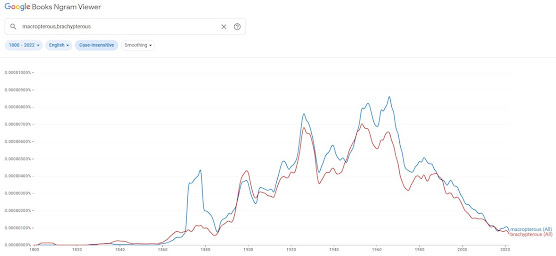
Google ngram: Because of the way Google harvests data for their ngrams, they’re not literally a tracking of the use of a word in society but can be usefully indicative of certain trends, (although one is never quite sure which trend(s)), especially over decades.  As a record of actual aggregate use, ngrams are not wholly reliable because: (1) the sub-set of texts Google uses is slanted towards the scientific & academic and (2) the technical limitations imposed by the use of OCR (optical character recognition) when handling older texts of sometime dubious legibility (a process AI should improve).  Where numbers bounce around, this may reflect either: (1) peaks and troughs in use for some reason or (2) some quirk in the data harvested.

Brachypterous (pronounced bruh-kip-ter-uhs)

In zoology (mostly in ornithology & entomology), having short, incompletely developed or otherwise abbreviated wings (defined historically as being structures which, when fully folded, do not reach to the base of the tail.long or large wings or fins.

Late 1700s: The construct was brachy- + -pterous.  The brachy- prefix was from the Ancient Greek βραχύς (brakhús) (short), from the Proto-Hellenic brəkús, from the primitive Indo-European mréǵus (short, brief).  The cognates included the Sanskrit मुहुर् (múhur) & मुहु (múhu), the Avestan m̨ərəzu.jīti (short-lived), the Latin brevis, the Old English miriġe (linked ultimately to the English “merry”) and the Albanian murriz.  It was appended to convey (1) short, brief and (2) short, small.  Brachypterous & brachypteran are adjectives and brachyptery & braˈchypterism are nouns.  The comparative would be more brachypterous and the superlative most brachypterous but because of the nature of the base word, that would seem unnatural.  The noun brachypter does not means “a brachypterous creature; it describes taeniopterygid stonefly of the genus Brachyptera”.

The European Chinch Bug which exists in both macropterous (left) and brachypterous (right) form; Of the latter, entomologists also use the term "micropterous" and use does seem interchangeable but within the profession there may be fine distinctions. 

The difference in the use of macropterous (long wings or fins) and brachypterous (short wings) is accounted for less by the etymological roots than the application and traditions of use.  In zoological science, macropterous was granted a broad remit and came to be used of any creature (form the fossil record as well as the living) with long wings (use most prevalent of insects) and water-dwellers with elongated fins.  The word was applied first to birds & insects before being used of fish (fins being metaphorical “wings” and in environmentally-specific function there is much overlap.  By extension, in the mid-twentieth century, macropterous came to be used in engineering, architecture and design including of cars, airframes and missiles.

Brachypterous (short wings) is used almost exclusively in zoology, particularly entomology, the phenomenon being much more common than among birds which, being heavier, rely for lift on wings with a large surface area.  Short wing birds do exist but many are flightless (the penguin a classic example where the wings are used in the water as fins (for both propulsion and direction)) and this descriptor prevails.  Brachypterous is less flexible in meaning because tightly it is tied to a specific biological phenomenon; essentially a “short fin” in a fish is understood as “a fin”.  Cultural and linguistic norms may also have been an influence in that while “macro-” is widely used a prefix denoting “large; big”, “brachy-” has never entered general used and remains a tool in biology.  So, in common scientific use, there’s no recognized term specifically for “short fins” equivalent to brachypterous (short wings) although, other than tradition, there seems no reason why brachypterous couldn’t be used thus in engineering & design.  If so minded, the ichthyologists could coin “brachyichthyous” (the construct being brachy- + ichthys (fish)) or brachypinnate (the construct being brachy- + pinna (“fin” or “feather” in Latin)), both meaning “short-finned fish”.  Neither seem likely to cath on however, the profession probably happy with “short-fin” or the nerdier “fin hypoplasia”.

The tailfin: the macropterous and the brachypterous
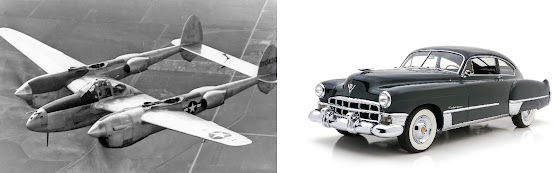
Lockheed P-38 Lightning in flight (left) and 1949 Cadillac (right).

Fins had appeared on cars during the inter-war years when genuinely they were added to assist in straight-line stability, a need identified as speeds rose.  The spread to the roads came from the beaches and salt flats where special vehicles were built to pursue the world land speed record (LSR) and by the mid 1920s, speeds in these contests were exceeding 150 mph (240 km/h) and at these velocities, straight-line stability could be a matter of life and death.  The LSR crew drew their inspiration from aviation and that field also provided the motif for Detroit’s early post-war fins, the 1949 Cadillac borrowing its tail features from the Lockheed P-38 Lightning (a US twin-boom fighter first flown in 1939 and built 1941-1945) although, despite the obvious resemblance, the conical additions to the front bumper bar were intended to evoke the image of speeding artillery shells rather than the P-38’s twin propeller bosses.
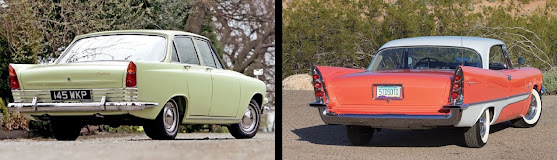
1962 Ford (England) Zodiac Mark III (left) and 1957 DeSoto Firesweep two-door hardtop (right).  Chrysler in 1957 really did claim the tail-fins were not mere decorations but "stabilizers" designed to move the centre of pressure rearward.

From there, the fins grew although it wasn’t until in 1956 when Chrysler released the next season’s rage that extravagance truly began.  To one extent or another, all Chrysler’s divisions (Plymouth, Dodge, DeSoto, Chrysler, Imperial) adopted the macropterous look and the public responded to what was being described in the press as “futuristic” or “jet-age” (Sputnik had yet to orbit the earth; “space-age” would soon come) with a spike in the corporation’s sales and profits.  The competition took note and it wasn’t long before General Motors (GM) responded (by 1957 some Cadillac fins were already there) although, curiously Ford in the US was always tentative about the fin and their interpretation was always rather brachypterous (unlike their English subsidiary which added surprisingly prominent fins to their Mark III Zephyr & Zodiac (1961-1966).

Macropterous: Lindsay Lohan with wings, generated with AI (artificial intelligence) by Stable Diffusion.

Even at the time the fins attracted criticism although it was just as part of a critique of the newer cars as becoming too big and heavy with a notable level of inefficiency (increasing fuel consumption and little (if any) increase in usable passenger space with most of the bulk consumed by the exterior dimensions, some created by apparently pointless styling features of which the big fins were but one.  The public continued to buy the big cars (one did get a lot of metal for the money) but there was also a boom in the sales of both imported cars (their smaller size among their many charms) but the corporation which later became AMC (American Motor Corporation) enjoyed good business for their generally smaller offerings.  Chrysler and GM ignored Ford’s lack of commitment to the macropterous and during the late 1950s their fin continued to grow upwards (and, in some cases, even outwards) but, noting the flood of imports, decided to join the trend, introducing smaller ranges; whereas in 1955, the majors offered a single basic design, by 1970 there would be locally manufactured “small cars”, sub-compacts”, “compacts” and “intermediates” as well as what the 1955 (which mostly had been sized somewhere between a “compact” and an “intermediate”) evolved into (now named “full-size”, a well-deserved appellation).
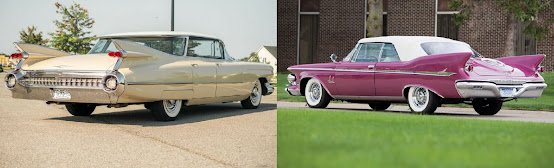
1959 Cadillac with four-window hardtop coachwork (the body-style known also as the "flattop" or "flying wing roof") (left) and 1961 Imperial Crown Convertible (right).

It was in 1959-1961 that things became “most macropterous” (peak fin) and the high-water mark of the excess to considered by most to be the 1959 Cadillac, east of the towering fins adorned with a pair of taillights often described as “bullet lights” but, interviewed year later, a member of the General Motors Technical Center (opened in 1956 and one of the mid-century’s great engines of planned obsolescence) claimed the image they had in mind was the glowing exhaust from a rocket in ascent, then often seen in popular culture including film, television and advertising.  However, although a stylistic high, it was the 1961 Imperials which set the mark literally, the tip of those fins standing almost a half inch (12 mm) taller and it was remembered too for the “neo-classical” touch of four free-standing headlights, something others in the industry declined to follow.
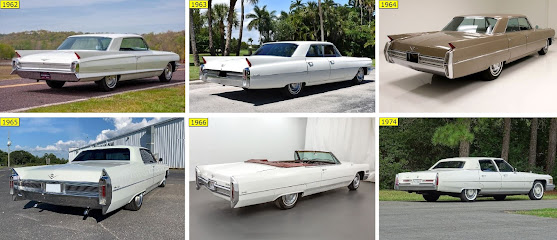
Tending to the brachypterous: As the seasons went by, the Cadillac's fins would retreat but would not for decades wholly vanish.

It’s a orthodoxy in the history of design that the fins grew to the point of absurdity and then vanished but that’s not what literally happened in all cases.  Some manufacturers indeed suddenly abandon the motif but Cadillac, perhaps conscious of having nurtured (and in a sense “perfected”) the debut of the 1949 range must have felt more attached because, after 1959, year after year, the fins would become smaller and smaller although decades later, vestigial fins were still obviously part of the language of design.  In Europe, others would also prune.

Macropterous to brachypterous.  Sunbeam Alpine: 1960 Series I (left) and 1966 Series V. 

Built in five series between 1959-1968, the fins on the Sunbeam Alpine would have seemed a good idea in 1957 when the lines were approved but trend didn’t persist and with the release in 1964 of the revised Series IV, the effect was toned down, the restyling achieved in an economical way by squaring off the rake at the rear, this lowering the height of the tips.  Because the release of the Series IV coincided with the debut of the Alpine Tiger (fitted initially with a 260 cubic inch (4.2 litre) V8 (and later a 4.7 (289)), all the V8 powered cars used the “low fin” body.

Macropterous to brachypterous. 1961 Mercedes-Benz 300 SE Lang (Long) (left) and 1971 Mercedes-Benz 280 SE 3.5 coupé.

Regarded by some as a symbol of the way the Wirtschaftswunder (the post war “economic miracle” in the FRG (Federal Republic of Germany, the old West Germany)) had ushered away austerity, the (slight) exuberance of the fins which appeared on the Mercedes-Benz W111 (1959-1968) & W112 (1961–1965) seemed almost to embarrass the company, offended by the suggestion they would indulge in a mere “styling trend”.  Although the public soon dubbed the cars the Heckflosse (literally “tail-fins”), the factory insisted they were Peilstege (parking aids or sight-lines (literally "bearing bars")), the construct being peil-, from peilen (take a bearing; find the direction) + Steg (bar) which marked the extent of the bodywork, this to assist while reversing.  That may have been true (the company has never been above a bit of myth-making) but when a coupé and cabriolet was added to the W111 & W112 range, the fins were noticeably smaller, achieving an elegance of line Mercedes-Benz has never matched.  Interestingly, a la Cadillac, when the succeeding sedans (W108-W109 (1965-1972) & W116, (1972-1979)) were released, both retained a small hint of a fin although by 1972 it wasn’t enough even to be called vestigial; the factory said the small deviation from the flat was there to increase structural rigidity.
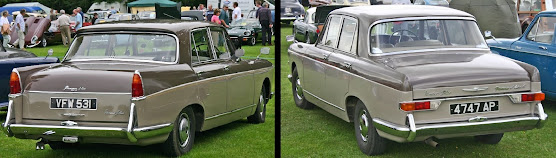
Macropterous to brachypterous: 1962 Vanden Plas Princess 3 Litre (left) and 1967 Vanden Plas Princess 4 Litre R (right).

The Italian design house Pinninfarina took to fins in the late 1950s and applied what really were variations of the same basic design to commissions from Fiat, Lancia, Peugeot and BMC (British Motor Corporation, a conglomerate created by merger in 1952 which brought together Morris, Austin (and soon Austin-Healey), MG, Riley, Wolseley & Vanden Plas under the one corporate umbrella.  There were a several BMC “Farinas” sold under six badges and the ones with the most prominent fins were the “big” Farinas, the most expensive of which were Princess 3 Litre (1959-1960), Vanden Plas Princess 3 Litre (1960-1964) and Vanden Plas Princess 4 Litre R (1964-1968); the “R” appended to the 4 Litre’s model name was to indicate its engine (which had begun life as a military unit) was supplied by Rolls-Royce, a most unusual arrangement.  The 4 Litre used the 3 Litre’s body with a number of changes, one of which was a change in the shape and reduction in the size of the rather chunky fins.  Although the frumpy shell remained, the restyling was thought quite accomplished though obviously influenced by the Mercedes-Benz W111 & W112 coupés & cabriolets but if one is going to imitate, one should choose to emulate the finest.

1957 Herter Duofoil Flying Fish Deluxe (15′ 7″ (4.75 m)).

Herter's outdoor goods business was founded by George Herter (1911–1994) of Waseca, Minnesota.  Mr Herter was a World War II (1939-1945) combat veteran and it seems that while not exactly reclusive, he avoided personal publicity although in addition to his manufacturing concerns and other business interests, he was also a prolific author, his best remembered the Bull Cook Series (1960-1970) and Authentic Historical Recipes and Practices (in three volumes) copies of which still circulate among collectors.  He built his outdoor goods business (hunting, fishing & shooting) using the mechanism of the mail-order catalog, long a tradition in American commerce and the Amazon of the pre-internet age.  The quality of the products offered was apparently good but the imaginative Mr Herter labelled most of the items as “world famous”, “model perfect”, “state of the art” and such while claiming many were endorsed by the (non-existent) “North Star Guides Association”.  Competition, changes in patterns of consumption and the restrictions imposed by the Gun Control Act (1968) (The second-hand Italian Carcano 6.5 mm rifle with which Lee Harvey Oswald (1939–1963) shot John Kennedy (JFK, 1917–1963; US president 1961-1963) was purchased by mail-order (US$19.95 + US$1.50 P&H (postage & handling)) made business difficult and Herter declared bankruptcy in 1977 although the trading-name was taken over by Cabela's and Bass Pro Shops which still uses the brand.

The Herter craft picked up the fin motif from GM & Chrysler but used only boating industry standard red marker lights (left) rather than something like the DeSoto triple-stack they perhaps deserved but one owner of a 1960 Herter Mark III Flying Fish Runabout (14' (4.2 m), right) saw the potential and replaced the modest lens with pair of the "twin bullet" items made famous on the 1959 Cadillac.  Unfortunately, they weren't installed mid-fin which would have replicated the original extravagance.

Mr Herter’s early boats were for duck hunting and fishing but, noting the post-war boom in recreational boating, the company expanded into the runabout market and the designs reflected his fascination with GRP (glass-reinforced plastic and soon better known as fibreglass) which he would use for a wide array of products, continuing even after from withdrawing from the boat business.  The first runabout was the “Chrome Fiberglass Duofoil World Famous Deluxe Flying Fish” (one of Mr Herter’s typically bombastic names) and it featured large, cast aluminum fins bolted to the rear deck.  Although powerboats built for racing and attempts on the WSR (water speed record) had long used fins to improve straight-line stability, those on the Herter runabouts were about as related to aerodynamics as Chrysler’s claim those on the 1957 Plymouths were “stabilizers”.  Herter fins didn’t get smaller for 1957 but were integrated with the fibreglass hull and in subsequent seasons became more obviously streamlined.  Apparently (and reputedly intentionally) never a profitable line, Mr Herter in 1962 abandoned the runabouts and focused production on the more utilitarian (and lucrative) duck boats and rowboats.

Tuesday, October 10, 2023

Macrocephalic

Macrocephalic (pronounced mak-roh-sef-a-lee)

The condition of having an abnormally large head or skull, the diagnostic criterion usually the circumference being beyond the normal range.

1851: From the Ancient Greek makrokephalos, the construct being māk ros (large, long), from the primitive Indo-European root māk- (long, thin) + the Ancient Greek κεφαλή (kephal) (head).  English borrowed cephaly from the French -céphalie or the German -zephalie, from the Latin -cephalia, from the Ancient Greek kephal.  The form macrocephalous (having a long head) dates from 1810.  The primitive Indo-European root māk (long, thin) forms part of emaciate, macro, macro-, macrobiotic, macron, meager & paramecium.  It’s thought to be the source of the Ancient Greek makros (long, large) & mēkos (length), the Latin macer (lean, thin), the Old Norse magr & the Old English mæger (lean, thin).  The less commonly used terms in pathology are megacephaly and megalocephaly and a related term is sub-macrocephaly.  Macrocephalic & macrocephalous are adjectives, macrocephalous and macrocephaly are nouns; the noun plural is macrocephalies

DPRK generals in their big hats, leaving the monthly hat ceremony, wearing the millinery badges they've been awarded.

There’s no evidence heads in the DPRK (Democratic People’s Republic of Korea (North Korea) differ, on a population basis, from the those of the rest of the human race.  Even though the DPRK has to a high degree been physically isolated from the outside population since the early 1950s, the gene pool in the population is sufficiently diverse that most in the field expect there’d be no change to aggregate outcomes in human physiology.  Indeed, those changes which have been noted (stunting etc), are thought the consequence of nutritional deficiencies rather than anything genetic.

Suleiman I (Süleyman the Magnificent, 1494-1566, Sultan of the Ottoman Empire 1520-1566) (far left), Pius XII (1876-1958; pope 1939-1958) in the papal triple tiara (triple crown) at his coronation, 1939 (centre left), depiction of Süleyman the Magnificent in his retaliatory four tier helmet (centre right) and Officer of the 4th (Royal Irish) Dragoon Guards (1826), watercolor by Richard Simkin (1850-1926) (far right).  The dragoons always had famously good hats.

Kim Jong-un, looking at DPRK generals in their big hats.

In military uniforms, ecclesiastical dress and fashion, big hats have been a thing for thousands of years, the earliest presumably a form of biomimicry, inspired by examples like the plumage of birds or the manes of lions.  In human society, the purpose would not have been dissimilar to that of the other animals: wishing to appear (1) larger and more threatening to deter attacks, (2) of a higher status than others or (3) more attractive to attract a mate and this procreate.  Some uses would of course have been for mere function, headwear serving as protection from the elements or impacts, modern examples including the wide-brimmed hats adopted to shade one from the sun, the Mexican sombrero emblematic of this.  In the modern era (and it's a trend noted since at least late antiquity), extravagant headwear exists for no purpose other than to attract whatever is the currency of the age, photographers at the fashion shows or clicks on the internet.  On the catwalks, some creations can hardly be described as functional or conventionally attractive so clickbait is the only explanation and whether some of that worn by figures such as Lady Gaga (b 1986) was inspired by the millinery of Süleyman the Magnificent isn't known but the thematic similarities can't be denied.  Of course, over thousands of years, there's going to be some stylistic overlap; there are only so many ways to adorn a head.

DPRKesque fashion: Adolf Hitler (1889-1945; Führer (leader) and German head of government 1933-1945 & head of state 1934-1945, left) and Victor Emmanuel III (1869–1947; King of Italy 1900-1946, right) observing the Italian Navy conduct maneuvers, Gulf of Naples, 1938 (left) and Lindsay Lohan in a promotional image from her campaign for US hair and skin beauty care corporation Nexxus, 2024.

Celebrities like big hats for a number of reasons.  Jacqueline Kennedy (1929-1994; US First Lady 1961-1963) told Lyndon Johnson (LBJ, 1908–1973; US president 1963-1969) she wore wide-brimmed hats to prevent him kissing her while the diminutive Victor Emmanuel III (1869–1947; King of Italy 1900-1946) had the royal milliners craft a number of unusually tall hats (including military caps) to add two inches (50 mm) odd to his  stature.  The elevation was especially obvious when he was standing with those wearing conventionally sized military headwear and it's doubtful anyone was fooled.  Technically, Victor Emmanuel didn’t fit the definition of dwarfism which sets a threshold of adult height at 4 feet 10 inches (1.47 m), the king about 2 inches (50 mm) taller (or less short) and it’s thought the inbreeding not uncommon among European royalty might have been a factor, both his parents and grandparents being first cousins.  However, although not technically a dwarf, that didn’t stop his detractors in Italy’s fascist government calling him (behind his back) il nano (the dwarf), a habit soon picked up the Nazis as der Zwerg (the dwarf) (although Hermann Göring (1893–1946; leading Nazi 1922-1945, Hitler's designated successor & Reichsmarschall 1940-1945) was said to have preferred der Pygmäe (the pygmy)).  In court circles he was knows also (apparently affectionately) as la piccola sciabola (the little sabre) a nickname actually literal in origin because the royal swordsmith had to forge a ceremonial sabre with an unusually short blade for the diminutive sovereign to wear with his many military uniforms.  His French-speaking wife (Princess Elena of Montenegro (1873–1952; Queen of Italy 1900-1946)) stood a statuesque six feet (1.8 m) tall and always called him mon petit roi (my little king).  It was a long and happy marriage and genetically helpful too, his son and successor (who enjoyed only a brief reign) very much taller although his was to be a tortured existence Still, in his unhappiness the scion stood tall and that would have been appreciated by the late Prince Philip, Duke of Edinburgh (1921–2021) who initially approved of the marriage of Lady Diana Spencer (1960-1997) to the Prince of Wales (b 1948) on the basis that she “would breed some height into the line”.

Kim Jong-un at a military briefing, conducted by DPRK generals in their big hats.

The papal triple tiara is a crown which has been worn by popes of the Roman Catholic Church since the eighth century.  Traditionally it was worn for their coronation but no pontiff has been so crowned since Saint Paul VI (1897-1978; pope 1963-1978) in 1963 and he abandoned its use after the Second Vatican Council (Vatican II, 1962-1965).  The name tiara refers to the entire headgear and it has used a three-tiered form since a third crown was added during the Avignon Papacy (1309–1378).  It's also referred to as the triregnum, triregno or Triple Crown.  In a piece of one- (or perhaps four-) upmanship, Süleyman the Magnificent commissioned from Venice a four tier helmet to show, in addition to the authority claimed by popes, he could add the symbol of his imperial power, his secular sovereignty.  Often put on display as the centrepiece of Ottoman regalia to impress visitors, there's no documentary evidence the sultan ever wore the four layer tiara, crowns not part of the tradition and, fashioned from gold and gemstones, it would anyway have been extraordinarily heavy and it may be it was worn only for brief, static, set piece ceremonies because an incautious movement could have risked neck injury.

A younger, more svelte Kim Jong-un at a military field conference, noting one general not issued with big hat.

A representation of the triregnum combined with two crossed keys of Saint Peter continues to be used as a symbol of the papacy and appears on papal documents, buildings and insignia.  Remarkably, there’s no certainty about what the three crowns symbolize.  Some modern historians link it to the threefold authority of the pope, (1) universal pastor, (2) universal ecclesiastical jurisdiction and (3) temporal power.  Others, including many biblical scholars, interpret the three tiers as meaning (1) father of princes and kings, (2) ruler of the world and (3) vicar of Christ on Earth, a theory lent credence by the words once used when popes were crowned:  Accipe tiaram tribus coronis ornatam, et scias te esse patrem principum et regum, rectorem orbis in terra vicarium Salvatoris nostri Jesu Christi, cui est honor et gloria in saecula saeculorum (Receive the tiara adorned with three crowns and know that thou art father of princes and kings, ruler of the world, vicar on earth of our Savior Jesus Christ, to whom is honor and glory for ever and ever).

Kim Jong-un on an afternoon stroll with DPRK generals, discussing the politics of big hair and big hats.

The preference in the DPRK armed forces for big hats is appears to be a matter of military fashion rather than physiological need and big hats are part of a military tradition which, although now restricted mostly to ceremonial use, were once functional in that they provided warmth, an impression of greater height and some degree of protection from attack.  Being made from animal fur, the hats are now controversial but, as a natural material, they have proved more durable and resistant to the weather than synthetic alternatives, factors which military authorities long cited as the reason for their retention.

Bearskin cap of the UK Foot Guards, made traditionally with the fur of Canadian bears (left) and model Lucy Clarkson (b 1982, right), fetchingly body-painted in the uniform of the Queen's Guards, in a demonstration organized by People for the Ethical Treatment of Animals (PETA) to draw attention to the slaughter of the bears due to the use of real bearskins in the Guard's ceremonial headdress, Westminster Bridge, London 2010.  Whether the Ministry of Defence was persuaded by PETA's arguments, Ms Clarkson's charms or some analysis which revealed the exorbitant cost of purchasing and maintaining the bearskin hats isn't clear but recently it was announced the traditional ones will be "phased out" in favor of units made from “faux” bearskin.

Kim Jong-un discussing millinery ethics with DPRK generals wearing big hats.

The tall bearskin cap, usually associated with parade ground manoeuvres around Buckingham palace, was historically the headgear of the Grenadier Guards and, remarkably, it was sometime part of battlefield dress even in the twentieth century.  It remains part of the ceremonial uniforms in many armed forces and not just those once part of the British Empire.  That up to a hundred Canadian bears are each season slaughtered "just so men could wear big hats while marching around in circles" is claimed by the activists to be of "no obvious military value but merely a tourist attraction".  While there's merit in the argument there is a legitimate military purpose in the maintenance of traditions, extending that to fur hats does seem quite abstract.  

Kim Jong-un (right) looking at Jang Song-thaek's big hat (left).

In the DPRK, Jang Song-thaek (1946-2013) was married to Kim Kyong-hui (b 1946; believed still alive), only daughter Kim Il-sung (1912-1994; Great Leader of DPRK 1949-1994) and only sister of (1941-2011; Dear Leader of DPRK; 1994-2011). He was thus the uncle (by marriage) of Kim Jong-un (b circa 1983; Supreme Leader of DPRK since 2011).  Within the party, he had a mixed career but ups and downs within the structure were not unusual and later in the reign of the Dear Leader, he emerged as a important figure in both the political and military machines around which things in the DPRK revolve.  His position appeared to be strengthened when the Supreme Leader assumed power but in 2013 he was accused of being a counter-revolutionary, was expelled from the party, dismissed from his many posts and was un-personed by having his photograph and mention of his name digitally erased from all official records.  In December that year, the KCNA (Korean Central News Agency, the regime's energetic and highly productive state media organization) announced his execution.

Obviously guilty as sin: Jang Song-thaek (left) being brought before the court (right).

On the basis of the official statement issued by the KCNA, he must have been guilty, highlights of the press release including confirmation he was an anti-party, counter-revolutionary factional element and despicable political careerist and trickster…, a traitor to the nation for all ages who perpetrated anti-party, counter-revolutionary factional acts in a bid to overthrow the leadership of our party and state and the socialist system”.  It noted that despite receiving much trust and benevolence by the peerlessly great men … The Great Leader, The Dear Leader and The Supreme Leader, he behaved worse than a dog, perpetrated thrice-cursed acts of treachery in betrayal of such profound trust and warmest paternal love.  Of note was his subversion of interior decorating, preventing “the Taedonggang Tile Factory from erecting a mosaic… as a monument to the Great Leader, not in its deserved place in the sun but “…in a shaded corner.  Perhaps worse of all, he let the decadent capitalist lifestyle find its way to our society by distributing all sorts of pornographic pictures among his confidants since 2009. He led a dissolute, depraved life, squandering money wherever he went.  In summary, the release added Jang was a thrice-cursed traitor without an equal in the world and that history will eternally record and never forget the shuddering crimes committed by Jang Song Thaek, the enemy of the party, revolution and people and heinous traitor to the nation.

Details of such matters are hard to confirm so it’s not known if the rumors of him being executed by anti-aircraft gun fire or a flame-thrower are true.  Nor is it known if whatever remained of the corpse was thrown to a pack of wild dogs but the KCNA's press release did add: “…the revolutionary army will never pardon all those who disobey the order of the Supreme Commander and there will be no place for them to be buried even after their death so the dog-food theory was at least plausible.

KCNA’s official photograph, commemorating the Supreme Leader’s tour of “inspection and field guidance” of the Taedonggang Tile Factory, September 2012.  Included in the Supreme Leader’s entourage was Jang Song-thaek (in army uniform on top platform).

The Supreme Leader learned in detail about factory operations including the processes used in the microlite shop and artificial marble tile shop, the latter able to produce tiles in the same colors and patterns as those of natural marble.  Addressing the workers, the Supreme Leader underlined the need to continue directing big efforts to improving the quality of products, noting that the quality of tiles depends on plane and right angle tolerable numerical value, contraction rate, intensity and resistance to cold.  When seeing tiles of diverse colors and sizes, he expressed great satisfaction that, figuratively speaking, “all clothes and underwear are locally made”, a thoughtful observation which attracted much applause.  It was on this visit the Supreme Leader became aware of the subversive and treasonous order from Jang Song-thaek that the mosaic erected as a monument to the Great Leader must be installed not in its deserved place in the sun but in a shaded corner.

Kim Jong-un, looking through binoculars across the Demilitarized Zone (DMZ) at the small hats worn by RoK (Republic of Korea (South Korea)) generals.