Showing posts sorted by relevance for query Ultimatum. Sort by date Show all posts

Saturday, March 28, 2026

Ultimatum

Ultimatum (pronounced uhl-tuh-mey-tuhm or uhl-tuh-mah-tuhm)

(1) A final, uncompromising demand or set of terms issued by a party to a dispute (used especially of governments and WAGs (wives & girlfriends)), the rejection of which may lead to a severance of relations, the imposition of sanctions, the use of force etc.

(2) A final proposal or statement of conditions; any final or peremptory demand, offer or proposal.

1731: From the New Latin, a specialized use of the Medieval Latin ultimatum (a final statement), noun use of neuter of Latin adjective ultimātus (last possible, final; ended, finished), past participle of ultimāre (to come to an end), from ultimus (extreme, last, furthest, farthest, final).  The Latin plural ultimata was used by the Romans as a noun in the sense of “what is farthest or most remote; the last, the end”.  In mid-1920s slang ultimatum described also “the buttocks” (a use which deserves to be revived).  In English, the plural form had an interesting trajectory.  Although the Anglo-Irish satirist & Anglican cleric Jonathan Swift (1667–1745) used “ultimatums”, that didn’t until the twentieth century convince the OED (Oxford English Dictionary) to displace ultimata as the recommended form.  In diplomacy (a world of “gray areas”), the comparative is “more ultimative”, the superlative “most ultimative”.  Ultimatum is a noun, ultimating & ultimated are verbs and ultimative is an adjective; the noun plural is ultimatums or ultimata. 

The first ultimatum would have been issued in prehistoric times and there have been many since.  History suggests a great many have been bluffs which can be a successful tactic if perceived as plausible but often the “bluff was called” and the ultimatum proved a hollow threat, thus the language of diplomacy including also the (sometimes darkly) satirical or humorous (1) penultimatum (plural penultimatums or penultimata) which describes a statement of terms or conditions made by one party to another, commonly expressed as an ultimatum in the hopes of compelling immediate compliance with demands, but that then is superseded by more negotiation instead of actual dire consequences and (2) antepenultimatum (plural antepenultimatums or antepenultimata) which describes a statement of terms or conditions made by one party to another, essentially a penultimatum, but even more tentative and more repeatedly abandoned in favour of subsequent ignominious compromises.  The trouble with unfulfilled ultimatums is that while rapidly they can lose their persuasive power (in a manner analogous with Aesop's Fable The boy who cried wolf), at some point a party issuing unenforced ultimatums may one day make good on their threats, the high stakes gambler Adolf Hitler (1889-1945; Führer (leader) and German head of government 1933-1945 & head of state 1934-1945) and the rather dim-witted Joachim von Ribbentrop (1893–1946; Nazi foreign minister 1938-1945) both in September 1939 genuinely surprised when the Anglo-French ultimatum guaranteeing the sovereignty of Poland was honoured, the previous back-downs no longer a guide.  Of course, six year later, Polish sovereignty was sacrificed to political necessity but a war which began with the RAF (Royal Air Force dropping leaflets politely asking the Germans to stop what they were doing and ended with the USAAF (US Army Air Force) dropping A-bombs of Japanese cities had many unintended consequences.

CD cover art for Lindsay Lohan's Spirit in the Dark (2008) album.

For centuries, the word “ultimatum” seems to have been avoided by poets, librettists and lyricists.  Ultimatum is a Latinate “formal” word so perhaps not well-suited to love songs but beyond the register and tone, those studying structural linguistics note the prosody: It’s a four-syllable word with a stress pattern (ul-TIM-a-tum) difficult to “fit into” common meters and melodic phrasing.  That said, while there’s a semantic narrowness, the idea of the ultimatum (a final demand backed by consequences) is hardly rare in opera and poetry but it tends to be described or implied rather than labelled with the specific word.  However, one niche was found in the definitely modern genre of rap, hip-hop and such and that’s attributed to the material putting a premium on conflict, violence and the technique of rhyming on the final syllable.  Undaunted however was Kara DioGuardi (b 1970) who included “ultimatum” in the opening verse of the Lindsay Lohan song Stay (2008).  Its inclusion is a genuine rarity.

Verse 1 of Stay (2008) Kara DioGuardi, sung by by Lindsay Lohan.

Baby, take your coat off and your shoes and just relax
Let your body sink into these arms, that's where it's at
I'll open up a bottle and slip into something else
I hope tonight's the night that all these walls are gonna melt
'Cause when we're out, you're sending me mixed signals all the time
You want me, but you don't just wanna lay it on the line
So baby, here's your ultimatum, are you in or out?
All you have to do is wanna turn this all around, and...

If it was for poets a challenge to splice “ultimatum” into the body of a work, without any discordance it could be used as a title and Philip Larkin (1922-1985) choose it for his first published poem which appeared in The Listener on 28 November, 1940:

Ultimatum (1940) by Philip Larkin.

But we must build our walls, for what we are
Necessitates it, and we must construct
The ship to navigate behind them, there.
Hopeless to ignore, helpless instruct
For any term of time beyond the years
That warn us of the need for emigration:
Exploded the ancient saying: Life is yours.
For on our island is no railway station,
There are no tickets for the Vale of Peace,
No docks where trading ships and seagulls pass.
Remember stories you read when a boy
- The shipwrecked sailor gaining safety by
His knife, treetrunk, and lianas - for now
You must escape, or perish saying no.

Unknown previously, “ultimatum” did occasionally appear in twentieth century poetry, a product probably of the big, multi-theatre wars and the use in modern and experimental poetry of language which borrowed from abstract or formal vocabularies.  While the terrible first half of the twentieth century gave poets plenty of scope to explore the concept (it was an age of ultimatums), in print, it was done almost without mention of the word.

The issuing of ultimatums has shaped a number of turning points in history; variously they have proved decisive, stabilizing or catastrophic.  Probably the most infamous was the “July Ultimatum”, served on Serbia by Austria-Hungary after a Serbian nationalist assassinated Archduke Franz Ferdinand (1863–1914; heir presumptive to the throne of the Austro-Hungarian Empire).  While such a procedure was orthodox politics, what was notable about what Vienna did in 1914 was to make demands it was certain Serbia would be unable to fulfil.  The Austrians hankered for war because they wanted permanently to put an end the “Serbian threat” and Berlin, anticipating a traditional, short, sharp, limited war of a few weeks, gave Vienna the infamous “German blank cheque” of support.  Belgrade accordingly turned to its traditional supporters in Moscow who agreed to offer military support; that came after the Kremlin had received confirmation from Paris that France would honor its treaty arrangement with Russia.  From all this came the outbreak of war in August 1914 by which time the British (for a variety of reasons) had become involved and by 1917 the US had become a belligerent; this was conflict which came to be called “The World War” before in the 1940s being renamed “World War I” (1914-1918).

Even in 1945, the phrase “unconditional surrender” (the origin an apparently chance remark (although subsequently he would cite a precedent from the US Civil War (1861-1865)) by Franklin Delano Roosevelt (FDR, 1882–1945, POTUS 1933-1945) at the Casablanca Conference (January 1943)) had been controversial because of the concern it had lengthened the war against Germany by dissuading (the probably chimerical) opposition forces within the country from staging a coup with a view to negotiating peace.  Despite that, at the Potsdam Conference (July-August 1945) the Allied powers (China, the UK & US, the Soviet Union not then at war with Japan) served Tokyo with the Potsdam Declaration demanding exactly that.  After the two A-bombs were dropped, the Japanese agreed to a surrender that fell a little short of being “unconditional” but the Americans decided to accept the offer, concluding having a “puppet emperor”.

Trump: The Art of the Deal (First Edition, 1987) by Donald J. Trump with Tony Schwartz.

One once improbable text in 2016 added to the reading lists of political analysts was Trump: The Art of the Deal (1987) by Donald J. Trump (b 1946; POTUS 2017-2021 and since 2025) with Tony Schwartz (b 1952).  It’s a useful book because in it Mr Trump (or Mr Schwartz depending on one’s spin of choice) provided examples of negotiating techniques.  That book was about commerce, notably property deals, but it gave an insight into why Mr Trump later succeeded so well in reality TV, his understanding of the potency of mixing fact, threats, spectacle and blatant untruths underlining that second career.  He may not, while the book was being drafted, have been contemplating politics as a third career but he did find many of its techniques could be adapted to international diplomacy.  In that he proved an innovator but there are limitations to how well things translate.  One weapon in the arsenal is the ultimatum which can be used in real-estate deals with few consequences beyond the relatively few individuals concerned but in international relations, such things can have cascading global effects.

If within the White House there were any doubts the issuing of ultimatums might have consequences other than what was desired, the path of the conflict in the Middle East should have given them some interesting case studies.  What’s also interesting is whether in the White House the possible reactions to ultimatums were discussed prior to them being presented.  Giving the Ayatollahs 48 hours to reopen the Strait of Hormuz or face withering new airstrikes on Iran’s power generation infrastructure sounded decisive on Truth Social (which definitely is part of the modern calculation in such matters) but Tehran responded by threatening to target the energy and water desalination facilities in the neighboring Gulf states.  As threats go, it was a stark warning because those nations can rely on desalinated water for as much as 90% of their needs and have no practical alternative so it would have been an escalation with potentially devastating regional consequences.

Not a model easily translatable to Iran.  Nicolás Maduro (b 1962; President of Venezuela 2013-2026, right) and his lawyer Barry Pollack (b 1964, left), US Federal Court, Manhattan, New York City, March 2026, illustration by Jane Rosenberg (b 1949).

Accordingly, prior to the deadline, Mr Trump announced he’d “temporarily” called of the strikes, claiming that was induced not by Tehran’s counter-threat but by “productive” talks with “the right people”.  He didn’t descent to specifics (something not unusual in back channel diplomacy) but did add the talks had revealed “major points of agreement” and “they want very much to make a deal, we'd like to make a deal, too.  Apparently unimpressed, Iranian state media, claimed the president had backed down in the face of their threats and denied talks of any significance were taking place.  Again, in diplomacy of this kind, denials are standard procedure.  A few hours later, Mr Trump assured an audience the US was conducting “very, very good discussions” with Iran.  So it’s competing narratives and analysts made no attempt to try to work out how much truthfulness was coming from either side but more than one observed that if the president had realized he’d painted himself into a corner by delivering the ultimatum, revealing previously unannounced back-channel discussions was a quick and face-saving way to buy some time to hope plan A (missiles and bombs) works.  There was though from some sources the notion the mention of “the right people” may put in the mind of the regime the audacious kidnapping of Nicolás Maduro (b 1962; President of Venezuela 2013-2026), an operation made possible by the cooperation of “the right people” in Caracas.  Some suspicion of one’s colleagues might be understandable given the extraordinary success achieved in assassinating leading figures in the Iranian political establishment and the IRGC (Islamic Revolutionary Guard Corps).

While it can be guaranteed US-Iran “talks” are taking place in some form, trying to predict the course of this conflict is difficult because there are relatively few models from the past which might provide something of indicative value.  Since the end of the Cold War, one endlessly repeated admonition issued by those in the Middle East to successive occupants of the White House has been not to do this or that because “you will open the gates of Hell”.  Many probably suspect that at some point in that last few years, those gates were at least pushed ajar but if things do escalate they could be torn from their hinges and the most worrying scenario is that US land forces will be deployed against Iran with the active cooperation of the Gulf States, something unthinkable as recently as a few weeks ago.  The theory supporting this is based on the notion that the attacks on Iran conducted over the past year have made irrevocable the Ayatollah’s determination to acquire an IND (independent nuclear deterrent), a quite rational response by any regime reviewing military matters since 1945.  Of course, ayatollahs with A-bombs would trigger a chain reaction because a number of states in the region would also demand their own IND with a genuinely autonomous launch capacity because, just as Charles de Gaulle (1890-1970; President of France 1959-1969) felt compelled to acquire the capacity because he doubted “a US president would risk New York to save Paris” the same concerns would extend to the fate of Dubai and Riyadh.

The power behind the curtain: Ayatollah Mojtaba Khamenei (b 1969; Supreme Leader, Islamic Republic of Iran since 2026, left) looking at his father Grand Ayatollah Ali Khamenei (1939-2026; Supreme Leader, Islamic Republic of Iran 1989-2026).  Mojtaba Khamenei’s nickname is reputed to be “The power behind the robes”, an allusion to the power he exercised while his father was supreme leader (something like the role fulfilled by Lieutenant General Oskar von Hindenburg (1883–1960) while serving as ADC (aide-de-camp) Field Marshal Paul von Hindenburg (1847–1934; President of Germany 1925-1934).

What Mr Trump has done is to abandon the “power realist” approach to dealing with the Islamic Republic.  As explained by its high priest (Dr Henry Kissinger (1923-2023; US national security advisor 1969-1975 & secretary of state 1973-1977)), the approach was an acknowledgment that “solving” some problems was either impossible or so dangerous to attempt that the preferred approach was endlessly to “manage” things, thereby either maintaining the problem at an acceptable level or allowing it, over time, to “solve itself”.  Mr Trump probably genuinely believes there is not a problem on the planet he can’t solve by “making a deal”, achieved by a combination of threats, inducements, spectacle and ultimatums.  In some fields, such optimism is a virtue but when dealing with Ayatollahs with a nuclear weapons programme and the dream of a global caliphate under their interpretation of Shi'i Islam, it’s at least potentially dangerous.  One can argue about whether the ayatollahs had, prior to the last two rounds of attack, already decided to develop a deliverable nuclear weapon but now there can be no doubt.  No US president before Mr Trump would have dared do what’s been done in the last twelve months but now he’s in the position of not daring to stop because nothing short of regime change can now make things better; all alternatives are worse.  On paper, given the regime’s internal contradictions and the widespread dissatisfaction among the population, there should be paths to regime change without a land invasion but the Ayatollahs and IRGC appear still to possess a formidable defensive apparatus.  As the missile exchanges continue, Mr Trump has announced a ten-day extension to the deadline to re-open the Strait of Hormuz.  Whether this will come to be regarded as ultimatum 1.1 or 2.0 will be one of the footnotes when the histories of this conflict are written.

Monday, March 7, 2022

War

War (pronounced wawr)

(1) A conflict carried on by force of arms, as between nations or between parties within a nation; warfare, as by land, sea, or air; in the singular, a specific conflict (eg Second Punic War).

(2) A state or period of armed hostility or active military operations.

(3) A contest carried on by force of arms, as in a series of battles or campaigns.

(4) By extension, a descriptor for various forms of non-armed conflict (war on poverty, trade war, war on drugs, war on cancer, war of words etc).

(5) A type of card game played with a 52 card pack.

(6) A battle (archaic).

(7) To conduct a conflict.

(8) In law, the standard abbreviation for warrant (and in England, the county Warwickshire.

Pre 1150: The noun was from the Middle English werre, from the late Old English were, were & wyrre (large-scale military conflict) (which displaced the native Old English ġewinn), from the Old Northern French were & werre (variant of Old French guerre (difficulty, dispute; hostility; fight, combat, war)), from the Medieval Latin werra, from the Frankish werru (confusion; quarrel), from the Old Norse verriworse and was cognate with the Old High German werra (confusion, strife, quarrel), the German verwirren (to confuse), the Old Saxon werran (to confuse, perplex), the Dutch war (confusion, disarray) and the West Frisian war (defense, self-defense, struggle (also confusion).  Root was the primitive Indo-European wers- (to mix up, confuse, beat, perplex) and the Cognates are thought to suggest the original sense was "to bring into a state of confusion”.  The verb was from the Middle English, from the late Old English verb transitive werrien (to make war upon) and was derivative of the noun.  The alternative English form warre was still in use as late as the seventeenth century.

Developments in other European languages including the Old French guerrer and the Old North French werreier.  The Spanish, Portuguese, and Italian guerra also are from the Germanic; why those speaking Romanic tongues turned to the Germanic for a word meaning "war" word is speculative but it may have been to avoid the Latin bellum (from which is derived bellicose) because its form tended to merge with bello- (beautiful).  Interestingly and belying the reputation later gained, there was no common Germanic word for "war" at the dawn of historical times.  Old English had many poetic words for "war" (wig, guð, heaðo, hild, all common in personal names), but the usual one to translate Latin bellum was gewin (struggle, strife (and related to “win”).

Lindsay Lohan making the pages of Foreign Policy (FP), July 2007.  Despite the title, FP’s content is sometimes discursive and popular culture figures can appear.

Foreign Policy (FP) was in 1970 founded by Harvard’s Professor Samuel Huntington (1927-2008) and was always intended to be a clearing house for lively, punchy articles in the field of international relations yet not constrained by formal, academic traditions, exemplified by a magazine like Foreign Affairs, published by the US think-tank the Council on Foreign Relations.  Professor Huntington is best remembered for his “Clash of Civilizations” (CoC, 1993) theory which, noting one of threads in world history of the last 1300-odd years, argued the defining conflict of the future would between Western civilization and the multi-national Islamic world, the old order of wars between nation-states rendered obsolete by changes in technology and geopolitics.  The unusual period at the end of the Cold War (1946-1991) was a time of TLAs (three-letter acronym), the era remembered also for US political scientist Francis Fukuyama’s coining of the “End of History” (EoH, 1992) the thesis being that with Western liberal democracy prevailing over the Soviet communist model, the end-point of humanity’s search of the ideal political and economic systems had been reached and it was that Western liberal democracy which would be the universal form, history in that sense, thus ended.  Unfortunately, since the EoH was declared, wars, if no longer declared, have continued to be waged.

War-time appeared first in the late fourteenth century; the territorial conflicts against Native Americans added several forms including warpath (1775), war-whoop (1761), war-dance (1757), war-song (1757) & war-paint (1826) the last of which came often to be applied to war-mongering (qv) politicians (as in "putting on their war-paint"), a profession which does seem to attract blood-thirsty non-combatants.  War crimes, although widely discussed for generations, were first discussed in the sense of being a particular set of acts which might give rise to specific offences which could be codified in International Law: A Treatise (1906) by LFL Oppenheim (1858–1919).  The war chest dates from 1901 although even then it’s use was certainly almost always figurative; in the distant past there presumably had in treasuries been chests of treasure to pay for armies.  War games, long an essential part of military planning, came to English from the German Kriegspiel, the Prussians most advanced in such matters because the innovative structure of their general staff system.

In English, war is most productive as a modifier, adjective etc and examples include: Types of war: Cold War, holy war, just war, civil war, war of succession, war of attrition, war on terror etc; Actual wars: World War I, Punic Wars, First Gulf War, Korean War, Hundred Years' War, Thirty Years' War, Six-day War etc; Campaigns against various social problems: War on Poverty, War on Drugs, War on cancer; The culture wars: War on Christmas, war on free speech; In commerce: Price wars, Cola Wars, turf war; In crime: turf war (also used in conventional commerce), gang war, Castellammarese War; In technology: Bus wars, operating system wars, browser wars; Various: pre-war, post-war, inter-war, man-o'-war, war cabinet, warhead, warhorse, warlord, war between the sexes, war bond, war reparations, war room.

Film set for the War Room in Dr Strangelove (1964).

Pre-war and post-war need obviously to be used in context; “pre-war” which in the inter-war years almost always meant pre-1914, came after the end of WWII to mean pre-1939 (even in US historiography).  “Post-war” tracked a similar path and now probably means the years immediately after WWII, the era generally thought to have ended (at the latest) in 1973 when the first oil shock ended the long boom.  Given the propensity over the centuries for wars between (tribes, cities, kings, states etc) to flare up from time to time, there have been many inter-war periods but the adjective inter-war didn’t come into wide use until the 1940s when it was used exclusively to describe the period (1918-1939) between the world wars.  The phrase “world war”, although tied to the big, multi-theatre conflicts of the twentieth century, had been used speculatively as early as 1898, then in the context of the US returning the Philippines (then a colonial possession) to Spain, trigging European war into which she might be drawn.  “Word War” (referring to the 1914-1918 conflict which is regarded as being “world-wide” since 1917 when the US entered as a belligerent) was used almost as soon as the war started but “Great War” continued to be the preferred form until 1939 when used of “world war” spiked; World War II came into use even before Russian, US & Japanese involvement in 1941.  For as long as there have been the war-like there’s presumably been the anti-war faction but the adjectival anti-war (also antiwar) came into general use only in 1812, an invention of American English, in reference to opposition to the War of 1812, the use extending by 1821 to describe a position of political pacifism which opposed all war.  War-monger (and warmonger) seems first to have appeared in Edmund Spenser’s (circa 1552-1599) Faerie Queene (1590) although it’s possible it may have prior currency.  The warhead was from 1989, used by engineers to describe the "explosive part of a torpedo", the use later transferred during the 1940s to missiles.  The warhorse, attested from the 1650s, was a "powerful horse ridden into war", one selected for strength and spirit and the figurative sense of "seasoned veteran" of anything dates from 1837.  The (quasi-offensive though vaguely admiring) reference to women perceived as tough was noted in 1921.

Man-o'-war (also as man-of-war) was an old form meaning "fighting man, soldier" while the meaning "armed ship, vessel equipped for warfare" was from the late fifteenth century and was one of the primary warships of early-modern navies, the sea creature known as the Portuguese man-of-war (1707) so called for its sail-like crest.  The more common form was “man o' war”.  The Cold War may have started as early as 1946 but certainly existed from some time in 1947-1948; it was a form of "non-hostile belligerency” (although the death–toll in proxy-wars fought for decades on its margins was considerable);  it seems first to have appeared in print in October 1945 in a piece by George Orwell (1903—1950).  The companion phrase “hot war” is actually just a synonym for “war” and makes sense only if used in conjunction with “cold war”.  The cold war was memorably defined by Lord Cherwell (Professor Frederick Lindemann, 1886–1957) as “two sides for years counting their missiles”.

On June 6, 2025, Friedrich Merz (b 1955, German chancellor since 2025) visited the White House.  He mentioned the war!  Donald Trump (b 1946; US president 2017-2021 and since 2025) would have been pleased by that because his aides would repeatedly have told him: “Don’t mention the war!

The chancellor’s reference was to “D-Day”, the Allied amphibious invasion of France on 6 June, 1944 and coincidently, the chancellor was born 11 November 1955, 37 years to the day after the signing of the armistice which ended World War I (1914-1918); the eleventh of November is now marked as “Remembrance Day” in the Commonwealth and “Veterans Day” in the US.  The D-Day invasion was the Allies biggest single combined operation of World War II (1939-1945) and remains the largest triphibious invasion in the history of warfare.  The portmanteau adjective triphibious was a blend of tri-(three) + (am)phibious and referred to the combined use of air, naval and ground forces.  The tri- prefix was from the Latin tri- (three) and the Ancient Greek τρι- (tri-) (three) while amphibious was from the Ancient Greek μφίβιος (amphíbios), the construct being μφί (amphí) (in this context “about, concerning”) + βίος (bíos) (life).  Military historians like triphibious but not all etymologists approve.

A civil war (battles among fellow citizens or within a community (as opposed to between tribes, cities, nations etc)) is civil in the sense of "occurring among fellow citizens" and the term dates from the fourteenth century batayle ciuile (civil battle), the exact phrase “civil war” attested from late fifteenth century in the Latin bella civicus.  In Ancient Rome, the rather nasty squabbles between the Optimates and the Senate Elites were known as bellum civile but should in English be understood as “governance war” because what was being described was a factional power-struggle for the control of Rome rather than a “civil war” as it is now understood.  The instances of what would now be called civil war pre-date antiquity but the early references typically were in reference to ancient Rome where the conflicts were, if not more frequent, certainly better documented.  A word for the type of conflict in the Old English was ingewinn and in Ancient Greek it had been polemos epidemios.

The struggle in England between the parliament and Charles I (1600-1649) has always and correctly been known as the English Civil War (1642-1651) whereas there are scholars who insist the US Civil War (1861-1865) should rightly be called the “War of Secession”, the “war between the States" or the “Federal-Confederate War”.  None of the alternatives ever managed great traction and “US Civil War” has long been the accepted form although, when memories were still raw, if there was ever a disagreement, the parties seem inevitability to have settled on “the War”.  The phrases pre-war and post-war are never applied the US Civil War, the equivalents being the Latin forms ante-bellum (literally “before the war”) and post-bellum (literally “after the war”).  The word “civil” of course is used in other ways and there has rarely be much that in another sense is “civil” about civil wars so when fought in what is thought to be in accordance with the “rules of war”, phrases like “chivalrous war” or “clean war” tend to be used although however fought, wars are a ghastly business are there are simply degrees of awfulness.

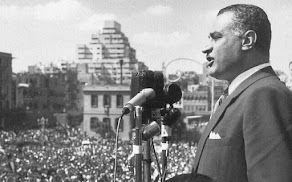
Colonel Nasser, president of Egypt, Republic Square, Cairo, 22 February 1958.

During the centuries when rules were rare, wars were not but there was little discussion about whether or not a war was happening.  There would be debates about the wisdom of going to war or the strategy adopted but whether or not it was a war was obvious to all.  That changed after the Second World War when the charter of the United Nations was agreed to attempt to ensure force would never again be used as a means of resolving disputes between nations.  That's obviously not been a success but the implications of the charter have certainly affected the language of conflict, much now hanging on whether an event is war or something else which merely looks like war.  An early example of the linguistic lengths to which those waging war (a thing of which they would have boasted) would go, in the post-charter world, to deny they were at war happened after British, French and Israeli forces in 1956 invaded Egypt in response to Colonel Gamal Nasser's (1918–1970; president of Egypt 1954-1970) nationalization of foreign-owned Suez Canal Company.  The invasion was a military success but it soon became apparent that Israel, France and Britain were, by any standards, waging an aggressive war and had conspired, ineptly, to make it appear something else.  The United States threatened sanctions against Britain & France and the invading forces withdrew.  There's always been the suspicion that in the wake of this split in the Western Alliance, the USSR seized the opportunity to intervene in Hungary which was threatening to become a renegade province.

Suez Canal, 1956.

In the House of Commons (Hansard: 1 November 1956 (vol 558 cc1631-7441631)), the prime minister (Anthony Eden, 1897–1977, UK prime-minister 1955-1957) was asked to justify how what appeared to be both an invasion and an act of aggressive war could be in conformity with the Charter of the United Nations.  Just to jog the prime-minister's memory of the charter, the words he delivered at the UN's foundation conference in San Francisco in 1945 were read out: “At intervals in history mankind has sought by the creation of international machinery to solve disputes between nations by agreement and not by force.”  In reply, Mr Eden assured the house there had been "...no declaration of war by us.", a situation he noted prevailed for the whole of the Korean War and while there was in Egypt clearly "...a state of armed conflict...", just as in Korea, "...there was no declaration of war.  It was never admitted that there was a state of war, and Korea was never a war in any technical or legal sense, nor are we at war with Egypt now."

Quite how the comparison with Korea, a police action under the auspices of the UN and authorized by the Security Council (the USSR was boycotting the place at the time) was relevant escaped many of the prime-minister's critics.  The UK had issued an ultimatum to Egypt regarding the canal which contained conditions as to time and other things; the time expired and the conditions were not accepted.  It was then clear in international law that in those circumstances the country which delivers the ultimatum is not entitled to carry on hostilities without a declaration of war so the question was what legal justification was there for an invasion?  The distinction between a “state of war" and a "state of armed conflict", whatever its relevance to certain technical matters, seemed not to matter in the fundamental question of the lawfulness of the invasion under international law.  Mr Eden continued to provide many answers but none to that question.

The aversion to declaring war continues to this day, the United States, hardly militarily inactive during the last eight-odd decades, last declared war in 1942 (against Italy, Hungary, Bulgaria & Romania, the latter three apparently at the insistence of the state department which identified certain legal technicalities).  There seems no an aversion even to the word, the UK not having had a secretary of state (minister) for war since 1964 and the US becoming (nominally) pacifist even earlier, the last secretary of war serving in 1947; the more UN-friendly “defense” the preferred word on both sides of the Atlantic.  In the Kremlin, Mr Putin (b 1952; prime-minister or president of Russia since 1999) seems also have come not to like the word.  While apparently sanguine at organizing “states of armed conflict”, he’s as reluctant as Mr Eden to hear his “special military operations” described as “invasions” or “wars” and in a recent legal flourish, arranged the passage of a law which made “mentioning the war” unlawful.

Not mentioning the war (special military operation): Mr Putin.

The bill which the Duma (lower house of parliament) & Federation Council (upper house) passed, and the president rapidly signed into law, provided for fines or imprisonment for up to fifteen years in the Gulag for intentionally spreading “fake news” or “discrediting the armed forces”, something which includes labelling the “special military operation” in Ukraine as a “war” or “invasion”.  Presumably, given the circumstances, the action could be described as a “state of armed conflict” and even Mr Putin seems to have stopped calling it a “peacekeeping operation”; he may have thought the irony too subtle for the audience.  Those who post or publish anything on the matter will be choosing their words with great care so as not to mention the war.

However, although Mr Putin may not like using the word “war”, there’s much to suggest he’s a devotee of the to the most famous (he coined a few) aphorism of Prussian general & military theorist Carl von Clausewitz (1780–1831): “War is the continuation of policy with other means.  The view has many adherents and while some acknowledge its cynical potency with a weary regret, for others it has been a world view to pursue with relish.  In the prison diary assembled from the huge volume of fragments he had smuggled out of Spandau prison while serving the twenty year sentence he was lucky to receive for war crimes & crimes against humanity (Spandauer Tagebücher (Spandau, the Secret Diaries), pp 451 William Collins Inc, 1976), Albert Speer (1905–1981; Nazi court architect 1934-1942; Nazi minister of armaments and war production 1942-1945) recounted one of Adolf Hitler’s (1889-1945; Führer (leader) and German head of government 1933-1945 & head of state 1934-1945) not infrequent monologues and the enthusiastic concurrence by the sycophantic Joachim von Ribbentrop (1893–1946; Nazi foreign minister 1938-1945):

"In the summer of 1939, On the terrace of the Berghof [Hitler’s alpine retreat], Hitler was pacing back and forth with one of his military adjutants. The other guests respectfully withdrew to the glassed-in veranda.  But in the midst of an animated lecture he was giving to the adjutant, Hitler called to us to join him on the terrace. “They should have listened to Moltke and struck at once” he said, resuming the thread of his thought, “as soon as France recovered her strength after the defeat in 1871.  Or else in 1898 and 1899.  America was at war with Spain, the French were fighting the English at Fashoda and were at odds with them over the Sudan, and England was having her problems with the Boers in South Africa, so that she would soon have to send her army in there.  And what a constellation there was in 1905 also, when Russia was beaten by Japan.   The rear in the East no threat, France and England on good terms, it is true, but without Russia no match for the Reich militarily. It’s an old principle: He who seizes the initiative in war has won more than a battle.  And after all, there was a war on!”  Seeing our stunned expressions, Hitler threw in almost irritably:There is always a war on. The Kaiser [Wilhelm II (1859–1941; German Emperor & King of Prussia 1888-1918)] hesitated too long."

Such epigrams usually transported Ribbentrop into a state of high excitement.  At these moments it was easy to see that he alone among us thought he was tracking down, along with Hitler, the innermost secrets of political action.  This time, too, he expressed his agreement with Hitler with that characteristic compound of subservience and the hauteur of an experienced traveller whose knowledge of foreign ways still made an impression on Hitler.  Ribbentrop’s guilt, that is, did not consist in his having made a policy of war on his own. Rather, he was to blame for using his authority as a supposed cosmopolite to corroborate Hider’s provincial ideas. The war itself was first and last Hitler’s idea and work.  “That is exactly what neither the Kaiser nor the Kaiser’s politicians ever really understood,” Ribbentrop was loudly explaining to everyone.  There’s always a war on. The difference is only whether the guns are firing or not.  There’s war in peacetime too. Anyone who has not realized that cannot make foreign policy.

Hider threw his foreign minister a look of something close to gratitude.  “Yes, Ribbentrop,” he said, “yes!"  He was visibly moved by having someone in this group who really understood him. “When the time comes that I am no longer here, people must keep that in mind.  Absolutely.”  And then, as though carried away by his insight into the nature of the historical process, he went on:Whoever succeeds me must be sure to have an opening for a new war.  We never want a static situation where that sort of thing hangs in doubt In future peace treaties we must therefore always leave open a few questions that will provide a pretext.  Think of Rome and Carthage, for instance. A new war was always built right into every peace treaty. That's Rome for you! That's statesmanship.

Pleased with himself, Hitler twisted from side to side, looking challengingly around the attentive, respectful circle.  He was obviously enjoying the vision of himself beside the statesmen of ancient Rome.  When he occasionally compared Ribbentrop with Bismarck—a comparison I myself sometimes heard him make—he was implying that he himself soared high above the level of bourgeois nationalistic policy.  He saw himself in the dimensions of world history. And so did we.  We went to the veranda.  Abruptly, as was his way, he began talking about something altogether banal."

Friday, October 2, 2020

Homily

Homily (pronounced hom-uh-lee)

(1) In Christianity, a kind of sermon, usually on a Biblical topic and often of a practical, non-doctrinal nature.

(2) An admonitory or moralizing discourse.

(3) A platitude or cliché intended to be inspirational.

1545-1555: From the Middle English omelī, omelīe & omelye, from the twelfth century Old French omelie (which persists in Modern French as homélie)and the Ecclesiastical Latin homilia & omilia (homily; a sermon), from the Ancient Greek μιλία (homilía) (homily; instruction), from μλος (hómīlos) (an assembled crowd; a throng), from the primitive Indo-European somalo- (a suffixed form of the root sem- (one; as one, together with) + -́ (-íā) (the suffix used to form abstract nouns).  The construct of the Greek μλος was μός (homós) (common; same) + ῑ̓́λη (ī́lē) (crowd), from ελω (eílō) (to aggregate).  The related common forms in Greek were homilia (conversation, discourse) & homilein (to converse with) and were cognate with the Sanskrit melah (assembly) and the Latin miles (in the senses of “an ordinary soldier”).  Under ecclesiastical influence, the Latinate form was restored in sixteenth century English.

The noun homilist, dating from the early seventeenth century described one who delivers a homily (although in some parishes in England the word was applied to a deacon or other junior cleric who wrote the text of a homily or sermon to be delivered by a bishop, dean etc).  The adjective homiletic was first recorded in the 1640s and was used to mean “of or pertaining to sermons” and was from the Late Latin homileticus, from the Ancient Greek homiletikos (of conversation, affable, a conversationalist), the related form the rare homiletical which rarely escaped the specialized field of study in divinity known as homiletics, a discipline which created also homilete & homiletical.  A bound or published collection of homilies or sermons is a homiliary (1844), a name used first in 1844 and they remain a feature of church publishing, especially those of leading figures (popes, archbishops etc).  The homiliary of Pope Benedict XVI (Joseph Ratzinger, b 1927; pope 2005-2013, pope emeritus since) is an outstanding collection and an illustration why he remains the best pope since Pius XII (Eugenio Pacelli 1876-1958; pope 1939-1958).  Homily is a noun & adverb, the noun plural is homilies.

The words homily and sermon are sometimes used interchangeably and not always without justification because, if one respects the traditional distinctions, there are sermons which read like homilies and vice versa.  In the Christian churches (Roman Catholic, Orthodox, Anglican and Lutheran religions), a homily is commentary delivered by a priest or deacon after the reading of scripture, the purpose being to reduce the sometimes abstract theological issues raised to something practical and expressed in a conversation voice; it's essentially an explanation of the passage from the Bible.  Sermon was from the Middle English sermoun, from the Anglo-Norman sermun (and the Old French sermon), from the Latin sermō & sermōnem (speech or discourse).  A sermon is a speech or discourse on theology or morality and may be in direct reference to a scriptural text but may also be an abstraction from Christian teaching or indeed any matter of morality or which touches on some matter of religious significance.  Strictly speaking, sermons need not be restricted to what is delivered as part of a service and indeed can be book-length endeavors which hints perhaps at why “sermon” is also casually used to mean a tedious and usually long lecture delivered as an admonishment.  The Second Vatican Council (Vatican II; 1962-1965) muddied the waters and it’s tempting to think it was the negative association of the word “sermon” (until then the commonly used word) which convinced the bishops to rebrand the message delivery system as "homily".  This may also account for why some believe the two interchangeable.

The classic (if not now exactly typical) sermon in Christianity is the The Sermon on the Mount (anglicized from the Matthean Vulgate Latin in which it was called Sermo in monte), an assembly of words attributed to Jesus of Nazareth and found in the Gospel of Matthew (chapters 5-7) that encapsulates his moral teachings.  It is the first of five discourses in the Gospel and remains one of the most extensively quoted (and misquoted).  Winston Churchill, no moral theologian and self-described as “an external buttress rather than a pillar of the Church” thought “Christ’s story was unequalled and his death to save sinners unsurpassed” and “the Sermon on the Mount was the last word in ethics” but while he always admired the teachings, he didn’t always follow their strictures and probably imagined God would forgive his sins because he “had a few runs on the board”.

The idea of the homily or sermon isn’t restricted to Christianity.  The Prophet Muhammad delivered the last sermon (or Khutba) on Friday, ninth Dhul Hijjah (twelfth month of Islamic year), in mount Arafat’s Uranah Valley, the message delivered to humanity, telling all they are accountable to God for their deeds.

O People, lend me an attentive ear, for I know not whether after this year, I shall ever be amongst you again. Therefore listen to what I am saying to you very carefully and TAKE THESE WORDS TO THOSE WHO COULD NOT BE PRESENT HERE TODAY.

Beware of Satan, for the safety of your religion…All mankind is from Adam and Eve, an Arab has no superiority over a non-Arab nor a non-Arab has any superiority over an Arab; also a white has no superiority over black nor a black has any superiority over white except by piety (taqwa) and good action.

Archbishop Porteous and the place of women & others

Homilies can be deployed as sword or shield and sometimes there’s a bit of overlap.  Late in October 2022, in faraway Tasmania, Archbishop Julian Porteous (b 1949; Roman Catholic Archbishop of Hobart since 2013) decided to use his Sunday homily to attack those who opposed him interpolating a so-called “submission reading” into the graduation mass he was to conduct at St Mary's College, an all-girls Roman Catholic school.  The reading the archbishop agreed to drop from the service was from Ephesians 5: 21-33 (KJV 1611):

Submitting yourselves one to another in the fear of God.  Wives, submit yourselves unto your own husbands, as unto the Lord.  For the husband is the head of the wife, even as Christ is the head of the church: and he is the saviour of the body.  Therefore as the church is subject unto Christ, so let the wives be to their own husbands in every thing.

Husbands, love your wives, even as Christ also loved the church, and gave himself for it; That he might sanctify and cleanse it with the washing of water by the word, That he might present it to himself a glorious church, not having spot, or wrinkle, or any such thing; but that it should be holy and without blemish.  So ought men to love their wives as their own bodies. He that loveth his wife loveth himself.  For no man ever yet hated his own flesh; but nourisheth and cherisheth it, even as the Lord the church:  For we are members of his body, of his flesh, and of his bones.

For this cause shall a man leave his father and mother, and shall be joined unto his wife, and they two shall be one flesh.  This is a great mystery: but I speak concerning Christ and the church.  Nevertheless let every one of you in particular so love his wife even as himself; and the wife see that she reverence her husband.

Apparently the archbishop intended to use a newer translation, thinking, not unreasonably, the archaic phrasing of the King James Version (1611) might make elusive the meaning he was trying to convey but why he thought the modernized text might be better received by the girls isn’t clear:

Wives should regard their husbands as they regard the Lord, since as Christ is head of the Church and saves the whole body, so is a husband the head of his wife; and as the Church submits to Christ, so should wives submit to their husbands, in everything.

Archbishop Porteous summing up.

Tasmania however has moved on from the seventeenth century (and even from 1997 when it was the last Australian jurisdiction to remove the criminal sanction for homosexual acts between men) and the reaction among staff, students and parents was swift, the backlash accelerated by the inevitable social media pile-on.  Doubtless disappointed by his flock's response, the archbishop felt compelled to change his script although he seemed unconcerned about whether a passage demanding women submit to the demands of their husbands upon marriage was an appropriate choice to deliver to young women celebrating graduation, many of whom were soon to begin higher education as a prelude to professional careers.  Nor did he comment on the possible implications of the phrase “so should wives submit to their husbands, in everything” in a country where in some jurisdictions, because the inheritance of English common law, it wasn’t until the 1990s that it became possible to prosecute cases of rape within marriage.

The archbishop had other worries and in his Sunday homily noted it was "not unusual for the teaching of sacred scripture to be at variance with the attitudes and ethos of our age", adding that increasingly Christians were being “criticized and persecuted because we believe what the scriptures teach and we desire to live by its imperatives, even when they are at variance with the ethos of our times."  Of particular interest to the archbishop (and others) was the recent case of a Christian who was compelled to resign from an appointment as Chief Executive Office with an Australian Rules (AFL) club (the AFL itself something of a religion among many) after it was revealed the “City on a Hill” church (where he sits on the board) had published a series of articles critical of homosexuality and abortion.  Promptly, the club issued a statement saying the church’s views were contrary to the club's values and handed its CEO an ultimatum requiring he either disavow the position of his church or resign as CEO.  He chose his faith (in Christ, not the Essendon Football Club) and submitted to corporate crucifixion.

Drawing the comparison between one line of his reading from Ephesians and one fragment of a statement from the City on the Hill being taken out of context, he concluded "This tells us that our society is becoming increasingly hostile to Christian beliefs found in sacred scripture and actually to demand that people abandon their Christian faith if they wish to exercise public office.”  He went onto explain the theological basis of St Paul’s words in Ephesians and how they were such a radical approach to enhancing the status of women and the sanctity of marriage in what was still a pagan society, issuing a statement noting scripture needed to be read “within the total understanding of the faith” and that “…taking one sentence in isolation fails to do this”.  In that he’s correct but it’s unlikely the bolshie schoolgirls will be much impressed with his nuances.

Lindsay Lohan (b 1986), recently married to Credit Suisse trader Bader Shammas (b 1987) is thought unlikely to “submit to her husband in everything”.  It would be out of character.

Not helping the archbishop in his latest battle in the culture wars was that he has “a bit of previous” in the assault on modernity.  In 2015 he distributed to some 12,000 families with children in Tasmanian Catholic schools a pamphlet entitled "Don’t Mess With Marriage" in which it was argued that those from the LGBTQQIAAOP community "pretending that their relationships are ‘marriages’ is not fair or just to them."  It must have taken some intellectual gymnastics to reach that conclusion and even with a most careful reading the Old and New Testaments, while it’s not hard to work out that for men to lie with other men as others might with women is as much an abomination to the Lord as it would be for them to lie with beasts of the field, it’s hard to find a passage where there’s much concern for fairness towards them.  Still, the archbishop will be better acquainted with scripture than most so his insights may reveal a rare vision.  The pamphlet aroused the ire of the usual suspects and there were attempts to have the Anti-Discrimination Commissioner take the case but their interest was hard to arouse and after a desultory six months of meandering, the matter was withdrawn.