Wednesday, August 17, 2022

Resin

Resin (pronounced rez-in)

(1) Any of a group of non-volatile solid or semisolid organic substances & compounds (that consist of amorphous mixtures of carboxylic acids), obtained directly from certain plants as exudations of such as copal, rosin & amber (or prepared by polymerization of simple molecules) and used typically in pharmaceuticals, plastic production, lacquers, adhesives and varnishes.

(2) A substance of this type obtained from certain pine trees (also called rosin).

(3) To treat, rub or coat with resin.

(4) A precipitate formed by the addition of water to certain tinctures.

(5) Any of various artificial substances, such as polyurethane, that possess similar properties to natural resins and used in the production of plastics; any synthetic compound with similar properties.

1350–1400: From the Middle English resyn & resyne (hardened secretions of various plants), from the Old French resine (gum, resin), from the Latin rēsīna (resin), from the Ancient Greek rhētī́nē (resin of the pine tree), both probably from a non-Indo-European language.  In chemistry, the word came to be applied to synthetic products by after 1883.  The verb resinate (impregnate with resin) dated from 1756.  The adjective resinous (of the nature of, pertaining to, or obtained from resin) is documented since the 1640s, from the Latin resinosus; the earlier adjective was resiny (having a character or quality like resin), noted since the 1570s.  The related (and now rare) noun rosin (distillate of turpentine (especially when in a solid state and employed for ordinary purposes)) dates from the late thirteenth century and was from the Old French raisine & rousine, both variants of résine; it was used as a verb after the mid-fifteenth century.  The later adjectives resiniferous & resinless appear never to have been used except in chemistry or technical literature in relevant industries, the more common forms in general use being resin-like or resinous.  Because the word resin covers a wide field of substances, it usually appears in modified form (acaroid resin, acrylic resin, epoxy resin, phenolic resin, polyresin, polyvinyl resin etc).  The present participle is resining and the past participle resined.  Resin, resinousness & resinite are nouns, resinously is an adverb and resinify is a verb; the noun plural is resins.

The Citroën SM and Michelin's resin wheels

1972 Citroën SM with Michelin RR wheels. 

Although sometimes referred to as being made from “carbon fibre”, materials engineers insist the optional wheels offered on the Citroën SM must be described as “synthetic resin reinforced with long-strand carbon fibre”.  Notable as the first composite road wheel offered for public sale, they were developed by Michelin, the tyre-maker which since 1934 had been Citroën’s parent corporation and the innovation was an appropriate accessory for the SM which, upon release in 1971, was immediately recognized as among the planet's most intricate and intriguing cars.  A descendant of the DS which in 1955 had been even more of a sensation, it took Citroën not only up-market but into a niche the SM had created, nothing quite like it previously existing, the combination of a large (in European terms), front-wheel-drive (FWD) luxury coupé with hydro-pneumatic suspension, self-centreing (Vari-Power) steering, high-pressure braking and a four-cam V6 engine, unique in the world.  The engine had been developed by Maserati, one of Citroën’s recent acquisitions and the name acknowledged the Italian debt, SM standing for Systemé Maserati.  Although, given the size and weight of the SM, the V6 was of modest displacement to attract lower taxes (initially 2.7 litres (163 cubic inch)) and power was limited (181 HP (133 kW)) compared to the competition, such was the slipperiness of the body's aerodynamics that in terms of top speed, it was at least a match for most.

Michelin RR wheel on Citroën SM.

However, lacking the high-performance pedigree enjoy by some of that competition, a rallying campaign had been planned as a promotional tool.  Although obviously unsuited to circuit racing, the big, heavy SM didn’t immediately commend itself as a rally car; early tests indicated some potential but there was a need radically to reduce weight.  One obvious candidate was the steel wheels but attempts to use lightweight aluminum units proved abortive, cracking encountered when tested under rally conditions.  Michelin immediately offered to develop glass-fibre reinforced resin wheels, the company familiar with the material which had proved durable when tested under extreme loads.  Called the Michelin RR (roues resin (resin wheel)), the new wheels were created as a one-piece mold, made entirely of resin except for some embedded steel reinforcements at the stud holes to distribute the stresses.  At around 9.4 lb (4¼ kg) apiece, they were less than half the weight of a steel wheel and in testing proved as strong and reliable as Michelin had promised.  Thus satisfied, Citroën went rallying.

Citroën SM, Morocco Rally, 1971.

The improbable rally car proved a success, winning first time out in the 1971 Morocco Rally and further success followed.  Strangely, the 1970s proved an era of heavy cruisers doing well in the sport, Mercedes-Benz winning long-distance events with their 450 SLC 5.0 (1977-1980) which was both the first V8 and the first car with an automatic transmission to win a European rally.  Stranger still, Ford in Australia re-purposed one of the Falcon GTHO Phase IV race cars which had become redundant when the programme was cancelled in 1972 and the thing proved surprisingly competitive during the brief periods it was mobile, the lack of suitable tyres for the large, heavy machine meaning the sidewalls repeatedly failed.  The SM, GTHO & SLC proved a quixotic tilt and, for better (Group B, 1982-1986) and worse (everything else), the sport went a different direction.  On the SM, the resin wheels had proved their durability, not one failing during the whole campaign and, encouraged by customer requests, Citroën in 1972 offered them as a factory option although only in Europe; apparently the thought of asking the US federal safety regulators to approve "plastic wheels" (as they’d already been dubbed by the motoring press) seemed to the French so absurd they never bothered to submit an application.

Reproduction RR wheel in aluminum. 

Michelin ceased to make the RR when SM production ended in 1975 but did provide another batch for sale in the mid 1980s and this was said to be a new production run rather than unsold stock.  A cult accessory for a cult car, perfect examples now sell for around US$2000 each which does sound expensive but, given what it can cost to restore (or even maintain) a SM, it’s not a significant sum and, unlike much of the rest of the machine, the RRs are at least trouble-free.  Michelin are not said to be contemplating resuming production but another company has produced visually identical wheels made from aluminum; these only slightly heavier.  Despite the success and the fifty-year history of robustness, Citroën didn’t persist and the rest of the industry never adopted the resin wheel.  The reason was two-fold: (1) Even if economies of scale operated to lower the unit cost, the technology was always going to be more expensive than using aluminum and advances in alloys meant the metal units can provide similar strength with only a slight weight penalty and (2) the resin was always susceptible to high temperatures, something not encountered on the SM which used inboard brakes.  Most cars don’t use inboard brakes and as Ford found when testing resin wheels during Lincoln's downsizing programme in the mid-1970s, although the weight reduction was impressive, almost the same was possible with aluminum at much lower cost and the problems caused by heat-soak from the brakes were insoluble.  So it proved until the late 1980s when, with the development of new, heat-resistant materials, reinforced composite wheels were made available on the limited-production Dodge Shelby Shadow CSX-VNT.

Shelby Shadow CSX-VNT (1987 Shelby American publicity still (left) and MWC Fiberrides wheel on 1989 model (right)): “This is the way the world ends / Not with a bang but a whimper” (the concluding line of T.S. Eliot’s (1888-1965) poem The Hollow Men (1925)).

After the Sturm und Drang of Shelby American’s Cobras and Mustangs, that the Shadow CSX-VNT (1987-1989 and based on the Dodge Shadow (1986-1994)) was the last production car built by the operation meant things at the storied facility ended “not with a bang but a whimper” but Carroll Shelby (1923–2012) did for his personal use retain Shadow CSX-VNT Number 001 (of the 500 built) and he was a fair judge of what was good to drive.  Shelby’s team designed the composite wheels (dubbed “Fiberrides”) with manufacturing handled by MWC (the Motor Wheel Corporation).  Although conceptually similar to the Michelin RR wheel in being a lightweight, composite unit that lighter than an aluminium wheel of the same dimension, the Fiberrides differed in the materials used and the technique of construction.  Despite appearing a generation earlier, the Michelin RR’s resin system was more advanced than what MWC did which was to use familiar glass-fiber reinforced plastic; Michelin’s approach offered some advantages but the tooling for mass-production was expensive and the costs would never have been amortized in the run of fewer than 3,000 needed for Shelby’s project.  While not a Cobra, the CSX-VNT is genuinely “a Shelby” and although not much sought by collectors, there is a minor following because they remain competitive machines in autocrossing although the guides now caution the plastic wheels are over three decades old and there have been reports of cracks being detected; the advice is, if being used in competition, switch to metal wheels and keep the Fiberrides for display.  The composite wheels have never been re-produced so the planet’s stock of them is static and thus, because nothing lasts forever, slowly diminishing.

1973 Citroën SM with reproduction RR wheels in aluminium. 

True carbon fibre wheels have had a little more success, although only at the top-end of the market, Koenigsegg in 2013 manufacturing carbon fibre single-piece wheels which it offered as a US$40,000 option; a number which needs to be considered in the context of the US$2 million price tag for one of their cars.  Porsche, Mercedes-Benz, Ferrari and Ford have all flirted with carbon fibre wheels and some manufactures are interested in the possibilities offered by hybrid designs which use aluminum for some components and carbon fibre for others, an idea familiar from earlier steel/aluminum combinations and unrelated to the "polycast" units of the 1970s & 1980s which used a conventional wheel to which a decorative plastic centre was bonded.  Regulatory authorities are apparently still pondering things.

The SM V8

1974 prototype Citroën SM with 4.0 V8.

Ambitious as in 1971 it so obviously was, circumstances combined in a curious way that might have made the SM more remarkable still.  By 1973, sales of the SM, after an encouraging start, had for two years been in decline, a reputation for unreliability already tarnishing its reputation but the first oil shock dealt what appeared to be a fatal blow; from selling almost 5000 in 1971, by 1974 production numbered not even 300.  The market for fast, thirsty cars had shrunk and most of the trans-Atlantic hybrids (combining elegant European coachwork with large, powerful and cheap US V8s), which had for more than a decade done good business as alternative to the highly strung Italian thoroughbreds, had been driven extinct.  Counter-intuitively, Citroën’s solution was to develop an even thirstier V8 SM and that actually made sense because, in an attempt to amortize costs, the SM’s platform had been used as the basis for the new Maserati Quattroporte but, bigger and heavier still, performance was sub-standard and the theory was a V8 version would transform both and appeal to the US market, then the hope of many struggling European manufacturers.

Recreation of 1974 Citroën SM V8 prototype.

Citroën didn’t have a V8; Maserati did but it origins were in racing and while its (never wholly tamed) raucous qualities suited the character of the sports cars and saloons Maserati offered in the 1960s & 1970s, it would have been less than ideal for something like the SM.  However, the SM’s Maserati V6 was a 90o unit and thus inherently better suited to an eight-cylinder configuration.  Therefore, in 1974, a 4.0 litre (244 cubic inch) V8 based on the V6 (by then 3.0 litres (181 cubic inch)) was quickly built and installed in an SM which was subjected to the usual battery of tests over a reported 20,000 km (12,000 miles) during which it was said to have performed faultlessly.  Unfortunately, bankruptcy (to which the SM, along with some of the company's other ventures, notably the GZ Wankel programme, contributed) was the death knell for SM production and the one-off V8 prototype was scrapped while the unique engine was removed and stored, later used to create a replica of the 1974 test mule.

The abortive Traction Avant V8

Citroën Traction Avant (TA) 22 (V8), Paris Motor Show, 1934 (the Coupé below, a Berline on the raised platform).  The frontal styling with fared-in headlights would have been exclusive to selected body-styles offered with the V8.

It was a shame because, despite being most associated with the US industry, it was the French engineer Léon Levavasseur (1863–1922) who in 1904 created the first V8 engine and at the 1934 Paris Motor Show, Citroën displayed their “TA 22”, a variation of their Traction Avant model but fitted with a 3.8 litre (233 cubic inch) V8, created by joining on a common crankcase two of their 1.9 litre (117 cubic inch) four-cylinder units.  At the show, several models were displayed and the promotional material confirmed the 22 would be available with a choice of coachwork including the Berline (four-door saloon), Familiale (long wheelbase (LWB) nine-passenger, four-door saloon with three rows of seats), two-door Coupé and Décapotable (two-door cabriolet).  Looming bankruptcy however halted the project and Michelin, having just taken corporate control, insisted the company concentrate on the best-selling, most profitable lines.  A reputed two dozen-odd 22s were built before the Michelin Man dropped his axe and it's never been clear if any passed into private hands in V8 form, most of the pre-production run having been re-fitted with standard 11 CV four cylinder engines under the usual hood (bonnet) and wings before being sold as TA 11s.  Inevitably, rumours abound, the most persistent being (1) an unnamed doctor or dentist in Brittany or Gascony locked a TA 22 in a barn where it remains, perfectly preserved and (2) there's one in a "secret garage" hidden somewhere in the Far-East, a remnant of the French colonial presence in Indo-China.  There's also the tale that one of the pre-production run displayed at the Paris Motor Show was stored in an underground car-park (in a "bricked-up room" to conceal it from the Nazi occupation forces which had a great fondness for the Traction Avant) in the Javel district of Paris (close to the Citroën factory) and it survived the war, only to be "destroyed" by Pierre "PJB" Boulanger (Pierre-Jules Boulanger, 1885–1950; chairman of Citroën 1935-1950).  Monsieur Boulanger was killed in an accident at the wheel of a TA 15-Six but, like the other legends, there's no documentary evidence of any of the V8 cars existing after 1935.  In recent years, some aficionados have built V8 TAs in the style of the 22 CVs, most fitted with contemporary Ford flathead V8s, an engine produced in several versions in France during the 1930s.   

1938 Citroën 11B Traction Avant coupé, one for four built in 1938 from a total production of 15.  Lovely though the art deco lines were, the 11B’s performance was rendered mediocre by the use of the even then rather agricultural 1.9 litre four-cylinder engine which, despite the fitting of twin downdraft carburetors, generated only 46 horsepower (hp) at a 3800 RPM of some harshness.  In the US, the memorable coffin-nose Cord 810 & 812 had already proved a power-train which combined a V8 with FWD could work and such a powerplant for the Traction Avant would have been transformative.  That the project was abandoned was one of many entries in the company’s long list of missed opportunities.

1937 Cord 812 Phaeton (left) and 1967 Cadillac Eldorado (right).

Thirty years apart, Cord and Cadillac demonstrated a big, FWD V8 could be made to work.  Rushed into production, the Cord had flaws but in a more buoyant economy might the resources might have been found to rectify the problems.  The Eldorado used an unusual chain-drive(!) version of the General Motors (GM) Turbo-Hydramatic automatic transmission which at the time raised the odd eyebrow but, coupled with engines as large as 500 cubic inches (8.2 litres which for 1970 briefly was tuned to a rated 400 hp), it proved robust and reliable.  Whatever happened later, in the 1960s, Cadillac's engineering could be said still to be the "standard of the world".

Lindsay Lohan in Tsubi Scooter Jeans, Andrea Brueckner Saddle Bag, L.A.M.B. Lambstooth sweater, Manolo Blahnik Butterfly sandals & Louis Vuitton Inclusion resin bangles, Los Angeles, April 2005.

Evidence does however suggest a V8 SM would likely have been a failure, just compounding the existing error on an even grander scale.  It’s true Oldsmobile and Cadillac had offered big FWD coupés with great success since the mid 1960s but they were very different machines to the SM and appealed to a different market.  Probably the first car to explore what demand might have existed for a V8 SM was the hardly successful 1986 Lancia Thema 8·32 which used the Ferrari 2.9 litre (179 cubic inch) V8 in a FWD platform.  Although well-executed within the limitations the configuration imposed, it was about a daft an idea as it sounds, the understeer prodigious when tested on racetracks although it seems to have been manageable when sensibly driven on the road.  Even had the V8 SM been all-wheel-drive (AWD) it would probably still have been a failure but so configured it would now be remembered as a revolution ahead of its time.  As it is, the whole SM story is just another of Citroën's many intriguing cul-de-sacs, albeit one which has become a minor cult.

Tuesday, August 16, 2022

Pachyderm

Pachyderm (pronounced pak-i-durm)

(1) Historically, any of the thick-skinned, non-ruminant ungulates, such as the elephant, hippopotamus, and rhinoceros.

(2) General (non-scientific) term for an elephant and some other, impressively large creatures.

(3) In the idiomatic, a person not sensitive to criticism, ridicule, etc; a thick-skinned person.

1838: From the seventeenth century French pachyderme, from the New Latin Pachyderma, the assumed singular of Pachydermata, from the Ancient Greek pakhudermos (thick-skinned), the construct being of pakhus (thick, large, massive) + derma (skin (from the primitive Indo-European root der (to split, flay, peel) with derivatives referring to skin and leather)).  The more familiar form of derma was dérmata, neuter plural of dermatos (skinned).  Pachyderme was in 1797 adopted as a biological term in 1797 by French naturalist Jean Léopold Nicolas Frédéric (Baron (Georges) Cuvier, 1769–1832) and while the order Pachydermata has fallen into disuse in formal zoology, pachyderm remains in common use to describe elephants, rhinoceroses, hippopotamuses etc.  The related forma are pachydermal, pachydermous, pachydermic, pachydermoid & pachydermatous.

Elephants

In zoology, the original taxonomic order, Pachydermata (“thick skin” the construct from the Ancient Greek being παχύς (pachys) (thick) + δέρμα, (derma) (skin) is a now obsolete order of mammals, a grouping which once included thick-skinned, hoofed animals such as the rhinoceros, hippopotamus, elephant, pig and horse.  Being polyphyletic, the order is no longer used but is an illustrative cul-de-sac in the history of systematics.  The word “pachyderm” remains in use to describe elephants, rhinoceroses, tapirs, and hippopotamuses.

The original classification Pachydermata included three herbivorous families: Proboscidiana, Pachydermata Ordinaria, and Solipedes.  They were later reclassified as Proboscidea (among living species represented now only by three species of elephants), the Perissodactyla (odd-toed ungulates, including horses, tapirs and rhinoceroses), the Suina (pigs and peccaries), the Hippopotamidae, and the Hyracoidea (hyraxes).  It was advances in genetic analysis which allowed the others to be classified as wholly separate clades.

Interestingly, despite the name being a reference to the thickness of skin, the thin-skinned horse genus was an original inclusion, based apparently on the other shared characteristic: "mammals with hoofs with more than two toes".  Belying appearances, horses do exhibit a slight departure from a true monodactylous structure, every member of the family having vestiges of two additional toes under the skin.

A pachyderm playing polo.

Chrysler’s 426 cubic inch (7.0 litre) Street Hemi V8 (1966-1971), was nicknamed “Elephant Motor”, an allusion to the bulky cylinder heads required to house the complex valve-train and their vague resemblance to ears of the beast.  The moniker was a piece of zoological one-upmanship on Chevrolet's mouse (small-block V8) and rat (big block V8).

Failures in verisimilitude in Mean Girls (2004):  One of the props was a framed photograph representing Cady Heron during her childhood in Africa, sitting atop an elephant.  The elephant of a different taxonomy, being an Asian elephant (Elephas maximus) instead of the appropriate African savanna bush elephant (Loxodonta africana) known in Kenya.  The left hand's inadvertent srpski pozdrav (a three-fingered Serbian salute originally expressing the Holy Trinity and used in rituals of the Orthodox Church which has (like much in the Balkans) been re-purposed as a nationalist symbol) is a Photoshop fail.

Sunday, August 14, 2022

Mall

Mall (pronounced mal or mawl)

(1) A clipping of shopping mall, a (usually) large retail complex containing a variety of stores and often restaurants and other business establishments housed in a series of connected or adjacent buildings or in a single large building.  Shopping centre is the usual alternative descriptor but market, plaza, marketplace & mart are also used.

(2) A large area, sometimes lined with shade trees and shrubbery, used as a public walk or promenade (in some places called boulevard, boardwalk, esplanade, alameda, parade or walk).

(3) In urban business districts, a street from which motor-traffic has been excluded and given over entirely to pedestrians.

(4) A strip of land, usually planted or paved, separating lanes of opposite traffic on highways, boulevards etc (use restricted to certain US states).

(5) In the game of pall-mall, either (1) the game itself, (2) the mallet used in the game or (3) the place or alley where pall-mall was played.

(6) The game of polo (obsolete since the late seventeenth century).

(7) To beat with a mall, or mallet; to beat with something heavy; to bruise.

(8) In the jargon of US property development, to build up an area with the development of shopping malls

(9) In slang, (often as malling), to shop at the mall (the “mall rat” being one who frequents such places (usually in a pack) without necessarily intending to shop.

1737: From The Mall, a fashionable tree-lined promenade (then thought of as a “pall-mall alley”) in St James's Park, London where originally the game pall-mall was played.  The name of the game was also spelled palle-malle, paille-maille, pel-mell & palle-maille, pell-mell.  The noun plural is malls.

Eighteenth century woodcut of men playing pall mall.

The use to describe a "shaded walk serving as a promenade" was generalized from The Mall, the name of a broad, tree-lined promenade in St. James's Park, London (the name dating from the 1670s and an evolution of the earlier (1640s) maill), so-called because it operated as open alley used to play the game of pall-mall, an ancestor of the modern croquet.  Pall-mall (although described as a “lawn game”) was played on a surface of compacted & leveled soil, boarded in at each side, using a wooden ball which was struck with a mallet to send it through an iron arch placed at the end of the alley, the winner the one who managed to do so with the fewest shots.  The game's name is from the French pallemaille, from the Italian pallamaglio, the construct being palla (ball) + maglio (mallet), from the Latin malleus (hammer, mallet), from the primitive Indo-European root mele- (to crush, grind).  The French and Italian forms (like the English pall-mall) both refer to a game something like croquet, played in Europe after the sixteenth century.

A View of St James Palace, Pall Mall (1763), oil on canvas by Thomas Bowles (1712-1791).

The mall in the sense of a street in an urban business district from which motor-traffic has been excluded and given over entirely to pedestrians dates from 1951.  The sense of an "enclosed shopping gallery" is from 1962 (although such structures in the US pre-date the descriptor and the mall rat (one who frequents a mall) wasn’t labeled as such until 1985.  Mall is the common term in North America but in many countries they’re called shopping centres, markets, plazas, marketplaces, marts or blends of these words.  Mall is still used in the original sense of a shaded walk but is now rare, plaza, esplanade (especially if riparian, costal etc) or boardwalk tending to be preferred whereas mall is most associated with suburban shopping centres or urban streets given over to pedestrians.  The strip mall is a smaller array of shops, assembled usually in a single line parallel with a major arterial road with parking for cars directly in front.  The Pavilion on the Mali in New York’s Central Park was used in the nineteenth century by the “Park Band:, the mali a paved path lined with trees.

Lindsay Lohan enjoying Wetzel's Pretzels, Americana Mall, Los Angeles, June 2009.

The concept of a large structure or area containing the outlets of many traders wasn’t new, recognizable forms identified in the archaeological record of many cultures across millennia.  What distinguished the modern mall was that it was inherently (1) suburban and (2) dependent on customers using private motor vehicles rather than walking or public transport.  It was these factors which enabled malls to develop at scale; the land being bar from city centres was cheap and the customer catchment was vast, needing only to be in driving range so thus could service an area of a hundreds square miles or more, something which explains why malls always had vast, often multi-layered car parks.  Urban geographers regard the Northland Center in Southfield, Michigan (which opened in 1954) as the first mall in the modern sense.  Immediately successful, it spawned imitators, immediately in the US and within a decade around the world, the building of malls tracking the development of road systems and the growth in car ownership.  One effect was the decline of commercial activity in city centres as traders followed their customers’ migration to the suburbs, a trend which really didn’t decline until the 1990s when the fashion for inner-city living returned.  This affected both the viability of malls and interest in developing new ones, something exacerbated by the arrival of the “big box” operations which were either single outlets at scale or thematic clusters of traders within the one geographical space.  For many customers, the clusters were attractive because, unlike the malls which tended to limit the number of similar businesses which could lease space, in a cluster one could find many shops servicing the same market centre, typically specialties such as home improvement or decorating.  Consequently, many malls had during the last quarter century been abandoned, demolished or re-purposed, the twenty-first century growth in on-line shopping accelerating the decline.

Pall Mall “Girl Watching” cigarette advertising, circa 1962.

Pall Mall menthol cigarette advertising, 1969.  By then called “the black demographic”, one of the first widespread uses of African-Americans in advertising published in mainstream media was for menthol cigarettes, reflecting the high market penetration of the product in that group.  Where there were profits to be had, commerce was a great supporter of DEI (diversity, equity & inclusion), long before the concept was imposed by governments.

The game Pall Mall was the subject of a number of contemporary paintings and sketches and Samuel Pepys (1633–1703; noted English diarist & Admiralty administrator) who had mentioned the game as early as 1661, in May 1663 noted in his diary: “I walked in the park… discoursing with the keeper of Pell Mell who was speaking of it; who told me of what the earth is mixed that do floor the Mall and that over all there is cockel-shells powdered.”  In an entry in 1665, Pepys referred to both street and game as Pell Mell.  There were many “Pall Mall” alleys in London and one of them became the street well known variously as a centre of artistic life, the home of many London clubs, the location of the War Office (when war offices were a thing) and a place on the Monopoly board.  Mall tends to be pronounced mawl in most of the world except in England where Pall Mall is pel mal although, even then, the phonetic influence of the US is such that mawl is often heard for uses other than the street.  In Australia, when the Queen Street Mall was in 1982 opened by Sir Joh Bjelke-Petersen (1911–2005; Country Party premier of Queensland, 1968-1987), he insisted it must be pronounced mawl because he had no wish to be reminded of Malcolm Fraser (1930–2015; Liberal Party prime minister of Australia 1975-1983).

A cluster of mall rats.

Saturday, August 13, 2022

Vellum

Vellum (pronounced vel-uhm)

(1) A fine parchment, prepared from calfskin, lambskin, kidskin etc, treated for use as a writing surface.

(2) A manuscript or the like on vellum.

(3) A texture of paper or cloth resembling vellum.

(4) A creamy colored heavy paper resembling vellum.

(5) Made of or resembling vellum (vellum sometime used by commercial stationery suppliers to refer to paper of the highest quality).

(6) Of a book, a work bound in vellum.

1400–1450: From the late Middle English velum, from velim, from the thirteenth century Old French velin (parchment made from calfskin (which endures in modern French as vélin), from the Middle French veelin & velin (of a calf), from vel (calf) & veel (veal), from the Latin vitulinus (of a calf).  The related word in English was bookfell (a skin prepared for writing upon; a sheet of vellum or parchment; paper), from the Middle English bocfel (parchment), from the Old English bōcfell (parchment, vellum).  It was cognate with the Old High German buohfel & puohfell (parchment), the Middle High German buohvël (parchment) and the Old Norse bókfell (parchment).  The noun plural is vellums.

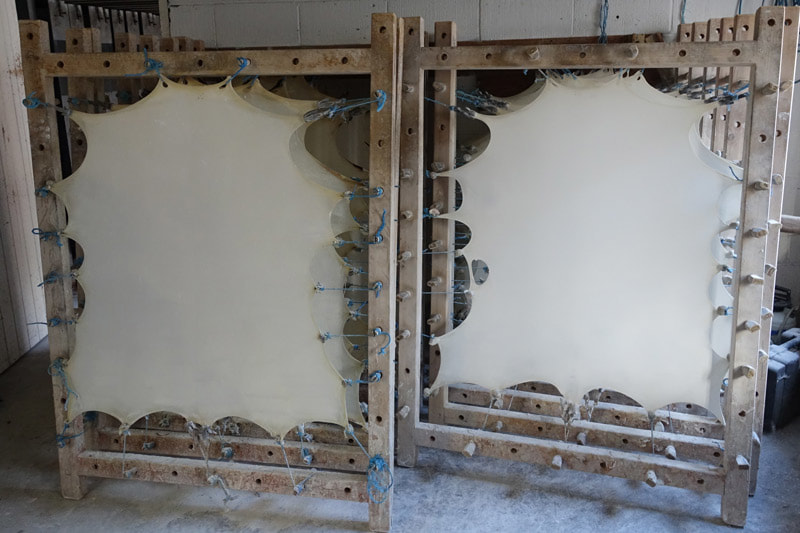
Vellum sheets being prepared.

It’s now probably only specialists who use the word vellum to refer to the material in its historic sense.  The most frequent use of the word is to describe either (1) a prepared (non-calf) animal skin or membrane (usually in pre-cut form for printing and often referred to also as parchment in its generic sense) or (2) any of the various high-quality editions of paper stock offered by many manufacturers.  In the narrow technical sense “true” vellum is (3) made from calfskin and available usually in single sheets which may be used individually (typically as scrolls) or assembled as bound folios, volumes or codices.  However, such is the quality of the modern, non-calf, parchments that only experts can tell the difference and in academic use, the term "membrane" (which means something very different to engineers and others) is now often preferred because even if it’s not exactly correct, nor can it ever be said to be wrong.  Finally, there is (4) "paper vellum" which is created using either plasticized rag cotton or cellulose fibres harvested from plant or trees.  Vellum paper has become popular for formal or ceremonial documents such as invitations because the lighter versions are translucent with a finish like frosted glass.  Despite its smooth feel, vellum paper does not contain plastic and is quite durable (though with nothing like the longevity of “true” vellum) and versatile in that it can in some cases be printed on with laser and inkjet printers.

Vellum scrolls stored in the UK parliament.

There was a perception that the Acts of the UK parliament had for hundreds of years been printed on vellum scrolls but the practice is of comparatively recent origin, begun only in 1849; prior to that they were handwritten on parchment rolls which were made usually from goatskin.  The innovation of printing record copies of public Acts on vellum was adopted following recommendations made by the Select Committee on Printing in 1848, and a 1849 report by the then Clerk Assistant of the House of Lords.  The resolutions abolished the practice of ingrossing (handwriting) record copies of Acts and inrolling them in parchment rolls containing all public Acts passed in a Parliamentary session.  Record copies of public Acts were henceforth printed in book form, on vellum while private Acts were printed on vellum between 1849-1956, since when they have been printed on archival paper.

Rendering of Lindsay Lohan in The Parent Trap by lemgras330, colored pencil on Bristol Vellum paper, June 2016.

In 1999 proposals to print record copies of public Acts on archival paper were considered.  The House of Lords approved a proposal to change to printing on archival paper, but the House of Commons voted against, noting claims that archival paper was of suitable quality and much cheaper but arguing against the change because of tradition, the superior durability of vellum and the threat to the viability of the UK’s last remaining printer of vellum.  It was one of the less dramatic and acrimonious disputes between the Commons and Lords but it nevertheless dragged on for almost two decades, their lordships never retreating from their view that “…printing on archival paper is a more appropriate use of public funds, and that the case for continuing to print on vellum is not made”.  Not wishing to appear obstructive, it was added that if “…the Commons wished to arrange a contract for printing record copies of Acts on vellum, then the Lords would share experience of managing the legacy contract to assist with this”.  Their last word however was that the House of Lords “…does not wish to contribute financially to any future printing on vellum”.  In a typically English way, the Commons found a compromise, agreeing to provide front and back vellum covers for record copies of Acts which the House of Lords would continue to print on archive paper.  Honor seemed to be satisfied on both sides and another constitutional crisis was averted.

The Brudenell Magna Carta, document on vellum, dated 12 October 1297.

Outside of the parliament however, there were some not convinced the Lords had gone far enough and them storage of the country’s laws on the skins of dead animals should give way to digital storage.  Obvious though it may seem to the Instagram generation for whom archival documents in physical form are rare, it may not be as simple as it seems.  Parchment does last a long time, the UK’s oldest extant law can still be found on a document dating from 1497 and while ordinary paper can deteriorate rapidly, vellum if carefully stored will endure for millennia and original copies for the Magna Carta, signed more than 800 years ago on vellum, still exist.

Victoria Tower, Palace of Westminster, London.

Many actually still exist, the parliamentary archives a collection of some five miles (8 km) of physical parchment, paper and photographs in the Victoria Tower which rises 325 feet (99 m) at the western edge of the Palace of Westminster.  In the tower, scrolls of vellum are piled up in a vast repository, spooled in a range of different sizes, looking much as they would have done hundreds of years ago.  Digital archiving obviously has no such history but the issues of long-term storage are, even after only a few decades of accumulation, well understood.  The advantages of digitization are ease of creation, economy of storage (especially in something as text-orientated as acts of parliament) and simplicity of replication.  However, although often referred to as “weightless”, digital storage inherently needs physical objects: disks (or discs), tapes or other media and an infrastructure of devices is also required for the archives to be read.  This has been a troublesome aspect to many with old archival material on electronic media which may still be usable but, if held on some rare and long obsolete specification of diskette or tape cartridge, may be effectively inaccessible.  The issue is not insurmountable and needs only a protocol under which material is moved from one media to another as technology changes but it’s still a more labour-intensive process (and one with much scope for error) than leaving a vellum scroll sitting of a shelf for centuries.

Friday, August 12, 2022

Disfluency

Disfluency (pronounced dis-floo-uhn-see)

(1) In clinical speech pathology, an impairment of the ability to produce smooth, fluent speech.

(2) In linguistics, an interruption in the smooth flow of speech, as by a pause or the repetition of a word, syllable and non-lexical vocables.

1981: A compound word, the construct being dis- + fluency.  The dis prefix was from the Middle English dis-, from the Old French des from the Latin dis, from the proto-Italic dwis, from the primitive Indo-European dwís and cognate with the Ancient Greek δίς (dís) and the Sanskrit द्विस् (dvis).  It was applied variously as an intensifier of words with negative valence and to render the senses “incorrect”, “to fail (to)”, “not” & “against”.  In Modern English, the rules applying to the dis prefix vary and when attached to a verbal root, prefixes often change the first vowel (whether initial or preceded by a consonant/consonant cluster) of that verb. These phonological changes took place in Latin and usually do not apply to words created (as in Modern Latin) from Latin components since the language was classified as “dead”.  The combination of prefix and following vowel did not always yield the same change and these changes in vowels are not necessarily particular to being prefixed with dis (ie other prefixes sometimes cause the same vowel change (con; ex)).  Fleuency was from the Late Latin fluentia, from the Latin fluens (flowing), present active participle of fluō (I flow) and was cognate with the French fluence.  When first used in English in the 1620s, fluency meant "abundance", the sense "smooth and easy flow" emerging the next decade from fluent + the abstract noun suffix -cy and it replaced the earlier (circa 1600) fluence.  The alternative spelling is dysfluency and the noun diffluence (a flowing off on all sides; fluidity) is not a standard part of the jargon of linguistics; it appears in fields in which aspects of fluid dynamics are discussed (physics, hydrology, engineering, meteorology etc).  Disfluency is a noun, disfluent is an adjective and disfluently is an adverb; the noun plural is disfluencies.

Ums & Ahs

George W Bush (b 1946; US president 2001-2009): Sometimes, a few more disfluencies might help.

Disfluencies are the filled pauses, the ums and ahs in speech which in structural linguistics are fillers called "non-lexical vocables".  Technically, fillers are neither recognized as purposeful or contain formal meanings and can be associated with articulation problems such as stuttering.  Considered a sin in broadcast media such as news reports or films, they’re an important part of everyday conversation, said by researchers to constitute some twenty percent of "words" in typical conversations.  Fillers can be used as a pause for thought or as an emphasis.  Research indicates that while disfluencies vary between languages, "huh" is the most recognized syllable throughout the world, used always as an interrogative.

Speech disfluencies caused many problems in the early days of speech-to-text software.  Of late, they’ve become important in the development of software convincingly to emulate a human for tasks like answering phones.  Unlike speech-to-text where perfection was the goal, here, it’s important the machine’s speech not be perfect; "ums" & "ahs" are required because that's how real people talk.  To date, most successful experiments have been where there are a limited number of variables and a closed vocabulary set such as booking an appointment at a hairdresser.  There the common variables are date, time, name, color, style and such, the industry term for this niche the conversational bot.  Interestingly, even advocates of the technology, whatever their private thoughts, aren’t suggesting this can soon be pursued to its logical conclusion but then technological changes tend not to follow a lineal path.  Conversational bots, just like humans when it all gets too much, will transfer the call to a supervisor and for the foreseeable future, they’re likely to remain flesh and blood but there's no reason why systems which don't yet exist (and possibly using bio-synthetic hardware and quantum technology) cannot entirely replace humans for all but a select number of tasks, both physical and non-physical.

The speech disorder stuttering (sometimes known as stammering) is most associated with involuntary repetitions and prolongations of sounds, syllables, words, or phrases in the flow of speech but disfluencies such as silent pauses or blocks during which the stutterer is unable to produce any sounds are also characteristic of the syndrome.  Stuttering seems to be a normal part of the human condition and the cause remains mysterious; males are much more susceptible than females and there appears to be some genetic link but even modern techniques in neurology have revealed little.  Because stuttering can be induced by physical brain injury, there was much interest in comparing the brains of victims of injury with those of natural stutterers but the findings from the research have proved inconclusive.  There have been many attempts to develop treatments and therapies to reduce the extent of an individual’s stuttering but while cases with degrees of success have been reported, the results have been so erratic that all that appears to have been indicated is that some patients can be helped and it matters little what method is chosen while others show no improvement, regardless of the therapy.  Interestingly, there seemed little relationship between the severity of the condition and the extent of the improvement reported, the only consistent finding being that those under the age of eight benefit most from intervention.  Among some adult stutterers, there is a political objection to treatment on the same basis that some in the Deaf community object to hearing implants because they perceive them as a threat to their culture and way of life, suspecting an attempt to erase a minority group, assimilating its members into the mainstream.

Non-lexical vocables, pauses and hesitancies are part of the stock-in-trade of actors and they’re deployed variously, sometimes because they’re in the script and sometimes they’re ad-libbed because they seem to improve things, adding a layer of “authenticity”.  If well-executed, it can make dialogue seem more “natural” and there are variant techniques used when playing someone speaking in a language other than their own (the classic, hesitant “ow you say?” is almost a cliché but the phrase is used in the wild).  Out in the wild, they can also appear organically as Lindsay Lohan in 2016 demonstrated when debuting Lilohan (usually pronounced lie-low-han), her non-geographically specific dialect of English.  It used a conventional US English vocabulary but was delivered, with an occasionally halting delivery, in an accent vaguely Russian or eastern European.

Lindsay Lohan explained things by saying it was “…a mixture of most of the languages I can understand or am trying to learn”, adding that she’d been “…learning different languages since I was a child I'm fluent in English and French can understand Russian and am learning Turkish, Italian and Arabic”. A limited edition LiLohan clothing line was released to welcome the latest addition to Earth's linguistic diversity.  Estimates are somewhat inexact but it's thought there are still some 7000 languages being spoken on Earth though the number is in decline, some extant languages may have but a handful of speakers remaining with neither extensive written records nor any programme to ensure preservation; almost half of the languages on Earth are spoken only by relatively small populations, ranging from dozens to a few thousand.  A philanthropic endeavor, part of the proceeds from each Lilohan item sold will benefit Caudwell Children and the Disaster and Emergency Management Presidency of Türkiye (AFAD).  An example of Lilohan being spoken may be heard here and the clothing range is available in black and white in a range of sizes: Tank tops and T-shirts are US$24.99; sweatshirts US$39.99.  Some grammar Nazis tweeted on X (then known as Twitter) that the text should read "I speak only Lilohan"; Ms Lohan ignored them. 

Lindsay Lohan meeting Recep Tayyip Erdoğan (b 1954; prime-minister or president of the Republic of Türkiye since 2003) and First Lady Emine Erdoğan (b 1955), Presidential Palace, Ankara, Türkiye, 27 January 2017.

The AFAD (Afet ve Acil Durum Yönetimi Başkanlığı), created in 2009, is the government’s central agency for emergency management and civil protection.  The AFAD conducts pre-incident work, such as preparedness, mitigation and risk management, during-incident work such as response, and post-incident work such as recovery and reconstruction.  The AFAD is under the auspices of the Ministry of Interior and coordinates the activities of NGOs with private and governmental agencies.  It additionally formulates and implements policies and in a disaster or emergency, is the state’s sole responsible organization.

Thursday, August 11, 2022

Benzodiazepine

Benzodiazepine (pronounced ben-zoh-dahy-az-uh-peen)

A family of chemical compounds used as minor tranquilizers that act against anxiety and convulsions and produce sedation and muscle relaxation; marketed, with variations, under a number of brand-names and trademarks such as Diazepam (Valium) and chlordiazepoxide (Librium).

1934: Word is a chemical construct, from benzo (word-forming element used in chemistry to indicate presence of a benzene ring fused with another ring) + di (from the Ancient Greek δίς (dís) (twice) + az (nitrogen-substituted) + epine (from the French hepta (seven-membered).

Benzodiazepines are a class of therapeutic agents capable of producing a calming, sedative effect and used in the treatment of fear, anxiety, tension, agitation, and related states of mental disturbance.  Among the most widely prescribed drugs in the world, the first benzodiazepine was chlordiazepoxide (Librium), followed by a large variety of agents, including diazepam (Valium) and alprazolam (Xanax), each with slightly different properties.  Benzodiazepines work by enhancing the action of the neurotransmitter gamma-aminobutyric acid (GABA), which inhibits anxiety by reducing certain nerve-impulse transmissions within the brain.

Before the development of the benzodiazepines, the only available anti-anxiety drugs were the barbiturates and meprobamate and, relative to these, the benzodiazepines had fewer unfavorable side effects and a reduced potential for abuse.  The thus quickly became the preferred treatment for anxiety, used also to treat insomnia, general stress, calming muscle spasms and preparing patient for anesthesia or dental surgery.  Side effects include sleepiness, drowsiness, reduced alertness, and unsteadiness of gait but benzodiazepines are not lethal even in very large overdoses, having the tendency only to increase the sedative effects of alcohol and other drugs.  Dependence may however occur, even in moderate dosages, with withdrawal symptoms observed even after short-term use and for long-term users, almost half may suffer withdrawal symptoms which can take months to subside.  As a consequence, some long-term users continue to take the drug not because of persistent anxiety but because the withdrawal symptoms are too unpleasant.

Valium was introduced by the Swiss Roche Labs in 1963.  It was the first billion-dollar medicine and ushered in the era of brand-name drugs, the model of later marketing campaigns for products such as Prozac and Viagra.  In its halcyon years between 1969 and 1982, more prescriptions were written for Valium than any other drug.  The name Valium (which in US trademark law was Hoffmann-La Roche’s proprietary name for diazepam, first registered in 1961) was a creation of the corporation, not, as is often claimed, from a Latin word or formation meaning "to be strong and well".  Valium was no different from Telstra and Optus, creations by consultants needing a word both unique and different enough from others to withstand legal challenge while being something which hints, however vaguely, at what’s being sold.  In Latin, there was validum (strong; powerful; efficacious), vallum (a fortification) and the plant valerian (a herbal sedative), all of which were probably in the corporate mind.  Some with medical connections such as vulnerary (used for or useful in healing wounds), valetudinarian (a person of a weak or sickly constitution) and valetudo (one's state of health (good or bad)) might have been a bit remote so the closest inspiration was likely valere (a Latin verb meaning “to be strong”; “to be well”).  Best of all the sardonic industry jokes was a connection with the Latin vale (goodbye; farewell) although Valium wasn’t much use in suicide attempts, fatal overdoses, while not impossible, were rare.

Xanax tablets.

Xanax is the brand name for the drug alprazolam which is a benzodiazepine.  It is a prescription medication primarily used to treat anxiety disorders, panic disorders and (more controversially) depression.  A fast & short-acting benzodiazepine, Xanax works by enhancing the activity of a neurotransmitter called gamma-aminobutyric acid (GABA), which helps to reduce anxiety and promote relaxation.  Xanax is regarded as effective for treating anxiety and related disorders when used as prescribed but can be habit-forming, leading to dependence and addiction.  Lindsay Lohan released (or "dropped" in the fashionable parlance) the track Xanax in 2019.  With a contribution from Finnish pop star Alma (Alma-Sofia Miettinen; b 1996), the accompanying music video was said to be “a compilation of vignettes of life”, Xanax reported as being inspired by Ms Lohan’s “personal life, including an ex-boyfriend and toxic friends”.  Structurally, Xanax was quoted as being based around "an interpolation ofBetter Off Alone, by Dutch Eurodance-pop collective Alice Deejay, slowed to a Xanax-appropriate tempo.