Tuesday, February 1, 2022

Ghat

Ghat (pronounced gat, got (Indian) or gawt (Indian) or (apparently optionally) fat/fhat for certain slang)

(1) In India, a wide set of steps descending to a river, especially a river used for bathing; a mountain pass; a mountain range or escarpment; a place of cremation (also as burning-ghat).

(2) A leaf possessing simulative qualities, chewed in Yemen, Ethiopia, Somalia, and among Yemenite Jews in Israel.  Ghat chewing sessions are social and involve playing music, smoking a nargilah (a hookah-type device for smoking) and what’s sometimes described as “other such Eastern reveries” (usually with initial capital).

(3) Among the criminal classes, a slang word for a firearm, derived from the Gat Air Pistol, a low-velocity air-powered pistol produced circa 1937-1996 which fired a variety of projectiles.

(4) An acronym standing for Give Hope And Take (away), a short series of events in which someone gives hope to another then instantly and ruthlessly takes it away.

(5) Slang for something very good or much admired, "ghatness" thus a desirable quality (class specific with a noted ethnic bias in use).

(6) As a homophone, slang for the Gatling Gun.

(7) As the homophonic acronym GATT, the General Agreement on Tariffs & Trade (1947-1995), predecessor of the World Trade Organization (WTO) arrangements.

(8) In Hinduism, a certain type of temple.  A brahmin (a member of the highest (priestly) caste) who acted as the hereditary superintendent of a particular ghat (temple) and who was regarded as authoritative in matters of genealogy and ritual was known as a panda.

1595–1605: From Hindi घाट (ghā) (a pier; a pass of descent from a mountain, hence also "mountain range, chain of hills," also "stairway leading up from a river" (to a shrine, temple, etc.), from the Sanskrit घट्ट (ghaṭṭa or ghattah) (a landing-place, steps on the side of a river leading to the waters).  The Sanskrit is of unknown origin but there may be a connection with the Telugu కట్ట (kaṭṭa) (dam, embankment).  In Indian use, the related form is ghaut.  Under the Raj, some language guides suggested a ghaut differed from a ghat in that the former was used exclusively to describe “a ravine leading to the sea” but this was later discredited.  The mistake probably arose in assuming a local practice was universal and it appears ghaut and ghat were inconsistently but widely used interchangeably (the plural was ghauts).  Ghat is a noun; the noun plural is ghats and all derived forms (ghating, ghated, ghatness etc are non-standard).

As a point of usage, it appears the slang forms of ghat should be pronounced with a hard “G” except when used in meaning 5 (above) when an “ef” or “ph” (as in fat or phat) is used.  It’s an important convention of use: If one has just been ghatted in the sense of meaning 4 (above), it’s correct to say “The bitch really gatted me” and not “The bitch really phatted me”.  That really seems just common sense.        

The Gat Air Pistol

Gat air pistol advertisement.

The Gat Air Pistol was made by the Harrington company in the United Kingdom.  It was in production continuously between the late 1930s and late 1990s, except during the World War II (1939-1945) when the factory re-tooled for war production.  The pistol could fire .177 pellets, ball bearings, darts, corks and anything else small and light enough to suit the barrel.  A low-powered weapon with a very low muzzle velocity, the target market was hobbyists and children, the latter predictably usually boys; there was a time when they were given such things.  The other lucrative market was the travelling fair.  In every sideshow ally there were usually several shooting gallery stall owners who offered infamously worthless prizes for anyone able to hit the target and for their purposes, the cheaply-produced, notoriously inaccurate Gat was ideal.  Anyone who could hit a target with a Gat gun was probably a pretty bad shot.


1920s US advertising.

Many Sociologists, psychologists and others have pondered why, despite generations of US youth having what was by international standards ready access to firearms, mass shootings at schools by them didn't exist as a phenomenon until the 1990s and the explanations offered have included (1) the effect of the internet, (2) the relaxation of censorship in popular culture, (3) the availability of high-powered, rapid fire weapons with large capacity magazines, (4) the use of increasingly potent narcotics at younger age of first use & addiction and (5) the rise of single parent (typically a mother) households.  

Monday, January 31, 2022

Longevity

Longevity (pronounced lon-jev-i-tee)

(1) A long individual life; great duration of individual life.

(2) The length or duration of life.

(3) Length of service, tenure etc; seniority.

(4) Duration of an individual life beyond the norm for the species.

1605-1615: From the Late Latin longaevitatem (nominative longaevitās), from longaevus (ancient, aged; long-lived (the feminine was longaeva and the neuter longaevum)), the construct being longus (long) + aevum (age) (from PIE primitive Indo-European root aiw- (vital force, life; long life, eternity); longevous was the adjective.  The construct of longaevitās was longaevus + -itās (the suffix from the Proto-Italic -itāts & -otāts (-tās added to i-stems or o-stems, later used freely) and ultimately from the primitive Indo-European -tehats.  The adjectival form, the Latin longevous (also as longevously) is now rare in English but does occasionally appear as a poetic or literary device.  (the comparative more longevous, the superlative most longevous).  The less common antonym is shortgevity and the plural longevities; there’s not an exact synonym, the closest being probably durability, endurance & lastingness.  Longevity is a noun; the noun plural is longevities

Reader's Digest Kids Letter Writer Book & Stationary Set, one of Lindsay Lohan’s early (in 1994, then aged seven) modelling jobs.

Among monarchs, longevity is not uncommon, Louis XIV (1638–1715; le Roi Soleil (the Sun King), King of France 1643-1715) holding the world record by setting the mark at 72 years, 110 days.  All a latter day king, queen or emperor need to have a crack the record is (1) assume the throne at an early and age and avoid (1) dropping dead, (2) suffering regicide, (3) being compelled th abdicate because of some scandal or (4) being deposed and historically most have managed most or all of those but, despite that, Louis XIV’s record had stood for more than three centuries.  In fields where “what one does” rather than “how long one stays alive” determines longevity, long careers are less common but many do long endure.  In the minds of some, Lindsay Lohan (b 1986 must seem to have “been around forever” and in terms of her industry, that’s a reasonable way of putting it.  Signed at the age of three to the agency Ford Models, her early gigs were in print advertising before she appeared in dozens of television commercials and at seven, she was in episode 3358 (29 March 1995) of Sesame Street which first aired in the US in 1969.  By 2026, aged 39, Ms Lohan had been in the business for 36 years and counting.  On paper, there have been impressively long military careers but many are a bit of a fudge because of the tradition “a field marshal does not retire”.  Field Marshal August von Mackensen (1849–1945) joined the Prussian Army in 1869 so over three-quarters of a century, his career spanned service to Kingdom of Prussia, the North German Confederation, the German Empire, the Weimar Republic, the Third Reich, the so-called “Dönitz administration” and the post-war Allied occupation.

Field Marshal August von Mackensen (colorization by Richard White) in fur busby with Totenkopf.  Busby is the English name for the Hungarian prémes csákó (fur shako) or kucsma, a military head-dress and the German Totenkopf (literally “dead person's head”) and widely used in the sense of “death’s head”.

Politics being a sordid, nasty business, old Enoch Powell’s (1912–1998) dictum that “all political careers end in failure” is fulfilled often enough to be thought a rule but circumstances can occur which can make even a relatively brief seem impressively long.  Remarkably, Schwerin von Krosigk (1887-1977) served continuously in cabinet as finance minister between 1932-1945, ending his government service as chancellor (prime minister), the previous appointee to that role Dr Joseph Goebbels (1897-1945; Nazi propaganda minister 1933-1945) having committed suicide, something at the time fashionable among Nazis.  Von Krosigk thus served as a minister under the Weimar Republic, the Third Reich and the Dönitz administration, proving something of a “Vicar of Bray” in troubled times; he was quite a survivor and Winston Churchill (1875-1965; UK prime-minister 1940-1945 & 1951-1955) even contemplated maintaining the Dönitz administration as a short-term German government so briefly there was the prospect of von Krosigk serving yet another master.  Churchill also benefited from the times coming to suit him.  As early as 1929 his political career had been dismissed as “a failure” yet it was the dramatic events of 1939-1945 which revived his prospects and late in life, his success was extraordinary.  First holding office in “the glittering Liberal ministry” of Sir Henry Campbell-Bannerman (1836–1908; UK prime minister 1905-1908), 50 years later he finally retired (not entirely willingly) from the premiership.  In politics, longevity of half a century-odd (off and on) is not unique but certainly untypical.

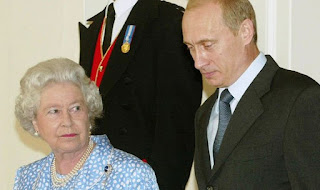
In political terms, Vladimir Vladimirovich Putin (Vladimirovich the patronymic, Putin the family name, b 1952; president or prime minister of Russia since 1999) has displayed an extraordinary longevity.  While it's true some of his Tsarist and Soviet predecessors ruled for longer, they were operating under systems, though sometimes violently dangerous, which made the maintenance and retention of power in many ways a different sort of task.  Since 1999 he has served either as prime-minister or president of Russia, at one point swapping between the offices to circumvent a tiresome constitutional clause which placed limitations on consecutive presidential terms.  In 2021, after a well-done referendum, constitutional amendments were effected which will permit Mr Putin to seek election twice more which, providing the elections are well-run, means he could retain the presidency until 2036.  Should he defy the odds which tend to increase against any politician as the years roll by and still be in rude good health as 2036 looms, there is the suggestion he might be unwilling to relinquish office; there may be a need for more constitutional reform.

With Elizabeth II (1926-2022; Queen of the UK and other places, 1952-2022).

With Muammar Gaddafi (circa 1942–2011; leader of Libya 1969-2011).

With Yasser Arafat (1929–2004; leader of the PLO (Palestine Liberation Organization) 1969-2004).

With John Paul II (1920-2005; pope 1978-2013).

With Jiang Zemin (1926–2022; General Secretary of the Chinese Communist Party (CCP) (and thus paramount leader) 1989-2002 and President of the People's Republic of China 1993-2003).

With Boris Yeltsin (1931–2007; President of Russia 1991-1999).

With Bill Clinton (b 1946; President of US 1993-2001).

With Rudy Giuliani (b 1944; Mayor of New York City 1994-2001).

With Silvio Berlusconi (1936-2023; prime minister of Italy 1994-1995, 2001-2006 & 2008-2011).

With Kim Jong-Il (Kim II, 1941-2011; Dear Leader of DPRK (Democratic People's Republic of Korea (North Korea)) 1994-2011).

With Jacques Chirac (1932–2019; President of France 1995-2007) & Gerhard Schröder (b 1944; Chancellor of Germany 1998-2005).

With John Howard (b 1939; Prime-Minister of Australian 1996-2007).

With Benjamin Netanyahu (b 1949; prime-minister of Israel 1996-1999, 2009-2021 and since 2022).

With Tony Blair (b 1953; Prime-Minister of UK 1997-2007.

With Yoshirō Mori (b 1937; Prime-Minister of Japan 2000-2001).

With Bashar al-Assad (b 1965; President of Syria 2000-2024).

With Junichiro Koizumi (b 1942; Prime-Minister of Japan 2001-2006).

With Ariel Sharon (1928–2014) Prime Minister of Israel 2001-2006).

With George W Bush (b 1946; President of US 2001-2009).

With Hu Jintao (b 1942; general secretary of the Chinese Communist Party (CCP) 2002 to 2012 (and thus paramount leader), president of the PRC (People's Republic of China) 2003-2013).

With Benedict XVI (1927–2022; pope 2005-2013, pope emeritus 2013-2022).

With Angela Merkel (b 1954; Chancellor of Germany 2005-2021).

With Nicolas Sarközy (b 1955, President of France 2007-2012).

With Barack Obama (b 1961; President of US 2009-2017).

With crooked Hillary Clinton (b 1947; US secretary of state 2009-2013).

With Kim Jong-Un (Kim III, b 1982; Supreme Leader of DPRK (Democratic People's Republic of Korea (North Korea)) since 2011).

With Xi Jinping (b 1953; general secretary of the Chinese Communist Party (CCP) and paramount leader of the People's Republic of China (PRC) since 2012).

With Francis (1936-2025; pope 2013-2025).

With Tony Abbott (b 1957; Prime-minister of Australia 2013-2015).

With Narendra Modi (b 1950; Prime-Minister of Indian since 2014).

With Theresa May (b 1956; Prime Minister of the UK 2016-2019).


With Donald Trump (b 1946; US president 2017-2021 and since 2025).

With Emmanuel Macron (b 1977; President of France since 2017).

With Boris Johnson (b 1964; UK prime-minister 2019-2022).

With Joe Biden (b 1942; President of US 2021-2025).

Sunday, January 30, 2022

Monitor

Monitor (pronounced mon-i-ter)

(1) A student appointed to assist in the conduct of a class or school, as to help take attendance or keep order (largely obsolete).

(2) A person appointed to supervise students, applicants, etc., taking an examination, chiefly to prevent cheating; proctor.

(3) A person who admonishes, especially with reference to conduct.

(4) Something that serves to remind or give warning.

(5) A device or arrangement for observing, detecting, or recording the operation of a machine or system, especially an automatic control system.

(6) An instrument for detecting dangerous gases, radiation, etc.

(7) A receiving apparatus used in a control room, especially to provide a steady check of the quality of an audio or video transmission.

(8) A similar apparatus placed in various parts of a studio so that an audience can watch a recorded portion of a show, the performer can see the various segments of a program, etc.

(9) Any such receiving apparatus used in a closed-circuit system, as in an operating room.

(10) The screen component of a computer, especially a free-standing screen.

(11) In early computing, a control program which handled the primitive file-loading, essentially a precursor to operating systems.

(12) A type of armored warship of very low freeboard, having one or more turrets and used for coastal defense (now obsolete).

(13) In architecture, a raised construction straddling the ridge of a roof and having windows or louvers for lighting or ventilating a building, as a factory or warehouse.

(14) An articulated mounting for a nozzle, usually mechanically operated, which permits a stream of water to be played in any desired direction, as in firefighting or hydraulic mining (also called giant).

(15) Any of various large predatory lizards of the genus Varanus and family Varanidae, of Africa, southern Asia, the East Indies, and Australia, fabled to give warning of the presence of crocodiles.

(16)  To listen to or observe something.

(17) In Engineering, a tool holder, as for a lathe, shaped like a low turret, and capable of being revolved on a vertical pivot so as to bring the several tools successively into position.

1540-1550: From the Latin monitor (one who warns) from perfect passive participle monitus (warning) from the verb monēre (to remind, bring to (one's) recollection, tell (of); admonish, advise, warn, instruct, teach) from the primitive Indo-European moneie- (to make think of, remind), source also of the Sanskrit manayati (to honor, respect) and the Old Avestan manaiia- (making think), a suffixed (causative) form of the root men- (to think), source also of the Latin memini (I remember, I am mindful of) & mens (mind).  The notion was "one who or that which warns of faults or informs of duties".  Most sources list the eighteenth century monitress ((1) a female mentor or advisor; a female observer or (2) a female monitor, or school leader) as rare or dated but, except in historic references, it's probably now extinct.  Monitor & monitoring are nouns & verbs, monitorability, monitorization, monitorer, monitress & monitorship are nouns, monitorize & monitored are verbs, monitorless, monitorial & monitorable are adjectives; the noun plural is monitors.

The first use in English was to describe a "senior pupil at a school charged with keeping order" (vaguely analogous with the block kapo in a Nazi concentration camp), from the Latin monitor (one who reminds, admonishes, or checks," also "an overseer, instructor, guide, teacher").  The lizard picked up the name in 1826 because of the fable in which it was said to give warnings of Nile crocodiles.  The squat, slow-moving ironclad warship was first used in 1862 during the US Civil War, the name chosen by the inventor, Swedish-born U.S. engineer John Ericsson (1803-1889), because it was meant to "admonish" (in the sense of the function of the senior school pupils appointed monitors) the Confederate (the pro-slavery states south of the Mason-Dixon Line that sought to secede from the Union) leaders in the US Civil War.  Use in broadcasting dates from 1924 when it meant "a device to continuously check on the technical quality of a radio transmission signals" and it was borrowed in 1931 during the development of early television broadcasts to describe "a TV screen displaying the picture from a particular camera."  It soon came to mean electronic screens of any type.  The general sense of monitoring stuff emerged in 1944 to describe certain wartime intelligence operations although as early as 1818 the romantic poet John Keats (1795-1821) used it in the sense of "to guide", a nod to the origins in Latin.

“Monitorlogically” does not exist but “Logic Monitor” is a generic term used for IT (information technology) infrastructure monitoring platforms.  Often hybrid-devices (components sometimes not even inter-connected), they’re intended usually to allow SysAdmins (system administrators), developers and MSPs (managed service providers) to track the health, performance, and availability of all or some of a technology stack (which might extend to networks, cloud services, servers, databases, backups and applications) from a single, unified dashboard.  Some are better than others.
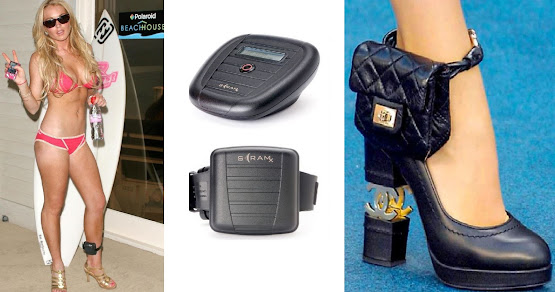
Lindsay Lohan in SCRAM bracelet (left), the SCRAM (centre) and Chanel's response from their Spring 2007 collection (right).

A very twenty-first century monitor: Before Lindsay Lohan began her “descent into respectability” (a quote from the equally admirable Mandy Rice-Davies (1944-2004) of MRDA fame), Lindsay Lohan inadvertently became of the internet’s early influencers when she for a time wore a court-ordered ankle monitor (often called “bracelets” which etymologically is dubious but rarely has English been noted for its purity).  At the time, many subject to such orders often concealed them under clothing but Ms Lohan made her SCRAM (Secure Continuous Remote Alcohol Monitor) a fashion statement, something that compelled the paparazzi to adjust their focal length to ensure her ankle of interest appeared in shots.  The industry responded with its usual alacrity and “ankle monitor” purses were soon being strutted down the catwalks.

Chanel's boot-mounted ankle purse in matching quilted black leather.

In one of several examples of this instance of Lohanic influence on design, in their Spring 2007 collection, Chanel included a range of ankle bags.  Functional to the extent of affording the wearing a hands-free experience and storage for perhaps a lipstick, gloss and credit card (and the modern young spinster should seldom need more), the range was said quickly to "sell-out" although the concept hasn't been seen in subsequent collections so analysts of such things should make of that what they will.  Chanel offered the same idea in a boot, a design actually borrowed from the military although they tended to be more commodious and, being often used by aircrew, easily accessible while in a seated position, the sealable flap on the outer calf, close to the knee.

125 Years of the Order of the Secret MonitorThe book actually contains no secrets and is thus something of a Masonic trick.

A Masonic Monitor is a printed volume containing lists of the rituals, symbols, ceremonies, and teachings of the fraternity.  Typically a Monitor will include prayers, scriptural readings associated with degrees as well as procedural instructions for meetings, funeral rites and other ceremonies.  The foundational text (which to this day remains a template for Monitors) was The Freemason's Monitor or Illustrations of Masonry, published in 1797 by Boston-born Thomas Smith Webb (1771-1819).  Webb’s work drew much from Illustrations of Masonry (1772) by the Scottish printer William Preston (1742–1818) but his innovation was structural, the Monitor arranged in a way which allowed the various temples and lodges to “localize the text” as required while substantially retaining Masonic standardization in forms, rituals and procedures.  Being a publicly available document, no Monitor ever contains esoteric secrets, specific grips (the infamous Masonic handshake) or passwords, these passed down only orally or by example.  Also, despite the tempting name, subsequent publications with titles such as The Order of the Secret Monitor reveal no more and hint little at the more mysterious rituals or the plotting and scheming for which the Masons are notorious.

The Monitors

Monitors were curious looking, relatively small warships which, while neither fast nor heavily armored, carried disproportionately large guns, sometimes a single barrel as large as 18 inches (460 mm).  First used in recognizable form the US Civil War (1861-1865), they saw service with several navies during both world wars and some were built by the USN (US Navy) as late as the 1960s to support costal operations in the war in Vietnam (1955-1975).  Essentially a floating gun platform, they could be used only in shallow waters and were thus restricted to river and coastal duties where they were deployed as shore bombardment vessels.  Although something of a footnote in naval architecture, the most heavily gunned monitors enjoy the distinction of firing heavier shells than most other warships, only the IJN (Imperial Japanese Navy, 1868-1945) ever equipping two doomed battleships with 18 inch guns.

HMS Marshall Ney (1915-1957)

The RN (Royal Navy) has a sense of history and maintains in the service a great veneration for her most illustrious ships, names like Dreadnought & Vanguard often re-used on newer vessels to maintain links with a tradition which dates back almost five centuries.  One ship however not often mentioned in the Admiralty's annals is HMS Marshal Ney, laid down in 1915 as the first of two monitors of her class.  Designed to use 15 inch (380 mm) guns using mounts and turrets which became available when the Admiralty opted to reconfigure the battleships Renown and Repulse as battle cruisers, Marshal Ney and her sister ship Marshal Soult were named in recognition of the then historically unusual situation of the French being allies rather than enemies.  Built with the same armor as earlier monitors which mounted 12 inch (300 mm) guns, the original plan had been also to use the same well-regarded and reliable engines but an unfortunate decision was taken to use some diesel engines which were otherwise unallocated.  In short order, HMS Marshal Ney would come to be known as “the worst ship in the navy”.

The Vickers engines in the Marshal Soult, though underpowered, were reliable but those in her sister ship, built by the German company of MAN were a disaster, the problems thought a consequence of it being impossible in wartime to employ the German technicians experienced in servicing them or obtain the spare parts needed to fix them.  On the rare occasions the engines successfully started, they rarely ran for long without something “blowing up” and the engineers reports make clear, this expression was literal rather than used in the figurative sense often heard in engine rooms, pieces of shrapnel flying around with disturbing frequency.  Remarkably, there were only minor injuries.  As a result, the navy removed the big gun and installed it on the better performing monitor HMS Terror though in one of the coincidences of war, one of its barrels was on HMS Repulse when she was sunk by the Japanese in 1941.  The Admiralty re-armed the Marshal Ney, firstly with a single 9.2 inch (235 mm) gun and later with six 6 inch (150 mm) bores but made no attempt to replace the engines, using the ship instead as a floating gun platform in the Channel, towed from port to port as required.  Despite being “the worst ship in the navy”, HMS Marshal Ney had a longer life on the active register than many more storied warships.  After the World War I (1914-1918), she became first a depot vessel and later an accommodation ship, renamed three times between 1922-1947, becoming successively Vivid, Drake and Alaunia II.  She was decommissioned in 1957 and sold for scrap, something which many sailors believed she'd been from the day rolled down the slipway.

Saturday, January 29, 2022

Glout

Glout (pronounced glout or gloot)

(1) To scowl or frown (archaic).

(2) To stare gloatingly (obsolete).

(3) To look sullen (modern revival for selfies & memes).

1400–1450: The origin is in late Middle English and although of uncertain origin, it’s related to the earlier use where to glout was “gloatingly to stare”.  The root, the Middle English glouten (to scowl) is thought derived from the Old Norse goltta (scornfully to grin) but, although likely, the link is undocumented.  Something tending to wards a glout would be gloutish and a hint of the look in another object would be gloutesque but both those adjectives are non-standard.  Although described as archaic as long ago as the eighteenth century, glout enjoyed a bit of a (brief) early twenty-first century revival as a descriptor of selfies and memes although the more evocative "resting bitch face" (RBF) tended to be preferred.  In the way the social works, the resurrected glout soon faded from use.  Glout is a noun & verb, glouted & glouting are verbs; the noun plural is glouts.

Noted glouters, glouting: Paris Hilton (b 1981; top left), Britney Spears (b 1981; top centre), Lindsay Lohan (b 1986; top right), Cardinal George Pell (1941-2023; bottom left), Eric Abetz (b 1958; Liberal Party senator for Tasmania, Australia 1994-2022, member of the Tasmanian House of assembly since 2024, bottom centre) and crooked Hillary Clinton (b 1947; US secretary of state 2009-2013).

Sometimes, some have cheerful faces and eyes full of joy while others can but glout.  Donald Trump (b 1946; US president 2017-2021, left) and Pope Francis (b 1936; pope since 2013, right) pause for a photo opportunity, the Vatican, May 2017.

His Holiness may have been reflecting on his words in: True Christians have cheerful faces and eyes full of joy, the homily he’d three months earlier delivered during morning Mass in the Casa Santa Marta.  His theme had been an invitation for the faithful to reflect on the relationship between God and money and the notion we cannot serve two masters so must choose between them.  He took his reading from Matthew 19, Mark 10 & Luke 18 which include the famous passage: “I say unto you, It is easier for a camel to go through the eye of a needle, than for a rich man to enter into the kingdom of God”, explaining the message of Jesus remains those who give up the pursuit of money will be rewarded for “there is no one who has given up house or brothers or sisters or mother or father or children or lands for my sake and for the sake of the Gospel, who will not receive a hundred times more now in this present age: houses and brothers and sisters and mothers and children and lands, with persecutions, and eternal life in the age to come”.  “The Lord is incapable of giving less than everything” the Pope said, “when he gives us something, he gives all of himself.”  “A cheerful face and eyes full of joy” Francis concluded: “these are the signs that we’re following this path of all and nothing, of fullness emptied out.