Bucket (pronounced buhk-it)
(1) A
deep, cylindrical vessel, usually of metal, plastic, or wood, with a flat
bottom and a semi-circular bail, for collecting, carrying, or holding water,
sand, fruit etc; a pail.
(2) Any
container related to or suggesting this.
(3) In
earth-moving and related machinery, any of the scoops attached to or forming
the endless chain in certain types of conveyors or elevators.
(4) The
scoop or clamshell of a steam shovel, power shovel, or dredge.
(5) A
vane or blade of a waterwheel, paddle wheel, water turbine, or the like.
(6) In
dam design, a concave surface at the foot of a spillway for deflecting the
downward flow of water.
(7) In
basketball, an informal term for the field goal; the part of the keyhole
extending from the foul line to the end line.
(8) In
seat design, as "bucket seat", most associated with cars, an individual seat for one person (as
opposed to the bench seat for two or more).
(9) In
ten-pin bowling, a "leave" of the two, four, five, and eight pins, or the three,
five, six, and nine pins.
(10) To
lift, carry, or handle in a bucket (often followed by up or out).
(11) In
slang, to ride a horse fast and without concern for tiring it; also, used as
slang for driving fast, both mostly UK use.
(12) To
handle (orders, transactions, etc.) in or as if in a "bucket shop".
(13) In
computer operating systems, as download bucket, a unit of storage on a
direct-access device from which data can be stacked and retrieved; a storage
space in a hash table for every item sharing a particular key.
(14) A
unit of measure equal to four (Imperial) gallons (UK archaic).
(15) In
Canadian (mostly Toronto) disparaging slang, a suggestion someone uses crack
cocaine.
(16) In
slang, an old vehicle that is not in good working order (often as rust bucket).
(17) In
variation management, a mechanism for avoiding the allocation of targets in
cases of mismanagement.
(18) As "bucket bag", the leather socket for holding the whip when driving (horses and
sled-dogs), or for the carbine or lance when mounted (cavalry use).
(19) The
pitcher in certain orchids.
(20) A
type of narrow brimmed hat, and as slang, hats in general; the use as “brain bucket” is specific
to crash helmets.
(21) In
rowing, to make, or cause to make (the recovery), with a certain hurried or
unskilful forward swing of the body.
(22) A
pulley (a now obsolete Norfolk dialectical use).
(23) As "bucket bong", an improvised form of drug paraphernalia assembled for the purpose of smoking weed and consisting of a bucket filled with water and a plastic bottle with the bottom surface removed. Social media platforms host instructional video clips for those who wish to hone their technique.
(24) As "bucket list", (1) a list of tasks to be undertaken following discussions (the idea of them being put "in a bucket") and (2) a list of the things one wishes to have done before one dies (ie "kicks the bucket").
1250–1300:
From the Middle English buket & boket, partly from the Anglo-Norman buket & buqet (tub, pail) and partly from the Old English bucc (bucket, pitcher), (a variant of būc (vessel, belly (cognate with the Old
High German būh & the German Bauch)) + the Old French –et.
The suffix –et
was from the Middle English -et, from
the Old French –et & its feminine
variant -ette, from the Late Latin -ittus (and the other gender forms -itta & -ittum). It was used to form diminutives, loosely
construed. The Anglo-Norman words (which in Norman had existed as boutchet & bouquet) were from the Old French
buc (abdomen; object with a cavity),
from the Vulgar Latin būcus (similar
forms were the Occitan and Catalan buc,
the Italian buco & buca (hole, gap), from the Frankish būk (belly, stomach). Both the Old English and Frankish terms
derive ultimately from the Proto-Germanic būkaz
(belly, stomach). The modern meaning "pail
or open vessel for drawing and carrying water and other liquids" emerged
by the mid-thirteenth century, the link to the idea conveyed by the Old English
buc (pitcher, bulging vessel (originally
"belly")) is that buckets were originally crafted from leather before
being made of word and later metal.

Lindsay
Lohan taking the #ALSIceBucketChallenge on the Jimmy Fallon show, August 2014. The Ice Bucket Challenge was a viral event to
promote awareness of amyotrophic lateral sclerosis (ALS, also known as motor
neuron disease and in the United States as Lou Gehrig's disease) and raise
money for research.
In idiomatic use, a “drop in
the bucket” is a small, usually inadequate amount in relation to what is needed
or requested. To “kick the bucket” (dating from 1785) means “to drop dead” which may be from the unrelated (1570s) bucket
(beam on which something may be hung or carried), from the French buquet (balance), a beam from which
slaughtered animals were hung (by the heels or hooves). This may also have been reinforced by the
notion of suicide by hanging after standing on an upturned bucket (apparently once
a most popular choice for the purpose). The
related “bucket list” is the list of things one should do before dropping dead
dates only from 2007 but had earlier been used in coding to describe algorithm
sorting. To “drop the bucket on” is
(mostly Australian slang) to implicate, incriminate, or expose, used also in
the form to “give (someone) a bucketing”..
Wet & Dry: Lindsay Lohan takes the #ALSIceBucketChallenge on the Jimmy Fallon show, August 2014.
Showing a concern for public opinion (an under-researched aspect of the dynamics of totalitarian systems), comrade Stalin (1878-1953; Soviet leader 1924-1953) used the phrase in this sense in 1939 during the negotiations for the Nazi-Soviet Pact when he observed it would be wise to tone down the effusive language describing the friendship between the two dictatorships which were, at least on paper, ideologically opposed (although the various similarities between the two were, even then, acknowledged as quite striking): "For many years now, we have been pouring buckets of shit on each other's heads, and our propaganda boys could not do enough in that direction. And now, all of a sudden, are we to make our peoples believe that all is forgotten and forgiven? Things don't work that fast." In most of the English-speaking world, bucket is the preferred term. Both bucket and pail are used throughout the US, pail most popular in the north, bucket more common elsewhere, especially in the mid-west and the south. Bucket is a noun, verb and (less commonly) an adjective, the present participle bucketing and the past and past participle bucketed; the noun plural is buckets. To say the rain is “bucketing down” suggests hard rain or anything in
great quantity and later Nobel literature laureate Bob Dylan included the track Buckets of Rain on his album Blood on the Tracks (1975). Presumably untypically in popular song, the word from the title appears in the first four lines and not thereafter:
Buckets of rain
Buckets of tears
Got all them buckets comin' out of my ears
Buckets of moonbeams in my hand
More
ominous was the use in 1997 by Tim Fischer (1946–2019; leader of the National
Party of Australia 1990-1999). In Wik Peoples v Queensland [1996] HCA 40-187
CLR 1, the High Court of Australia (HCA) had handed down a judgement which, in
certain limited circumstances, granted to certain indigenous peoples (the “traditional
owners of the land”) a “native title” which could exist concurrently if
events since European settlement had not “extinguished” that status. In September 1997, John Howard (b 1939; prime
minister of Australia 1996-2007) introduced to the parliament his government’s legislative
response to the decision: the Native Title Amendment Bill (1997 and known as
the “Ten Point Plan”) which proposed
to broaden the power of governments to extinguish native title, remove the
right to claim over urban areas and make the initiation of claims more
burdensome. Mr Howard explained things
thus: “My aim
has always been to strike a fair balance between respect for native title and
security for pastoralists, farmers and miners.
The fact is that the Wik decision pushed the pendulum too far in the Aboriginal
direction. The 10 point plan will return
the pendulum to the centre.” Mr
Fischer was earthier, telling the National Party faithful the purpose of the
Ten Point Plan was to deliver “…bucket loads of extinguishment.”

Mercedes-Benz 220 SE Coupé (foreground) & cabriolet (background) with standard rear bench seats, Frankfurt, September 1961 (left) & 1965 220 SE coupé with safari seat option (right).
One rarely specified option on the early Mercedes-Benz W111 (1961-1971; 220 SE, 250 SE, 280 SE & 280 SE 3.5) & W112 (1962-1967; 300 SE) coupés and cabriolets was the fitting of two individual (bucket) seats in the rear instead of the usual bench. Individual seats in a car’s rear compartment had actually been not uncommon in the early days of motoring but by 1961, when the W111 coupé was released at the Geneva Motor Show, except for a few coach-built rarities, the option was unique. The factory called then “safari seats”, the source of that being their special metal frame which actually permitted them to be removed and placed on the ground outside, the implication presumably that this would be handy for those on safari who wished to sit outside and watch the zebras. Whether many of these machines were taken on safari isn’t known but the concept was transferrable to those going on picnics or watching the polo. On both sides of the Atlantic, the fitting of individual rear-seats caught on for some high-end models but other than in some utility vehicles intended mostly for off-road use, no manufacturer made them removable.

Rear buckets, top row, left to right: 1986 Ferrari 412, 2021 Mercedes-Benz GLS 600 Maybach edition, 1974 Jensen Interceptor and 1975 Lamborghini Jarama S. Bottom row, left to right: 1973 Ford (Australia) Landau, 2014 Bentley Continental GTC Speed, 1974 Lamborghini Espada Series III and 1988 BMW M6. The sheer volume of the surface area can make the four-seat machines expensive to restore, something the Jensen Interceptor demanding as many as seven hides, a high-quality re-trim in the US costing usually in excess of US$20,000.
As a marker
of the things which increase appeal as the price rises (extravagance,
exclusivity, impracticality) rear bucket sets became popular in the 1970s,
installed increasingly with the full-length consoles which offered an
accessible housing for cigar lighters & ashtrays (then still a thing) and
stowage compartments though nobody had yet thought of cup-holders. Like many forms of design they represented
one implementation of the trade-off inherent in engineering: optimizing one
aspect can be achieved only at the cost of compromising another. The Ford Australia’s 1973 Landau was based on
the humble Falcon which, configured with bench seats front and rear, was
designed to seat, in reasonable comfort, six adults. The Landau was strictly a four seater but
both comfort and visual impact greatly were enhanced.

1966 Dodge
Hemi Charger.
One
mainstream manufacturer which anticipated the adoption of the motif was Dodge
which in 1966 released the first generation (1966-1967) of the Charger, an
intermediate-sized fastback which suffered in the market because (1) the price
was high and (2) the ungainly slab-sided styling. Still, the aerodynamic qualities of the
fastback’s lines worked well (after a few tweaks) at high-speed on the NASCAR
ovals so at least one department in Dodge division was happy. In an attempt to stimulate demand, Dodge
“de-contented” the 1967 models, one sacrifice being the rear bucket seats which
were replaced by a more utilitarian (and cheaper to produce) bench. The market didn’t respond but it did in 1968
when a sleek new body debuted with the second generation (1968-1970), sales
increasing more than three-fold.
Unfortunately (in another example of trade-offs), the stylish shape
which persuades so many buyers didn’t impress the laws of physics and it proved
quite unstable at racing speeds, something it would take the corporation two
attempts (and the assistance of genuine rocket scientists who became available
as one unintended consequence of Richard Nixon’s (1913-1994; US president
1969-1974) arm-control initiatives, a prelude to the later police of détente
with the Soviet Union) to resolve. The
1966 Charger possessed a most unusual combination of virtues, able to be
ordered with the 426 cubic inch (7.0) Street Hemi V8 (a slightly detuned version
of the one used in NASCAR competition) yet the twin rear bucket seats could be
folded down to create a large space for cargo (a la station wagon), accessible
from the truck (boot).

1967
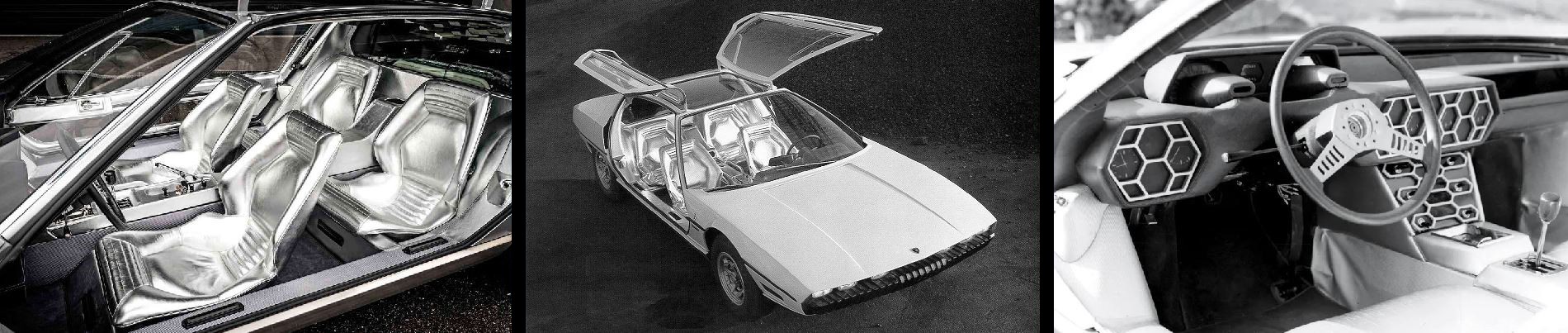
Lamborghini Marzal, perhaps the purest implementation ever of the “four-bucket”
look.
A one-off concept car first
shown at the 1967 Genera Auto Salon, the Marzal was a marvellously impractical
design by Bertone’s Marcello Gandini (1938–2024) which featured two vast
gull-wing doors, providing access to what genuinely was a four-seat interior,
noted for the thematic use of hexagons.
It was powered by a transversely-mounted 2.0 litre (120 cubic inch) straight-six
(essentially half of the company’s V12) which was fitted behind the rear axle,
making the rear-bias in weight distribution rather pronounced. It was one of the most dramatic designs of
the decade and although production was never contemplated, traces of the silhouette
can be seen in the Lamborghini Espada (1968-1978) which adopted a conventional
front-location for its 3.9 litre (240 cubic inch) V12 and was also a creditable
four-seater although the gull-wing doors used on early design studies quickly were
abandoned. The Espada featured notably
less glass than the Marzal and many have expressed doubts the air-conditioning
system able to be used in the Marzal would in high temperatures have coped with
the heat-soak and build-up.

Cockpit of
a replica Porsche 907K (Kurzheck (short
tail); note the balsa-wood gearshift knob, used not for weight-saving but as a way of reducing the heat-soak reaching the driver's hand although it saved a few grams and while that may not sound worthwhile, by 1968 competition in Group 6 was fierce and nobody was giving anything away.
The Porsche
907 competed under the Fédération
Internationale de l'Automobile’s (the FIA; the International Automobile
Federation) Group 6 (Prototype class) in the World Sportscar Championship and
one rule was the cars have “two seats”.
Accordingly, just about every Group 6 Machine on the grid had bolted to
the floor a lightweight, shell-like “bucket seat” (the Group 7 (unlimited
displacement) Can-Am cars also used the trick) although, as the lack of seat
belts and the location of the fire extinguisher suggest, it wasn’t a seat in
which someone was intended to sit. The
approach had a long tradition, as early as the 1920s, cars used in European
racing were sometimes fitted with tiny doors just conform with the rules which
demanded they be in place; some were even “fake doors”, blatant cheating being
another long tradition in motorsport.

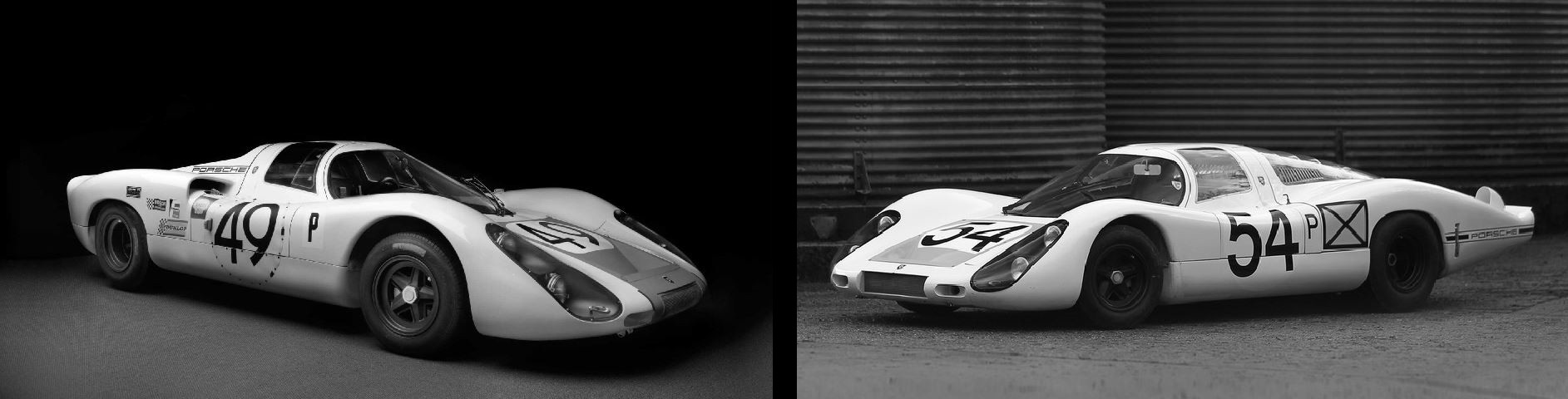
Porsche 907
K (left) and Porsche 907LH (right).
Built in
1967-1968 and victorious in 12 Hours of Sebring and the Targa Florio in 1968, the
907K was used on circuits where really high speeds couldn’t be attained, the
rear bodywork designed to increase the down-force most beneficial in places
with lots of corners. The companion 907LH
(Langheck (long-tail)) was allocated
to the high speed tracks where the long straights put a premium on top speed,
the drivers having to adjust their techniques to compensate for the increased
tendency for the LH in certain circumstances to lift. That approach (again, trade-offs in action)
proved manageable, even with speed the 907s could attain (Kurzheck: 302 km/h (188 mph) & Langheck: 330 km/h (205 mph)) but the instability inherent in Langheck shape became apparent in 1969
when the much more powerful 917 was released: At the 386 km/h (240 mph) it
could reach on the longest straights, the fluid dynamics of the airflow made
the long tail behave more like the way an aircraft’s wing creates lift, something
discovered only when the first cars reached the circuits because Porsche had no
access to a test track where such a speed could be reached, computer
simulations then decades away.

1967
Porsche 910 (Chassis 910001).
There were
though occasions on which a harness was fitted to the fibreglass “fake seats”. Sometimes passengers were present during
high-speed testing but a Porsche 910 (Chassis 910001) was in 1969 registered in
Austria for road use, thus the need for restraints. That what was so obviously a race car could
be registered for use on the streets but Austria was not then a member of the
EEC (the European Economic Community, predecessor of the EU (European Union))
and thus not as riddled with bureaucracy, rules & regulations and anyway,
in the era, there was more freedom in the air. A half-decade on, by having his lawyers thread
a clause through a loophole, a well-connected (and resourced) Italian aristocrat
was able to use the registration granted (in never wholly explained
circumstances) by the Alabama DMV (Department of Motor Vehicles) to be able to register
a Porsche 917 for use on European roads and another 917 to this day remains
registered in Monaco, one of those jurisdictions where some definitely are more
equal than others. In fairness to the Austrians, the 910 was a less extreme machine than the 917 and demanded fewer modifications to render it a plausible road-car; there are still street-legal 910s in the US.

Porsche 908/2 Spyder, Road Atlanta, Round 7 of the 1970 Can-Am season, September 1970. Can-Am cars also used a "fake" bucket seat because "two seats" was one of the few rules.
Based on
the Porsche 906 (1966) the 910 was produced during 1966-1967 with all 28 coupés
built in 1967. Most used 2.0 & 2.2 litre
(121 & 132 cubic inch) flat-sixes but some were fitted with a 2.0 litre
flat-eight and these were dubbed 910/8 rather than being separately
designated. The 910/8 proved faster but
also more fragile and it was the six-cylinder 910 which in the 1967 Nürburgring
1000 km (625 mile) endurance race delivered the factory its “breakthrough”
victory, securing Porsche its first trophy in a major World Sportscar
Championship event since 1960; subsequently, a910 would also be victorious in
the 1967 Targa Florio. Development
continued and a 3.0 litre (182 cubic inch) flat-eight 908 would even win the
1970 Road Atlanta round of the 1970 Canadian-American Challenge Cup (the Group
7 Can-Am for unlimited displacement sports cars), a remarkable event remembered
for the drivers escaping with noting more than bruising, despite there being 16
accidents (four collisions and 12 spinouts).
Although the 908 was not a factory entry (it was a second-hand race car
being run by an unsponsored privateer) and, against the seven and eight litre V8
monsters was not the fastest, the flat-eight proved reliable and prevailed; it
was the first time in 20 Can-Am races a McLaren had not taken the chequered
flag. It was a harbinger of what was to
come, the Porsche 917 dominating in 1972 and 1973.

Subaru BRAT with “outdoor bucket seats” in use. It wasn’t
only machines made for Group 6 & 7 racing which were fitted with lightweight,
plastic seats to comply with the letter of the law. The Subaru BRAT was (depending on linguistic
practice) (1) a coupé utility, (2) a compact pick-up or (3) a small four wheel
drive (4WD) ute (utility) and the name an acronym (Bi-drive Recreational All-terrain Transporter), the novel idea of
“bi-drive” (4WD) being the notion of both axles being driven, something
dictated by the need to form the acronym.
Although now in some places a cult vehicle (especially in Japan where it
was never sold), the BRAT is now most remembered as a “Chicken Tax car”. Tax regimes have a long history of
influencing or dictating automotive design, the Japanese system of
displacement-based taxation responsible for the entire market segment of “Kei cars”
(a clipping of kei-jidōsha (軽自動車)
(light automobile), the best known of which have been produced with 360, 600
& 660 cm3 (22, 37 & 40 cubic inch) engines in an astonishing range of
configurations ranging from micro city cars to roadsters and 4WD dump trucks. In Europe too, the post-war fiscal threshold
resulted in a wealth of manufacturers (Mercedes-Benz, Jaguar, BMW, Ford,
Maserati, Opel etc) offering several generations of 2.8 litre (171 cubic
inch) sixes while the that imposed by the Italian government saw special runs
of certain 2.0 litre (122 cubic inch) fours, sixes & even V8s. The US government’s “Chicken Tax” (a part of
the “Chicken War”) was different in that it was a 25% tariff imposed in 1963 by
the Johnson administration on potato starch, dextrin, brandy and light trucks;
it was a response to the impost of a similar tariffs by France and the FRG
(Federal Republic of Germany, the old West Germany) on chicken meat imported
from the US.

Two 1987 BRATs with retro-fitted seats, the one on the right also with an after-market roll-bar, something which, all things considered, seems a sensible addition. Of the physics, those familiar Sir Isaac Newton's (1642–1727) First Law of Motion (known also as the Law of Inertia: "An object at rest will remain at rest, and an object in motion will continue in motion with the same speed and in the same direction unless acted upon by an unbalanced external force") can ponder the possibilities while wondering whether to bother buckling up the seat belt or just rely on the "grab handles" (and probably never was that term used more appropriately). Although the seats weren't factory-fitted after 1985, the parts could still be ordered and many later models have been retro-fitted. The adjustable headrests were a nice touch although some did note they could be classified also as "rear window protectors".
In Fuji
Heavy Industries’ (then Subaru’s parent corporation) Ebisu boardroom, the
challenge of what probably was described as the “Chicken Tax Incident” was met
by adding to the BRAT two plastic, rear-facing jump seats, thereby qualifying
the vehicle as a “passenger car” subject in the US only to a 2.5 and not a 25%
import tax. Such a “feature” probably
seems strange in the regulatory environment of the 2020s but there was a time
when there was more freedom in the air.
Subaru’s US operation decided the BRAT’s “outdoor bucket seats” made it
an “open tourer” and slanted the advertising thus, the model enjoying much
success although the additional seating wasn’t available after 1985 and the
model was withdrawn from the US market after 1987.

1966
Lamborghini 350 GT in the rare 2+1 configuration with central rear bucket seat
(left), the later rear storage area shared by most 350 GTs and the 23 400 GT “Interims”
(centre) and 1968 Lamborghini 400 GT 2+2 (right).
Lamborghini’s 350 GT was
the company’s first production car, 131 of which were made between 1964-1966
and while that might sound modest, by the standards of contemporary European
exotica, it was mass-production. Powered
by a 3.5 litre (211 cubic inch) version of the company’s first V12 (which would
serve the line for over 50 years), the shape was based on the slinky 350 GTV prototype
which left an impression but was wholly unsuited to series production. Either nine or ten of the early GT 350s were
configured with an unusual 2+1 seating arrangement (two buckets in the front
and one, centrally located, in the rear).
On the later 350 GTs, the central bucket wasn’t
fitted and the whole space was configured as a storage area with an upholstered
shelf so it can be thought of as Lamborghini’s take on the two-door business
coupé, a US creation of the 1930s which was a conventional two-door sedan with
no rear-seat, the area added to the trunk (boot), providing travelling salesmen
with a large, lockable storage space for their wares. When the 400 GT (1966-1968 and powered by a
3.9 litre (240 cubic inch) V12) was released, the first 23 were configured with
the upholstered shelf (and known semi-formally as the “400 GT Interim”) while
the remainder of the 247 featured 2+2 seating.

Seatbelt not required: 1964 Mercedes-Benz 230 SL with Kindetsitz. Like the un-belted baby in the Corvair, the occupant of the kinder seat would be subject to Newton's First Law of Motion.
There were other 2+1s and for all of the 1960s Mercedes-Benz offered the not uncommonly ordered option of transverse single seat (centre) made the W113 (230, 250 & 280 SL, 1963-1971) roadster, making it one of the rare post-war 2+1s. While it could accommodate an adult-sized human, the factory listed it as the Kindetsitz (child's seat, code 565) although German men often preferred Schwiegermutterplatz or Schwiegermuttersitz (mother-in-law seat). That the factory would offer (in a convertible!) a "child's seat" which sat sideways and was fitted with no restraint system is an indication of how things have changed.
Donald Healey Motor Company’s Speed Equipment Catalogue 1960-1961.
Dubious though the safety credentials of the Kindetsitza may now seem, at least Mercedes-Benz secured it to the structure with good, German high-tensile nuts and bolts and that can be C&Ced (compared & contrasted) with the approach the British once took when designing a child’s seat. Listed in the 1960-1961 Speed Equipment Catalogue from the Donald Healey Motor Company was a child’s seat for the Austin-Healey Sprite, a diminutive roadster which was definitely a two-seater (although “rear seats” were at times offered, both third-party miniature “buckets” and a factory “bench” although the latter, supplied without a squab, is better described as a “padded parcel shelf”). Unlike the Germans, the Healey product was held in place only by the pressure the four steel prongs exerted on the transmission tunnel on which it sat and while that meant it was quick and easy to fit and remove, were one’s Sprite suddenly to come to a halt (ie crashing into something), child and (depending on velocity at point of impact) seat would be subject to Newton’s second law of motion. Clearly, the UK’s latter day reputation as a latter-day hotbed of H&S (health & Safety) legislation and enforcement was unknown in 1960.

Awaiting "installation" and lucky young passenger: Donald Healey Motor Company’s Child's Seat for Austin-Healey Sprite.
Pros: Looks comfortable for a child; finished in leathercloth with contrasting piping to match interior trim; can be installed or removed literally in seconds; location permits child to use feet to play with gear shifter, keeping them amused on long trips.
Cons: Unsecured installation means in the event of an accident, depending on speed of impact, it would function like an ejector seat and, were the roadster’s roof at the time not erected, trajectory of seat and child would be either (1) into or (2) over windscreen; location permits child to use feet to play with gear shifter, possibly knocking car out of gear or selecting incorrect gear.

US market 1958 Austin-Healey Sprite ("Bugeye" or "Frogeye") with Healey's "child's seat" in place.
The “child's seat” was a Donald Healey Motor Company part number and not one which appeared in the lists of BMC (British Motor Corporation) which was the corporate umbrella under which Healey operated. Although advertised only during the era of the Austin-Healey Sprite Mark 1 (1958-1961; the so-called “bugeye” or “frogeye”), the useful option could be fitted to any subsequent Sprite or the companion (and substantially identical) MG Midget. When the Sprite first was revised in 1961, simultaneously the MG Midget was released and it continued until 1980 while the Sprite lasted only until 1971 (and in its final season sold as the “Austin Sprite” after the contract with Donald Healey expired). Perhaps predictably, Healy’s child’s seat was not a big seller and although (hopefully) no longer used for its intended purpose, the rarity and shock value (to twenty-first century eyes) make it a prized option in the Sprite community.
A full bucket of VPOTUS.
In the US during the nineteenth century there was a joke about two brothers: "One ran off to sea and the other became vice-president; neither were ever heard of again." That was of course an exaggeration but it reflected the general view of the office which has very few formal duties and can only ever be as powerful or influential as a president allows although the incumbent is "a heartbeat from the presidency". John Nance Garner III (1868–1967, vice president of the US 1933-1941), a reasonable judge of these things, once told Lyndon Johnson (LBJ, 1908–1973; US president 1963-1969) being VPOTUS was "not worth a bucket of warm piss" (which is polite company usually is sanitized as "...bucket of warm spit"). In the US, a number of VPOTUSs (Vice-President of the United States) have become POTUS (President of the United States) and some have worked out well although of late the record has not been encouraging, the presidencies of Lyndon Johnson (LBJ, 1908–1973; VPOTUS 1961-1963, POTUS 1963-1968), Richard Nixon (1913-1994; VPOTUS 1953-1961, POTUS 1969-1974), George H. W. Bush (George XLI, 1924-2018; VPOTUS 1981-1989, POTUS 1989-1993) and Joe Biden (b 1942; VPOTUS 2008-2017, POTUS 2021-2025) 1963-1968, all ending badly, in despair, disgrace, defeat and decrepitude respectively.

Microsoft's
Internet Explorer (usually referred to as IE (IE7, IE8 etc by nerds) was in
June 2022, officially retired. It was
released in 1995 as part of the Plus! package for Windows 95 which, remarkable
as it now seems, shipped to an expectant and receptive market without any
vision of it being a platform for internet access, Microsoft's preferred model
their proprietary walled-garden the Microsoft Network (MSN). The public’s reaction meant corporate belief
in that model didn't last and MSN was soon re-positioned as just another place
to go on the internet. IE had its early controversies
because of the use of code belonging to other companies and subsequently
because it was given away or bundled with Microsoft's operating systems,
thereby undermining the business model of competing companies which had
developed browsers as shrink-wrap products to be sold for a profit. With a few twists and turns, those issues
worked their way (slowly) through US and European courts, Microsoft often using
what had become the industry's preferred
solution: Throw money at the problem and it goes away. That approach was applied too to product
development and sometimes it needed to be, Windows 95, IE4 and the then
mysterious “Active Desktop” ensemble resisting many attempts to secure
stability.

Still, most competition thus eliminated, IE went on to
great things and early in the century enjoyed a market-share which at its peak
exceeded 90%, the penetration assisted greatly by IE being the choice of many corporations
which began using the browser as their default interface for internal as well
as external access. However, this very
success was what ultimately doomed IE as Microsoft was compelled to retain much
legacy support within the browser to accommodate the corporations which generated
so much of Microsoft’s revenue. Newer competitors
were able to offer faster, more flexible browsers with modernized interfaces and
gradually gained critical mass, IE by 2020 confined mostly to those corporations
using legacy applications with a specific dependence. Indeed, although noting IE’s retirement, for
the affected corporations Microsoft is retaining a small subset of software
support on Windows Server 2019 and the Windows 10 LTSC (Long-Term Servicing
Channel), the latter in five and ten year programmes.

Pol Roger Champagne ice bucket by Argit of France in nickel plated brass, circa 1920.
Unfashionable
though it became, there was one aspect of IE which for years worked better than
the implementation on other browsers: The handling of download buckets. Download buckets are the places on operating
systems which permit users to tag files for downloading as a batch, rather than
having to download each individually.
For whatever reason, IE’s download buckets seemed for years always more
stable than the newer entrants. Even today,
Microsoft’s own update catalogue offers support for a download bucket on IE but
not on other browsers although, helpfully, Microsoft’s own (Chromium-based)
Edge browser can be configured with an “IE mode” which continues to support the
bucket, the “Add” and “Remove” options appearing as before.

Microsoft
Update Catalog on IE (and Edge in IE mode).

Microsoft
Update Catalog on Chromium-based browsers (and Firefox) in native mode.