Showing posts sorted by relevance for query Eschatology. Sort by date Show all posts

Wednesday, September 6, 2023

Eschatology

Eschatology (pronounced es-kuh-tol-uh-jee)

(1) Any system of doctrines concerning last, or final, matters, as death, final judgments or the future state.

(2) The branch of theology dealing with such matters.

(3) Of or pertaining to the end of times, notably in Jewish, Christian and Islamic theology and in Christianity, associated particularly with the second coming of Christ, the Apocalypse or the Last Judgment.

1844: From the Greek σχατον (éskhaton), neuter of σχατος (éskhatos) (last, furthest, uttermost, extreme, most remote), the construct being was éschato(s) + logy.  Origins were in academic theology, the study of the four last things: death, judgment, heaven & hell.  Eschatology, eschatologism & eschatologist are nouns, eschatological & eschatologic are adjectives and eschatologically is an adverb; the noun plural is  eschatologies.

Most interesting aspect of the etymology is the -logy suffix.  Although use has extended, -logy originates with loanwords from the Greek, usually via Latin and French, where the suffix - λόγος (lógos) is an integral part of the word loaned, a sixteenth century English example being astrology, from astrologia.  The French -logie was a continuation of the Latin -logia, also ultimately from the Greek -λογία (-logía).  Within Greek, the suffix is an abstract from Ancient Greek λόγος (lógos) (account, explanation, narrative), itself a verbal noun from λέγω (légō) (I say, speak, converse, tell a story).  In English, the suffix quickly became productive, applied particularly to the sciences, often analogous to names of disciplines borrowed from the Latin, such as the earlier mentioned astrology and geology from geologia.  By the later eighteenth century, it became applied to compositions of terms with no precedent in Greek or Latin, sometimes imitating French or German templates such as insectology (1766) after the French insectologie or terminology (1801) from the German terminologie.  Linguistic promiscuity soon followed with the rapid application to words long wholly absorbed into English; undergroundology was noted in 1820 and hatology in 1837.  The form -ology is also used when including the connecting vowel -o- that is frequently used in connecting two elements of Greek origin.

The Four Horsemen of the Apocalypse

The Four Horsemen of the Apocalypse are written of in the Book of Revelation, the last book of the New Testament which tells of God summoning four beings who ride out on white, red, black, and pale horses. The four riders are usually described as symbolizing Pestilence (black), War (red), Famine (black) and Death (pale) and in Christian eschatology are sent by God to deliver upon the earth a divine apocalypse as harbingers of the Last Judgment.

The Four Horsemen of the Apocalypse (circa 1496), woodcut by Albrecht Durer (1471–1528).

Jewish and Christian eschatology differ but whatever the theological divergence, there are structural similarities in the visions of the Old and New Testaments.  In Ezekiel 1:5-14, God summons another quadrumvirate:

5: And from the midst of it there came the likeness of four living creatures. And this was their appearance: They had the likeness of a man.

6: And every one had four faces, and every one of them had four wings.

7: And their feet were straight feet, and the sole of their feet was like the sole of a calf's foot; and they sparkled like the sight of burnished bronze.

8: And the hands of a man were under their wings on their four sides. And the four of them had their faces and their wings thus:

9: Their wings were joined one to another; they did not turn as they went; each went straight forward.

10: As for the likeness of their faces, they had the face of a man; and the four of them had the face of a lion on the right side, and the four of them had the face of an ox on the left side, and the four of them had the face of an eagle.

11: And thus their faces were. And their wings were spread out upward; two wings of each were joined one to another, and two covered their bodies.

12: And each went straight forward; wherever the Spirit was to go, they went; they did not turn as they went.

13: As for the likeness of the living creatures, their appearance was like burning coals of fire, like the appearance of torches; the fire went to and fro among the living creatures, and the fire was bright; and out of the fire went forth lightning.

14: And the living creatures ran to and fro like the appearance of a lightning bolt.

Amateur painter George W Bush (George XLIII, b 1946; US president 2001-2009) putting the finishing touches to his take on the Four Horsemen of the Apocalypse.  Mr Bush wasn’t noted for his subtle irony so he probably was thinking only of the Book of Revelation when he depicted Pestilence, War, Famine & Death although for many the sight of the painting might summon memories of (1) the former president, (2) Dick Cheney (born 1941; US vice president 2001-2009), (3) Condoleezza Rice (b 1954; US secretary of state 2005-2009) and (4) Donald Rumsfeld (1932–2021: US defense secretary 1975-1977 & 2001-2006).  The art and theology departments in some (liberal) university should include an exam question inviting students to explain which horse each neocon best represented, points to be deducted for anyone who took the easy option and called Dr Rice “Pestilence”.

Tuesday, August 24, 2021

Doom

Doom (pronounced doom)

(1) Fate or destiny, especially adverse fate; unavoidable ill fortune.

(2) Ruin; death.

(3) A judgment, decision, or sentence, especially an unfavorable one.

(4) In Christian eschatology, the Last Judgment, at the end of days.

Pre 900: From the Middle English dome & doome from the Old English dōm (a law, statute, decree; administration of justice, judgment; justice, equity, righteousness; condemnation) from the Proto-Germanic domaz (source also of the Old Saxon and Old Frisian dom, the Old Norse domr, the Old High German tuom (judgment, decree), the Gothic doms (discernment, distinction), possibly from the primitive Indo-European root dhe- (to set, place, put, do), (source also of the Sanskrit dhā́man (custom or law), the Greek themis (law) and the Lithuanian domė (attention)).  It was with the Old Norse dōmr (judgement), the Old High German tuom (condition) and the Gothic dōms (sentence).  A book of laws in Old English was a dombec.

Lidsay Lohan and her lawyer in court, Los Angeles, December 2011. 

In all its original forms, it seems to have been used in a neutral sense but sometimes also "a decision determining fate or fortune, irrevocable destiny."  The Modern adverse sense of "fate, ruin, destruction" began in the early fourteenth century and evolved into its general sense after circa 1600, influenced by doomsday and the finality of the Christian Judgment. The "crack of doom" is the last trump, the signal for the dissolution of all things and the finality of the Christian Judgment Day, is most memorably evoked in the Old Testament, in Ezekiel 7:7-8.

(7) Doom has come upon you, upon you who dwell in the land. The time has come! The day is near! There is panic, not joy, on the mountains.

(8) I am about to pour out my wrath on you and spend my anger against you. I will judge you according to your conduct and repay you for all your detestable practices.

Doom Paintings

Doom paintings are the vivid depictions of the Last Judgment, that moment in Christian eschatology when Christ judges souls and send them either to Heaven or Hell.  They became popular in medieval English churches as a form of graphical advertising to an often illiterate congregation, dramatizing the difference between rapture of heaven and the agonies of hell, consequences of a life of virtue or wickedness.  During the English Reformation, many doom paintings were destroyed, thought by the new order rather too lavishly Romish.

Weltgericht (Last Judgement) (circa 1435)); Tempera on oak triptych by German artist Stefan Lochner (c1410–1451).

Friday, June 30, 2023

Antichrist

Antichrist (pronounced an-ti-krahyst)

(1) In Christian theology, a particular personage or power, variously identified or explained, who is conceived of as appearing in the world as the principal antagonist of Christ.

(2) An opponent of Christ; a person or power antagonistic to Christ (sometimes lowercase).

(3) A disbeliever in Christ (often initial lowercase)

(4) A false Christ (often initial lowercase).

1400s: From the Middle English, from the (pre 1150) Late Old English antecrist (an opponent of Christ, an opponent of the Church, especially the last and greatest persecutor of the faith at the end of the world), from the Late Latin Antichrīstus, from the Late Greek ντίχριστος (antíkhristos & antíchrīstos (I John ii.18)), the construct being aντί- (anti-) (against) + khristos (Christ); the Greek Χριστός meaning "anointed one".   This was the earliest appearance of anti- in English and one of the few before circa 1600.  In contemporary English, it’s often (but not always) preceded by the definite article: the Antichrist.  Antichrist is a noun, antichristian is a noun & adjective, antichristianism is a proper noun, antichristianly is an adverb and antichristic is an adjective; the noun plural is antichrists.

The Antichrist and the End of Days

The Antichrist is mentioned in three passages in The New Testament, all in the First and Second Epistles of John (I John 2.18-27, I John 4.1-6, 2 John 7).  Common to all is the theme of Christian eschatology, that the Antichrist is the one prophesied by the Bible who will substitute themselves in Christ's place before the Second Coming.  Biblical scholars note also the term pseudokhristos (false Christ) in the books of Matthew (chapter 24) and Mark (chapter 13), Jesus warning the disciples not to be deceived by false prophets claiming to be Christ and offering "great signs and wonders".  Other imagery which can be associated with an Antichrist is mentioned in the Apostle Paul's Second Epistle to the Thessalonians and, of course, the Beast in the Book of Revelation.  The scriptural language is redolent with drama, the Antichrist spoken of or alluded to as the “abomination of desolation”, the son of perdition, “the man of lawlessness” or “the beast” (from earth or sea).

For most of the Middle Ages, it was the scriptural construct of the Antichrist as an individual which dominated Christian thought; the Antichrist born of Satan but yet an earthly tyrant and trickster, perfectly evil in all he was and did because he was the diametric opposite of Jesus Christ, perfect in his goodness and deeds.  Jesus Christ, the son of God, was born of a virgin into earthly existence and the Antichrist, the son of Satan would be born of the antivirgin, a whore who, like her evil offspring, would claim purity.  More than a fine theological point, it’s also quite deliberately a hurdle for Christ to cross in his Second Coming.  Where Christ was God in the flesh, the Antichrist was Satan in the flesh and point was to beware of imitations.  This was the framework of the medieval narrative, well understood and hardly remarkable but writers fleshed it out to create essentially two threads.  For centuries there was the idea of the single Antichrist who would accrue his disciples, have his followers accept him as the Messiah and put to the sword those who did not.  He would then rule for seven years before until his defeat and destruction by (depending on the author) the archangel Gabriel or Christ the true and his divine armies, all before the resurrection of the dead and the day of Final Judgement.

For two-thousand-odd years, there has been speculation about the identity of the Antichrist. 

By the late Middle Ages, another narrative thread evolved, this one with a modern, structuralist flavor and one more able to be harnessed to a political agenda.  Now the Antichrist was presented not as a force of evil outside the Church but the evil force within, the deceiver perhaps the Pope, the institution of the papacy or the very structure of the Church.  This was a marvellously adaptable theory, well suited to those seeking to attack the institutional church for it rendered the Antichrist as whatever the construct needed to be: the flesh incarnate of a pope, the sins and corruption of a dozen popes and his cardinals or the very wealth and power of the institution, with all that implied for its relationships with the secular world.  That was the position of the more uncompromising of those who fermented the Protestant Reformation of the sixteenth century.  The monk Martin Luther (1483-1546) saw about him venality, depravity and corruption and knew the end of days and the Final Judgement was close, the pope the true “end times Antichrist who has raised himself over and set himself against Christ”.  Unlike the long tradition of antipopes, this was true eschatology in action.  There have been many Antipopes (from the Middle French antipape, from the Medieval Latin antipāpa) although just how many isn't clear and they came and went often as part of the cut and thrust of the Church’s ever-shifting alliances and low skulduggery.  While some of the disputes were over theological or doctrinal differences, sometimes they were about little more than whose turn it was.

The Reverend Dr Ian Paisley, European Parliament, Strasbourg, France, 11 October 1988.

For centuries, Antichrist was a label often used, Nero, Caligula and the prophet Muhammad all victims, sometimes with some frequency and the epithet was often exchanged in the squabbles between Rome and Constantinople.  In the modern, mostly secular West, while the Antichrist has vanished from the consciousness of even most Christians, in the pockets of religiosity which the general godlessness has probably afforced, Antichrists appear to have multiplied.  Like “fascist” in political discourse, “Antichrist” has become a trigger word, a general category where disapprobation is not enough and there’s the need to demonise though even the hunter can be captured by the game.  In October 1988, Pope John Paul II (Karol Wojtyła 1920–2005; pope 1978-2005), who had often warned of the Antichrist waving his antigospel, was interrupted during a speech to the European Parliament by the Reverend Dr Ian Paisley (1926–2014; leader of the Democratic Unionist Party (DUP) 1971-2008 & First Minister of Northern Ireland 2007-2008), who loudly denounced him as ''the Antichrist.''  Standing and holding a large red placard displaying his message, Dr Paisley shouted out ''I renounce you as the Antichrist!''.  He was soon ejected, his holiness seemingly unperturbed.  The late Reverend had a long history of antipathy to popery in general and the “Bachelor bishop of Rome” in particular and, when later interviewed, told the press ''I don't believe he is infallible. He doesn't have the power to turn wine into the blood of Christ.''

Coming usually from the evangelical right, south of the Mason-Dixon Line, it seems to play well and it’s been aimed at the usual suspects including Barack Obama, Osama bin Laden, Saddam Hussein, Adolf Hitler, Joseph Stalin, Bill Gates, George Soros, at least two ayatollahs and, perhaps most plausibly, crooked Hillary Clinton.  Interestingly, although never denying practicing witchcraft or voodoo, crooked Hillary Clinton did feel the need to deny being the Antichrist.  In What Happened (Simon & Schuster, 2017, 512 pp ISBN: 978-1-5011-7556-5), a work of a few dozen pages somehow padded out to over five-hundred using the “how to write an Amazon best-seller” template, a recounting of the denial is there and the exchange does have a rare ring of truth.  It’s a shame that didn’t extend to the rest of the book; claimed to be a review of the 2016 presidential election, it might have been an interesting apologia rather than a two-inch thick wad of blame-shifting.  Never despair.  In the Christian tradition, the Antichrist will finally be defeated by the armies of God under the leadership of Christ with the Kingdom of God on earth or in heaven to follow.  Good finally will prevail over evil.

Sunday, April 10, 2022

Rapture

Rapture (pronounced rap-cher)

(1) Ecstatic joy or delight; joyful ecstasy; bliss, beatitude, exaltation.

(2) The carrying of a person to another place or sphere of existence.

(3) In Christian theology, the experience, anticipated by some fundamentalist Christians, of meeting Christ midway in the air upon his return to earth.

(4) The act of carrying off (archaic).

1590: A compound word, the construct being rapt + ure (the suffix -ure was from the Middle English -ure, from the Old French -ure, from the Latin -tūra and was used to create a word meaning (1) a process; a condition; a result of an action or (2) an official entity or function).  Rapt was from the Medieval Latin raptūra, (seizure, rape, kidnapping), from the Classical Latin raptus (a carrying off, abduction, snatching away; rape (the future active participle of rapiō)).  In the sense of “carrying off”, the English use was in parallel with the Middle French rapture with the meaning drawn from the Medieval Latin raptura (seizure, rape, kidnapping, carrying off, abduction, snatching away) and the word rape is a cognate of this.  The sense of "spiritual ecstasy, state of mental transport or exaltation" is recorded by circa 1600 (as “the raptures”), the connecting notion being a sudden or violent taking and carrying away.  The meaning "expression of exalted or passionate feeling" in words or music is from the 1610s and from here it became frequently used in sacred music and art.

El rapto de Europa (The Rape of Europa (1628-1629)), oil on canvas by Peter Paul Rubens (1577-1640), Prado Museum, Madrid.  It follows a 1562 work in the same vein by Tiziano Vecelli (circa 1489-1576 and known in English as Titian).

The earliest attested use in English is with women as objects and in the seventeenth century it sometimes carried the meaning of the verb “rape”.  The use of the word “rape” in the sense of “carrying off” in so much art and sculpture from Antiquity and the Middle Ages is the cause of much misunderstanding in modern audiences.  Sense of "spiritual ecstasy or state of mental transport” was first recorded in the 1630s and rapture as a verb meaning "to enrapture, put in a state of rapture" (implied in raptured) became widely used.  The adjective rapturous (ecstatically joyous or exalted) dates from the 1670s, the adverb rapturously having emerged a decade earlier.  The verb enrapture, a creation apparently of the church, is attested from 1740.  The adjective ravishing, dating from the mid fourteenth century and meaning "enchanting, exciting rapture or ecstasy" (present-participle adjective from the verb ravish) is now probably associated with Mills & Boon romances but the origin was sacred, the figurative notion being "carrying off from earth to heaven"; the adverb was ravishingly.

A Rapture, by Stereo Alchemy, starring Lindsay Lohan, Petey Wright, and Sofia Boutella (from the album God of love).  Directed by Yu Tsai.

In Christian eschatology, the rapture refers to the end of days when all Christian believers (both the living and resurrected dead) will rise into the sky and join Christ for eternity, a vision in Paul's first letter to the Thessalonians (1 Thessalonians 4:17)). 

Then we which are alive and remain shall be caught up together with them in the clouds, to meet the Lord in the air: and so shall we ever be with the Lord.

Rapturists prefer this to less exclusive second comings such as those mentioned in Second Thessalonians, Matthew, First Corinthians and Revelation.

Home Thoughts from Abroad (1845) by Robert Browning (1812–1889)

I

Oh, to be in England now that April’s there

And whoever wakes in England sees, some morning, unaware,

That the lowest boughs and the brushwood sheaf

Round the elm-tree bole are in tiny leaf,

While the chaffinch sings on the orchard bough

In England—now!

II

And after April, when May follows

And the white-throat builds, and all the swallows!

Hark, where my blossom’d pear-tree in the hedge

Leans to the field and scatters on the clover

Blossoms and dewdrops—at the bent spray’s edge—

That’s the wise thrush: he sings each song twice over

Lest you should think he never could re-capture

The first fine careless rapture!

And, though the fields look rough with hoary dew,

All will be gay when noontide wakes anew

The buttercups, the little children’s dower,

Far brighter than this gaudy melon-flower!

Rapture (2019) by Roberta J Heslop (b 1973), oil & acrylic on canvas.

Friday, January 10, 2020

Dogmatic

Dogmatic (pronounced dawg-mat-ik or dog- mat-ik)

(1) Relating to or of the nature of a dogma or dogmas or any strong set of principles concerning faith, morals, etc., as those laid down by a church; doctrinal.

(2) Asserting opinions in a doctrinaire or arrogant manner; opinionated; forcibly asserted as if authoritative and unchallengeable

(3) In science (historically, especially medicine) the practice of pursuing the profession based on assumptions rather than empirical observation.

(4) Of a person, one prone to dogmatic statements.

1595-1605; From the French dogmatique, from the Late Latin dogmaticus and the Hellenistic Ancient Greek δογματικός (dogmatikós) (didactic), from δόγμα (dógma) (dogma), the construct being dogmat (stem of dógma) + ikos or ic.  In the 1680s, it came to be applied to persons, writings etc, "disposed to make positive assertions without presenting arguments or evidence" the use by 1706 extending to matters "pertaining to or of the nature of dogma".  The use of variations of the derived form antidogmatic (antidogmatical, antidogmatically etc) have apparently been in decline since the nineteenth century; "dogmatical" was attested from circa 1600.  The most frequently used related word is dogma (opinion, tenet (literally "that which one thinks is true"), from the Latin dogma (philosophical tenet), from the Ancient Greek δόγμα (dógma) (opinion, tenet), from δοκέω (dokéō or dokein) (I seem good, think); in the seventeenth & eighteenth century it was treated as Greek, with the plural dogmata; the ultimate root was the primitive Indo-European root dek- (to take, accept).  Dogmatic is a noun & adjective, dogmaticalness, dogmatism & dogmatician are nouns, dogmatical is an adjective, dogmatize is a verb and dogmatically is an adverb; the noun plural is dogmatics but the more commonly used is dogmatisms.

The suffix -ic was from the Middle English -ik, from the Old French -ique, from the Latin -icus, from the primitive Indo-European -kos & -os, formed with the i-stem suffix -i- and the adjectival suffix -kos & -os.  The form existed also in the Ancient Greek as -ικός (-ikós), in Sanskrit as -इक (-ika) and the Old Church Slavonic as -ъкъ (-ŭkŭ); A doublet of -y.  In European languages, adding -kos to noun stems carried the meaning "characteristic of, like, typical, pertaining to" while on adjectival stems it acted emphatically; in English it's always been used to form adjectives from nouns with the meaning “of or pertaining to”.  A precise technical use exists in physical chemistry where it's used to denote certain chemical compounds in which a specified chemical element has a higher oxidation number than in the equivalent compound whose name ends in the suffix -ous; (eg sulphuric acid (HSO) has more oxygen atoms per molecule than sulphurous acid (HSO).

Karl Barth, Kirchliche Dogmatik

Bedside table reading.

Those not content with a discursive existence and who think it might help to keep the same train of thought for a decade odd might care to read Kirchliche Dogmatik (Church Dogmatics) by Swiss Protestant theologian Karl Barth (1882-1968).  In English translation a fourteen-volume work of some six-million words and published between 1932 and 1967, Barth's purpose was to recover the proclamation of the word of God as the place where God's message of salvation meets sinful man.  Pope Pius XII (1879-1958; pope 1939-1958), a fair judge of such things, is said to have thought Barth the most important theologian since Saint Thomas Aquinas (1225–1274).

Kirchliche Dogmatik explored four themes: revelation, God, creation, and atonement (or reconciliation) although Barth’s intention had been to complete the work by addressing the doctrines of redemption and eschatology.  That he died before being able to finish the project led to something of a theological cult in the 1970s as others speculated how Barth might have discussed such things and structuralists, from a number of disciplines, differed on whether the Dogmatics should be considered an unfinished work.  Perhaps wisely, nobody has ever attempted to write these final volumes.  Nine-thousand pages in German, a pleasing thousand fewer in English, Dogmatics is probably more readable in the digital age, hypertext links assisting those new to the densely referenced and highly technical language in which it’s written.

Albert Speer (1905–1981; Nazi court architect 1934-1942; Nazi minister of armaments and war production 1942-1945), who claimed to have read all the volumes, noted both the conceptual and textual difficulties; sentenced to imprisonment for twenty years by the International Military Tribunal (IMT) which in 1945-1946 sat at Nuremberg to try the leading Nazis in the first and best-known of thirteen such trials, more than most he had time to devote to the task.  In 1959, by the time he'd finished a sixth volume, he noted: “There is much that I still cannot comprehend, chiefly because of the terminology and the subject.  But I have had a curious experience.  The uncomprehended passages exert a tranquilizing effect.  With Barth's help I feel in balance and actually, in spite of all that's oppressive, as if liberated.”  Speer continued: I owe to Barth the insight that man’s responsibility is not relieved just because evil is part of his nature. Man is by nature evil and nevertheless responsible.  It seems to me there is a kind of complement to that idea in Plato’s statement that for a man who has committed a wrong ‘there is only one salvation: punishment.’  Plato continues: ‘Therefore it is better for him to suffer this punishment than to escape it; for it sustains man’s inward being.’

Guilty as sin: Speer in the dock at Nuremberg, 1946.

Those passages didn't appear until the publication of Speer's Spandauer Tagebücher (Spandau: The Secret Diaries) (1975), some eight years after Barth's death so he was never able to comment on the idea of his work lending a sense of liberation to someone who would have been hanged had the concealed evidence of the extent of his complicity in the war crimes and crimes against humanity been brought before the court.  Speer's rationalization that an authority as venerated as Plato could be interpreted as saying in serving his sentence he "paid his debt to society" is wholly consistent with both the approach he took at the trial (admitting the "collective guilt" of the regime of which he was a part while denying personal responsibility for any indictable offence) and his successful and lucrative post-war career as an author and celebrity.  Some six months before his observations on Barth, in another context he had noted: “Some time ago I noted that we always read such sentences too late.  That was wrong. What I meant was: We understand them too late.”  By the time he died it does seem likely he understood his guilt but the evasions and denials never ceased.

Saturday, August 28, 2021

Doomsday

Doomsday (pronounced doomz-dey)

(1) In Christian eschatology, the day of the Last Judgment, at the end of the world (sometimes capital letter); the end of days; the end of times.

(2) Any day of judgment or sentence (sometimes initial capital).

(3) In casual use, the destruction of the world, since the 1950s, by means of nuclear weapons.

(4) As doomsday weapon(s), the device(s) causing the destruction of the world; anything capable of causing widespread or total destruction.

(5) Given to or marked by forebodings or predictions of impending calamity; especially concerned with or predicting future universal destruction.

(6) As Doomsday Clock, a symbolic warning device indicating how close humanity is to destroying the world, run since 1947 as a private venture by the members of the Bulletin of the Atomic Scientists.

Pre 1000: A compound from the Middle English domes + dai from the Old English construct dom (judgment) + dæg (day), dōmesdæg (sometimes dōmes dæg) (Judgment Day) and related to the Old Norse domsdagr.  Dome was borrowed from the Middle French dome & domme (which survives in Modern French as dôme), from the Italian duomo, from the Latin domus (ecclesiae) (literally “house (of the church)”), a calque of the Ancient Greek οκος τς κκλησίας (oîkos tês ekklēsías); doublet of domus.  Dom was from the Proto-West Germanic dōm and was cognate with the Old Frisian dōm, the Old Saxon dōm, the Old High German tuom, the Old Norse dómr and the Gothic dōms.  The Germanic source was from a stem verb originally meaning “to place, to set”, a sense-development also found in the Latin statutum and the Ancient Greek θέμις (thémis).  Dai had the alternative forms deg, deag & dœg all from the Proto-West Germanic dag; it was cognate with the Old Frisian dei, the Old Saxon dag, the Old Dutch dag, the Old High German tag, the Old Norse dagr and the Gothic dags.

In medieval England, doomsday was expected when the world's age had reached 6,000 years from the creation, thought to have been in 5200 BC and English Benedictine monk, the Venerable Bede (circa 672-735) complained of being pestered by rustici (the "uneducated and coarse-mannered, rough of speech"), asking him "how many years till the sixth millennium be endeth?"  However, despite the assertions (circa 1999) of the Y2K doomsday preppers, there is no evidence to support the story of a general panic in Christian Europe in the days approaching the years 800 or 1000 AD.  The use to describe a hypothetical nuclear bomb powerful enough to wipe out human life (or all life) on earth is from 1960 but the speculation was the work of others than physicists and the general trend since the 1960s has been towards smaller devices although paradoxically, this has been to maximize the destructive potential through an avoidance of the "surplus ballistic effect" (ie the realization by military planners that blasting rubble into to smaller-sized rocks was "wasted effort and bad economics").

The Domesday Book

Domesday is a proper noun that is used to describe the documents known collectively as the Domesday Book, at the time an enormous survey (a kind of early census) ordered by William I (circa 1028-1087; styled usually as William the Conqueror, King of England 1066-1087) in 1085.  The survey enumerated all the wealth in England and determined ownership in order to assess taxes.  Domesday was the Middle English spelling of doomsday, and is pronounced as doomsday.

Original Domesday book, UK National Archives, London.

The name Domesday Book (which was Doomsday in earlier spellings) was first recorded almost a century after 1086.  An addition to the manuscript was made probably circa 1114-1119 when it was known as the Book of Winchester and between then and 1179, it acquired the name by which it has since been known.  Just to clarify its status, the Treasurer of England himself announced “This book is called by the native English Domesday, that is Day of Judgement” (Dialogus de scaccario), adding that, like the Biblical Last Judgment, the decisions of Domesday Book were unalterable because “… as from the Last Judgment, there is no further appeal.”  This point was reinforced by a clause in the Dialogue of the Exchequer (1179) which noted “just as the sentence of that strict and terrible Last Judgement cannot be evaded by any art or subterfuge, so, when a dispute arises in this realm concerning facts which are written down, and an appeal is made to the book itself, the evidence it gives cannot be set at nought or evaded with impunity.”  It was from this point that began in England the idea of the centralised written record taking precedence over local oral traditions, the same concept which would evolve as the common law.

The Doomsday Book described in remarkable detail the landholdings and resources of late eleventh century England and is illustrative of both the power of the government machine by the late medieval period and its deep thirst for information.  Nothing on the scale of the survey had been undertaken in contemporary Europe, and was not matched in comprehensiveness until the population censuses of the nineteenth century although, Doomsday is not a full population census, the names appearing almost wholly restricted to landowners who could thus be taxed.  It was for centuries used for administrative and legal purposes and remains often the starting point for many purposes for historians but of late has been subject to an increasingly detailed textual analysis and it’s certainly not error-free.

The Doomsday Clock

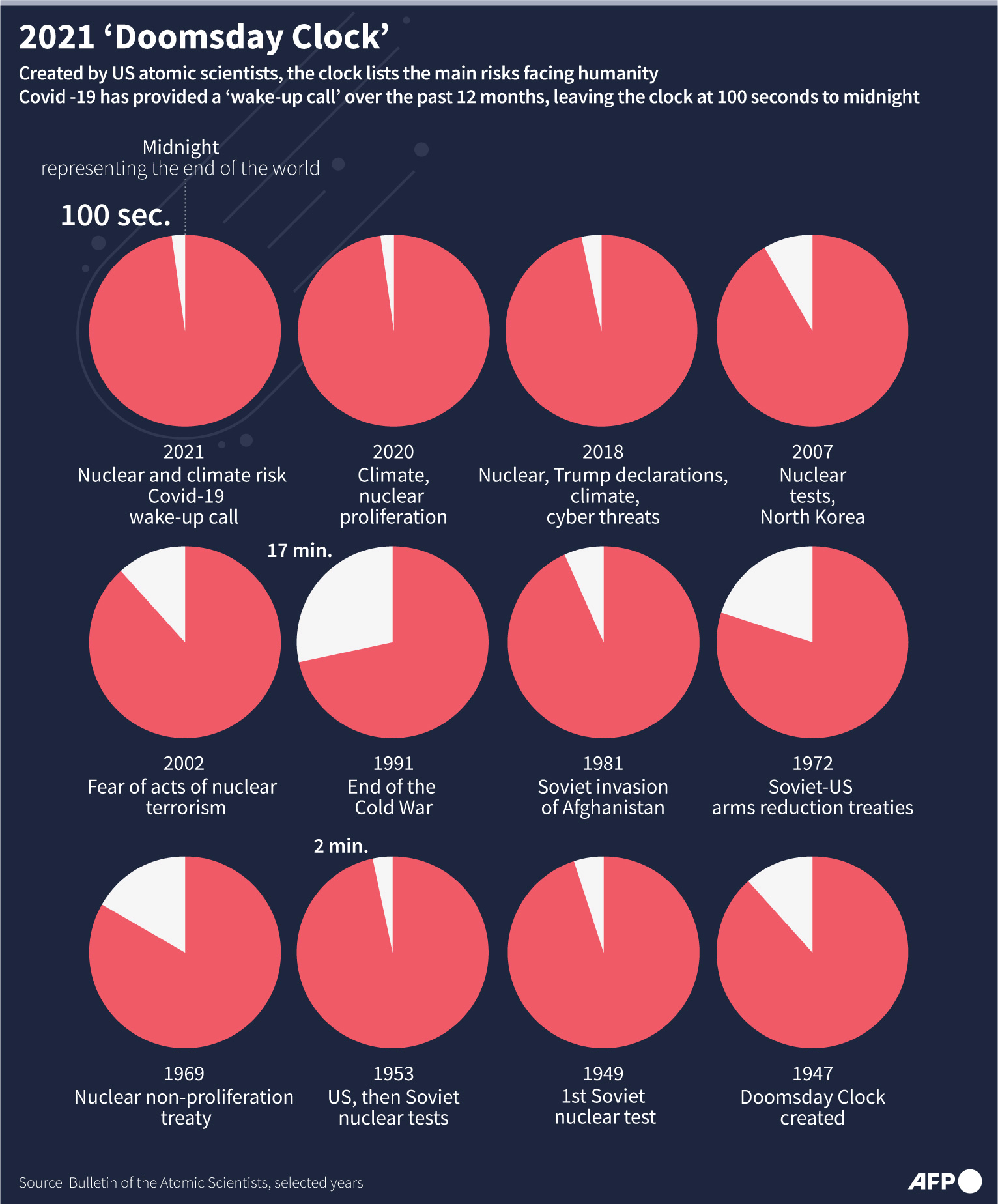
The Doomsday Clock is a symbol that represents the likelihood of a man-made global catastrophe.  Maintained since 1947 by the members of the Bulletin of the Atomic Scientists (BOTAS), the clock was created as a metaphor for threat to humanity posed by nuclear weapons.  On the clock, a hypothetical global catastrophe is represented as the stroke of midnight and BOTAS’s view of the closeness to that hour being reached by the number of minutes or seconds to midnight.  Every January, BOTAS’s Science and Security Board committee meets to decide where the second-hand of the clock should point and in recent years, other risk factors have been considered, including disease and climate change, the committee monitoring developments in science and technology that could inflict catastrophic damage.

Lindsay Lohan and her lawyer in court, Los Angeles, December 2011.

These concerns do have a long history in philosophy and theology but the use in 1945 of nuclear fission to create atomic weapons focused the minds of many more on the possibilities, the concerns growing in the second half of the twentieth century as the bombs got bigger and proliferated extraordinarily to the point where, if all were detonated in the right place at the right time, almost everyone on Earth would have been killed several times over.  At least on paper, the threat was real and even before Hiroshima made the world suddenly aware of the matter, there had been some in apocalyptic mood: Winston Churchill's (1875-1965; UK prime-minister 1940-1945 & 1951-1955) “finest hour” speech in 1940 warning of the risk civilization might “…sink into the abyss of a new Dark Age made more sinister, and perhaps more protracted, by the lights of perverted science”.  It had been a growing theme in liberal interwar politics since the implications of technology and the industrialisation of warfare had been writ large by the World War I (1914-1918).

HG Wells’ (1866–1946) last book was Mind at the End of its Tether (1945), a slim volume, best remembered for the fragment “…everything was driving anyhow to anywhere at a steadily increasing velocity”, seemingly describing a world which had become more complicated, chaotic and terrifying than anything he had prophesized in his fiction. In this it’s often contrasted with the spirit of cheerful optimism and forward-looking stoicism of the book he published a few months earlier, The Happy Turning (1945), but that may be a misreading.  Mind at the End of its Tether is a curious text, easy to read yet difficult to reduce to a theme; in his review, George Orwell (1903-1950) called it “disjointed” and it does have a quality of vagueness, some chapters hinting at despair for all humanity, others suggesting hope for the future.  It’s perhaps the publication date that tints the opinions of some.  Although released some three months after the first use of atomic bombs in August 1945, publishing has lead-times and Wells hadn’t heard of the A-bomb at the time of writing although, he had in 1914 predicted such a device in The World Set Free.  In writing Mind at the End of its Tether, Wells, the great seer of science, wasn’t in dark despair at news of science’s greatest achievement, nuclear fission, but instead a dying man disappointed about the terrible twentieth century which, at the end of the nineteenth, had offered such promise.

In 1947, though the USSR had still not even tested an atomic bomb and the US enjoyed exclusive possession of the weapon, BOTAS was well aware it was only a matter of time and the clock was set at seven minutes to midnight.  Adjustments have been made a couple of dozen times since, the most optimistic days being in 1991 with the end of the Cold War when it was seventeen minutes to midnight and the most ominous right now, BOTAS in 2023 choosing 90 seconds, ten seconds worse than the 100 settled on in 2020.

The committee each year issues an explanatory note and in 2021 noted the influences on their decision.  The COVID-19 pandemic was a factor, not because it threatened to obliterate civilization but because it “…revealed just how unprepared and unwilling countries and the international system are to handle global emergencies properly. In this time of genuine crisis, governments too often abdicated responsibility, ignored scientific advice, did not cooperate or communicate effectively, and consequently failed to protect the health and welfare of their citizens.  As a result, many hundreds of thousands of human beings died needlessly.  COVID-19 they noted, will eventually recede but the pandemic, as it unfolded, was a vivid illustration that national governments and international organizations are unprepared to manage nuclear weapons and climate change, which currently pose existential threats to humanity, or the other dangers—including more virulent pandemics and next-generation warfare—that could threaten civilization in the near future.  In 2023, the adjustment was attributed mostly to (1) the increased risk of the use of nuclear weapons after the Russian invasion of Ukraine, (2) climate change, (3) biological threats such as COVID-19 and (4) the spread of disinformation through disruptive technology such as generative AI (artificial intelligence).

The acceleration of nuclear weapons programs by many countries was thought to have increased instability, especially in conjunction with the simultaneous development of delivery systems increasingly adaptable to the use of conventional or nuclear warheads.  The concern was expressed this may raise the probability of miscalculation in times of tension.  Governments were considered to have “…failed sufficiently to address climate change” and that while fossil fuel use needs to decline precipitously if the worst effects of climate change are to be avoided, instead “…fossil fuel development and production are projected to increase.  Political factors were also mentioned including the corrosive effects of “false and misleading information disseminated over the internet…, a wanton disregard for science and the large-scale embrace” of conspiracy theories often “driven by political figures”.  They did offer a glimmer of hope, notably the change of administration in the US to one with a more aggressive approach to climate change policy and a renewed commitment to nuclear arms control agreements but it wasn’t enough to convince them to move the hands of the clock.  It remains a hundred seconds to midnight.

The clock is not without critics, even the Wall Street Journal (WSJ) expressing disapproval since falling under the control of Rupert Murdoch (b 1931).  There is the argument that after seventy years, its usefulness has diminished because over those decades it has become "the boy who cried wolf": a depiction of humanity on the precipice of the abyss yet life went on.  Questions have also been raised about the narrowness of the committee and whether a body which historically has had a narrow focus on atomic weapons and security is adequately qualified to assess the range of issues which should be considered.  Mission creep too is seen as a problem.  The clock began as a means of expressing the imminence of nuclear war.  Is it appropriate to use the same mechanism to warn of impending climate change which has anyway already begun and is likely accelerating?  Global thermo-nuclear war can cause a catastrophic loss of life and societal disruption within hours, whereas the climate catastrophe is projected to unfolds over decades and centuries.  Would a companion calendar be a more helpful metaphor?  The criticism may miss the point, the clock not being a track of climate change but of political will to do something to limit and ameliorate the effects (everyone having realised it can’t be stopped).