Showing posts sorted by relevance for query Cimarron. Sort by date Show all posts

Monday, October 18, 2021

Cimarron

Cimarron (pronounced sim-uh-ron, sim-uh-rohn or sim-er-uhn)

(1) A Maroon (an African or one of African descent who escaped slavery in the Americas, (or a descendant thereof, especially a member of the Cimarron people of Panama).

(2) In Latin America (1) feral animals or those which have returned to the wild, (2) rural areas (campestral) and the inhabitants there dwelling & (3) wild plants.

(3) A name used in the US for both rivers & as both a localities.

(4) A not fondly remembered small "Cadillac", built between 1981-1988.

1840–1850: From the Colonial Spanish cimarrón (a maroon (used also casually of feral animals, wild rams etc), from the Spanish and thought likely equivalent to the Old Spanish cimarra (brushwood, thicket), the construct being & cim(a) (peak, summit (from the Latin cȳma (spring shoots of a vegetable), from the Ancient Greek  + -arrón (the adjectival suffix).  Most etymologists appear to accept the Spanish cimarrón was a native Spanish formation from cima (summit, peak), referring to slaves who escaped to seek refuge in the mountains but the alternative theory is that it was a borrowing from Taíno símaran (wild (like a stray arrow)), from símara (arrow).  The feminine was cimarrona, the masculine plural cimarrones & the feminine plural cimarronas.  The verb maroon (put ashore on a desolate island or some isolate and remote coast by way of punishment) dates from 1724 and was from maroon (fugitive black slave living in the wilder parts of Dutch Guyana or Jamaica and other West Indies islands) which has always been assumed to be a corruption of the Spanish cimmaron & cimarrón.  Cimarron is a noun & proper noun (the adjective cimarific (based on Cimar(ron) + (horr)ific) was sardonic; a slur relating to the Cadillac); the noun plural is Cimarrons.

The Cadillac Cimarron, 1982-1988
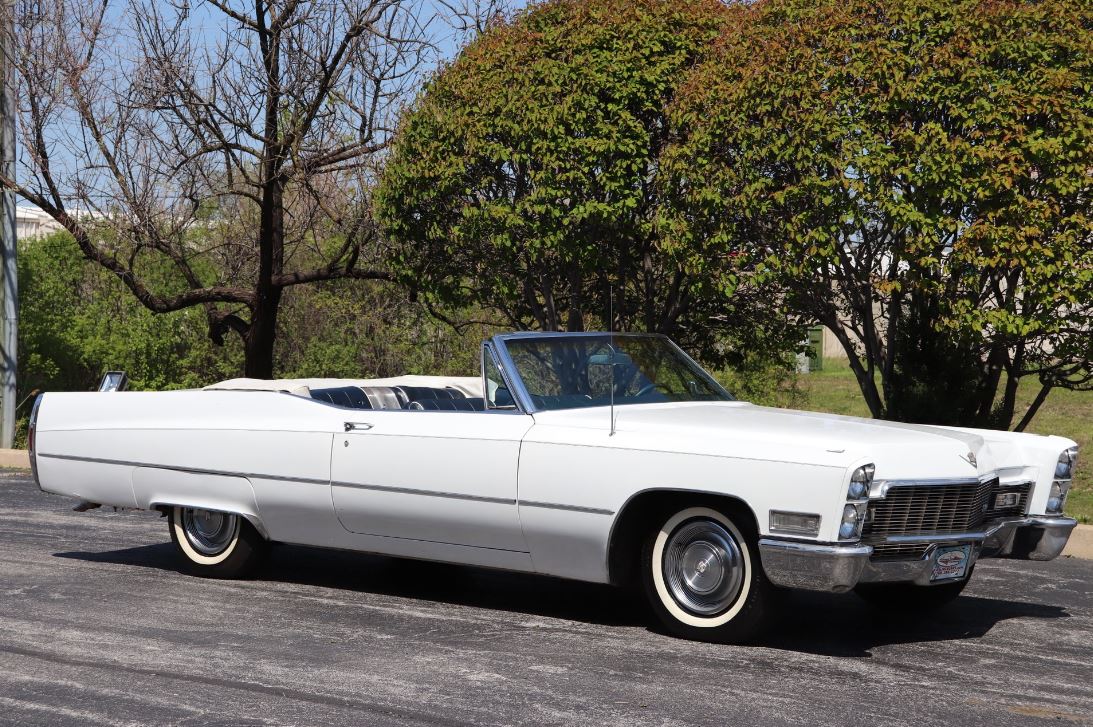
For those who can remember the way things used to done: 1968 Cadillac Coupe DeVille convertible.

The path of the reputation of the unfortunate Cadillac Cimarron was unusual in the more it was upgraded and improved, the further it seemed to fall in the estimation of the motoring press.  Despite the impression which seems over the decades to have become embedded, the early critical reaction to the Cimarron was generally polite and even positive, while acknowledging the inadequacies of the original engine-transmission combinations.  The journalists may however have been in a mood to be unusually forgiving because in 1981, when the first examples were provided for press evaluation, that a Cadillac was for the first time since 1914 fitted with a four-cylinder engine and one with a displacement smaller than 2.0 litres (122 cubic inch) for the first time since 1908 was a sign how much the universe had shifted; not even ten years earlier every Cadillac on sale used an 8.2 litre (500 cubic inch) V8.  The ripples of the oil shocks of the 1970s would see the big-block V8 twice downsized (before being driven to extinction) but so much had the rising cost (and threatened scarcity) of gas (petrol) scarred consumers that even Cadillac owners wanted more efficient vehicles.  They still wanted to drive Cadillacs and while demand for the full-sized cars remained, it was obvious to General Motors (GM) the segment was in decline and the alternatives proving popular were not the traditional Lincolns or big Chryslers (the Imperial of old by then a memory) but the premium brand Europeans, Mercedes-Benz, BMW and (as a niche player), Jaguar.

The cleverly engineered 1976 Cadillac Seville which hid its origins well.

The Europeans produced very different machines to the Cadillacs and it would have taken much time and money to match them in sophistication but what could be done quickly and at relatively low cost was to make a Cadillac out of a Chevrolet and that was the path chosen, the long-serving Chevrolet Nova re-styled, re-trimmed, re-engined (with the 5.7 litre (350 cubic inch) Oldsmobile V8) and re-badged as the Cadillac Seville.  On paper, it didn’t sound promising but on the road it actually worked rather well, essentially because Chevrolet had done a creditable job in making the Nova drive something like a Cadillac with some (vaguely) Mercedes-Benzesque like characteristics.  So, the task for Cadillac’s engineers wasn’t that onerous but they did it well and the Seville was a great success, something especially pleasing to GM because the thing retailed at some four times what Chevrolet charged for Novas.  That made the Seville one of the most famously profitable lines ever to emerge from Detroit which was good but what was not was that most people who bought one weren’t conquests from Mercedes-Benz or BMW (and definitely not from Jaguar) but those who would otherwise have bought a Cadillac.  Still, the Seville did its bit and contributed to brief era of record sales and high profits for GM.

Cadillac’s new enemy: 1982 BMW 320i (E21).  Lincolns & Imperials they understood, BMWs were a mystery.

By the early 1980s however, Cadillac decided it need to do the same thing again, this time on a smaller scale.  A second oil shock had struck in 1979 (this one triggered by Persian ayatollahs rather than Arab sheikhs) and this time the US economy wasn’t bouncing back as it had in the mid-1970s; the recession of the early 1980s was nasty indeed.  One market segment which was a bright spot however was what was called the “small executive sedan” dominated then by the BMW 3-Series, soon to be joined by what would become known as the Mercedes-Benz C-Class, compact, high-quality and high-priced cars being bought by what to Cadillac would be a most attractive demographic: the then newly defined Yuppies (young upwardly-mobile professionals).  Cadillac had nothing which appealed to this market and their plans for an entry were years away even from the initial design phases.  The economic situation of the time however had made the matter urgent and so, at a very late stage, Cadillac was appended to GM’s ambitious programme to use the one “world car” platform to be used in the divisions which produced cars in the planet’s major markets (the US, UK, Europe, Japan & Australasia).  This one front-wheel drive platform would provide a family sized car in Japan, the UK and Europe, a compact-sized entrant in Australasia and a small car in the US with the highest possible degree of component interchangeability and a consequent reduction in the time and cost to bring the lines to production.

1982 Holden Camira SL/E (1982-1989), the Australian version of the “World Car”.

The longevity of the GM “World Car" (the J-Car (J-Body the US nomenclature)), the last produced in 2005, attests to the quality of GM’s fundamental engineering and over the decades, over 10 million would be sold as Vauxhalls (UK), Opels (Europe), Holdens (Australia & New Zealand), Isuzus, Toyotas (Japan) and Chevrolets, Buicks, Oldsmobiles, Pontiacs & Cadillacs (US).  By the standards of the time they were good cars (although they did prove less suited to Australian driving conditions) but they could not, and certainly not in the eleven months available, be made into what would be thought of as “a Cadillac”.  To do that, given the technology available at the time, ideally the platform would have been widened, a small version of one of the corporate V8s (perhaps as small as 3.5 litres (215 cubic inch) fitted and the configuration changed to accommodate rear-wheel drive (RWD) and independent rear suspension (IRS).  The J-Body could have accommodated all this and, thus configured, coupled with the lashings of leather expected in the interior, GM would have had an appropriately sized small executive sedan, executed in an uniquely American way.  Like the Seville, it may not have made much of a dent in the business Mercedes-Benz and BMW were doing but it would have had real appeal and it’s doubtful it would have cannibalized the sales of the bigger Cadillacs.  Additionally, it would have been ideally place to take advantage of the rapid fall in gas prices which came with the 1980s “oil glut”.  Alas, such ideas would have been fanciful, such a thing taking too long to develop and it would have been such an expensive programme Cadillac would have convinced the GM board they may as well accelerate the development of their own small car.  So, needing something small to put in the showrooms because that’s what Cadillac dealers were clamouring for, the decision was taken to gorp-up (the term "bling" not the in use) the J-Body.

1982 Cadillac Cimarron (1982-1988), the origins of which, unlike those of the 1976 Seville, were obvious.

That, for the 1982 model year, was exactly what was done.  The Cadillac Cimarron was nothing more than a Chevrolet Cavalier with a lot of extra stuff bolted or glued on.  Apparently, the name “Cimarron” was chosen because it had in the US been used to refer to the wild horses which once roamed freely in the American West, the company hoping to add the idea of an “untamed spirit” to the (even if by then slightly tarnished) reputation for luxury and elegance once associated with Cadillac.  Whether much thought was given to the name’s association with slavery isn’t known.  That aside, the spirit wasn’t exactly untamed because the already anaemic performance of the Chevrolet was hampered further by all the extra weight of the luxury fittings which adorned the Cimarron, something which was tolerated (indeed probably expected) in what Chevrolet was selling as an “economy car” but luxury buyers (paying much more) had higher expectations.

Cadillac found that bigger was better: Yuppie Lindsay Lohan entering Cadillac Escalade, May 2012.

Most would conclude it made things worse.  Had it been sold as the Chevrolet Caprice II or a Buick something, the Cimarron would probably have been a hit and while there would have been the same criticisms, in a car costing so much less, they would have been less pointed.  However, that would have meant the Cadillac dealers not having product to put in their showrooms which was of course the point of the whole Cimarron venture.  As it was, sales never came close to Cadillac’s optimistic projections, numbers influenced presumably by the Seville’s stellar performance a few years earlier and this time the mark-up was less, a Cimarron only twice the cost of a Cavalier.  That wasn’t enough however and nor were the constant upgrades, the most notable of which was the introduction of the Chevrolet’s 2.8 litre (173 cubic inch) V6 in 1985 and that did induce a surge in sales (though never to anything like the once hoped for levels) but it was short lived and after production ended in 1988, Cadillac offered no replacement and they’ve not since attempted to build anything on this scale.  While not exactly "another Edsel", memories of the Cimarron remain Cadillac's warning to itself and, according to industry legend, one of the company's later product directors kept on his desk a framed picture of one, the caption reading: "Lest we forget".

1977 Lincoln Versailles advertising, this image shot in one of the twin towers of New York’s WTC (World Trade Center) some 24 years before they were destroyed in the 9/11 terrorist attacks.

In the era, there was another footnote to the success of the Seville.  The Lincoln Versailles (1977-1980) was model hastily concocted by Ford, the corporation impressed the Seville had proved “Cadillac people” were prepared to pay high prices for a machine much smaller than what had for decades been the marque’s signature product.  Although based on the compact (in US terms) Chevrolet Nova platform (X-Body 1974-1979), the Seville had benefited from extensive re-engineering by GM (General Motors) and, although afflicted by some of the flaws of “malaise era” cars, was regarded as an accomplished product.  By comparison, the Versailles was a Q&D (quick & dirty) make-over of the Ford Granada (with roots in the Falcon which had appeared in 1959) with few fundamental changes beyond the addition of much gorp and some buyers may have been disappointed by the performance after, in a well-publicized pre-release road-test, Mechanix Illustrated magazine reported the “final prototype” recorded a standing ¼ mile (400 m) ET (elapsed time) of 15.5 seconds; the versions which appeared in the showrooms took were much less lively, taking at least three seconds longer.  The Versailles sold in not even a third of the volume Cadillac achieved with the Seville but according to the authoritative site Curbside Classic, because it was built using commerce’s most prized formula (low cost of production; high price) it was a most profitable line so while the US motoring journalists (still obsessed with Lancias and such) may have been laughing at it, Ford was laughing all the way to the bank.

In English, malaise was an unadapted loanword from the French malaise (ill ease), the construct being mal- (bad, badly) + aise (ease).  It was used to describe (1) a feeling of general bodily discomfort, fatigue or unpleasantness (sometimes associated with the onset of illness), (2) an ambiguous feeling of mental or moral depression (the sense tending more to “melancholy” than “angst”) and (3) ill will or hurtful feelings for others.  The US cars of the years between 1974-1984 (some say it went on a bit longer) came to be called “malaise era” cars, the name from the thoughtful but perhaps unfortunate “Crisis of Confidence” address Jimmy Carter (1924-2024; US president 1977-1981) delivered in July 1979.  Carter’s years of malaise remains emblematic the America of the late 1970s (a time of stagflation, oil-shock induced energy price-rises & shortages, high interest rates and general gloom) but the details have become blurred.  The use of the word “malaise” emerged from a retreat the president had convened at the Camp David retreat after concluding neither he, his advisors or the entire machinery of government could come up with solution to the nation’s many problems.  Attended by notables from the clergy, academia and other realms including the governor of Arkansas, BillClinton (b 1946; US president 1993-2001), the curious event prompted one historian to describe it as “…the most remarkable exercise in presidential navel-gazing in American history…” but what did lodge in Carter’s memory was an observation by the pollster Patrick Caddell (1950–2019) that after some fifteen years of trauma including assassinations, race riots, the war in Vietnam and Watergate, the nation was experiencing a “malaise” and the president decided this notion would be the centrepiece of his address to the people.

Malaise: 1978 Ford Mustang II King Cobra.

An emblematic malaise era machine, twenty-first century viewers would be surprised to learn it was possible for a relatively small, light car with a 302 cubic inch (4.9 litre) V8 to deliver such anaemic performance.  However, the Mustang II (1973-1978) was the the right car for the right car (debuting some weeks before the first oil shock) and was a great success.

The word “malaise” wasn’t included in the text of Carter’s speech but, replete with phrases like “…strikes at the very heart and soul and spirit of our national will…” & “…crisis of confidence…”, the tone was clear and almost universally the press called it the “malaise speech”.  Despite what has long been the popular perception, at the time the speech was not a political disaster and was well-received, Carter’s approval ratings surging; it was only as the year unfolded he came to be damned by his own words and if any single term is now associated with his unhappy single term, it's “malaise”.  As was customary for presidential addresses of this nature, the speech was nationally televised live by the three major commercial networks (ABC (American Broadcasting Company), CBS (Columbia Broadcasting System) & NBC (National Broadcasting Company)) and simultaneously broadcast by many radio stations, the total audience estimated at some 65 million (there was then no FoxNews but it's not difficult to predict what the nature of that commentary would have been).  Given the coverage, it’s certain the address contributed greatly to the eventual public disillusionment with the president and may thus have been an example of videomalaise (a term from late 1990s political science which linked voters’ decreasing trust in politicians with depictions of the latter on televised news).

Honorable exception: 1973 Pontiac Firebird Trans-Am SD-455.

Available only on the Firebird (Formula or Trans-AM) in 1973 & 1974, the SD-455 was one of the few bright spots of the malaise era although it did need slightly to be detuned for commercial release, its original 310 (HP) horsepower configuration able to pass the EPA's (Environmental Protection Authority) emission tests only if a devious "cheater" device was installed (shades of Volkswagen's later "dieselgate" although Pontiac got off with nothing more than a "slap on the wrist" rather than the billions it cost the equally guilty Germans).  The production version was rated at 290 HP which was still enough to make it the powerful US car of its time.

The "malaise era" cars were so named because compared with the previous generations, they were heavier, slower, thirstier and less pleasant to drive, a collection of characteristics which weren't the fault of President Carter but he had the misfortune to be in the White House at the same time.  They were of course safer and less polluting but those advantages were hidden while the ugliness of the battering-ram bumper-bars, reduced power and sometimes tiresome driving characteristics were obvious.  When speaking of these mostly unlamented machines, the phrase “Malaise Era” is believed to have been coined by writer Murilee Martin (the pen name of Phil Greden) who used it first in 2007 on the website Jalopnik.

Wednesday, July 24, 2024

Brougham

Brougham (prounced broo-uhm, broom-uhm or broh-uhm)

(1) In horse-drawn passenger transport, a four-wheeled, boxlike, closed carriage for two or four persons with the having the driver's seat outside.

(2) In automotive use, an early designation for a with an open driver's compartment.

(3) In automotive use, an early designation for a style of coachwork resembling a coupé but tending to be powered by an electric motor.

(4) In automotive use, a post-war designation used (mostly in the US) as a model name (more commonly as a sub-name) for luxury versions of mass-produced models.

1849: The coach was named after Henry Peter Brougham, 1st Baron Brougham and Vaux (1778–1868; Lord High Chancellor of Great Britain 1830-1834) who in 1839 took delivery of one in the style.  Although he would sometimes prove a difficult colleague, Lord Brougham’s achievements during his political career were notable and it was while he was Lord Chancellor that the parliament passed both the first Reform Act (1832) (the first substantial building block which would culminate in the democratic nature the British constitution eventually attained in the twentieth century) and the Slavery Abolition Act (1833).  Although Lord Brougham was born in Edinburgh, the surname “Brougham” is of English origin and thought derived from a place name in Westmorland (now part of Cumbria, in north-west of England).  Genealogists believe the name was originally locational, the construct being burg (fort or castle) + hām (homestead or village) and thus understood as “the homestead or village by the fort”.  Brougham Manor (purchased by Lord Brougham in 1926) and the nearby Cumbrian village of Brougham have a long association with the Brougham family.  Brougham is a noun, the noun plural is broughams (initial upper case if used as a proper noun).

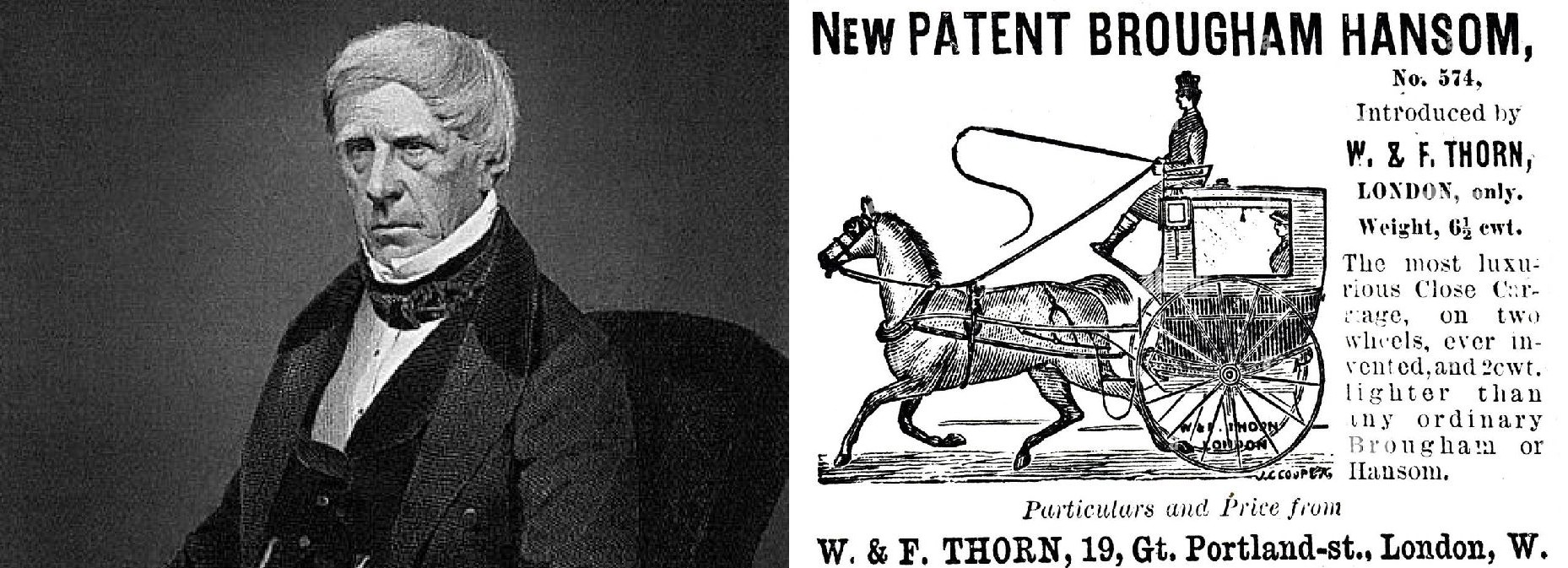
The forbidding visage of Lord Brougham (left) and a mid-nineteenth century coach-builder’s advertisement for a Hansom Cab based on the concept of the brougham, the compact dimensions idea for European cities, many with districts still built around tight systems of streets dating from Medieval or even Roman times.

Lord Brougham’s design was very much to suit his requirements and he drew up the specifications simply because no coach was then available with the combination of features he desired.  What he wanted was a compact carriage designed to seat two (although many versions would, for occasional use, often include two small, foldable “jump” seats, a concept which later would be included in many limousines) in an enclosed compartment (the driver sitting outside) with a particular emphasis of ease of ingress and egress.  Its light weight and easy manoeuvrability made the brougham ideal for urban use and the style was influential, not only widely imitated but also productive in that variations (smaller and larger) appeared and it soon became the preferred middle-class carriage of the era.  It differed from the earlier Hansom Cab which was even smaller and designed to accommodate two in a cabin which often wasn’t enclosed.  The Hansom Cab was the ancestor of the modern taxi and they were produced almost exclusively for the use by hire-operators whereas the larger, better appointed brougham was aimed at the private market.

Harold Wilson (1916–1995; UK prime minister 1964-1970 & 1974-1976) outside 10 Downing Street with his Rover 3.5 saloon (P5B, 1967-1973) left, the 3.5 coupé with the lowered roofline (the first of the four-door breed of coupé), centre and Lindsay Lohan with Porsche Panamera 4S (introduced in 2009 in response to the Mercedes-Benz CLS (2004-2023) which revived the concept of the "four-door coupé), right.  Porsche doesn't use the designation "four door coupé". 

Confusingly for modern audiences, in the nineteenth century, the terms “brougham” and “coupé” often were used interchangeably.  In English, coupé (often and increasingly as “coupe”) was from the French coupé (low, short, four-wheeled, close carriage without the front seat, carrying two inside, with an outside seat for the driver (also “front compartment of a stage coach”)), a shortened form of carrosse coupé (a cut-off or shortened version of the Berlin (from Berliner) coach, modified to remove the back seat), the past participle of couper (to cut off; to cut in half), the verbal derivative of coup (blow; stroke); a doublet of cup, hive and keeve, thus the link with goblets, cups & glasses.  It was first applied to two-door automobiles with enclosed coachwork by 1897 while the Coupe de ville (or Coup de ville) dates from 1931, describing originally a car with an open driver's position and an enclosed passenger compartment.

1957 Cadillac Eldorado Brougham.  Cadillac in the 1950s used "Brougham" as just a model name, the same approach as in 1916 when it had no relationship with the historic coach-building styles. 

In the coach-building business, the critical part of the etymology was “a shortened form” and the coupé thus came to be understood as a “smaller” version of the original; originally this meant “shorter” but the industry soon came to use the term to apply to vehicles which were lower, lighter or in any other way down-scaled.  It’s for this reason the use of coupé (usually coupe in US use) came during the 1930s to be (sort of) standardized as a two-door version of a platform which typically appeared also in other forms.  Coupes in the US were by the later 1930s usually enclosed vehicles of a particular style (typically more rakish than two-door “sedans”) but the English clung more closely to the origin of the word by coining “fixed head coupé” (the FHC, ie what in the US would be a “coupe” of some sort) and the “drop-head coupé (the DHC, what would in other places be called a convertible or cabriolet (though not to be confused with a roadster or phaeton).

Named as a homage to the style of US First Lady Jacqueline Kennedy (1929-1994; US First Lady 1961-1963), Pinninfarina's memorable, one-off Cadillac "Brougham Jacqueline" presents an extraordinary contrast with the 1961 Cadillac on which it was based.  Shown at the 1961 Paris Motor Show, it's a glimpse of what Lancia might have built had they been able to offer 390 cubic inch (6.4 litre) V8s.

During the twentieth century, there was significant fragmentation of meaning in the terms which to coach-builders had once meant something quite specific.  By the 1960s, cars sold as coupés could have four doors and although the earliest versions of these made some concession to the etymology by being configured with a lowered roof-line, for others it was just a model name which might be indicative of sleeker lines but not always and the fate of “brougham” was more quixotic still, eventually for a time becoming the US industry’s term of choice when wanting to impart the impression of “up-market”, luxurious etc.  That wasn’t something out of the blue because as early as 1916 Cadillac introduced a model called “Brougham” which owed little to the obvious features of Lord Brougham’s carriage, the fully-enclosed, four-door Cadillac being now understood as a saloon, sedan or limousine depending on where one lives.  Those things which distinguished Lord Brougham’s design: (1) the enclosed passenger compartment and (2) the open section for the driver came instead to be associated with something called the "sedanca de ville" although few of these combined this with any quality of compactness.  Cadillac would from time to time flirt with the Brougham name but it’s now best remembered for what’s called “the great Brougham era”.  That term seems to have been invented by Curbside Classic, a curated website which is a gallimaufry of interesting content, built around the theme of once-familiar and often everyday vehicles which are now a rare sight until discovered by Curbside Classic’s contributors (who self-style as "curbivores"), parked next to some curb.  These are the often the machines neglected by automotive historians and collectors who prefer things which are fast, lovely and rare.  According to Curbside Classic, the “great brougham era” began in 1965 with the release of the LTD option for the mass-market Ford Galaxie and that approach was nothing new because even the Galaxie name had in 1959 been coined for a "luxury" version of the Fairlane 500, a trick the US industry had been using for some time.

For whatever reason, Ford’s LTD in 1965 created what would now be called a paradigm and it caught not only the public imagination but more importantly convinced them to spend their money buying one and sales were strong.  Profits were also strong because it cost Ford considerably less to tart up a Galaxie than the premium they charged for the LTD package (it was originally an option before becoming a separate model line) and the other mass-market players scrambled to respond, the most blatantly imitative being the Chevrolet Caprice and Plymouth VIP, both released within months of Ford's venture.  Of course, Ford, General Motors (GM) and Chrysler all had other brands, the purpose of which once had been to use the same platform in tarted up form so this internal corporate cannibalization is an interesting case-study in marketing and it’s worth remembering once somewhat up-market brand-names like Mercury and Oldsmobile no longer exist.  By the standards of Broughams which would follow, the “luxury” fittings of the LTD, Caprice and VIP were modest enough but the trend had been started and soon what came to be called the “gingerbread” was being laid on with a trowel: faux wood (plastic), faux chrome (anodized plastic), faux silk (polyester brocade), faux wire wheels (these were at least mostly metal) and that status symbol of the age, the vinyl roof.  The first cars actually to wear a “Brougham” badge seem to have appeared in late 1966 for the 1967 model year and over the decades there would some two dozen using the nomenclature, each understood as being something “more expensive” and therefore “better”.

Landmarks of the great brougham era

1965 Ford LTD:

The 1965 LTD is remembered now for the extra trim and the effect on the industry but in fairness to Ford, the car benefited greatly from the redesigned chassis which included coil-spring suspension on all four wheels.  There was also much attention (Ford spoke in terms of man-years) devoted to the then novel art & science of NVH (noise, vibration & harshness) and fearlessly advertised the thing as being quieter than a new Rolls-Royce.  Many probably thought that mere puffery but more than one publication duly hired acoustic engineers who installed their equipment and ran their tests, confirming the claim.  As a piece of marketing, the extra trim proved quite an enticement and LTD buyers, although they got as standard a 289 cubic inch (4.7 litre) V8 and automatic transmission, got little else and many ticked the boxes on the option list, adding features such as power brakes, power steering, brakes, electric windows and even air-conditioning, then a rarity.  Once all those boxes had been ticked, it wasn’t uncommon for LTDs to be sold for more than the cost of many a nominally up-market Mercury and even the cheapest Lincoln was remarkably close in price.

1994 Mercedes-Benz E 500 Limited.

The Ford Motor Company seems never to have discussed the meaning of “LTD” and the consensus is it was probably an attempt to summon in buyers’ minds the idea of “Limited Edition” and thus impart a hint of exclusivity.  Over the years there were suggestions it stood for “Lincoln Type Design”, “Luxury Trim Decor” or “Limited Trim Design” but there’s no evidence to support any of these and “LTD” came to be understood (in the US & Australia) as “a fancy Ford” of the type which would come later to be described as “blinged up”.  Among mechanics at the time, the joke was LTD stood for “Lots of Tin from Detroit” and the more erudite used “Lots of Tin from Dearborn” (Dearborn the suburb in Detroit, Michigan where Ford was headquartered).  There was also a Mercedes-Benz commonly referred to as the “E 500 Ltd” although the factory only ever used the word “Limited”.  It had been intended to offer the model as a genuine “limited edition” with a run of 500 planned but although the most expensive of the anyway costly 5.0 litre (303 cubic inch) version (500 E (1991-1993) & E 500 (1993-1995)) of the W124 sedans (1958-1995), such was the demand 951 “Limited” editions left the line.  Very much in the tradition of the old 300 SEL 6.3 (1967-1972) the E 500 probably was the company’s best ever high-performance sedan and if that wasn’t enough, the “Limited” could be optioned with the E60 package which included a 6.0 litre (364 cubic inch) V8.

1968 Holden HK Brougham (left) and 1970 Holden Premier (right).

The Holden Brougham (1968-1971) was not so much a landmark of the era as a cul-de-sac but it did indicate how quickly the “brougham” label had come to be associated with prestige and like Chevrolet’s Caprice, the Brougham was a response to a Ford.  In Australia, Ford had been locally assembling the full-sized Galaxies for the government and executive markets but tariffs and the maintenance of the Australian currency peg at US$1.12 meant profitability was marginal, so the engineers (with a budget said to be: "three-quarters of four-fifths of fuck all") took the modest, locally made Falcon, stretched the wheelbase by five inches (125 mm), tweaked the front and rear styling (which although hardly radical resulted in a remarkably different look), added some bling (though that word was not then in use) and named it Fairlane.

The Fairlane name was chosen because of the success the company had had in selling first the full-sized US Fairlanes (nicknamed by locals as the “tank Fairlane”) between 1959-1962 and later the smaller version (1962-1965) which Robert McNamara (1916–2009 and briefly the president of Ford Motor Company before serving as US secretary of defense (1961-1968) under John Kennedy (JFK, 1917–1963; US president 1961-1963) & Lyndon Johnson (LBJ, 1908–1973; US president 1963-1969)) describes as "the size of car Americans should be driving".  In that McNamara was right and what came in the 1960s to be called the "intermediates" (ie between the "compact" & "full-size" lines) proved a sweet spot in the market and that was because they were essentially the size of the "standard" US automobile before the breed became oversized in the mid-late 1950s.  The Australia Fairlane was for decades a successful and profitable product and eventually Holden (General Motors's (GM) local outpost) followed the formula but not before the curious diversion which was the Brougham.  For 1968, Holden chose what even at the time was thought a bizarre approach in trying to match the Fairlane; instead of a longer wheelbase (and thus more interior space), the Brougham was conjured up by extending the tail of the less exalted Premier by 8 inches (200 mm), the strange elongation a hurried and less than successful response.  Unwanted for decades when the could be bought for Aus$250, the handful of surviving Broughams became twenty-first century collectables, advertised for sale at as much as $Aus$90,000, some Holden connoisseurs (as one-eyed a crew as any) even finding a previously undetected elegance in the lines.

1958 Cadillac Series 62 Extended Length Sedan (Body Style 6239EDX, left) and 1958 Cadillac Series 62 Sedan (Body Style 6239, right).

In their defense, Holden could have pointed to a corporate precedent, the 1958 Cadillac range including the “Series 62 Extended Length Sedan”.  The Series 62 Sedan was already an impressive 216.8 inches (5.5 m) long but the Extended Length version measured an even more imposing 225.3 (5.7), the additional 8.5 inches (216 mm) all in the rear deck, creating a more capacious trunk.  There can’t have been many Cadillac buyers with that much luggage (although, impressionistically, golf club car parks did suggest there would be those for whom the ability to carry several sets of clubs might be compelling) but the new model did attract buyers, either despite or because of the healthy industry in jokes about Mafia functionaries and other figures in organized crime grateful finally to have more space to transport the bodies.  Unfortunately for Cadillac, there were only so many golfers and Mafia hit-men and despite 20,952 of the 103,455 (excluding Eldorados and “chassis only” sales) Series 62s produced in 1958 being the Extended Length Sedan (some 20%), it proved a single-season one-off which perhaps should have been a warning to Holden.

Cadillac's other take on the “long & slightly less long of it: 1963 Cadillac Four-Window Sedan De Ville (Body Style 6239, left) and 1963 Cadillac Sedan De Ville Park Avenue (Body Style 6389, right).

Strangely, Cadillac’s next venture in rear-deck management went the other way, “short deck” versions of certain models offered between 1961-1963, the things created by removing 7 inches (178 mm) of aft bodywork, the effect more noticeable for the final season when the truncation was 8 inches (203 mm).  Demand, anyway muted, quickly declined and there ended Cadillac’s experiments with rear deck length.  There was at the time much criticism that “full-size” US cars had become too big but the “short deck” venture was most un-Cadillac like and, by international standards, the truck capacity of even the abbreviated models was still quite generous, able effortlessly to accommodate two sets of gold clubs, something which later became a de-facto standard in assessing the practicality of sports cars.  Jaguar used this feature as a selling point when the XK8 (1996-2006) was introduced because it wasn’t possible with all versions of the old E-Type (1961-1974).  For a variety of reasons, by the 1970s, there would be a smaller Cadillac and the first generation Seville (1975-1979) was most accomplished but of the even smaller Cimarron (1982–1988) there are few fond memories.  It wasn't that the Cimarron was, by the standards of its time, an especially bad car; it just wasn't "a Cadillac" as that construct was then understood.  

1967 Ford GT40 Mark III (left) and 1967 Ford GT40 Mark I (road version, right).

From 1967 there was also a more contemporary example to inspire the antipodean engineers although it’s unlikely it much caught their eye; that was the Ford GT40 (1964-1969), one of the most successful machines in 1960s sports car racing which beat not only the competition but also the attempts by the Fédération Internationale de l'Automobile (the FIA; the International Automobile Federation) to legislate it into un-competitiveness,  Then (as now), the FIA was international sport’s dopiest regulatory body.  In the happy era when it was possible to make a few minor modifications and register a Le Mans race car for the road, 31 of the 105 GT40s were so configured (even a cigarette lighter was installed) but the driving experience was still very much that of a (slightly) quieter race car, the accommodation cramped, the ventilation marginal and the luggage space fit for little more than a proverbial topless bikini.  But some hardly souls bought them because there were few things on the road faster so thoughts turned to making a “more civilized” version with the creature comforts now expected.  Thus the 1967 GT40 Mark III with a slightly detuned engine, improved ventilation, a conventional, centrally mounted gear shift, sound deadening, more compliant suspension settings and even a reasonably sized ashtray to compliment the cigarette lighter.  However, only seven were built because they cost as much as a middle-class house, were still cramped (with challenging ingress and egress for all but the young or athletic) and in appearance differed in several aspects from the cheaper (Mark I) GT40 road cars still available from John Wyer (1909–1989).

Herbert von Karajan's 1967 Ford GT40 Mark III; of the seven produced, it was one of four LHD (left hand drive) versions.  The trunk would have be large enough for his conductor's baton and maybe a little more.

By virtue of the long tail, the Mark III did though have more luggage space (for soft baggage rather than suitcases) and it appealed to some, the most famous purchaser being the Austrian conductor Herbert von Karajan (1908–1989).  The Mark III was fitted with additional sound deadening and the exhaust system made the sometimes Wagnerian sound of the 289 cubic inch (4.7 litre) V8 less intrusive but inside it was no Rolls-Royce and certainly not a 1965 Ford LTD (which Ford paid acoustic engineers to prove was quieter than a Rolls-Royce Silver Cloud III) so whether Karajan ever tried to fit a radio or tape deck ("sound-systems would come later) is unlikely.  It would anyway have been better to focus on the road because even in its detuned form the GT40 Mark III could be a handful, especially to those unacquainted with the then still novel characteristics of mid-engined road cars although Karajan also for a while drove a Mercedes-Benz 300 SL Gullwing (W198, 1954-1957) so he may have been not unfamiliar with quirky handling.  Wisely, he never drove his GT40 on wet roads.  

1957 Continental Mark II (left) and 1972 Oldsmobile Ninety-Eight Regency (right).  The Continental Mark II (1956-1957) was at the time the most expensive car produced in the US and substantially "hand made" but the relative austerity of the interior compared with the various "broughams" of later decades illustrates how profoundly the manufacturers shaped consumer tastes during the era. 

By 1972, there were so many “Broughams” on the market Oldsmobile must have thought the tag was becoming a bit common so to mark the company’s 75th anniversary, they called their new creation the “Regency”.  Vague as most Americans might have been about the origin of “brougham”, most probably knew “regency” often had something to do with royalty so as an associative pointer it was good.  The Ninety-Eight Regency in 1972 was however as audacious as the LTD had half-a-decade earlier been tentative because it seemed the target was Oldsmobile’s senior stable-mate (two rungs up the ladder in the GM hierarchy), the top-of-the-range Cadillac and there was nothing in Cadillac’s showrooms which could match the conspicuous opulence of the black or covert gold “pillow effect”, tufted velour upholstery.  Each Regency was registered at Tiffany's which supplied the specially designed clock and provided the owner with a distinctive sterling silver key ring; if lost, the keys could be dropped in a mailbox and Tiffany's would return them to the owner.  Take that Cadillac.  A limited run of 2,650 75th anniversary Ninety-Eight Regency cars was built, all of them four-door hardtops and the (non-anniversary) model continued in 1973.  By 1982, Oldsmobile concluded the message needed again to be drummed into buyers and introduced the Regency Brougham.

Peak brougham: 1977 Chrysler New Yorker Brougham four-door hardtop.

The high-water mark of the great brougham era was set by the Cadillac Fleetwood Talisman (1974-1976), the Cadillac Fleetwood Brougham D'Elegance (those produced in 1988-1989) and the most expensive cars from Chrysler Corporation (the Imperials and Chrysler New Yorkers) during the last days of the full-sized cars (1974-1978).  After this, designers really could go no further in this direction and had to think of something else.

Thursday, December 17, 2020

Clutch

Clutch (pronounced kluhch)

(1) To seize with or as with the hands or claws; snatch.

(2) To grip or hold tightly or firmly.

(3) In slang, to spellbind; grip a person's emotions, attention, or interest; to become tense with fright or panic (both archaic and rare outside US).

(4) To operate the clutch in a vehicle.

(5) The hand, claw, etc when grasping.

(6) Power of disposal or control; mastery (usually in the plural).

(7) The act of clutching; a snatch or grasp; a tight grip or hold.

(8) A device for gripping something.

(9) In automotive and other machinery, a mechanism for readily engaging or disengaging a shaft with or from another shaft or rotating part (a specialized form of coupling); a control, usually a pedal, for operating this mechanism.

(10) In sports, an extremely important or crucial moment of a game (rare outside US).

(11) Any critical position or situation; emergency (rare outside US).

(12) A small purse that can be carried in the hand and usually has no handle or strap (also called clutch bag).

(13) In poultry production, a hatch of eggs; the number of eggs produced or incubated at one time; a brood of chickens.

(14) One of several collective nouns for books or dancers.

1175–1225: A variant of (the now Northern English dialectal) cletch, from the Middle English clucchen, clicchen, cluchen, clechen & cleken, a variant of clicchen, from the Old English clyccan (bring together, bend (the fingers), clench), akin to the Scots cleck (to hatch) from the Old Norse klekja (to hatch) and related to the Old Frisian kletsie (spear) & the Swedish klyka (clasp, fork).  It was cognate with the Irish glac (hand).  The origins of the English verb were Germanic, the source the Proto-Germanic klukjaną, from the Proto-Germanic klu- (to ball up, conglomerate, amass), from the primitive Indo-European glew- (to ball up; lump, mass).  It was cognate with the Swedish klyka (clamp, fork, branch). The noun is from Middle English cleche, cloche, & cloke (claw, talon, hand), related to the Scots cleuk, cluke & cluik (claw, talon), of uncertain origin, with the form probably assimilated to the verb.

The meaning "to grasp" is early fourteenth century; that of "to seize with the claws or clutches" from later that century.  The sense of "hold tightly and close" is from circa 1600, influenced by the Middle English cloke (a claw) whereas "a brood, the number of eggs incubated at any one time" (in reference to chickens) dates from 1721 and is a (southern England) dialectal variant of cletch (1690s), noun from the verb cleck which is from the 1400s Middle English clekken (to hatch, give birth to), most likely from a Scandinavian source such as the Old Norse klekja (to hatch), perhaps of imitative origin in the same way as cluck.  The original meaning (a grip, grasp, tight hold) dates from circa 1200, the form clutches (in the sense of “the hands" suggesting grasping rapacity or cruelty) not emerging until the 1520s.  A product of the industrial revolution, the mechanical clutch (movable mechanical coupling or locking and unlocking contrivance for transmitting motion) is from 1814 with the "seizing" sense extended to "a coupling device for bringing working parts together".  Originally applied to the static machines in mills, it was first used to describe the transmissions (as the coupling between crankshaft and gearbox) in 1899.  The now rare meaning "moment when heroics are required" is attested from the 1920s but never gained currency outside the US

The clutch purse

One’s eye is always drawn to a nice clutch purse.  Salma Hayek (b 1966) with Alexander McQueen (1969-2010) skull clutch, Evening Standard Theatre Awards, London, November 2015.

The modern definition of a “clutch” is a handbag without handles but with a detachable (sometimes a chain) strap and (usually) rectangular in shape.  Most often an evening bag, they can be used during the day, the most defining characteristics being they’re slim and primarily hand-held.  Bags and purses predate pockets and the clutch bag seems to have been a very early solution to the problem of carrying small, high-value possessions.  Evidence survives in the historic record in paintings and tapestries but few examples remain extant because almost all were made from perishable materials, a seven-hundred year old relic on display at London’s Courtauld Gallery the oldest known to exist.

For her much anticipated appearances at the Cannes film Festival, Salma Hayek has over the years made the clutch purse her signature accessory, guaranteeing attention from the photographers.

Lindsay Lohan with Carmen Steffens evening clutch, annual amfAR fundraiser at the Cannes Film Festival, Hotel Eden Roc in Cap D’Antibes, May 2017.

In many parts of the world, clutch bags never went away but in the west, the increasing emancipation in the nineteenth century meant bags became larger and the clutch all but disappeared.   It was the resurgence of classical style dresses in the 1920s which led to its revival because it was an ideal accessory for the diaphanous flapper dresses of the era, a style which didn’t detract from the line of the body.  They’ve not since faded from popularity and are now an essential fashion accessory, performing also the socially invaluable function of giving the hands something to do. Because clutch purses so often tend to the rectangular in all aspects, they’re often styled using the motifs associated with the art deco era of the early-mid twentieth century and most designers seem to favor the elaborate, decorative styles of the earlier (pre 1929 Wall Street crash) art deco.  Given the small size of a clutch purse, this can be a challenge to implement but so can the more simplified plays of flattened and stylized geometric shapes or abstract patterns.

Cadillac, Ferrari and the clutch pedal

Although not all early Ferraris were so equipped and by 1976 the 400 GT was even offered with an automatic transmission (General Motors’ famously robust Turbo-Hydramatic 400), the open-gate shift was for decades a motif associated with the marque.  However, advances in hydraulics and electronics meant that by the early twenty-first century, the inefficiencies and technical disadvantages attached to automatic transmissions had been overcome to the point where no Ferrari with a manual transmission, however expertly driven, could match their performance.  Using automatic transmissions meant a clutch pedal was no longer necessary but it didn’t mean clutches were deleted; instead they were automated.  Scuderia Ferrari first used the technology in the Tipo 640 Formula One car in 1989 and any doubts about its speed or reliability were quickly allayed, the machine winning at its maiden appearance in the Brazilian Grand Prix.  Development continued and in 1997, the automated system, dubbed F1, was offered as an option in the F355, the first road car so equipped, the electro-hydraulic system operated by paddles behind the steering wheel linked to the F355's otherwise conventional 6-speed manual transmission.

It certainly started a trend and paddles quickly become almost a de rigueur piece of technology for high-performance cars, the occasional old style, three-pedal model released only to cater for the dwindling number of drivers who enjoyed the experience of the way things used to be done.  In Ferrari dealerships, the numbers dwindled fast and the last Ferrari with a manual transmission was sold in 2012, the replacement a dual-clutch transmission (also called twin-clutch or double-clutch) which used two separate clutches for odd and even gear-sets although the separate transmissions had their respective clutches contained in one housing, working as a single unit.  The model which enjoyed the distinction of providing a swansong for the old open gate was the California.  Upon release in 2008 it was estimated between 5-10% of buyers would opt for a clutch pedal but, between then and late 2011, a mere three were ordered (some sources say two or five but the factory insists it was three).

2012 Ferrari California (top) and 2012 Cadillac CTS-V sedan.

So the last decade at Maranello has been automatic (technically “automated manual transmission”) all the way and although a consequence of the quest for ultimate performance, it wasn’t anything dictatorial and had customer demand existed at a sustainable level, the factory would have continued to supply manual transmissions.  Amusingly, Cadillac had in 2004 begun offering a model with a manual transmission for the first time since the 1953 Series 75 (among the Cadillac crowd the Cimarron (1982-1988) is never spoken of except in the phrase "the unpleasantness of 1982" ) and by 2013, while one could buy a Cadillac with a clutch pedal, one could not buy such a Ferrari.  For most of the second half of the twentieth century, few would have thought that anything but improbable or unthinkable.

Whether that’s going to change isn’t certain but in 2025 Ferrari disclosed the idea was being considered.  Not only have there been requests from “customers in good standing with the factory” but also it will have been noted a niche industry has emerged where specialists convert the paddle-shifted into cars with the traditional gated transmission, complete with a clutch pedal.  In some cases this is done exclusively with the use of genuine Ferrari parts while others use a mix of those and some machined as replicas; either way the build costs tens of thousands of dollars so it’s easy to see why the feeling in  Maranello may be there’s a lucrative gap in the market.  It’s not that Ferrari’s view about the technical superiority of the automated transmission has changed, just that the laws of physics and the realities of human physiology interact to impose a limit on the performance it’s possible for modern cars to attain.  While years of technological advances and investments in engineering probably could make cars quicker and faster, Ferraris in their present form already offer performance beyond what most drivers safely can exploit (certainly on public roads).  Indeed, Ferrari note the AWD (all-wheel-drive) SF90 XX already is within two-tenths of a second of the 2.3 seconds the current Formula One race car takes for the 0-100 km/h (0—60 mph) run and there’s little point in pushing further in this direction because the Formula One drivers of today have a very different physiology from those of earlier generations because of the specific muscle development required to withstand the stresses and G-forces.  A typical human simply wouldn’t cope.

In the Ferrari boardroom, when pondering the return of the gated transmission, the 1969 Ford Mustang Mach 1 428 probably won't much be discussed but the principle is the same: The three-speed automatic (left) is quicker while the four-speed manual (right) is more fun.

So while the focus on ultimate performance might be restricted to a handful of special models, the famous gated shifter might make a comeback, not because it’s better but because it’s more fun.  In the post-war years the British manufacturers sold to Americans shiploads of their underpowered, antiquated roadsters, not because they were fast but because they were so entertaining to drive and the collector market does support the allure: all else being equal, between a Ferrari with a gated shift and an otherwise identical one with paddles, it’s the one with the clutch pedal which will command a premium.  That preference extends to other segments such as the Porsche 911 & Jaguar E-Type and while with that pair the manual gearbox offers both higher speeds and more fun, even though many US muscle cars were in the 1960s & 1970s ordered with automatic gearboxes because that was the quickest way along a drag-strip’s ¼ mile, it’s now the ones with a four-speed manual which are most sought.  The attraction for Ferrari is of course that fun can be just another packaged commodity on the option list and if it does re-appear, the gated transmission is expected to be expensive because while its old technology, it needs to be profitable and the factory are well acquainted with the margins options offer.  On the 2019 812 Superfast for example, in addition to the MSRP (Manufacturer's Suggested Retail Price) of US$561,272, buyers could tick the box for, inter alia, the AFS (Adaptive Front Lights) & SBL (Static Bending Lights) combo (US$3,375), yellow brake calipers (US$1,519), a pair of cloisonné prancing horse fender shields (US$15,000), carbon-fibre dashboard inserts (US$7,593) and a golf bag matching the interior trim (US$10,000).  All those were cheaper than matte paint (US$40,000) but Bentley charge US$160,000 for a Breitling clock so it’s not unreasonable to expect a Ferrari gated shift to list well into six figures and to "test the waters", at least initially, availability will be restricted to a single model although, as the "customer is always right", if demand clearly exists, supply will follow.