Showing posts sorted by relevance for query Plasma. Sort by date Show all posts

Friday, March 5, 2021

Plasma

Plasma (pronounced plaz-muh)

(1) In anatomy, physiology & hematology, the liquid part of blood or lymph, as distinguished from the suspended elements; A clear component of blood or lymph containing fibrin.

(2) In cell biology, a former name for protoplasm; cytoplasm

(3) In cheese-making, a less common term for whey (a milk serum, separating as liquid from the curd after coagulation, as in cheese making).

(4) In mineralogy, a green, faintly translucent chalcedony.  Heliotrope is a green variety of chalcedony, containing red inclusions of iron oxide that resemble drops of blood, giving heliotrope its alternative name of bloodstone. In a similar variety, the spots are yellow instead, known as plasma.

(5) In physics, a highly ionized gas containing an approximately equal number of positive ions and electrons.

(6) In historic medicine, a mixture of starch and glycerin, once used as a substitute for ointments.

(7) In digital graphics (as demoscene), a visual effect in which cycles of changing colors are warped in various ways to give the illusion of liquid organic movement.

1712: From the Late Latin plasma (literally "mold") from the Ancient Greek πλάσμα (plásma) (something molded or formed, hence "image, figure; counterfeit, forgery; formed style, affectation”), akin to plássein (to form, mold; (and related to the modern plastic).  The Ancient Greek plásma originally meant "to spread thin" from the primitive Indo-European plath-yein, from the root pele (flat; to spread).  The original meaning in English was the now obsolete "form; shape" which reflected the classical form of the earlier plasm, the sense of a "liquid part of blood" dating from 1845 while that of "ionized gas" was from 1928.  Plasma is a noun and plasmatic & plasmic are adjectives; the noun plural is plasmas.

Plasma physics

Although plasma was first observed (and named “radiant matter”) in 1879 by British chemist and physicist Sir William Crookes (1832–1919),its nature wasn’t identified until work in 1897 by British physicist Sir Joseph Thomson (1856–1940).  The term “plasma” was first used in 1928 by American chemist, physicist, and engineer Irving Langmuir (1881–1957), the word chosen as a description of ionised gas because Langmuir noted the similarity between the transport of electrons from thermionic filaments and the way blood plasma carries the red and white corpuscles. 

Almost all observable matter in the universe is in the plasma state. Formed at high temperatures, plasmas consist of freely moving ions and free electrons and are known as the “fourth state of matter” because their unique physical properties distinguish them from solids, liquids and gases.  Plasma densities and temperatures greatly vary, from the cold gases of interstellar space to the extraordinarily hot, dense cores of stars and inside a detonating nuclear weapon.  Plasma and ionized gases possess unique properties quite unlike those of the other three states, the transition between them more a definitional question of the point(s) at which nomenclature shifts from one to the other; a kind of demarcation dispute between physicists.  A wholly speculative dispute is whether plasma is the most abundant form of ordinary matter in the universe, something impossible to determine because of uncertainty surrounding the existence and properties of dark matter.  Based on the existing mathematical models of the universe, there should be a great deal more matter and energy than has ever been observed, hence the “dark” fudge.  The assumption is that both are there but because they’re “dark” we can’t see them.  That assumption is however based on other known orthodoxies and either the existence or the deduced volume of dark matter may be found to be errors if any of those orthodoxies are either disproved or proved to have been wrongly calculated.  In the history of science, probably most orthodoxies have be overturned.

Plasma and blood

Plasma & platelets not separated: Lindsay Lohan in a blood-soaked photo-shoot by Tyler Shields (b 1982), Los Angeles, 2011.  Shields had worked with blood before, once completing a painting with blood from twenty donors, obtained using a commercial service after physicians declined to be involved in the project.

Plasma is the liquid component of blood and in human blood and by volume, some 55% of blood is plasma, the remainder made of red & white blood cells and platelets, all of which is suspended in the plasma which is about 92% water, a further 7% containing vital proteins such as albumin, gamma globulin and anti-hemophilic factor while the remaining 1% consists of mineral salts, sugars, fats, hormones and vitamins.  Plasma is vital for human function because it (1) assists in the maintenance of blood pressure and volume (2) transports the proteins critical for blood clotting and immunity, (3) carries electrolytes such as sodium and potassium on which muscles depends and (4) assists cell function by maintaining the body's pH balance.

In clinical medicine, plasma is given to trauma, burn and shock patients, as well as people with severe liver disease or multiple clotting factor deficiencies.  It boosts a patient’s blood volume, helping to prevent shock and encouraging clotting.  Pharmaceutical companies use plasma to make treatments for conditions such as immune deficiencies and bleeding disorders and in blood donations, the liquid portion can be separated from the cells.  As blood is drawn from the arm, it is fed through a machine which collects the plasma, the donor’s red blood cells and platelets then returned to the donor along with some saline. Remarkably, the process takes little longer than donating whole blood.  Donated plasma is frozen within 24 hours of being donated to preserve its clotting factors and can then safely be stored for up to a year, thawed for transfusion when needed.

Thursday, May 16, 2024

Pellucid

Pellucid (pronounced puh-loo-sid)

(1) Allowing the maximum passage of light, as glass; transparent; translucent; non-opaque.

(2) Clear; limpid.

(3) In fashion, a see through fabric or a garment made of such (used loosely also of many which are semi-opaque and thus technically subpellucid).

(4) Easily recognized or seen through; apparent, obvious (archaic).

(5) By extension, of music or some other sound: not discordant or harsh; clear and pure-sounding (technical use only in composition, academic study or criticism).

(6) Figuratively, clear in meaning, expression, or style; not obscure.

(7) Figuratively, of a person, able to think and understand clearly; not confused, perspicacious (now rare).

(8) In anatomy, as "zona pellucida" (the plural: zonae pellucidae or zonæ pellucidæ), a glycoprotein membrane surrounding the plasma membrane of an oocyte.

1610-1620: A learned borrowing from the Latin pellūcidus, a variant of perlūcidus (transparent, pellucid; very bright, radiant; very understandable), from perlūcēre (to shine through), the construct being per- (as a prefix, “through; throughout; completely, thoroughly”), from the primitive Indo-European root per- (forward, hence “through”) + lūcēre or lūcidus (clear; full of light, bright, shining (and figuratively “easily understood, clear, lucid”)), from lūceō (to shine; to become visible, show through (and figuratively “to be apparent, conspicuous, or evident”)).  The construct of the Latin lucidus was understood as lux (light), ultimately from the primitive Indo-European lewk- (bright; to see; to shine) + -idus (the suffix forming adjectives conveying the sense “tending towards”).  The construct in English may thus be understood as pe(r) +-l- + lucid (see through).  The (now rare) noun was derived from the adjective.  In technical use, the preferred word to convey the idea of “somewhat pellucid; tending toward pellucidness” appears to be subpellucid (along with the derived subpellucidly & subpellucidness, all sometimes hyphenated) rather than semi-pellucid, quasi-pellucid, or other possibilities.  The comparative is “more pellucid” and the superlative “most pellucid”).  Pellucid is a noun & adjective, pellucidness & pellucidity are nouns and pellucidly is an adverb; the noun plural is pellucids.  Pellucid and its derivatives are good words and should be used, just not by lawyers.

The pellucid water of Flathead Lake, Montana USA.

“These wells were filled with water, and with a blue light, celestial in its loveliness,—a light ethereal and pellucid.” (Over the Rocky Mountains to Alaska (1914) by Charles Warren Stoddard (1843-1909)).  In literary and poetic use, one will sometimes find “pellucid waters” but the word seem too obscure for advertizing copy-writers who, seeking pellucidity, prefer “crystal clear” although the once uncommon “azure” seems to have become sufficient familiar for the bays of the Mediterranean or Caribbean to be called “azure blue waters”.

Lindsay Lohan in swimsuit with subpellucid V-cut panel; clutch purse by Chanel and wearing Lanvin Classic Garnet ballet flats, Los Angeles, August 2012.

Although there are a few which are designed to be eye-catching, the extensive use the industry makes of pellucid (see-through) fabrics mostly is barely noticed because typically the application is either (1) only subpellucid, (2) covering non-sexualized body-parts such as arms or (3) as an overlay designed to highlight or subtly alter the color or texture of the fabric with which what lies beneath is made.  One intriguing tradition exploiting a fabric’s quality of pellucidly which has endured despite the unpromising origin is the bride’s wedding veil.  Historically, the idea of the veil was to conceal the bride’s appearance from the groom until the priest had pronounced the couple man & wife, thereby having joined together in the name of God what “let no man tear asunder”.  The functional advantage was as a precaution against a groom finding grounds for rejecting his betrothed in those once not uncommon cases where the ceremony was the first time the two had met, the arrangements having been hammered out by the often distant families, sometimes years in advance.  The point at which the bride was unveiled and the priest spoke the words: “You may now kiss the bride” which, in the cases of arranged marriages, actually meant: “You’re stuck with her mate; good luck.”  Even in times gone by however, most brides and grooms were well known to each other (“known” sometimes in the Biblical sense, thus the need for sometimes hastily arranged marriages) but the veil became a popular part of a bride’s ensemble and still they’re sometimes used.

In most parts of the English-speaking world, in recent decades there have been attempts to ensue “plain English” is used in legislation and legal documents.  It’s an admirable goal for many reasons but perhaps the most obvious is a contribution to increased compliance with laws, simply because pellucidness in wording would decrease the risk of unintentional breaches of law and legal obligations, at least some of which are the consequences of misunderstanding; as an example, a word like pellucid should not appear in legal documents because it is little-known and rare.  Using sentences plain in meaning and unambiguous even to those without legal training improves communication which increases information, thereby reducing the need for interpreters (lawyers), thereby decreasing the costs associated with the administration and application of legislation and other legal documents.  Those fond of conspiracy theories like to find in the difficult language a sort of job-creation programme for lawyers but it was really a product of the power of precedent, the phrases and terms of law, many still in their original Latin, having gained a certainty of meaning and thus maintained for generation after generation.  Language itself also had some inertia, the idea of a “legal style” of writing soon entrenched as “correct” and maintained by law schools and practitioners.

Lindsay Lohan and her lawyer in Court, Los Angeles, December 2011.

The matter for a long had attracted the interest of reformers in the law and parliaments but began to coalesce as a movement in the post-war years and this may at least have been influenced by the extent to which the increasing volume of laws passed by modern states were starting to intrude on the lives of more citizens, most of whom historically had little direct contact with legislation unless they came to the attention of the police.  In 1950, when sitting as a Lord of Appeal, the English judge Lord Radcliffe (1899–1977) observed what as early as 1913 had come to be called “legalese” had become: “…a sort of hieratic language… by which the priests incant the commandments.  I seem to see the ordinary citizen today standing before the law like the laity in a medieval church: at the far end the lights glow, the priestly figures move to and fro, but it is in an unknown tongue that the great mysteries of right and wrong are proclaimed.”  He concluded by asking: “...what willing allegiance can a man owe to a canon of obligation which is not even conceived in such a form as to be understood?”

It was a reasonable question, even if phrased in a way many would find as arcane as the object of his Lordship’s critique it wasn’t until the 1970s that law reform commissions and others began to circulate discussion papers and proposals  The rationale was encapsulated in one fragment in the decision handed down by Lord Donaldson (1920–2005; Master of the Rolls 1982-1992) in Merkur Island Shipping Corp v Laughton [1983]1 All ER 334: “The efficacy and maintenance of the rule of law, which is the foundation of any parliamentary democracy, has at least two prerequisites.  First people must understand that it is in their interests, as well as in that of the community as a whole, that they should live their lives in accordance with the rules and all the rules.  Second they must know what those rules are.”  In the 1990s, reform of language began to happen at scale and there was in this an element of technological determinism, the digitization of legislation and codes meaning texts ancient and modern began to appear on the screens of word processors, making modernization a simpler process.

Sunday, January 2, 2022

Semiotics

Semiotics (pronounced sem-e-ot-ics)

(1) The study of signs and symbols as elements of communicative behaviour; the analysis of systems of communication, as language, gestures, or clothing.

(2) A general theory of signs and symbolism, usually divided into the branches of pragmatics, semantics and syntactics.

(3) Of or relating to signs.

(4) As a (now archaic) specialized use in medicine, the scientific study of the symptoms of disease (known later as symptomatology).

1660s: From the Ancient Greek σημειωτικός (sēmeiōtikós) (fitted for marking, portending), stem of sēmeioûn (to interpret as a sign), from σημειῶ (sēmeiô) (to mark, to interpret as a portend), from σημεῖον (sēmeîon) (a mark, sign, token), from σῆμα (sêma) (mark, sign).  Semiotics is the sense now understood in English was an adaptation by English physician and philosopher John Locke (1632-1704) on the model of Greek logic to mean “the doctrine of signs”.  The medical sense was from the 1660s, the use to describe the study of signs and symbols with special regard to function and origin dates from the 1880s and the use in psychology began in 1923.

The structural model of semiotics.

Semiotics is the study of signs and symbols, with special regard to function and origin especially as means of language or communication.  Essentially a branch of the study of meaning-making and meaningful communication including the deconstruction of signs and sign processes, indication, designation, likeness, analogy, allegory, metonymy, metaphor, symbolism, signification, and communication.  Semiotics has evolved to be closely related to linguistics, but can be treated, at least to some point, as a parallel stream.  The semiotic tradition explores the study of signs and symbols as a significant part of communications which can be, but are not of necessity tied to linguistics.  Indeed, semiotics is probably best known for non-linguistic sign systems.  Semiotics became popular with anthropologists who enjoyed the way cultural phenomenon could be studied without any lineal relationship to a specific language.  In a similar vein, zoologists used the method to examine how organisms make predictions about, and adapt to, their semiotic niche in the world.  In general, semiotic theories take signs or sign systems as their object of study including the communication of information in living organisms without structured language in the sense of human text.


Lindsay Lohan in a hotel bathroom, perhaps perplexed by unlabelled taps.

A classic example of semiotics is the convention that red indicates hot water and blue cold but not all manufacturers conform to this standard, some tapware designers apparently offended by the idea of any sort of label making a vulgar intrusion on their carefully crafted shapes.  In the days when Intourist (Интурист in the Russian, a contraction of иностранный турист (foreign tourist); the Soviet Union's notoriously erratic travel agency) enjoyed what was close to a monopoly in the operation of hotels in the USSR, the travel diaries of politicians, journalists and others lucky enough to enjoy a visit would not infrequently comment on the plumbing, taps either not labelled or with labels which would only by apparent coincidence be a reliable guide, faucets which might in the morning have conformed, swapping roles by the evening.


A semiotic convention (left) and examples of variation (right).

It's well understood that Green is for safety (like an exit door) and red for danger (such as a fire).  However, except where stipulated in regulations (which tend to be local rather than national), there's no guarantee the colors used in one place will translate to another and manufacturers' parts lists often include interchangeable components in a variety of colors so users can choose although, where consequences can be both severe and with implications over vast areas (such as sites dealing with nuclear energy), the color-coding and language of signs is done to an international standard.  The reason for danger signs being usually red is likely one of human historical association, red the color of blood and fire so linked with anger and danger.  Plasma physicists point out also that red is the color least scattered by air, water or dust molecules and thus remains visible for longer and at greater distances in adverse environments .  The effect of scattering is inversely related to the fourth power of the wavelength of a given color and because red has the highest wavelength, it gets scattered the least and is thus able to travel the longest distance through fog, rain etc before fading away.  It's the same reason the sky appears blue, the fine particles in the atmosphere scatter blue light most among all the components of white light.


Sometimes though, a color is just a color.  Temporary signs such as those warning of "men at work" or "wet floor" are typically in made in bright (even lurid) colors with the text rendered in a shade with maximum contrast, the object being to attract attention.  Curiously though, manufacturers do offer these in grey and black, perhaps because of the popularity of white and cream as floor colors in commercial spaces.

Thursday, October 6, 2022

Plastic

Plastic (pronounced plas-tik)

(1) Any of a group of synthetic (and usually hydrocarbon-based) polymer materials which may be shaped when soft and subsequently hardened.

(2) In slang, a credit card, or credit cards collectively (an allusion to the material typically used in their manufacture); money, payment, or credit represented by the use of a credit card or cards.

(3) Something (or a number of things), made from or resembling plastic (sometimes merely descriptive, sometimes as a slur suggesting inferiority in quality).

(4) Capable of being molded or of receiving form; having the power of molding or shaping formless or yielding material.

(5) In psychology, the quality of being easily influenced; impressionable.

(6) In biology of or relating to any formative process; able to change, develop, or grow; capable of adapting to varying conditions; characterized by environmental adaptability.

(7) Figuratively and in slang, something superficially attractive yet unoriginal or artificial; insincerity or fakeness in an individual or group.

(8) A widely used combining form (plastic surgery, plastic bullet, plastic explosive, chloroplastic, protoplastic etc).

(9) A sculptor or molder; any solid but malleable substance (both obsolete).

(10) In physiology, producing tissue (obsolete).

1625–1635: From the Latin plasticus (that which may be molded or relating to that which has been molded), from the Ancient Greek πλαστικός (plastikós) (fit for molding, capable of being molded into various forms; pertaining to molding), from πλάσσω (plássō) (to mold, to form).  In Hellenic use, in relation to the arts, there was plastos (molded, formed) the verbal adjective from plassein (to mold) and from the Greek plastikós was derived both plaster and plasma.  Words vaguely or exactly synonymous (depending on context) include elastic, molded, synthetic, bending, giving, yielding, cast, chemical, ersatz, phony, pseudo, substitute, ductile, fictile, formable, moldable, pliable, pliant, resilient, shapeable, flexible & amenable.  The seventeenth century spelling plastick is long obsolete.  Plastic is a noun, verb & adjective, plastically & plasticly are adverbs and plasticity is a noun; the noun plural is plastics.

Three decades of progress in consumer products, Soviet style: Two comrades approaching their 1957 Trabant P50 in stylish korallenrot (coral red) over creme (cream) and 1990 Trabant 601 in a by then more typical beige (right).  In fairness, a 1959 and 2000 Mini enjoy a not dissimilar degree of visual similarity.  Note the 1957 Trabant's amber turn signals; Trabants were factory-fitted with flashers at a time Rolls-Royce and other manufacturers in the “advanced West” were still installing antiquated semaphores.

Materials with plastic properties were attractive for car producers for different reasons.  It made low-volume production runs viable because the tooling costs were a fraction of the cost of those using steel or aluminum and in some cases the light weight and ease of modification was an attraction.  In the GDR (German Democratic Republic, the old East Germany), the long-running (1957-1991) Trabant's bodywork was made with Duroplast, a composite thermosetting plastic (and a descendant of Bakelite).  It was a resin plastic reinforced with fibres (the GDR used waste from both cotton & wool processing) and structurally was similar to fibreglass although the urban myth Trabants were made from reinforced cardboard persists.  The first Trabants left the Saxony production line in November 1957, only weeks after the Soviet Union had startled the world by launching Sputnik, the first man-made Earth satellite.  Launched into an elliptical low Earth orbit where it circulated for three months, it did nothing other than transmit radio pulses which, because of the flight path, could at various time be detected just about anywhere below.  Compared with what space programmes would become, it sounds now a modest achievement but at the time was a sensation and the event which triggered the “space race”.

Low-emission Trabant (rated at 1 PP (pony-power)) with driver using semaphore signal to indicate intention to turn left, Barnim district, Bernau bei Berlin, GDR, 1981.

In the Eastern Bloc there weren’t many marketing departments but there was a vast propaganda apparatus and opportunistically, the name Trabant was derived from the Middle High German drabant (satellite; companion; foot soldier) which at the time was a positive association with the famous Sputnik but it later became emblematic of the economic and moral bankruptcy of the whole communist project: While by the fall of the Berlin Wall (1961-1989) Soviet satellites and related technologies greatly had advanced, the “Trubi” remained a little changed “1957 time capsule”.  Although much despised in the early 1990s in the aftermath of the break-up of the Soviet Union (1922-1991), opinions softened and the survivors of the more than three million produced (a greater volume than BMC's (British Motor Corporation) Mini (1959-2000)) gained a cult following.  More correctly, the marque gained a number of cult followings, some attracted by the “retro-cuteness”, some with genuine, Putinesque nostalgia for the old Soviet system and other with a variety of projects as varied as EV (electric vehicle) conversions, the installation of V8s for drag-racing and the re-purposing in many forms of competition.  The Trubi is now a fixture in the lower reaches (a notch above the Austin Allegro) of the collector market.
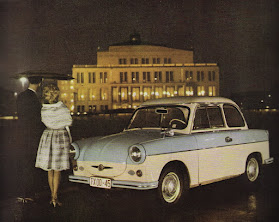
Two comrades with their 1960 Trabant P50 in stylish two-tone pastellblau (pastel blue) over creme (cream) admiring the Leipzig Opera building, Saxony, circa 1961.

The photograph of the horse-drawn Trubi, while not representative of the entire Eastern Bloc experience under communist rule, captures a sight which would not have been uncommon away from large urban centres (which could be grim enough).  Dr Henry Kissinger (1923-2023; US national security advisor 1969-1975 & secretary of state 1937-1977) said his abiding memory of Eastern Bloc cities was of “the smell of boiled cabbage and an unrelenting greyness.”  In fairness, English cooks probably inflicted worse on the noble cabbage than anything done behind the Iron Curtain but his sense of “greyness” was literal, the appalling air pollution of the GDR (its industrial base powered by burning lignite (from the Latin lignum (wood)) and other forms of low-grade, “dirty coal”), thus the griminess of the buildings.  Places like London similarly were affected and it was only after the 1952 “Great Smog of London” that the Clean Air Act (1956) became law, meaning air quality began slowly to improve.  That the photographs of the era look so drab was not because of the film stock; buildings literally were “dirty”.  Because of various advances in health care, it’s difficult to quantify the contribution to reducing mortality achieved by reducing air pollution but few doubt it was significant.

1953 Chevrolet Corvette (C1).

By 1952 the success in the US of MG and Jaguar had made it clear to Chevrolet that demand existed for sports cars and the market spread across a wide price band so with the then novel GRP (glass reinforced plastic, soon better as “fibreglass”) offering the possibility of producing relatively low volumes of cars with complex curves without the need for expensive tooling or a workforce of craftsmen to shape them, a prototype was prepared for display at General Motors’ (GM) 1953 Motorama show.  Despite the perception among some it was the positive response of the Motorama audience which convinced GM’s management to approve production, the project had already be signed-off but the enthusiastic reaction certainly encouraged Chevrolet to bring the Corvette to market as soon as possible.  The name Corvette was chosen in the hope of establishing a connection with the light, nimble naval vessels.

1969 Chevrolet Corvette (C3) L88 Convertible.

The haste brought its own, unique challenges.  In 1953, Chevrolet had no experience of large-scale production of GRP-bodied cars but neither did anybody else, GM really was being innovative.  The decision was thus taken to build a batch of three-hundred identical copies, the rationale being the workers would be able to perfect the assembly techniques involved in bolting and gluing together the forty-six GRP pieces produced by an outside contractor.  Thus, by a process of trial and error, were assembled three hundred white Corvettes with red interiors, a modest beginning but the sales performance was less impressive still, fewer than two-hundred finding buyers, mainly because the rate of production was erratic and with so few cars available for the whole country, dealers weren’t encouraged to take orders; uncertainty surrounded the programme for the whole year.  Seldom has GM made so little attempt actually to sell a car, preferring to use the available stock for travelling display purposes, tantalizing those who wanted one so they would be ready to spend when mass-production started.

2023 Chevrolet Corvette (C8) Z06 Coupe.

From this tentative toe in the plastic pond, seventy years on, the Corvette remains in production as one of GM’s most profitable lines.  Introduced in 2020, the eighth generation (C8) Corvette is for the first time mid-engined and the materials used are radically different from the steel & GRP of 1953.  The platform is now a spaceframe (of six die-cast aluminium-alloy assemblies, augmented with stampings, extrusions, castings and hydro-formed tubes augmented by a single CFRP (carbon fiber-reinforced composite) piece) atop which is attached a body fashioned from CFRP.  Radically different though the C8 is in design, construction and the use of materials, the concept of a “plastic” body over a metal structure remains true to the 1953 C1. 

The notion of being "capable of change or of receiving a new direction" emerged in 1791 and this idea was picked up in 1839 when the term plastic surgery was first used to describe a procedure undertaken to "remedy a deficiency of structure" is recorded by 1839 (in plastic surgery).  The most familiar use referring to the hydrocarbon-based polymers dates from 1909 when the expression "made of plastic" gained currency which remained literal until 1963 when the US counterculture adopted it as slang meaning "false, superficial", applying it both the political and consumer culture.  The noun plastic (solid substance that can be molded) however appears first to have been used in 1905 and was applied originally to dental molds.  Our plastic age can be said to have begun in 1909 when a US patent was issued for Polyoxybenzylmethylenglycolanhydride (marketed as Bakelite), a resin created by the reaction between phenol & formaldehyde.  Chemists had for years been experimenting with various compounds, much of the research funded by the petroleum industry which was seeking some profitable use for its by-products but Bakelite was the first plastic material which had characteristics which made it suitable for manufacture at scale and adaptability to a wide range of uses.  Thus the first commercially available plastic made from synthetic components which retained its formed shape if heated, it was developed by Belgian chemist Leo Baekeland (1863-1944) while working in the US.

The “plastics” at lunch with product-placement, plastic packaging and plastic trays, Mean Girls (2004).  Note the plastic straws.

On 10 March 2025 the White House issued a fact sheet advising Donald Trump (b 1946; US president 2017-2021 and since 2025) had signed an executive order to “end the procurement and forced use of paper straws.”  Explaining the policy of the previous administration had been an “irrational campaign” which “forced Americans to use non-functional paper straws”, Executive Order 90 FR 9585 (2025-02735) was part of the “BRINGING BACK COMMON SENSE” theme of the second Trump administration.  To avoid the fake news media being able to accuse the fact sheet of pedalling “alternative facts”, the White House provided a scientific rationale, noting “paper straws use chemicals that may carry risks to human health – including ‘forever chemical’ PFAS (per- and polyfluoroalkyl substances) which are known to be highly water soluble and can bleed from the straw into a drink. A study found that while PFAS were found in paper straws, no measurable PFAS were found in plastic straws.”  Additionally, “Paper straws are more expensive than plastic straws, and often force users to use multiple straws.  Paper straws are not the eco-friendly alternative they claim to be – studies have shown that producing paper straws can have a larger carbon footprint and require more water than plastic straws.  Paper straws often come individually wrapped in plastic, undermining the environmental argument for their use.”  Executive Order 90 FR 9585 (2025-02735) was an indication the second Trump administration will not be “…caving to pressure from woke activists who prioritize symbolism over science.”  Like face-mask wearing during the COVID-19 pandemic whether one uses paper or plastic straws may enter the culture wars as a marker of one’s political position.

Plastic explosive (explosive material with a putty-like consistency) became familiar to the military only in the Second World War and more generally in the 1950s but the first use of the term dates from 1894.  Earlier uses include describing the creative or formative processes in art generally as plastic, an echo of the use which sometime prevailed in Hellenic culture but this faded after a few decades during the seventeenth century although the noun plasticity (capability of being molded or formed; property of giving form or shape to matter) endured after first being noted in 1768.  A nineteenth century adoption was in the biological sciences in the sense of “organisms capable of adapting to varying conditions; characterized by environmental adaptability and in the same era, in engineering it came to mean “of or pertaining to the inelastic, non-brittle, deformation of a material”.

The success of Bakelite triggered a rush of development which produced the early versions of the numerous substances that can be shaped and molded when subjected to heat or pressure.  Plastics gain their plasticity because they consist of long-chain molecules known as polymers which flex but don’t break their bonds when subjected to all but extreme stresses.  They’re almost always artificial resins (but can be made from some natural substances such as shellac) and the best known are Polyvinyl chloride (PVC) and polystyrene.  Useful as it is, plastic (with a life measured in some cases in centuries) has emerged as a significant environmental threat, both as visible waste (and thus a threat in many way to wildlife) and as micro-plastic, microscopic-sized fragments which exist in the environment including the human food chain.

Piet Mondrian, neo-plastic painting and adhesive tape

Piet Mondrian’s (1872-1944) 1941 New York City 1 is a series of abstract works created with multi-colored adhesive paper tape.  One version first exhibited at New York’s Museum of Modern Art (MOMA) in 1945 has since 1980 hung in the Düsseldorf Museum as part of the Kunstsammlung Nordrhein-Westfalen’s collection and recently it was revealed for the past 77 years it has been hanging upside down.  The work is unsigned, sometimes an indication the artist deemed it unfinished but Mondrian left no notes.

Mondrian’s 1941 New York City 1 as it (presumably correctly) sat in the artist's studio in 1944 (left) and as it was since 1945 exhibited (upside-down) in New York and Düsseldorf (right).  Spot the difference. 

The decades-long, trans-Atlantic mistake came to light during a press conference held to announce the Kunstsammlung’s new Mondrian exhibition.  During research for the show, a photograph of Mondrian’s studio taken shortly after his death showed the work oriented in the opposite direction and this is being treated as proof of the artist’s intension although experts say the placement of the adhesive tape on the unsigned painting also suggests the piece was hung upside down.  How the error occurred is unclear but when first displayed at MOMA, it may have been as simple as the packing-crate being overturned or misleading instructions being given to the staff.  However, 1941 New York City 1 will remain upside because of the condition of the adhesive strips.  “The adhesive tapes are already extremely loose and hanging by a thread,” a curator was quoted as saying, adding that if it were now to be turned-over, “…gravity would pull it into another direction.  And it’s now part of the work’s story.”

1941 New York City 1, Paris Museum of Modern Art.

The curator made the point that as hung, the interlacing lattice of red, yellow, black and blue adhesive tapes thicken towards the bottom, suggesting a sparser skyline but that “…the thickening of the grid should be at the top, like a dark sky” and another of Mondrian’s creations in a similar vein (the oil on canvas New York City I (1942)) hangs in the Musée National d’Art Moderne in Paris with the thickening of lines at the top.  Whether Mondrian intended 1941 New York City 1 to be part of his oeuvre or it was just a mock-up in adhesive tape for the oil-on canvas composition to follow isn’t known, artists having many reasons for leaving works unsigned.  Mondrian was one of the more significant theorists of abstract art and its withdrawal from nature and natural subjects.  "Denaturalization" he proclaimed to be a milestone in human progress, adding: "The power of neo-plastic painting lies in having shown the necessity of this denaturalization in painterly terms... to denaturalize is to abstract... to abstract is to deepen."   

Plasticity in catwalk fashion

Bella Hadid, Coperni show, Paris Fashion Week, October 2022.

Although many in the industry prefer to talk about natural fibres like silk or linen, it’s plastics like nylon or polyester which make possible both the shape and behavior of many modern garments and their mass-production.  One possibility offered by plastics was illustrated at the 2022 Paris Fashion Week in October when as the concluding set-piece of the Coperni show, Bella Hadid (b 1996) appeared on the catwalk wearing only G-string knickers.  There she paused while for about a quarter hour, two men sprayed her body with what appeared to be white paint.  Once done, a woman emerged to cut a thigh-high asymmetric slit and adjusted things slightly to render an off-the-shoulder look.  Essentially a free-form exercise in 3D printing, the spray-on dress was left deliberately unfinished so as not to detract from the performance; had such a creation been built behind closed doors, either on a human or mannequin, re-usable and adjustable formwork would likely have been used to catch overspray and allow things like hems, straps and splits more precisely to be rendered.  On the night though, the fraying at the edges was just part of the look and Ms Hadid looked wonderful, a thinspiration to the whole pro-ana community.  The term “sprayed on” had long been used to describe skin-tight clothing but the Coperni show lent it a literalism new to most.

On the catwalk, spray-painting a model had been done before, two robots used in Alexander McQueen’s spring 1999 show to adorn Shalom Harlow (b 1973) after the fashion of those used in car assembly plants but that was literally just paint onto a conventional fabric whereas Ms Hadid’s dress appeared over bare (though presumably some sort of lotion was used to suit the properties of the plastic) skin.  The spray-on material is called Fabrican, created by Dr Manel Torres who first demonstrated its properties in 2006.  It’s a liquid fibre, bound by polymers, bio polymers and greener solvents which evaporate on contact with a surface (like Ms Hadid’s skin and including water).  As a fabric, it’s said to have a similar texture to suede and can be manipulated like any other but the feel can be altered depending on the fibers (natural or synthetic) used in the mix and the shape of the nozzle used on the spray device.

Although an eye-catching example of the technology, Fabrican’s place in fashion business is likely to be as an adjunct device rather than one used to create whole garments.  It would be invaluable for Q&D (quick and dirty) solutions such as effecting repairs or adding something but it’s been demonstrated as long ago as 2010 at London Fashion Week without demand emerging though it may yet find a niche.  What more likely beckons is a role in medicine (perhaps especially for military medics in the field) as a sterilized (perhaps even an anti-bacterial) bandage-in-a-can.  Indeed, the style of dress created in Paris is known as the “bandage” dress.

Bella Hadid, Coperni’s 2023 show, Paris, 2022

Shalom Harlow, Alexander McQueen’s spring show, London, 1999.

Wednesday, September 4, 2024

Zigzag

Zigzag (pronounced zig-zag)

(1) A line, course, or progression characterized by sharp turns first to one side and then to the other.

(2) One of a series of such turns, as in a line or path (typically in a repeating “Z-like” pattern.

(3) Proceeding or formed in a zigzag:

(4) In sewing, dressmaking etc, a pattern or stitches in this shape.

(5) In military use (land, sea & air), to move or manoeuvre in a zigzaging motion, usually as a form of evasion.

(6) In figurative use, something performed in a non-lineal way, characterized by frequent changes, often in response to external influences such as criticism.

(7) As “zigzag rule”, a rule composed of light strips of wood joined by rivets so as to be foldable, all the opening and closing parts being in parallel planes.

(8) In World War I (1914-1918) US military slang, a slang term for “someone drunk”.

1712: From the mid-seventeenth century French zigzag which replaced the earlier ziczac, from the German zickzack, from the Walloon ziczac, a gradational compound based on Zacke (tack) (familiar in English use as the “zigzagging technique” used in yachting).  It’s thought the coining of the original may have been influenced by the letter “Z” which appears twice, a “Z” able to be interpreted as a representation of a “zigzag movement”.  Less supported among etymologists is the alternative theory the German Zickzack was from Zacke (point; tooth; prong; jagged projection).  The earliest known use in German was to describe military siege approaches, a use adopted (by analogy) by early English landscape architects (then known as “gardeners”) to the layout of appropriately shaped paths in parks.  It was used as an adjective from the mid eighteenth century, the first appearing in 1774.  The brand of cigarette paper (a favorite of many stoners because the glue was said to make joints “easier to roll”) was first sold in 1909.  The adjectival use is common in fabric design and dressmaking, the zigzag pattern widely used.  In sewing, a zigzag stitch is one of the standard set in sewing machines, used usually to finish edges, the attachment to create such stitches known as a zigzagger.  The hyphenated spelling zig-zag is common.  Zigzag is a noun, verb adjective & adverb; zigzaggedness & zigzagger are nouns and zigzagged & zigzagging are verbs; the noun plural is zigzags.

ZIG is used as an acronym for a number of purposes including (1) zoster immune globulin (a globulin fraction of pooled plasma from patients who have recovered from herpes zoster and used prophylactically for immuno-suppressed children exposed to varicella and therapeutically to ameliorate varicella infection), (2) a general-purpose imperative, statically typed, compiled programming language intended as a modern successor to the C language and is (3) the abbreviation of Zimbabwe Gold, the official national currency of Zimbabwe since April 2024; it began in October 2023 as a gold-backed digital token in October 2023.  ZAG is the International Air Transport Association’s (IATA) code for Zagreb International Airport, Croatia and to describe Zymosan-Activated Granulocytes (a type of white blood cell (granulocytes) that have been stimulated by exposure to zymosan, a polysaccharide derived from the cell walls of yeast species like Saccharomyces cerevisiae).

Lindsay Lohan with Kim Kardashian (b 1980) with strategically placed “gash” in dress.

The feature may be described as either a “zig” or “zag” because the terms are interchangeable.  However, were there to be two connected gashes which assume opposite directions: that would be a “zigzag”.  While the nature of the formation of the words “zig” & “zag” is not unique, it is unusual in that, dating from the late eighteenth century, both were extractions: back-formation from “zigzag”.  A notable quirk of zig & zag is that interchangeably they can be used to mean the same thing yet when used in the same sentence, they mean “to move in opposite directions”.  In separate use, it thus matters not whether one says “she zigged around” or “she zagged around”; the meaning is the same.  Used together however, the rule is strict: she will always be described as “zigzagging” and never “zagzigging”.  Zigzag is often intended to be humorous and when applied to politicians it’s a way of saying they are “being evasive” or “flip-flopping”.

Lindsay Lohan wearing a Tolani zig zag scarf (given it was winter, the piece should probably be described as a “muffler”) in the style made famous by the Italian fashion house Missoni, New York, November 2007.

Founded in 1953 by Ottavio (1921-2013) and Rosita (b 1931) Missoni, the house became well-known during the 1960s for their vibrant and colorful knitwear, the signature motif of which was a distinctive zigzag pattern.  The technology which made the garments possible was not new, the Missoni’s “re-discovering” the long discarded “Rachel” machines traditionally used to create the shawls worn in the south of Italy, devices which permitted an almost infinite variation of lines and styles within a given design; such things were of course possible using other machinery but the versatile Rachels allowed changes to be integrated into the production line process, making possible economies of scale not available to other manufacturers; all that was required was a quick juggling of the assembly’s array of multi-colored points and what would emerge was fabric with horizontal and vertical lines in a rainbow of colors.  Ottavio Missoni did acknowledge the stylistic debt owed, once saying: “For a thousand years, the Incas have been copying my knit sweaters…”

A swatch of Missoni's signature zigzag.

The event which made Missoni famous was at the time thought scandalous although, given what these days is worn on catwalks and red carpets, it seems quaint indeed.  After their first, well-received, catwalk show in 1966, Missoni was invited to the event held in Florence’s Pitti Palace in April 1967 and it was only during last-minute rehearsals Rosita Missoni became aware the shape and color of the models’ bras were clearly visible, distracting attention from the unique zigzagging patterns which were the brand’s signature.  With no time to arrange a fix like skin-toned bodysuits, her solution was for the models to remove their bras; that solved the problem but replaced one distraction with another, the assembled pack of photographers most impressed because, under venue’s unusually bright lights, the pieces became transparent.  Since dubbed “The Battle of the Bras”, at the time not all thought the look “appropriate” but it generated much publicity and was one of the reasons Milan would in the late 1960s emerge as one of the world’s fashion capitals, the photographers following the Missonis back to Milan.  The couple weren’t invited to the next year’s Pitti Palace show but Vogue, Marie Claire, Elle, and Harper's Bazaar all provided generous coverage and the Rubicon had been crossed, Yves Saint-Laurent (1936–2008) in 1968 displaying the “see-through” look.  Since then, it’s never gone away.

PLA Shenyang J-8II (left) and USN Lockheed EP-3E ARIES II (right)

The phrase “he zigged when he should have zagged” came into common use in the mid-twentieth century and is believed to have been popularized by radio sports commentators who needed something “graphical” to paint a “word picture” of why a football player had been tackled.  The origin is thought to be sardonic military humor and a euphemism for “he was killed while attempting an evasive maneuver”.  An example of “he zigged when he should have zagged” was the fate of the unfortunate Lieutenant Commander (shao xiao) Wang Wei (1969-2001) of the People's Liberation Army (PLA) Navy of the PRC (People’s Republic of China), killed when his Shenyang J-8II interceptor (a Chinese knock-off of the old Soviet-era MiG 21) collided with a US Navy Lockheed EP-3E ARIES II signals reconnaissance aircraft (a development of the old P-3 Orion).  The affair became known as the “Hainan Island Incident” because the damaged EP-3 was forced to land on the Chinese territory of Hainan Island, the ensuring diplomatic spat played out over the next ten days, resolved by the US ambassador to Beijing handing to the PRC’s foreign minister the “Letter of the two sorries”; US surveillance flights have continued and the PLA is now more cautious in its shadowing.  US pilots noted the dark linguistic coincidence of the name “Wang Wei” being pronounced “wong way”.

Jewish Museum Berlin (2001), overhead view (left), exterior (centre) and interior (right).

Designed by US architect Daniel Libeskind (b 1946) and opened in 2001, Berlin’s Jewish Museum is noted for the “zigzag” theme reflected in its floor plan, exterior surfaces and interior detailing.  The “gashes”, a recurring motif, are integral to the design and described as “voids”, deep, empty spaces which “cut their way” through the building, serving as symbols representing the absence, loss, and emptiness left by the Holocaust.  The architect’s idea was to evoke a sense of disorientation & fragmentation, recalling the often disrupted history of the Jewish people in Germany (the Holocaust only the most severe of the pogroms suffered).  According to the museum, the voids are intended to summon in visitors periods of reflection, silence, and remembrance; a recall of what irrevocably has been lost.  In terms of design & effect, one of the most celebrated voids is the "Memory Void" in which houses the installation Shalekhet (Fallen Leaves) by Israeli painter & sculptor Menashe Kadishman (1932–2015), constructed with thousands of metallic faces spread across the floor.  On these, visitors walk, producing a haunting sound many report as “intensifying the emotional experience”.  Voids are not unusual in museums, galleries and other exhibition spaces but unlike some, those in the Jewish Museum contain no exhibits, reminding visitor of the void in Jewish culture rent by the Holocaust.