Thursday, October 17, 2024

Slant

Slant (pronounced slant or slahnt)

(1) A surface, structure, line etc at a slope or in an oblique direction.

(2) In (US) football, an offensive play in which the ball-carrier runs toward the line of scrimmage at an angle (known also as the “slant-in”, a pass pattern in which a receiver cuts diagonally across the middle of the field).

(3) In prosody, as “slant rhyme”, a synonym for the “half rhyme”, “near rhyme” & “quasi-rhyme” (a form of imperfect rhyme in which the final (coda) consonants of stressed syllables (and, in modern English poetry, any following syllables to the end of the words) are identical in sound, but the vowels of the stressed syllables are not.

(4) In typography, a synonym of slash (/, particularly in its use to set off pronunciations from other text (not used in IT where the distinctions are between the forward-slash (/) and the back-slash (\) which nerds call respectively the slash and the slosh.

(5) In biology, a sloping surface in a culture medium.

(6) In hydro-carbon extraction, as “slant drilling”, a technique in which the drilling is undertaken at an oblique angle rather than the traditional vertical orientation.

(7) In extractive mining, as type of run in which a heading is driven diagonally between the dip and strike of a coal seam.

(8) In informal use, a glance or look.

(9) To veer or angle away from a given level or line, especially from a horizontal; slope (in to incline, to lean).

(10) Figuratively, to have or be influenced by a subjective point of view, bias, personal feeling or inclination etc (often as “slant towards”, “slanted view” etc); a mental leaning, bias, or distortion (“feminist slant”, “MAGA slant”, “liberal slant”, “business slant” etc).

(11) To cause to slope.

(12) Figuratively, to distort information by rendering it unfaithfully or incompletely, especially in order to reflect a particular viewpoint (more generously sometimes described as “spin” or “massaged”).  The concept is known also as “angle journalism” (the particular mood or vein in which something is written, edited, or published).  In Scots English, the meaning “to lie or exaggerate” captures the flavor.  When used to describe the composing, editing, or publishing of something to attract the interest of a specific sub-group (a “slanted” story), “slanted towards” is necessarily pejorative if used only to suggest something optimized to appeal to a certain market segment or demographic (ie it’s more like “aimed at” or “intended for”).

(13) In slang, as “slant eye” (a racial slur now listed as disparaging & offensive), a reference to people from the Far East (applied historically mostly to the Chinese & Japanese), based on the shape of the eyes.  The variants included “slit eye”, “slitty-eyed” & “slopehead”, all equally offensive and now proscribed.

(14) In painting (art) a pan with a sloped bottom used for holding paintbrushes; a depression on a palette with a sloping bottom for holding and mixing watercolors; a palette or similar container with slants or sloping depressions.

(15) In US regional slang, a sarcastic remark; shade, an indirect mocking insult (archaic).

(16) In US slang, an opportunity, particularly to go somewhere (now rare).

(17) In historic Australian colonial slang, a crime committed for the purpose of being apprehended and transported to a major settlement.

Circa 1480s: From the Middle English –slonte or -slonte, both aphetic (in phonetics, linguistics & prosody, “of, relating to, or formed by aphesis” (the loss of the initial unstressed vowel of a word)) variants of aslant, thought to be of Scandinavian origin.  The other influence was probably the earlier dialectical slent, from the Old Norse or another North Germanic source and cognate with the Old Norse slent, the Swedish slinta (to slip) and the Norwegian slenta (to fall on the side), from the Proto-Germanic slintaną (which, in turn, was probably in some way linked with aslant.  Slant & slanting are nouns, verbs & adjectives, slanted is a verb & adjective, slantish is an adjective, slantwise is an adjective & adverb and slantingly & slantly are adverbs; the noun plural is slants.  The pleasing adjective slantendicular is listed by some as non-standard and presumably is proscribed in geometry and mathematics because it's an oxymoron; it’s a portmanteau word, the construct being slant + (perp)endicular.  It may be useful however in commerce or engineering where it might be used to describe something like a tool with a shaft which at some point assumes an oblique or skewed angle.   So it’s there to be used and slantindicular should be applied to stuff which is neither wholly nor fully slanted and in architecture, such structures are numerous.  In commerce, it could be used as a noun.

The noun slant by the 1650s was used to mean “an oblique direction or plane” and began in geography & civil engineering (of landforms, notably ski-slopes), developed from the verb or its adjective.  The now familiar (in the Fox News sense) meaning “way of regarding something, a mental bias” dates from 1905 while the derogatory slang sense of “a person of Asian appearance” came into use some time in the 1940s, a direct descendent from the earlier "slant-eyes", documented since 1929.  The verb slant is documented since the 1520s in the sense of “obliquely to strike (against something)”, an alteration the late thirteenth century slenten (slip sideways), the origin of which is murky but etymologists have concluded it came (via a Scandinavian source (noting the Swedish slinta (to slip)) and the Norwegian slenta (to fall on one side), from the Proto-Germanic slintanan.  The intransitive sense of “to slope, to lie obliquely” was in use by the 1690s, while the transitive sense of “to give a sloping direction to” had emerged by the early nineteenth century.  As early as the late fifteenth century forms were in use as an adverb, the adjectival use attested from the 1610s.  The technical use in literary theory as “poetic slant rhyme” was first used in the mid 1920s (assonance or consonance) although such lines had appeared for centuries, used sometimes deliberately as a device, sometimes not.  In the following stanza by English poet Peter Redgrove (The Archaeologist, published in Dr Faust's Sea-Spiral Spirit (1972)), the second and third lines contain a form of slant rhyme while the first and fourth have pure rhymes:

So I take one of those thin plates
And fit it to a knuckled other,
Carefully, for it trembles on the edge of powder,
Restore the jaw and find the fangs their mates.

Slanted right: You are watching Fox.

While it’s unlikely volumes of the poetry of Emily Dickinson (1830–1886) sit upon the bookshelves of those members of the Fox News audience who have bookshelves, they likely would concur with her words: “Tell the truth but tell it slant.  Slanted reporting” has become something which in recent years has attracted much attention (and much hand-wringing by the usual suspects) as an increasingly polarization of positions has been alleged to be a feature of political discourse in the West.  There is little doubt the effect (as reported) is obvious but there’s some debate about both the mechanics and the implications of the phenomenon.  As long ago as 2018, a study found that although the tenor and volume of things on X (formerly known as Twitter) was found to be increasingly toxic and surging, the number of active users engaged in these political polemics was found to be tiny and their effect was distorted by (1) the huge number of tweets they tended to post, (2) the propensity of their fellow-travelers to re-tweet and (3) the use of bots which were more prolific still.  If anything, recent voting patterns suggest it would seem the views of the general population appear to be trending away from the extremes towards the more centralist positions offered by independents or small-parties, something most obvious in Australia where compulsory voting exists.  Outfits like Fox News offer a slanted take on just about everything (and promote country & western music which truly is inexcusable) but this is something which has been identifiable in the news media as long as it’s existed and their blatant bias is hardly subversive or threatening, simply because it is so blatant.  What was most interesting in what emerged from the recent defamation suit filed by Dominion Voting Systems against Fox News suggested the network’s stance on things was motivated more by the financial imperative than ideological purity.  Intriguingly, what some analysts concluded was that if the universe shifted and the Fox News audience transformed into a bunch of seed-eating hippies, there would follow Fox’s editorial position, the slant being towards the advertising revenue rather than a particular world view.  Of course, there are some slants which are unalterable and dictated by ideological purity but with commercial media, it’s likely sometimes cause is confused with effect.

The New Statesman, 14-20 June 2024: A publication with a leftist slant depicting the European right, slanted to the right.

Founded in 1913 by Sidney (1859–1947) & Beatrice Webb (1858–1943) with patronage from George Bernard Shaw (GBS; 1856-1950) and other worthies from the socialist Fabian Society.  Its circulation was at its highest during the high-water mark of British socialism under Harold Wilson (1916–1995; UK prime minister 1964-1970 & 1974-1976) but, now with print and digital editions in the common manner, it has survived and while unashamedly left-wing (the editorial boards preferring terms like “progressive” & “liberal”), it also has an emphasis on culture and literature, a mix similar to The Spectator (right) and The Economist (centre-right).  Unlike the Spectator which picks up readers from across the spectrum because the often punchy writing attracts (as well as those who read it on the basis of "know thy enemy"), the published surveys suggest The New Statesman's readership tends to be from the left.

The Leaning Tower of Pisa (left) and Lindsay Lohan in The Parent Trap (1998) in front of London’s perpendicular Big Ben (1859) (right).  The architect’s original name for the latter was a typically succinct “Clock Tower”, chosen because it housed the “Great Bell of the Great Clock of Westminster” but it was in 2012 renamed “Elizabeth Tower”, marking the Diamond Jubilee of Elizabeth II (1926-2022; Queen of the UK and other places, 1952-2022), something little noted by Londoners or those beyond who continue to prefer the nickname “Big Ben” although strictly speaking that’s a reference only to the “Great Bell” a 13.5 ton (13.7 tonne) casting in bell metal (a bronze which is an alloy of about 77% copper & 23% tin).  The origin of the nickname is contested but there are no romantic tales, all the possible inspirations being worthy white men as was the Victorian way.

Although in Italy alone there are seven leaning towers (three of which stand (ie lean) in Venice), it’s the torre di Pisa (Tower of Pisa) which is by far the best-known and a frequent Instagram prop.  Built between 1173-1372, the structure in the Piazza del Duomo (Pisa’s Cathedral Square) is the campanile (the freestanding bell tower) of the adjacent Pisa Cathedral and the famous lean of some 4o (actually somewhat less than its greatest extent after more than a century of compensating engineering works) was apparent even during construction, the cause the softness of the sub-surface.  That geological feature has however contributed to the tower’s survival, the “rubber-like” sponginess below acting to absorb movement and despite a number of severe earthquakes in the region over the centuries, the tower remains.  It is of course known as the leaning tower than a sloping, oblique or slanted tower, probably because of the conventions of use which evolved in English.

The words “sloping”, “oblique”, “slanted”, & “leaning” all describe something not vertical or horizontal there tend to be nuances which dictate the choice of which to use.  Sloping generally is used of something which inclines or declines at a gentle or continuous angle, the implication being of a gradual or smooth transition from elevation to another, such as the way a hillside rises gradually rises to its summit.  Oblique is mostly a matter of specific angles and is thus common is mathematics, geometry and engineering.  Again, it’s a reference to something neither parallel nor perpendicular to a baseline but it tends to be restricted to something which can be defined with an exact measurement; in geometric or technical use, an oblique line or angle is one neither 90o nor perfectly horizontal.  Slanted describes something positioned at a diagonal, often used to imply a more noticeable or sharp angle but also is widely used figuratively, metaphorically and in idiomatic phrases.  Leaning refers to something tilted or positioned at an angle due to external pressure, the object in an unstable position and in need of support.  The implication carried is that something which “slants” is designed thus to do while something which “leans” does so because of some design flaw or unexpected external force being applied so it’s the leaning and not the sloping tower of Pisa, even though the structure has assumed quite a slope.

Slanting Engines

On a slant: Diagram of the mounting of the M194 straight-six engine in the Le Mans winning Mercedes-Benz 300 SL (W194) canted at a 40o slant (left); the Mercedes-Benz M196 straight-eight engine schematic (centre) and installed in a 1954 W196R "Streamliner" at a 53o slant (right).  The two large donut-like objects at the front are the inboard, finned brake drums; at the time, the engineers maintained disk brakes were "not yet ready for use". 

There are “slant” engines and they exist in three configurations.  The first is simply a conventional in-line engine (straight-six, straight-eight etc) which, when installed in a vehicle, is fitted with the block canted to the left or right, the objective being a lower hood line which means a better aerodynamic outcome.  A classic example was the Mercedes-Benz W196R Formula One racing car (1954-1955) in which the straight-eight was canted to the right at a 53o angle, the technique carried over when the same structure was used to produce the W196S (1955) used to contest the World Sports Car Championship.  Rather opportunistically, the W196S was dubbed the 300 SLR (one of which in 2022 became the world's most expensive used car, selling at a private auction for US$142 million) as a form of cross promotion with the 300 SL (W198, 1954-1956) Gullwing then in production, even though the two types shared little more than nuts, bolts and a resemblance.  The 300 SL did however also have its straight-six engine sitting at a slant, this time canted at a 50o angle and although the factory never published an estimate of the reduction in drag, it’s long been presumed to be “at least several percent”.  Another advantage of the configuration was it made possible the use of “long-tube” runners for the induction system, taking advantage of the properties of fluid dynamics to permit them to be tuned either for mid-range torque or top-end power.  The concept used math which had been worked out in the nineteenth century and had often been used in competition but it wasn’t until 1959 when Chrysler in the US released their picturesque induction castings that the system, imaginatively named the “Sonoramic”, reached a wider audience.

Chrysler Slant Six (170 cid, 1963) schematic.

The “true” slant engines were those with a slanted block atop an otherwise conventional arrangement of components, the best known of which was Chrysler’s long-serving “Slant Six”, produced in displacements of 170 cubic inch (2.8 litre, 1959-1969), 198 cubic inch (3.2 litre, 1970-1974) and 225 cubic inch (3.7 litre, 1960-2000).  The block of the Slant Six was canted to the right at a 30o and like Mercedes-Benz, Chrysler took advantage of the space created to the left to produce some wide induction runners, the most extravagant those used by the special Hyper Pack option package which used a four barrel carburetor, enabling the engine to produce power which made it competitive with many V8 powered machines.  Although the name “Slant Six” became famous, it was only in the mid-sixties it caught on, Plymouth originally calling the thing a 30-D (a reference to the a 30o slant), hardly very catchy and something to which only engineers would relate and Slant Six was soon preferred although the aficionados really like “tower of power” and the engine even today still has a devoted following.

Chrysler Slant Six with Hyper Pak in 1962 Plymouth Valiant V-200.

Chrysler didn’t restrict the Sonoramics to the big-block V8s, using it also on the short-lived (1960-1962) Hyper Pak performance option for the both 170 cubic inch (2.8 litre, 1959-1969) and 225 cubic inch (3.7 litre, 1987-2000) versions of the Slant Six, the engineers taking advantage of the space afforded by the canted block to permit the curvaceous intake runners nearly to fill the engine bay.  The Hyper Pak wasn't seen in showrooms but was available as an over-the-counter kit (literally a cardboard box containing all necessary parts) from Dodge & Plymouth spare parts departments and its life was limited because it became a victim of its own success.  Although less suitable for street use because it turned the mild-mannered straight-six into something at its best at full throttle, in the race events for which it was eligible it proved unbeatable, dominating the competition for two years, compelling the sanctioning body cancel the series.

Manifold porn: The Slant Six's angle meant there was much space available to the left and a range of intake manifolds followed, some of which remain available to this day.  Using variations of the sonoramic tuning, manifolds were produced for single, two & four barrel carburetors and between 1965-1968, Chrysler's Argentine operation produced the Slant Six in a version with twin single barrel carburetors.  The use of the properties of fluid dynamics to gain power or torque as desired quickly was adopted by the industry as an engineering orthodoxy.

Some myths seem to have become attached to the Hyper-Pak.  What seems to be true is the original kit, sold in 1960 for the 170 engines used in competition, was a genuine homologation exercise and as well as the intake manifold & Carter AFB four barrel carburetor, it included all the internal parts such as the high-compression pistons, the high-lift camshaft and the valve train components needed to support the consequently higher engine speeds.  Because the competition rules allowed modifications to the exhaust system, on the track the cars ran tubular steel headers which fed an open exhaust, terminating in the racers' preferred “dump pipe”.  After the requisite number of “complete” kits were sold, thus fulfilling the homologation demands, the kits were reconfigured and included only the “bolt-on” parts such as the induction system and a camshaft which, while more aggressive than the standard unit, wasn’t as radical as the one used on the track but could be used in conjunction with the standard valve train and Chrysler’s TorqueFlite automatic, thus expanding the Hyper-Pak’s appeal.

At the same time, the availability was extended to the larger 225 which between 1961-1963 was also available with an aluminum block, thus becoming one of the small number of engines configured with the combination of an aluminum block with a cast-iron head.  US manufacturers were at the time aware the trend was for cars to continue getting bigger so they were interested in ways to reduce weight.  However, despite saving some 70 lbs (32 KG), Chrysler’s aluminum block was, like General Motors’ (GM) 215 cubic inch (3.5 litre) V8, short-lived (though the V8 after being sold to Rover enjoyed a long, lucrative and prolific second life, not finally laid to rest until 2006) for not only were teething troubles encountered with the still novel method of construction, the accountants made clear using cast iron was always going to be cheaper so the industry just accepted weight gain and whenever required, increased displacement to compensate, an approach which persisted until the first oil shock of the early 1970s.

1970 Dodge Challenger (1970-1974) with 225 Slant Six.

Until 1973, both the Challenger & the corporation's companion E-Body pony car (the Plymouth Barracuda (1969-1974)) was available with the Slant Six (198 & 225) although the fitment rate was under 10%, unlike the early pony cars (Ford Mustang, Chevrolet Camaro and the early Barracudas) where the six-cylinder versions would at times be close to 40% of production.  Many of the surviving Slant Six Challengers & Barracudas have been "re-purposed" as clones of the more desirable versions with potent small or big-block V8s.  Because of the rarity, exceptional examples of slant-six E-body cars do trade in a niche in the collector market. 

Although it was the longer lived 225 version which gained the Slant Six its stellar reputation for durability and the ease with which additional power could be extracted, there's always been a following for the short-stroke 170 because of its European-like willingness to rev, the characteristics of the over-square engine (unique among the slant-six's three displacements (170-198-225)) unusually lively for a US straight-six.  Despite some aspects of the specification being modest (there were only four main bearings although they were the beefy units used in the 426 cubic inch Street Hemi V8), for much of its life it used a tough forged steel crankshaft and high-speed tolerant solid valve lifters; it proved a famously robust engine and one remarkably tolerant of neglect.  Despite that, after the Hyper Pak affair, Chrysler in the US showed little interest in any performance potential, knowing the US preference for V8s, something which doomed also Pontiac's short-lived single overhead camshaft (SOHC) straight-six (1966-1969).  A version of the 225 with a two-barrel carburetor (rated at 160 horsepower, an increase of 15 over the standard unit) was offered in some non-North American markets where V8 sales were not dominant and it proved very popular in South Africa, Australia, New Zealand and Central & South America but only when tighter US emission regulations forced its adoption did a 225 with a two barrel carburetor appear in the home market though there it was installed to restore the power losses suffered after the emission control plumbing was added rather than seek gains.

Pontiac Trophy 4 cutaway.

Making a straight-eight or V8 by combining two in-line fours has been done a few times and many have been successful (although Triumph managed to create a truly horrid one for the otherwise lovely Stag).  Less common is making a four from an eight but that’s what Pontiac did when they conjured their 194.5 cubic inch (3.2 litre) four by using one bank of their 389 cubic inch (6.4 litre) Trophy V8 and it was (just about) literally cut in half, meaning the cylinders were canted to the right by 45o (the V8 obviously in a conventional 90o configuration).  To emphasize the family connection with the highly regarded Pontiac Trophy V8, the smaller offspring was called the Trophy 4 (although it was at time also dubbed the Indy 4 or Indianapolis 4 which even at the time sounded ambitious).  It did work and the economic advantages for the manufacturer (use of common components and the same assembly line) were compelling but the limitations inherent in a four-cylinder of such a large displacement were apparent in the rough-running and wear on critical parts and it was available only between 1961-1963 and used in a single model, the compact (in US terms) Tempest.

Pontiac 389 cubic inch V8 and "Tri-Power" (three Rochester two-barrel carburetors) induction in 1966 GTO convertible; one of these is more sought after than two Trophy 4s and worth more than twice as much.

The Pontiac V8 which provided the bones for the Trophy 4 was unusual compared with the US industry's post-war practice in that although its displacement ranged between 265-455 cubic inches (4.3-7.5 litres), only one block was used whereas others would produce several, the most common distinction being the "big block" and "small block", terms which were not always indicative of relative internal capacity but were literal in terms of external dimensions.  Ford muddied the waters a bit when one "big block" was continued in production after another (even bigger) "big block" was released and this had led some to prefer the opportunistically coined "mid block" but that's always been too nerdy for most who continue to prefer the well-understood small-big distinction.  All Oldsmobile's post-war V8s also shared the one basic block but the division followed the usual practice of using a "tall deck" version (ie one with metal added to the casting to permit a longer stroke) for the larger displacement iterations whereas Pontiac chose to use a unique "short deck" casting for some in the last days before General Motors (GM) extended the intra-divisional sharing of engines, something which doomed the Pontiac V8.  The fact that the external dimensions of the Pontiac V8s were almost all identical, regardless of displacement intrigued some who saw a simple, cheap path to power, replacing a 326 cubic inch (5.3 litre) V8 with a 455 cubic inch version a remarkably simple process.  However, as some soon found out, just because it fitted under the hood didn't mean other components would tolerate the increase in power and torque, something which applied especially to some of Pontiac's novel (and short-lived) engineering in the early 1960s such as the flexible driveshaft (the so-called "rope-drive") or the rear-mounted transaxle;  quickly, things would break.

Diagram showing balance shaft locations.

Bigger even than the Pontiac Trophy 4, large displacement four cylinder engines were once common although some were exceptional.  Fiat in 1910 built two of their S76s to contest the world LSR (land speed record) and they were an hefty 28.4 litres (1730 cubic inch), the “Beast of Turin” using its then impressive 290 horsepower (216 kW) to attain a one-way speed of 132.27 mph (213 km/h) but, because it was not possible for the team to make the “return run” (ie in the opposite direction) within the stipulated one hour, the LSR remained with the Blitzen Benz which in 1909 had set a mark of 125.94 mph (202.65 km/h).  On land, never again would anyone build a four with the capacity to match the Beasts of Turin but units with displacements approaching 5.0 litres (305 cubic inch) were not uncommon during the inter-war years.  However, the technology of the internal combustion engine (ICE) greatly advanced during World War II (1939-1945) and one consequence of that was engine speeds rose and less displacement was required for a specific output, both factors which conspired to make the big fours unfashionable.  They did however make a comeback in the 1970s when the clever trick of “balance shafts” enabled the inherently chronic second order harmonic vibrations to be “dampened out” and Porsche between 1991-1995 produced a 3.0 litre (183 cubic inch) range which used the technique.  The balance shaft was invented early in the twentieth century by English engineer Frederick Lanchester (1868–1946) but it was Mitsubishi which in the 1970s patented their “Silent Shaft” system and although Porsche developed their own version, they worked out the Japanese design was superior so used that instead, paying Mitsubishi a small royalty (under US$10) for each one installed.  A balance shaft uses two counterweights (looking something like small hockey pucks with the shaft running through them), set some 1½ inches (40 mm) apart and turns at twice the engine-speed.  With one shaft mounted high on one side of the engine and the other low on the opposite side, the pair counter-rotates, balancing the large reciprocating mass.  In that, the balance shafts can be thought of as a variation of a crankshaft's harmonic balancer.

Headlights on a slant

The one-off, 1938 Jaguar SS100 fixed head coupé (FHC) “Grey Lady” which demonstrates the traditional placement when four lights were used.

Headlights at a slant (mounted diagonally and known also as "canted") have also been a thing.  The inclination designers for decades felt to use a diagonal arrangement for headlights began innocently enough in the pre-war years when it emulated the usual practice of placing a pair of driving lamps or for lights inboard of the main headlamps and lower down, mounted typically on the bumper bar or its supporting brackets.  Most headlamps until the late 1930s were in separate housings, as were the auxiliary devices and even cars which integrated them into the coachwork adopted the same geometry.  This was due in part to the evolutionary nature of automobile styling which has often tried to avoid the “shock of the new” and in part to regulations, especially those which applied in the US.

Jaguar S-Type (1963-1968, left), Vanden Plas Princess R (1964-1968, centre) and Volvo 164 (1968-1975, right).

Although most would regard the technique which essentially integrated the driving lamps/fog lamps into the coachwork as just a variation on the diagonal theme, professional designers insist not; they say this is just wrapping enveloping bodywork around an existing device.  Also, the professionals prefer the term “canted headlamps” because “diagonal” has a more precise definition in mathematics.

Rover 3.5 Coupé (P5B 1967-1973, left) and Packard Coupe (1958) (right)

While the US manufacturers usually re-tooled in 1957-1958 after regulations had been changed to allow quad head-lamps, the British were often fiscally challenged and needed to continue to use existing sheet metal.  A design like the Vanden Plas Princess R (and the companion Wolseley 6/99 & 6/110 (1959-1968)) has sufficient space to allow the diagonal placement but the Rover P5 (1958-1967) with its wider grill precluded the approach so the expedient solution was to go vertical.  Although obviously just “bolted on”, such was the appeal of the P5B it just added to the charm.  It could have been much worse because less charming was the 1958 Packard Coupe, produced by Studebaker-Packard, the company an ultimately doomed marriage of corporate convenience which seemed at the time a good idea but proved anything but. Studebaker-Packard lacked the funds to re-tool to take advantage of the rules allowing four head-lamps but without the feature their cars would have looked even more hopelessly outdated than they anyway did so cheap fibreglass “pods” were produced which looked as “tacked on” as they were.  They were the last Packards made and Studebaker’s demise followed within a decade.

1963 Zunder

The Zunder ("spark" in German) was produced in Argentina between 1960-1963 and used the power-train from the Porsche 356.  The body was fashioned in fibreglass and was one of the many interesting products of the post war industry in Brazil and Argentina, the history of which is much neglected.  By the standards of time, it was well-built but as a niche product, was never able to achieve the critical mass necessary to ensure the company’s survival and production ceased in 1963 after some 200 had been built.

Buick Electra 225 (First generation 1959–1960, left) and (Lincoln) Continental Mark III (1958-1960, right).  The Buick adopted horizontal headlamps in 1960.

In the late 1950s, most US manufacturers did have cash to spend and the industry spirit at the time was never to do in moderation what could be done in excess although by comparison with the Lincoln, the Buick verged on the restrained.  Tellingly, the Buick sold well while the Continental was such a disaster Ford considered sending Lincoln to join Edsel on the corporate scrapheap and the nameplate was saved only because it was possible at low cost to re-purpose a prototype Ford Thunderbird as the new Continental.  Rarely has any replacement been such a transformation and the 1961 Continental would influence the design of full-sized American cars for twenty years.  It used horizontally mounted head-lamps.

1961 Chrysler 300 G.

Chrysler’s “Letter Series 300” (1955-1965) coupes and convertibles were the brightest glint in the golden age in which Detroit’s power race was played out in the big cars, an era which would be ended by the introduction of the intermediates and pony cars in the 1960s.  The 300G (1961) was visually little changed from the previous year’s 300F but the simple change to diagonal headlamps was transformative.  There were those who didn’t like the look but generally it was well received and as a first impression, the feeling might have been Chrysler had mastered the motif in a way the Continental Mark III proved Ford just didn’t get it.

1961 DeSoto Adventurer (left), 1962 Dodge Dart (centre) and 1963 Dodge Polara (right).

However, Chrysler’s designers in the early 1960s may have decided they liked diagonal headlamps which was good but seemingly they liked them so much they though the buyers should be offered as many permutations of the idea as could be made to work on a production line.  What’s remarkable is not that the public didn’t take to the approach but that it took the corporation so long to admit the mistake and try something more conventional.  Just to hedge their bets, while Dodge, Plymouth and DeSoto all had headlamps mounted at an obvious degree of cant, on the Chryslers the effect was so subtle one really needed to hold a spirit level to the front end to confirm there was an slant, albeit one imperceptible to the naked eye.  The one division which never were the diagonal way was the Imperial but it’s headlamp treatment was more bizarre still.

1961 DeSoto styling proposal (September 1958) for the 1961 range.

For DeSoto, things could have looked worse even than they did, some of the implementations of the diagonal motif which went as far as clay models or actual metal prototypes so bizarre one wonders what external influences were being studied (or inhaled).  As it turned out, 1961 would be the end of the line for DeSoto, a nameplate which had been successful as recently as the mid 1950s.  Its demise was little to do with diagonal head-lamps (though they didn’t help) but a product of Chrysler’s other divisions expanding their ranges up and down, encroaching on a market segment DeSoto once found so lucrative.  The phenomenon was a harbinger of the eventual fate of marques like Mercury, Pontiac, Oldsmobile and Plymouth.
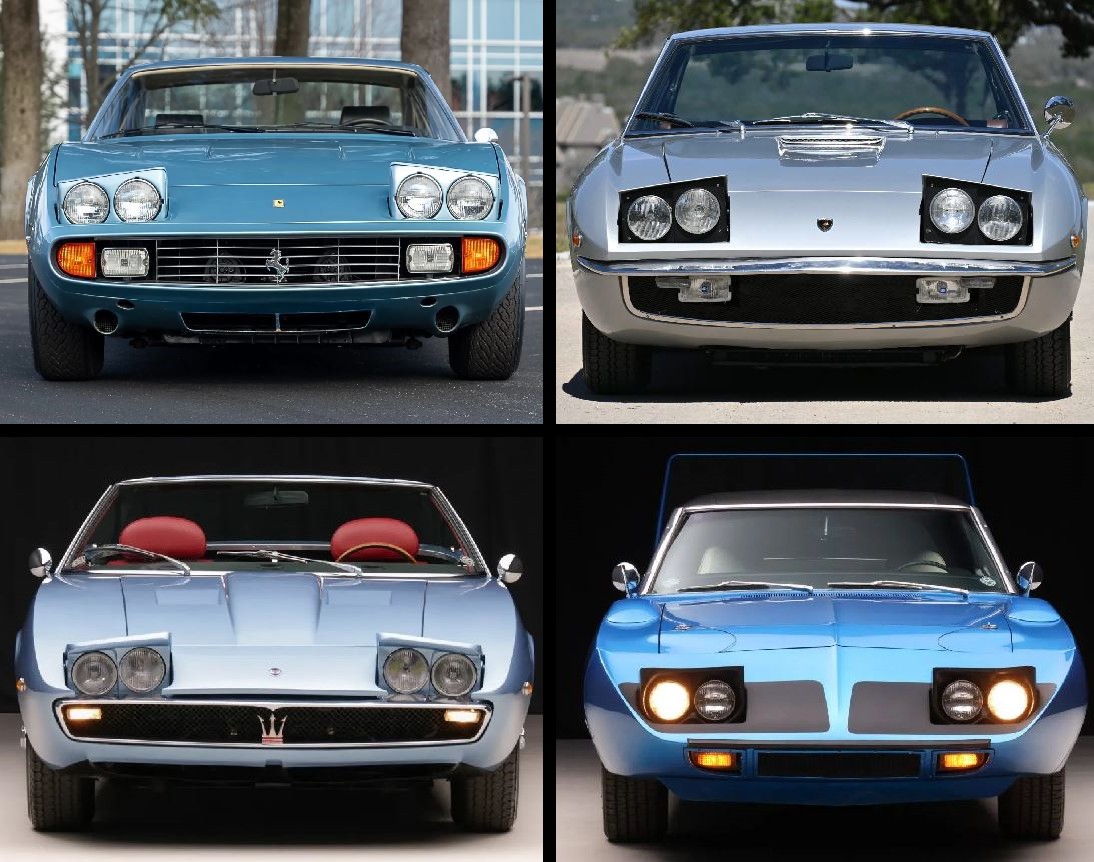
Retractable headlights: 1972 Ferrari 356 GTC/4 (top left), 1968 Lamborghini Isoero (top right), 1967 Maserati Ghibli Spyder (bottom left) and 1970 Plymouth Superbird (bottom right).

Although sometimes the diagonal placement of headlights was a deliberate choice by the stylist, it could be something dictated by the body's shape and this was the case when quad units were used in conjunction with retractable housings.  On most cars the diagonal motif appeared with the outboard lights mounted noticeably higher than those inboard but, because of the slope, when retractable lights were used the inner lights could sit higher, the visual effect sometimes exaggerated because the angle the housing (following the horizontal nose-line) assume when erected made the inboard lights seem higher still.  It was a product of shape and not something inherent to the “pop-up” retractable technique: The 1969 Dodge Daytona and 1970 Plymouth Superbird (both homologation exercises for use on the NASCAR (National Association for Stock Car Auto Racing) ovals & tracks) both had their four headlights aligned in the horizontal.

1964 Bentley S3 “Chinese-eye” two-door saloon by Mulliner, Park Ward (MPW).  MPW was in 1961 created as the in-house coach-building division of Rolls-Royce by merging Park Ward (a subsidiary since 1939) and H. J. Mulliner (a subsidiary since 1959).  In 1991 the operation was shut down but the Mulliner name endures as Bentley’s “personal commissioning division” which offers services ranging from high-priced bling to bespoke coach-built bodies.

Bentley’s Continental “sports saloon” was in 1952 introduced on the R-Type chassis, the line continued (with some sacrifice in individuality) with the S-Type generation of six-cylinder cars in 1955.  When the S2 was released in 1959, the external appearance was little changed although under the bonnet (hood) there was the new 6¼ litre V8 which faithfully would serve for some six decades until 2020 when the last was fitted to a Bentley Mulsanne although by then, there were few parts able to be interchanged with those in the original run.  With the debut of the V8, it was no longer possible to purchase a Bentley with a manual transmission and, unlike some of the S3 range, all the Continentals had coach-built bodies from H J Mulliner, James Young or Park Ward.  The Mulliner (and later MPW) cars featured slanting nacelles for the quad headlights and quickly these gained the sobriquet “Chinese eye” which, surprisingly, seems to have survived the linguistic treadmill and the term still is used by the trade servicing the collector community.

Clockwise from top left: Fiat 8V (1952-1954), Gordon-Keeble GK-1 (1961-1967), Jensen C-V8 (1962-1966) and Triumph Vitesse convertible (1962-1971).

Perhaps surprisingly, the French majors were never much enamored, presumably because Citroën and Renault didn’t like to be thought imitative and Peugeot was too conservative.  Some of the Europeans did dabble with the idea, embracing it as an expression of modernity although the then radical treatment of the head-lamps sometimes struck a discordant note when the look was grafted onto something where the rest of the platform was so obviously from one or two generations past.  Fiat’s exquisite 8Vs didn’t all get the diagonal look but those which did remain the most memorable of the few of the breed built.  An unqualified aesthetic success was the Gordon-Keeble built to aviation standards and powered by a Chevrolet V8 in Corvette tune.  It deserved to succeed but floundered as much of the British industry did in the era because of a lack of capitalization and an accounting operation which didn’t match the quality of the engineering.  More commercially successful was the Jensen C-V8 but while the distinctive front end now makes it much prized by collectors, at the time it was less admired and its very presence served only to emphasize how antiquated the rest of the styling had become.  For its replacement, Jensen tuned to an Italian styling house and the Interceptor, introduced in 1966 and remembered for the vast expanse of rear glass, is now thought a classic of the era.  The one which sold best was the Triumph Vitesse, one of a number of variations built on the robust and versatile separate chassis of the Herald (1959-1971) including the Spitfire and GT6.  Although not exactly the BMW M3 of its day, the six-cylinder engines did provide effortless performance and the Vitesse’s front end actually lived on in India (though without the torquey straight-sixes) to enjoy an "Indian summer" but curiously, the inner headlights weren’t fitted.

Gilding the lily: The Lancia Fulvia coupé (1965-1976) before & after.

The lovely, delicate lines of the Lancia Fulvia were perfect and really couldn’t be improved.  The unfortunate facelift with the canted lights was no improvement.  

Tuesday, October 15, 2024

Refusenik

Refusenik (pronounced ri-fyooz-nik)

(1) In (originally) informal use, a citizen of the USSR (the Union of Soviet Socialist Republics, 1922-1991), a Soviet citizen (usually Jewish) who was denied permission to emigrate from the Soviet Union (usually to Israel).

(2) By extension, a person who refuses to cooperate with a system or comply with a law as a matter of political principle or because of a moral conviction.

Circa 1975: The construct was refuse + -nik.  The Russian отказник (otkáznik), the construct of which was отка́з (otkáz) (refusal, denial, repudiation, rejection, nonsuit; renunciation, disavowal; breakdown, failure) + -ник (-nik) was a synonym of refusenik.  The -ник suffix was from the Proto-Slavic -ьnikъ, created originally by a nominalization of the adjectives in -ьnъ with the suffix -ikъ (from -ик (-ik)).  The suffix and was used to form masculine nouns, usually denoting adherents etc, the use illustrated by forms such as the dialectal Lithuanian lauk-inykas (peasant, farmer), from laũkas (field) and the Old Prussian lauk-inikis (vassal).  Refuse (in the sense of “to decline a request or demand” was from the Middle English refusen, from the Old French refuser, from the Vulgar Latin refūsāre, a blend of Classical Latin refūtāre (the source also of “refute”) and recūsāre (the source also of recuse).  The use in the sense of “items or material that have been discarded; rubbish, garbage, trash) was a late Middle English borrowing of the Middle French refusé, past participle of refuser (to refuse) which displaced the native Middle English wernen (to refuse).  In English, “refusenik” began as a calque of the Russian отка́зник (otkáznik) and from the mid-1970s, “refusenik” came to be used of someone who refused to do something (usually some law with which most complied), often either as a protest against government policy (conscription) or as a matter of personal autonomy (mandated vaccination).  While the construct of the word was an amusing novelty, the idea conveyed had a long tradition, the English agent noun refuser documented since the late fifteenth century.  The alternative spelling refusnik was not uncommon.  Refusenik is a noun; the noun plural is refuseniks.  Forms like refuseniking & refuseniked are non-standard but used for humorous effect as required.

Technically the –nik suffix corresponds approximately to the English –er in that nearly always it denotes an agent noun (ie it describes a person related to the thing, state, habit, or action described by the word to which the suffix is attached).  The –er suffix was from the Middle English –er & -ere, from the Old English -ere, from the Proto-Germanic -ārijaz, thought most likely to have been borrowed from the Latin –ārius where, as a suffix, it was used to form adjectives from nouns or numerals.  In English, the –er suffix, when added to a verb, created an agent noun: the person or thing that doing the action indicated by the root verb.   The use in English was reinforced by the synonymous but unrelated Old French –or & -eor (the Anglo-Norman variant -our), from the Latin -ātor & -tor, from the primitive Indo-European -tōr.  When appended to a noun, it created the noun denoting an occupation or describing the person whose occupation is the noun.  The connotation however is different in that –er is linguistically neutral (ie the value in the word “murderer” is carried by the “murder” element) whereas a –nik word is usually loaded and that can be negative, positive and often jocular. 

In structural linguistics, the process of creating words by adding a foreign suffix (such as refusenik) is known as “suffix borrowing” (or “affix borrowing”, “prefix borrowing” the obvious companion term).  Refusenik was thus a fork of the phenomenon known as “neoclassical blending” or “neoclassical compounding”, where a foreign morpheme is combined with a native or other language base.  The forms are described as “neologisms created through affixation” and many are coined for jocular effect, the “-nik” subset used to imply a person associated with something, often in a somewhat negative sense, other noted examples including “beatnik” (a member of the “beat” generation of the 1950s, an early example of what would in the 1960s come to be called the “counter culture” and a kind of proto-hippie), “peacenik” (one opposed to war and coined originally to describe those associated with the anti-war movement in the US and opposed to US participation in the conflict in Indochina), “warnick” (the response of the peaceniks to those who supported US policy (which wasn’t picked up by the establishment, unlike “dry”, used originally as a slur by the those who had been labeled “wet” (higher taxes, more social spending etc); the “drys” (smaller government, deregulation etc) liked the term and adopted it although their attempt to give it a little more appeal as “warm & dry” never caught on), “appeasenik” (used in a derogatory sense to describe those who prefer a policy of appeasement to a more robust foreign policy response), “contranik”, (used in a derogatory sense to describe those in the US supporting the right-wing Contras (from the Spanish la contrarrevolución (literally “the counter-revolution”) who between 1979-1990 staged an insurgency against Nicaragua’s Marxist Sandinista Junta), “nogoodnik” (someone disreputable), “neatnick” (someone thought obsessively tidy in their habits), “kibbutznik” (In Israel, a member of a kibbutz (and not necessarily a Russian émigré)), “sweetnik” (one’s sweetheart (male or female), “noisenik” (a musician who produces harsh, discordant music (with deliberate intent rather than through lack of skill) and “nudenik” (a advocate of nude sunbathing).

The latest cohort of refusniks are certain specialist surgeons.  There are often sound medical reasons why surgeons might refuse to perform procedures, whether generally or on specific individuals but the emergence of "flat refusal" has become one of the theatres in the culture wars.  Women diagnosed with breast cancer sometimes undergo either a unilateral (or single) or bilateral (or double) mastectomy (the surgical amputation of the breast) and while many have in recent decades been able to have the cosmetic appearance of the organ(s) surgically reconstructed, others have chosen to use an external prosthesis (which sits inside a pocketed mastectomy bra) or make no attempt to emulate their pre-surgical appearance.  There is now an activist community of post-mastectomy women who style themselves as "flatties" and their movement they call "go flat"; their interest is in seeking to enforce the right of women to have surgeons follow their request to receive what they describe as an AFC (aesthetic flat closure, a surgical closure (sewing up) in which the “surplus” skin often preserved to accommodate a future reconstructive procedure is removed and the chest rendered essentially “flat”).  The movement disclosed some surgeons simply refuse to perform AFCs, some patients discovering this only after their surgical dressings were removed.  The Go Flat movement reflects both an aesthetic choice and a reaction against what is described in the US as the “medical-industrial complex”, the point being that women who have undergone a mastectomy should not be subject to pressure either to use a prosthetic or agree to surgical reconstruction (a lucrative procedure for the industry),  The medical industry has argued an AFC can preclude a satisfactory cosmetic outcome in reconstruction if a woman “changes her mind” but the movement insists it's an example of how the “informed consent” of women is not being respected.  Essentially, what the movement is arguing is the request for an AFC should be understood as an example of the legal principle of VAR (voluntary assumption of risk).

A 1961 guide to the beatnik world view.

The difference between a “beatnik and a “beat” was that the “Beats” were members of the “Beat Generation” a literary and cultural movement which emerged in the late 1940s and popularized by the writers Jack Kerouac (1922-1969), Allen Ginsberg (1926–1997), William S Burroughs (1914–1997) a Neal Cassady (1926-1968).  Kerouac would describe the Beat state as being “beaten down, exhausted, but also in touch with the raw, spiritual, and authentic experiences of life” and they were a harbinger of the counter-culture of the 1960s.  There were at the time claims there was a distinct “Beat philosophy” but there were so many claims about this that it really can’t be said there was ever a coherent “philosophy” beyond a sense of rebellion against mainstream culture, materialism, and the alleged conformity on post-war America life, the latter something which in later decades would exert a strong nostalgic pull, exploited by a number of politicians.  The term “beatnik” was more about the stereotyped. Superficial elements associated with those who followed what they thought was the “beat lifestyle”.  It’s not fair to say the beatniks were “the Beat’s groupies” but that probably was the public perception, one which imagined them sitting in coffee shops, wearing berets and listening to poetry readings.

The “nik” words belong to a broader class of borrowed affixed words or loanword derivatives, the best known of which are the neoclassical compounds, formed by combining elements (usually prefixes or suffixes) from classical languages, particularly Greek and Latin, with existing words or roots from other languages (or simply combining Greek & Latin elements, something of which some purists don’t approve).  These compound words are common both in general use and specialized or technical fields such as science, medicine, and philosophy.  Well known examples include: “television” (the construct being tele- (from the Greek tēle (far)) + vision (from the Latin videre (to see)), “automobile”, the construct being auto- (from the Greek autos (self)) + mobile (from the Latin mobilis (movable)), “astronaut” (the construct being astro- (from the Greek astron (star)) + -naut (from the Greek nautēs (sailor)), “bicycle”, the construct being bi- (from the Latin bis (twice)) + cycle (from the Greek kyklos (circle; wheel)).

There has never been an authenticated Lindsaygate or Lohangate so, deductively, Lindsay Lohan has lived a scandal-free life although she does have some history of refusenikism.

Refusenik though belongs to the subset of the type coined usually for humorous effect or a commercial purpose and they include the “-zillas” (stormzilla, bridezilla, bosszilla etc), the suffix from the fictional Godzilla and appended to imply something or someone is excessively large, powerful, or monstrous, usually in an exaggerated or absurd way, the “-aholics” (shopaholic, chocoholic, workaholic etc) the suffix appended to The suffix -aholic (from alcoholic) is often humorously attached to nouns to describe someone addicted to or obsessed with something, the “fests” (geekfest, nerdfest, laughfest, foodfest etc, the –fest suffix from the German Fest (festival), appended to describe and event involves much of a certain thing or theme or will attract those of a certain type, the “-o-ramas” (snack-o-rama, fright-o-rama, book-o-rama etc), the -orama suffix from panorama (a wide view) and appended to suggest an abundance or spectacle of something and of course the “-gates” (pizzagate, whitewatergate, snipergate, servergate, benghazigate etc (all in some way related to crooked Hillary Clinton which is interesting), the -gate suffix from the Watergate scandal of the early 1970s.  The use of the –gate scandal is an example of what’s called “transferred, implied or imputed meaning” and because it creates form which are “mock-serious”, the words can straddle a range of senses, unlike something like “chocoholic” which, whatever might be the implications for an individual’s health, is always jocular.

In English, the use of the –nik suffix spiked after the USSR in October 1957 launched Sputnik, the first satellite to orbit the Earth although the earlier Yiddish forms (in Yinglish, the words contributed by Yiddish speakers from Eastern Europe) may also have exerted some regional influence, notably in New York where as early as the 1930s nudnik (an annoying person; a pest, a nag, a jerk) had spread beyond the Jewish community.  The association of with Sputnik created a minor industry among headline writers looking for words to describe the failures, explosions and crashes which were a feature of the launches in the early days of the US space program after the Russian’s satellite had so shocked the Americans.  The terms like kaputnik, dudnik and flopnik became briefly famous and contributed to the impression the Soviets were much more advanced in rocketry and related technology but that was misleading because the Russians had suffered just as many failures but theirs were a state secret and therefore unknown outside official circles while for the US launches were televised nationally on network television.  The perceptions generated by kaputnik, dudnik and flopnik also created a political ripple which would play out in the 1960 US presidential election and beyond.  Although Sputnik gave things quite a shove, the suffix had a long history in English and the Oxford English Dictionary (OED) notes raskolnik (a bit of a rascal) was in use by at least 1723.  After following the British Empire to the other side of the world, raskol washed up in PNG (Papua New Guinea) as a noun meaning “a criminal, operating sometimes as part of a gang”.  IN PNG, raskol was from the English rascal (a rogue, a scoundrel, a trickster) and entered Tok Pisin (“talk + pidgin”, one of PNG’s official languages and a creole of Indo-European, Malayo-Polynesian and Trans-New Guinean languages (principally English and Kuanua).  In later editions of The American Language (first published in 1919), the US satirist & critic HL Mencken (1880–1956 and a fair scholar of the tongue) credited the popularity of the practice of appending -nik to the ends of adjectives to create nouns to US Cartoonist Al Capp (1909–1979) who put a few of them in his syndicated Li'l Abner cartoon (1934-1977), Sputnik (1957) & beatnik (1958) respectively an accelerant or product of the process.

While it often was applied humorously, it also was used of those in Israel who refused to participate in military operations conducted by the Tsva ha-Hagana le-Yisra'el (the Israel Defence Forces (IDF)) in the occupied Palestinian territories (which the government of Israel calls “disputed territories” which the refuseniks regards as unlawful under international law.  Language matters much in the Middle East and some still use “Tel Aviv” as the synecdoche for “government of Israel” because recognition Jerusalem (another “disputed” space” as the capital is so limited.  Tel Aviv briefly was the capital between May 1948-December 1949 and a time when ongoing military conflict rendered Jerusalem too unstable for government operations.  Jerusalem was declared the capital in December 1949 and by mid-1950, most of the state’s administrative apparatus was based there but its status as a national capital is recognized by only a handful of nations.

Books (left & centre), academic journals and magazines used the title “Refusenik” in its original sense of “a Soviet citizen (usually Jewish) who was denied permission to emigrate from the Soviet Union (usually to Israel), something which was a feature of the Brezhnev-era (Leonid Brezhnev (1906–1982; Soviet leader 1964-1982)) USSR but it was later adopted (by extension) in the English-speaking world to refer to those refusing to cooperate with a system or comply with a law as a matter of political principle or because of a moral conviction.  Edited by self-described refusenik (in the later sense) Peretz Kidron (1933–2011) and published in 2013 by Bloomsbury, Refusenik (right) applied the word in the later sense of “those who refuse” rather than the original “those who were refused”.  With a blurb including a quote from linguistics theorist & public intellectual Professor Noam Chomsky (b 1928) and a foreword by author and essayist Susan Sontag (1933-2004), it’s possible a few positive reviews were written before a page was turned.

Monday, October 14, 2024

Etiolate

Etiolate (pronounced ee-tee-uh-leyt)

(1) In botany, to cause a plant to whiten or grow pale by excluding light.

(2) To cause to become weakened or sickly; to remove vigor.

(3) To drain of color; to make pale and sickly-looking; to become pale or blanched.

(4) In literary theory (usually as “etiolated verse” or etiolated text”), to revise a text to remove fanciful or pretentious forms.

1791: The past participle of the seventeenth century French étioler (to blanch) and used to mean “to make pale, to remove a light source from plants during growth to induce them to form in a lighter hue”, presumed to be a derivative of a Norman French dialect form of with the appended -ate suffix.  The suffix -ate was a word-forming element used in forming nouns from Latin words ending in -ātus, -āta, & -ātum (such as estate, primate & senate).  Those that came to English via French often began with -at, but an -e was added in the fifteenth century or later to indicate the long vowel.  It can also mark adjectives formed from Latin perfect passive participle suffixes of first conjugation verbs -ātus, -āta, & -ātum (such as desolate, moderate & separate).  Again, often they were adopted in Middle English with an –at suffix, the -e appended after circa 1400; a doublet of –ee.  The idea in French may have been derived from the notion of “to make the color of straw” or even literally “to become like straw” and it was used in a branch of horticulture to “turn a plant white by growing it in darkness”, the attraction of white being the association with “delicacy; purity” and it was a commercial approach in market gardens to create “high priced vegetables” and was from étiolé, past participle of the seventeenth century étioler (to blanch), probably from the Norman dialect étule (a stalk) and the Old French esteule (straw, field of stubble) from the Latin stupla from stipula (straw; stubble).  Etiolate is a verb & adjective, etiolation is a noun, etiolative is a noun & adjective, etiolated is a verb & adjective, etiolating is a verb and etiolatively is an adverb; the noun plural is etiolations.

In literary theory, “to etiolate” a text is to remove or revise the “purple passages” (known just as alliteratively also as “purple prose”).  In literature, purple passages are those sections of a text which are overly elaborate, flowery, or extravagant in style, often prioritizing ornate or decorative language and the use of needlessly long words, the meaning of which is often obscure.  Such writing is thought a literary self-indulgence or a mere pretentious display of knowledge; grandiose execution at the expense of clarity, the usual critique being “style over substance”.  The phrase is almost certainly derived from the historic use of the once rare and expensive purple dye being restricted (actually by statute or edict in some places) to royalty and even when availability became wider, the association with luxury & wealth continued.  The idea has long been a tool of critics, Roman lyric poet Horace (Quintus Horatius Flaccus, 65-8 BC) in his Ars Poetica (The Art of Poetry, 19 BC) referring disapprovingly to the purpureus… pannus (a purple piece of cloth), the irrelevant insertion of a grandiloquent or melodramatic passage into a work.  Horace thought this disruptive at best and absurd at worst and “purple passages” continues to be used to describe writing which is needlessly ornate, florid and usually discordantly incongruous.  Used almost always pejoratively (although there do seem to be some admirers), comrade Stalin (1878-1953; Soviet leader 1924-1953) might have called such flourishes “formalism”.  Amusingly, in an example of how idiomatic use in English must baffle those learning the language, “purple patch”, also once applied to such tortured text, would come to be used to describes any particular good period or performance (in any context), the use always wholly positive.

Pencil sketch (circa 1845) of Anne Brontë (1820–1849) by her sister Charlotte (1816–1855).

What is a purple passage is a cultural construct and in literature fashions change, some works regarded still regarded as “literary classics” written in a style which if release now would be thought absurd or a parody.  That’s because such judgments tend now to be made on the basis of the manner in which people “actually talk” and although that is highly variable and influenced by social class and regional traditions, in the age of modern media there is probably a broad (if not at the margins wholly accurate) understanding of the range and it’s to this literature need to adhere.  So, consider what Anne Brontë has the Reverend Michael Millward say in The Tenant of Wildfell Hall (1848):

But I have heard that, with some persons, temperance—that is, moderation—is almost impossible; and if abstinence be an evil (which some have doubted), no one will deny that excess is a greater. Some parents have entirely prohibited their children from tasting intoxicating liquors; but a parent’s authority cannot last for ever; children are naturally prone to hanker after forbidden things; and a child, in such a case, would be likely to have a strong curiosity to taste, and try the effect of what has been so lauded and enjoyed by others, so strictly forbidden to himself—which curiosity would generally be gratified on the first convenient opportunity; and the restraint once broken, serious consequences might ensue. I don’t pretend to be a judge of such matters, but it seems to me, that this plan of Mrs. Graham’s, as you describe it, Mrs. Markham, extraordinary as it may be, is not without its advantages; for here you see the child is delivered at once from temptation; he has no secret curiosity, no hankering desire; he is as well acquainted with the tempting liquors as he ever wishes to be; and is thoroughly disgusted with them, without having suffered from their effects.

Once that text is etiolated, the parson is suggesting if one’s children are introduced to strong drink under parental supervision, they’ll be less likely to grow up as drunken philanders and sluts.  Did, in general discourse, even the most loquacious Church of England clergy of the 1840s talk in the way the author would have us believe or did novelists write in an elaborated, formalized style because that’s what their readers wanted?  It can’t be certain because there are only letters and no audio recordings; such transcripts as we have are from formal, set piece events like public addresses or debates in parliament which are hardly representative but on the basis of what was reported as the way “educated folk” spoke in court proceedings, it was with nothing like the prolixity of Ms Brontë’s reverend gentleman.  But that was the way fiction so often was written and the works of some who have contributed much to the canon must strike the modern reader as “artificially ornate” including John Milton (1608–1674), Nathaniel Hawthorne (1804–1864), Edgar Allan Poe (1809–1849), Herman Melville (1819–1891) and Thomas Hardy (1840–1928).  Write now as they did now and expect to be accused of writing purple passages.

Beans, etiolated (left) and not (right).

For most of human history, the purpose in agriculture was to cultivate plants for optimal growth and productivity but in the eighteenth century the technique of deliberate etiolation emerged as a niche industry with specific goals.  What the gardeners did was at certain point in a plant’s development to deprive it of light while continuing to supply water and fertilizer.  What this cause was for the foliage to lose its natural color and tend towards being white, manifested usually in a “straw-like” coloring although some outcomes truly were white.  Additionally, many plants would grow with long, weak & slender stems, the elongation thought elegant compared with the thick, robust structures of those which remained exposed to natural light.  In biological terms, what the plants were doing was devoting all available energy to grow longer in the search for light, that essential element of photosynthesis, the process with which plants convert the energy from light (historically sunlight) into the chemical energy (notably sugars) used by their metabolism.

Delightfully etiolated: A stunningly pale Lindsay Lohan leaving the Byron & Tracey salon, Beverly Hills, California, September 2011.

Although the technique was used of seedlings which were started indoors or in a sheltered spot, encouraging early growth before being transplanted outside in the spring, etiolated plants were valued most for their aesthetic appeal, the association of white with not only delicacy & purity but also wealth because the pale complexion of the rich was a symbol of a privileged existence not spent toiling in the fields under the harsh sun which so darkened the skin of peasants.  Thus, etiolated plants, with their long, slender stems were prized for their visual appeal in gardens and floral arrangements while small, leafed vegetables in an unusually pale hue were prized by the chefs of the rich because they were so useful in making food into “plate art” a thing then as now and that such produce invariably lacked taste was just a price to be paid for the effect.  Of course etiolation tended to weaken plants so it was only ever a niche product for a high-priced market segment but, in controlled conditions, it did prove a useful technique in selective breeding for specific traits and it’s believed some of the long-stemmed plants still cultivated today are varieties which date for the era.

Natural selection means plants do tend to grow towards the light but many like also to grow vertically, something Albert Speer (1905–1981; Nazi court architect 1934-1942; Nazi minister of armaments and war production 1942-1945) had plenty of time to observe while serving in Berlin’s Spandau prison the twenty year sentence he was lucky to have been handed by the IMT (International Military Tribunal) in the first Nuremberg Trial (1945-1946) for war crimes (Count three of the indictment) and crimes against humanity (Count 4).  In his clandestine prison diary (Spandauer Tagebücher (Spandau: The Secret Diaries) (1975)) he noted the mixed behaviour of the seeds he planted:

June 25, 1951: A month ago I planted peas, in groups of three, at depths of seven, fifteen, twenty-five, and forty centimeters, and watered them plentifully.  Today I undertake a cautious excavation. Even when the eye was down, the shoot turned in a sharp arc and grew vertically upward. None of the many shoots left the vertical by so much as a few degrees, not even those that germinated at a depth of forty centimeters.  Only one pea at a depth of twenty-five centimeters lost its sense of direction and grew into a confused snarl of thick threads.  In greenhouses, heating cables often keep the temperatures under the roots higher than on the surface.  So it cannot be the sun’s warmth.  A pine tree twenty meters tall growing by a shady cliff in the Black Forest does not grow toward the light, but vertically upward. Gravity, then?  It is particularly important for technology, which tries to achieve reactions similar to that of the pea, to investigate such guidance mechanisms.  New experiment.  I have dug a pit forty centimeters in depth.  At the bottom of it I lay out a row of alternating beans and peas. I close off the side toward the south with a pane of glass.  Then I fill in the pit with topsoil.  The arrangement is such that the surface of the soil is just as far from the seeds as the pane of glass.  Consequently warmth and light operate with equal intensity on both sides.  If growth is determined by one of these influences, the peas would have to grow toward the glass.  But I am still assuming that the plants have a tendency to oppose the pull of gravity.

August 22, 1951: Once again the peas have grown upward with amazing directional impulse, without reacting to the sunlight offered from the side.  Out of thirty peas, eleven have found the long way, forty centimeters, to the surface. Two peas gave up after they had grown twenty centimeters, and several others became impatient with this long distance for growing.  About eight centimeters under the surface of the soil they sent out side shoots with formed leaves.  But these peas, too, were disciplined enough to abandon these energy-consuming shoots after half a centimeter. What vital energy is displayed in these physical achievements, elaborating from a tiny round pea a tube one to one and a half millimeters in thickness and forty centimeters in length.  As I suspected, no such strong biological “instinct” can be ascribed to the beans. Out of six beans, only a single one tried to make its way to the surface, and it too gave up several centimeters before it reached its goal, while the others, obviously confused, sent shoots out in various directions from the seed.  What brings about such different behavior in such closely related plants?

Sunday, October 13, 2024

Brobdingnagian

Brobdingnagian (pronounced brob-ding-nag-ee-uhn)

(1) Of huge size; gigantic; tremendous.

(2) Larger than typical or expected.

(3) In medicine (psychiatry & clinical ophthalmology), as the noun “brobdingnagian vision”, a hallucination or visual disorder in which objects appear larger or nearer than they are (macropsia).  The companion (antonym) condition is “lilliputian vision”, a hallucination or visual disorder in which objects appear smaller or more distant than they are (micropsia).

(4) In mycology, of the brobdingnagia, a genus of fungi in the family Phyllachoraceae.

(5) Of or pertaining to the fictional land of Brobdingnag.

(5) An inhabitant or native of the fictional land of Brobdingnag.

1728 (in more frequent use by mid-century): An adjective to convey the sense of “enormous in size, huge, immense, gigantic etc, derived from the noun Brobdingnag (the land of the giants) the second of the exotic lands visited by the protagonist Lemuel Gulliver in Gulliver’s Travels (1726 and titled Travels into several remote nations of the world for the first edition), written in the style of contemporary “travel guides” by the Anglo-Irish author & satirist Jonathan Swift (1667–1745).  The construct was Brobdingnag + -ian.  The suffix -ian was a euphonic variant of –an & -n, from the Middle English -an, (regularly -ain, -ein & -en), from the Old French –ain & -ein (or before i, -en), the Modern French forms being –ain & -en (feminine -aine, -enne), from the Latin -iānus (the alternative forms were -ānus, -ēnus, -īnus & -ūnus), which formed adjectives of belonging or origin from a noun, being -nus (cognate with the Ancient Greek -νος (-nos)), preceded by a vowel, from the primitive Indo-European -nós.  It was cognate with the English -en.  Brobdingnagian is a noun & adjective; the noun plural is Brobdingnagians (initial upper case if used of the inhabitants or natives of the fictional land of Brobdingnag but not for other purposes (such as untypically large cosmic objects)).  To distinguish between big stuff, the comparative is “more brobdingnagian” and the superlative “most brobdingnagian”.

In constructing the name Brobdingnag for his fictional land of giants, Swift used a technique more subtle than some authors who use more obvious charactonyms.  In literature, a charactonym is a name given to a character that suggests something about their personality, behavior, or role in the story; these names almost always have some literal or symbolic meaning aligning with or hinting at the character’s traits and examples include:

Alfred Doolittle (lazy and opportunistic) in George Bernard Shaw’s (GBS; 1856-1950) Pygmalion (1913).

Miss Honey (sweet & gentle) in Roald Dahl’s (1916–1990) Matilda (1988) and Veruca Salt (harsh and unpleasant) in his Charlie and the Chocolate Factory (1964).

Mr Bumble (noted for his bumbling inept incompetence) in Charles Dickens’ (1812–1870) Oliver Twist (1837).

Willy Loman (of low social status and beset with feelings of inadequacy) in Arthur Miller’s (1915–2005) Death of a Salesman (1949).

The use of blatant charactonyms is not always an example of linguistic brutishness and it’s often used in children's literarure or when it’s demanded by the rhythm of text or plat.  There are also “reverse charactonyms” when the traits of a characteristic become famously (or infamously) emblematic of something such as Shylock in William Shakespeare’s (1564–1616) The Merchant of Venice (1598) or Ebenezer Scrooge in Dickens A Christmas Carol (1843).

A brobdingnagian on the beach; a Lindsay Lohan meme.  Although a Swiftian meme, the use of that term will now probably be more suggestive of a later Swift, certainly to Swifties (the devotees of the singer Taylor Swift (b 1989)).

As well as the meanings of words, Swift liked to use the sounds of language in fashioning fictional names which were both plausible and in some way suggestive of the association he wanted to summon.  Structurally, what he appears to have done is combine arbitrary syllables to create a word sounding foreign and exotic while still being pronounceable by the English-speaking audience for which he wrote; the technique is harder to master than it sounds although with modern generative AI, presumably it’s become easier.  As a literary trick, Brobdingnag works because of the elements in the construction (1) the multisyllabic length and (2) the use of “harsh” consonants (notably the “b” & “g” which lend a sense of bulk and largeness, appropriate for the “land of the giants”.  The other exotic land in Gulliver’s Travels was Lilliput, the place where the people are tiny.  Just as he intended Brobdingnag to invoke thoughts of something (or someone) clumsy and heavy, Lilliput and Lilliputian were meant to suggest “small, delicate”.

Map of Brobdingnag from the 1726 edition of Travels into several remote nations of the world (the original title of Gulliver's Travels).

Although since Swift, the adjective brobdingnagian has never gone away, it’s length and “unnatural” (for English) spelling has meant it’s only ever been a “niche” word”, used as a literary device and astronomers like it when writing of stars, galaxies, black holes and such which are of such dimensions that miles or kilometres are not c convenient measure, demanding instead terms like “light years” (the distance in which light travels in one Earth year” or “parsecs” (a unit of astronomical length, based on the distance from Earth at which a star would have a parallax of one second of arc which is equivalent to 206,265 times the distance from the earth to the sun or 3.26 light-years.  Its lineal equivalent is about 19.1 trillion miles (30.8 trillion km)).

The king of Brobdingnag and Gulliver, cartoon by James Gillray (1756-1815), published in London 10 February 1804 during the era of the Napoleonic Wars (1803-1815).  British Cartoon Prints Collection, Library of Congress, Washington DC.

The work depicts the king of Brobdingnag (George III (1738–1820; King of Great Britain and Ireland 1760-1820)) staring intently at a tank in which is sailing Gulliver (Napoleon Bonaparte (1769–1821; leader of the French Republic 1799-1804 & Emperor of the French from 1804-1814 & 1815).  Lord Salisbury (1748–1823) stands behind the king.  It was a time when Napoleon was planning to invade England, his Grande Armée transported in “flat-bottomed boats” which were a sort of early landing craft, a design which would emerge in specialized forks for various purposes (troops, tanks etc) during World War II (1939-1945).  It wasn’t until the Royal Navy prevailed in the Battle of Trafalgar (21 October 1805) that the threat of invasion was ended.  At the time of the cartoon’s publication, George III had for some years already been displaying signs of mental instability (thought now to be consistent with bipolar disorder (the old manic depression)) although it would be almost a decade before his condition deteriorated to such an extent a regent was appointed.

Brobdingnagian’s more familiar role is in literature where it depends for effect on rarity; twice in the one book is one too many  Tellingly (and unsurprisingly given the inherent clumsiness), it’s rare in poetry although some have made the effort, possibly just to prove it can be done, one anonymous poet leaving us The Awful Fate of Mr. Foster, believed to be a parody of the poetic style of William Makepeace Thackeray (1811–1863) “Brobdingnagian” interpolated possibly because Thackeray was wrote some acerbic critiques of Swift’s work:

He never more will rise again, or open those kind eyes again,
He lies beneath the sod;
Beneath the tall Brobdingnagian tomb, the popular concernment's doom,
Of an enormous god!

Saturday, October 12, 2024

Ekpyrosis

Ekpyrosis (pronounced eck-pyh-row-sys)

(1) In modern cosmology, a speculative theory proposing the known universe originated in the collision of two other three-dimensional universes traveling in a hidden fourth dimension. This scenario does not require a singularity at the moment of the Big Bang.

(2) In the philosophy of the Stoic school in Antiquity, the idea that all existence is cyclical in nature and universe is the result of a recurring conflagration in which the all is destroyed and reborn in the same process.

1590s (in English): From the Ancient Greek ἐκπύρωσις (ekpúrōsis) (conflagration, cyclically recurring conflagration in which the universe is destroyed and reborn according to some factions in Stoic philosophy), the construct being the Ancient Greek ἐκ (ek) (out of; from) + πύρωσις (pyrōsis), from πῦρ (pyr) (fire) + -ōsis (the suffix).  While there’s no direct relationship between the modern “big bang theory” and the Stoic’s notion of periodic cosmic conflagration (the idea the universe is periodically destroyed by fire and then recreated), the conceptual similarity is obvious.  The Stoic philosophy reflected the general Greek (and indeed Roman) view of fire representing both destruction and renewal.  In English, ekpyrosis first appeared in the late sixteenth century translations or descriptions of ancient Stoic philosophy, particularly in relation to their cosmological theories and it came to be used either as the Stoics applied it or in some analogous way.  It was one of a number of words which during the Renaissance came to the attention of scholars in the West, a period which saw a revival of interest in ancient Greek and Roman thought, art & architecture and for centuries many of the somewhat idealized descriptions and visions of the epoch were those constructed (sometimes rather imaginatively) during the Renaissance.  The alternative spelling was ecpyrosis.  Ekpyrosis is a noun and ekpyrotic is an adjective; the noun plural is ekpyroses.

In stoic philosophy, ekpyrosis was described sometimes as a recurring, unitary process (the periodic destruction & rebirth of the universe in a single conflagration) and sometimes and the final stage of one existence (destruction) which was the source of a palingenesis (the subsequent rebirth).  Palingenesis was almost certainly a variant of palingenesia (rebirth; regeneration) with the appending of the suffix -genesis (used to suggest “origin; production”).  Palingenesia was a learned borrowing from the Late Latin palingenesia (rebirth; regeneration), from the Koine Greek παλιγγενεσία (palingenesía) (rebirth), the construct being the Ancient Greek πᾰ́λῐν (pálin) (again, anew, once more), ultimately from the primitive Indo-European kwel (to turn (end-over-end); to revolve around; to dwell; a sojourn)) + γένεσις (genesis) (creation; manner of birth; origin, source).  The construct of the suffix was from the primitive Indo-European ǵenh- (to beget; to give birth; to produce”) + -ῐ́ᾱ (-íā) (the suffix used to form feminine abstract nouns).

Lindsay Lohan and her lawyer in court, Los Angeles, December, 2011.

In biology, the word was in the nineteenth century was adopted to describe “an apparent repetition, during the development of a single embryo, of changes that occurred previously in the evolution of its species) came directly from the German Palingenesis (the first papers published in Berlin).  In geology & vulcanology, it was used to mean “regeneration of magma by the melting of metamorphic rocks”) and came from the Swedish palingenes (which, like the German, came from the Greek).  In the study of history, palingenesis could be used to describe (often rather loosely) the recurrence of historical events in the same order, the implication being that was the natural pattern of history which would emerge if assessed over a sufficiently long time.  When such things used to be part of respectable philosophy, it was used to mean “a spiritual rebirth through the transmigration of the soul”, a notion which exists in some theological traditions and it has an inevitable attraction for the new-age set.

The Death of Seneca (1773), oil on canvas by Jacques-Louis David (1748–1825), Petit Palais, Musée Des Beaux-Arts, De La Ville De Paris, France.  Lucius Annaeus Seneca (Seneca the Younger, (circa 4 BC–65 AD)) was one of the best known of the Roman Stoics and the painting is a classic example of the modern understanding of stoicism, Seneca calmly accepting being compelled to commit suicide, condenmed after being implicated in a conspiracy to assassinate the Nero (37-68; Roman emperor  54-68).  The consensus among historians is seems to be Seneca was likely “aware of but not involved in” the plot (a la a number of the Third Reich's generals & field marshals who preferred to await the outcome of the July 1944 plot to assassinate Adolf Hitler (1889-1945; Führer (leader) and German head of government 1933-1945 & head of state 1934-1945) before committing themselves to the cause).  There are many paintings depicting the death of Seneca, most showing him affecting the same air of “resigned acceptance” to his fate.

The Stoics were a group of philosophers whose school of thought was for centuries among the most influential in Antiquity.  Although the word “stoic” is now most often used to refer to someone indifferent to pleasure or pain and who is able gracefully to handle the vicissitudes of life, that’s as misleading as suggesting the Ancient Epicureans were interested only in feasting.  What Stoicism emphasized was living a virtuous life, humans like any part of the universe created and governed by Logos and thus it was essential to at all times remain in harmony with the universe.  Interestingly, although the notion of ekpyrosis was one of the distinctive tenants of the school, there was a Stoic faction which thought devoting much energy to such thoughts was something of a waste of energy and that they should devote themselves to the best way to live, harmony with logos the key to avoiding suffering.  Their ideas live on in notions like “virtue is its own reward” and ultimately more rewarding than indulgence or worldly goods which are mere transitory vanities.

While the speculative theory of an ekpyrotic universe in modern cosmology and the ancient Stoic idea of ekpyrosis both revolve around a cyclical process of destruction and renewal, they differ significantly in detail and the phenomena they describe.  Most significantly, in modern cosmology there’s no conception of this having an underlying motivation, something of great matter in Antiquity.  The modern theory is an alternative to what is now the orthodoxy of the Big Bang theory; it contends the universe did not with a “big bang” (originally a term of derision but later adopted by all) begin from a singular point of infinite density in but rather emerged from the collision of two large, parallel branes (membranes) in higher-dimensional space.  In the mysterious brane cosmology, the universe is imagined as a three- dimensional “brane” within a higher-dimensional space (which tends to be called the “bulk”).  It’s the great, cataclysmic collision of two branes which triggers each defining event in the endless cycle of cosmic evolution.  In common with the Stoics, the process is described as cyclical and after each collusion, the universe undergoes a long period of contraction, followed by another collision that causes a new expansion.  Thus, elements are shared with the “Big Bang” & “Big Crunch” cycles but the critical variations are (1) there’s no conception of a singularity (2) although this isn’t entirely clear according to some, time never actually has to “begin” which critics have called a bit of a “fudge” because it avoids the implications of physical laws breaking down (inherent in the Big Bang’s singularity) and assumes cosmic events occur smoothly (in the sense of physics rather than violence) during brane collisions.

Bust of Marcus Aurelius (121–180; Roman emperor 161-180), Musée Saint-Raymond, Toulouse, France.

Something in the vein of the “philosopher kings” many imagine they’d like to live under (until finding the actual experience less pleasant than they’d hoped), Marcus Aurelius was a Stoic philosopher who has always been admired for his admirable brevity of expression, the stoic world-view encapsulated in his phases such as “Waste no more time arguing about what a good man should be.  Be one.”, “The happiness of your life depends upon the quality of your thoughts.” and “Our life is what our thoughts make it.  Marcus Aurelius was the last emperor of Pax Romana (Roman peace, 27 BC-180 AD), a golden age of Roman imperial power and prosperity.  

To the Stoics of Antiquity, ekpyrosis described the periodic destruction of the universe by a great cosmic fire, followed by its rebirth, fire in the Classical epoch a common symbol both of destruction and creation; the Stoic universe was a deterministic place.  In the metaphysics of the ancients, the notion of fire and the central event was not unreasonable because people for millennia had been watching conflagrations which seemed so destructive yet after which life emerged, endured and flourished and the idea was the same conflagration which wrote finis to all was the same primordial fire from which all that was new would be born.  More to the point however, it would be re-born, the Stoics idea always that the universe would re-emerge exactly as it had been before.  The notion of eternal recurrence doesn’t actually depend on the new being the same as the old but clearly, the Greeks liked things the way they were and didn’t want anything to change.  That too was deterministic because it was Logos which didn’t want anything to change.  The Stoics knew all that had been, all this is and all that would be were all governed by Logos (rational principle or divine reason) and it was this which ensured the balance, order and harmony of the universe, destruction and re-birth just parts of that.  Logos had motivation and that was to maintain the rational, natural order but in modern cosmology there’s no motivation in the laws of physics, stuff just happens by virtue of their operation.