Wednesday, February 24, 2021

Polysphere

Polysphere (pronounced pol-ee-sfeer)

(1) In mathematics, a product of spheres.

(2) In mechanical engineering, a design of combustion chamber formed by the two shallow concave domes under the intake and exhaust valve seats.

1955: A compound word, the construct being poly + sphere.  Poly is from the Ancient Greek πολύς (polús or polys) (many, much), from the primitive Indo-European polhiús (much, many) from the root pele (to fill), akin to the Old English fela (many).  Sphere is from the Middle English spere, from the Old French spere, from the Late Latin sphēra, from the Classical Latin sphaera (ball, globe, celestial sphere), from the Ancient Greek σφαρα (sphaîra) (ball, globe), of unknown origin.  Despite spread of the myth by some medieval writes, sphere is not related to superficially similar Persian سپهر‎ (sepehr) (sky).  Poly, in modern English (especially in industrial and scientific application) use became a word-forming element meaning "many, much, multi-, one or more" with derivatives referring to multitudinousness or abundance.  It was equivalent to the Latin multi- and should properly be used in compounds only with words of Greek origin but this, etymologically slutty English ignores.  Polysphere is a noun and polyspheric is an adjective; the noun plural is polyspheres.

Lindsay Lohan with polyspheric hair.  Polyspheric hair styles are possible, the classic example of which is the symmetrical “twin dome” look which is difficult exactly to achieve and harder still to maintain for more than a brief time.  They’re thus seen usually only at photo-shoots or for one-off events but the design element is popular with asymmetric styles.

Chrysler, the poly, the hemi and the hemi which is really a poly

Chrysler didn’t invent hemispherical combustion chambers but they certainly made a cult of them.  In internal combustion engines (ICE) of the mid-late twentieth century, especially as the availability of higher octane gas (petrol) made possible higher compression ratios, the hemispherical combustion chamber was one of the best designs with with to provide an efficient burn-space while minimizing thermal loss and permitting the use of large diameter, canted-valves to optimize intake and exhaust flow.  The early Chrysler Hemi V8s (1951-1958) were the most powerful of their generation but there were drawbacks.  To take advantage of the large valves at diverging angles, the valve train assembly was both bulky and heavy, needing two rocker shafts rather than the single unit possible with in-line arrangements and adding to the cost and complication were the inherently more expensive casting and machining processes required to produce the hemispherical shape of the combustion chambers in the cylinder heads.  To enable the mass-production of a less expensive V8 to use in their lower-priced lines, Chrysler created new cylinder heads with what they named polyspheric (two shallow concave domes under the in-line valves) which, as a companion to the Hemi, quickly was nicknamed "“Poly”.  Although less powerful than the Hemis, the Polys, with  more quickly machined combustion chambers and a single rocker shaft, enjoyed significantly lower unit production costs so the economics were attractive although it wouldn’t be until the 1960s Chrysler standardized engines across their divisions; an early adoption of such economies of scale might have saved the corporation more money than retaining an exclusively Hemi-headed line would have cost.

The Hemi, 1951-1958 & 1964-1971 (left), the Polyspheric, 1955-1967 (centre) and the new "Hemi" which is really a swirl Chamber, 2003- (right).

The Poly however proved a cul-de-sac.  In an era of cheap gas, larger capacity engines proved a more attractive route to horsepower than sophisticated combustion chamber design and the Hemis were retired in 1958, replaced by engines of larger displacement with wedge-shaped chambers, used by other manufacturers and much more suited to mass-production.  Consigned to the grave with the Hemi were almost all the Polys, only the 318 V8 (5.2 litre) retained as a rare oddity until 1967.  The Hemi would in 1964 return, available as a 426 cubic inch (7.0 litre) race engine (there were also some reduced displacement versions to satisfy local rules) which, for homologation purposes would in 1966 be released in (slightly) detuned form detuned for street use, remaining an expensive option in certain Dodges and Plymouths until 1971.  The name however held such an allure it was in 2003 revived in 2003 (although the corporation's Australian arm between 1970-1981 produced a straight-six "Hemi" (which was really a "semi-hemi")) for Chrysler's new (and perhaps final) generation of V8s.  Like the highly-regarded Australian engine, in the narrow technical sense, the use of "Hemi" for the new V8 (dubbed "Generation III to capitalize on the name's storied legacy") really was a marketing than an engineering term because the combustion chambers were something of a hemispheric cum polyspheric hybrid, the general term describing them for the last fifty-odd years being swirl chambers, a design which, in combination with modern electronic engine management systems (EMS), makes possible autput of power, low emissions and economy which would have been thought impossible to achieve as recently as the 1980s.

Street Muscle's helpful summary of the strange tale of the “318 Poly”; note the unusual arrangement in which the exhaust valve runs parallel to the bore while the intake valve is canted toward the intake manifold.

When Chrysler in 1964 introduced the 273 cubic inch (4.5 litre) V8 as the first of its LA-Series (that would begat the later 318, 340 & 360 (the V10 Magnum used in the Dodge Viper also as descendent)), the most obvious visual difference from the earlier A-Series V8s was the noticeably smaller cylinder heads.  The A engines used a skew-type valve arrangement in which the exhaust valve was parallel to the bore with the intake valve tipped toward the intake manifold (the classic polyspherical chamber).  For the LA, Chrysler rendered all the valves tipped to the intake manifold and in-line (as viewed from the front), the industry’s standard approach with a wedge combustion chamber.  The reason for the change was the decision had been taken to offer the compact (in contemporary US terms; it would have seemed pretty big in most of the planet) Valiant with a V8 but it had been designed to accommodate only a straight-six and the wide-shouldered polyspheric head A-Series V8s simply wouldn’t fit.  So, essentially, wedge-heads were bolted atop the old A-Series block but the “L” in LA stood for light and the engineers wanted something genuinely lighter for the Valiant.  Accordingly, in addition to the reduced size of the heads and intake manifold, a new casting process was developed for the block (the biggest, heaviest part of an engine) which made possible thinner walls.  With the exception of the Hemis, the new big-block engines used wedge-heads and the small block polyspheres (the A-Series) were replaced by the LA except for an export version of the 313 (5.1 litre) which, in small batches, was manufactured until 1965 and the 318, the last of which was fitted in 1967.  Confusingly, the replacement LA engine was also a 318, a product of carrying over certain components, both the 318-A & 318-LA sharing the same bore & stroke.  In an example of production-line rationalization, when Chrysler Australia bored out their 245 cubic inch (4.0 litre) Hemi-six to create the 265 (4.3), the bore chosen was the same as the 318s so pistons could have been shared with the V8 although for technical reasons this wasn't actually done.  The Australian "Hemi" straight sixes used another variation of the combustion chamber in that chambers sat in upper third of the globe, hence the "low hemispherical" slang which wasn't wholly accurate but Ford's Boss 429 V8 had already been dubbed the "semi-hemi" and linguistic novelty was becoming hard to concoct.

Upon release in 1955, the Polyspheric V8s were thought such a novelty they generated much publicity, not only in trade or specialist publications but also in the mainstream press.  Although not yet the “space age”, it was already the “jet age” and there was genuine public fascination with apparently new or innovative products, even if many were really variations of something old and the advertising copy was sometimes the most adventurous aspect.  To help the journalists, included in Chrysler’s press-kits were full-color diagrams explain the theory, illustrating the unseen cycle of fluid dynamics happening under the hood (bonnet) thousands of times a second.  However pleasing the graphics, not all were impressed by the name, Motor Trend magazine in their February 1955 edition publishing a letter from a Mr Hal Julian of Los Angeles whose objection was the word “polyspherical” didn’t exist and what Chrysler should have used was “hemispheroid” (used variously to mean (1) having a roughly hemispheric shape and (2) half of a spheroid), definitions of the latter appearing in dictionaries.  However, while it may not have appeared in the shorter (abridged) dictionaries, polysphere (in mathematics & geometry “a product of spheres”) did have entries in both supplements to the twelve volume Oxford English Dictionary (1933) and Webster's New International Dictionary (1934) which weighed in with over 600,000 words and was an impressive eight-odd inches (200 mm) thick.

Drie bollen I (Three Spheres I), houtgravure (wood engraving) (1945) by Dutch graphic artist Maurits Cornelis "M.C." Escher (1898–1972).  The final engraving (left) may be compared with the pencil on paper study (right).  This was one of a number of works in which Escher explored how, with the greatest precision, a three-dimensional form could be represented on a flat surface.

Polyspherical seems first to have appeared in print in the 1920s in papers published by British physicist Sir Edmund Whittaker (1873–1956) and US physical chemist Gilbert Lewis (1875–1946), the latter remembered also for having in 1926 coined the word “photon” to describe the smallest unit of radiant energy.  The two both used “polyspherical” in the context of what they termed “polyspherical coordinates”, used as devices to solve puzzles in partial differential equations in higher-dimensional spaces, an arcane field understood, even now, only by a few although most of us benefit from the implications.  It’s a fork of the discipline replete with terms baffling to most but the experts note “polyspherical coordinates” by the mid-1930s became formalized in its use to refer to systems “generalizing spherical coordinates to higher dimensions using nested angular parametrizations”.  Sounds simple enough.

Tuesday, February 23, 2021

Mainline

Mainline (pronounced meyn-lahyn)

(1) A slang term for the intravenous (injected directly into a vein as opposed to subcutaneous (skin popping)) use of injectable drugs (historically associated most with opium and its derivatives, especially heroin);  a principal or prominent vein into which a drug can be injected.

(2) To use, enjoy or imbibe something without restriction.

(3) The normal, established, or widely accepted position; major (a synonym of mainstream although without any of the the negative connotations mainstream has in recent years acquired.

(4) In rail transport (1) of or pertaining to the principal route or line of a railway or (2) of or pertaining to a surface railway as distinct from an underground, elevated or light rail one (originally as main line or main-line).

(5) In computing, to integrate (code etc) into the main repository for a software project, rather than separate forks.

(6) In civil aviation, an airline's main operating unit, as opposed to codeshares or regional subsidiaries (by extension from the railroad use).

(7) As Mainlinie (line of the Maine), a (historical and political) boundary between northern and southern Germany, roughly following the River Main.

(8) In chess, of a sequence of opening moves, the principal, most important, or most often played variation of such (ie the "main line", the orthodox sequence of opening moves considered to be "best play").

(9) In foodie slang, voraciously to consume.

(10) In longline fishing, the central line to which the branch lines with baits are attached.

(11) In plumbing, the pipeline carrying wastewater to the public drains or a septic tank.

(12) In the US and Australia, related but different models of Ford cars sold during the 1950s.

1841 (1933-1934 as applied to injectable drugs): All senses of mainline (sometimes variously as main-line or with initial capital) are Americanisms and a compound of main + line.  Main is from the Middle English mayn, main, maine, mæin & meyn, from main (noun) and related to the Old English mægen (strong, main, principal) and the Old Norse megn & megenn (strong, main).  It was cognate with Old High German megīn (strong, mighty) from which Modern German gained Möge & Vermögen (power, wealth) and akin to the Old English magan (to be able to).  Line is from the Middle English line & lyne, from Old English līne (line, cable, rope, hawser, series, row, rule, direction) from the Proto-Germanic līnǭ (line, rope, flaxen cord, thread) from the Proto-Germanic līną (flax, linen), from the primitive Indo-European līno (flax).  Influenced in Middle English by the Middle French ligne (line), from Latin linea, it was cognate with the Scots line (line), the North Frisian liin (line), the West Frisian line (line), the Dutch lijn (rope, cord), the German Leine (line, rope), the Danish line (rope, cord), the Swedish lina (line, rope, wire) and the Icelandic lína (line). It was related also to Dutch lijn (flax), the German Lein (flax, linen), the Gothic lein (linen, cloth), the Latin linea (linen, thread, string, line) & linum (flax, thread, linen, cable), the Ancient Greek λίνον (línon) (flax, linen, thread, garment), the Old Church Slavonic линъ (linŭ) (flax), the Russian лён (ljon) (flax), the Lithuanian linai (flax) and the Irish līn (lion) (flax).  The oldest sense of the word is "rope, cord, thread"; from this the senses "path" & "continuous mark" were derived.  Mainline is a noun in the sense of railways and a verb (used without object) if injecting drugs; those doing the latter known, inter alia, as "mainers" or "mainliners", the mainlined not infrequently ending up on a pathologist's autopsy table.  Mainline is a noun, verb & adjective, mainliner is a noun and mainlinging & mainlined are verbs; the noun plural is mainlines.

1952 Ford Mainline Business Coupe (US).

Ford in the US produced the Mainline between 1952-1956.  It was the base-model of its three tier offering (Ford at that time manufacturing in the US offering just a single range of passenger cars), the more highly specified models being the Customline and Crestline.  The name was dropped for 1957 when the Custom nameplate was introduced although this had nothing to do with the association of “mainline” with injecting drug users; while that connection had existed since 1933, it would be until well into the 1960s it came into common use in this sense.  In the US, the Mainline was offered as a sedan (two or four doors), a station wagons (the latter which in England was sometimes called a shooting brake) and a two door coupé (the convertibles were restricted to the more expensive lines).

1956 Ford Mainline "Coupé Utility" (Australia).

However, Australia was a smaller market and neither the three trim options nor all the body styles were offered, sales between 1952-1959 restricted to the four-door Customline, a limited number of station wagons and a locally developed “coupé utility”, a kind of light pickup which had been a feature of the Australian market since the 1930s.  The coupé utility used the Mainline name and was built on the station wagon chassis with the addition of the convertible’s X-member to permit the higher load carrying capacity, a further quirk being the Australian Fords continued until 1954 to use the old flathead V8 which had ceased to be used in the US in 1953, local models not adopting the new overhead valve (OHV) Y-Block V8 until 1955.  The Mainline remained in the Australian lineup until 1959 when the new Fairlane replaced the big car but Ford didn’t develop a coupé utility version, this body style offered on the compact platform the next year when the Falcon (1960-2016) entered local production.

Map of southern England's Great Western Main Line. 

Main Line had since 1841 been used generally to mean "principal line of a railway" and the Main Line was once Philadelphia's most desired suburban district.  Once just another rural hamlet, in the 1870s & 1880s it was transformed by the Pennsylvania Railroad Company which built expensive housing developments and hotels, hence the association of "Main Line" with the meaning "affluent area of residence", noted by 1917 and eventually used in that sense without capital letters and as the single-word mainline.  Essentially creating a fashionable suburb, the Railroad's urban development project linked Philadelphia to Paoli along the Paoli Local train-line via the station stops Overbrook, Merion, Narberth, Wynnewood, Ardmore, Haverford & Bryn Mawr.  Eventually, the Main Line connected Philadelphia with Pittsburgh via Harrisburg but was later split into two lines, Amtrak's Philadelphia to Harrisburg Main Line and the Norfolk Southern Railway's Pittsburgh Line.

An emulation of Lindsay Lohan's vascular system; the thicker veins and arteries being the "main lines" (left) and Philadelphia's rail network, again (following the same practice), the thickest lines indicate Main Line status (right).   

The original slang among drug users, dating from 1933 used mainline as a noun, referring the principal or prominent vein into which a drug was most effective injected.  The verb in the sense of "inject (drugs) intravenously" was noted the following year although the associated verb mainlining didn't enter regular use until the mid-1960s and the unfortunate companion verb mainlined (dead from a drug overdose) soon followed, used in that sense by Mimi Fariña (1945–2001) for the Joan Baez (b 1941) song In the Quiet Morning (1970) which noted the death of Janis Joplin (1943–1970).  Joplin's death, although technically caused by an impact injury, happened under the influence of heroin.  Counterintuitively, despite injecting drug-use being so obviously associated with veins and arteries, it seems it was the imagery of main and secondary railway lines rather than the human vascular system (also called the circulatory system) that prompted the simile of mainline in drug-related slang.  It was probably because of the general familiarity with the word being used to describe train tracks and the often-seen graphical representation of them at stations and in carriages.  Even in medicine, mainline appears hardly used by physicians when speaking of arteries and veins, the term apparently not useful within the profession because of the need for precision when discussing such things although it may be handy for pathologists who tend often to work in retrospect.  However, there are citations where physicians and neurologists have adopted a similar metaphor (based perhaps on the rabbit warrens that are hospitals) to  explain the process of the brain using the “back passages” to restore blood-flow to areas affected by a stroke which has blocked the “main passage”, again drawing on the idea of primary and secondary lines.

In the Quiet Morning by Mimi Farina © Universal Music Publishing Group, recorded by Joan Baez (1970).  The song noted the drug-related death of the singer Janis Joplin (1943–1970). 

In the quiet morning, there was much despair
And in the hours that followed, no one could repair
That poor girl, tossed by the tides of misfortune
Barely here to tell her tale, rolled in on a sea of disaster
Rolled out on a mainline rail
 
She once walked tight at my side, I'm sure she walked by you
Her striding steps could not deny, torment from a child who knew
 
That in the quiet morning, there would be despair
And in the hours that followed, no one could repair
That poor girl, she cried out her song so loud
It was heard the whole world round, a symphony of violence
The great southwest unbound
 
La la la la la la la
La la la la la la la la la
La la la la, la la la
 
In the quiet morning, there was much despair
And in the hours that followed, no one could repair
That poor girl, tossed by the tides of misfortune
Barely here to tell her tale, rolled in on a sea of disaster
Rolled out on a mainline rail
 
La la la la la la la
La la la la la la la la la
La la la la, la la la


Monday, February 22, 2021

Sahib

Sahib (pronounced sahb, sah-ib, sa-hib or saheeb)

(1) In India, a form of address or title placed after a man's name or designation, used as a mark of respect, similar to “sir” in English or “San” in Japanese.

(2) In India, under the Raj, a term of respect for a white European or other person of rank in colonial India (historical references only).

(3) In modern India, a polite form of address corresponding with “Mr”.

1670-1680: From the Hindustani (Hindi, Urdu) साहिब (sāhib) & صاحب‎ (sāhib) (lord), from the Persian صاحب‎ (sâheb), from the Arabic صَاحِب‎ (āib) (friend, companion) & çāhib (master, literally either “friend” or “owner”).  The Arabic Sahib was the singular of Ashab and the rarer derivation was sahiba (he accompanied).  Under the Raj it operated something like "Mr" or "sir".  Sahib, memsahib & sahibdom are nouns and sahibesque and sahibish have been used (in criticism) as adjectives though both are non-standard; the noun plural is sahibs.

Under the Raj

The female form of sahib was mem-sahib, written sometimes as memsahib (the plural apparently rarely hyphenated).  It appears first to have been documented in 1832 although a number of sources suggest it was not widely adopted until 1857, a notable date in Indian history although the mutiny of that year appears unrelated to memsahib’s etymology.  It was an interesting linguistic hybrid; a merging of the local pronunciation of the English ma'am + the Hindi and Urdu sahib and, under the Raj, was a companion to the latter, functioning as a respectful term of address to a white European woman.  The role of women under the Raj (their relationships with the Indians and their colonial oppressors), was never as well documented or researched as that of men although the subject began to attract academic and popular interest in the 1980s, two books from different perspectives being Margaret MacMillan's (b 1943) Women of the Raj (1988) and Anne de Courcy's (b 1927) The Fishing Fleet: Husband Hunting in the Raj (2012).

Briefly a memsahib: Lindsay Lohan in Lindsay Lohan's Indian Journey (BBC Three, 2010).

Although most associated with the Raj, shib and memsahib are still used by English speakers in the sub-continent as a polite form of address in much the same way Mr & Mrs are applied.  It’s also appended to the names of holy places associated with the Sikh Gurus in a similar manner to the way the Japanese have applied San to objects as well as people.  The term Pukka sahib meant "absolutely genuine" and pukka endures among certain classes, though most think it an affectation.

The sahib, the Mahātmā and the memsahib:  Lord Louis Mountbatten (1900–1979; last viceroy and first governor-general of India 1947-1948), Mohandas Gandhi (1869–1948; lawyer & Indian anti-colonial political leader) and Edwina, Countess Mountbatten (née Ashley, 1901–1960), Government House, New Delhi, India, 1947.  When Edwina died, she was buried at sea, prompting the Queen Mother (1901-2002) to remark: "That's Edwina, she did like to make a splash".

Joe Randolph (JR) Ackerley (1896–1967), an English part-time writer and full-time homosexual, spent only a few months in colonial India but it was long enough for him to form a low opinion of the colonists, noting their racism, snobbery and ingratitude.  In his writings, he mentioned the anecdote of a memsahib, accompanied by a servant, returning one evening to her bungalow when suddenly a krait, one of India’s most venomous snakes, slithered directly into her path.  The memsahib was quoted as saying:  Then the servant did a thing absolutely without precedent in India—he touched me!—he put his hand on my shoulder and pulled me back … Of course if he hadn’t done that I should undoubtedly have been killed; but I didn’t like it all the same, and got rid of him soon after.”

Sunday, February 21, 2021

Cruciform

Cruciform (pronounced kroo-suh-fawrm)

(1) In geometry, a geometric curve, shaped like a cross, which has four similar branches asymptotic to two mutually perpendicular pairs of lines (equation: x ² y ² – a ² x ² – a ² y ² = 0, where x = y = ± a are the four lines).

(2) In engineering or design, being in the shape of a cross; cross-shaped.

(3) An emblem or escutcheon in the shape of a cross.

(4) In aeronautical engineering, a type of tail structure.

(5) In genetics, a cross shape in DNA (known also as the Holliday junction).

1814: From the Modern Latin cruciformis (1655-1665), the construct being from crux (genitive crucis) (stake, cross) + forma (form, shape), both Latin words of unknown origin; the he English form was first documented in 1814.  Early etymologists suggested crucis might have links with the Irish cruach (heap, hill), the Gaulish krouka (summit), the Old Norse hryggr (backbone) or the Old English hrycg (back) but modern scholars, although offering the odd speculation, concede only it may have been borrowed from “somewhere” an observation which, while probably true, isn't a great deal of help.  Form first entered Old English around the turn of the thirteenth century as forme & fourme (semblance, image, likeness), a direct borrowing from the Old French forme & fourme (physical form, appearance; pleasing looks; shape, image; way, manner), from the Latin forma (form, contour, figure, shape; appearance, looks; a fine form, beauty; an outline, a model, pattern, design; sort, kind condition), again a word of unknown origin, the most accepted theory being it may be from or cognate with the Ancient Greek morphe (form, beauty, outward appearance).  Cruciform is a noun & adjective, cruciformity is a noun and cruciformly an adverb; the noun plural is cruciforms.

Empennages: the cruciform & the T-Tail

On airframes, a cruciform tail is an empennage (the tail assembly, almost always at the extreme rear of an aircraft, provides directional stability while in flight, as the feathers on an arrow generate, the word derived from the French empenner (to feather an arrow)), a configuration which, when viewed in direct frontal or rearward aspect, assume a cruciform (lower case ) shape.  The accepted practice is for the horizontal stabilizer to intersect the vertical tail close to the middle, well above the fuselage.

Cruciform tail: Rockwell B-1 Lancer

The cruciform tail is a compromise.  While not offering all the aerodynamic advantages of the T-Tail (where the horizontal stabilizer is mounted atop the tail (upper case T) and thus almost completely removed from the wake of the engines), it doesn’t demand the additional structural strengthening (and thus weight) or suffer the same vulnerability to metal fatigue.

T-Tails: Lockheed C-141 Starlifter (produced 1963-1968), Wright-Patterson USAF (US Air Force) Base, Dayton Ohio (left), Vickers VC10 (produced 1962-1970) in BOAC livery, BOAC promotional photograph, 1964 (centre) and Lockheed C-5M Galaxys (produced (all versions) 1968-1989) at USAF Base, Dover, Delaware (right).

The T-Tail is used in aviation for a variety of reasons.  On freighters, the advantage is the horizontal stabilizers are moved away from the rear of the fuselage, meaning the space-consuming mechanical and hydraulic assemblies don't intrude on the rear-loading area, permitting both a larger door aperture and an uninterrupted load-path.  One unusual use was the Vickers VC10, a design distinguished by the four engines being mounted in the tail section, something which precluded the conventional placement of horizontal stabilizers.  The VC10 was a design cul-de-sac but as the K.3 aerial refueling tanker, the airframe remained in service with the Royal Air Force (RAF) until 2013.

The cruciform (left) and the T-Tail (right) can be borrowed from aeronautical design and applied to hairstyles: Lindsay Lohan demonstrates.

Saturday, February 20, 2021

Mongoose

Mongoose (pronounced mong-goos or mon-goos)

(1) Slender, ferret-like carnivores, any small predatory viverrine mammal of the genus Herpestes edwardsi and related genera, occurring in Africa and from southern Europe to South-East Asia, typically having a long tail and brindled coat; feeds on rodents, birds, and eggs, noted especially for its ability to kill cobras and other venomous snakes; known in Italian as the mangusta.

(2) Any of several other animals of this genus or related genera.

(3) Any species of the Malagasy mongoos; only distantly related to the Herpestidae, these are members of the family Eupleridae; they resemble mongooses in appearance and habits, but have larger ears and ringed tails.

1698: From the Portuguese mangusto, from the Marathi मुंगूस (mugūs), from the Old Marathi mugusa, from the Telugu ముంగిస (mugisa).  The Portuguese mangusto was concocted to refer to the "snake-killing ichneumon of India, from an Indic language (of which the Mahrathi variations are the best known), probably ultimately from Dravidian.  Other Indian forms documented during the Raj were the Telugu mangisu, the Kanarese mungisi and the Tamil mangus.  The English form is mongoose but in most languages where the word exists, it’s as a variation of the Portuguese mangusto (mangusta the spelling in Italian, Polish and Lithuanian).  In the eighteenth & nineteenth centuries, the spelling in English was mungoose, derived from the names used in India including the Hindi mugūs (magūs in the classical Hindi), the Marathi mugūs, the Telugu mungisa and the Kannada munguli, mungi & mungisi, the form displacing the native Old English nǣderbita (literally “snake biter”). The spelling mungoose emerged in 1698, the “-goose” part adopted by virtue of folk etymology with goose and the noun plural is mongooses, not the occasionally seen mongeese, the mistake an understandable by-product of the example of "goose" and an example of why English must sometimes seem strange to those learning the language. There is no accepted collective noun, suggestions including troop, committee and delegation.  The correct plural is mongooses because of the origin in India; the plural thus built in the regular English way.  Goose is different and one of only seven common nouns (all of which can be traced back to the Old English) in which changing a vowel in the middle is involved in the construction of a plural.  Three are beasts (louse/lice; mouse/mice & goose/geese) two are body parts (foot/feet & tooth/teeth) and two are humans (man/men & woman/women).  The woman/women this is unique in that the first vowel also changes sound, even though the “o” stays in place.

The mongoose is a small terrestrial carnivorous mammal of the family Herpestidae, split into two subfamilies, the Herpestinae and the Mungotinae; in the former there are some two-dozen species native to southern Europe, Africa and Asia while the later exists in half that number, all native to Africa.  A famously efficient hunter of snakes, in the 1870s, mongooses were introduced to the Caribbean colony of St Lucia as a control measure against the deadly fer-de-lance (from either the French or Créole and translated variously as “iron of the lance”, “iron spear point”, “lancehead” or “spearhead”), the local name for the Terciopelo (Bothrops asper), a species of pit viper.  The voracious little killers proved more effective than the Governor's bounty of sixpence per fer-de-lance which had yielded a disappointing 1200 victims in seven months.

Mongooses enjoying morning tea, Queen Elizabeth National Park, Uganda: The interaction between the mongoose and the usually disagreeable common warthog (Phacochoerus africanus; an un-domesticated member of the pig family (Suidae) endemic in the savanna & forests of sub-Saharan Africa) is an example of symbiosis in nature.  In what behavioral zoologists call a "mutualistic partnership" (which they distinguish from true symbiosis), a resting warthog will allow mongooses to gather and perform some grooming, snacking on the annoying biting ticks which infest their coats.  

The De Tomaso Mangusta

Dance of death: Cobra and Mongoose.

Argentine-born Alejandro de Tomaso (1928-2003) in 1955 fled to his father’s native Italy after being linked to a plot to overthrow President Juan Perón (1895–1974; Argentine president 1946-1955 & 1973-1974).  In Latin America, that wasn’t something at the time unusual, young, middle-class men having long been attracted to scheming against left-wing rulers to the point where in some families, it was a calling.  In Italy, he married a rich heiress, spending her money to go racing (without notable success) and, (rather more productively), building fast cars.

Shelby American Cobra: Fiftieth Anniversary 427 SC Continuation (2014, 50 of which were built, allocated serial #CSX4500-CSX4599).

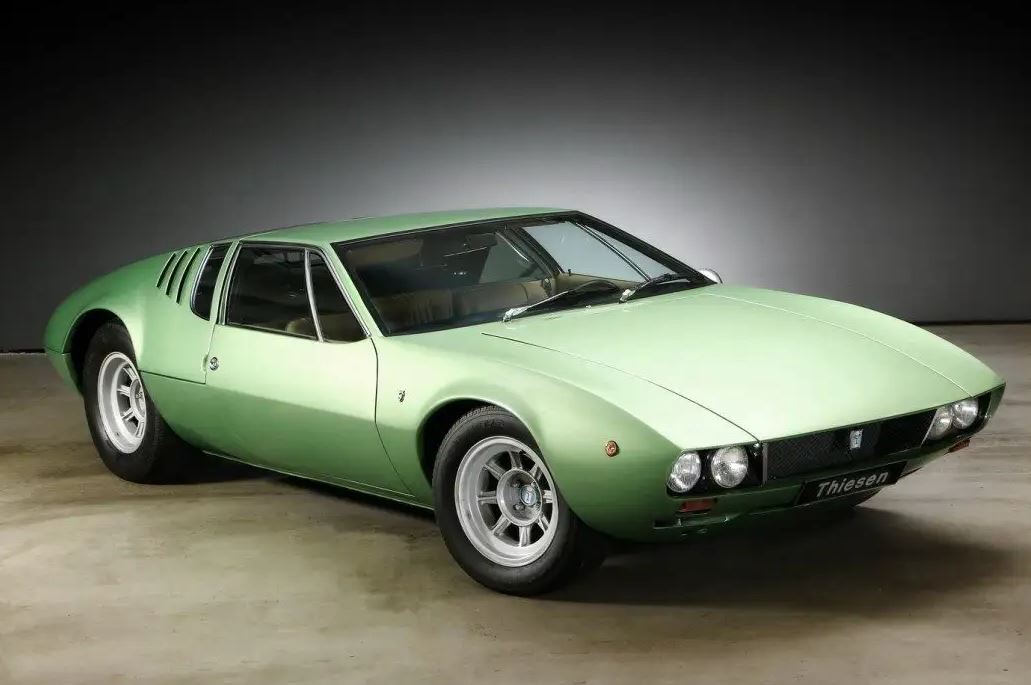
In 1964, he met Le Mans winner, Carroll Shelby (1923–2012), famous also for his Anglo-American hot-rod, the AC Shelby Cobra.  They entered into an agreement to build racing cars for the up-coming Can-Am series but squabbles between the two ensued, the arrangement ending in acrimony.  De Tomaso continued to develop the vehicle, this time as a road car which, in revenge, he named Mangusta (mongoose), a beast renowned for its skill in hunting and killing snakes including Cobras.  Designed by Giorgetto Giugiaro (b 1938) of Ghia, between 1967-1971 some four-hundred Mangustas were produced and although the details are contested, the 150-odd are said to have been powered by the same highly-tuned 289 cubic-inch (4.7 litre) Ford (Windsor) V8 as the most numerous of Shelby’s Cobras, the remainder using a milder 302 (4.9 litre) Windsor for the lucrative US market, the 302 compliant with their more onerous emission regulations.

1969 De Tomaso Mangusta (289).

Achingly lovely though it was, adapting a race car for the road necessitates compromises and the Mangusta had not a few.  A 32/68% front/rear weight distribution delights racing-car drivers but induces characteristics likely to frighten everybody else and the interior was cramped, something tolerated in competition vehicles but not endearing to buyers looking for something with which to impress the bourgeoisie.  However, it sold well enough to encourage de Tomaso to pursue the concept and the better designed (if less beautiful) replacement, the Pantera (Italian for "panther"), lasted from 1971 to 1993, over seven-thousand being sold, some with the Australian-built Ford 351 (5.8 litre) V8 (which continued usually to be referred to as the "Cleveland" (a reference to the Ohio plant where the US versions were first built) even though most of the blocks were cast in the foundry attached to Ford Australia's manufacturing facility in Geelong, Victoria.  The idea of a "351 Geelong" never caught on but a footnote in Ford's V8 history is the Australians also concocted a unique "302 Cleveland" (all other pre-modern 302s using the earlier "Windsor" block).

1970 De Tomaso Mangusta (289).

As a road car, the Mangusta was fundamentally so flawed it really couldn’t be fixed; seen first in 1966, it came from those innocent times before Ralph Nader (b 1934) got politicians interested drawing up rules, some of which admittedly were both desirable and overdue.  However, even had it been possible to re-engineer the thing into something well-behaved enough for real people safely to drive (and what Porsche's engineers achieved with the 911 proved such things could be done), there was no way it could have been adapted to conform to the laws which began with severity to be imposed in the 1970s.  The solution was the Pantera, designed with a copy of the regulations in one hand and a cheque from the Ford Motor Company in the other, FoMoCo interested in having in their showrooms a competitor for Chevrolet’s Corvette.  Discarding the Mangusta’s steel backbone chassis for a steel unibody, with a 44/56% front/rear weight distribution, inherently the Pantera was safer in non-expert hands and contemporary testers praised the handling characteristics.  Its sales volumes never challenged those of the Corvette but in the four years it was available in the US through Ford's Lincoln-Mercury dealer network, well over 5000 were sold although Ford was required to inject significant resources to ensure quality control was maintained (infamously, the US singer Elvis Presley (1935-1977) one morning shot his when it refused to start).  

1972 De Tomaso Pantera.

This time, De Tomaso used the 351 cubic inch version of Ford's new 335 series (Cleveland) V8, which, although somewhat bigger and heavier than the earlier Windsor, did offer some advantages in that it was designed with emission controls in mind and used a more efficient cylinder head.  None of that much helped in the market conditions which prevailed in the recession induced after the first oil shock in 1973 and sales declined to the point where Ford concluded any continuing investment was no longer viable; in 1975 the arrangement with De Tomaso was terminated.  After the withdrawal from the US market, De Tomaso maintained production on a smaller scale, the majority sold in Europe and it enjoyed a long Indian summer, the final examples not leaving the factory until 1993 by which time output had slowed to a trickle; the final count when production ended after 19 years was 7260.  After 1988, there was a switch to the Windsor V8 because Ford Australia (Cleveland V8 production moved to the Geelong foundry after 1974), reacting to both the second oil shock in 1979 and changing customer behavior, in 1983 closed the line (they would later realize that had been a mistake and in 1991 began importing US built V8s which would remain available until the Australian operation was closed in 2016).  De Tomaso accordingly warehoused Australian 351s which powered the Panteras until the stockpile was exhausted.

1985 De Tomaso Pantera GTS.

Disappointingly, despite on paper appearing to possess a promising specification, there was never a stellar career in competition although factory support was offered and private teams ran regular campaigns.  Conspiracy theorists have long attributed the paucity of success to the more established players like Ferrari and Porsche having undue influence on the regulatory bodies (such as the habitually dopey Fédération Internationale de l'Automobile (the FIA; the International Automobile Federation)), nudging them always in directions favouring their machines.  It had been done before.  Doubts had always been expressed about the suitability of the Cleveland engine for competition because the lubrication system lacked the passages which made the Windsor so robust but there were work-arounds for that and the factory arranged small runs of Panteras which conformed to the FIA's Group 3 and Group 4 racing regulations (some of which owners later converted to Group 5 specifications) but consistent success proved elusive.  De Tomaso however knew his market.  Even if he couldn’t often beat the Porsches and Ferraris on the track, as the years went by the Panteras adopted increasingly wild styling and they certainly looked the part although it'll always be remembered as a car for the boulevard rather than the track, one in 1972 memorably awarded to Playboy's playmate of the year (PotY), finished in the magazine's then traditional pink.

1991 De Tomaso Pantera 90 Si in Giallo Cromo (chrome yellow) over Nero (black) leather.

For its final run, the bodywork was updated by Bertone’s Marcello Gandini (1938–2024) and given the designation Pantera 90 Si, 41 of which would be built; two were sacrificed to crash-testing, one (chassis #9641) was allocated to the de Tomaso museum and 38 were offered for general sale.  The touches of Gandini (noted for his work on Lamborghini’s Miura (1966-1973) & Countach (1974-1990, first displayed in 1971), the Lancia Stratos HF (1973-1978) and Alfa Romeo Carabo (1968)) were more subtle than previous revisions to the design.  The 90 Si (it was sold in the UK market as the Pantera 90) used the Windsor 302 (Type 99E) although it was much updated from the unit which had powered the US bound Mangustas two decades earlier, fitted with electronic fuel injection, revised cylinder heads, camshafts, pistons valves and intake manifolds.  The underpinnings were also modernized with revised suspension geometry and the addition of ventilated and cross-drilled disc brakes, the four-piston Brembo calipers familiar from the appearance on the Ferrari F40 (1987-1992).

1991 De Tomaso Pantera 90 Si in Rosso Corsa (racing red) over Beige leather.

Based on the GT5S, beneath the skin was used a modified version of the original steel unibody, now featuring a tubular rear subframe for the engine, transaxle and suspension, the new design both lighter and more rigid.  The wheels were 17 inch Fondmetal cast in magnesium wheels (the front 9 inches wide, the rear 12) which replaced the various Campagnolo units used since 1971; originally they were shod with Michelin MXX tyres (235/45ZR/17 front, 335/35/ZR/17 rear).  Supplied from the US in the form fitted to the Ford Mustang (with a 9.0:1 compression ratio (CR) and rated at 225 hp at 4200 rpm), de Tomaso’s modifications included lifting the CR to 11.0 and the factory claimed 305 hp at 5800 rpm, a number more plausible than the 306 hp Shelby American allocated (somewhat arbitrarily) to the original 289 Cobras.  The 90 Si continued to use the 5-speed ZF transaxle but two (chassis # 9637 & 9639) were fitted with Getrag 6-speed units.

1991 De Tomaso Pantera 90 Si in Rosso Corsa (racing red) over Beige leather.

With air-conditioning, electric windows, a CD player, wood veneer inserts on the dash, centre console and door panels and much leather, the 90 Si was the most lavishly appointed Pantera ever.  The mechanical modifications made it also the best behaved and most civilized but although the design brief had included making it suitable to be certified for sale in the US, none were exported there and the recession of the early 1990s saw demand for such machines collapse and sales never approached the optimistic expectation of 75 a year justified its conception and development.  Production ceased late in 1993.  One was even made in RHD (right-hand-drive) and in the UK the importer (Emilia Concessionaires) offered the option of twin turbochargers, advertising it as the Pantera 200 (an allusion to the claimed top speed of 200 mph (322 km/h) although it seems not certain that was ever verified.

1993 1991 De Tomaso Pantera 90 Si Targa by Carrozzeria Ernesto Pavesi in Stratos Blu (blue) over Beige Leather.  This is chassis #9637, one of two with a Getrag 6-speed transaxle.

Between 1993-1994, four of the 38 90Si Panteras (chassis #9636, 9637, 9638 & 9639) were converted to targas by Carrozzeria Ernesto Pavesi (1929-2012), a coach-building house with a decades-long association with Alejandro de Tomaso, the company having produced the 14 Longchamp spyders (and reputedly also the two convertible Maserati Kyalamis which were Longchamp-based).  The quality of Pavesi's work attracted the attention of some Longchamp owners who had their cars converted to spyders.   Founded in Milan by Ernesto Pavesi (1901-1974) in 1929, Carrozzeria Ernesto Pavesi (1929-2012) proved adaptable to a changing environment and survived the Great Depression, World War II (1939-1945) and the post-war decline of coach-building but succumbed finally to the effects of the GFC (global financial crisis, 2008-2012).  Pavesi completed the last of the four Pantera Targas in 1994, demand further hampered by it being some 50% more expensive than the coupé.