Thursday, August 13, 2020

Mania

Mania (pronounced mey-nee-uh or meyn-yuh)

(1) Excessive excitement or enthusiasm; craze; excessive or unreasonable desire; insane passion affecting one or many people; fanaticism.

(2) In psychiatry, the condition manic disorder; a combining form of mania (megalomania); extended to mean “enthusiasm, often of an extreme and transient nature,” for that specified by the initial element; characterized by great excitement and occasionally violent behavior; violent derangement of mind; madness; insanity.

(3) In mythology, the consort of Mantus, Etruscan god of the dead and ruler of the underworld.  Perhaps identified with the tenebrous Mater Larum, she should not be confused with the Greek Maniae, goddess of the dead; In Greek mythology Mania was the personification of insanity.

(4) In popular use, any behavior, practice, cultural phenomenon, product etc enjoying a sudden popularity.

1350–1400: From the Middle English mania (madness), from the Latin mania (insanity, madness), from the Ancient Greek μανία (manía) (madness, frenzy; enthusiasm, inspired frenzy; mad passion, fury), from μαίνομαι (maínomai) (I am mad) + -́ (-íā).  The –ia suffix was from the Latin -ia and the Ancient Greek -ία (-ía) & -εια (-eia), which form abstract nouns of feminine gender.  It was used when names of countries, diseases, species etc and occasionally collections of stuff.  The Ancient Greek mainesthai (to rage, go mad), mantis (seer) and menos (passion, spirit), were all of uncertain origin but probably related to the primitive Indo-European mnyo-, a suffixed form of the root men- (to think)," with derivatives referring to qualities and states of maenad (mind) or thought.

The suffix –mania was from the Latin mania, from the Ancient Greek μανία (mania) (madness).  In modern use in psychiatry it is used to describe a state of abnormally elevated or irritable mood, arousal, and/or energy levels and as a suffix appended as required.  In general use, under the influence of the historic meaning (violent derangement of mind; madness; insanity), it’s applied to describe any “excessive or unreasonable desire; a passion or fanaticism” which can us used even of unthreatening behaviors such as “a mania for flower arranging, crochet etc”.  As a suffix, it’s often appended with the interfix -o- make pronunciation more natural.  The sense of a "fad, craze, enthusiasm resembling mania, eager or uncontrollable desire" dates from the 1680s, the use in English in this sense borrowed from the French manie.  In Middle English, mania had sometimes been nativized as manye. The familiar modern use as the second element in compounds expressing particular types of madness emerged in the 1500s (bibliomania 1734, nymphomania, 1775; kleptomania, 1830; narcomania 1887, megalomania, 1890), the origin of this being Medical Latin, in imitation of the Greek, which had a few such compounds (although, despite the common perception, most were actually post-classical: gynaikomania (women), hippomania (horses) etc).

The adjective maniac was from circa 1600 in the sense of "affected with mania, raving with madness" and was from the fourteenth century French maniaque, from the Late Latin maniacus, from the Ancient Greek maniakos, the Adoption in English another borrowing from French use; from 1727 it came also to mean "pertaining to mania." The noun, "one who is affected with mania, a madman" was noted from 1763, derived from the adjective.  The adjective manic (pertaining to or affected with mania), dates from 1902, the same year the clinical term “manic depressive” appeared in the literature although, perhaps strangely, the condition “manic depression” wasn’t describe until the following year although the symptoms had as early as 1857 been noted as defined as “circular insanity”, from the from French folie circulaire (1854).  It’s now known as bi-polar disorder.  The constructions hypermania & submania are both from the mid-twentieth century.  The adjective maniacal was from the 1670s, firstly in the sense of "affected with mania" and by 1701 "pertaining to or characteristic of a maniac; the form maniacally emerged during the same era.  Mania is quite specific but craving, craze, craziness, enthusiasm, fad, fascination, frenzy, infatuation, lunacy, obsession, passion, rage, aberration, bee, bug, compulsion, delirium, derangement, desire & disorder peacefully co-exist.

Noted manias

Anglomania: An excessive or undue enthusiasm for England and all things English; rarely noted in the Quai D'Orsay.

Anthomania: An extravagant passion for flowers; although it really can’t be proved, the most extreme of these are probably the orchid fanciers.  Those with an extravagant passion for weed are a different sub-set of humanity and are really narcomanics (qv) although there may be some overlap. 

Apimania: A passionate obsession with bees; beekeepers tend to be devoted to their little creatures so among the manias, this one may more than most be a spectrum condition.

Arithmomania: A compulsive desire to count objects and make calculations; noted since 1884, it’s now usually regarded as being within the rubric of obsessive-compulsive disorder (OCD).

Bibliomania: A rage for collecting rare or unusual books.  This has led to crime and there have been famous cases.

Cacodaemomania: The obsessive fixation on the idea that one is inhabited by evil spirits.  To the point where it becomes troublesome it’s apparently rare but there are dramatic cases in the literature, one of the most notorious being Anneliese Michel (1952–1976) who was subject to the rites of exorcism by Roman Catholic priests in the months before she died.  The priests and her parents (who after conventional medical interventions failed, also become convinced the cause of her problems was demonic possession) were convicted of various offences related to her death.  Films based on the events leading up to death have been released including The Exorcism of Emily Rose (2005), Requiem (2006) and Anneliese: The Exorcist Tapes (2011).

Callomania: The obsessive belief in one’s own beauty, even when to all others this is obviously delusional.

Dipsomania: The morbid craving for alcohol; in pre-modern medicine, it was used also to describe the “temporary madness caused by excessive drinking”, the origin of this being Italian (1829) and German (1830) medical literature.

Egomania: An obsessive self-centeredness; it was known since 1825 but use didn’t spike until Freud (and others) made it widely discussed after the 1890s and few terms from the early days of psycho-analysis are better remembered.

Erotomania: Desperate love, a sentimentalism producing morbid feelings.

Flagellomania: An obsessive interest in flogging and/or being flogged, often as one’s single form of sexual expression and thus a manifestation of monomania (qv).  The English Liberal Party politician Robert Bernays (1902-1945), the son of a Church of England vicar, was a flagellomanic whose proclivities were, in the manner of English society at the time, both much discussed and kept secret.  He was also an illustration of the way such fetishes transcend other sexual categories.

Gallomania: An excessive or undue enthusiasm for France and all things French; rarely noted in the British Foreign Office.

Graphomania: A morbid desire to write.  Niccolò Machiavelli (1469-1527; Italian diplomat, philosopher and political advisor of the Renaissance) attributed many of the problems he suffered to his graphomania and he was right, his sufferings because of what he wrote, when it was written and about whom.

Hippomania: An excessive fondness for horses; an affliction which often manifests as the intense and passionate interest in horses developed by some girls who join pony clubs and fall in love.

Hypermania: There’s a definitional dualism to hypermania; it can mean either an extreme example of any mania or, as used by clinicians, specifically (and characterized usually by a mental state with high intensity disorientation and often violent behavior), a severe case of bipolar disorder (the old manic-depression).  The earlier term was hypomania (A manic elation accompanied by quickened perception), one of the earliest (1882) clinical terms from early-modern psychiatry.

Kleptomania: The obsessive desire to steal; in early (1830s) use, the alternative form was cleptomania.  The klepto element was from the Ancient Greek kleptes (thief, a cheater), from kleptein (to steal, act secretly), from the primitive Indo-European klep- (to steal), from the root kel- (to cover, conceal, save) and was cognate with the Latin clepere (to steal, listen secretly to), the Old Prussian au-klipts (hidden), the Old Church Slavonic poklopu (cover, wrapping) and the Gothic hlifan (to steal) & hliftus (thief).  The history of the word kleptomania is of interest also to sociologists in that as early as the mid-nineteenth century, there was controversy about the use by those with the capacity to buy the services of doctors and lawyers were able to minimize or escape the consequences of criminal misbehavior by claiming a psychological motive.  The argument was that the “respectable” classes were afforded the benefit of this defense while the working class were presumed to be inherently criminal and judged accordingly.  The same debate, now also along racial divides, continues today.

Lindsaymania: A specific instance of mania suffered by those obsessed with Lindsay Lohan (manifested often on Instagram and other social media platforms), including those poor deluded souls who curate blogs with substantial Lohanic content.  They are sometimes referred to as "Lindsaiacs".  Those who focus on Ms Lohan's feet were historically labeled podophiles but the DSM has since re-classified them as "foot particularists"; if their interest is restricted to her feet alone they are a subset of the Lindsaymaniacs whereas if their interest includes the feet of others, they are pure foot particularists. 

Logomania: An obsession with words.  It differs from graphomania (qv) which is an obsession to write; logomania instead is a fascination with words, their meanings and etymologies.

Megalomania: Delusions of greatness; a form of insanity in which the subjects imagine themselves to be great, exalted, or powerful personages.  It was first used in the medical literature in 1866 (from the French mégalomanie) and came to be widely applied to many politicians and potentates the twentieth century.

Micromania:  "A form of mania in which the patient thinks himself, or some part of himself, to be reduced in size", noted first in 1879 and twenty years later used also in reference to insane self-belittling.  In the twentieth century and beyond, micromania was widely used, sometimes humorously, to refer to things as varied as the sudden consumer in interest in small cars to the shrinking size of electronic components.   

Monomania: An insane obsession in regard to a single subject or class of subjects; applied most often in academic, scientific or political matters but can be used about anything where the overriding mental impulses are perverted to a specific delusion or the pursuit of a particular thing.

Morphinomania: A craving for morphine; one of the earliest of the words which noted specific addictions, it dates from 1885 but earlier still there had been morphiomania (1876) and morphinism (1875) from the German Morphiumsucht.  In the medical literature, morphinomaniac & morphiomaniac rapidly became common.

Narcomania: The uncontrollable craving for narcotic drugs and a term which is so nineteenth century, the preferred modern form being variations of "addiction".

Necromania: An obsession to have sexual relations with the bodies of the dead although, perhaps surprisingly, practitioners (those who treat rather than practice the condition) classify many different behaviors which they list under the rubric of necromania, some of the less confronting being a morbid interest in funeral rituals,  morgues, autopsies, and cemeteries.   Those whose hobbies include the study of the architecture of crypts and tombs or the coachwork of funeral hearses might be shocked to find there are psychiatrists who classify them in the same chapters as those who enjoy intimacy with corpses.

Nymphomania: The morbid and uncontrollable sexual desire in women.  Perhaps the most celebrated (and often sought) of the manias, it dates from 1775, in the English translation of Nymphomania, or a Dissertation Concerning the Furor Uterinus (1771) by French doctor Jean Baptiste Louis de Thesacq de Bienville (1726-1813), the construct being the Ancient Greek nymphē (bride, young wife; young lady) + mania.  The actual condition is presumed to have long pre-dated the term and in use, deserves to be distinguished from less pleasing modern forms such as the "skanky ho".

Onomatomania: One obsessively compelled to respond with a rhyming word to the last word spoken by another (something possible even with orange and silver).  It’s thought to co-exist with other conditions, especially schizophrenia.

Phonomania: An uncontrollable urge to murder; those who suffer this now usually described as the more accessible “homicidal maniac”.  When applied especially to serial killers, the companion condition (just further along the spectrum) is androphonomania which, if properly argued, could be a defense against a charge of mass-murder but counsel would need to be most assiduous in jury selection.

Plutomania: The obsessive pursuit of wealth (and used sometimes in a clinical setting to describe an "imaginary possession of wealth").

Pyromania: A form of insanity marked by a mania for destroying things by fire.  It was used in German in the 1830s and seemed to have captured the imagination of Richard Wagner (1813–1883); the older word for the condition was incendiarism.

Rhinotillexomania: Nose picking. Gross, but a thing which apparently often manifests when young but fades, usually of its own volition or in reaction to the disapprobation of others.

Trichotillomania: The compulsion to pull-out one’s hair.  The companion condition is trichtillophagia which is the compulsive eating of one’s own hair, one of a remarkable number of eating disorders.

Definitional variations in the criteria for mania, DSM-IV & DSM-5

The study and classification of idea of manias had been part of psychiatry almost from its origin as a modern discipline although the wealth of details and fragmentation of nomenclature would come later, the condition first noted “increased busyness”, the manic episodes characterized by Emil Kraepelin (1856-1926; a founding father of psychiatric phenomenology) as those of someone who was “…a stranger to fatigue, his activity goes on day and night; work becomes very easy to him; ideas flow to him.” 

Whatever the advances (and otherwise) in treatment regimes, little has changed in some aspects of the condition.  In the fifth edition of the Diagnostic and Statistical Manual of Mental Disorders (DSM-5, 2013), the primary criterion of mania remains “a distinct period of abnormally and persistently elevated, expansive, or irritable mood” and “abnormally and persistently increased goal-directed activity or energy” but did extend duration of the event to qualify for a diagnosis.  In the DSM-IV (1994), the criterion for a manic episode only required “a distinct period of abnormally and persistently elevated, expansive, or irritable mood, lasting at least one week” whereas DSM-5 now requires in addition the presence of “abnormally and persistently increased goal-directed activity or energy”; moreover, these symptoms must not only last at least one week, they must also be “present most of the day, nearly every day.

The changes certainly affected the practice of the clinician, DSM-5 substantially increasing the complexity associated with the diagnosis and treatment of bipolar disorder, no longer requiring that clinically significant symptoms which may be present should be ignored.  All those years ago, Kraepelin conceptualized manic-depression as a single illness with a continuum of episodic presentations including admixtures of symptoms which have long since been considered opposing polarity.  DSM-5 thus represents an advance with the possibility of improved treatment outcomes because it enables clinicians to diagnose mood episodes and specify the presence of symptoms inconsistent with pure episodes; a major depressive episode with or without mixed features and manic/hypomanic episodes with or without mixed features.
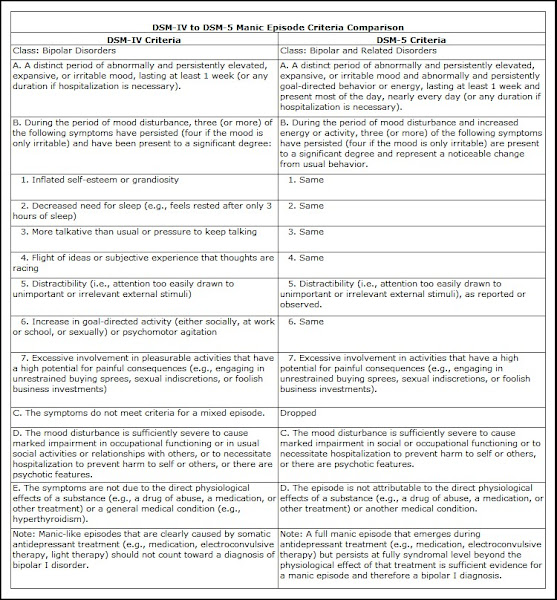
The revisions in DSM-5 also reflect the efforts of the editors over several decades to simplify diagnostic criteria while developing more precise categories of classification.  In the DSM-IV, both bipolar disorder and major depressive disorder were included in one chapter of mood disorders and a “mixed state” was a subtype of bipolar I mania, a diagnosis of a mixed state requiring that criteria for both a manic episode (at least three or four of seven manic symptoms) and a depressive episode (at least five of nine depressive symptoms) were met for at least one week.  In DSM-5, bipolar disorder and depressive disorders have their own chapters, and “mixed state” was removed and replaced with “manic episode with mixed features” and “major depressive disorder with mixed features.

Wednesday, August 12, 2020

Disc or Disk

Disc or disk (pronounced disk)

(1) A phonograph record.

(2) Any thin, flat, circular plate or object.

(3) Any surface that is flat and round, or seemingly so.

(4) In computing hardware, any of several types of media consisting of thin, round plates of plastic or metal, used for external storage.

(5) In zoology and anatomy, any of various roundish, flat structures or parts in the body, especially an intervertebral disc.

(6) In botany, (in the daisy and other composite plants) the central portion of the flower head, composed of tubular florets (especially the middle part of the lip of an orchid).

(7) Any of the circular steel blades that form the working part of a disk harrow.

(8) In mathematics, the domain bounded by a circle.

1655-1665: From the French disque, from the Latin discus, from Ancient Greek δίσκος (dískos) (disk, quoit, platter; a circular plate suited for hurling) from δικεν (dikeîn) (to hurl, to launch) from the primitive Indo-European dik-skos from the root deik (to show, pronounce solemnly).  The Proto-Germanic diskaz was also drawn from the Latin and Greek root and was cognate with the Old Saxon disk, the Old Dutch disc (Dutch dis (table)), the Old High German tisc (German tisch (table)) and the Old Norse diskr (plate).

The sense of "phonograph disk" dates from 1888 and discophile was used to describe enthusiasts for gramophone recordings from 1940.  Disk jockey as a term to describe those on radio who broadcast music from records was first recorded 1941; it became dee-jay is 1955 and was further truncated to DJ in 1961; the video version "veejay" is from 1982 but never really caught on.  Disk-drive is from 1952 although disk was first noted in the context of computing in 1947.  Disc brakes were first developed in the late nineteenth century, began to be used on cars at scale in the 1950s and were widely widely available early in the next decade.  The first compact disc (CD) was released in 1982, the digital versatile disc (DVD) in 1995 and the BluRay (BD) disc in 2006.

Disk or Disc

LP album cover; the LP was the final evolution of the traditional phonographic disk.  This cover is memorable but fake; it is a fake disk.

Although both the Latin and Greek spellings have endured, there is in English no formal rule for the use of disc & disk and the two are often used interchangeably.  Even within industries or in countries, there is no consensus on the difference but there are conventions.  Historically the Latinate form was preferred in the British Empire and the Greek in the US but the advent of disk as the preferred use in the computing industry from the 1940s spread worldwide although, as a point of deliberate differentiation, disc was adopted for the new optical hardware (CD, DVD and BluRay).  The distinction is maintained still; mechanical devices are diskettes or hard disks whereas the optical are all discs.

The newer form of storage is solid state and the devices are properly called semiconductor storage devices (SSD) but are more typically referred to (wrongly and presumably influenced by the SSD acronym) as  solid-state disks, or solid-state drives even though SSDs don't have the rotating disk or the drive mechanism which powers the movable read–write heads used with hard disk drives (HDD) and floppy disks (FDD); even among those who understand the difference, the habits of old die hard.  So, the SSD has neither disk nor drive but does require, somewhere in the system, a software driver.

Lindsay Lohan music albums on CD: Speak (2004) and A Little More Personal (RAW) (2005, both released by Casablanca Records.

Although the use in IT greatly increased use of disk, even before the debut of optical media, there was never any indication disc would become extinct.  Except where specifically defined as a brand-name or trademark (such as the CD), both are likely to continue to be used interchangeably with regional and perhaps even generational variations.  Most style guides, even those which provide prescriptive lists, acknowledge this and suggest regardless of the form(s) users choose, what matters is to maintain consistency.  Rotating disks and discs are anyway vanishing from computer hardware so the influence of the industry's conventions of use will presumably diminish.

Monday, August 10, 2020

Interahamwe

Interahamwe (pronounced in-ter-ah-ham-way or in-tra-ham-way)

A Hutu paramilitary organization.

1992: A constructed proper noun, described variously as (1) borrowed from a Rwanda-Rundi (a dialect of Kinyarwanda) term or (2) a creation to describe the paramilitary formation.  Literal translation is "those who work together" and is thus a euphemism, one based on the link to the Interahamwe’s preferred choice of weapons: farm tools and the machete.  The construct is intera (from the verb gutera), (to work) + hamwe (together) which is related to rimwe (one).

After the genocide

Flag of the Interahamwe.

Although most associated with the Rwandan genocide on 1994, the Interahamwe began as the innocuous youth wing of the National Republican Movement for Democracy and Development (MRND), then the Hutu ruling party of Rwanda.  However, like other some political youth movements (the Taliban in Pakistan; the Mandela United Football Club in South Africa etc), the circumstances of the times led to mission creep.

The Rwanda genocide had its origin in the Hutu-Tutsi civil war of 1990-1992.  As violence escalated, use of the word “Interahamwe” changed from a description of the youth group into a broad term applied to almost anyone engaged in the mass-murder of Tutsis, regardless of their age of membership of the MRND.  The translation as “those who work together” became a euphemism for “those who kill together”.  Sardonic forms are not rare in both military and paramilitary jargon; the IDF (Israeli Defense Force) category for suicide-bombers prematurely blown-up by their own malfunctioning devices is “work accident”.

Although their numbers are now much reduced, the Interahamwe retain the ambition to destabilize Rwanda and still operate from the Democratic Republic of the Congo (DRC), the place to which they fled in late 1994.  From there and neighboring countries, along with other splinter groups such as the Democratic Forces for the Liberation of Rwanda (FDLR), they conduct an insurgency against Rwanda although recent operations suggest they're as much concerned with the various criminal activities undertaken to ensure their survival as any political agenda.

Sunday, August 9, 2020

Mufti

Mufti (pronounced muhf-tee (U) or muff-tee (non-U))

(1) Civilian clothes, in contrast with military or other uniforms worn (as applied to persons who usually wear a uniform (used in the English-speaking world except North America); the synonym is civvies.

(2) As Islamic scholar & jurist expert in the shari’a law and the interpretation of legal principles written in the Koran who issues fatwas.

(3) In the Ottoman Empire, a deputy to the Sultan’s chief adviser on matters of Islamic law.

(4) As Grand Mufti, a senior figure in some Islamic systems.

(5) The acronym of Minimum Use of Force and Tactical Intervention, used in the military and law enforcement.

1580-1590: From the Ottoman Turkish مفتی‎ (müftî), from the Arabic مُفْتِي‎ (muftī) (one who delivers a fatwa (literally “deliverer of formal opinion”), from مُفْتٍ‎ (muftin), the active participle of أَفْتَى‎ (ʾaftā) (to give), a conjugated form of fata (he gave a (legal) decision).  The use to describe civilian clothes (worn by military officers when off-duty) as opposed to military uniform dates from 1816 and was a term used in the British Indian Army under the Raj.  The origin is murky but is presumed to reference a mufti’s costume of robe and slippers in stage plays of the time and was thus a synecdoche for plain clothes.  The archaic alternative spellings in English were muftee & mufty; the noun plural is muftis.

Of Muftis, the Sheikhs, Mullahs, Imams and Ayatollahs

Sheikh Hasina Wazed (b 1947; Prime Minister of Bangladesh 1996-2001 &  2009-2024).

Like many religions, In Islam there are a number of titles, some of which seem to overlap and the use in one place can in detail differ from the duties and responsibilities undertaken in another.  An added complication is that Islam does not have the same distinctions between religious and other matters familiar in many other faiths.  A Mullah (the word a substitute for molvi or molai) is one who has studied and attained a degree in the fields of Hadith, Tafseer & Fiqh from any authentic Jamia or Madrassah (University of Islamic Sciences) and holds a qualification of Sanad or Ijazat-e-Hadees.   A student is announced Scholar (Molvi) in a graduation ceremony after when he has attained Ijazat e Hadith from his teacher of Hadith (Sheikh-ul-Hadith).  With this qualification, the graduate is deemed able to understand & explain Ahadith (plural of Hadith (the entire collection of hadiths (sayings and deeds) of Muhammad within a particular branch of Islam or Islamic jurisprudence).  A Mufti is one who, after graduating, has undertaken further study in a specialization in one or more of the field such as law or history.  A Mufti is able to issue a fatwa, a written authorized verdict on any of the Islamic problems brought to his attention.  The best known of these judgments are those associated with Dar-ul-ifta (the institution with the authority to write and publish verdicts on the Islamic issues of every nature).  A Grand Mufti is the highest ranked Mufti at a Dar-ul-ifta and can be thought of as something like a chief judge in a court but, because Islam is structurally more integrated than the pattern understood in many countries, such comparisons are merely indicative.

Ayatollah Ruhollah Khomeini (1900-1989; supreme leader of Iran 1979-1989).

The widely used Sheikh is often misunderstood.  It is an honorific title for someone and need not be formally conferred and, unusually, it can be used by women; a mark of respect vaguely similar to “sir” in English or “san” in Japanese.  However, in some parts of the Arab world, Sheikh can be used instead of mufti (or molvi).  An Imam is a leader, the term used for a recognized religious scholar or authority in Islam and in Sunni Islam, it is the Imam is the one who leads formal prayers, even in locations beyond a mosque and for a mosque formally to be constituted, there must be an imam to lead the prayers, even if in circumstances it may be someone from the gathered congregation rather than an appointed official.  Such a person is chosen on the basis of their knowledge of the Quran, and Sunnah (the prophetic tradition) and their good character; their age is not relevant.  Imams, formal and otherwise are almost always male and in some traditions exclusively so but in some cultures women certainly lead women in prayer and there is a long history of women fulfilling the role when the congregation is comprised exclusively of family members, even if it includes men.  The Sunni branch of Islam does not have imams in the same sense as the Shi'a where the role is best understood in the position of Ayatollah, the most famous of which are those of the Islamic Republic of Iran.  The founder of that state, Ayatollah Ruhollah Khomeini, was within the country usually referred to as “the Imam”, a courtesy title not extended to his successor.

The Führer and the Grand Mufti, Berlin, 1941.

The 1941 meeting in Berlin between Adolf Hitler (1889-1945; Nazi head of government 1933-1945 & head of state 1934-1945) and the Grand Mufti of Jerusalem (Mohammed Amin al-Husseini (1897–1974) Mufti (Grand Mufti after 1922) of Jerusalem 1921-1948) cast a long shadow.  In 2015 then Israeli prime Minister Benjamin Netanyahu (b 1949; prime minister 1996-1999 & 2009- 2021) claimed Hitler at the time of the meeting was not considering exterminating the Jews, but only expelling them from Europe and that it was al-Husseini who inspired the genocide of the holocaust to ensure they didn’t come to Palestine.  Mr Netanyahu is marvelously unscrupulous and inclined, where there's some gap or inconsistency in the historical record, to insert alternative facts which suit his purposes.

The only record of the meeting is the official German report, published decades ago and there’s nothing in it to support Mr Netanyahu’s accusations.  Of course, an official government record of a meeting involved his head of state may not be a complete record of the conversation and it may be that the views attributed to the mufti by Mr Netanyahu are exactly those expressed to the Führer and not included in the official record for reasons of political sensitivity.  It’s just that there’s no basis for the accusation and that all the available evidence does confirm the Nazis had months before the meeting taken the decision to proceed with the holocaust and the planning was well-advanced before the mufti arrived in Berlin.  The mufti was anti-Semitic and collaborated with the Nazis as a broadcaster and propagandist, helping recruit Balkan Muslims to form a division of the Waffen-SS.  He also appears to have known about the Holocaust as early as 1943 but there is no evidence to support the assertion he was in 1941 either its inspiration or even an advocate.

Australia’s most entertaining mufti was the Egyptian-born Sheikh Taj El-Din Hamid Hilaly (1941-2023; Mufti of Australia 1988-2007),  After a quiet start he was never far from the news but his most celebrated moment came in 2006 when he delivered a sermon discussing the relationship between rape and the clothing women choose to wear.  The essence of his message was:

Were one to leave uncovered meat in the street, in the garden, in the park or in the backyard, just leave it without a cover, when the cat comes and eats it, is that the fault of the cat or the uncovered meat?  Of course it is the fault of the uncovered meat.  If she was in her room, in her home, in her hijab, no problem would have occurred.

Covered meat: Lindsay Lohan in hijab (al-amira).

After repeating his comments in public, there was an unfavorable reaction and he issued a statement: "I unreservedly apologize to any woman who is offended by my comments. I had only intended to protect women's honor, something lost in (the newspaper’s) presentation of my talk.  I would like to unequivocally confirm that the presentation related to religious teachings on modesty and not to go to extremes in enticements. This does not condone rape. I condemn rape.  Women in our Australian society have the freedom and right to dress as they choose; the duty of man is to avert his glance or walk away."

Saturday, August 8, 2020

Genocide

Genocide (pronounced jen-uh-sahyd)

(1) A special class of mass-murder, the deliberate and systematic extermination of a national, racial, political, or cultural group, usually by a state; the systematic killing of substantial numbers of people on the basis of their ethnicity, religion, or nationality.

(2) In casual (and imprecise) use, by extension, the systematic killing of substantial numbers of people on other grounds.

(3) In casual (and imprecise) use, by extension, the systematic suppression of a cultural identity, language etc on the basis of cultural, racial or ethnic origin (often expressed as culturicide or cultural genocide).

1944: The construct is géno + cide.  Géno is from the Ancient Greek γένος (genos) (race; kind) from the primitive Indo-European gene- (give birth, beget (with derivatives referring to procreation and familial and tribal groups)); it was cognate with the Latin gēns (tribe, clan).  The suffix cide (cīda) is from the Latin caedere (to kill; a killing).  The creation of the word genocide is attributed to Polish-born US lawyer Raphael Lemkin (1900-1959) who used it in his book Axis Rule in Occupied Europe (1943-1944) in reference to the Nazi extermination of the Jews of Europe.  In the English-speaking world, there were the pedants who didn’t approve of the mixing of Latin and Greek, noting the proper formation would be genticide, the construct being the Latin gēns (a race, nation, people; a clan, family (oblique stem: gent-)) + -cide and is a hypothetical Latin etymon of the form genticīdium (from gēns + -cīdium (the suffix denoting “killer”; “cutter”) + -ium (from the Latin -um (neuter singular morphological suffix)).  Genocidal is the adjective.

There was earlier, in a similar sense, the French populicide (variously cited as dating from 1792 or 1799) from French populicide, a construct made necessary by the excesses in the aftermath of the 1789 French Revolution.  This was later adopted in German as Völkermeuchelnden (genocidal) and was known in English by 1893 as the anglicized folk-murdering.  The less rigorous ethnocide is attested from 1970 in French and 1974 in English.

Raphael Lemkin (1900-1959).

The word genocide was coined by Raphael Lemkin (1900-1959), a Polish-Jewish lawyer who had immersed himself in study after, as a student, being shocked to discover there existed nothing in international law to prosecute the Ottoman leaders who were complicit in what is now (though not by all) often called the Armenian Genocide (1915-1917) in which over a million are thought to have been killed.  Essentially, Lemkin identified the doctrine of sovereign immunity (the idea that what happens within nation boundaries must be regarded as purely internal matters) as the reason state-sanctioned mass-murder had such a long history and it could be stopped only if this doctrine was subject to some limitations.

In November 1944, Lemkin’s book Axis Rule in Occupied Europe was published.  It was a review of the legal implications of the consequences of the Nazi Germany New Order administrations in the occupied nations and contained the first definitional framework of genocide.  His point was that genocide did not of necessity mean “the immediate destruction of a nation” which was a concept of course familiar from thousands of years of warfare but instead signified “a coordinated plan of different actions aimed at the destruction of essential foundations of the life of national groups, with the aim of annihilating the groups themselves.”  That formulation was something specific to the circumstances of the holocaust, a process which, for almost a decade, progressed from the Nazi state introducing laws which sought to marginalize and exclude the Jews from Germany’s cultural and economic life to the building of an industrial system intended to murder every Jew in Europe, a process which was organic, a reaction to the circumstances at the time.  The Nazis, upon their assumption of power in 1933 had not even the vaguest plan of extermination, not because Hitler would have thought mass-murder on any scale unacceptable but because it was unimaginable that such a thing was possible.  What was planned was eradication, the forced migration of the Jews from what Germany was and what it was to become, what would now be described (in the literal sense rather than as the euphemism with which the phrase is now associated) as ethnic cleansing.  It was the circumstances of inter-war politics and later war-time realities which meant (1) that mass-emigration firstly within and later beyond Europe was not possible and (2) that under the Nacht und Nebel (night and fog) of war, the mass-murder of millions became possible.  As the word tends now to be used, between 1933 and 1942, a displacement of population became genocide.

Perhaps surprisingly given the perceptions of many, the word genocide did not figure large in the incitements served at the Nuremburg Trial (1946-1946), being mentioned not as one of the four counts but included in Count Three (War Crimes:  "...deliberate and systematic genocide, viz, the extermination of racial and national groups, against the civilian populations of certain occupied territories in order to destroy particular races and classes of people and national, racial or religious groups, particularly Jews, Poles and Gypsies and others."

Judges' bench at the International Military Tribunal, Nuremberg, 1945-1946.

Although the holocaust was the most monstrous matter to be tried at Nuremberg, any reluctance to include genocide as a separate count was understandable. Nothing quite like the International Military Tribunal (IMT) which convened at Nuremberg had ever been assembled and it was acknowledged at the time some of the matters with which the defendants were charged were based in retrospective law; they were being held to account for conduct which, at the time, was not unlawful.  Sensitive to this and the need to frame the incitements as close as possible to acknowledged legal norms, the prosecutors, mostly working lawyers for whom the primary concern was winning the case, tried as much as possible to avoid novelty in the incitement.  As it was, the document grew from a three-odd page draft in June to a final copy of sixty-five pages when served on the defendants.  The word genocide appeared just the once.

Genocide was in 1946 recognized as a crime under international law by the United Nations General Assembly and was codified as a crime in the 1948 Convention on the Prevention and Punishment of the Crime of Genocide (the Genocide Convention.  It expanded Lemkin’s definition, holding that genocide was “any of the following acts committed with intent to destroy, in whole or in part, a national, ethnical, racial or religious group, as such:

(1) Killing members of the group.

(2) Causing serious bodily or mental harm to members of the group.

(3) Deliberately inflicting on the group conditions of life calculated to bring about its physical destruction in whole or in part.

(4) Imposing measures intended to prevent births within the group.

(5) Forcibly transferring children of the group to another group.

Genocide is defined in the same terms in the Rome Statute which created the International Criminal Court (ICC) as well as in the statutes of other international and hybrid jurisdictions.  Over one-hundred and fifty states have ratified the convention but the International Court of Justice (ICJ) has anyway ruled the convention embodies principles that are part of general customary international law so whether or not ratified, in legal theory, all states are bound by the principle that genocide is a crime prohibited under international law.  Many states have also criminalized genocide in their domestic law.  Technically, intent is the most contentious element in any genocide prosecution.  To succeed, intent must be a proven on the part of perpetrators physically to destroy a national, ethnical, racial or religious group; cultural suppression or destruction is not genocide and nor is expulsion from territory. 

After Nuremberg, genocide was long applied only to the destruction of an ethnic group (as conventionally defined) although there has more recently been a debate about whether it applies only if killing of all members of the group is involved or if other means, such as dispersing the group to the point where shared cultural practices or identity are no longer possible also constitutes (an unqualified) genocide; the concepts of cultural genocide, linguistic genocide etc.  The crime has never needed to be absolute.  It has always been understood to include “systematic mass killing”, even if there’s not an intention absolutely to eradicate a group, thereby covering geographically localized events, the actions which in the Balkan wars of the 1990s came to be known as “ethnic cleansing”.  Where there is some purpose other than the actual destruction of a group, such as terrorizing the group or killing the population of a particular place irrespective of group membership, the more precise term is democide, the construct being the Ancient Greek δμος (demos) (people) + -cide.  

As many passages in sacred texts (including the Koran and the Bible) indicate, genocide, as a political imperative and military strategy, has a long and cross-cultural history in human civilization.  Although most attention is devoted to the most modern events with the highest death-toll (such as the holocaust, the still disputed matter of the Armenians in 1915 and the events in Rwanda in 1994), in a global sense, the most recent genocide which went closest to succeeding was the genocide of the Moriori, the indigenous people of the Chatham Islands (which lie to the east of New Zealand).  Invaded by the Maori in 1835, the Moriori were subject to mass murder, enslavement and a policy of deliberate cultural repression; the population which had once numbered close to two thousand by the 1870s shrinking to under a hundred.  In a sense that act of genocide did succeed, the last pure-blooded Moriori dying early in the twentieth century.

Friday, August 7, 2020

Regent

Regent (pronounced ree-juhnt)

(1) A person who exercises the ruling power in a kingdom during the minority, absence, or disability of the sovereign.

(2) A ruler or governor (obsolete).

(3) In certain schools and colleges in Scotland, the US and Canada, a member of the governing board of a state university or a state educational system.

(4) A university officer who exercises general supervision over the conduct and welfare of the students (now rare); a senior teacher or administrator in certain universities (rare, mostly obsolete).

(5) In certain Catholic universities, a member of the religious order who is associated in the administration of a school or college with a layperson who is its dean or director.

1375-1400: From the Anglo-Norman regent (a ruler), from the adjective regent (ruling, governing (later "exercising vicarious authority")), from the Middle French, from the Old French, from the Medieval  Latin regentem from regēns (ruling; ruler, governor, prince), present participle of regō (I govern, I steer), noun use of present participle of regere (to rule, direct).  The ultimate root was the primitive Indo-European reg- (move in a straight line) derivatives of this carrying the sense “to direct in a straight line" thus eventually the meaning "to lead, rule".  The most familiar meaning "one who rules during the minority or absence of a sovereign" emerged in the early fifteenth century as an alternative to king, not implying legitimacy or permanence of rule; the Latin for this was interrex (plural interreges).  The sense "university faculty member" is attested from late fourteenth century and preserves the original meaning.  When used in any of its adjectival forms, the sense is usually postpositive.

The last King of Italy

Umberto II while Prince of Piedmont, a 1928 portrait by Anglo-Hungarian painter Philip Asexius László de Lombos (1869–1937 and known professionally as Philip de László).  Note the ruffled collar and bubble pantaloons.

Umberto Nicola Tommaso Giovanni Maria di Savoia (1904–1983) was the last king of Italy, his reign as Umberto II lasting but thirty-four days during May-June 1946; Italians nicknamed him the Re di Maggio (May king) although some better-informed Romans preferred regina di maggio (May queen).  At the instigation of the US and British political representatives of the allied military authorities, in April 1944 he was appointed regent because it was clear popular support for Victor Emmanuel III (1869-1947; King of Italy 1900-1946) had collapsed.  Despite Victor Emmanuel’s reputation suffering by association, his relationship with the fascists had often been uneasy and, seeking means to blackmail the royal house, Mussolini’s spies compiled a dossier (reputably several inches thick), detailing the ways of his son’s private life.  Then styled Prince of Piedmont, the secret police discovered Umberto was a sincere and committed Roman Catholic but one unable to resist his "satanic homosexual urges” and his biographer agreed, noting the prince was "forever rushing between chapel and brothel, confessional and steam bath" often spending hours “praying for divine forgiveness.  After a referendum abolished the monarchy, Umberto II lived his remaining 37 years in exile, never again setting foot on Italian soil.  His turbulent marriage to Princess Marie-José of Belgium (1906-2001) produced four children but historians consider it quite possible none of them were his.

Lindsay Lohan at the Mr Pink Ginseng Drink Launch Party, Regent Beverly Wilshire Hotel, Beverly Hills, California, 11 October 2012.