Showing posts sorted by relevance for query Tranche. Sort by date Show all posts

Friday, October 29, 2021

Tranche

Tranche (pronounced trahnch, trahnsh, or trahnsh (French))

(1) One part or division of a larger unit; a slice, section or portion.

(2) A group of securities that share a certain characteristic and form part of a larger offering.

(3) Any part, division, or instalment.

(4) In finance, to divide into parts, applied especially to loans and share issues.

(5) In insurance, a distinct subdivision of a single policyholder's benefits, typically relating to separate premium increments.

(6) In pensions, a scheme's or scheme member's benefits relating to distinct accrual periods with different rules.

1400s: From the French tranche, (a cutting (literally, “a slice”)), a form of trancher (to cut, to slice), from Old French trenchier, trancher & trancher (cut, make a cut), possibly from the Vulgar Latin trinicāre (cut in three parts). It was cognate with the English trench.  The specific uses in economics and finance didn’t emerge until 1930.  The form in Modern French is tranché (feminine tranchée, masculine plural tranchés, feminine plural tranchées), the past participle of trancher (clear-cut, marked, bold, distinct (and in heraldry: per bend)).  Tranche is a noun & verb and tranched & tranching are verbs; the noun plural is tranches.

Tranches in a collateralised debt structure.

Tranche has become so associated with matters financial that the word is now seldom used in other contexts, probably a good thing given it’s likely only to confuse.  In finance, a tranche is a portion of a security (loans, mortgages, stocks, bonds etc) that can be packaged for sale to investors; Securities are broken to be reassembled in different forms for a number of reasons, the most obvious of which is to make them easier to sell.  Because investors base their decision to purchase on factors such as risk, time and the quality of asset backing, tranches prepared for sale vary in the emphasis placed on these factors to attract buyers with different priorities.

Slicing the cake.

Since the global financial crisis (GFC) began in 2008, the perception probably is that packaging is most associated with residential mortgages, the money banks and others loan to people to buy houses as homes or investments.  That’s not entirely true but it has been a big part of the market.  Typically, mortgages are repaid over fifteen to thirty years but the lenders prefer to churn, banks, rather than waiting decades to get the money, on-sell mortgages to investors, thereby gaining the funds to lend for more mortgages.  Because of the limited number of number of investors, individuals and institutional, willing to buy thirty year mortgages, banks create tranches, some including the first three years of each mortgage, some the five years while a few will run for the whole term.

This spread of products appeals to a spread-out market.  Some investors will prefer the low-risk tranche of three-year mortgages and accept the lower interest rate while others will opt for the riskier long-term tranche, attracted by the higher rate.  Tranching is thus a device which maintains the liquidity of the loan pool and provides a differentiated securities market in which investors can adjust their exposure according to their own risk versus reward calculation.

Pick your tranche; you pay your money, you take your choice.

The particular, celebrated case of the sub-prime mortgage crisis which began to manifest in 2008-2009 involved mostly tranches of CMOs (collateralized mortgage obligations) and the problems then were not a product of the structural design of tranching but the quality of what was being tranched.  Essentially, like many of the periodic crises in capitalism, the GFC was triggered by over-production.  The traditional mortgage market consisted of borrowers judged to be capable of repaying the loan but, various things having combined to mean the lenders had run out of them, they resorted to lending to people who would never be able to repay.  That required some clever contractual engineering to ensure (1) the credit-rating agencies would grant investment-grade ratings to what were junk securities so (2) the risk would be quickly on-sold.  The rationale for all of this was that the tranching was done in such a way that the spread of the risk was so diversified that whatever defaults occurred would present no systemic threat.  There are interesting stories about (1) & (2).

Lots lost lots in the GFC but there were also quite a number who made much and very quickly.  So profitable for those few in the right place at the right time was the loaning of money to those with no capacity to repay that it’s hard to believe it won’t, at scale, happen again and there are suggestions it may be happening now.  The unusual combination of borrowing at historically high multiples against static or falling incomes for assets at historically high valuations has happened in an era of historically low interest rates.  Movements downwards in asset values or upwards in interest rates will have a multiplier effect on each-other and those movements, if sufficient, will essentially render much mortgage debt functionally sub-prime and there were those who predicted the extraordinary increase in the global money-supply playing out this way.

The headline in the French language which in 2016 announced: Lindsay Lohan s'est tranché le doigt en deux (Lindsay Lohan sliced her finger in half).

Actually "sliced her finger in half" was a bit sensationalist (one might even say Anglo-Saxon style click-bait).  In October 2016, during an Aegean cruise, there was a nautical incident, the tip of one of her fingers severed by the boat's anchor chain but details of the circumstances are sketchy.  It may be that upon hearing the captain give the command “weigh anchor”, she decided to help but, lacking any background in admiralty terms and phrases, misunderstood the instruction.  The detached piece of digit was salvaged from the deck and ashore, soon re-attached by micro-surgery.  Digit and the rest of the patient are said to have made full recoveries, something especially significant because it was the ring finger which was “tranched” but, thanks to the surgeon’s skill in fixing the gruesome injury, she managed later to find husband and the finger now displays engagement and wedding rings.  All’s well that ends well.

Monday, August 31, 2020

Pizza

Pizza (pronounced peet-suh)

A flat, open-faced baked pie of Italian origin, consisting of a thin layer of bread dough topped with spiced tomato sauce and cheese, often garnished with anchovies, sausage slices, mushrooms etc and baked in a very hot oven; also called pizza pie.

Pre 1000: From the Modern Neapolitan Italian pizza (a variant of pitta (a flat bread)), the origin of which is uncertain.  Although unattested, it may be related to the Vulgar Latin picea, from the Classical Latin piceus (relating to pitch).  An alternative, and more likely, etymology traces it back to the Byzantine Greek πίτα (pita) (cake, pie) which exists in Modern Greek as pitta (cake), the ultimate root being the Ancient Greek ptea (bran) and pētítēs (bran; bread).  More speculative is the suggested link with the Langobardic (an ancient German language in northern Italy), from a Germanic source akin to the Old High German pizzo or bizzo (mouthful; morsel; bite) from the proto-Germanic biton (bit).

The first documented use of the word pizza appears to have been AD 997 in Gaeta and then later in different parts of Central and Southern Italy although it’s unclear whether it refers to something which would now be called a pizza.  The official Italian view remains that published in 1907 in the two volume Vocabolario Etimologico della Lingua Italiana (Etymological Vocabulary of the Italian language) that the origin lies in the dialectal pinza (clamp) from the Latin pinsere (to pound or stamp).  The word appears not to have entered general use in English use until the early 1800s although it was known, English linguist, poet & lexicographer John Florio (1552-1625; aka Giovanni Florio) included an entry in his Italian-English Dictionary (A Worlde of Wordes, or Dictionarie of the Italian and English tongues (1598)) defining pizza as “a small cake or wafer”.

Lindsay Lohan with slice of pizza.

The concept of a flat piece of bread dough, covered with savory toppings, is so obviously a convenient and economical way of preparing a meal using pre-modern technology that pizza-like dishes were probably included in the meals of many cultures, the cooking method doubtless quite ancient.  From Greek and Roman records it’s apparent it was known in antiquity a doubtless pre-dates even those civilizations, the Armenians famously having staked a claim to its invention but as part of modernity, it’s long been regarded as one of Italy’s many gifts to the world.  Within Italy, it’s the Neapolitans who most regard it as their own and some are quite proprietorial, appalled by some of the variations (especially those favored by English-speaking barbarians) which appear around the planet, the most infamous probably the ham and pineapple pizza, apparently a Canadian innovation from 1962.  The Neapolitans have allies in their battle for culinary hygiene, Iceland's president, Guðni Jóhannesson (b 1968, President of Iceland since 2016) in 2017 saying he’d like to ban pineapple on pizza.  He later confirmed to do so wasn’t within the constitutional authority of his office and admitted it wasn’t a desirable power of a head of state to possess.  Thinking it an abomination, the Neapolitans are probably more dictatorial and would ban it if they could, insisting that all may appear atop a pizza base is:

Plum tomatoes
Tomato puree (optional)
A sprinkling of table or sea salt
Freshly ground black pepper
Fresh Mozzarella balls
Parmesan cheese
A drizzle of Olive Oil
A hand-full of fresh basil leaves

The pizzeria (shop where pizzas are made, sold, or eaten) seems to have been a US coining, noted from 1928 in New York City, the number of restaurant using the name proliferating quickly there before spreading in the US and beyond.  In the 1920s and 1930s, “pizzeria” was used also to describe the dish itself.  The shortened for “za” was US student slang for pizza, two syllables just too much for the hippies of the time.

Crooked Hillary Clinton eating pizza: crookedly.

Pizzagate was a conspiracy theory that circulated during the 2016 US presidential campaign, sparked by WikiLeaks publishing a tranche of emails from within the Democrat Party machine.  According to some, encoded in the text of the emails was a series of messages between highly-placed members of the party who were involved in a pedophile ring, even detailing crooked Hillary Clinton’s part in the ritualistic sexual abuse of children in the basement of a certain pizzeria in Washington DC.  The named pizzeria didn’t actually have a basement but the story for a while caused a stir, later integrated (though with less specificity) into the cultural phenomenon which would next year emerge as QAnon.  QAnon may have started as satire in the wake of pizzagate, an absurdist parody of conspiracy theories with claims only simpletons would take seriously but it turned out there were a lot of them about and QAnon soon gained critical mass, assuming a life of its own.  What its rapid traction did suggest was those asserting something unbelievably evil or bizarre need only to claim crooked Hillary Clinton is in some way involved to make it sound creditable.  Had it not been for the perception of crooked Hillary's crooked crookedness, the whole QAnon thing may never have become a thing.

Donald Trump with Sarah Palin (b 1964; 2008 Republican vice presidential nominee), eating pizza with knife & fork.

The Italians (who should know), maintain the correct way to eat pizza is with a knife & fork, starting at the triangular tip and working towards the crust.  Only when what remains is a small remnant of crust, resistant to the prod of the fork, is it thought good form to pick it up with the fingers.  Folding, a popular recommendation among those concerned with cheese-loss, is also frowned upon.  In Italian a folded slice of pizza is known as a calzone (literally “stocking; trouser”) and even those should be eaten with knife & fork.

Donald Trump eating pizza, tip first.

Pizza etiquette is an inexact science but in the West there are few prepared to argue the correct technique is anything but some variation on holding it at the crust-end and eating from the tip although there are some bases so thin and floppy they defy any method short of being rolled into a sushi-like cylinder: for these it’s whatever works.  Generally though, hold the pizza by the crust and begin.  If it’s a thin base and droops towards the tip, lift it higher and lower the tip to the mouth; as the width of what’s left increases, structural integrity will improve and by at least half-way through, it’ll be rigid enough to be eaten horizontally.  Using the thumb, index and middle finger, the slice can slightly be curved (the edges raised) to prevent cheese or other topping sliding off.  In New York City, locals often insist this is called the “New York fold” but, having claimed authorship of the Martini (disputed) and the club sandwich (probably true), many assume if it’s in NYC, they own it.

Advertising agency BBDO's concept paper (3 August 1995) for Pizza Hut’s Stuffed Crust campaign (Donald & Ivana Trump).

Proving that Donald Trump (b 1946; US president 2017-2021) will do just about anything for money, in 1995 he and ex-wife (#1; the divorce granted in 1990) Ivana (née Zelníčková, 1949–2022)  starred in a commercial for Pizza Hut’s new “Stuffed Crust” pizza, encouraging consumers to eat the things “crust first”.   He knew it was wrong but did it anyway, something some critics suggest is an element in much of Mr Trump's conduct.

Recommended pizza toppings

Silverbeet, broccolini & mozzarella
Sweet potato, goat's cheese & pine nuts
Crab, roasted capsicum & pesto
Grilled aubergine (eggplant) & parmigiana
Blue cheese & roast pumpkin
Polenta, cheese & mushroom
Asparagus & artichoke pesto
Turkey, sticky onion & tart cranberry relish
Grilled aubergine (eggplant) & artichoke
Caramelized pineapple & bacon
Smoked salmon & brie
Pumpkin & zucchini with basil
Zucchini, capsicum & cashew
Gorgonzola, potato & bacon

Friday, February 14, 2020

Narthex

Narthex (pronounced nahr-theks)

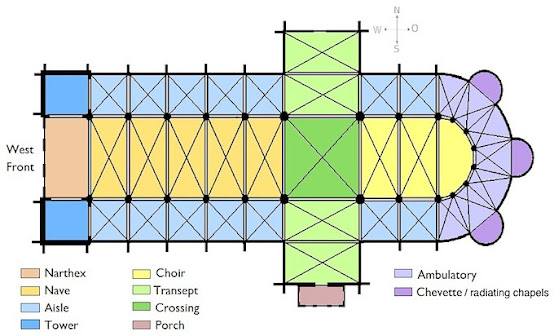
(1) In church architecture, a portico (enclosed passage) at the west end of a basilica or church, usually at right angles to the nave and located between the main entrance and the nave.

(2) In botany, a taxonomic genus within the family Apiaceae (umbelliferous plants), now included in Ferula, Narthex asafoetida and thus obsolete.

1665-1675: From the Medieval Latin narthex, from the Medieval Greek narthex (enclosed porch, enclosure (the earlier meaning was “box”), from the Ancient Greek νάρθηξ (narthēx) (giant fennel, scourge (and later “casket” (the Modern Greek νάρθηκας (nárthikas)), and, on the basis of the suffix, probably a pre-Greek word.  The connection between the giant fennel plant and boxes is that the fibre from the stems of the plant was used to make boxes.  In Greek, the word was linked also to νάρδος (nárdos) (nard plant, spikenard, nardin, muskroot).  The Modern Greek νάρθηκας (narthekas) long ago relinquished the early senses and now means either the feature in church architecture or the brace of a sprained wrist or sling of a broken arm.  The plant was well known in Greek mythology.  In the Θεογονία (circa 730–700 BC) (Theogonía (the genealogy or birth of the gods)), known in the West as The Theogony, an epic poem of a thousand-odd lines by the (8th-7th century BC) poet Hesod, it was in hollow fennel stalks that Prometheus conveyed fire from Heaven to Earth.  In Armenia the name for a narthex is gavit.  The adjectival form was narthecal and the plural either narthexes or narthices, the English form preferable for most purposes.

Narthexs were part of many early Christian and Byzantine basilicas and churches, located traditionally to the west of the nave and functioned (1) as a lobby area and (2) as the place where penitents were required to remain.  Although the archaeological record suggests there may have been some early churches with annexes or even small separate structures located nearby which fulfilled the latter function, narthexes seem quickly to have been integrated.  That means that structurally and architecturally, a narthex was part of the building but theologically was not, its purpose being to permit those not entitled to admission as part of the congregation (mostly catechumens and penitents) nevertheless to hear the service and (hopefully) be encouraged to pursue communion.

For ceremonies other than services, the narthex was otherwise a functional space, the church’s baptismal font often mounted there and in some traditions (both Eastern & Western) worshipers would sometimes anoint themselves and their children with a daub of holy water before stepping foot in the nave and some branches of the Orthodox Church use the narthex for funeral ceremonies.  There were also architectural variations in the early churches which persisted in larger building and cathedrals, the narthex divided in two, (1) an esonarthex (inner narthex) between the west wall and the body of the church proper, separated from the nave and aisles by a wall, trellis or some other means and (2) an external closed space, the exonarthex (outer narthex), a court in front of the church façade with a perimeter defined by on all sides by colonnades.

In the Western Church, reforms removed the requirement to exclude from services those who were not full members of the congregation which of course meant the narthex was rendered technically redundant.  However, the shape churches had assumed with a narthex included had become part of the tradition of the Church so architects continued to include the space, both as part of the nave structure and something semi-separated.  They attracted a number of names, borrowed mostly from secular buildings including vestibule, porch, foyer, hallway, antechamber, anteroom, entrance, entry, entryway, gateway, hall, lobby, portal & portico, the choice dictated sometimes by local tradition, sometimes by the nature of construction and sometimes, it seems to have been entirely arbitrary.  In the Eastern Orthodox Church, the esonarthex and exonarthex retained distinct liturgical functions, some rituals terminating in the exonarthex while services still exclusively penitential services are usually chanted in the esonarthex.  In dialectal northern English, the casual term for the penitents forced to remain in the narthex was “the narts”.

The NART Ferrari spiders

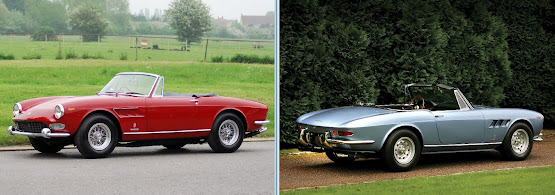
1966 Ferrari 275 GTS

Although Ferrari produced the 275 GTB (berlinetta (coupé)) (1964-1968) and 275 GTS (spider (roadster)) (1964-1966) in unison with substantially the same mechanical specification, the two had completely different coachwork, sharing not one external panel.  Styled by Pininfarina, the 275 GTS, elegant and well-proportioned, recalled the earlier 250 Cabriolets and buyers appreciated the sophistication of the improved specification but Luigi Chinetti (1901-1994), Ferrari's North American distributer, remembering the sensuous lines of the 250 California Spider (1957-1960), asked the factory for a run of spiders (roadsters) based on the 275 GTB.

1960 Ferrari 250 California Spider

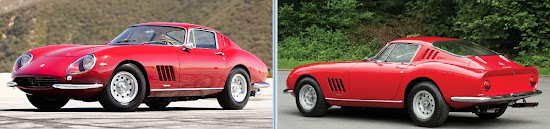
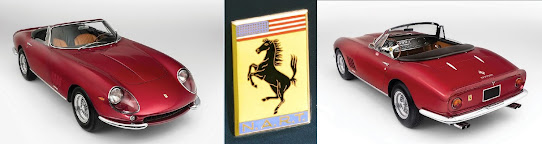
Ferrari commissioned its traditional coachbuilder, Carrozzeria Scaglietti, to produce the series and in 1967, the first tranche of ten of a planned twenty-five was completed and delivered to the United States.  The spiders were based on the newly-released 275 GTB/4 which included a number of refinements to the original series, most notably the twin-cam heads, the factory rating the 3.3 Litre (201 cubic inch) V12 at 300 horsepower, a lift of 20 over the earlier single-cam engines.  Because Chinetti’s competition department was called the North American Racing Team (NART), the ten roadsters have always been referred to as the “NART Spiders” and although the factory never adopted the designation, Chinetti added to the tail of each a small cloisonné badge with the team's logo.  Interestingly, the factory also continued to list the cars as 275 GTB/4s, even though the usual naming convention would have been to designate them as 275 GTS/4s, a hint perhaps from Ferrari that it really wasn’t their idea.

1967 Ferrari 275 GTB/4

The addition of the badge, an unusual addition to anything from Scaglietti workshops, was not unreasonable given the spiders were very much a co-production, Chinetti receiving technical assistance and the precious benefit of official status from the factory but it was made clear that financial responsibility for the project lay exclusively with the US operation which would be required to pay for each prior to delivery.  On that basis things proceeded but, modified from production 275 GTB/4’s with (then typically Italian) labour-intensive coach-building techniques, the spiders were expensive and sales were slow, American buyers more seduced by Ferrari's new and more luxuriously trimmed and cheaper 330 GTS; even then air-conditioning was a persuasive inducement and the more spartan NARTs languished for some months in Chinetti’s showroom waiting for someone with a longing for the ways things used to be done.  As a consequence, it was only that first run of ten which was built but they’ve since become highly prized by collectors, NART #10709 in August 2013 selling at auction for US$27.5 million (including commission) at RM Sotheby's in Monterey, California.

1969 Ferrari 275 GTB/4 NART Spider

Daytona 24 Hours, 1967: First-Ferrari 330 P3/4 (#23; Chris Amon & Lorenzo Bandini), Second-Ferrari 330 P4 (#24; Mike Parkes & Ludovico Scarfiotti and Third-Ferrari 412 P (#26; Pedro Rodriguez & Jean Guichet.

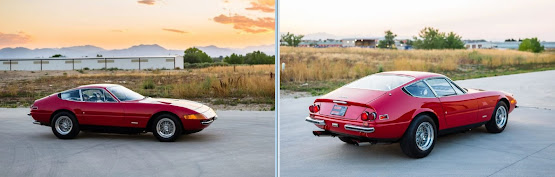
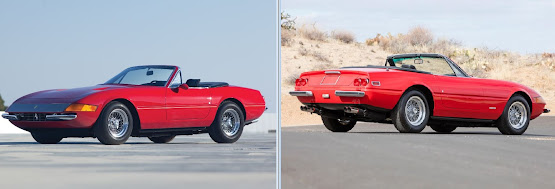
However, despite the modest demand for the NART spiders, Ferrari must have been convinced the concept was viable with full factory backing and when, in 1968, the 275 GTB/4 was replaced with the 365 GTB/4 (1968-1973), a companion spider was listed as an official model, again built by Carrozzeria Scaglietti.  This model came to be known as the Daytona in recognition of Ferrari’s 1-2-3 finish in the 1967 24 Hours of Daytona even though the cars which contested the race were different models, the connection being some photographs from the race which were used in promotional material when the 365 GTB/4 was released.  It was the first new model since the 1-2-3 finish and the name stuck, an attachment about which Ferrari seemed never much enthused although views seem to have softened over the years and "Daytona" appears now even on the corporate website.  The V12 was now 4.4 litres (268 cubic inches) and generating some 340-355 horsepower (depending on market) although the figure on which many fixated was the claimed top speed of 174 mph (280 km/h), the need to out-pace the mark of 171 mph (275 km/h) set by the Lamborghini Miura P400 in 1966 said to be one of the design objectives.  Quite a few verified Ferrari’s claim; few attempted it in the somewhat trickier to handle Miura although contemporary reports confirmed the factory's number.  The Ferrari might actually have gone faster, given enough road.  Luigi Chinetti (1901–1994), who drove the competition version of the Daytona in the 1971 Le Mans 24 hour classic (the last year before the 3.7 mile (6 km) Mulsanne straight was spoiled by the chicanes the FIA imposed) reported than on Mulsanne it never actually stopped accelerating.  Remarkably, the Daytona finished fifth, even winning the mysterious Index of Thermal Efficiency.  Whatever it was, Ferrari must have been content with the thing's terminal velocity but Lamborghini wanted bragging rights and the more powerful Miura P400 S debuted in 1969 with a claim of 180 mph (290 km/h) which Autosport magazine in 1970 almost matched, clocking 288.6 km/h (179.3 mph).  That turned out to be the decade's high-water mark, the succeeding P400 SV more powerful still but a little slower because the aerodynamics were slightly compromised by the need to add a little width to accommodate some needed improvements and the use of fatter tyres which absorbed a surprising amount of energy.  It would be many years before a production car went faster than the P400 S.    

1972 Ferrari 365 GTB/4 (Daytona)

What was however learned from 275 NART experience was that the customers had become sybarites who wanted cars which looked like the austere roadsters of old but fitted with the accruements of modernity, air conditioning, power steering and electric windows.  On that basis the Daytona entered production and in what was by then a much more competitive market, the approach was vindicated, the Daytona close to doubling the sales of its predecessor, including 122 spiders.  Intriguingly, within a few years of the end of Daytona production ending, the realization hit that there wouldn’t again be something like the 365 GTS/4, the days of the big, front-engined V12s thought over and even if one returned, the feeling in the 1970s was that government regulations would be there would be no more roadsters and interest in Daytona spiders began to spike.  With only 122 produced, the math of the supply-demand curve was predictable and prices of spiders soared above the berlinetta, the factory having made more than ten times as many of them.

1971 Ferrari 365 GTS/4 (Daytona)

Thus stimulated was the roofectomy business which had long been part of the coach-building trade but few conversions were potentially as lucrative as a Daytona.  Done properly, the results could be satisfactory but, beyond the roof, there were a number of differences between the two and not all were done properly.  However it’s done, a genuine Scaglietti spider is going to be worth some multiple of a conversion in similar condition, which may now attract little premium over a berlinetta, originality now more of a fetish than it was in the 1970s and 1980s.  In 2013, the New York Times reported Ferrari, unhappy about what they regarded as fakes being traded, were going to try to pressure the high-end auction houses not to host such sales but the industry persists and there are a number of replica 275 NARTs although, not all were based on a twin-cam original, industry sources suggesting a premium above a berlinetta of 20% at most.  Other popular candidates for conversion include the Mercedes-Benz 280 SE 3.5 Coupés (1968-1971; on which an exact conversion is also very challenging), Maserati Ghiblis (1967-1973) and the early Jaguar E-Types, technically a simpler job especially in years gone by when suitable cars were both cheaper and more numerous.

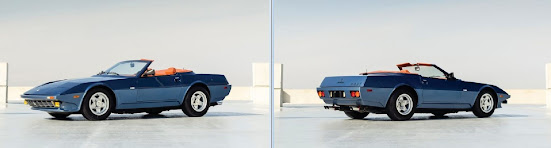
1976 Ferrari 365 GTB/4 NART by Michelotti 

In a footnote to the Daytona’s history, either not discouraged by his experience with the 275 NART or impressed by the prices the ten were commanding, Luigi Chinetti commissioned the construction of five 365 GTB/4 Daytona NART Spiders, the design turned over to Giovanni Michelotti (1921–1980).  In the spirit of 1950s minimalism, Michelotti’s first design, shown at the 1974 Turin Motor Show featured cut-down doors and a removable targa top but the second, built for the 1975 24 Hours of Le Mans, was more a conventional race-car, its lines attuned to aerodynamic enhancement although it never made the event because of a dispute with the notoriously difficult stewards.  Still interested in the concept however, in 1976 Chinetti ordered three more NART Daytonas from Michelotti, configured this time as road-cars with air conditioning and electric windows, the target market the US.  Unlike the 275 NARTs, the three NART Daytonas really were used cars, production of the originals having ceased in 1973.  One of them has been a fixture on the show and auction scene for a while, Michelotti using it as a display piece and it spent two years as an exhibit at the Le Mans Museum before bouncing around the premium auction circuit where it’s exchanged between collectors at increasingly higher prices.  The wedge shape certainly marks the design as a product of the age but so did the detailing: instead of a delicate cloisonné on the tail, NART was printed in big, bold, upper-case letters.

Thursday, May 7, 2020

Gate

Gate (pronunced geyt)

(1) A movable barrier, usually on hinges, closing an opening in a fence, wall, or other enclosure.

(2) An opening permitting passage through an enclosure.

(3) A tower, architectural setting, etc., for defending or adorning such an opening or for providing a monumental entrance to a street, park etc.

(4) Any means of access or entrance.

(5) A mountain pass.

(6) Any movable barrier, as at a tollbooth or a road or railroad crossing.

(7) A sliding barrier for regulating the passage of water, steam, or the like, as in a dam or pipe; valve.

(8) In skiing, an obstacle in a slalom race, consisting of two upright poles anchored in the snow a certain distance apart.

(9) The total number of persons who pay for admission to an athletic contest, a performance, an exhibition or the total revenue from such admissions.

(10) In cell biology, a temporary channel in a cell membrane through which substances diffuse into or out of a cell; in flow cytometry, a line separating particle type-clusters on two-dimensional dot plots.

(11) A sash or frame for a saw or gang of saws.

(12) In metallurgy, (1) a channel or opening in a mold through which molten metal is poured into the mold cavity (also called ingate) or (2), the waste metal left in such a channel after hardening; (written also as geat and git).

(13) In electronics, a signal that makes an electronic circuit operative or inoperative either for a certain time interval or until another signal is received, also called logic gate; a circuit with one output that is activated only by certain combinations of two or more inputs.

(14) In historic British university use, to punish by confining to the college grounds (largely archaic).

(15) In Scots and northern English use, a habitual manner or way of acting (largely archaic).

(16) A path (largely archaic but endures in historic references).

(17) As a suffix (-gate), a combining form extracted from Watergate, occurring as the final element in journalistic coinages, usually nonce words, that name scandals resulting from concealed crime or other alleged improprieties in government or business.

(18) In cricket, the gap between a batsman's bat and pad, used usually as “bowled through the gate”.

(19) In computing and electronics, a logical pathway made up of switches which turn on or off; the controlling terminal of a field effect transistor (FET).

(20) In airport or seaport design, a (usually numerically differentiated) passageway or assembly point with a physical door or gate through which passengers embark or disembark.

(21) In a lock tumbler, the opening for the stump of the bolt to pass through or into.

(22) In pre-digital cinematography, a mechanism, in a film camera and projector, that holds each frame momentarily stationary behind the aperture.

(23) A tally mark consisting of four vertical bars crossed by a diagonal, representing a count of five.

Pre 900:  From the Middle English gate, gat, ȝate & ȝeat, from the Old English gæt, gat & ġeat (a gate, door), from the Proto-Germanic gatą (hole, opening).  It was cognate with the Low German and Dutch gat (hole or breach), the Low German Gatt, gat & Gööt, the Old Norse gata (path) and was related to the Old High German gazza (road, street).  Yate was a dialectical form which was an alternative spelling until the seventeenth century; the plural is gates.  Many European languages picked up variations of the Old Norse to describe both paths and what is now understood as a gate.  The Old English geat (plural geatu) was used to mean "gate, door, opening, passage, hinged framework barrier", as was Proto-Germanic gatan, and the Dutch gat; in Modern German, it emerged as gasse meaning “street”; the Finnish katu, and the Lettish gatua (street) are Germanic loan-words.  Interestingly, scholars trace the ultimate source as the Primitive European ǵed (to defecate).

The meaning "money from selling tickets" dates from 1896, a contraction of 1820’s gate-money.  The first reference to uninvited gate-crashers is from 1927 and gated community appears in 1989; that was Emerald Bay, Laguna Beach, California although conceptually similar defensive structures had for millennia been built in many places.

G Gordon Liddy (1930–2021) was the CREEP lawyer convicted of conspiracy, burglary, and illegal wiretapping for his role in the Watergate Affair.  Receiving a twenty-year sentence, he served over four, paroled after Jimmy Carter (b 1924; US President 1977-1981) commuted the term to eight years.  He was one of the great characters of the affair.

The practice of using -gate as a suffix appended to a word to indicate a "scandal involving," is a use abstracted from Watergate, the building complex in Washington DC, which, in 1972, housed the national headquarters of the Democratic Party.  On 17 June, it was burgled by operatives found later to be associated with Richard Nixon's (1913-1994; US president 1969-1974) Campaign to Re-elect the President committee (CREEP).  Since Watergate, there have been at least dozens of –gates.

Notable Post-Watergate Gates

Billygate: In 1980, US President Jimmy Carter's brother, Billy (1937-1988), was found to have represented the Libyan government as a foreign agent.  Cynics noted that, unlike his brother, Billy at least had a foreign policy.  Crooked Hillary Clinton (b 1947; US secretary of state 2009-2013) has provided the lexicon many "-gates".

A marvelous linguistic coincidence gave us Whitewatergate, a confusing package of real estate deals later found technically to be lawful and Futuregate was a reference to some still inexplicable (and profitable) dabbles in her name in the futures markets.  Servergate was the mail server affair which featured mutually contradictory defenses to various allegations, the Benghazi affair and more.  There was also a minor matter but one which remains emblematic of character.  Crooked Hillary Clinton, after years of fudging, was forced to admit she “misspoke” when claiming that to avoid sniper-fire, she and her entourage “…just ran with our heads down to get into the vehicles to get to our base” when landing at a Bosnian airport in 1996.  She admitted she “misspoke” only after a video was released of her walking down the airplane’s stairs to be greeted by a little girl who presented her with a bouquet of flowers.  Even her admission was constructed with weasel words: “…if I misspoke, that was just a misstatement”.  That seemed to clear things up and the matter is now recorded in the long history of crooked Hillary Clinton's untruthfulness as Snipergate.  Most bizarre was Pizzagate, a conspiracy theory that circulated during the 2016 US presidential campaign, sparked by WikiLeaks publishing a tranche of emails from within the Democrat Party machine.  According to some, encoded in the text of the emails was a series of messages between highly-placed members of the party who were involved in a pedophile ring, even detailing crooked Hillary Clinton’s part in the ritualistic sexual abuse of children in the basement of a certain pizzeria in Washington DC.  Among the Hillarygates, pizzagate was unusual in that she was innocent of every allegation made; not even the pizzeria's basement existed.

Closetgate: References the controversy following the 2005 South Park episode "Trapped in the Closet", a parody of the Church of Scientology in which the Scientologist film star Tom Cruise (b 1962) refuses to come out of a closet.  Not discouraged by the threat of writs, South Park later featured an episode in which the actor worked in a confectionery factory packing fudge. 

Grangegate: In Australia in 2014, while giving evidence to the state's Independent Commission against Corruption (ICAC), Barry O'Farrell (b 1959; Premier of New South Wales 2011-2014) forget he’d been given a Aus$3,000 bottle of Penfolds Grange (which he drank without disclosing the gift as the rules required).  He felt compelled to resign.

Perhaps counterintuitively, there seems never to have been a Lindsaygate or LohangateIn that sense, Lindsay Lohan may be said to have lived a scandal-free life.

Irangate: Sometimes called contragate, this was the big scandal of Ronald Reagan's (1911-2004; US president 1981-1989) second term.  As a back channel operation, the administration had sold weapons to the Islamic Republic of Iran and diverted the profits to fund the Contra rebels opposing the Sandinista government of Nicaragua.  Congress had earlier cut the funding.

Nipplegate: Sometimes called boobgate, this was a reaction to singer Janet Jackson’s (b 1966) description of what happened at the conclusion of her 2004 Superbowl performance as a “wardrobe malfunction”.  In Europe, they just didn't get what all the fuss was about.

Monicagate: The most celebrated scandal of President Bill Clinton’s (b 1946; US President 1993-2001) second term.  Named after White House intern Monica Lewinsky (b 1973), with whom the president “…did not have sexual relations…”.

1973 Pontiac Trans-Am SD-455.

Dieselgate: In 2015, Volkswagen was caught cheating on emissions tests used to certify for sale some eleven-million VW diesel vehicles by programming them to enable emissions controls during testing, but not during real-world driving.  Manufacturers had been known to do this.  In 1973 Pontiac tried to certify their SD-455 (Super Duty)  engine with a not dissimilar trick but the EPA (Environmental Protection Authority) wasn't fooled which is why the production SD-455 was rated at 290 HP (horsepower) rather than 310.  Later, manufacturers in the Fourth Reich turned out to be just as guilty and, in that handy phrase from German historiography "they all knew".  Including the fines thus far levied, legal fees and the costs associated with product recalls, the affair is estimated so far to have cost VW some US$27 billion but the full accounting won't be complete for some time.  Other German manufacturers were also affected but Daimler (maker of Mercedes-Benz) avoided a penalty by snitching on the others. 

In Australia, Utegate was a 2009 campaign run by opposition leader Malcolm Turnbull (b 1954; prime-minister of Australia 2015-2018) and his then (they're no longer on speaking terms) henchman, Eric Abetz (b 1958, Liberal Party senator for Tasmania, Australia 1994-2022), which accused Dr Kevin Rudd (b 1957; Australian prime-minister 2007-2010 & 2013) of receiving a backhander from a car dealer, the matters in question revolving around an old and battered ute (pick-up).  Based on documents forged by Treasury official Godwin Grech (b 1967), it led to the (first) downfall of Turnbull.  Abetz went on to bigger things but Turnbull neither forgot nor forgave, sacking Abetz during his second coming (which started well but ended badly).  Abetz however proved he still has the numbers which matter, gaining preselection and in 2024 winning a seat in the Tasmanian Legislative Assembly (the state's lower house).  He now serves as minister for business, industry & resources and minister for transport as well as leader of the house in the minority Liberal Party government.  

The first Nutellagate arose at Columbia University early in 2013 with allegations of organized, large-scale theft by students of the Nutella provided in the dining halls. Apparently students, unable to resist the temptation of the newly available nutty spread, were (1) consuming vast quantities, (2) pilfering it using containers secreted in back-packs and (3) actually purloining entire jars from the tables.

In the spirit of the investigative journalism which ultimately brought down Richard Nixon, the Columbia Daily Spectator, breaking the story, reported that based on a leak from their deep throat in the catering department, the crime was costing some US$5,000 per week, the hungry students said ravenously to be munching their way through around 100 pounds (37 or 45 KG (deep throat not specific whether the losses were weighed on the avoirdupois or troy scale)) of Nutella every seven days.  The newspaper noted the heist was on such a scale that, unless addressed, the cost to the university would be US$250,000 a year, enough to buy seven jars for every undergraduate student.

The national media picked up the story noting, apart from the criminality, there were concerns about the relationship between the wastage of food, excessively expensive student services, the exorbitant cost of tuition fees and a rampant consumer culture.  It seemed a minor moral panic might ensue until the student newspaper (now a blog) deconstructed the Spectator’s numbers and worked out the caterers must be paying 70% more for Nutella than that quoted by local wholesalers, casting some doubt on the matter.  The university authorities responded within days, issuing a press release headed “Nutellagate Exposed: It's a Smear!"  Their audit revealed that the accounting system had booked US$2,500 against Nutella purchases in the first week of term but that was the usual practice when stocking inventory and that consumption was around the budgeted US$450 in subsequent weeks.  Deep throat (Nutella edition) lost face and was discredited.

Nutellagate II broke in 2017 when a consumer protection organization released a report noting the recipe had, without warning, been changed, the spread now having more sugar and milk powder but less cocoa and, as a result, was now of a lighter hue.  Ferrero’s crisis-management operative responded on twitter, tweeting “our recipe underwent a fine-tuning and continues to deliver the Nutella fans know and love with high quality ingredients,”… adding “…sugar, like other ingredients, can be enjoyed in moderation as part of a balanced diet.”

#Nutellagate soon trended and users expressed displeasure, many invoking the memory of New Coke or the IBM PS/2, two other products which appeared also to try to fix something not broken.  The twitterstorm soon subsided, the speculation being that, because it contained more sugar, consumers would become more addicted and soon forget the fuss.  So it proved, sales remaining strong.  Nutella though remains controversial because of the sugar content and the use of palm oil, a product harvested from vast monocultural plantations and associated with social and environmental damage.  Ferrero has now and again suggested they may be ceasing production but the user base has proved resistant although, recent movements in the hazelnut price may test the elasticity of demand.

Open-Gate Ferraris

The much admired but now almost extinct open-gate shifters were originally purely functional before becoming fetishized.  At a time when more primitive transmissions and shifter assemblies were built with linkages and cables which operated with much less precision than would come later, the open-gates served as a guidance mechanism, making the throws more uniform and ensuring the correct movement of the controlling lever.  Improvements in design actually made open-gates redundant decades ago but they'd become so associated with cars such as Ferraris and Lamborghinis that they'd become part of the expectations of many buyers and it wasn't hard to persuade the engineers to persist, even though the things had descended to be matters purely of style.  A gimmick they may have become but, cut from stainless steel and often secured with exposed screw-heads, they were among the coolest of nostalgia pieces.  

Reality eventually bit when modern, fast electronics meant automatic transmissions both shifted faster and were programmed always to change ratios at the optimal point and no driver however skilled could match that combination.  Once essential to quick, clear shifts, by the late 1990s, the open-gate had actually become a hindrance to the process and while there were a few who still relished the clicky, tactile experience, such folk were slowly dying off and with sales in rapid decline, manufacturers became increasingly unwilling to indulge them with what had become a low-volume, unprofitable option.  

Not all the Ferraris with manual gearboxes used the open-gate fitting, some of the grand-touring cars using concealing leather boots but both are now relics, the factory recently retiring the manual gearbox because of a lack of demand.  The 599 GTB Fiorano was made between 2006-2012 and included the option but of the 3200-odd made, only 30 buyers specified the manual.  That run of 30 was however mass-production compared with the California (2009-2014) which was both the first Ferrari equipped with a dual-clutch transmission and the last to offer a manual, ending the tradition of open gate-shifters which stretched back 65 years.  Testing the market, a six-speed manual option had been added to the hard-top convertible in 2010 and the market spoke, the factory dropping it from the order sheet in 2012 after selling just three cars in three years.  The rarity has however created collectables; on the rare occasions an open gate 599 or California is offered at auction, they attract quite a premium and there's now an after-market converting Ferraris to open gate manuals.  It's said to cost up to US$40,000 depending on the model and, predictably, the most highly regarded are those converted using "verified factory parts".

2012 Ferrari California (top) and 2012 Cadillac CTS-V sedan.

So the last decade at Maranello has been automatic (technically “automated manual transmission”) all the way and although a consequence of the quest for ultimate performance, it wasn’t anything dictatorial and had customer demand existed at a sustainable level, the factory would have continued to supply manual transmissions.  There is however an alternative, Cadillac since 2004 offering some models with manual transmission for the first time since the 1953 Series 75 (among the Cadillac crowd the Cimarron (1982-1988) is never spoken of except in the phrase "the unpleasantness of 1982" ) and by 2013, while one could buy a Cadillac with a clutch pedal, one could not buy such a Ferrari.  For most of the second half of the twentieth century, few would have thought that anything but improbable or unthinkable.

Ferrari open-gate shifter porn 

1965 250 LM

1967 330 GTC

1968 275 GTS/4 NART Spyder

1969 365 GTC

1972 365 GTB/4

1988 Testarossa

1991 Mondial-T Cabriolet

1994 348 Spider

2011 599 GTB Fiorano

2012 California