Showing posts sorted by relevance for query Scoop. Sort by date Show all posts

Friday, February 19, 2021

Scoop

Scoop (pronounced skoop)

(1) A ladle or ladle-like utensil, especially a small, deep-sided shovel with a short, horizontal handle, for taking up flour, sugar etc.

(2) A utensil composed of a palm-sized hollow hemisphere attached to a horizontal handle, for dishing out ice cream or other soft foods.

(3) A hemispherical portion of food as dished out by such a utensil.

(4) The bucket of a dredge, steam shovel etc.

(5) In medicine, a spoon-like surgical apparatus for removing substances or foreign objects from the body; a special spinal board used by emergency department staff that divides laterally (ie literally “scooping up” patients).

(6) A hollow or hollowed-out place.

(7) The act of ladling, dipping, dredging etc.

(8) The quantity held in a ladle, dipper, shovel, bucket etc.

(9) In journalism, a news item, report, or story revealed in one paper, magazine, newscast etc before any other outlet; in informal use, news, information, or details, especially as obtained from experience or an immediate source.

(10) A gathering to oneself, indicated usually by a sweeping motions of the hands or arms.

(11) In informal use, a big haul of something.

(12) In television & film production, a single-lens large floodlight shaped like a flour scoop and fitted with a reflector.

(13) To win a prize, award, or large amount of money.

(14) In bat & ball sports, to hit the ball on its underside so that it rises into the air.

(15) In hydrological management, a part of a drain used to direct flow.

(16) In air-induction management (to the engines in cars, boats, aircraft etc), a device which captures external the air-flow and directs it for purposes of cooling or combustion.

(17) In Scots English, the peak of a cap.

(18) In pinball, a hole on the playfield that catches a ball, but eventually returns it to play in one way or another.

(19) In surfboard design, the raised end of a board.

(20) In music (often as “scoop up”), to begin a vocal note slightly below the target pitch and then to slide up to the target pitch, prevalent particularly in country & western music.

1300–1350: From the Middle English scope & schoupe, from the Middle Dutch scoep, scuep, schope & schoepe (bucket for bailing water) and the Middle Dutch schoppe, scoppe & schuppe (a scoop, shovel (the modern Dutch being schop (spade)), from the Proto-Germanic skuppǭ & skuppijǭ, from the primitive Indo-European kep & skep- (to cut, to scrape, to hack).  It was cognate with the Old Frisian skuppe (shovel), the Middle Low German schōpe (scoop, shovel), the German Low German Schüppe & Schüpp (shovel), the German Schüppe & Schippe (shovel, spade) and related to the Dutch schoep (vessel for baling).  The mid-fourteenth century Middle English verb scōpen (to bail out, draw out with a scoop) was from the noun and was from the Middle Low German schüppen (to draw water), from the Middle Dutch schoppen, from the Proto-Germanic skuppon (source also of the Old Saxon skeppian, the Dutch scheppen, the Old High German scaphan and the German schöpfen (to scoop, ladle out), from the primitive Indo-European root skeubh- (source also of the Old English sceofl (shovel) and the Old Saxon skufla.

Sherman L Kelly's (1869–1952) ice-cream scoop (the dipper; 1935) was a masterpiece of modern industrial design and thought sufficiently aesthetically pleasing to be a permanent exhibit in New York's Museum of Modern Art (MoMA).  Its most clever feature was the fluid encased in the handle; being made from cast aluminum, the heat from the user's hands was transferred to the cup, obviating the need for the moving parts sometimes used to separate the ice-cream for dishing out.  The dipper is like the pencil, one of those designs which really can't be improved.  In the industry, the technical term for the small but annoyingly intrusive globule of ice cream which appears at the base of a scoop is “skirt”.  Some manufacturers of ice cream scoops (the advertising folk also like “scooper”) promote their product's ability to avoid “over-serving & wasteful skirt”.

A New York Post scoop, 29 June 2007.  This was the Murdoch press's biggest scoop since the publication in 1983 of the "Hitler Diaries".  The "diaries" turned out to be forgeries; the picture of Lindsay Lohan resting in a Cadillac was genuine.

The meaning “hand-shovel with a short handle and a deep, hollow receptacle” dates from the late fifteenth century while the extended sense of “an instrument for gouging out a piece” emerged by 1706 while the colloquial use to mean “a big haul” was from 1893.  The journalistic sense of “the securing and publication of exclusive information in advance of a rival” was an invention of US English, first used in 1874 in the newspaper business, echoing the earlier commercial verbal slang which imparted the sense of “appropriate so as to exclude competitors”, the use recorded in 1850 but thought to be considerably older.  The meaning "remove soft or loose material with a concave instrument" dates from the early seventeenth century while sense of “action of scooping” was from 1742; that of “amount in a scoop” being from 1832.  The noun scooper (one who scoops) was first used in the 1660s and the word was adopted early in the nineteenth century to describe “a tool for scooping, especially one used by wood-engravers”, the form the agent noun from the verb scoop.  Scoop is a noun & verb, scooper & scoopful are nouns and scooped & scooping are verbs; the noun plural is scoops.

XPLR//Create’s fluid dynamics tests comparing the relative efficiency of ducts (left) & scoops (right).

In air-induction management (to the engines in cars, boats, aircraft etc), a scoop is a device which captures external the air-flow and directs it for purposes of cooling or combustion.  An air scoop differs from an air duct in that a scoop stands proud of a structure's surface allowing air to be "rammed" into its ducting while a duct is an aperture integrated into the structure, "sucking" air in from the low pressure zone created by its geometry.  For a given size of aperture, a scoop can achieve an airflow up to twice that of a duct but that doesn't of necessity mean as scoop is always preferable, the choice depending on the application.  In situations where optimal aerodynamic efficiency is desired, a duct may be chosen because scoops can increase frontal area and almost always, regardless of placement, leave a wake of turbulent air, further increasing drag.  It's thus one of those trade-offs with which engineers are familiar: If a scoop is used then sufficient air is available for purposes of cooling & combustion but at the cost of aerodynamic efficiency while if a duct is fitted, drag is reduced but the internal air-flow might be inadequate.

NACA Ducts: 1969 Shelby Mustang GT500 (left), 1971 Ford Mustang Mach 1 351 (centre) & 1972 Ford Falcon GTHO Phase IV (Right).

When Ford introduced NACA ducts on the 1971 Mustangs (subsequently adopted by Ford Australia for the XB (1973-1976) & XC (1976-1979) Falcon), whether in error or to take advantage of the public’s greater “brand-awareness” of the National Aeronautics & Space Administration (NASA), they were promoted as “NASA ducts”.  In fairness, the two institutions were related, NASA created in 1958 after the National Advisory Committee for Aeronautics (NACA) was dissolved, the process essentially a name change although much had changed since the NACA’s formation in 1915, the annual budget then US$5000 and the dozen committee members unpaid.  The NACA duct was one of many innovations the institution provided to commercial and military aviation and in the post-war years race cars began to appear with them, positioned variously to channel air to radiators, brakes and fuel induction systems as required.

Scoops: 1969 Ford Mustang Boss 429 (left), 1969 Ford Mustang Mach 1 428 CobraJet (with shaker scoop) (centre) & 1974 Pontiac Trans Am 455 SD (with rearward-facing scoop) (right).

From those pragmatic purposes, the ducts migrated to road cars where often they were hardly a necessity and, in some cases, merely decorative, no plumbing sitting behind what was actually a fake aperture.  Scoops appeared too, some appearing extravagantly large but there were applications where the volume of air required was so high that a NACA duct which would provide for the flow simply couldn’t be fashioned.  That said, on road cars, there were always suspicions that some scoops might be fashionably rather than functionally large, the lines drawn in the styling and not the engineering office.  There was innovation in scoops too, some rearward facing to take advantage of the inherently cool, low pressure air which accumulated in the cowl area at the base of the windscreen although the best remembered scoops are probably the “shakers”, assemblies protruding through a hole in the hood (bonnet) and attached directly to the air-cleaner which sat atop the carburetor, an arrangement which shook as the engine vibrated.  By such things, men are much amused.

The inaugural meeting of the NACA (National Advisory Committee for Aeronautics), 23 April 1915.

The NACA remains a useful case-study in the way a bureaucracy can contribute first to the development of an ecosystem which enables the institution's growth yet ultimately outlives its purpose in the sense of becoming a victim of its own success.  When World War I (1914-1918) war broke out, the US army possessed only 23 aircraft (at a time when France possessed 1,400 airplanes, Germany 1,000 and Russia 800), reflecting the historic view in Washington DC that aviation was an amusing diversion for the rich rather than a strategic matter for government.  Rapidly, the blast of war changed that view and in the way these things still are done, Congress added a rider to Navy appropriation legislation that established the NACA; to this day the first response of politicians is to form a committee.  In that spirit the NACA soon established four expert sub-committees to focus on the fields it had recognized as critical: airframe structures, aerodynamics, methods of propulsion and aircraft operations.  The NACA’s original mandate was (loosely) to coordinate the nation’s efforts in aeronautical research but because in the inter-war years both military and civilian aviation rapidly advanced and new industries emerged, the committee soon was transformed into an independent research organization with labs and workshops staffed by engineers, scientists and technicians, its wind tunnels, the biggest and best in the US.  Even prior to the outbreak of World War II (1939-1945), NACA was spread over multiple sites and, in conjunction with industry, universities and the military, it made substantial contributions to supersonic flight, jet propulsion and improvements to airframes.  The NACA was disbanded in 1958 to become the foundation for the National Aeronautics and Space Administration (NASA), the creation of which was prompted by the shock caused by the Soviet’s successful launch of Sputnik 1 in October, 1957.

The NACA's "C" being removed to make way for the NASA's "S", NASA’s Aircraft Engine Research Laboratory, Cleveland, Ohio, 1958.

One potential economy which could have been achieved by the re-branding in 1958 was the signage on the buildings would have demanded only the scrapping of the “C” and its replacement with a “S”.  That sounds DOGE (Department of Government Efficiency) friendly but lateral-thinker Elon Musk (b 1971) would probably have suggested the name should have been National Aeronautics and Cosmic Administration, thus meaning the signage could stay.  As things turned out, NASA got a new logo.  Compared with some of the NACA’s contributions (which led ultimately to the space program) the NACA duct seems slight but after it first appeared on race cars in the 1960s it became well-known although when a pair were included on the 1971 “ram-air” Mustangs, Ford’s advertising agency promoted it as the “NASA duct” undoubtedly because the Moon-landings had made NASA famous while NACA was known to few.

Shelby American Mustang GT500: 1969 (left) and 1970 (right).

The 1969 & 1970 Shelby Mustangs featured an impressive five NACA ducts on the hood (three to let air in, two to allow it to escape) and one able to admire them was Connie Kreski (1946-1995, left) who received a pink GT500 as her prize for being judged Playboy magazine’s PotY (Playmate of the Year), an honor the photographs suggest richly she deserved.  Five NACA ducts is at least three more than most cars in the era had but one owner of a 1970 GT500 (right) decided it just wasn’t enough and added a scoop atop.  It was a era of annual styling changes but the reason the 1969 & 1970 Shelby Mustangs look so similar is that Shelby American and Ford agreed not to continue production in 1970 but because there was an unsold stock of 798 1969 cars, they were (under the supervision of the FBI (Federal Bureau of Investigation)) issued new VINs (vehicle identification numbers) and sold as 1970 models.  Visually, the only things which distinguish the 1970 cars are a chin spoiler and two black hood (bonnet) strips which pass over the outer pair of NACA ducts.  The owner of the green car (not in the sense Greta Thunberg (b 2003) uses the phrase) must have decided the stripes and spoiler might have detracted from the impact of the big scoop. 

Japanese gold-lined sugar scuttle & sugar scoop with laurel leaf detailing (circa 1970s, left) and William IV sterling silver sugar bowl (1832) by John Fry II, London, England (right).

Sugar scoops are used to scoop sugar from a “sugar scuttle” whereas if one’s sugar is in a “sugar bowl”, a “sugar spoon” is used.  A lump of sugar is handled with a pair of “sugar tongs” (another of those cases in which the nominally plural “pair” is correct when describing a singular object because the first “pairs of tongs” literally were “two tongs” manipulated in unison.  The difference between a “sugar spoon” and a “tea spoon” is the former has a deeper and usually more rounded bowl and most are supplied as part of a “tea set” or “tea service”, often with the same decorative elements.  Among antique dealers, all are often bundled for sale with a tea tray” although in many instances, such agglomerations are a case of “mix & match”.

Jaguar E-Type: S1 with covered headlight (left), S1.25 with early "sugar scoop" (centre) and S2 with later "sugar scoop" (right). 

After the Jaguar E-type's (1961-1974; sometimes known in the US as XK-E or XKE) lovely headlight covers were legislated to extinction by the newly created US DOT (Department of Transportation, established by an act of Congress on 15 October 1966 and beginning operation on 1 April 1967), the replacement (uncovered) apparatus came to be called the “sugar scoop”, a term earlier used for the Volkswagens & Porsches sold in North America US market which had to be fitted with sealed-beam headlights because of protectionist rules designed for the benefit of US manufacturers.  The use of “sugar scoop” for the E-Type was appropriate because the visual link with the utensil was much more obvious than on the Volkswagens & Porsches.

UUA 368 is an Australian-registered 1968 (S2) Jaguar E-Type and is available for hire at a daily rate of Aus$890.00 (including 200 km (124 miles)); the hire company has dubbed her (the car) "Penelope".  Not all jurisdictions allow the registration plate to be painted on the hood (bonnet), a practice made famous in 1961 by the photographs of 9600 HP, a pre-production E-Type used as one of the factory’s original press-cars.  It was 9600 HP which The Autocar magazine took to Belgium, successfully verifying the then astonishing claim of a top speed of 150 mph (241 km/h) although, years later, it was revealed there had been a few subtle tweaks and an E-Type off the showroom floor wouldn’t quite hit the magic number.  Painting the registration on the hood avoided disfiguring the lovely lines with a plate (no flat surfaces on the front of an E-Type) and many followed the lead, some places allowing it, some not.  A S2 E-Type, UUA 368 has the more elevated of the two styles of open headlight but, being delivered in Australia, it retains the triple SU carburettors by then denied to customers in North America so its response will be more lively, especially above 100 mph (160 km/h).

The lure of the headlight covers: 1973 E-Type with headlight covers subsequently added (left) and with the original "sugar scoops" (left).  These are US market cars with the additional "dagmars" appended to the bumperettes.  Even by 1973, thin whitewall tyres were still a popular option on US Jaguars and they remained available until the last were sold in 1975 but the wide whitewalls often supplied in the early 1960s had long fallen from favor.  Although the judges in the JCNA (Jaguar Clubs of North America) confederation are usually uncompromising members of the originality police, they make a rare exception in usually not deducting points from late-build S1 (1967) E-Types (the so-called S1.25 & S1.5) which have been fitted with the headlight covers.  Although the covers never appeared on the S3 E-Types, their presence clearly doesn't dissuade buyers because the S3 pictured above (left), in February, 2021 sold at auction for US$230,000.  It was an exceptionally low-mileage example (8000-odd miles (13,000 km)) but even given that it represented an impressive premium for what was a "modified" vehicle. 
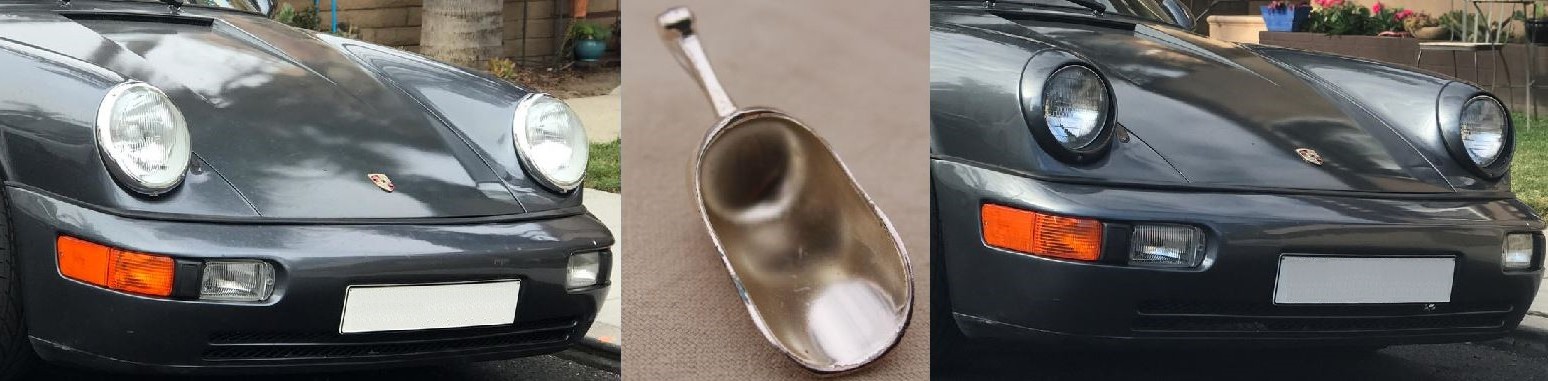
A US market 1977 Porsche 911 (1964-1989), fitted with the front bumper assembly of a later 911 (964 (1989-1994)):  The original “sugar scoops” are seen on the right and the replacement Hella H4 lights are to the left (in RoW (rest of the world) cars both H2 & H4 units were fitted).  Conceptually identical, a sugar scoop (centre) is similar in form to some smaller "coal scuttles", differing only in scale.

Sunday, May 24, 2020

Cellar

Cellar (pronounced sel-er)

(1) A room or set of rooms, for the storage of food, fuel etc, wholly or partly underground and usually beneath a building.

(2) As “wine cellar”, an underground room in wine is stored (now often built above ground but still referred to as “wine cellar”); as “cellar”, a stock of bottled wines.

(3) As “cellar dweller(s)”, in the slang of competitive sport, a reference to teams in the lowliest reaches of the points ladder.

(4) As a verb, to store something (usually wine) in a cellar.

(5) As “salt cellar”, (1) a historical term for a small dish used for holding salt to be dispensed by a spoon & (2) an alternative (if historically misleading) term for what tends in modern use (initially especially in North America but later more generally) to be called a “salt shaker”.

1175–1225: From the Middle English celer and the Old French celier (“salt box” which survives in Modern French as cellier) from the Anglo-French & Latin cellārium (pantry; storeroom (literally group of cells”)), the construct being cell(a) + -ārium, the later re-spelling adopted to reflect the Latin form.  The fifteenth century English saler is from the Old French salier (salière in Modern French), from the Latin salarius (relating to salt) from the Latin sal (salt).  The Latin salarium was a noun use of the adjective meaning "pertaining to salt," again derived from the Latin sal (salt) from the primitive Indo-European sal- (salt).  The sense "room under a house or other building, mostly underground and used for storage" gradually emerged in late Middle and early Modern English, cellar-door attested by 1640s.  The somewhat clumsy noun cellarer (the person, usually in a monastery, responsible for providing food and drink) appears to have gone extinct by the late eighteenth century.

Of cellars, jugs, pots, mills & all that

Lindsay Lohan with milk jug, preparing a Pilk.  A Pilk is a mix of Pepsi Cola and milk, one of a class of beverages created by the Pepsi Corporation called Dirty Sodas which includes the Naughty & Ice, the Chocolate Extreme, the Cherry on Top, the Snow Fl(oat) and the Nutty Cracker.  All are intended to be served with cookies (biscuits).

In English, to describe the containers in which small quantities of stuff (as opposed to bulk-storage such as a bin) was stored, a variety of terms evolved.  Ground pepper is stored in a pepper pot which is shaken; whole or cracked peppercorns being stored in a pepper mill (often now called a pepper grinder) which is ground.  Ground salt is stored in a salt cellar and should be dispensed with a spoon whereas if shaken from a container it's best called a salt shaker; salt crystals are stored in a salt mill (often now called a salt grinder) which is ground.  Sometimes, the pepper pot and salt cellar are kept in a receptacle called a condiment caddy.  Ink, if used by directly dipping in a nib or quill end, is kept in an inkwell; if bought from a shop, it is sold in an ink pot, the latter more recent and, with the decline of writing with ink, now more prevalent.  Gravy is served in a gravy boat.  A ramekin is a small bowl used for preparing and serving individual portions of a variety of dishes, including crème brûlée, soup, molten cakes, moin moin, cheese or egg dishes, poi, macaroni and cheese, lasagna, potted shrimps, ice cream, soufflé, baked cocottes, crumbles, chakra póngal, or scallops, or used to serve side garnishes and condiments alongside an entrée.  Biscuits are kept in a biscuit barrel.  Tea is kept in a tea caddy, milk is served from a milk jug and sugar is taken from a sugar bowl with tongs if in lumps and if in crystals, is taken with a spoon or sprinkled from a caster or, more rarely, a sifter. Liquid condiments such as olive oil and balsamic vinegar are served from a cruet.  Soups and stews are served in a tureen and dispensed with a ladle.

Japanese gold-lined sugar scuttle & sugar scoop with laurel leaf detailing (circa 1970s, left) and William IV Sterling Silver Sugar Bowl, John Fry II, London, England, 1832 (right).  Sugar scoops are used to scoop sugar from a “sugar scuttle” whereas if one’s sugar is in a “sugar bowl”, a “sugar spoon” is used.  The difference between a “sugar spoon” and a “tea spoon” is the former has a deeper and usually more rounded bowl and most are supplied as part of a “tea set” or “tea service”, often with the same decorative elements.

The word ladle is the subject of one of the more curious definitional disputes in English.  A ladle is thought by most reasonable folk to be a specialized spoon but there are pedants of gastronomy who insist that while ladles have a spoon-shaped bowl, the angle of the handle (which can be so acute as to be perpendicular to the bowl) means they are so different to every other spoon that they can be used only for ladling, not spooning.  The etymological evidence offered is that the Middle English ladel is from the Old English hlædel, derived from the Proto-Germanic hlaþaną (to load), derived from several primitive Indo-European sources which meant “to put”, “lay out”, to spread” and, the Old English hlædel (a glossing of the Latin antlia (pump for drawing water)) is from hladan (to load; to draw up water).  It’s less a technical point than a social class signifier known probably only to etymologist and the more snobby maîtres d'hôtel.

Saliera (salt cellar) circa 1542 by Benvenuto Cellini (1500-1571), Kunsthistorisches Museum, Wien.

In addition to the works he completed, Italian sculptor and goldsmith Benvenuto Cellini remembered for his vividly written autobiography, a few of the more extravagant tales suggesting some unreliability of memory but the four murders to which he confesses are undisputed and well-documented.  Convinced of his own greatness, which he did not seek to conceal from his readers, his virtues and vices he seems to suggest were the essential qualities of his genius and for an abundance of one he should be forgiven the excesses of the other.  Friends in high places seemed to agree.  Thanks repeatedly to the interventions of well-placed men of influence, including many cardinals and more than one pope, he was able either to escape punishment or secure pardons and early release from the imprisonment imposed for many of his crimes which, as well as the murders, included sodomy of both young men and women, one of whom in Paris filed a complaint accusing him of using her "after the Italian fashion".

A mannerist masterpiece, the memorable Saliera (salt cellar) is some 10" (250 mm) high and 13" (330 mm) wide, sculpted by hand from rolled gold, resting on a base of ebony into which are installed ivory bearings to permit it to be rolled between guests, around the table.  It represents the gods of the earth and sea, their legs intertwined and thought to suggest “those lengthier branches of the sea which run up into the continents”.  A small boat in which to store the salt floats next to the sea god while a temple for peppercorns sits next to the earth goddess, the figures on the base noting the winds and times of day.  When Cellini presented the piece he made no mention of the names of the figures and only later would they be identified as Neptune and Tellus.

Saturday, January 18, 2025

Blister

Blister (pronounced blis-tah or blis-ter)

(1) A thin vesicle on the skin, containing watery matter or serum and induced typically by caused by friction, pressure, burning, freezing, chemical irritation, disease or infection.

(2) In botany, a swelling on a plant.

(3) A swelling containing air or liquid, as on a painted surface.

(4) In medicine, something applied to the skin to raise a blister; a vesicatory (blister agent) or other applied medicine (mostly archaic).

(5) In glass-blowing, a relatively large bubble occurring during the process.

(5) In roofing, an enclosed pocket of air, which may be mixed with water or solvent vapor, trapped between impermeable layers of felt or between the membrane and substrate.

(7) In military jargon, a transparent bulge or dome on the fuselage of an airplane, usually for purposes of observation or mounting a gun but used sometimes as a housing for rearward air extraction.

(8) In photography, a bubble of air formed where the emulsion has separated from the base of a film, usually as a result of defective processing.

(9) In metallurgy, a form of smelted copper with a blistered surface.

(10) A dome or skylight on a building.

(11) The moving bubble in a spirit level.

(12) The small blister-like covering of plastic, usually affixed to a piece of cardboard or other flat sheet, and containing a small item (pens, hardware items etc).

(13) As “blister pack” or “blister card”, the packaging used for therapeutic or medicinal tablets in which the pills sit under small blister-like coverings, often labeled sequentially (1,2,3 or Mon, Tue, Wed etc) to aid patients.

(14) As “blister packaging” a type of pre-formed packaging made from plastic that contains cavities; a variant of bubble-wrap.

(15) In slang, an annoying person; an irritant.

(16) The rhyming slang for “sister”, thus the derived forms “little blister”, “big blister”, “evil blister” etc).

(17) In slang, a “B-lister” (ie a celebrity used for some purpose or invited to an event when it’s not possible to secure the services of an “A-Lister”.  In industry slang, the less successful celebrity managers are “blister agencies”.

(18) To raise a blister; to form or rise as a blister or blisters; to become blistered.

(19) To criticize or severely to rebuke (often as “blistering attack”).

(20) To beat or thrash; severely to punish.

(21) In cooking, to sear after blanching

1250–1300: From the Middle English blister & blester (thin vesicle on the skin containing watery matter), possibly from the Old French blestre (blister, lump, bump), probably from the Middle Dutch blyster & bluyster (swelling; blister), from the Old Norse blǣstri (a blowing), dative of blāstr (swelling).  All the European forms are from the primitive Indo-European bhlei- (to blow, swell), an extension of the root bhel- (to blow, swell).  The verb emerged late in the fifteenth century in the sense of “to become covered in blisters” and the medical use (of vesicatories) meaning “to raise blisters on” is in the literature from the 1540s.  The noun & adjective vesicatory dates from the early eighteenth century was from the Modern Latin vesicularis, from vesicula (little blister), diminutive of vesica (bladder).  In historic medicine, a vesicant (plural vesicants) or vesicatory (plural vesicatories) is used as an agent which induces blistering.  Typically a chemical compound, the primary purpose was intentionally to create a blister to draw blood or other bodily fluids to the surface, often in an attempt to relieve inflammation, improve circulation in a specific area, or treat various conditions indirectly by this counter-irritation technique.  Historically, vesicatories were commonly used with substances like cantharidin (from blister beetles) being applied to the skin to achieve this effect but in modern medicine the practice is (mostly) obsolete because more effective and less invasive treatments now exist.  Blister & blistering are nouns, verbs & adjectives, blistered is a verb & adjective, and blisterlike, blisterless & blistery are adjectives; the noun plural is blisters.

1968 MGC Roadster with bulge, blister and the bulge's curious stainless steel trim.

The MGC (1967-1969) was created by replacing the MGB’s (1962-1980) 1.8 litre four cylinder engine with a 2.9 litre (178 cubic inch) straight-six, something which necessitated a number of changes, one of which was the bonnet (hood) which gained a bulge to accommodate the revised placement of the radiator and, on the left-hand side, a small blister because the forward of the two carburettors sat just a little too high to fit even with the bulge.  Because to raise the whole bulge would have the bonnet look absurd, the decision was taken just to add a blister.  A blister (in this context) is of course a type of bulge and where a blister ends a bulge begins is just a convention of use, blisters informally defined as being smaller and of a “blister-like shape”, something recalling one appearing on one’s foot after a day in tight, new shoes.  A blister (which some seem to insist on calling a “teardrop” in they happen to assume that shape) also differs from a scoop in that it’s a enclosed structure whereas a scoop has an aperture to permit airflow.  There are however some creations in the shape of a typical blister which are used for air-extraction (the aperture to the rear) but these tend to be called “air ducts” rather than blisters.  MGC’s bulged and blistered bonnet has always been admired (especially by students of asymmetry) and both the originals (in aluminium which is an attraction in itself) and reproduction items are often used by MGB owners, either just for the visual appeal or to provide greater space for those who have installed a V8.  The apparently superfluous stainless steel trim piece in the bulge (there's no seam to conceal) is believed to be a motif recalling the small grill which was in a similar place on BMC’s (British Motor Corporation) old Austin-Healey 3000 (1959-1967), the MGC created because the 3000 couldn’t easily be modified to comply with the increasingly onerous US regulations.  Because there were doubts the cost of developing a replacement would ever be recovered, the decision was taken to build what was, in effect, a six-cylinder MGB.  The considerable additional weight of the bigger engine spoiled the MGB’s almost perfect balance and although a genuine 120 mph (195 km/h) machine, the MGC was never a critical or commercial success with only 8,999 (4,542 roadsters & 4,457 coupés) produced during its brief, two season life.

Republic P-47C Thunderbolt with the original colonnaded canopy (top) and the later P-47D with blister canopy (bottom).

When the Republic P-47 Thunderbolt (1941-1945) entered service with the USAAF (United States Army Air Force) in 1942, it was the largest, heaviest, single seat, piston-engined fighter ever produced, a distinction it enjoys to this day.  However, one thing it did share with some of its contemporaries was the replacement in later versions of the colonnaded canopy over the cockpit by an all-enveloping single panoramic structure which afforded the pilot unparalleled visibility, something made possible by advances in injection molding to fabricate shapes in Perspex, then still a quite novel material.  These canopies were adopted also for later versions of the The Supermarine Spitfire (1938-1948) and the North American P-51 Mustang (1941-1946) but the historians of aviation seem never to have settled on a description, opinion divided between “bubble-top” and “blister top”.

In military aviation, “blister” is more familiar as a use to describe the transparent bulge (or dome) on the fuselage of an airplane, usually for purposes of observation or mounting a gun but used sometimes to house a rearward air extraction device.  However, because of other linguistic traditions in military design, the “blisters” used as gun mounting position were also described with other words, the use sometimes a little “loose”.  One term was barbette (plural barbettes), a borrowing from the French and used historically to mean (1) a mound of earth or a platform in a fortification, on which guns are mounted to fire over the parapet and (2) (in naval use), the inside fixed trunk of a warship's gun-mounting, on which the turret revolves and used to contain the hoists for shells and cordite from the shell-room and magazine.

Meme-makers know whatever the advantages conferred by blister-packs, getting to the tablet can take a vital second or two.  Imodium is a medication used to treat occasional diarrhea.

Also used was turret, from the Middle English touret, from the Old French torete (which endures in Modern French as tourette), a diminutive of tour (tower), from the Latin turris.  In architecture (and later adoptions like electronic circuitry and railcar design), turrets tended to be variations of or analogous with “towers” but in military use there was a specific evolution.  The early military turrets were “siege towers”, effectively a “proto-tank” or APC (armoured personnel carrier) in the form of what was essentially a “building on wheels”, used to carry ladders, casting bridges, weapons and soldiers equipped with the tools and devices need to storm so fortified structure such as a fort or castle.  From this evolved the still current idea notion of an armoured, rotating gun installation on a fort or warship and as powered land vehicles and later flying machines (aircraft) were developed, the term was adopted for their various forms of specialized gun mountings.  In aircraft, the term blister came later, and allusion to the blister-like shape increasingly used to optimize aerodynamic efficiency, something of little concern to admiralties.

Mar-a-Lago, Ocean Boulevard, Palm Beach, Florida.

Another military blister was the cupola (plural cupolas or cupolae), from the Italian cupola, from the Late Latin cūpula (a small cask; a little tub), from the Classical Latin cuppella, from cuppa & cūpa (tub), from the Ancient Greek κύπελλον (kúpellon) (small cup), the construct being cūp(a) + -ula, from the primitive Indo-European -dlom (the instrumental suffix) and used as a noun suffix denoting an instrument.  The origin in Latin was based on the resemblance to an upturned cup, hence the use to describe the rounded top of just about any structure where no specific descriptor existed.  In military use, a cupola is basically a helmet fixed in place and that may be on a building, a ship or an armored vehicle, the function being to protect the head while offering a field of view.  Sometimes, especially in tanks or armored cars, guns or flame-throwers were integrated into cupolas and in naval gunnery, there was the special use to describe the dome-like structures protecting a (usually single) gun mounting, something which distinguished them from the larger, flatter constructions which fulfilled the same purpose for multi-gun batteries.  Turrets and cupolas are among the architectural features of Mar-a-Lago, Donald Trump’s (b 1946; US president 2017-2021) winter palace on Ocean Boulevard, Palm Beach, Florida.

Northrop P-61 Black Widow:  A prototype with the troublesome dorsal blister turret (left), the early production P-61A with the blister removed (upper right) and the later P-61B with the blister restored (lower right).

The attractive aerodynamic properties of the classic blister shape was an obvious choice for use in aircraft but even then, they weren’t a complete solution.  The Northrop P-61 Black Widow was the first aircraft designed from a clean sheet of paper as a night-fighter, cognizant of the experience of the RAF (Royal Air Force) which during the Luftwaffe’s (the German air force) Blitz of London (1940-1941) had pressed into service day-fighter interceptors.  Designed to accommodate on-board radar, the Black Widow was heavily gunned and incorporated notable US innovations such as remote control firing mechanisms.  Part of the original was a remotely-controlled blister turret on the dorsal section which proved the shape’s aerodynamic properties worked only when pointed in the appropriate direction; when pointed at right-angles to the aircraft’s centre-line, the tail section between the twin-booms suffered severe buffeting.  Accordingly, the blister turret was deleted from the early production versions but the early experience of the military confirmed the need for additional firepower and after a re-design, it was restored to the slightly lengthened P-61B.  The integration of so many novel aspects of design meant the P-61 didn’t enter service until 1944 and, as the first of its breed, it was never a wholly satisfactory night-fighter but it was robust, had good handling characteristics and offered the advantage of being able to carry a heavy payload which meant it could operate as a nocturnal intruder with a lethal disposable load.  It was however in some ways a demanding airframe to operate, the manufacturer recommending that when fully-loaded in its heaviest configuration, a take-off run-up of 3 miles (4.8 km) was required.  Although its service in World War II (1939-1945) was limited, remarkably, like the de Havilland Mosquito (DH.98), the Black Widow was also a Cold War fighter, both in service until 1951-1952 because of a technology deficit which meant it wasn’t until then jet-powered night-fighters came into service.  The Black Widow was in 1949 (by then designated F-51), the first aircraft in service in the embryonic USADC (US Air Defense Command), formed to defend the country from any Soviet intrusion or attack.

Xanax (Alprazolam), a fast-acting benzodiazepine.  It is marketed as anti-anxiety medication and supplied in blister packs.

Lindsay Lohan released the track Xanax in 2019.  With a contribution from Finnish pop star Alma (Alma-Sofia Miettinen; b 1996), the accompanying music video was said to be “a compilation of vignettes of life”, Xanax reported as being inspired by Ms Lohan’s “personal life, including an ex-boyfriend and toxic friends”.  Structurally, Xanax was quoted as being based around "an interpolation ofBetter Off Alone, by Dutch Eurodance-pop collective Alice Deejay, slowed to a Xanax-appropriate tempo.

Xanax by Lindsay Lohan

I don't like the parties in LA, I go home
In a bad mood, pass out, wake up alone
Just to do it all over again, oh
Looking for you

Only one reason I came here
Too many people, I can't hear
Damn, I got here at ten
Now it's 4 AM

I can't be in this club
It's too crowded and I'm fucked
Ain't nobody here for love
Ain't nobody care about us
I got social anxiety, but you're like Xanax to me, yeah
Social anxiety, when you kiss me, I can't breathe
No, I can't be in this club
It's too crowded and I'm fucked
Ain't nobody here for love
Ain't nobody care 'bout us
 
I got social anxiety, but you're like Xanax to me, yeah
Social anxiety, when you kiss me, I can't breathe, yeah
 
But you're like Xanax to me
When you kiss me, I can't breathe
 
I try to stay away from you, but you get me high
Only person in this town that I like
Guess I can take one more trip for the night
Just for the night
 
Only one reason I came here
Too many people, I can't hear
Damn, I got here at ten
Now it's 4 AM
 
I can't be in this club
It's too crowded and I'm fucked
Ain't nobody here for love
Ain't nobody care about us
I got social anxiety, but you're like Xanax to me, yeah
Social anxiety, when you kiss me, I can't breathe
No, I can't be in this club
It's too crowded and I'm fucked
Ain't nobody here for love
Ain't nobody care 'bout us
 
I got social anxiety, but you're like Xanax to me, yeah
Social anxiety, when you kiss me, I can't breathe, yeah
 
But you're like Xanax to me
When you kiss me, I can't breathe
 
But you're like Xanax to me
When you kiss me, I can't breathe

Xanax lyrics Universal © Music Publishing Group