Saturday, December 3, 2022

Boulevard

Boulevard (pronounced bool-uh-vahrd or boo-luh-vahrd)

(1) A broad avenue in a city, usually with areas at the sides or in the center planted with trees, grass, or flowers, often used as a promenade.

(2) A strip of lawn between a sidewalk (footpath) and the curb (a regionalism from the upper Midwest US & Canada, also called a boulevard strip).

(3) As loosely applied in street names in many cities, usually for wide thoroughfares.

(4) The centre strip of a road dividing traffic travelling in different directions (rare and sometimes applied also to the landscaped sides).

1769: From the French boulevard (broad street or promenade planted with rows of trees), from the Middle French boulevard, bollevart, boulevars, bolevers & bollewerc (promenade, avenue, rampart), either from the Middle High German bolewerc & bolwerc (which endures in modern German as Bollwerk) or the Middle Dutch bolwerc & bollewerc (“bulwark, bastion”), the latter from the Picard, Walloon in the sense of “rampart, avenue built on the site of a razed rampart”, so called because the structures were originally often built on the ruins of old ramparts.  The apparently strange transition from the Middle Dutch bolwerc (wall of a fortification) to the French boulevard, originally (top surface of a military rampart, used as a thoroughfare) is explained by the linguistic tangle of translation, the French language at the time having no “w”, hence the early attempts including boloart, boulever, boloirque & bollvercq.

Lindsay Lohan leaving Boulevard3 nightclub, Los Angeles, 2009.

Although there’s now usually no direct relationship, the idea of boulevards being wider than most streets and with associated landscaping dates from the early promenades being laid out atop demolished city walls, structures which were much wider than the usually narrow urban streets.  The word was adopted in English because there was a frank admiration of the layout of Paris and the Americans picked it up as an obvious differentiation for some of the widest streets of their newer cities although there was sometimes also an element of a wish to emulate European style.  The word is used in many countries with the same French spelling adopted in English although there are variants including the Spanish bulevar and the Turkish bulvar and in Italian the word is sometimes used in the otherwise archaic sense of embankment (a direct inheritance of the sense of “rampart”).  The noun boulevardier dates from 1856 and deconstructed literally means “one who frequents the boulevard”, the implication being ”man-about-town, a city dweller, part of café society”.  Boulevardier was later adopted (also as boulevard cruiser & boulevard car) to describe cars which ape the style of high-speed machines but sacrifice performance for comfort and ease of operation.  In urban cartography & town planning the most common abbreviation is blvd. but bd. & bl. are also used.  Boulevard is a noun and boulevardier is a noun & adjective; the noun plural is boulevards.

The Boulevardier cocktail

Erskine Gwynne (1898-1948) between 1927-1932 was the publisher of Paris Boulevardier, an English-language magazine in the vein of the New Yorker, its market the then quite large colony of Anglo-American expats living in Paris.  While in Paris, Gwynne created a cocktail called the Boulevardier which he suggested was the ideal drink for his readership but it was after it was included in Harry MacElhone’s (1890-1958) book Barflies and Cocktails (1927), that it became popular on both sides of the Atlantic.

Made with whiskey, sweet vermouth and Campari, the Boulevardier is a variation of the classic Negroni, renowned when properly mixed for its deft balance of bitter, boozy and sweet (although some anthologies of cocktails asterisk a proviso that women often prefer them with more vermouth and thus sweeter).  However, while the gin-based Negroni is crisp and refreshing, the whiskey-rich Boulevardier is rich and warming, very much a drink for dark evenings.  Traditionally, it was made with bourbon but there are recipes which use the spicier rye whiskey and, unlike a Negroini where classically the ingredients are in equal parts, a Boulevardier mixes the whiskey in a slightly higher proportion.  It’s served on ice, stirred and garnished with an orange twist.

Ingredients

1 ¼ ounces bourbon whiskey

1 oz Campari

1 oz sweet vermouth

Garnish: orange twist

Instructions

Add bourbon, Campari and sweet vermouth into a mixing glass with ice and stir until well-chilled.  Strain into a rocks glass over fresh ice.  Garnish with an orange twist.

Boulevard cars

1961 Chevrolet Impala SS.

The idea of the “boulevard car” was concocted to describe cars which ape the style of high-speed machines but sacrifice performance for comfort and ease of operation, usually at a lower price; for show rather than go as it were.  Chevrolet had actually institutionalized the concept with what became their popular SS (Super Sport) option pack, released in 1961 as a bundle available for Impalas with high-performance V8s.  It featured both suspension modifications and dress-up items including unique body and interior trim, power steering, power brakes with sintered metallic linings, full wheel covers with a three blade spinner, a passenger grab bar, a console for the floor shift, and a tachometer on the steering column.  In that year, Chevrolet built close to half a million Impalas but only 453 buyers opted for what was (at US$53.80) the bargain-priced SS package, an indication the marketing needed to be tweaked.  The problem was that Chevrolet had intended the 1961 SS live up to its name and it was available only with the 348 & 409 cubic inch (5.7 & 6.7 litre) V8s which could be quite raucous and were notably thirstier than many were prepared to tolerate.  The dealers noted how buyers were drawn to the style but were put off by the specification which demanded much more from the driver that the smaller-engined models which wafted effortlessly along, automatic transmissions by now the default choice for most Impala buyers.
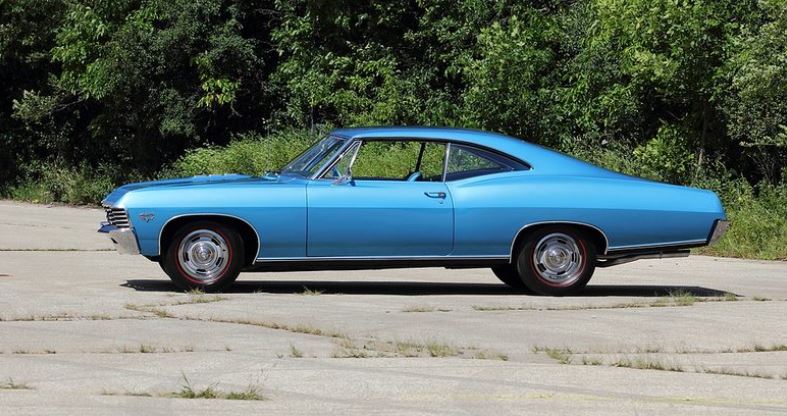
1967 Chevrolet SS427.

So the sales barrier was the implication of the costs attached to the SS bundle rather than the attractiveness.  The headline number of US$53.80 actually included only the "spinner" wheel covers, SS badges, a shiny floor plate for the four-speed's shifter and a Corvette-style grab-bar for the glove-box (Ralph Nadar (b 1934) noted that one).  However, ticking the SS option box triggered a list of "mandatory options" (a seeming oxymoron Detroit came to adore) including wider tyres (with compulsory narrow-band whitewalls), PAS & PB, (power assisted steering & power brakes), LPO (Limited Production Option) 1108 (Police Handling Package, a bundle including HD (heavy-duty) suspension components and sintered metallic brake linings), a steering column mounted 7000 rpm tachometer and a padded dashboard (the last unlikely much to impress Mr Nader).  Having agreed to pay for all that, the buyer then had to decide whether to opt (at progressively increasing cost) for the 348 (with 305, 340 or 350 horsepower (HP)) or 409 (360 HP).  The Powerglide two-speed  automatic transmission was available only with the mildest of the 348s, further limiting the sales potential, the three or four-speed manual otherwise obligatory.  In 1961, it was much more expensive to buy a SS Chevrolet than the US$53.80 on the brochure suggested and however pleasing, it was a long way removed from Chevrolet's traditional place as the low-priced rung on the "Sloan ladder".  The decision was thus taken for 1962 to make the "show" available without the "go" and the SS became an "appearance package", available with even six-cylinder engines.  Sales skyrocketed and between 1962-1969 some 920,000 SS packages were sold for the full-sized line.

1973 Porsche 911T-Lux Targa (left) and 1973 Porsche 911S Targa (right).  The driving experiences were very different but visually, unless closely inspected, it took a well-trained eye to tell the difference. 

GM had noted the dress-up bits were just Chevrolet part-numbers which could be ordered by dealers, some of which received customer requests separately to fit the trim pieces so some 1961 Impalas did to some extent resemble the SS cars though without the high-performance equipment.  It was therefore clear there were more buyers who wanted their Impala to look like a a fast one than were able or prepared to pay for the experience and Chevrolet’s “SS appearance package” proved influential, the approach becoming a a template for the whole industry, spreading internationally, the Porsche 911T Lux (1972-1973) an example.  The entry level 911T was the least powerful of the range and lacked some of the luxury fittings of the more expensive and more powerful 911E & 911S but for those who wanted the fittings but had no desire for the horsepower, the 911T-Lux was created which combined the mechanical specification of the "T" with the trim of the "S", the factory doing exactly what so many of Chevrolet's SS customers settled on after 1962.

Chevrolet’s solution was to become a template for the whole industry which would spend the next decade making, advertising (and, in relatively small numbers, selling) the so-called "muscle cars" which would become so storied.  The muscle-car ecosystem of those years is better documented and more celebrated than any other phase through which Detroit passed yet the numbers of the genuine high performance machines produced was tiny compared to total production of the models upon which they were based.  The experience of 1961 convinced Chevrolet that what most people wanted was not a tyre-melting muscle car (which came with a thirsty, noisy and sometimes cantankerous engine along with what would become prohibitively expensive insurance rates) but one which looked like one.  Splitting the market between drag-strip monsters and boulevard cruisers which could be made to look much the same proved a great success.  For some reason though, late in the decade Chevrolet briefly offered the stand-alone SS 427 in an Impala body but without the Impala badge while, confusingly, the actual Impala could be ordered with both the SS package and the 427 cubic inch (7.0 litre) V8.  Thus there was the SS 427 and the Impala SS 427, the former rather more special and much sought after today so many clones of both have been concocted, leading to a small industry of specialists able to pick real from fake, the difference a matter (in the collector market) of tens of thousands of dollars.

1958 Mercedes-Benz 300 SL Roadster

Manufacturers had been pursuing the concept even before Chevrolet formalized it in the marketing manual.  Even in the interwar years the coincidently named SS cars (which after 1945 become Jaguar) offered essentially the same racy looking machines in a variety of configurations, some of which delivered the performance the lines promised and some did not, the former thought of as genuine sports cars, the latter we would now call boulevard cruisers.  Jaguar considered pursuing the strategy in the early post-war years before deciding sports cars really should all be sporty and although their saloons would come with engines small and large, the roadsters and coupés would be about both show and go.  Mercedes-Benz understood the attraction the 300SL gullwing (W198) had for buyers but knew also it, and the planned roadster version which would be its replacement, were always going to be too expensive for most and that few of them anyway needed a car which could hit what was in the 1950s a most impressive 150 mph (240 km/h).  What they wanted was a stylish machine which recalled the 300 SL in which to cruise along wide boulevards.

1955 Mercedes Benz 190 SL.

Thus was crafted the 190 SL (W121; 1955-1963), built on the modest platform of the company’s small, four cylinder saloon rather than the exotic space-frame of the 300 SL.  Eschewed too were costly features like dry-sump lubrication and fuel-injection and the engine was barely more powerful than in the saloon but for a boulevard cruiser that was perfect and over an eight-year run, it out-sold the expensive 300 SL roadster a dozen-fold.  There were plans even for a 220 SL, using the 2.2 litre (134 cubic inch) six cylinder from the “pontoon” saloon and prototypes were built but the continuing success of the 190SL and capacity constraints first postponed and finally doomed the project.  Even this had been an attempt not to create a true sports car but instead make the little roadster cruise the boulevards more smoothly and, in the decades which followed, this indeed was the historic course subsequent generations of the SL would follow.  It would not be until the 1990s some SLs again became genuinely fast and in the twenty-first century the factory returned to making versions for which a racetrack would seem a native environment.

Friday, December 2, 2022

Hilt

Hilt (pronounced hilt)

(1) The handle of a sword or dagger.

(2) The handle of many weapons and tools.

(3) In anatomy, the base of the penis.

(4) To furnish with a hilt.

(5) As the idiom “to the hilt”, to the maximum extent or degree; completely; fully.

Pre 900:  From the Middle English hilt, from the Old English hilt & hilte (handle of a sword or dagger); cognate with the Middle Dutch hilt & hilte, the Old Norse hjalt, the Old Saxon helta (oar handle) and the Old High German helza (handle of a sword).  Source was the Proto-Germanic helt, heltą, heltǭ, heltō & hiltijō, probably from the primitive Indo-European kel- (to strike, cut).  One form of the idiom which died out was “up to the hilts”, the plural having exactly the same meaning as the still familiar singular; first noted in the 1670s, it was extinct by the mid-eighteenth century except in Scotland and the border regions of northern England where it survived another hundred-odd years.  The vivid imagery summoned by the expression “to the hilt” is of a dagger stabbed into someone’s heart, the blade buried all the way to the hilt.  The phrase is used to suggest one’s total commitment to something although those training British commandos in such things during World War II (1939-1945) did caution that a blade buried in a victim "to the hilt" could be "difficult to get it out", such were "the contractions of the sinews".  Hilt is a noun & verb, hilting is a verb, hilted is a verb & adjective and hiltless is an adjective; the noun plural is hilts.

Consisting of the pommel, grip & guard, hilt was a European swordsmith’s technical name for the handle of a knife, dagger, sword or bayonet; the once used terms haft and shaft have long been obsolete.  The pommel is the large fitting at the top of the handle, originally developed to prevent the weapon slipping from the grasp but during the late medieval period, swordsmiths began to add weight so they were sufficiently heavy to be a counterweight to the blade.  This had the effect of shifting the point of balance closer to the hilt, the physics of this assisting swordsmanship.  The pommel could also be used as a blunt instrument with which to strike an opponent, something from the German school of swordsmanship known as the Mordhau (or Mordstreich or Mordschlag (literally “murder-stroke” or “murder-strike” or “murder-blow”)) method, a half-sword technique of holding the sword inverted, with both hands gripping the blade while striking one's opponent with the pommel or cross-guard.  The technique essentially makes as sword function as a mace or hammer and in military training was envisaged for use in armoured combat although in the hands of a skilled exponent it could be deadly in close combat.  Some hilts were explicitly designed for this purpose.  Pommel was from the Middle English pommel (ornamental knob or ball, decorative boss), from the Old French pom (hilt of a sword) & pommel (knob) and the Medieval Latin pumellum & pōmellum (little apple), probably via the Vulgar Latin pomellum (ball, knob), diminutive of the Late Latin pōmum (apple).  The use in weaponry came first, the sense of "front peak of a saddle" dating from the mid 1400s and in fifteenth and sixteenth century poetry it also sometimes meant "a woman's breasts".  The gymnast's pommel horse (vaulting horse) is so called by 1908, named for the removable handles, which resemble pommels of a saddle, the use in saddlery noted first in 1887.

Grips still are made almost always of wood or metal and once were usually wrapped with shagreen (untanned tough leather or shark skin) but this proved less durable in climates with high-humidity and in these regions, rubber was increasingly used from the mid-nineteenth century.  Whatever the material, it’s almost always both glued to the grip and wrapped with wire in a helix.  The guard sits between grip and blade.  The guard was originally a simple stop (a straight crossbar perpendicular to the blade (later called a quillon)) to prevent the hand slipping up the blade but later evolved into an armoured gauntlet to protect the wielder's entire hand from an opponent’s sword.  By the sixteenth century, guards became elaborate, now often decorative as well as functional, the innovation of this time being a single curved piece alongside the fingers (parallel with the blade and perpendicular to any cross-guards); it became known as the knuckle-bow.

Lindsay Lohan with saw-tooth edged dagger held at the hilt; from a Tyler Shields (b 1982) photo session, 2013.

The “blood” in this photograph is believed to be “fake blood” of the type used in film & television production; it's a substance with an interesting history.  Before the introduction of color film, the liquid was not red but black or a deep blue because those were the hues which, when using monochrome (ie black & white) or sepia film stock, those were the shades which looked convincingly “red” while true red did not.  In the industry, the stuff variously is called “stage blood”, “theatrical blood”, “Prop blood”, “FX blood” or “SFX blood”.  “FX” is the general term for “effects” while “SFX” refers to “special effects” and there’s also “VFX” which, meaning “visual effects” doesn’t have a blood department.  Chemically, the mix is interesting stuff because there are a number of flavours including (1) edible blood which is safe (though not necessarily pleasant) to ingest (made from water, corn syrup & vegetable-based food coloring, etc), (2) non-edible blood used on clothing and props (it can include detergents, thickeners and even sand), (3) rapid-drying blood designed to simulate dried or clotted blood and (4) flowing blood which is used in scenes with active bleeding so realistic viscosity is needed, the mixes ranging from “squirting” to “flowing”.  Historically, each variety was tailored to the specific lighting conditions in use but with post-production digital editing of brightness, color saturation and such now routine, that’s now less critical.

Great moments in elaborately carved hilts: Ivory hilt for ceremonial sword carved in 1801-1802 by the London firm Rundell, Bridge and Rundell for George IV (1762–1830) King of the United Kingdom 1820-1830).

George IV’s ivory hilt (left) depicts the rescue of Andromeda by Perseus, who descended on his winged horse Pegasus to destroy the fierce dragon tormenting his captive.  The artisans were thought to have been influenced by the ivory carvings which emerged during the mid-seventeenth century from workshops in the Netherlands city of Maastricht when large volumes of ivory were being imported by the Dutch East India Company.  The hilt consists of four separate pieces: (1) pommel and grip (with Perseus and the chained Andromeda), (2) knuckle-guard (with the long neck and mouth of the dragon), (3) quillon-block and rear quillon (the dragon's back and tail) and (4) the (somewhat diminished) shells, carved with the dragon's wings and feet.  The wavy-edged blade was sometimes a feature of ceremonial swords.  In London, the most accomplished of the artisans who worked with ivory were members of the Worshipful Company of Cutlers.

Great moments in elaborately carved hilts: Ivory hilt for hunting sword carved circa 1740 and attributed to German artisan Joseph Deutschmann (1717-1787) for Maximilian III Joseph (1727–1777; Prince-elector of the Holy Roman Empire and Duke of Bavaria 1745-1777).

Prince Maximilian’s ivory hilt is a classic example of the Rococo ornamentation of the era (some were more extravagant) and is thought also to be a piece of unsubtle political messaging, the lion a top the grip holding a crescent moon in its claws, an allusion to recent European victories over the Ottoman Turks on the battlefields of Eastern Europe and, despite being crafted as a “hunting sword”, this blade almost certainly was reserved for ceremonial purposes.  Hunting swords were one-handed weapons which in the mid-twelfth century emerged in Europe as a distinct class.  They were characterized by a relatively short blade and were essentially a sidearm carried when hunting big (and sometimes dangerous) game, their size and weight making them a convenient weapon able quickly to be drawn and swung.  Many single-edged hunting swords featured a saw-like serrated pattern on the back edge; this was another convenience item as hunters utilized this for slicing or sectioning the catch.  The blade shape evolved over the centuries to become narrower on the first two-thirds of its length before at the end widening.  Hunting swords remained in general use well into the eighteenth century.

Thursday, December 1, 2022

Pullman

Pullman (pronounced pool-muhn or pull-minn)

(1) A range of railroad sleeping cars produced by the Pullman Palace Car Company which operated in the US between 1867 and 1968.

(2) A generic term for up-market coaches and train carriages.

(3) A term used by certain automobile manufacturers to describe lengthened versions of their limousines; most associated with Humber in the UK and Daimler-Benz in Germany.

(4) A type of long, square bread developed to be baked in the small kitchens of rail cars.

(5) As Pullman case, a type of large suitcase.

(6) In architecture, a long, narrow room, a visual allusion to the interior of a railway carriage.

1867: From the name of Chicago-based US engineer and industrialist George Mortimer Pullman (1831–1897).  It was first applied to the luxury railway coaches the Pullman Palace Car Company introduced in 1867, first in Chicago, later used across the US.  Describing up-market coaches and train carriages, the name became widely used in a number of countries.  In England, the origin of the surname Pullman was topographical meaning “a dweller by the pool (or stream) while in German (as a variant of Puhlmann) it was occupational for a bottle blower, the construct being Pulle (bottle) + Mann (man) and appears to be an Ashkenazic Jewish form.  Pullman is a noun; the noun plural is pullmans (with initial capital if used as proper noun).

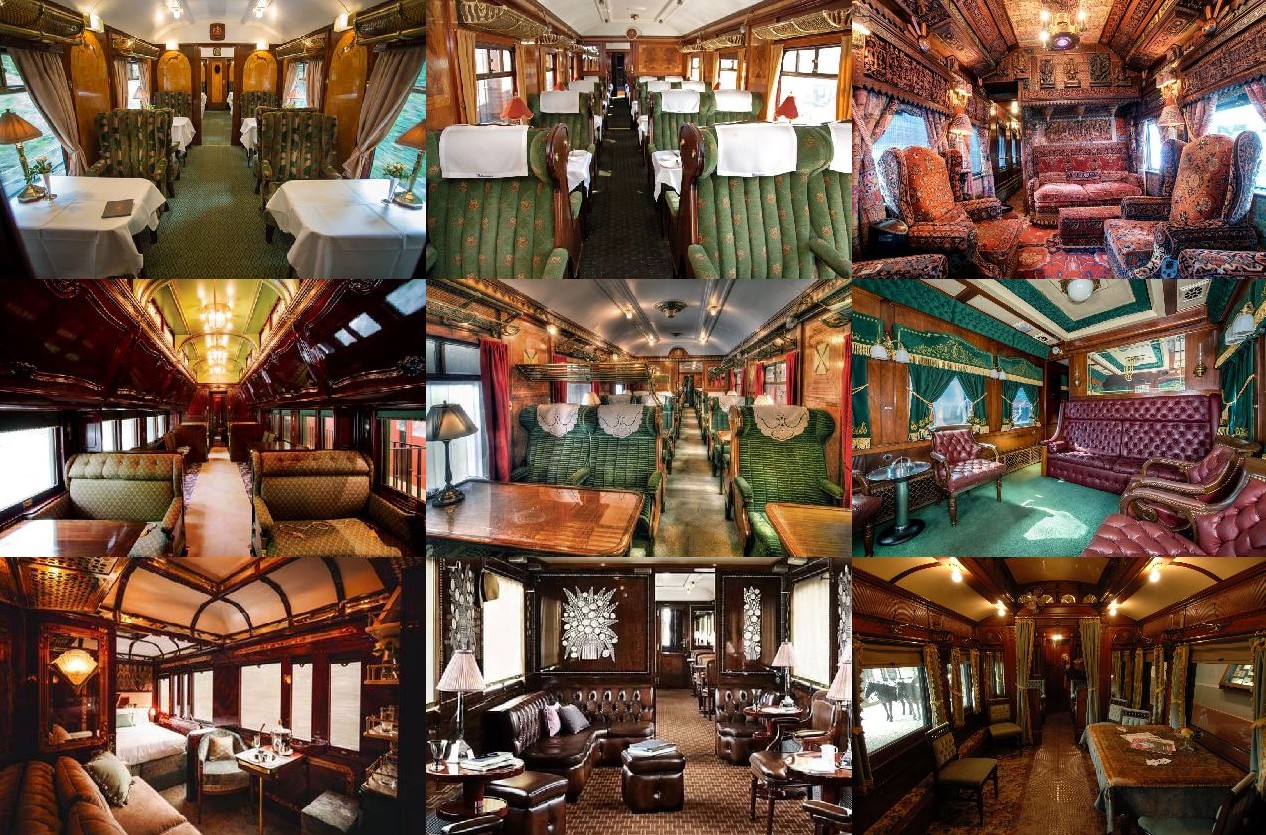
Interiors of Pullman train carriages.  The target market was the folk who now either fly first-class or use private aviation. 

Bristol Type 26 Pullman.

The Bristol Pullman first flew in 1918, designated originally as the Type 24 Braemar Triplane, a four-engined heavy bomber.  Tests soon revealed performance deficiencies and, as the Type 25 Braemar II, a second prototype took to the air in 1919, now with four, more powerful straight-12 Liberty engines and though it proved satisfactory the end of World War I (1914-1918) meant the Air Ministry no longer required a long-range bomber so Bristol reconfigured the third prototype as the Type 26 Pullman, a 14-passenger transport.  The use of the Pullman name was an allusion to the luxury of trains but, weight being of greater significance in the air than on railway tracks, the fittings were notably less extravagant.  Although exhibited to acclaim at the Olympia Air Show in 1920, the projected price was too high for the embryonic civilian airlines of the era and the Pullman never entered production, the sole prototype dismantled in 1921; it was though, in a sense, the first “modern” airliner but the wildly ambitious Type 40 Pullman (an enlarged 40-passenger version), never advanced beyond the drawing board.  Whether the Type 25 it would have been an effective heavy bomber has been debated.  The top speed was claimed to be 122 mph (196 km/h) which was competitive with the fighters of the time and the service ceiling was said to 15,000 feet (4575 m), a height which even some of the early heavy bombers of World War II (1939-1945) struggled to match but whether these numbers would have been achievable when fully loaded, under combat conditions, isn’t known.

Mercedes-Benz 600 Pullman & Pullman Landaulet

Lindsay Lohan with 600 Pullman during the filming of Liz & Dick (2012).

Since the inter-war years (1919-1939) Daimler-Benz had used the "Pullman" designation for variants of its sedans with larger passenger compartments but now it's most associated with the 600.  A symbol of the post-war Wirtschaftswunder (economic miracle) in the FRG (Bundesrepublik Deutschland (Federal Republic of Germany; the old West Germany) 1949-1990), Daimler-Benz first showed the Mercedes-Benz 600 (W100; 1963-1981) in September 1963 at the Frankfurt Motor Show although deliveries didn’t begin until the following year.  Known as the Größer Mercedes (Grosser Mercedes) in the tradition of the 770 K (W07; 1930-1938 & W150; 1938-1943)), it was what had by the 1960s become an automotive rarity, a genuinely new car with few carry-over components from previous vehicles and was a technological tour de force, even eschewing (relatively) noisy electric motors for accessories like windows and sun roofs, instead controlling them via a swift and silent hydraulic system which extended to the closing of doors and trunk (boot).  Powered by a 6.3 litre (386 cubic inch) SOHC (single overhead camshaft) V8, which powered it to a top speed of 128 mph (205 km/h); (124 (200) for the heavier Pullman), it rode on air suspension which, in addition to the expectedly cushion-like ride, permitted the 600 a competence in handling and roadholding exceeding many of the sports car of the era, some of which couldn’t match its straight-line speed.  Remarkably, this was achieved with the use of swing axles at the rear although years of refinement of the anti-squat, anti-dive geometry and a compensating device above the differential tamed the worst of the tendencies inherent in what was, even in the early 1960s, seen as an inherently flawed design.

In this context, in the English-speaking world, the use of “grosser” is sometimes misunderstood.  In German, groß means “large” while the Kompatativ (comparative) is größer and the Superlativ (superlative) größte;  Der große Mercedes thus translates as “the big Mercedes”.  In that sense groß is used in the sense of “physically large” but it can be used also to be “highest” as in the naval rank Großadmiral (a five-star rank translated in English usually as “grand admiral” and equivalent to admiral of the fleet or fleet admiral).  The idea of the "big Mercedes" wasn't unique and to this day collectors still use the phrase "big Healey" (the Austin-Healey sports car, introduced as the 100 BN 1 (1953-55) which evolved into the 3000 (1959-1968), the term coined in 1958 to distinguish those cars from the smaller Austin Healey Sprite (1958-1970), produced also as the Austin Sprite (1971) and MG Midget (1961-1979)). In English, “gross” went on to prove itself a word of great versatility and in the social media age young women in particular found many uses for “grossness” and the marvelous “grossnessness”.

600 Saloon (known colloquially as the SWB (short wheelbase)) (left), 600 Pullman four door (centre) & 600 Pullman Landaulet with the "short" folding roof (right).

The factory built the landaulets to requested configurations, so both the long and short folding roofs could be ordered with either the four or six-door coachwork although it is known all landaulets included a central divider (option on the SWBs and fitted to all but one of the closed Pullmans.  The "long" fabric roof opened to reveal the whole rear compartment while the "short" version exposed only the rearmost seat.  Although the cars with the longer folding roof are sometimes referred to as the "presidential", this was never an official designation.  The English coach-builder Crayford converted a 1973 four-door Pullman to a short-roof Landaulet and while well-executed, easily it is distinguishable from the factory versions by the retention of the standard rear side-window frames (Crayford were pragmatic; for their Mercedes-Benz C123 cabriolets, they used the folding roofs of 1973 Ford Mustangs, salvaged from US wrecking yards!).  In the parlance of the collector car business, the Crayford 600 Landaulet is "number 60 of 59".

With economies expanding on both sides of the Atlantic, Daimler-Benz had great expectations for the 600, predicting sales would soon exceed a thousand a year but, after an encouraging 345 were built in 1965 (the first full-year of production), demand waned and even that high-water mark was never again approached.  The increasingly onerous regulations being imposed in the United States meant that by 1972, the 600 had to be withdrawn from what had always been the most important market, it being simply financially unviable to re-engineer the thing given annual sales were projected barely to reach three figures.  After that, although dictators in Africa and Asia maintained their fondness and with increased attention devoted to UK, European and Middle Eastern markets and there were some encouraging signs but, in something of an own goal, in 1972 Mercedes-Benz released the W116, the first model to be known as the “S Class” which, although in a different market segment to the Grosser, was so advanced and obviously modern instantly it made the anyway rather baroque 600 look antiquated.  The final nail in the coffin was the first oil shock in 1973 and from then until the end of the line in 1981, production dwindled to a handful a year, availability maintained only because of the importance in the brand’s image and the lingering aura of having upon its release been lauded generally as “the best car in the world”, perhaps the last time there would about that be a consensus.

600 Pullman Landaulets: four doors with the short roof (left & centre) and six door with the long roof (right).  The factory built the Pullmans to order and there were many variations (one Pullman even built as a "family car" without the glass partition which normally separated the chauffeur from the passengers), most of the four door cars were fitted with vis-à-vis seating whereas the six door models usually had occasional "jump seats" which folded into the central partition.

The standard (SWB) 600 saloon was built on a wheelbase of 3200 mm (126 inches) while the Pullmans (and all but one of the landaulets) used a lengthened platform, extending this to 3900 mm (153 ½“).  The SWB was 5540 mm (218 inches) in length while the elongated Pullmans (sometimes called the LWB (long wheelbase)) stretch this to 6240 mm (245¾ inches) and the weight varied, depending on configuration between 3000-3300 kg (6600-7275 lb).  Over the eighteen-odd years it was on the books, Mercedes built 2677 600s (including 45 “special protection” versions, a coupé and one SWB Landaulet).  The factory has, off and on, continued to use the Pullman designation for their in-house "stretch limos" (ie sedans with extended wheelbase).

Four door 600 Pullman Landaulet (left), four door 600 Pullman Landaulet used by the FRG government for the 1965 state visit of Elizabeth II (1926-2022; Queen of the UK and other places, 1952-2022) (centre) and four door 600 Pullman (right), most of which were configured with the vis-à-vis seating.

Few cars have ever so encapsulated an association with wealth and power (including that exercised by some unsavoury types) which is why Pullmans continue to be sought be film directors looking for a prop which at a glance delivers the desired verisimilitude.  Additionally, being long and low-slung, unlike the traditional, upright Rolls-Royce Phantom limousines, the 600 always managed to convey something slightly sinister, thus the appearance in films of a certain kind although the use in The Exorcist (1973) was to suggest "money".  If the look alone isn’t enough, the ownership list included:

Park Chung Hee (1917–1979; President of RoK (Republic of Korea (South Korea)) 1962-1979)

Comrade Enver Hoxha (1908-1985; dictator of Albanian 1944-1985)

Pol Pot (Saloth Sâr; 1925–1998; dictator the communist (Maoist) state of Democratic Kampuchea (Cambodia) 1975-1979)

François "Papa Doc" Duvalier (1907–1971; president of Haiti 1957-1971)

Jean-Claude "Baby Doc" Duvalier (1951–2014; president of Haiti 1971-1986)

Jean-Bédel Bokassa (1921–1996; president or emperor of the CAR (Central African Republic) 1966-1979)

Frederik Willem ("F.W.") de Klerk (1936–2021; president of South Africa 1989-1994)

Comrade Leonid Brezhnev (1906–1982; Soviet leader 1964-1982)

Comrade Fidel Castro (1926–2016; prime-minister or president of Cuba 1959-2008)

Robert Mugabe (1924–2019; prime-minister or president of Zimbabwe 1980-2017)

Hirohita (Emperor Shōwa) 1901–1989; emperor of Japan 1926-1989)

Jomo Kenyatta (circa 1897–1978; prime minister (1963-1964) & president of Kenya (1964-1978)

Daniel arap Moi (1924–2020; president of Kenya 1978-2002)

Ferdinand Marcos (1917–1989; president of the Philippines 1965-1986)

Kim Il-Sung (Kim I, 1912–1994; Great Leader of DPRK (Democratic People's Republic of Korea (North Korea)) 1948-1994)

Kim Jong-Il (Kim II, 1941-2011; Dear Leader of DPRK (Democratic People's Republic of Korea (North Korea)) 1994-2011)

Kim Jong-Un (Kim III, b 1982; Supreme Leader of DPRK (Democratic People's Republic of Korea (North Korea)) since 2011)

Saddam Hussein (1937–2006; president of Iraq 1979-2003)

Mohammad Reza Pahlavi (1919–1980; last Shah of Iran 1941-1979)

Comrade Chairman Mao Zedong (1893–1976; chairman of the Chinese Communist Party (CCP) & paramont leader of the PRC (People's Republic of China) 1949-1976)

Comrade Deng Xiaoping (1904–1997; paramount leader of the PRC (People's Republic of China) 1978-1989)

Norodom Sihanouk (1922–2012; variously, off and on, king, chief of state or prime minister of Cambodia 1941-2012)

Comrade Nicolae Ceaușescu (1918–1989; general secretary of the Romanian Communist Party and dictator of Romania 1965-1989)

Comrade Josip Broz Tito (1892–1980; prime-minister or president of Yugoslavia 1944-1980)

His Excellency, President for Life, Field Marshal Al Hadji Doctor Idi Amin Dada, VC, DSO, MC, CBE, Lord of All the Beasts of the Earth and Fishes of the Seas and Conqueror of the British Empire in Africa in General and Uganda in Particular, (1928-2003; president of Uganda 1971-1979)

Mobutu Sese Seko (1930–1997; president of the of the DRC (Democratic Republic of the Congo) 1965-1971 and the (renamed) Zaire 1971-1997)

Among that lot, the erstwhile presenter of the BBC's TV show Top Gear (Jeremy Clarkson (b 1960)) doesn't seem out-of-place but there are those who say the 600's reputation never recovered from him owning one.  However, preserving the car's status, Kin Jong-Un is the only individual known to own a brace of the long-roof (presidential) Landaulets, DPRK events (of which there are many and they are among the world's most elaborately choreographed ceremonies) thus the only place where two of the things have been photographed in the same frame.  The Supreme Leader inherited the pair from the Dear Leader (along with the rest of the DPRK and its people) who had been willed them by the Great Leader.

SCV 1, the "high roof" 600 Pullman used as the papal car by the Holy See, 1965-1986.

The 600 Landaulet presented to Paul VI (1897–1978; pope 1963-1978) and used by the Holy See between 1965-1986 was the latest in a line of papal Mercedes-Benz which had included a 1930 Nürburg 460 (W08) and a 1960 300d Cabriolet D (W189), both fitted with the throne-like, single rear seat, the same configuration used in “popemobiles” to this day.  It was one of the 45 “special build” 600s, using the long wheelbase platform but was unique in that the rear doors were 256 mm (10 inches) longer, directly adjacent to the front.  The roof of the was raised by 70 mm (2¾ inches) to provide adequate headroom, something necessitated by the floor being level in the rear, the transmission tunnel concealed beneath.  Since 1986 the 600 has been on display in the Mercedes-Benz Museum in Untertürkheim, complete with the registration SCV 1 (Stato della Città del Vaticano 1 (Vatican City State No 1), the "1" identifying the pope’s official car at any given time, much as the US Air Force call-sign "Air Force 1" is attached not to a specific airframe but to the POTUS, shifting with him).

A most unfortunate conjunction of imagery: Adolf Hitler on Berlin's newly opened East-West Axis in his Mercedes-Benz 770 K Grosser Cabriolet F open tourer (W150) in a parade marking his 50th birthday, opposite the Technical High School, 20 April 1939 (left) and David Bowie in his Mercedes-Benz 600 (W100) Pullman Landaulet, Victoria Station, London, 2 May 1976 (right).

Sometimes a wave is just an excuse.  The pop star David Bowie (1947-2016) understood he was an influential figure in music but on more than one occasion explained to interviewers: “I am not an original thinker”.  Trawling pop-culture for inspiration nevertheless served him well but he later came to regret dabbling with history slightly less recent.  Not impressed with the state of British society and its economy in the troubled mid-1970s, he was quoted variously as suggesting the country would benefit for “an ultra right-wing government” or “a fascist leader”.  Although he would later claim he was captivated more by the fashions (the long leather coats said to be a favorite) than the policies of the Third Reich, the most celebrated event of this period came in 1976 in what remains known as the "Victoria Station incident".  Mr Bowie staged a media event, arriving standing in an open Mercedes-Benz 600 Pullman Landaulet, recalling for many the way in which Hitler so often appeared in his 770 K.  Unfortunately, a photographer captured a shot in what the singer later claimed was “mid wave” and it certainly resembled a Nazi salute.  He later attributed all that happened during this stage of his career to too many hard drugs which had caused his interest in the aesthetics of inter-war Berlin to turn into an obsession with politics of the period.  All was however quickly forgiven and his audience awaited the next album which is an interesting contrast to the cancel culture created by the shark-feeding dynamic of the social media era.

Lindsay Lohan: Sometimes, a wave is just a wave.

Now, were a pop star to tell interviewers: “Britain could benefit from a fascist leader” and “I believe very strongly in fascism … Adolf Hitler was one of the first rock stars”, their future career prospects might be "nasty, solitary, brutish and short".  Despite that orthodoxy however, the multi-media personality Ye (the artist formerly known as Kanye West (b 1977)) has expressed what seem to be pro-Hitler sentiments and been photographed wearing a "swastika T-shirt", even (briefly) offering them for sale on the (now apparently in abeyance) Yeezy website.  Rather than having him cancelled, Mr Ye's comments and products seem to have had at least a financial upside because in a post on X (formerly known as Twitter) he stated: "...AND I MADE 40 MILLION THE NEXT DAY BETWEEN MY DIFFERENT BUSINESS. THERE'S I LOT OF JEWISH PEOPLE I KNOW AND LOVE AND STILL WORK WITH. THE POINT I MADE AND SHOWED IS THAT I AM NOT UNDER JEWISH CONTROL ANYMORE IN WAR YOU TAKE A COUPLE LOSES..."  That would seem to suggest that in the right circumstances, the Irish writer Oscar Wilde (1854–1900) and Dr Joseph Goebbels (1897-1975; Nazi propaganda minister 1933-1945) were right: "It doesn't matter what people are saying about you as long as they're saying something."

Wednesday, November 30, 2022

Cheque

Cheque (pronounced chek)

(1) A bill, debenture, coupon, IOU, receipt, warrant, order or bond (all now rare).

(2) A bill of exchange drawn on a bank by the holder of a current account; payable into a bank account, if crossed, or on demand, if uncrossed.

(3) In agricultural jargon (Australian and NZ), the total sum of money received for contract work or a crop; a slang term for wages.

1828: From the Middle English chek & chekke, borrowed from the Old French eschek, eschec & eschac, from the Medieval Latin scaccus, a borrowing from the Arabic شَاه‎ (šāh), from the Persian شاه‎ (šâh) (king) from the primitive-Indo-Iranian kšáyati (he rules, he has power over), ultimately from the primitive Indo-European tek- (to gain power over, gain control over).  The first cheque book was issued in England in 1872, the first checking account in the US offered in 1897.  The meaning as a negotiable instrument for the transfer of money comes from check in the sense of a means of verification (ie a check against forgery or fraud) and was influenced by exchequer, from Old French eschequier.  Chèque is the French spelling, chequé the Spanish.

Crooked Hillary Clinton summing up her campaign strategy.

Check is the original spelling, cheque coming into use in 1828 when James William Gilbart (1794-1863) published his Practical Treatise on Banking.  The spellings check, checque, and cheque were used interchangeably between the seventeenth and twentieth centuries but cheque became the standard form for the financial instrument in the Commonwealth and Ireland, while check is used only for other meanings, thus distinguishing the two definitions in writing.  The Americans, preferring the spelling check for all purposes lost this; one of the rare examples where the American spelling of English words incurs a disadvantage.


Lindsay Lohan with novelty check (cheque), part of a protest on Billy Eichner’s “Billy on the Street” piece about about a television show being cancelled, New York, 2014.  The piece didn't result in the show returning for another season but did succeed in the demolition of a Volvo so there's that.