Friday, September 9, 2022

Hysteria

Hysteria (pronounced hi-ster-ee-uh (U) or hi-steer-re-ah (non-U))

(1) In casual use, an uncontrollable outburst of emotion or fear, often characterized by irrationality, laughter, weeping, etc.

(2) In psychoanalysis, a psychoneurotic disorder characterized by violent emotional outbreaks, disturbances of sensory and motor functions, and various abnormal effects due to autosuggestion.

(3) In clinical psychiatry, conversion disorder.

(4) In (historic) clinical medicine, a mental disorder characterized by emotional excitability etc without an organic cause (archaic).

1795-1805: From the New Latin hysteria, from hysteric, from Classical Latin hystericus, from the Ancient Greek στερικός (husterikós) (a suffering in the uterus, hysterical), from στέρα (hustéra) (womb).  It’s from the same classical root that French gained hystérie and the long-archaic alternative English form is hysterick.  Now entirely obsolete as a medical term, hysteria is most often used as (1) a descriptor of someone behaving in an emotionally over-wrought way (with many feminist critics noting the loaded associations whether applied to men or women) or (2) in sociology and psychology (as mass hysteria) to describe a phenomenon that manifests as a collective illusion of fears in a whole or a sub-set of a population.  Like many terms that start with a non-silent h but have emphasis on their second syllable, some people precede hysteric with an, others with a.  Both practices are acceptable in modern English as long as use is consistent.  Hysteria & hystericalness are nouns, hysteric is a noun & adjective, hysterical is an adjective and hysterically is an adverb; the noun plural is hysterias, hysteriae or hysteriæ (the latter two rare even in the medical literature).  According to the trackers, the most common noun plural is hysterics.

Once exclusively female

For reasons both of linguistic and physiological determinism, until the nineteenth century it wasn’t possible for men to receive a diagnosis of hysteria, regardless of how hysterically they might have behaved.  Western medicine had long accepted the Ancient Greek belief hysteria was caused by a disturbance in the uterus and thus was exclusively a condition of women; an alternative description was uterine melancholy.  While drawn from the Greek hystera (uterus), the word is not ancient, the phrase in Greek medicine being hysterical suffocation.  The Greeks thought the uterus moved through the body, eventually strangling her and inducing disease, hence the tradition of centuries the disorder could exist only in women.  The mysterious tarassis was suggested as a name for male hysteria but is noted by only a few sources and then as either obscure or archaic although the Tarassis (male hysteria) mini-skirt is available from RedBubble as part number 31587934.

Jean Martin Charcot, Une leçon clinique à la Salpêtrière (A Clinical Lesson at the Salpêtrière, 1887), oil on canvas by André Brouillet (1857–1914), Paris Descartes University, Paris.

Jean-Martin Charcot (1825–1893) was a French neurologist and professor of anatomical pathology with a great interest in hysteria, most notably that exhibited by his patient Louise Augustine Gleizes (1861-1904), the woman who is the focus of this painting.  Professor Charcot was one of the seminal influences on early-modern neurology, psychology & psychiatry but his protocols for treating patients like Mademoiselle Gleizes would appal modern ethics committess.  First exhibited at the Salon of 1887 in the Louvre's Salon CarréBrouillet's painting however is one of the most famous in the history of neurology so there's that. 

Lindsay Lohan, hysteria scene, The Canyons (2013).  Professor Charcot would have known what to do.

Late in the nineteenth century, Sigmund Freud's (1856-1939) early work with diagnosed hysterics was important in his development of psychoanalytic therapy, one patient ever calling the treatment a "talking cure" and within the profession it’s still known as “talk therapy”.  It wasn’t until 1980 the American Psychiatric Association's (APA) Diagnostic and Statistical Manual of Mental Disorders (DSM) withdrew the word.  In the first edition of the DSM (DSM–I (1952)) the condition was named “conversion reaction” while, in DSM–II (1968), it was grouped with dissociation disorder under the new diagnostic category of “hysterical neurosis” although, later, conversion disorder was conceptualised as a disorder of the brain associated with disordered emotions.  The transition to a system that classified psychiatric disorders by clinical phenomenology rather than aetiology resulted in the elimination of “hysterical neurosis” from DSM–III (1980), supplanted by “dissociation  disorders” and “conversion disorders” with the latter separated from the former and listed as a “somatoform disorder”. Thus, since 1980, somatoform disorders and the dissociative disorders have been separate categories in the DSM (the changes generally reflected in the World Health Organization’s (WHO) International Classification of Diseases (ICD)), the nomenclature progressing thus:

1952 DSM–I: Conversion reaction

1968 DSM–II: Hysterical neurosis (conversion type)

1980 DSM–III: Conversion disorder

1992 ICD–10: Dissociative (conversion) disorder

1994 DSM–IV: Conversion disorder

2013 DSM-5: No substantive changes, confirming symptoms once labeled under the broad umbrella of hysteria would fit under what is now referred to as somatic symptom disorder.

2025 Chevrolet Corvette 2025 Stingray 1LT in Hysteria Purple with Carbon Flash Painted Aluminum Wheels with Machined Edge (US$995) and standard lug nuts: photographed in natural light.

Although the US manufacturers in the twenty-first century revived a number of the more famous hues available during the first muscle car era (1964-1974), the “Hysteria Purple” (Code GXL; touch-up paint part-number WA-134H) Chevrolet in 2025 added to the Corvette’s exterior color chart genuinely was new.  Unlike four of the metallic choices which for 2026 attracted an additional charge (between US$500-995), Hysteria Purple was a NAC (no additional cost) option and could be ordered in conjunction with several of the available interior colors.  The “recommended” color combinations reflect what the designers think is good taste but, the customer always being right”, the factory allows buyers to tick the CCO (Color Combination Override (Code D30)) option box to mix ‘n’ match as they wish; the CCO lists at US$695.

2026 Chevrolet Corvette ZR1X in Hysteria Purple with standard wheels & lug nuts: studio photograph from Chevrolet’s website.

Response to Hysteria Purple was favorable but there’s been extensive coverage of the intriguing phenomenon of the color appearing to be “purple” when seen indoors, in the shade or at night yet when in natural light seeming more of a “blueberry blue”.  Chemically, the mix is said to be of blue and purple and Chevrolet would have been aware of the color-shift as ambient light changes so clearly it was deliberate rather than something like the “unintended consequences” suffered in 1970 by Imperials when, after exposure to direct sunlight, their hastily dyed vinyl roofs deteriorated rapidly from a fetching mix of blue & purple swirls to a less pleasing beige & brown combo.  On social media platforms and the well-populated Corvette forums, the consensus seemed to be the “bluish-purple” deserved to be dubbed with the portmanteau word “blurple”.

Lug nut porn.

The first run of 300 C1 (1953-1962) Corvettes were all were finished in “Polo White” (part of a patriotic “red, white & blue” theme which included “Sportsman Red” interiors and engines painted “Blue Flame” Blue) but since then the color palettes have been many and varied.  Now, the factory even accommodates those for whom the color of their wheel lugs is an important aesthetic.  The standard wheel on 2026 Corvettes is a forged aluminum piece finished in “Stirling Silver” (a reference to the paint’s color rather than metal) but blue, black and silver forged aluminum units are available for as much as an additional US$1,995 and for a Ferrariesque US$13,995 a buyer can specify “Visible carbon fiber” ones.  So, different color wheels meant a gap in the market for the lug nuts and for those not content with the standard metal fittings, Chevrolet offers them (as a dealer-fitted option) in chrome (US$275) or black (US$295), thus a unit-cost respectively of US$14 & US$15.  That doesn’t seem unreasonable for a high-quality piece of machining but, being dealer-fitted, it’s not clear if the buyer gets to keep the standard lugs fitted at the factory or they’re retained by the dealer.

Thursday, September 8, 2022

Terpsichore

Terpsichore (pronounced turp-sik-uh-ree)

(1) In Classical Mythology, the goddess of dancing and choral song and one of the nine Muses who were daughters of Zeus (god of sky and thunder) & Mnemosyne (the goddess of memory).

(2) In choreography; the art of dancing (should always be lowercase).

(3) In astronomy (as 81 Terpsichore), a main belt asteroid.

Circa 1760: From the Classical Latin Terpsichorē from the Ancient Greek Τερψιχόρη (Terpsikhórē) (literally “enjoyment of dance”), noun use of the feminine of terpsíchoros (delighting in the dance), the construct being τέρψις (térpsis; térpein) (to delight; enjoyment) + χορός (khorós) (dance; chorus); it’s from terpsíchoros that English gained chorus.  The Greek was térpein was from the primitive Indo-European root terp- (to satisfy) source also of Sanskrit trpyati (takes one's fill) and the Lithuanian tarpstu & tarpti (to thrive, prosper).

The adjective terpsichorean (pertaining to dancing (literally “of Terpsichore”)) dates from 1869, and was from the Latinized form of the Greek noun terpsikhore (Muse of dancing and dramatic chorus).  From this came the theatrical slang terp (stage dancer, chorus girl) noted since 1937.  The adjectival form terpsichorean often appears with an initial capital letter because of its etymology from a proper noun.  Either is acceptable but the conventions of Modern English tend eventually to prevail which suggests use of the capital T will reduce with time but, given the rarity of the word except in a few technical and historical disciplines, the classic form is likely to endure among those few who enjoy its use.

In the mythology of Ancient Greece, nine goddesses ruled over art and literature.  The Greeks called them Muses and the Muse of dance and choral music was Terpsichore.  Of late she’s been of interest to astronomers who adopted her as a metaphor for the rhythm and ordered movement in the universe, such as mechanical oscillations.  In Archaic Greece, there were but three Muses, all associated with song and dance; it was only in the classical period they became nine and assigned to distinct spheres: Calliope of epic poetry, Clio of history, Euterpe of lyric poetry, Erato of love poetry, Melpomene of tragedy, Polyhymnia of hymns, Thalia of comedy, Urania of astronomy, and Terpsichore of dance and choral music.  The daughters of Zeus and Mnemosyne, they dwelt in the land of Pieria in the foothills of Mount Olympus.  In later mythology, writers tended to compare the Muses to the sirens but while both were young nymphs famous for their beautiful songs, the Muses sang to enrich men’s souls while the sirens were chthonic and sang to lure them to their deaths.

The Greek historian Herodotus (circa 484-425 BC) wrote his στορίαι (historíai̯; in the West styled variously as The History or The Histories of Herodotus)) as an account of the Greco-Persian Wars (499-449 BC).  Although there was once some doubt about the veracity as a historical document (reflecting more the scepticism about medieval editors and translators than the original texts), modern research has concluded the work is one of the most reliable histories from antiquity.  Herodotus was called “The Father of History” by the Roman orator Cicero (103-46 BC) because of the quality of his writing but he's also now acknowledged as the father of historiography's modern structural form.  Written histories had existed prior to Herodotus but he was the first to adopt a recognizably modern thematic form.  At some unknown time, one or more editors reorganized The History into nine chapters, each name after a Muse, one of which was Terpsichore:  Book I (Clio), Book II (Euterpe), Book III (Thalia), Book IIII (Melpomene), Book V (Terpsichore), Book VI (Erato), Book VII (Polymnia), Book VIII (Urania) & Book IX (Calliope).

The Muse Terpsichore In Ancient & Modern Greece.  Allegory of the Muse Terpsichore playing a harp, from the Florentine School of the eighteenth century, oil on canvas by an unknown artist (left) and Lindsay Lohan dancing The Lilo, Lohan Beach House, Mykonos, Greece, 2018 (right).

Despite the similarity, there’s no verified connection between khorós (dance; chorus) and χώρς (khrās), inflection of χώρ (kh) (location, place, spot; the proper place; one's place in life; piece of land: tract, land, field; country (as opposed to a city or town), countryside; country, nation.  The origin of khôra is unknown and it may be from a Pre-Greek substrate or other regional language although speculative links have been suggested including χ́ος (kháos) (empty space, abyss, chasm) and χατέω (khatéō) (to lack, miss, need, desire) but few etymologists have supported either and the lack of cognates beyond the Greek rendered research a dead end.  Khōra had been adopted as the ancient name for the land lying between the Tigris and Euphrates rivers north of Babylon (modern-day Iraq), from the Greek mesopotamia (khōra (literally "a country between two rivers)), from the feminine of mesopotamos, the construct being mesos (middle), from the primitive Indo-European root medhyo- (middle") + potamos (river).  That use borrowed directly from the discussions from Antiquity.

However, khôra did attract the interest of those scourges of late twentieth century linguistics: the French deconstructionists.  Their attention seems to have been excited by the concept of khôra in the sense of “the territory of the Ancient Greek polis which lay beyond the city proper”.  The philosophers of Antiquity, noting the idea of khôra simultaneously as (1) the physical space between city & the wilderness, (2) the time it takes to transverse the space and (3) one’s state of mind while in the space.  It was very much a concept of the indeterminate, a triton genos (third kind), being neither civilization nor the state of nature and city nor wilderness and few things so appealed to the deconstructionists as the indeterminate.

Of course, one attraction of deconstruction was that it was in itself a layer of indeterminacy and Jacques Derrida (1930-2004), post-modernism’s most famous explorer of khôra in the context of apophatism or negative theology, was interested not how the word had been understood in the traditions of metaphysics & metaphorics but what meaning could be constructed for something which is neither present or absent, passive or active.  The findings from khôra’s time on post-modernism’s autopsy table did illustrate why deconstruction gained a special role in language because there was surely no other way that Plato’s entirely cosmological concept could become psycho-linguistic and produce, in all seriousness, the idea of khôra as “container of the uncontainable”.  Plato (circa 425-circa 347 BC) had imagined khôra as that space through which something could pass but in which nothing could remain so thus to a French deconstructionist the very essence of tout autre (fully other) and from there it wasn’t very far to the idea of khôra also as time and space interacting.  At that point, in the tradition of post-modernism, khôra meant whatever the observer decided it meant.

The Terpsichore in Modern Greece: Lindsay Lohan dancing The Lilo, Lohan Beach House, Mykonos, Greece, 2018.


Cracker

Cracker (pronounced krak-er)

(1) A thin, crisp biscuit, sometimes flavored and salted (less widely used in North America).

(2) A firework (a clipping of firecracker).

(3) A small paper roll used as a party favor, that usually contains candy, trinkets etc which separates with an induced pop when pulled sharply at one or both ends; also called a Christmas cracker or bon bon.

(4) A nickname for a native or inhabitant of the US states of Georgia or Florida (initial capital letter) which is neutral when used in a self-referential manner by inhabitants (also as Cracker State) but can be disparaging and offensive if applied by outsiders (and among certain communities in Florida, a derogatory term for a police officer).

(5) As disparaging and offensive slang, a contemptuous term used to refer to a white person in the South, especially a poor white living in some rural parts of the south-eastern US.

(6) Slang for a black hat or a boastful man (both archaic).

(7) As an onomatopoeic form, a person or thing that cracks.

(8) In chemistry, a chemical reactor used for cracking, often as the refinery equipment used to pyrolyse organic feed-stocks (if catalyst is used to accelerate the process, it’s informally called a cat-cracker).

(9) In the plural (often with a modifier), an informal term to describe someone mad, wild, crazy etc.

(10) In (chiefly UK) slang a thing or person of notable qualities or abilities (often in the form crackerjack).

(11) In Australian & New Zealand slang, something or someone thought worthless or useless (often in the form “not worth a cracker).

(12) In computing senses (as cracker, crack, and cracking), terms suggested in the 1980s as an alternative to “white-hat hacker” in an attempt to create a more positive public image of certain activities.

(13) In cryptology, as code-cracker (synonymous with code-breaker), one who decodes, analogous with the previous safe-cracker but often without the pejorative associations.

(14) A short piece of twisted material (often string) tied to the end of a whip that creates the distinctive sound when the whip is thrown (or cracked); the crack is the sonic boom as the material passes through the sound barrier.

(15) In zoology, a northern pintail, species of dabbling duck.

(16) In materials processing, a pair of fluted rolls used for grinding (obsolete).

(17) In Czech slang, a drug user.

(17) In botany, as crackerberry, the Canadian bunchberry (Cornus canadensis).

1400-1450: Crack was from the Middle English crakken, craken & craker, from the Old English cracian (to resound, crack), from the Proto-West Germanic krakōn, from the Proto-Germanic krakōną (to crack, crackle, shriek), ultimately from the primitive Indo-European gerhz (to resound, cry hoarsely).  It was cognate with the Scots crak (to crack), the West Frisian kreakje (to crack), the Dutch kraken (to crunch, creak, squeak), the Low German kraken (to crack), the German krachen (to crash, crack, creak), the Lithuanian gìrgžděti (to creak, squeak), the Old Armenian կարկաչ (karkačʿ) and the Sanskrit गर्जति (gárjati) (to roar, hum).  The meaning “to break” is thought related to the Latin crepare (to rattle, crack, creak), and the secondary, figurative meaning of that “boast of, prattle, make ado about” gave rise to the Elizabethan era meaning of “a braggard”, which, after reaching southern North America in the 1760s, gained new interpretations.

Not all approve of onions as an additive.

The sense of a cracker as a hard bread dates from the fifteenth century but the use to describe a thin, crisp biscuit was first attested in 1739.  The most common modern understanding of a cracker is a dry, thin, crispy baked biscuit (usually salty or savory, but sometimes sweet, as in the case of graham crackers and animal crackers.  Being thin and crisp they crack easily (hence cracker (literally "that which cracks or breaks", agent noun from the verb crack)) and are often sold with a modifier added to the name (cream cracker, saltine cracker, soda cracker, water cracker etc).  The meaning in agricultural milling (instrument for crushing or cracking) is from 1630s and in various forms of engineering, chemistry & physics, the descriptor was adopted over the centuries, the best known the steam-powered coal cracker (machinery that breaks up mined coal (1857)) although the term (apparently since 1853) the tem had been applied to people manually doing the same job.  The original Cracker-barrel dates from 1861 and was literally a "barrel full of soda-crackers for sale" and came to be associated with general stores in rural areas which influenced the development by 1905 of the adjectival sense “cracker barrel” to suggest something or someone "emblematic of unsophisticated ways and views".  The noun wisecracker dates from 1906 an was an invention of American English meaning someone boastful (from wise + crack (in the sense of "boast") and though wisecrack survived, the use wisecracker, wisecracking and cracker in this general sense declined as “wise guy” came to be preferred.  The idea of crackers referring to someone mad or exhibiting unstable behavior emerged in the late nineteenth century and was based on the imagery of something “cracked up”; crackpot was of similar origin, the idea of boiling water in a pot with a crack being unwise.

The noun nut-cracker (also nutcracker) (hand operated instrument for cracking hard-shelled nuts) dates from the 1540s although there is evidence similar devices had been fabricated centuries earlier.  The term was applied to the "toy having a grotesque human head, in the mouth of which a nut is placed to be cracked by a screw or lever".  Pyotr Ilyich Tchaikovsky's (1840-1893) two-act "fairy ballet" The Nutcracker was first performed in 1892; it was based on Alexandre Dumas' (1802–1870) rendition of ETA Hoffmann's (1776-1822) story Nussknacker und Mausekönig (The Nutcracker and the Mouse King (1816)).  The noun cracker-jack (also crackerjack) (something excellent) was a US colloquialism from 1893, said to be a fanciful construction, the earliest use in reference to racing horses and the first evidence of the caramel-coated popcorn-and-peanuts confection is from the World's Columbian Exposition of that year, the (unverified) connection being someone using the then popular expression "that's a cracker-jack" when tasting some; the name was trademarked 1896, the "Prize in Every Box" introduced 1912.  The noun firecracker (also fire-cracker) (exploding paper cylinder) dates from 1830, a coinage of American English for what is elsewhere in the English-speaking world called a cracker, but the US use distinguishes it from the word related to thin biscuits.  The noun safecracker (also safe-cracker) was first used in 1897, a reference to thieves who used dynamite.

Cracker (and Cracker State) is used as a neutral or affectionate nickname by inhabitants of the US states if Georgia and Florida.  However, when applied by outsiders, it’s often used with disparaging intent and perceived as an insult.  Cracker is always disparaging and offensive when used to refer to a poor white person in the South; the word in this sense often implies that the person is regarded as ignorant or uneducated (and thus vaguely similar to redneck, hillbilly, chav bogan etc used in various places).  However, when used by people of color, cracker can refer to a white racist or white supremacist and be unrelated to whether the target is poor or rural; in that it’s in the long and unsuccessful tradition of trying to coin descriptors (honky, peckerwood, redneck, trailer n-word, trailer trash, white trash, whitey, wonderbread etc) which white people find offensive.

The origin of cracker as a racial slur against poor white Southerners is uncertain.  One theory suggests it began (as corn-crackers) with impoverished white corn and wheat farmers who cracked their crops rather than taking them to the mill for processing.  An alternative explanation is that it was applied because Georgia and Florida settlers (the original Florida crackers) cracked whips to drive herds of cattle; the related speculative etymology references the whip cracking of plantation slave drivers.  Both may be correct yet may have run in parallel with the inherited use of cracker in use since the Elizabethan era to describe braggarts, the link being the sense (attested from the early sixteenth century) of "a boaster, a braggart", thought related to the Latin crepare (to rattle, crack, creak), the secondary figurative sense of which was "boast of, prattle, make ado about".  It’s argued the US form emerged to suggest a boastful person was “not all he was cracked up to be”.
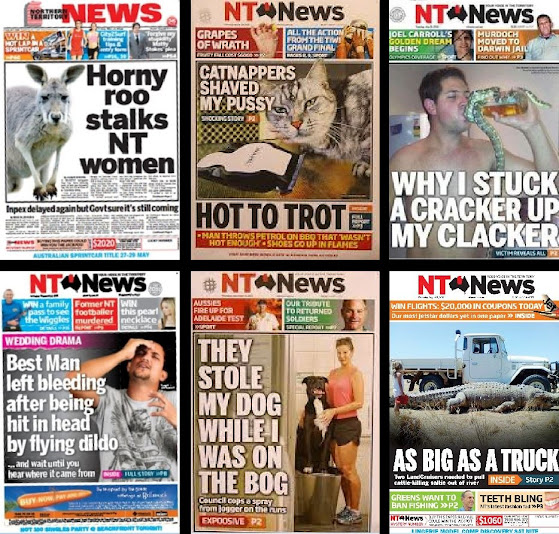
Published in Darwin since 1949, the NT News serves readers in Australia’s Northern Territory and, purchased in 1960, was one of Rupert Murdoch’s early acquisitions, published to this day by News Corp.  Rather than the journalism within, it’s noted for its award winning front pages, many of which feature large crocodiles, double entendres, or a combination of the two and the most famous remains WHY I STUCK A CRACKER UP MY CLACKER.  The onomatopoeic clacker in most places means (1) in music a percussion instrument that makes a clacking noise and (2) by extension, any device which makes a clacking noise but in the slang of Australia & New Zealand it also means (3) “the anus” (the etymological connection hopefully obvious).  Helpfully, the NT News did explain why the firework was so placed (and detonated) and, unsurprisingly for anyone acquainted with Northern Territory culture, it involved alcohol.  Firecrackers remain available for sale in the Northern Territory on specific occasions, long after most jurisdictions in the country banned “cracker nights”, the origins of which lay in the “Gunpowder Plot”, the attempt on 5 November 1605 by Guy Fawkes (1570–1606) to blow up the English houses of parliament.  Guy Fawkes' plot was thwarted and although the Luftwaffe did some damage, the UK's parliament has, with the odd interruption, kept going as a place of "low skulduggery" and the occasional "pursuit of noble causes", one often disguised as the other.
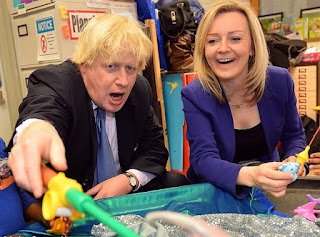
Boris Johnson & Liz Truss discussing policy.  Political scientists ignore the linguistic rules and classify both as "madmen".

That the members of the British Conservative & Unionist Party (the Tories) voted to replace Boris Johnson (b 1964; prime-minister 2018-2022) as leader with Liz Truss Liz Truss (b 1975; UK prime-minister since 2022) was predicted by the polls, her margin of 57.4% less decisive than recent contests (Boris Johnson (2019, 66.4%), Davis Cameron (2005 67.6 %) & Ian Duncan Smith (2001 60.7%)) and some did suggest a better number was expected.  One interesting aspect of the succession was the Tories, unusually, replacing one madman with another.  Under the compelling system of characterization suggested by former Labour Party notable Tony Benn (1925-2015; aka Anthony Wedgwood Benn & the second Viscount Stansgate), those who ascend the greasy pole to the premiership are either: (1) Fixers, (2) Straight men or (3) Madmen.

Fixers are those who do deals and strike bargains to gain the consensus needed to make the system work better; straight men (the term drawn from the stage where the "straight man" was a foil for the comedian) are incrementalists who seek to maintain the existing system and their place within while madmen change people, institutions and history, if necessary blowing up whatever stands in their way (usually figuratively, unlike Guy Fawkes or Hermann Göring (1893–1946; leading Nazi 1922-1945, Hitler's designated successor & Reichsmarschall 1940-1945)) although prime-ministers, madmen, fixers and straight men alike, have shown little reluctance literally to blow up small parts of other people's countries if there's political advantage to be had.  Interviewed while awaiting trial before the IMT (International Military Tribunal) which conducted the first Nuremberg Trial (1945-1946) Göring succinctly expressed the madman world view when asked to justify the murder of Ernst Röhm (1887–1934; chief of the Nazi Sturmabteilung (the stormtroopers (the SA)) during the suppression of the "Röhm putsch" (the collateral damage extending to a death toll in the hundreds).  Probably surprised at his interrogator's naivety, he answered: "But he was in my way.Politics does tend to be cyclical and though the three types don’t always operate in sequential rotation, it is unusual for one madman to replace another as Tory Party leader whereas there have in the past been successions of straight men or fixers.  In the literature, the cyclical nature of politics often is explored and US political Scientist James David Barber (1930-2004) in The Pulse of Politics: Electing Presidents in the Media Age (1980) constructed a model where, predictably, the political landscape shifts between “conflict” (combative battles), “conscience” (moral crusades), and “conciliation” (unity), a different concept from Benn's idea yet with remarkably similar outcomes if one mapping is overlaid atop the other.
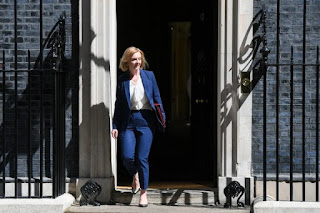
Liz Truss in pantsuit.

Most observes seem to agree Liz Truss is a madman in the sense Benn used but while few suggest she’s actually barking mad (or even unstable to whatever degree a clinician might delicately describe her state of mind), most enjoyed the thoughts of Dominic Cummings (b 1971; political strategist and adviser to Boris Johnson 2019-2020).  Cummings is hardly an impartial observer but in branding Ms Truss “about as close to properly crackers as anybody I’ve met in parliament”, he did strike a chord in finding a way succinctly to express what many thought but couldn’t quite put into words.  Crackers is such a good word and in the world of the early 2020s, for a head of government, it might be more a qualification than a diagnosis; desirable but not essential.
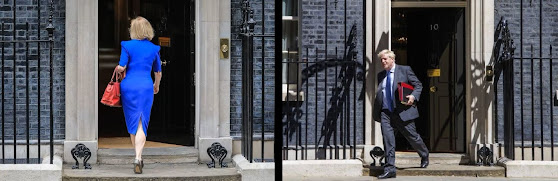
Number 10: Coming and going.

Of course what's more interesting than Ms Truss being elected to an office once held by Sir Robert Peel (1788–1850), Benjamin Disraeli (1804–1881), Lord Salisbury (1830–1903), Winston Churchill (1874–1965) & Harold Macmillan (1894–1986) was that although she may be crackers, all alternatives were clearly thought worse still.  It may seem not a desirable time to take Number 10 but the chance doesn’t occur that often (although there’s of late been a bit of churn) and, regardless of the circumstances, Ms Truss must think it still "something to be prime-minister of England" so should be wished the best of British luck.  If it works out then all’s well that ends well but one who will be watching with particular interest is Mr Johnson because, recalling Disraeli’s words that “finality is not the language of politics” he’ll not have abandoned hope but whether he comes back will be dependent wholly on events.  If the circumstances align so the Tories think only he can win them an election (or at least limit the loss of seats) then they'll take him back and so marvelously unprincipled is Mr Johnson that if need be, he'd campaign on the basis of re-joining the EU.  People still don't seem to realize how much he enjoyed being PM and principles will be blown up if they stand in the way.  His affectionate biography of Churchill added little to the historical record but he'll no doubt be re-reading the bits which covered "the wilderness years" between 1929-1939 although the millions he'll make from the public-speaking circuit and other lucrative dabbles should soften the blow; it's doubtful he'll be reduced to a diet of locusts and wild honey.

Lucius Quinctius Cincinnatus Called from the Plow to the Dictatorship (circa 1707), oil on canvas by Sebastiano Ricci (1659–1734)

Barely out the door, already he’s missed.  Comparing himself to a spaceship's booster rockets falling back to Earth after their usefulness ended was a nice touch but not un-noticed in Mr Johnson's valedictory address was his allusion to the Roman dictator Cincinnatus (circa 519–circa 430 BC) who, after a brief rule, retired to his farm only later to return to solve a crisis no one else could master.  It's worth noting too that booster rockets, fished from the water after "splashing down invisibly in some remote and obscure corner of the Pacific" are now designed to be returned to the shop to be refurbished, refueled and re-fitted for re-launch.

Although he has a lifetime's history of carelessness in such matters, on this occasion, one suspects Mr Johnson chose his words with rare care and nobody would deny he has a way with words.  Mixing his classical allusions with quotes from pop culture lent his speeches a vividness often lacking in politics and his farewell phrase uttered in PMQs (prime-minister's questions) in the House of Commons was borrowed from the movie Terminator 2: Judgment Day (1991): "Hasta la vista baby! (see you later!)"  It was going down with guns blazing but what was probably on his mind was the punchier phrase made famous in the original (Terminator (1984)): "I'll be back!"

Wednesday, September 7, 2022

Checkered

Checkered (pronounced chek-erd)

(1) Marked by numerous and various shifts or changes; variegated; diversified in color; alternately light and shadowed.

(2) Figuratively, changeable; inconsistent, marked by dubious episodes; suspect in character or quality, often in the forms “a checkered career”, “a checkered past” etc.  The still preferred spelling in the UK and much of the old British Empire is "chequered". 

(3) A fabric or other material marked with squares (most often in alternating black & white).

1350–1400: Check was from the Middle English chek & chekke, from the Old French eschek, eschec & eschac, from the Medieval Latin scaccus, from the Arabic شَاه‎ (šāh) (king (or check at chess); shah), from the Persian شاه‎ (šâh) (king, shah), from the Middle Persian mlkʾ & šāh, from the Old Persian xšāyaθiya (king), from the Proto-Indo-Iranian kšáyati (he rules, he has power over), ultimately from the primitive Indo-European tek- (to gain power over, gain control over).  The phrase “checkered past” appeared first in print in 1831 as a figurative use in the sense of “variegated with different qualities or events, having a character both good and bad”.  Checkered is an adjective.  Exchequer was from the Middle English escheker and eschequier, borrowed from the Anglo-French escheker and eschekier, derived from the Old French eschequier and escheccheck (chessboard, counting table).  Source was the Medieval Latin scaccarium (chess board).  The meaning with which it’s now most associated, government finances, emerged under the Norman kings of England, basis being the design of the cloth, divided in squares, covering the tables on which accounts of revenue were reckoned with counters.  These reminded all who saw them of a chess board and the name was adopted.  The English respelling with an -x- was because of the erroneous medieval belief that it originally was a Latin ex- word.

Flags in motorsport

Taking the checkered flag: Ralph Mulford (1884–1973) in a Lozier Type 51, winning the Vanderbilt Cup, Savannah, Georgia, USA, 28 November 1911.  In motorsport, the term "taking the checkered flag" means winning the race although at the conclusion of an event, the flag is displayed to all competitors as they cross the finish line for the final time.  Even in the digital age, flags continue to play a vital part in motorsport.  Despite progress, flags remain an efficient and reliable system instantly to convey information to those in visual range although in top-flight competition (such as Formula One) the bunting is now augmented by color-coded in-car display systems.  The most commonly seen flags are:

Green: Normal racing conditions apply.  The green flag is used also by staff under the control of the race director (the old "clerk of the course", a term borrowed from horse racing which donated much early terminology to the sport) in a way the drivers never see: When the cars are assembled on the grid prior to the start of an event, the race marshal posted at the back of the field will wave a green flag to indicate all vehicles are correctly placed; once the starter sees this, they are free to start the race which they do by waving a flag and while this may be green, these days it's often a national (or sub-national) flag or one with the symbol of a sponsor.    

Yellow: The hazard flag.  Its use varies according to the rules of the sanctioning body but in general: (1) it waved, it denotes a hazard on the racing surface, (2) if stationary a hazard near the racing surface and if two yellow flags are waved simultaneously, there’s a hazard (an object or person) blocking at least part of the racing surface.

Red and yellow vertical stripes: The oil flag.  It’s really the slipperiness flag because it’s used to warn of something on the surface (oil, coolant, sand, gravel, other fluids etc) which mean the track will offer less grip; despite that everybody calls it the oil flag.  Some sanctioning bodies display the flag until the hazard has cleared; others use it only for a couple of laps, the hazard beyond that point deemed "part of the track” with which the drivers are assumed to have become familiar.

Red: Stop the race.  This is usually done because a severe accident or natural conditions (weather, earthquake etc) mean it’s too dangerous to continue and, depending on the circumstances, drivers need either immediately to stop or slow to a safe speed and proceed to the pits.  Sometimes it’s used in conjunction with a yellow flag (there’s even a diagonally divided red and yellow flag for this purpose) to indicate the field should assemble for a re-start.

White: Once, the white flag was used to warn drivers an ambulance was sharing the track and as late as the 1970s, ambulances were deployed with the field still at racing speed and those for whom that sounds remarkable, should view footage of the aftermath of the horrific accident at Le Mans in 1955 to see how things used to be done without interfering with the running of the race.  Of late the white flag has come to be used in US motorsport as a component in the Green–White–Checker finish (GWC), an innovation which was a product of the sport being a content provider for television (and latterly other) feeds.  Its core rationale is to ensure races end under competitive conditions rather something anti-climatically processional under caution the caution flag.  Adopted in NASCAR, IndyCar (with variations), and other US series, the official explanation is that GWC ensures fairness while maintaining a structured approach but it’s really a device to ensure the product (the viewers) continue happily to be delivered to the customers (the advertisers).  In NASCAR the GWC is implemented with set parameters: (1) a green flag is waved to indicate the start of the final two laps (the so-called “overtime”) and (2) a white is waved to signify the final lap.  Should another caution flag be required before the white flag point is reached, the process can begin anew and this can be done as often as is possible within whatever “retries limit” rule applies on the day; should the white flag be taken, the next flag (checkered or caution) ends the race.  Other series have variations on the system, some extending laps under green or utilizing “red flag” stoppages to enable a competitive finish.

Black: The solid black flag is shown to inform a drive they should return to the pits to serve a penalty for some infringement of the rules or to have the vehicle checked because of some concern.  The black flag with an orange disc in the centre (the so-called meatball flag) is used to call a vehicle to the pits to have some mechanical defect immediately rectified.  The meatball flag, either by explicit regulation or convention, is used only when the mechanical defect presents some real or immediate risk to drivers or spectators (oil leaks, protruding bodywork etc)  

Blue: A proximity warning.  If held in a static position, it tells the driver another vehicle is closely following while if waved, it means another vehicle is attempting to overtake.  The idea is a slower car should not impede the progress of a faster one but the pattern of enforcement varies, the most common regulation being that lapped cars must yield to one attempting to pass but while this is mandated in some series, in others it remains merely advisory (although conduct can still be subject to “bad sportsmanship” rules, the ultimate on-track sanction of which is the “black flag”).  Often, the blue flag is used also at the exit from the pits to assist vehicles safely to re-join the race without disrupting those still circulating.

Checkered:  Also known as the chequered flag, the checkered flag indicates the end of a race.  Some sources suggest historically it was waved to acknowledge the race winner and held static to indicate to others the race had finished but there’s no evidence this practice was ever written into rules or even widely adopted and the checkered flag seems mostly to be waved.  The winner of a race is said to have “taken the checkered flag”.  Checkered flags are usually black and white and rendered in squares or rectangles but different color combinations have been used, sometimes to suit the needs of sponsors.  A noted innovation came in the 1980 Indianapolis 500 when two checkered flags were waved at race-end and the Indy series has adopted this as a standard.

Lindsay Lohan with fingernails in checkered flag pattern.

Various stories have been offered as the origin of the checkered flag in motorsport.  One suggests that in the horse-racing events popular at the large public picnics held during the settlement of the American mid-west during the nineteenth century, when the ladies were ready to serve lunch, they would wave large, checker-board tablecloths to inform the men food was ready and they competition should quickly be concluded.  As motorsport emerged as another amusement for men, because the early competitions were almost always held on dirt tracks, it’s said the contrasting colors of the checkerboard pattern were easier to see in a dusty environment and were thus ideal to signal the finish line.  Historians of the sport think these stories dubious on the basis of a lack of any contemporary evidence and for the some reason they’ve always been unwilling to give credence to any link with late nineteenth century bicycle racing in France.

British Admiralty Flag Chart.  

More convincing is the notion it may have been a borrowing from a naval flag signaling system and those of some admiralties did include a black (or blue) & white checkerboard to denote “Z” (ie final letter and thus the end in that sense).  It may be true or else, like many things, the checkered flag was chosen for its purpose at random.  What all agree upon is the documentary record.  The earliest known use of the checkered flag, based on the photographic record, is the one used to mark the end of the 1906 Vanderbilt Cup race in Long Island, New York.

Manufacturers used the checkered flag to convey a sense of high performance and to suggest some link (which sometimes was real) with a competition history.

The flag of Croatia

A banner used in Croatia between 925-1102 (left), the current Croatian flag adopted after independence in 1990 (centre) and the Croatian naval ensign (1990).

One of the most ancient symbols to endure in modern nation flags is the red & white checkered pattern used to this day on the flag of Croatia.  The oldest known example dates from 925 and the pattern was used (with the odd interruption) for centuries, even when the country was a non-sovereign component of supranational states such as the Habsburg Empire.  A red star was used instead when Croatia was a part of comrade Marshall Tito’s (1892-1980) Jugoslavija (Yugoslavia) between 1945-1990 but the red & white checks were restored when independence was regained in 1990.

Ivana Knoll at the FIFA World Cup in Qatar.

Noted Instagram influencer Ms Ivana Knoll (b 1992) was a finalist in the Miss Croatia beauty contest in 2016 and for her appearances at the 2022 FIFA World Cup in Qatar, chose a number of outfits using the national symbol of the red and white checkerboard, matching the home strip worn by the team.  By the standards of Instagram, the design of the hoodie she donned for Croatia's game against Morocco at the Al-Bayat stadium wasn't particularly revealing but it certainly caught the eye.  As if Gianni Infantino (b 1970, president of the Fédération Internationale de Football Association (FIFA, the International Federation of Association Football) since 2016) didn't have enough to ponder, the former Miss Croatia contestant tagged FIFA in her posts, fearing perhaps the president might not be among her 600,000 Instagram followers and her strategy seems to have had the desired effect.  Although it deems dubious the design (which did cover her hair, shoulders and legs) was sufficiently demur to satisfy the local rules, it seems she posted throughout the event, undisturbed.   The guidance provided by FIFA indicated non-Qatari women didn't need to wear the abaya (the long, black robe) but tops had to cover the midriff and shoulders, and skirts, dresses or trousers must cover the knees; moreover, clothing should not be tight or reveal any cleavage.  In accordance with the rules or not, Ms Knoll proved a popular accessory for Qatari men seeking selfies.

Croatian FIFA World Cup 2022 strips, home (left) & away (right). 

On the basis of her Instagram posts, the German-born beauty (although perhaps technically in violation of some rules) had a pleasant tournament if she's had any problems, Sepp Blatter's (b 1936; FIFA president 1998-2015) lawyers may have been available.  They seem pretty good.  Paradoxically, although the impressively pneumatic Ms Knoll generated much interest in her hoodie, had she worn an all-enveloping burka in the red & white checkerboard, it might have gained even more clicks.