Tuesday, September 15, 2020

Hezbollah

Hezbollah (pronounced hez-buh-lah or khes-bah-lah (Arabic))

A Shiʿite Muslim political and military organization (though genuinely with cross-denomination support), based in Lebanon but involved also in various regional operations.

1985: From the Persian hezbollah and the Arabic حِزْبُ اللّٰه‎ (ḥizbu llāh) (literally "Party of God"), the alternative spellings being Hizbullah, Hizballah & Hizb Allah, the construct being hezb (hizb) (party) + Allah (God); an adherent is styled a Hezbollahi although in Western commentaries that term seems to be applied more loosely.  Hezbollah is a proper noun.  Hezbollahzation & Hezbollahization are non-standard nouns used only in political science although, like balkanize etc, if use spreads they may enter general use.

The Hezbollah

Flag of the Hezbollah (right), the public display of which is banned in some jurisdictions where both the organization's political & military wings are listed as "terrorist organizations".  The national flag of Mozambique (left) also includes a depiction of a Kalashnikov AK-47 assault rifle although the Africans fixed a bayonet to the barrel which was a nice touch.  Mozambique gained independence from Portugal in 1975 although the flag wasn’t officially adopted until 1983 as a modified version of what was essentially the battle flag of the Frente de Libertação de Moçambique (FRELIMO, the Mozambique Liberation Front, the Marxist (later styled “democratic socialist”) resistance movement which fought a war of liberation (1964-1974) against the Portuguese colonial forces).

Although the Hezbollah began to coalesce in 1982-1983 (in the wake of the 1982 Israeli invasion of Lebanon), it wasn’t until 1985 it assumed the familiar structural arrangement with both military and political wings.  Unlike many organizations with similar pasts, although the personnel structures don't (wholly) overlap, the Hezbollah has never made any attempt to suggest there is any functional or philosophical separation between their political & military wings.  Despite that, during periods when regional tensions are more subdued, they do receive invitations usually restricted to the respectable and a Hezbollah delegation attended the coronation of Benedict XVI (1927–2022; pope 2005-2013, pope emeritus 2013-2022).  Like the Hezbollah, Hamas, a militant Palestinian resistance movement also operates as an apparatus with military, political and administrative divisions but the distinctions are less defined than those of the Lebanese operation and the name of Hamas comes from a similar linguistic tradition.  Formed in 1987 after the outbreak of the First Intifada against Israeli occupation, its roots lie in Muslim Brotherhood so, unlike the Hezbollah, it’s thus a Sunni group although the historical and theological differences haven’t prevented the two cooperating when the circumstances have appeared compelling.  The word Hamas is an acronym of the Arabic phrase حركة المقاومة الإسلامية (Ḥarakah al-Muqāwamah al-ʾIslāmiyyah) (Islamic Resistance Movement), used originally as the initializsm HMS.  In 1988, when the The ميثاق حركة المقاومة الإسلامية حماس (Covenant of the Islamic Resistance Movement and better known in the West as the “Hamas Covenant” or “Hamas Charter”) was published, this was glossed by the adoption of the Arabic word (حماس) (hamās) (strength, zeal, bravery).

The very existence of the Hezbollah disturbs some but certainly not the structural-functionalists who note that for an institution to continue to exist, the niche it inhabits must remain (even if artificially maintained, explaining the ongoing existence of the BIS (Bank for International Settlements), a classic example of bureaucratic inertia).  Those whose fastidiousness in this & that lead them to suggest some alternative to Hezbollah would be preferable seem never to go into details and the reluctance is understandable.  There are many countries in which the substitution of one political party for another can be modelled and the implications pondered but scarcely is it possible to imagine Lebanese politics without the Hezbollah.  As far as can be foreseen, it seems something permanent and Lebanon has for decades been a troubled place, badly served by its elites who, motivated only by self interest have a dynamic relationship that is (in the phrase used in another context by Antony Blinken (b 1962; US Secretary of State 2021-2025): "Competitive when it should be, collaborative when it can be, and adversarial when it must be."  Lebanon is not going to become a liberal democratic state in the Nordic mode; it is an Arab nation with Arab traditions and things will be worked out in the Arab way.  Just as the yakuza (the Japan-based trans-national organized crime syndicates and usually in katakana as ヤクザ) deploy rapidly in the aftermath of disasters like the Kobe earthquake (1995) and the Fukushima “incident” (2011) to provide affected populations with food, shelter and medical aid, it was the Hezbollah’s well-resourced (compared with the Lebanese state) social welfare infrastructure that was mobilized to provide the first response after the explosion in the Port of Beirut (2020).

The Beirut Port explosion, 20 August 2020, viewed from the sea, showing the mushroom cloud and effect of the blast wave.  It was one of the most powerful non-nuclear, man-made explosions ever recorded.

Such comparisons are intriguing because the yakuza are an integral part of the Japanese nuclear industry and much money was paid to them by TEPCO (the Tokyo Electric Power Company which ran the Fukushima plant) to keep secret the existence of cracks in vital parts of the machinery.  Although much of the world seems to think the meltdown (TEPCO and the Japanese government preferred “incident”, a word with a long cultural tradition until the IAEA (International Atomic Energy Agency) called a spade a spade) was something which “happened in 2011”, it’s an ongoing event and will be for the next 40-50 years because unless TEPCO continues to pump water into the “hot” reactor core, the meltdown will resume.  That water has to go somewhere and for those 40-50 years the plan is to continue to pump it into the Pacific Ocean; there is no immediate alternative.  The pumping project will likely demand increasing yakuza involvement because they are willing lucratively to be involved in projects others prefer to avoid.  Some allege the invaluable role fulfilled by the Hezbollah in responding to the explosion at the Port of Beirut in August 2020 has a similar quality of circularity because the triggering of some 2¾ tonnes of ammonium nitrate (an explosive equivalent in excess of 1 kiloton of TNT (similar to some small, tactical nuclear weapons)) was linked to a Hezbollah weapons cache held in the same facility.  No evidence has been produced to support that and most analysts believe the blast was the result of an enormous quantity of explosive being stored in a low security environment, welding work on the day said to have “lit the fuse”.  However, whether all will ever be known about the matter is unclear because the Hezbollah (and others with their own reasons) have managed to ensure investigations have been curtailed.

The other side of Lebanon: Lindsay Lohan's Instagram post of photographs taken while on holiday in Lebanon, June 2022. 

Hezbollah has been the name of various Islamic groups in the twentieth century, the first known reference in English being from 1960, describing an Indonesian guerilla battalion of 1945 that appears to have been either an off-shoot of or successor to Laskar Hizbullah, formed by the Japanese to give military training to young Muslims they had recruited to their cause (an aspect of which was the training to become a kamikaze (ie suicide bomber)).  Laskar Hizbullah was ostensibly national-wide but, unlike the Lebanese namesake, had little effective central organization and, given the circumstances of 1945, didn’t enjoy the ongoing support from Tokyo the Hezbollah has had from the ayatollahs in Tehran.  It was militarily ineffective but its idea (if not the actual structures) carried over to post-war anti-colonial forces and (debatably) the communist movement which in the mid-1960s the Indonesian government suppressed, the death-toll of that operation claimed to be close to half-a-million.

Monday, September 14, 2020

Intifada

Intifada (pronounced in-tuh-fah-duh)

(1) A historic Arabic word for a (usually violent) political uprising against the ruling or occupying power.

(2) Either of two revolts by Palestinian Arabs to protest Israel's occupation of the West Bank and Gaza Strip (sometimes with initial capital letter).

1985: From the Arabic verb Arabic اِنْتِفَاضَة (intifāḍa)(translated variously as “a shaking off”; “a jumping up (in reaction to something)”; “tremor”; “shivering” or “shuddering”) and technically a derivative of fāḍa (to shake off) but is most rendered into English as “uprising”, “resistance” or “rebellion”.  Because of recent history, the best understood translation is now probably "Palestinian revolt".  The "problem of Palestine" is a long-standing thing: In February 1945 the Lebanese minister resident in Paris was in discussion with the British ambassador to France to whom he remarked: "Palestine should be an entirely Arab state".  The ambassador asked him about the status of Jews resident in Palestine under such an arrangement and the minister replied: "...if the British would only close their eyes for a few minutes the Arabs would soon settle the Jewish question."  The variations in spelling include intefadah, intifadah & Intifada.  Intifada & intifadists are nouns; the noun plural is intifadas.  

West of the Jordan, east of the Rock of Gibraltar

Although the concept dates back centuries, historians consider the 1952 left-wing revolt against the Hashemite monarchy in Iraq as the first modern instance even though it was preceded by Colonel Abdel Nasser's (1918–1970; president of Egypt 1954-1970) revolution in Egypt.  The post-war wind of change which blew through the colonial world affected Africa and the Middle East with revolts in Sudan (1964), Bahrain (1965) and the Spanish Sahara (1970) but it’s the first (1987-1996) and second (2000-2005) intifadas in the occupied Palestinian territories which have defined use of the word.

Although the spasmodic incidents of unrest in the territories in 2014-2015 are sometimes referred to as intifadas none has been of sufficient intensity or duration to be labelled a third intifada.  Nor are other events in the region such as the 1990 Bahrain uprising, the 1991 Iraqi revolt, the 1999-2005 protests in Morocco or the 2005 revolution in the Lebanon remembered as intifadas because, in the West, the word is now almost exclusively associated with the two uprisings in the West Bank and Gaza.  It is only another action in the model of the earlier actions that will become known as the third intifada.  Indeed, the revolutionary wave which began on 18 December 2010 in Tunisia attracted the label Arab Spring and although the odd journalist or academic historian wrote of an intifada (with a couple of British specialists preferring “…a series of intifadas”) the more romantic Arab Spring prevailed.

Saturday, September 12, 2020

Dimorphous

Dimorphous (pronounced dahy-mawr-fuhs)

(1) Occurring or existing in two different forms.

(2) In botany, plants with roots with two distinctive forms for two separate functions.

(3) In botany, as frond dimorphism, differing forms of fern fronds between the sterile and fertile fronds.

(4) In botany, as dimorphic fungi, fungi which can exist as both mold and yeast.

(5) In cell biology, as phenotypic dimorphism, a switching between two or more cellular morphologies.

(6) In zoology, a phenotypic difference between males and females of the same species.

(7) In nuclear physics, a cell where the nuclear apparatus is composed of two structurally and functionally differentiated types of nuclei.

(8) In geology, the property of some substances to exist in two distinct crystalline forms.

1801: From the Ancient Greek dímorphos (of two forms), the construct being di + morphē (form, shape).  The suffix di- was from the Ancient Greek δῐ- (di-), from δῐά (diá) (through), from the Latin di- (two, twice or double (the synonyms were duo-, bi- & bis-)) and was an alternative form of dis-, shortened when placed before l, m, n, r, s (followed by a consonant), and v; it was also often shortened before g, and sometimes before j.  Morphe was a back-formation from morpheme, from the Ancient Greek μορφή (morphḗ) (form, shape); the similar German Morph is from morphem and attested since the 1940s.  In formal grammar and structural linguistics, morphe is a physical form representing some morpheme in language; a recurrent distinctive sound or sequence of sounds.  In linguistics, an allomorph is one of a set of realizations that a morpheme can have in different contexts.  The –ous suffix is from the Middle English -ous, from the Old French –ous & -eux, from the Latin -ōsus (full, full of); a doublet of -ose in an unstressed position.  It was used to form adjectives from nouns, to denote possession or presence of a quality in any degree, commonly in abundance.  In chemistry, it has a specific technical application, used in the nomenclature to name chemical compounds in which a specified chemical element has a lower oxidation number than in the equivalent compound whose name ends in the suffix -ic.  For example sulphuric acid (H2SO4) has more oxygen atoms per molecule than sulphurous acid (H2SO3).  The class of words to which dimorphous belongs originally was most often used in botany to describe plants with one (monœcious), two (diœcious) or there (trimorphic) forms.  Dimorphous & dimorphic are adjectives, dimorphism is a noun and dimorphically is an adverb; the noun plural is dimorphisms.

The asteroid Dimorphos compared with the Colosseum in Rome.

First observed in 2003, Dimorphos is a small asteroid, technically a minor-planet moon of a synchronous binary system, Didymos, discovered in 1996, the primary asteroid.  Unfortunately, after the usual committee processes of the Working Group Small Body Nomenclature (WGSBN) of the International Astronomical Union (IAU), the astronomers’ preferred nickname "Didymoon" was declined, the official name Dimorphos granted on 23 June 2020.  With a diameter of 170 metres (560 feet), it’s among the smallest astronomical objects to be given a permanent name.

The LICIACube.

Dimorphos is of greater interest than most asteroids because it’s the target of NASA's Double Asteroid Redirection Test (DART) mission, the impact scheduled for 26 Sep 2022.  The DART project is a proof-of-concept mission to test the viability of using small-scale physical impacts as a means to divert the trajectory of asteroids or other objects likely to hit Earth.  The DART process too is dimorphous and only partially self-destructive, the European Space Agency’s (ESA) Light Italian CubeSat for Imaging Asteroids (LICIACube) travelling attached to the doomed projectile, separating ten days before impact, that mission to observe and record the impact’s consequences.  Although about the size of a small car, with the solar panel wings unfurled, DART is as big as a 32-40 seat bus while LICIACube, equipped with the LICIACube Unit Key Explorer (LUKE) and LICIACube Explorer Imaging for Asteroid (LEIA) optical cameras is a small package with a mass of about 30 pounds (14 kilograms), barely bigger than a respectable handbag.  The size and weight of the ESA’s equipment was dictated by the limits imposed by the need to restrict the volume to what could be carried by DART for the entire journey.

DART with its solar panel wings unfurled.

The name, derived from the Ancient Greek Dimorphos (having two forms) refers not to what the unsuspecting rock is but what it will become, the second of its forms emerging after DART strikes.  Dimorphos will become the first celestial body in history, the form of which will substantially be changed by human intervention and this may therefore be something unique in the universe.  The point of the experiment is to determine if impacts at speed (and therefore of greater energy, DART planned to hit at 15,000 mph (24,100 km/h)) by small objects is sufficient to deflect objects by enough to change their course.  The theory is that if undertaken at long-distance, only a tiny change in trajectory should be enough to avert an object from a collusion path with Earth.  NASA launched DART on 24 November 2021.

Point of DART and LICIA separation.

Ten days before DART strikes Dimorphos, LICIACube will be released, firing its thrusters to separate from the mother-ship, then positioning itself to be at the correct angle to optimize the viewing window while ensuring it’s remains at a distance close enough to capture the desired details yet not so close as to risk damage from whatever debris the impact may eject.  The DART images immediately prior to impact will actually be a real-time stream; travelling at the speed of light, the data will take some 38 seconds to travel the 6.8 million miles (10.9 million km) to Earth.  LICIACube will store the data and continually transmit images in the months after DART’s demise. 

DART Mission plan.

Although the target asteroid is tiny compared to the cataclysmic Chicxulub behemoth which struck Earth 66 million years ago, ending the long age of the dinosaurs, the data derived from the DART experiment should be robust enough to be scalable and mathematical models will be developed to work out how much energy will need to be deployed to gain the desired effect, hence the often speculated use of nuclear explosions if the troublesome rock is really big.  Asteroids, primordial rocky remnants from the solar system’s formation some 4.6 billion years, are not uncommon and some are already on a path to strike earth sometime during the next few million years so the threat is real, even if the timing is unpredictable.

One flavor of the dimorphic role: Lindsay Lohan in The Parent Trap (1998).

In fictional depictions, well known examples of dimorphic roles include (1) the one individual manifesting in two very different forms such as the protagonist(s) in Robert Louis Stevenson's (1850–1894) Strange Case of Dr Jekyll and Mr Hyde (1886), (2) one which explores aspects of duality which manifest as two characters with lives or personalities intertwined to the extent that the distinction between the two is sometimes lost (Waiting for Godot (1953) by Samuel Beckett (1906-1989)) or used as a literary device (The End of the Affair (1951) by Graham Greene (1904-1991)) & (3) the one actor playing two different characters who are in some way closely related or associated (Lindsay Lohan in The Parent Trap (1998)).  However, where an actor plays two quite distinct roles (Peter Sellers (1925–1980) in Dr Strangelove (1964) although he actually played three) this is not thought dimorphic because the characters are connected except through the device of the plot.

Friday, September 11, 2020

Ancestor

Ancestor (pronounced an-ses-ter or an-suh-ster)

(1) A person from whom one is descended (maternal or paternal); forebear; progenitor (often used in the plural and by convention, applied usually to (1) great grand-parents or earlier or (2) those already deceased).

(2) In biology, the actual or hypothetical form or stock from which a (usually dissimilar) organism has developed or descended.

(3) An object, idea, style, or occurrence serving as a prototype, forerunner, or inspiration to a later one; in linguistics, a word or phrase which serves as the origin of a term in another language.

(4) A person who serves as an influence or model for another; one from whom mental, artistic, spiritual etc descent is claimed.

(5) In the law of probate, person from whom an heir derives an inheritance; one from whom an estate has descended (the correlative of heir).

(6) In figurative use, one who had the same role or function in former times (now rare except as a literary device).

1250–1300: From the Middle English ancestre, auncestre & ancessour (one from whom a person is descended).  Ancestre & auncestre were from the (early) Old French ancesre & (the later) ancestre (which endures in modern French as ancêtre), from the Latin nominative antecēssor (one who goes before (literally “fore-goer”), from the Classical Latin antecēdere (to procede), the construct being ante (before), from the primitive Indo-European root ant- (front, forehead (and influenced by the derivatives meaning "in front of, before")) + cedere (to go), from the primitive Indo-European root ked- (to go, yield).  Ancessour was from the Old French ancessor, from the Latin accusative antecessorem, from antecedo (to go before), the construct being ante (before) + cedo (to go).  Both rare outside of technical literature, the present participle is ancestoring and the past participle ancestored.  Synonyms include forebear, forefather, founder, antecedent, ascendant, foremother, forerunner, precursor, primogenitor, progenitor, antecessor & foregoer.

The now rare (and probably extinct) antecessor (a doublet of ancestor) dates from circa 1300 in the sense of "an ancestor" and a century later as the more generalized "a predecessor".  The noun ancestry (series or line of ancestors, descent from ancestors) was from the early fourteenth century auncestrie, from the Old French ancesserie (ancestry, ancestors, forefathers) from ancestre, the spelling modified in English under the influence of ancestor.  The adjective ancestral (pertaining to ancestors) dates from the 1520s, from Old French ancestrel (the spelling in Anglo-French auncestrel) (ancestral) from ancestre.  The alternative form ancestorial co-existed for decades after the 1650s but presumably can still be used for linguistic variety although it’s probably obsolete and may thus be thought an affectation.  The adverb ancestrally followed the adjective.

The familiar spelling in Modern English was in circulation by the early fifteenth century and the alternative spellings ancestour, antecessour, auncestor & auncestour (etymologists nothing even more as errors in medieval transcription rather than linguistic forks) are all long obsolete.  The noun plural is ancestors and the always rare feminine form ancestress, dating from the 1570s, is probably extinct except in historic reference.  In the biological sciences and the study of human genealogy, the derived terms include cenancestor (the last ancestor common of two or more lineages, especially the universal last common ancestor (LCA) of all life and grandcestor (not precisely defined but used to refer to more distant ancestors, especially (collectively) those for whom no identifiable records exist.  One interesting modern creation is trancestor (a forebear or forerunner to a trans person, or to modern transgender people in general).

Conventions of use

Depending on context, the word ancestor can be used (1) to refer to those who constitute one’s direct lineage (father, grandmother, great grandfather etc), (2) one’s ethnic heritage (English, German, Persian etc), or (3) the line of ancient evolutionary descent ((hominoidea, hominiade etc).  Such forbears (usually synonymous with ancestor but can be used more generally (eg political forebares), even without an (often implied) modifier) are also in some sense one’s predecessors (from the Middle English predecessour, from the Old French predecesseor (forebear), from the Late Latin praedēcessor, the construct being prae- (pre-) (before; prior to) + dēcessor (retiring officer), Latin dēcēdō (I retire, I die (source of the English decease)) but that word tends to be used where the human relationships are not familial or with objects.  One’s ancestors are thus (1) exactly known (back as many generations as records exist which, depending on the family, may be recent or stretch back centuries), (2) hypothesized (earlier generations the details of which are undocumented or of which there is no awareness), (3) a generalized expression of ethnic extraction (slavic, Polish-Scottish etc) and (4) an expression of human evolution.

Lindsay Lohan's family tree.  Genealogists traditionally use a trunk and branch metaphor because it's the best way graphically to display the procreative ways of one's ancestors.  

Ancestry is thus not something exclusively human and extends to non-human animal species, plant life and even organisms which are not alive in some senses of the word such as viruses.  So usefully understood is the concept of ancestry that that the word is used even in fields like cosmology (discussing the evolution of planets, stars etc), software (the industry’s naming conventions (1.0, 1.1, 2.0 etc) inherently ancestral), geology (noting the transformative process by which liquid magma becomes rock) and generally in fields such as philosophy, musicology, architecture, painting or any discipline where there is some discernible relationship between an idea or object and that which can be defined as a predecessor.

Nor is it unique to human ancestry that ancestors are individually identified and named to the extent possible.  In the pedigree breeding of animals (cats, dogs etc), the papers exist to trace the lineage of these beasts back further than a goodly number of the world’s population can manage, the best known example of which is are thoroughbred race horses for to qualify as one, it must be possible to trace the descent of each individual back to three Arabian stallions brought to England in the seventeenth & eighteenth centuries: Byerley Turk (1680s), Darley Arabian (1704), & Godolphin Arabian (1729).  Ancestry is also important to those other thoroughbreds, royalty and the aristocracy, for upon it depends inheritance of title, land, wealth and occasionally countries.  Vital therefore but as a guarantee of blue-blooded purity it’s long proved a challenge to maintain because of the proclivity of both species to sire bastard progeny and it could be dangerous too, wars over such matters not unknown and the odd inconvenient bastard has met an unfortunate end.

The muscle car and its ancestors

1970 Plymouth Hemi Roadrunner.

The definition of the muscle car is sometimes disputed and the term is more useful if the net is cast a little wider but the classic definition is “an American mid-sized (intermediate) two-door, four seat car produced between 1964-1972 and powered by the large engines hitherto reserved for the full-sized lines”.  That’s precise but also excludes many machines most (definitionally non-obsessive) folk include when considering the muscle car era such as the highest-performance version of the two-seat sports cars (Chevrolet Corvette, AC Shelby Cobra, AMC AMX), the full-sized machines (Ford Galaxie, Chevrolet Impala etc), the pony cars (Ford Mustang, Pontiac Firebird etc) and the compacts (Chevrolet Nova, Dodge Dart etc).
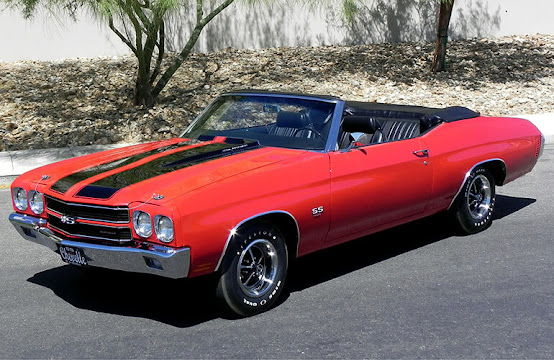
1970 Chevrolet Chevelle SS454 Convertible (LS6).

Apart from what frankly was the craziness of the muscle cars, one reason the machines of the era remain so memorable is that the 1960s represented the industry's last days of relative freedom.  The regulations imposed by government on designers went from being in the 1950s a manageable nuisance (the few rules which existed sometimes just versions of industry protection) to something annoying intrusive by the late 1960s before in the 1970s becoming truly restrictive and costly.  That most of the regulations were a very good idea and in the interest of just about everybody is not the point.
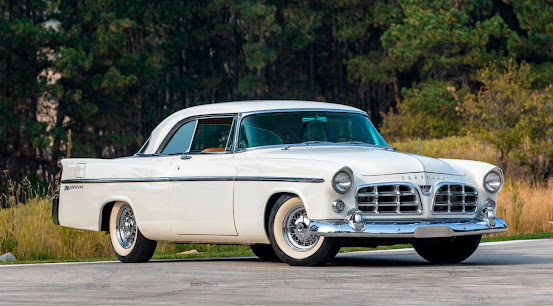
1956 Chrysler 300B.

There had in the 1950s been something of a power race as manufacturers competed to offer increasingly powerful V8s although in that era, there were no intermediate, compact or pony cars, each manufacturer offering essentially a one-size-fits-all range so the biggest, most powerful engines tended to be installed in the most luxurious and expensive of their lines.  The car with the most obvious claim to ancestry is probably the 1949 Oldsmobile 88 which used the new 303 cubic inch (5.0 litre) Rocket V8 which was modest enough compared with what would follow but was certainly a step in the muscle car direction.  Similarly, the 1955 Chrysler 300 was probably the first post-war US sedan blatantly to emphasize performance and it did offer the corporation's most powerful engine but it was still in the same body as the rest of the range.  More convincing ancestors perhaps were offerings by Chevrolet and (improbably) Rambler which offered high-power options in usually inoffensive sedans but the lift was achieved not by increased capacity but the technological advance of fuel-injection.  The tradition was thus of muscular rather than muscle cars (as subsequently defined), the latter needing the smaller platforms which would appear in the early 1960s.

1964 Pontiac GTO.

The first muscle car is usually said to be the 1964 Pontiac GTO, created by offering the 389 cubic inch (6.5 litre) V8 as an option in the intermediate Tempest, the largest engine otherwise available the (now slightly downsized) 326 (5.3 litre) cubic inch unit.  The original GTO was an option package rather than a designated model, this a contrivance to work-around an edict from General Motors (GM, Pontiac’s corporate parent) which didn’t permit the big engines to be used in the intermediate platform.  Such was success of the (highly profitable) GTO that GM rapidly withdrew the prohibition and a rash of imitators immediately emerged, both from the corporation’s other divisions and those under the umbrella of the competition, Ford and Chrysler.
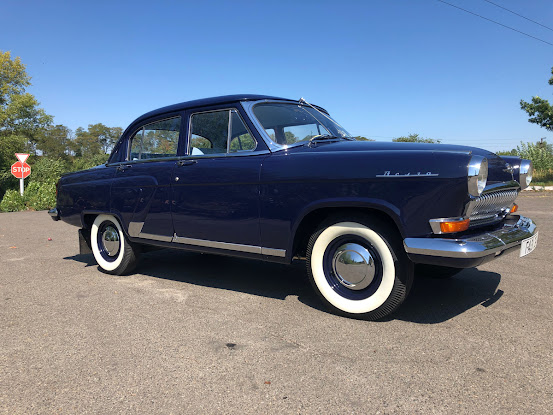
1962 GAZ-21 Volga (rebuilt to M-23 (KGB (V8) specifications)).

GM in the 1960s was in many ways an innovative corporation but also, as circumstances demanded, imitative: The 1962 Chevy II (later Nova) was conceptually a copy of the 1960 Ford Falcon, the 1966 Chevrolet Camaro a response to the 1964 Ford Mustang and the 1965 Chevrolet Caprice was inspired by the debut of the Ford LTD a few months earlier.  That’s accepted orthodoxy but the accepted wisdom has long been the idea of putting a big-car’s big engine into an intermediate-size platform began in 1964 with the arrival of the Pontiac GTO.  It may be however that Pontiac got the idea from America’s ideological foe, the Soviet Union, which anticipated the concept by two years because between 1962-1970, GAZ produced the intermediate sized M-23 Volga (a special-variant of the M-21) for the exclusive use of the KGB and other Soviet “special services”.  Equipped with the 5.53 litre (337 cubic inch) V8 engine from the big GAZ-13 Chaika (Gull) (1959-1981 and in the Soviet hierarchy, second only to the even bigger ZIL limousines (1936-2012)), the car was said to be a not entirely successful piece of engineering but it was certainly faster than the four-cylinder model on which it was based.  It’s never been clear just what was the top speed because while the factory claimed 170 km/h (106 mph), the speedometer was calibrated to 180 km/h (112 mph) but one intrepid KGB apparatchik claimed to have achieved that and reported his Volga was “still accelerating”.  The standard rule during the Cold War was that “nothing should be regarded as confirmed until the Kremlin denies it” so until someone takes one of the survivors (a reputed 19 known to exist) to something like Bonneville Speed Week for a run on the salt flats, it's all speculative.  Like some of the US muscle cars which were produced only in small numbers, in its eight-year run, GAZ made only 603 M-23 Volgas (rare thus compared with a US equivalent, the 1970 Plymouth Hemi ‘Cuda which in that year alone numbered a pleasing 666) but it perhaps more than the GTO deserves a place in history as the first muscle car.

1971 Plymouth Hemi Roadrunner.

Between 1964-1970, the muscle car movement would evolve into wilder and increasingly more powerful machinery, an evolution which unfolded in unison with similar developments on the ever lighter pony car platforms.  Things peaked in 1970 but by then the writing was not so much on the wall as on bill papers in the Congress and the revised contract schedules of insurance companies, an onrush of safety and emission-control regulation alone perhaps enough to kill the muscle car ecosystem but the enormous rise in insurance premiums was the final killer.  The combination of affordable high power in cars with dubious handling and braking in packages which appealed to males aged 17-25 had proved a lethal combination and the insurance industry reacted.  In name, the muscle cars would linger on for a couple of seasons but demand had collapsed a combination of circumstances which pre-dated the first oil shock in 1973 which would otherwise likely have been the death knell.

Ancestors of the muscle car
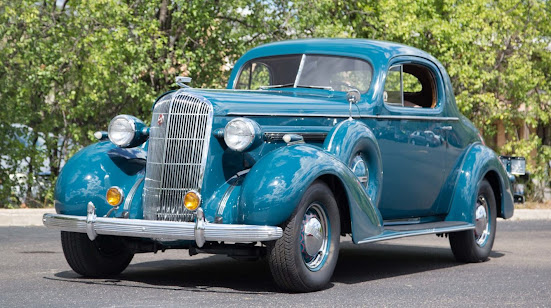
1936 Buick Century 66S Coupé (Fisher body style # 36457).

Although the improvement in the economy remained patchy, Buick rang in the changes for 1936, re-naming its entire line.  Notably, one newly designated offering was the Century, a revised version of the model 60, created by replacing the 233 cubic inch (3.8 litre) straight eight with the 320 cubic inch (5.2 litre) unit from the longer, heavier Roadmaster.  Putting big engines into small cars was nothing new and during the interwar years some had taken the idea to extremes, using huge aero-engines, but those tended to be one-offs for racing or speed-record attempts.  In Europe, (slightly) larger engines were sometimes substituted and British manufacturers often put six cylinder power-plants where once there had been a four but their quest was usually for smoothness and refinement rather than outright speed and the Century was really the first time a major manufacturer had used the concept in series production.  It’s regarded by many as the last common ancestor (LCA) of the muscle car.

Much muscle: 1933 Napier-Railton, fitted with a 23.9 litre (1461 cubic inch) W12, naturally aspirated aero-engine.  Between 1933-1937, it would set 47 world speed records in England, France and the United States.  Fuel consumption at speed was an impressive 4.2 mpg (imperial gallons) (67.29 litres/100 kilometers).

The Century gained its name from British slang, “doing the century” meaning to attain 100 mph (161 km/h) on a public road, then a reasonable achievement given the machinery and the roads of the day.  In production between 1936-1942, the Buick’s positioning of the Century in the market was hinted at by initially offering a range of four two door coupés & convertibles and a solitary four door sedan although subsequent demand saw further variations of the latter added in 1938.  Always the most expensive of the short wheelbase (SWB) line, the high-performance Century was as much a niche model as the later muscle cars would be and the Century never constituted more than 10% of production but demand was steady and it remained available until civilian production of cars was prematurely curtailed early in 1942.

1958 Jaguar 3.4.  VDU 881 was a Jaguar factory car on loan to Mike Hawthorn (1929–1959; FI world champion 1958) who tuned it further and used it both as a road car and for racing.  In VDU 881 he was killed in a motorway accident in treacherous conditions and although high speed was certainly a factor, the exact reason for the crash will never be known, the most common theory being the behavior of the early radial-ply tyres which, although raising the limits of adhesion beyond that of the earlier cross-plys, did tend suddenly to lose grip at the limit rather than gradually and predictably sliding towards that point.

One obvious spiritual ancestor from across the Atlantic was the Jaguar 3.4 (1957-1959), created by the same formula which would become Detroit’s muscle car template: take a big engine from a big car and put it in a small car.  The Jaguar 2.4 had been on sale since 1955, a successful incursion into the market segment BMW would later define with the 3 Series (1975-).  Jaguar had not deliberately neglected the small saloon segment since 1949 but in the early post-war years lacked the capacity to add another line, their resources fully absorbed by production of the XK120 (1948-1654) sports car and the big saloon, the Mark V (1948-1951).  It wasn’t until after the new big car, the Mark VII (1951-1956) had been released that attention (as Project Utah) could be turned to development of a smaller line and that emerged in 1955 as the 2.4, running a short-stroke, 2.5 litre (152 cubic inch) version of the XK-six, the package carefully honed to ensure a genuine 100 mph (161 km/h) was attainable (although when the heavier Mark 2 was released in 1959, the claim was no longer made and it wasn't until 1967 when the cylinder head was revised the magic "ton" was restored for the last of the line (the re-named 240).  Instantly successful, it quickly became the company’s biggest seller and within two years, responding to demand, a 3.4 litre (210 cubic inch) version was released.

Bob Jane in 1959 Jaguar Mk 2 3.8 (with 4.1 litre engine) winner of the Australian Touring Car Championship, Mallala, South Australia, 1963.

Because of the importance of the US market, much emphasis was put on the availability of an automatic transmission but the manual versions were also much fancied, rapid on the road and in racing but even at the time, there were comments that perhaps the power available exceeded the capability of the platform.  Jaguar did (at least partially) acknowledge things weren’t ideal by offering disc brakes, an option which proved popular.  Substantial revisions to the underpinnings weren’t however undertaken until the release in 1959 of the Mark 2 (the earlier 2.4 & 3.4 retrospectively dubbed Mark 1) which much improved the car’s manners.  However, although now fitted with a 3.8 litre (231 cubic inch) XK-six, the new car was heavier so there wasn’t that much of a lift in performance and, at the limit, both could be a handful, even in the hands of experts.  So, even if some don't call it a muscle car, it could behave like one.

Thursday, September 10, 2020

International

International (pronounced in-ter-nash-uh-nl)

(1) Between or among nations; involving two or more nations.

(2) Of or relating to two or more nations or their citizens.

(3) Pertaining to the relations between nations.

(4) Any of the four international socialist or communist organizations formed in the nineteenth and twentieth centuries (with initial capital letter).

(5) A labor union having locals in two or more countries.

(6) An organization, enterprise, or group, especially a major business concern, having branches, dealings, or members in several countries (often styled as multi-national or multinational).

(7) An employee, especially an executive, assigned to work in a foreign country or countries by a business or organization that has branches or dealings in several countries.

(8) A casual term for sporting matches played between national teams in many sports (rugby, cricket, football eta al) and applied also to individuals selected for those contests.

1780: A compound word, inter + national, coined apparently by English philosopher Jeremy Bentham  (1748-1832) in his Introduction to the Principles of Morals and Legislation (1870) and appears also in A Plan for a Universal and Perpetual Peace (1786–1789) which forms part IV of the Principles of International Law.  Inter was from the Latin inter (between, amid), a form of prepositional inter (between).  Nation existed in Middle English as nacioun and nacion, borrowed from Old French nation, nacion and nasion (nation), from the Latin nātiōnem, accusative of nātiō and gnātiō (nation, race, birth) from natus & gnatus, past participle stem of nasci & gnasci (to be born).  In displaced the native Middle English when it emerged as theode, thede (nation), from the Old English þēod, the Middle English burthe (birth, nation, race, nature) and the Middle English leod, leode, lede (people, race), all ultimately from the Old English root lēod.  Variations of nation exist in most European languages including the Saterland Frisian nation, the West Frisian naasje, the Dutch natie, the Middle Low German nacie and the German, Danish and Swedish nation.

The socialist hymn The Internationale was written in 1871 by French anarchist (and confessed freemason) Eugène Pottier (1816-1887) and the International Date Line (IDL) was first standardized in 1884 (although it's since been tinkered with for reasons reasons both administrative and opportunistic).  Multinational, in the sense of trans-national corporations was first noted in 1921 and is often used in a derogatory manner; when CEO of Ford Motor Company in the mid-1970s, Lee Iacocca (1924-2019) was sensitive to this and said he preferred the term internationalism.  That never caught on, probably because it had traditionally been a word associated with the left and fellow travelers with faith first in the League of Nations (LN; 1920-1946) and subsequently the United Nations (UN; 1945). 

The Internationals

The International Workingmen's Association (later known as the First International) was an international structure intended to unite a myriad of anarchist, socialist and communist political groups with the still embryonic trade union movements.  Essentially, it was meant to be a broad, left-wing, working-class organization devoted to bringing the class struggle to fruition.  Founded in 1864, it quickly gained a membership of millions but, by 1872, communist and anarchist factions had split the movement; it was dissolved in 1876.

The Second International was formed in 1889 as a grouping of the newly-created socialist and labour political parties.  Although emblematic of the utopian spirit in the workers’ parties of the pre-1914 world, the Second International did attempt to construct coherent platforms and was in some way a precursor of the march through the institutions approach three generations later.  They attempted to exclude from their councils the anarcho-syndicalists and unionists who had splintered the First International but in this had limited success.  The Second International was dissolved in 1916 amid much rancor, both about (1) the way leaders of labour parties seemed anxious to collaborate with the capitalists becoming, in effect, a stratum above the working class and (2) the way, on nationalist grounds, they supported their own bourgeois in the bloody slaughter of the First World War.

The Communist International (Comintern), also known as the Third International was formed in 1919 as an outgrowth of the creation of the Soviet Union and, in its original formation, advocated world communism.  This was to be achieved by “…all available means, including armed force” and aimed to overthrow the international bourgeoisie to be replaced by an international soviet republic as a transitional phase before the “…complete abolition of the state".  The vicissitudes of history gradually wore this down to the point where Soviet practice, if not orthodoxy, had become “socialism in one state”.  Ostensibly to improve relations with London and Washington (although his motives were influenced more by a desire to weaken parts of the communist movement), Comrade Stalin unexpectedly dissolved the Third International in 1943.

Comrade Stalin & Comrade Trotsky.

The Fourth International was founded in 1938 by Leon Trotsky (1879-1940), directly to oppose what Soviet communism had become under Comrade Stalin (1878-1953) which Comrade Trotsky considered counter-revolutionary and essentially a fascist state under the control of a bureaucratic elite directed by Stalin.  The Fourth International suffered its own splits and, despite attempts at re-unification, no longer exists as a single trans-national grouping.  However, with its inherently anti-authoritarian core, the doctrines of the Fourth International retain a popular, almost romantic following and around the planet there exist Trotskyite groups for those attracted by the defense of workers' internationalism.  Comrade Stalin had Comrade Trotsky assassinated in 1940; the murder weapon an ice-axe.  In the way of these things, calls for a fifth international were heard only months after the formation of the Fourth.  Indeed, in response to the increasingly plaintive cries, over the decades, several were announced but all soon withered away.  Still longed for by a handful, the movements seem never to have progressed beyond the stage of running lamington drives.

Lindsay Lohan with former special friend Samantha Ronson, Los Angeles International Airport (LAX), 2008.