Thursday, August 27, 2020

Phonetic

Phonetic (pronounced fuh-net-ik)

(1) Of or relating to speech sounds, their production, or their transcription in written symbols.

(2) Corresponding to pronunciation; agreeing with pronunciation; spelling in accord with pronunciation.

(3) Concerning or involving the discrimination of non-distinctive elements of a language (in English, certain phonological features, as length and aspiration, are phonetic but not phonemic); denoting any perceptible distinction between one speech sound and another, irrespective of whether the sounds are phonemes or allophones.

(4) As a noun, (in Chinese writing) a written element that represents a sound and is used in combination with a radical to form a character.

(5) In the language of structural linguistics, relating to phones (as opposed to phonemes).

1803: From the New Latin phōnēticus, from the Ancient Greek φωνητκός (phōnētikós) (vocal), the construct being phōnēt(ós) (utterable; to be spoken (verbid of phōneîn (to make sounds; to speak))) + -ikos (the adjective suffix).  The source was the Latin phōnē (sound, voice), from the primitive Indo-European bha- (to speak, tell, say).  The meaning "relating or pertaining to the human voice as used in speech" was in use by 1861 but the technical use "phonetic science” (scientific study of speech) was in the literature twenty years earlier.  Phonetic is an adjective and a noun (in the technical sense of a element in Chinese writing) and phonetically an adverb.  Phonetical is an adjective which can correctly be used in certain sentences but is largely synonymous with phonetic and thus often potentially redundant.  Fauxnetic (the construct being faux (fake) + (pho)netic) exists to describe a respelling system: not adequately indicating pronunciation and can be used humorously or technically.

The NATO Phonetic Alphabet

Phonetic alphabets were devised as radiotelephonic spelling systems to enhance the clarity of voice-messaging in potentially adverse audio environments, afflicted by factors such as the clatter of the battlefield, poor signal quality or language barriers where differences in pronunciation can distort understanding.  If a universal radiotelephonic spelling alphabet (substituting a code word for each letter of the alphabet) is adopted, critical messages are more likely correctly to be understood.

The NATO (North Atlantic Treaty Organization) phonetic alphabet became effective in 1956 and soon became the established universal phonetic alphabet but the one familiar today took some time to emerge, several adaptations earlier trialed.  The early inventors and adopters of what were then variously called voice procedure alphabets, (radio-)telephony alphabets & (word-)spelling alphabets, were branches of the military anxious, as the volume of radio communication increasingly multiplied, to adopt a standardized set of standards as they had in Morse Code for cable traffic and semaphore for signals.  A surprising array of systems were developed by the military and the cable & telephony operators which, obviously worked well within institutions but as communications systems were tending to become interconnected, the utility for interoperability was limited by the confusion which could arise where the choices of name didn’t coincide.

Probably the first genuinely global models were those standardized during the 1920s by the International Civil Aviation Organization (ICAO) and International Telecommunication Union (ITU), the latter adopted by many post offices (and other authorities administering regional telephone systems).  It featured mostly the names of cities across the globe although substituted kilogramme (sic) for the Khartoum or Kimberley used earlier by others:

Amsterdam, Baltimore, Casablanca, Denmark, Edison, Florida, Gallipoli, Havana, Italia, Jerusalem, Kilogramme, Liverpool, Madagascar, New York, Oslo, Paris, Quebec, Roma, Santiago, Tripoli, Uppsala, Valencia, Washington, Xanthippe, Yokohama, Zurich.

City names had long been a popular choice because they were usually well-known with (at least in the English-speaking world), more-or-less standardized pronunciations but the military, always interested in specific (if not general) efficiencies, preferred words with no more than two syllables and preferably one.  The joint Army/Navy project in the US (called the Able Baker alphabet after the first two code words) was adopted across the entire service in 1941 and its utility, coupled with the wealth of documentation available saw it quickly and widely used by allied forces, something encouraged by their dependence on US materiel and logistical support.  In the muddle of war, adoption was ad hoc and it seems nothing was formalized until the 1943 when the British Royal Air Force (RAF) advised all stations that Able Baker was the RAF standard, codifying what had for some time been standard operating procedure.  The Able Baker set used:

Able, Baker, Charlie, Dog, Easy, Fox, George, How, Item, Jig, King, Love, Mike, Nan, Oboe, Peter, Queen, Roger, Sugar, Tare, Uncle, Victor, William, X-ray, Yoke, Zebra.

The demands of war meant there was little time for linguistic sociology but after the war, concerns began to be expressed that almost all (and by then dozens had been created) the phonetic alphabets were decidedly English in composition.  A new version incorporating sounds common to English, French, and Spanish was proposed by the International Air Transport Association (IATA), one of the alphabet soup of international organizations which emerged after the formation of the United Nations (UN); their code-set was, for civil aviation only, adopted in 1951 and was very similar to that used today:

Alfa, Bravo, Coca, Delta, Echo, Foxtrot, Gold, Hotel, India, Juliett, Kilo, Lima, Metro, Nectar, Oscar, Papa, Quebec, Romeo, Sierra, Tango, Union, Victor, Whiskey, eXtra, Yankee, Zulu.

Most agreed the IATA system was technically better and certainly more suited to communications conducted by a multi-language community, for whom many English was neither a first nor sometimes even a familiar tongue.  However, the military in this era was still using the Able Baker system and the difficulties this created were practical, many airfields and the overwhelming bulk of air-space shared between civil and military operators.  It was clear the need for a universal phonetic alphabet was greater than ever and accordingly, reviews were begun, soon coordinated by the newly formed NATO.  After some inter-service discussion, NATO provided a position paper proposing changing the words for the letters C, M, N, U, and X.  This was submitted to the International Civil Aviation Organization (IACO) and, having a world-wide membership structure, the IAOC took a while to consider thing but eventually, a consensus was almost to hand except for the letter N, the military faction wanting November, the civil Nectar and neither side seemed willing to budge.  Seeing no progress, NATO in April 1955 engaged I a bit of linguistic brinkmanship, the North Atlantic Military Committee Standing Group advising that regardless of what the IACO did, the alphabet would “be adopted and made effective for NATO use on 1 January 1956.”

This created the potential for an imbroglio in that there were many civilian institutions and not a few branches of militaries with which they interacted, hesitant to adopt the alphabet for national use until the ICAO decided what to do which would have created the unfortunate situation in which the NATO Military Commands would be on the one system and others on a mixture.  Fortunately, the ICAO responded with new-found alacrity and approved the alphabet, November prevailing.  NATO formalized the use with effect from 1 March 1956 and the ITU later adopted it which had the effect of it becoming the established universal phonetic alphabet governing all military, civilian and amateur radio communications.  Although it was substantially the work of other, particularly the various civil aviation authorities around the world, because it was NATO which was most associated with the final revision, it became known as the NATO Phonetic Alphabet.

Russian military phonetic alphabet compared with NATO set.

There were objections.  In the word-nerdy world of structural linguistics, there are objections to the very phrase "phonetic alphabet" because they don’t indicate phonetics and cannot function as genuine phonetic transcription systems like the International Phonetic Alphabet, reminding us the NATO system is actually the International Radiotelephony Spelling Alphabet.  Those few who note the argument tend politely to agree and move on.  There are also those who use the NATO set but disapprove of the Americans, NATO, the West, capitalism etc; they call it something else if they call it anything at all.  Then there are countries which speak languages other than English.  English is the international language of civil aviation so they’re stuck with that but foreign militaries and security services often have their own sets.

There’s never been the same interest in or effort devoted to a system of numeric code words (ie the numbers from zero to nine) and the IMO defines a different set than does the ICAO: 0 (Nadazero), 1 (Unaone), 2 (Bissotwo), 3 (Terrathree), 4 (Kartefour), 5 (Pantafive), 6 (Soxisix), 7 (Setteseven), 8 (Oktoeight) & 9 (Novenine).  The divergence has never created much controversy because the nature of the words which designated numbers tend not easily to be confused with others and the fact they were often spoken is a context which made obvious their numerical nature added to clarity.  Indeed, although NATO created a comple set of ten names for numbers, the only ones recommended for use were : 3 (Tree), 4 (Fowler), 5 (Fife) & 9 (Niner), these the only ones thought potentially troublesome.  In practice, in NATO and beyond, these are rarely used and that very rarity means they’re as likely to confuse as clarify, especially if spoken between those who speak different languages.

Pronunciation can of course be political so therefore can be contextual.  Depending on what one’s trying to achieve, how one chooses to pronounce words can vary according to time, place, platform or audience.  Some still not wholly explained variations in Lindsay Lohan’s accent were noted circa 2016 and the newest addition to the planet’s tongues (Lohanese or Lilohan) was thought by most to lie somewhere between Moscow and the Mediterranean, possibly via Prague.  It had a notable inflection range and the speed of delivery varied with the moment.  Psychologist Wojciech Kulesza of SWPS University of Social Sciences and Humanities in Poland identified context as the crucial element.  Dr Kulesza studies the social motives behind various forms of verbal mimicry (including accent, rhythm & tone) and he called the phenomenon the “echo effect”, the tendency, habit or technique of emulating the vocal patters of one’s conversational partners.  He analysed clips of Lilohan and noted a correlation between the nuances of the accent adopted and those of the person with who Ms Lohan was speaking.  Psychologists explain the various instances of imitative behaviour (conscious or not) as one of the building blocks of “social capital”, a means of bonding with others, something which seems to be inherent in human nature.  It’s known also as the “chameleon effect”, the instinctive tendency to mirror behaviors perceived in others and it’s observed also in politicians although their motives are entirely those of cynical self-interest, crooked Hillary Clinton’s adoption of a “southern drawl” when speaking in a church south of the Mason-Dixon Line a notorious example.

Memo: Team Douglas Productions, 29 July 2004.

Also of interest to students of nomenclature is the process by which the names of people can become objects applied variously.  As Napoleon, Churchill and Hitler live on as Napoleonic, Churchillian and Hitlerite, on the internet is a body of the Lohanic.  Universally, that’s pronounced lo-han-ick but Lindsay Lohan has mentioned in interviews that being a surname of Irish origin, it’s “correctly” low-en, a form she adopted early in 2022 with her first posting on TikTok where it rhymed with “Coen” (used usually for the surname “Cohen” which is of Hebrew origin and unrelated to Celtic influence).  For a generation brought up on lo-han it must have been a syllable too far because it didn’t catch on and by early 2023, she was back to lo-han with the hard “h”.  Curiously, while etymologists seem to agree that historically lo-en was likely the form most heard in Ireland, the popular genealogy sites all indicate the modern practice is to use lo-han so hopefully that’s the last word.  However, the brief flirtation with phonetic h-lessness did have a precedent:  When Herbie: Fully Loaded (2005) was being filmed in 2004, the production company circulated a memo to the crew informing all that Lohan was pronounced “Lo-en like Coen” with a silent “h”.

Wednesday, August 26, 2020

Protagonist

Protagonist (pronounced proh-tag-uh-nist)

(1) The leading character or hero of a performance or literary work.

(2) A proponent for or a political or other cause (from an incorrect construction but now widely used).

(3) The leader or principal advocate of a political or other cause.

(4) The first actor in ancient Greek drama, who played not only the main role, but also other roles when the main character was off-stage and was thus first amongst deuteragonists and tritagonists.

1671: From the Ancient Greek πρωταγωνιστής (prōtagōnists) (actor who plays the first part; principal character in a story, drama), the literal translation being “first combatant” and according to the Oxford English Dictionary (OED), the word first appeared in English in 1671 in the writings of the English poet, literary critic, translator and playwright John Dryden (1631–1700).  The construct was πρτος (prôtos) (first) + γωνιστής (agōnists) (one who contends for a prize; a combatant; an actor), from the primitive Indo-European root per (forward (hence "in front of, first, chief")) + agōnistēs (actor, competitor), from agōn (contest), from the primitive Indo-European root ag- (to drive, draw out or forth, move).  The link between the two is the notion of one who contends for some prize in a contest (agōn).  The general meaning "leading person in any cause or contest" is from 1889. The mistaken sense of "advocate, supporter" (1935) is from misunderstanding of the Greek prōt- meaning the same as the Latin pro- (for; in favor of) (thus the comparison with antagonist).  The Deuteragonist "second person or actor in a drama", is attested from 1840.  The general meaning "leading person in any cause or contest" seems first to have been used only as late as 1889.  Linguistic sloppiness saw some, by 1935, add the sense of "advocate or supporter", probably from a misreading of the Greek prōt & prōtos, either equating or confusing it with the Latin pro (for).  More than tolerated, it seems in English to have become a standard meaning and is often used in sub-electoral politics.  The relatively rare silver medallist, the deuteragonist (second person or actor in a drama), is attested from 1840.

The protagonist’s opponent is the antagonist (from the Ancient Greek νταγωνιστής (antagōnists) (opponent)) and in classical Greek drama, the protagonist was the hero, the antagonist the villain.  A protagonist was central to the plot, although, there could be sub-plots, each narrative with its own protagonist.  There were plays with two protagonists tangled in one plot, but that happened where the first had died, the second then assuming the role.  Some playwrights would introduce false protagonists, soon to vanish.  Modern material (as opposed to the modernist), does not always adhere to the classical Greek form.  For content-providers, especially on screens, having multiple protagonists within the one plot is far from unusual.

In his highly recommended book The Surgeon of Crowthorne (1998), historian Simon Winchester (b 1944) noted the dispute between two of the great authorities in the matter of the English language: the Oxford English Dictionary (OED) and Henry Watson Fowler (1858–1933), author of A Dictionary of Modern English Usage (1926).  The OED quoted Dryden’s passage from 1671 (the first known instance in English of “protagonist”) in which the poet used the word in the plural whereas, as Henry Fowler well knew, in any Greek drama there could only ever be one protagonist.  It had of course always been possible for a critic to write about protagonists if comparing two or more productions but that was a function of syntax, not meaning.  Henry Fowler disapproved of much which was modern and in the matter of a play with two protagonists, he rules not only was that wrong but also “absurd” because, a protagonist being the most important figure in the text, there couldn’t be two: “One is either the most important person or one is not”.  So Fowler’s entry of 1926 and the OED’s of two years later stood for decades as contrary judgements, factions in support of one or the other presumably forms from the handful of earnest souls on the planet who care about such things.  When Sir Ernest Gowers (1880–1966) revised A Dictionary of Modern English Usage (the second edition published in 1965), he retained Fowler’s original condemnatory paragraphs but added a coda, noting the original sense from Antiquity but acknowledging that in a dynamic, living language like English, meanings can shift and words can be re-appropriated, adding that in the case of “protagonist”, it seemed “The temptation to regard protagonist as the antonym of antagonist seems irresistible…”  In 1981 when the OED published one of their supplements, it was made clear Fowler was correct if the word is used in the context of Greek theatre (for which it was coined) but that English had moved on and there had for at least centuries been works of fiction with two or more characters of equal importance and it was both convenient and well understood by all when they were so labelled.            

Lindsay Lohan, vampiric protagonist

Directed by Tiago Mesquita with a screenplay by Mark Morgan, Among the Shadows is a thriller which straddles the genres, elements of horror and the supernatural spliced in as required.  Although in production since 2015, with the shooting in London and Rome not completed until the next year, it wasn’t until 2018 when, at the European Film Market, held in conjunction with the Berlin International Film Festival, that Tombstone Distribution listed it, the distribution rights acquired by VMI, Momentum and Entertainment One, and VMI Worldwide.  In 2019, it was released progressively on DVD and video on demand (VOD), firstly in European markets, the UK release delayed until mid-2020.  In some markets, for reasons unknown, it was released with the title The Shadow Within.

It was Lindsay Lohan’s first film since The Canyons (2013).  In Among the Shadows, she plays a character married to an EU politician, a hint it’s somewhere on the horror continuum, the twist being she’s also a vampire.  Which makes sense.  When you think about it.  What unfolds is a murky mix of political intrigue and mass-murder in which the vampire and a woman with her own secrets are thrown together as protagonists struggling to stop the politician being horribly slaughtered by a pack of werewolves.

That may have been the flaw in the plot.  A film in which most of the members of the European Council, European Commission and (perhaps especially) the European Parliament are murdered by werewolves, preferably in the bloodiest ways imaginable, would probably have been a blockbuster.  Even without social distancing, from Bristol to Berlin, the queues outside cinemas would likely have stretched for blocks.  As it was, without the bodies of eurocrats piled high, critical and commercial reaction was muted, some interesting technical points raised about the editing and even the sequence of filming.  Still, it’s Lohan-noir, Lindsay as a vampire, gruesome killings, werewolves and a Scottish detective, just the movie for a first date during a pandemic.  There is a trailer.

Tuesday, August 25, 2020

Tactile

Tactile (pronounced tak-til or tak-tahyl)

(1) Of, pertaining to, endowed with, or affecting the sense of touch.

(2) Perceptible to the touch; tangible.

(3) Capable of being touched; tangible (archaic).

1605–1615: From the Middle French tactile, from the Latin tāctilis (tangible), from tāctus, past participle of tangere (to touch)), from the primitive Indo-European root tag (to touch; to handle).  The construct was tact(us) + ile.  The –ile suffix was from the Latin –īlis (neuter -ile, comparative -ilior, superlative -illimus or -ilissimus; the third-declension two-termination suffix), from the Proto-Italic -elis, from the primitive Indo-European -elis, from -lós.  It was used to form an adjective noun of relation, frequently passive, to the verb or root.  The meaning "of or pertaining to the sense of touch" is attested from the 1650s.  Tactile is an adjective; tactility is a noun.

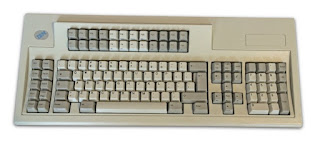
Work of art: 1992 IBM (Blue Label) Model M keyboard.

In the few decades computing has been a mainstream activity, there has been such a variety of hardware, operating systems, languages and software at various points in the application layers, that there’s little general agreement about what’s best in any particular field but most with any exposure to the IBM Model M keyboard agree it’s probably the finest keyboard ever made.  Even those not attracted to the tactility which is its most obvious feature (and there are those who prefer a “squishy” to a “clicky” keyboard) will usually concede the build quality is exceptional, compared especially to some of the sad devices bundled with systems in recent years.  It shouldn’t be surprising IBM was able to build something like the Model M keyboard at scale given the company’s decades of experience in engineering a construction and there are Model M nerds prepared to believe all those years were but preparation for what was required to make the tactile devices. 

1973 IBM Selectric with three elements (golfballs).

International Business Machines (IBM) began in New York in 1888 (adopting the IBM name in 1924), its early core-business mechanical “tabulating systems” for accounting and time-keeping and by the 1930s, some of the mechanical engineering used in these systems was applied to typewriter technology after it acquired the tools, patents and production facilities of Electromatic Typewriters of Rochester.  The result of the R&D effort was the Model 01 IBM Electric Typewriter which was released in 1935 and became the first really successful electric typewriter in the US, the beginning of a line which, in 1961 produced the IBM Selectric, famous for its “element” which the rest of the world called the “golfball”.  The almost spherical “golfball” (which appears in some IBM documents both also as “typeball”) contained the impressions of the letters which struck the ribbon and was interchangeable with other made with other font sets.  That was not a new idea, other manufacturers using the principle of interchangeability in the late nineteenth century but with “type wheels” which were larger and tended to be fragile, the three-dimensional “golfball” both more robust and, having to travel a smaller distance per key stroke, permitting a faster typing rate.  It was with the Selectric that the evolution of what became the Model M keyboard really began.

1984 IBM Model F keyboard; the IBM mouse of the era was a ghastly to use as it looks.

The first version of the definitively tactile, stand-alone IBM keyboard was the Model 14 which, although most associated with the original IBM PC-1 released in August 1981, had actually debuted with the System/23 Datamaster (1981-1985), a short-lived corporate workstation which proved a dinosaur, unable to compete with the IBM PC, the success of which was also the death knell for the earlier 6580 Displaywriter (1980-1986) which had actually enjoyed some success as a hefty and expensive but capable corporate word-processor.  The Datamaster, introduced just five weeks prior to the PC-1, used the same Model 14 keyboard, initially with an 83 key layout and the nerdiest of nerds note its technical superiority over the Model M in that it uses a buckling spring over a capacitive PCB (printed circuit board) rather than the later membrane.  The Model F remained in general production until 1985, being then built in limited numbers (by both IBM and Lexmark) until 1985 and was notable for innovations such as the revisions to the layout to accommodate the PC-AT protocols and the availability of specialized models with as few as 50 or as many as 127 keys.

Customized IBM Model F keyboard with LED module.

Model F aficionados can be snobby, pointing out even IBM admitted one of the design objectives with the Model M was to reduce manufacturing costs but their attraction is real, the intricacies of the Model F intriguing and their labour-intensive production process does mean nothing like them is likely again to be made.  The internal assembly uses two curved metal back-plates and the PCB is flexible, thus also curved when attached to the back-plate and while just about every other keyboard's curves are simulated by the molding of the keycap profiles, the Model F's curve is integral to the frame, thus allowing all keycaps to be the same shape and size, a great advantage for those who like to tinker and customize.  Freaks customizing keyboards are perhaps less frequently found than once they were but still exist in dark rooms living on pizza and Coca-Cola.  Snobbery or not, the freaks do have a point (up to a point) because the mechanical advantages are real.  The capacitive design is superior, requiring a lighter actuation force and delivering a crisper feel and a slightly sharper feedback; it’s also more robust, IBM guaranteeing each key with a MTBF (mean time between failure) of over 100 million key-presses, a reasonable life even for the most productive trolls.  The switch from PCBs to membranes meant these characteristics were to some degree toned down in order to lower manufacturing costs although the MTBF was still rated an impressive 80 million.

1988 IBM Model M keyboard (122 key version).

Pace the freaks but the Model M is preferable, if for no other reason than simply because it (more-or-less) standardized the core keyboard layout (most others now conform) and in use, the tactility is little different from its predecessor.  Regarding the layout, the case can be made that the Model F’s location of the function keys to the left may actually make more sense but the planet has settled on the Model M layout.  Introduced in 1985 with the 3161 terminal, the PC-compatible version appeared in 1987 when it was included with the PS/2.  In use the Model M is a solid (9 lb (4 kg)) tactile experience which feels little different from the Model F and users have a long time to become accustomed to that feel; the keyboards, the oldest of which are now some forty years old, appearing not to have a life expectancy, many in continuous use for decades and a servicing ecosystem exists should any parts need to be replaced although it’s said rectifying the consequences of spills (of coffee, red wine, G&Ts etc) is a more common request.  The best source for the tactile IBMs is ClickyKeyboards.

United States Patent # 4,118,611 Buckling Spring torsional snap actuator. Harris, 1978:

It will be appreciated with regard to the figures that depression of the key button 1 moves the key button and its stem 6 into the housing 3, creating longitudinal compression and lateral deflection of the helical compression spring 2. An initial counter-clockwise moment is exerted on the rocker member 4 which is approximately equal to the force F times the distance between the pivot point 8 of the rocking member 4 and the center line of the spring. The upper end of the helical spring 2 is held squarely against the key button 1 by a clockwise moment created by a force equal to approximately F times the diameter of the spring divided by two. The rocker member 4 will initially be held firmly over the contacts 5A and 5B. As the lateral motion of the center of the helical compression spring 2 increases, both the top and bottom reaction moments in spring 2 are decreased because F is transmitted through the center section of spring 2. Shortly after these moments approach 0, the rocker member rocks to a position squarely over contacts 5A and 5C and the top of spring 2 rocks about the right hand edge of its topmost coil. The constraints upon the depression column spring have changed from an initial end clamped condition to an end clamped-pinned condition. This sudden change provides the tactile response of the key and is accompanied by a sudden rocking action of the rocker member 4 which creates an acoustic feedback as well.

The "buckling spring torsional snap actuator" is the core of the Model M’s charm.  Unlike mechanical switches that are depressed straight down like plungers, the Model M has springs under each key that contract, snap flat, or "buckle," and then spring back into place when released.  This provides the audible “click” so associated with the model and which some don’t like but for those who become accustomed to typing on one, it’s hard to go back to anything else; they have the feel of a pre-modern (circa 1980 and earlier) Mercedes-Benz.  Because of the physicality, typing on a Model M is a tangible experience; like a typewriter, the tactility and the feedback of the click gives every letter a physical presence.

IBM Model M user Lindsay Lohan in Life-Size (2000, Walt Disney Television).

NASA's Lunar Sample Laboratory Facility (LSLF) is a repository and laboratory facility at the Lyndon B. Johnson Space Center in Houston.  Since 1979 it's housed geologic samples returned from the Moon by the Apollo program missions to the lunar surface (1969-1972).  The facility preserves in a secure vault most of the 842 lb (382 kg) of lunar material returned to Earth as well as some other material and the associated data records.  The facility also contains clean-environment laboratories so samples can be processed and studied in a contamination-free environment.

The LSLF houses the only eight lunar rocks (some nearly four billion years old) on earth available to be touched by the general public.

The LSLF also includes an IBM Model M keyboard and PS/2 PC (it’s not known if it’s running PC-DOS or OS/2) in an exhibit which is a replica of a room in the Space Centre during the 1980s.

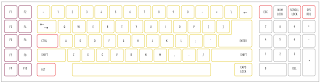
Layout Model F, PC & XT, (1981).

Layout Model F, PC-AT (1984).

Layout Model M, 3161 Terminal (1985) & PS/2 (1987). 

Monday, August 24, 2020

Umbra

Umbra (pronounced uhm-bruh)

(1) Shade; shadow, now restricted mostly to literary use.

(2) The invariable or characteristic accompaniment or companion of a person or thing.

(3) In astronomy, the complete or perfect shadow of an opaque body, as a planet, where the direct light from the source of illumination is completely cut off.

(4) In astronomy, the dark central portion of a sunspot.

(5) A phantom or shadowy apparition, as of someone or something not physically present; ghost; spectral image.

(6) An uninvited guest brought along by one who was invited (archaic).

(7) The fully shaded inner region of a shadow cast by an opaque object.

(8) One of the family Umbridae of mudminnows; a sciaenoid fish, the umbrine.

(9) In typography, a sans-serif display typeface released in 1935 as a variation of the earlier Tempo.  Similar to many contemporary art deco designs, it's constructed with a shadow effect, the letter shapes built as negative space and defined by a black dimensional shadow.

1590s: From the Latin umbra (literally “shade”; shadow), a doublet of umber and of uncertain origin.  If it was from the Old Latin omra, source may have been the primitive Indo-European hzmrup-, related to the Ancient Greek μαυρός (amaurós) (dark) and “rot” & “rotten” in the Luwian hieroglyphic.  Etymologists also note the Hittite Maraššantiya (their name for the Kızılırmak River), and this Indo-European source is said to be a possible borrowing from a Semitic root -m-r (be red), linked to the Arabic ح م ر‎ ( m r).  All agree there is a connection with the Lithuanian unksna.  The adjectives are umbral & umbrageous and the noun plurals are umbras & umbrae.

The early meaning was that of a “phantom or ghost," a figurative use drawn from the Latin umbra (shade, shadow), which gave rise to the later umbrage (A feeling of anger or annoyance caused by something offensive or (now rarely) a feeling of doubt, from the Middle French ombrage (umbrage), from the Old French ombrage, from the Latin umbrāticus (in the shade), from umbra (shadow, shade)).  The astronomical sense of a "shadow cast by the earth or moon during an eclipse" was first used during the 1670s.  The meaning "an uninvited guest accompanying an invited one" is from 1690s and was an invention in English, from a secondary sense used in Ancient Rome.  The related noun umber (brown earthy pigment) is from the 1560s, from the French ombre (in terre d'ombre), or the Italian ombra (in terra di ombra), both from the Latin umbra (shade, shadow) or otherwise from Umbra, the feminine form of Umber "of or belonging to Umbria, the region in central Italy from where the coloring material was first discovered.  Burnt umber, specially prepared and redder in color, is attested from circa 1650 and distinguished from raw umber, both well-known to artists of the era.

It’s the cosmic coincidence of the relationship between the diameter of the Moon and its distance from the Sun which makes solar eclipses such a spectacular sight from planet earth.  On other planets, where the relationship is different, solar eclipses may not be as enchanting.  A solar eclipse happens sometimes as the Moon moves between the Sun and Earth, the Moon blocking the light of the Sun from reaching Earth.  Astronomers classify solar eclipses into three types:

(1) A total solar eclipse which is visible from a small area on Earth.  Those who see a total eclipse are those standing in the center of the Moon's shadow when it hits Earth. The sky becomes very dark, as if it were night. A total eclipse occurs only when the Sun, Moon and Earth are in a direct line.

(2) A partial solar eclipse happens when the Sun, Moon and Earth are not exactly aligned, the sun appearing to have a dark shadow on a small part of its surface.

(3) In an annular solar eclipse, the Moon seems further because the annular happens when the Moon is farthest from Earth and thus does not block the entire view of the Sun, instead looking like a dark disk on top of a larger Sun-colored disk.

A solar total eclipse.

Solar eclipses are not rare, visible around every eighteen months somewhere on Earth although the viewing spot is always relatively small.  Unlike lunar eclipses, solar eclipses last only a few minutes.  The umbra is the darkest part of a shadow, especially the cone-shaped region of full shadow cast by Earth, the Moon, or another body during an eclipse. In a full lunar eclipse, which generally lasts for one or two hours, the entire disk of the Moon is darkened as it passes through the umbra. During this period the Moon takes on a faint reddish glow due to illumination by a small amount of sunlight that is refracted through the Earth's atmosphere and bent toward the darkened Moon; the reddish tint is caused by the filtering out of blue wavelengths as the sunlight passes through the Earth's atmosphere, leaving only the longer wavelengths on the red end of the spectrum.

The umbra is the innermost and darkest part of a shadow, the area in which the light source is entirely obscured by the occluding body and if standing in this space, the viewer will experience a total eclipse.  Viewed in the abstract, the Sun, Moon & Earth all being (almost) spherical, umbra forms a right circular cone and, if viewed from the cone's apex, the two bodies will seem the same size.  The penumbra, from the Latin paene (almost, nearly) is the region in which only some of the light source is obscured by the occluding body so the viewer standing in the experiences a partial eclipse.  The antumbra, from the Latin ante (before) is the region from which the occluding body appears entirely within the disc of the light source.  The viewer standing in this apace experiences an annular eclipse, which manifests as a bright ring visible around the eclipsing body.  If the viewer is able to move closer to the light source, the apparent size of the occluding body increases until it causes a full umbra.

An umbraphile (shadow lover) is a person with much interest in eclipses, often making extraordinary efforts to travel to see them.  The construct is umbra + phile.  Phile is from the Latin -phila, from the Ancient Greek φίλος (phílos) (dear, beloved) and from the same source is -phil, a word-forming element meaning "one that loves, likes, or is attracted to," via the French -phile and the Medieval Latin -philus in this sense, from the Ancient Greek -philos, a common suffix in personal names (such as Theophilos), from philos (loving, friendly, dear; related, own) and related to philein (to love) which is of unknown origin.  One authoritative etymologist suggests the original meaning was "own; accompanying" rather than "beloved."

Umbraphilia emerged as a niche in nineteenth century high-end tourism, gentlemen scientists and society figures sailing around the world to observe and sometimes report their findings.  The longest known observation of a solar eclipse was that undertaken on 30 June 1973 when a group travelled on board the Concorde, enjoying seventy-four minutes of totality.


Sunday, August 23, 2020

Planet

Planet (pronounced plan-it)

(1) In astronomy (now also as “major planet), any of the eight large spherical bodies revolving about the sun in elliptical orbits and shining by reflected light: Mercury, Venus, Earth, Mars, Jupiter, Saturn, Uranus, or Neptune, in the order of their proximity to the sun.

(2) A similar body revolving about a star other than the sun.

(3) A celestial body moving in the sky, as distinguished from (the apparently fixed) stars, applied also to the sun and moon (obsolete except in historic reference).

(4) In astrology, the sun, moon, Mercury, Venus, Mars, Jupiter, Saturn, Uranus, Neptune, or Pluto: regarded as sources of energy or consciousness in the interpretation of horoscopes.

1250-1300: From the Middle English planete, from the late Old English planete, from the Old French planete (which endures in Modern French as planète), from the Latin planeta & planetes (found only in plural planētae), from the Ancient Greek πλανήτης (plantēs) (wanderer), (ellipsis of πλάνητες στέρες (plánētes astéres (literally “wandering stars”)), from the Ancient Greek πλανάω (planáō) (to wander about, to stray), from planasthai (to wander), of uncertain etymology.  It was cognate with the Latin pālor (to wander about, to stray), the Old Norse flana (to rush about), and the Norwegian flanta (“to wander about”); from here English ultimately gained flaunt.  The source may have been a nasalized form of the primitive Indo-European root pele- (flat; to spread) on the notion of "spread out" but it’s speculative, etymologists noting a similarity of meaning in the Greek plazein (to make devious, repel, dissuade from the right path, bewilder) the evidence simply doesn’t exist to permit a conclusion to be drawn.  Planets were originally so-called because, viewed by the astronomers from Antiquity, they display apparent motion, unlike the stars which seemed “fixed” in space, the word derived from the Ancient Greek phrase plánētes astéres (literally “wandering stars”), ultimately from planasthai (to wander).  Thus the earliest definitions of planets encompassed both the Moon and Sun but not the Earth.  The sense define by modern science of a “world which orbits a star" was first noted in English in the 1630s.  It wasn’t until the Copernican revolution that the Earth was recognized as a planet, and the Sun was seen to be fundamentally different.

The noun planetoid (one of the asteroids, or minor planets, revolving about the sun between the orbits of Mars and Jupiter) is from 1803, the adjectival form planetoidal adopted in 1809.  Strangely, there’s never been an accepted definition of planetoid.  Within astronomical circles, it was initially a synonym for asteroid, "asteroid" referring to the star-like image seen through a telescope while "planetoid" described the object’s planet-like orbit.  In the literature, by the early twentieth century “planetoid” and “asteroid” were both widely used but the latter had prevailed almost wholly by the late 1970s.  This decline in use as a synonym is because it had instead become handy as a word to describe a subset of the larger members of the asteroid community, used to mean “planet-like in form or geology”.  Improvements in observational capacity in the early twenty-first century saw a surge in use as so many more planetary bodies were discovered in the Kuiper belt and beyond.  Within the astronomical community, there was a consensus most were hardly asteroids and concomitant with doubts as to the appropriate definition of "planet", planetoid was the label of choice.

The noun protoplanet (a large, diffuse cloud of matter in the orbit of a young star, regarded as the preliminary state of a planet) dates from 1949, the construct being proto- + planet.  The proto- prefix was a learned borrowing from the Ancient Greek πρωτο- (prōto-), a combination form of πρτος (prôtos) (first), superlative of πρό (pró) (before).  The adjective planetary (of or pertaining to a planet) was from the 1590s, probably influenced by the Late Latin planetarius (pertaining to a planet or planets) although the Oxford English Dictionary (OED) notes the only attested meaning as a noun was "an astrologer".  The planetary nebula, so-called because of the shape as seen through a telescope, is from 1785.  1690s The adjective interplanetary (existing between planets) was used in the sense of "travel between planets” as early as 1897 although the English philosopher and physician John Locke (1632–1704) used intermundane in the same sense, the Roman Epicureans having had intermundia (neuter plural) for "spaces between the worlds", translating from the Ancient Greek metakosmia.  Mundane was from the Middle English mondeyne, from the Old French mondain, from the Late Latin mundanus, from the Classical Latin mundus (world).  The noun planetarium (orrery, astronomical machine which by the movements of its parts represents the motions and orbits of the planets) dates from 1734 and was a creation of Modern Latin, the construct being the Late Latin planeta + Latin -arium (a place for).  The modern meaning "device for projecting the night sky onto the interior of a dome" describe the device developed by the optical engineering company Zeiss in Germany; it was first demonstrated in Munich in 1923, the word planetarium adopted in English in 1929.

#plutoisaplanet: Pluto photographed on 14 July 2015 by the New Horizons interplanetary space probe, launched by NASA in 2006.

The Galileian satellites of Jupiter were initially called satellite planets but were later reclassified along with the Moon.  The first observed asteroids were also considered planets, but were reclassified when became apparent how many there were, crossing each other's orbits, in a zone where only a single planet had been expected.   Pluto was found where an outer planet had been expected, but doubts were soon raised about its status because (1) it was found to cross Neptune's orbit and (2) was much smaller than the expectation had suggested.  The debate about the status of Pluto went on for decades after its discovery in 1930.  The pro-planet faction may have become complacent, thinking that because Pluto had always been a planet, it would forever be thus but, after seventy-six years in the textbooks as a planet, the International Astronomical Union (IAU) in 2006 voted to re-classify Pluto as a dwarf planet on the basis that the icy orb failed to meet a set of criteria which the IAU claimed had been accepted for decades.

To be a planet, the IAU noted, the body must (1) orbit a sun, (2) be sufficiently massive to it pull itself into a sphere under its own gravity and (3), "clear its neighborhood" of debris and other celestial bodies, proving it has gravitational dominance in its corner of the solar system.  Pluto fails the third test.  Because it orbits in the Kuiper Belt (a massive ring of asteroids and planetoids that stretches beyond the orbit of Neptune), Pluto is surrounded by thousands of other celestial bodies and chunks of debris, each exerting its own gravity.  Pluto is thus not the gravitationally dominant object in its neighborhood and therefore, not a planet and but a dwarf, a sort of better class of asteroid.  The IAU’s action had been prompted by the discovery in the Kuiper Belt of a body larger than Pluto yet still not meeting the criteria for planethood.  Feeling the need to draw a line in the cosmos, the IAU dumped Pluto.

Lindsay Lohan in Planet Fitness commercial played during Super Bowl 2022.

However #plutoisaplanet is a thing and Pluto’s supporters have a website, arguing that while it’s universally accepted a planet should be spherical and orbit the Sun, the "clearing the neighborhood" rule is arbitrary, having appears only in a single paper published in 1801.  The history is certainly muddied, Galileo having described the moons of Jupiter as planets and there are plenty of other more recent precedents to suggest the definitional consensus has bounced around a bit and there are even extremists really to accept the implications of loosening the rules such as the moons of Earth, Jupiter and Saturn becoming planets.  Most however just want Pluto restored.

The most compelling argument however is probably just that the IAU are a bunch of humorless cosmic clerks, something like the Vogons ("...not actually evil, but bad-tempered, bureaucratic, officious and callous.") in Douglas Adams' (1952–2001) Hitchhiker's Guide to the Galaxy (1979-1992) and that Pluto should be restored to planethood because of the romance.  Although lacking the lovely rings of Saturn (a feature shared on a smaller scale by Jupiter, Uranus & Neptune), Pluto is the most charming of all because it’s so far away; desolate, lonely and cold, it's the solar system’s emo.  If for no other reason, it should be a planet in tribute to the scientists who, for decades during the late nineteenth and early twentieth centuries, calculated possible positions and hunted for the elusive orb.  In an example of Donald Rumsfeld's (1932–2021; US secretary of defense 1975-1977 & 2001-2006) “unknown knowns”, the proof was actually obtained as early as 1915 but it wasn’t until 1930 that was realized.  In an indication of just how far away Pluto lies, since the 1840s when equations based on Newtonian mechanics were first used to predict the position of the then “undiscovered” planet, it has yet to complete even one orbit of the Sun, one Plutonian year being 247.68 years long.  The name "Pluto" was from the Roman god of the underworld, from the Classical Latin Pluto & Pluton, from the Ancient Greek Πλούτων (Ploútōn) (god of wealth) from ploutos (wealth; riches (probably originally "overflowing" from the primitive Indo-European pleu- (to flow).  It was the alternative Greek name or epithet of Hades in his function as the god of wealth (precious metals and gems, coming from beneath the earth, form part of his realm).