Showing posts sorted by relevance for query Synod. Sort by date Show all posts

Monday, October 4, 2021

Synod

Synod (pronounced sin-uhd)

(1) An assembly of ecclesiastics or other church delegates (particularly of a diocese), convoked pursuant to the law of the church, for the discussion and decision of ecclesiastical affairs (in various denominations such gatherings sometimes described as ecclesiastical councils or).

(2) An assembly or council having civil authority; a legislative body and used (sometimes loosely) of any council of any institution (in this context also used disparagingly of secular institutions thought becoming too rigid in thought or process.

(3) An (often geographical) administrative division or district in the structures of some churches, either the entire denomination or a mid-level division such as a “middle judicatory” or “district”); use of the word “synod” differs between and sometimes within denominations.

(4) In astronomy, a conjunction of two or more of the heavenly bodies.

1350–1400: From the Middle English synod (ecclesiastical council), from the Late Latin synodus, From the Ancient Greek σύνοδος (súnodos or sýnodos) (assembly, meeting; a coming together, a conjunction of planets), the construct being the English syn-(from the Ancient Greek σύν (sún) (with, in company with, together with) + δός ((h)odós) (traveling, journeying; a manner or system (of doing, speaking, etc.); a way, road, path (the word of uncertain origin).  The term סַנְהֶדְרִין‎ (sunédrion) exists in the Hebrew Talmudic literature and was used in a similar way and the early twelfth century Middle English form was sinoth.  Synod was used in the Presbyterian Church between 1953-1922 in the traditional sense of “an assembly of ministers and other elders” when the term was changed to “General Council”, an act of modernization apparently provoked by the word “synod” beings so associated with the Roman Catholic Church and the Church of England.  In the schismatic world of the Medieval Church, just as there were from time to time, “antipopes” (from the Medieval Latin antipāpa), there were also antisynods, convened as meetings of his supporters.  Synod and synodicon are nouns, synodic is an adjective, synodal is a noun & adjective, the noun plural is synods.

The adjective synodal (of or relating to a synod) was a mid-fifteenth century creation from the Late Latin synodalis.  As a noun, a synodal was (1) a constitution made in a provincial or diocesan synod which was subject to review by a central body or (2) a tribute in money formerly paid to the bishop or archdeacon (at the time of his Easter visitation), by every parish priest (now made to the ecclesiastical commissioners and in later versions of canon law referred to as a "procuration").  The adjective synodic dates from the 1630s and was from the Latin synodicus, from the Ancient Greek συνοδικός (sunodikós) (of or related to an assembly or meeting); the form used in the late sixteenth century was synodical.  When used of the conjunction of two or more of the heavenly bodies (the moon and the planets) described by the astronomers of Antiquity, the phenomenon may be called a “synodical revolution” and the time in which it occurs a “synodical month”. Despite sounding suspiciously modern, a synodicon is not associated with on-line video gaming.  The noun synodicon was from the Latin, from the Ancient Greek συνοδικόν (sunodikón) and was a substantivisation of συνοδικός (sunodikós) (synodical).  Institutionalized in modern Italianate Ecclesiastical Latin, it describes a document from a church synod or synods, especially the official records of proceedings.  A subsynod (sometimes as sub-synod) is either (1) an assembly of officials which meets prior to a synod proper to make administrative arrangements, formalize an agenda etc or (2) a kind of sub-committee of a synod which is created for some purpose such as allowing a technical matter to be discussed by experts before being referred to the full assembly of the synod for deliberation.

The noun synodality (the plural synodalities) is used in Christianity to refer (sometimes perhaps optimistically) to the “quality or style of a synod; the fraternal collaboration and discernment as typified in a synod”.  The origin of the word synod (the Ancient Greek συν (together) + δός (journey) hints at the hopefully fraternal collaboration and discernment that such gatherings of ecclesiastical worthies are intended to be, the expression of this the essence of synodality.  The notion of synodality is a part of the mystique of the Roman Catholic Church because it’s said to denote the essence of the church’s mission, something explained by the Holy See's International Theological Commission (ITC) which states that synodality encapsulates “the specific modus vivendi et operandi (way of living & method of operation) of the Church, the People of God, which reveals and gives substance to her being as communion when all her members journey together, gather in assembly and take an active part in her evangelizing mission”.

The ITC is an organization of the Roman Curia which advises the magisterium of the church, most notably the Dicastery for the Doctrine of the Faith (DDF, the old Holy Office which many still refer to by its original name: The Inquisition).  The IDF was a creation of the re-structuring in the wake of the Second Vatican Council (Vatican II; 1962-1965) and formerly was established in 1969 as a kind of internal think tank which might present a kinder face to the world than the rather austere Congregation for the Doctrine of the Faith (the CDF (as the DDF was then known)).  That was an approach not unknown (for good & bad) in secular politics and while over the years there have been those who claimed the relationship between the ITC and the CDF was the sort of “creative tension” needed to ensure debates over matters of ethics and procedure stayed dynamic, others have seen the tension but little creativity.  For students of structuralism, it’s of interest the prefect of the DDF is ex officio the president of the ITC, an arrangement carried over in June 2022 when Pope Francis (b 1936; pope since 2013), as a part of a range of reforms to the curia, announced the name change from CDF to DDF.

Pope Francis has made synodality (at least his conception of it) as perhaps the core value he intends to be the legacy of his pontificate and the ITC in 2018 published a paper which made explicit Francis was not modest in his ambitions for that legacy, the ITC’s document stating it was “…precisely this path of synodality which God expects of the Church of the third millennium” and stressed synodality “…is an essential dimension of the Church”, in the sense that “what the Lord is asking of us is already in some sense present in the very word 'synod’”.  Although presumably the pope and the ITC were more concerned with theology than etymology, tracing a tread which ran from the gathering of Christ’s disciples to the sessions of Vatican II in the 1960s, word nerds would anyway have enjoyed the thoughts:

In ecclesiastical Greek it expresses how the disciples of Jesus were called together as an assembly and in some cases it is a synonym for the ecclesial community. Saint John Chrysostom, for example, writes that the Church is a “name standing for 'walking together’ (σύνοδος)". He explains that the Church is actually the assembly convoked to give God thanks and glory like a choir, a harmonic reality which holds everything together (σύστημα), since, by their reciprocal and ordered relations, those who compose it converge in αγάπη and όμονοία (common mind).

Since the first centuries, the word “synod” has been applied, with a specific meaning, to the ecclesial assemblies convoked on various levels (diocesan, provincial, regional, patriarchal or universal) to discern, by the light of the Word of God and listening to the Holy Spirit, the doctrinal, liturgical, canonical and pastoral questions that arise as time goes by.

The Greek σύνοδος is translated into Latin as synodus or concilium. Concilium, in its profane use, refers to an assembly convoked by some legitimate authority. Although the roots of “synod” and “council” are different, their meanings converge. In fact, “council” enriches the semantic content of “synod” by its reference to the Hebrew   קָהָל(qahal), the assembly convoked by the Lord, and its translation into Greek as έκκλησία, which, in the New Testament, refers to the eschatological convocation of the People of God in Christ Jesus.

In the Catholic Church the distinction between the use of the words “council” and “synod” is a recent one. In Vatican II they are synonymous, both referring to the council session. A precise distinction was introduced by the Codex Iuris Canonici of the Latin Church (1983), which distinguishes between a particular (plenary or provincial) Council and an ecumenical Council on the one hand, and a Synod of Bishops and a diocesan Synod on the other hand.

5. In the theological, canonical and pastoral literature of recent decades, a neologism has appeared, the noun “synodality”, a correlate of the adjective “synodal”, with both of these deriving from the word “synod”. Thus people speak of synodality as a “constitutive dimension” of the Church or tout court of the “synodal Church”. This linguistic novelty, which needs careful theological clarification, is a sign of something new that has been maturing in the ecclesial consciousness starting from the Magisterium of Vatican II, and from the lived experience of local Churches and the universal Church since the last Council until today.

So for Francis, the word synodality has assumed an importance beyond that with which it has so long been vested in the Catholic Church so the Vatican watchers took note when, under the pope’s imprimatur, it was in October 2021 announced a summit to be conducted over two years was to be known as the Synod on Synodality.  It would have sounded an innocuous thing had it not been for the ITC’s paper three years earlier and it had the inevitable immediate effect among the clergy, the laity and the theologians: sniffing change in the air, some were hopeful and some fearful.  However, the pope, although thought by many a disruptor is also a realist and understands change in his 2000 year old institution will unfold among the generations to come and his immediate ambition seems restricted to tweaking the way the church relates to the rest of the world rather than overturning dogma.  Thus, expectations of welcoming the LGBTQQIAAOP in the church or approving the ordination of women are absurd but there may be changes in the way bishops both interact with their flock and the priests who are closer to that flock.  Just because a change doesn’t happen in the corridors of the Vatican where the curia plot and scheme, doesn’t mean the power structures haven’t changed.  The flock doesn’t mix with the curia; they talk to their parish priest.

Interestingly, for something some fear will be the harbinger of something radical, the Synod on Synodality is structured in the traditional (Vatican II style) modules with un-threatening names like "communion", "mission" & "participation" but however vague may be the indication of the content, few doubt that at the next session the factions will be mapping onto those titles the concerns which have for decades troubled Rome and it’ll be mostly about sex: whether the thousand-year enforcement of clerical celibacy is the underlying cause of the rampant child-sex abuse among its members, the role of women in the power structures and attitudes towards same-sex relationships including marriage.  Those discussions will play out between the factions and there are few with any hope there'll be many minds changed but the tone of the synod will be important and Francis has the advantage of being the absolute monarch in a theocracy; it is Francis who gets to review the synodicon the theologians and the bishops will submit and he will write the final document of the Synod on Synodality.

Working for more synodality in the world: Lindsay Lohan supporting the NOH8 campaign which sought to end California's 2008 voter-approved gay marriage ban (Proposition 8). 

It means Francis has immense power to shape things and point them in the desired direction and his contribution to ecclesiology is likely to be very different to the intriguing exercises in abstraction which came from the pen of Benedict XVI (1927–2022; pope 2005-2013, pope emeritus 2013-2022).  Whether that means it becomes simultaneously possible for the church simultaneously to continue to condemn homosexuality as a sin yet approve priests giving a blessing to those in a same-sex marriage remains to be seen but in many places, it would merely be an acknowledgement of what’s already happening.  Still, those who enjoy the process of such things more than the outcome can be assured there'll be much weeping and gnashing of teeth during the modules and some rending of garments on the way out.

Tuesday, September 21, 2021

Heresy

Heresy (pronounced her-uh-see)

(1) Opinion or doctrine at variance with the orthodox or accepted doctrine, especially of a church or religious system.

(2) The maintaining of such an opinion or doctrine.

(3) In Roman Catholic canon law, the wilful and persistent rejection of any article of faith by a baptized member of the church.

(4) Dissent, iconoclasm, dissension.

1175–1225: From Middle English heresie from Old French heresie and Late Latin haeresis (school of thought, philosophical sect) derived from the Greek haíresis (act of choosing, derivative of haireîn (to choose)).  Source of the Greek was haireisthai (take, seize), middle voice of hairein (to choose) of unknown origin but likely derived from the primitive ser (to seize), thought also to be the root of both the Hittite šaru and the Welsh herw, both best translated as “booty".  The modern meaning emerged from the use by early Christian writers who used the literal translation from the Latin (sect or doctrine) to convey their disapproval of unorthodox thoughts or ideas.  The Greek word was used in the New Testament in reference to the Sadducees, Pharisees, and even the Christians, as sects of Judaism, but in English bibles it usually is translated as sect.   The meaning "religious belief opposed to the orthodox doctrines of the Church" evolved in Late Latin and was adopted for non-religious use as early as the late fourteenth century.

The Church of England Rejects Heresy Courts Proposal

Lindsay Lohan offering salvation to a heretic in Machete (2010).  The revolver is a Smith & Wesson Model 500 (8.38" barrel; .50 Magnum load)

In mid-1999, in a rare moment of clarity, the Church of England flirted, after a gap of one-hundred and fifty years, with the re-introduction of heresy trials to deal with clergy accused of deviation in matters of doctrine or ritual.  The last heresy trial was in 1847, when the Bishop of Exeter (Henry Phillpotts (1778–1869; Anglican Bishop of Exeter 1830-1869) accused the Reverend George Cornelius Gorham (1787–1857) of being unsound on the doctrine of "baptismal regeneration", Mr Gorham not agreeing a person was cleansed of original sin at baptism and born again into Christ.  Although the Court of Arches agreed with the bishop, on appeal, the Judicial Committee of the Privy Council overturned the ruling which caused a (very Anglican) controversy about whether a secular court should be able to rule on matters of doctrine (as opposed to law or procedure).  Since then clergy and bishops have been (more or less) free to deviate from doctrine without punishment and the Right Reverend David Jenkins (1925-2016), a former Bishop of Durham (1984-1994), famously raised a few eyebrows when he discussed his heterodoxic view on the virgin birth and bodily resurrection of Christ.  The new disciplinary procedure for clergy was to include offences against "doctrine, ritual and the ceremonial" because those who profess atheism or deny the doctrine of the Trinity or the Incarnation “should be disciplined”.

Heretic crooked Hillary Clinton (b 1947; US secretary of state 2009-2013) being burned at the stake (digitally altered image).

Although not as well known as other inquisitions, in England, in the sixteenth century Reformation during the reign of Henry VIII (1491–1547; King of England (and Ireland after 1541) 1509-1547), about 60 heretics were executed.  Heresy laws were repealed in 1547, but reintroduced in 1554 by Mary I (1516–1558; Queen of England and Ireland 1553-1558 & Queen of Spain 1556-1558), under whom about 290 heretics were burned at the stake after the restoration of papal jurisdiction.  Executions of some 180 religious opponents continued under Elizabeth I (1533–1603; Queen of England & Ireland 1558-1603) but on grounds of treason rather than heresy although the offence remained on the books.  To the condemned, it must have seemed a tiresome technical distinction.  The last execution of a "heretic" in England occurred in 1612 although technically that was for the offence of blasphemy.  Puritanical, if not quite to the end but certainly for as long as they could, there was one later execution in Scotland in 1697 when Thomas Aikenhead (circa 1676-1697) was accused, inter alia, of denying the doctrine of the Trinity.  In a example of Scottish judicial modernization, Mr Aikenhead was hanged rather than burned at the stake although blasphemy as a capital offence was retained until 1825.

Benedict XVI (1927–2022; pope 2005-2013, pope emeritus 2013-2022) and Cardinal George Pell (1941-2023) discuss the fate of heretics. 

Unfortunately, after mulling over things for half-a–decade, the General Synod of the Church of England rejected the revival of a heresy court and didn’t, even more regrettably, consider bringing back burnings at the stake.  It seems there were fears the court could be used to enforce a traditionalist view, targeting clergy, who for example, support same-sex marriages or gay clergy, both now apparently matters of greater theological importance than a belief in the resurrection.  That does seem strange given it’s the central tenet of Christianity but that’s clearly become view from both the General Synod and Lambeth Palace.  In an address to the synod, displaying his flair for simultaneously changing the subject and answering a different question than the one asked, then Archbishop of Canterbury, Dr Rowan Williams (b 1950; Archbishop of Canterbury 2002-2012), said it was important for the church “…to be able to speak out against issues like Apartheid.  The question I think we ought to be asking is whether this does or does not serve the integrity or credibility of the church in the long run.  I believe that such a measure can serve the integrity and credibility of the church if we do indeed step back in this way.  It is over twenty years since the World Alliance of Reform Churches declared that the theological justification for Apartheid was a heresy.  It would be, I think a very incredible and inadequate Christian church which did not have the resource to say something like that.”

Thy neighbor’s ass.

To most in the secular West, the terms “blasphemy” and “heresy” probably sound archaic although they remain fixtures in figurative use in sport, popular culture and such.  However, in the Roman Catholic Church they remain matters of significance, the latter even handled by canon law.  Although misleading, a way to illustrate the difference is to regard blasphemy as a sin against God while heresy is an offence against faith (technically against the church but according to the Holy See they’re the same thing).  Rome regards blasphemy as any speech, action, or thought which discloses one’s contempt, disrespect, or irreverence toward God, Jesus Christ, the Virgin Mary, the saints or anything treated as sacred.  Perhaps surprisingly (given how it’s handled in other jurisdictions), in the narrow technical sense, blasphemy is not explicitly defined in the 1983 Code of Canon Law (CIC) and instead is considered a grave sin and evidence of it can be used as evidence when considering specific offenses which are codified.  Once can commit blasphemy by cursing God, mocking sacred rites or publicly insulting the Eucharist and historically “taking the name of the Lord in vain” was the best known injunction against the habit.  In the King James Version of the Bible (KJV, 1611) it was written as: “Thou shalt not take the name of the LORD thy God in vain” and was in most translations the second of the Ten Commandments in Judaism and Christianity, handed down to man by God.  In the unforgiving Old testament (Exodus 20:7 & Deuteronomy 5:11) it’s reinforced by the injunction: “Thou shalt not take the name of the LORD thy God in vain; for the LORD will not hold him guiltless that taketh his name in vain.” and that it appears so high in the list of ten (only: “Thou shalt have no other gods before me.” precedes it) does suggest it may have been thought a more critical matter than someone coveting their neighbor’s ass (tenth and last).  Not being mentioned in canon law, dealing with the offence varies on a case-by-case basis and while excommunication is now rare, depending on severity or recidivism, there can be canonical penalties, especially if there’s any whiff of scandal (ie bad publicity).

Heresy is different in that it’s codified in Canon 751 of the 1983 CIC as: “the obstinate denial or obstinate doubt after the reception of baptism of some truth which is to be believed by divine and Catholic faith.  That obviously casts a wide judicial net but, since the major revision of the CIC in 1917, the most commonly cited examples have been (1) denying the divinity of Christ, (2) rejecting the doctrine of the Trinity or (3) refusing to accept papal infallibility (although of the latter there’s much de facto tolerance by virtue of papal infallibility being now something implied rather than invoked (which, in the narrow technical sense, has happened only once in the last 150-odd years)).  As students of the modern church have noted, there’s much heresy going on (indeed, for some bolshie priests it seems to be a calling) but despite Canon 1364 stating a heretic is subject to latae sententiae (automatic) excommunication (meaning they are excommunicated without and need for a formal declaration), the sanction is now rarely invoked.  These days, it seems to be excommunicated for heresy, the offense needs to be both serious and repeated.

Door not ajar: The Dicastery for the Doctrine of the Faith where blasphemy and heresy are deracinated.

Contrasting that, the vagueness of “blasphemy” means it is available as charge for offences which don’t have to fall within defined criteria.  In other words, quite what blasphemy is can be up to the Inquisitor (the Prefect of the Dicastery for the Doctrine of the Faith (DDF)) and in that sense Vatican justice can be seen as something like “the length of the chancellor’s foot” in Medieval England.  That doesn’t mean it’s quite like the apocryphal “unspecified offences” and the closest comparison is probably the CCP’s (Chinese Communist Party) 寻衅滋事 (Picking quarrels and provoking trouble) that can be used to secure a conviction when, inconveniently, no law appears to have been broken.  One heresy which can have consequences short of excommunication is a defiance of what is the core rule of the framework on which the church is built: obedience to the chain of command.  Structurally, the Roman Catholic Church operates on the Führerprinzip (leader principle) best known from the German Nazi state that was the Third Reich (1933-1945) and what that means is as the bishops must obey the pope, so priests must obey their bishop.  In practice of course there’s long been a bit of drift from this and most offences are dealt with by (1) ignoring them, (2) pretending they never happened or (3) rationalizing them as something else but if a malcontent’s conduct becomes so defiantly egregious it starts to frighten the horses, Rome will act.

Condemned blasphemer the former Father Pavone in MAGA (Make America Great Again) cap, fulfilling his broadcast media commitments, Orlando, Florida, February 2024.

Frank Pavone (b 1959 and still head of the organization Priests for Life (a US-based anti-abortion collective) despite having been laicised (defrocked) in 2022), found himself in the Inquisitor’s sights because of what was described by the Vatican as: “blasphemous communications on social media” and “persistent disobedience” of his bishop although the communiqué didn’t specify which was thought more heinous.  Ominously, a letter from the papal nuncio (the Holy See’s ambassador) to the US bishops made it clear there is no mechanism available to lodge an appeal.  Ordained in 1988, the former Father Pavone had been investigated by his then-diocese of Amarillo, Texas, for having in 2016 placed an aborted fetus on an altar and posting a video of it on two social media sites but what seems to have most disturbed Rome was him being one of those “meddling priests” who involved himself less in the spiritual and more in the earthly, posting frequently to decry crooked Hillary Clinton and extol the virtues of Donald Trump (b 1946; US president 2017-2021 and since 2025), almost always on the basis of their respective positions on abortion.  Mr Pavone remained defiant after being defrocked, comparing his fate to that of the unborn children he vowed to continue to defend: “So in every profession, including the priesthood, if you defend the #unborn, you will be treated like them!  The only difference is that when we are “aborted”, we continue to speak, loud and clear.  Even defrocked, he wasn’t without clerical support, one bishop calling then President Joe Biden's (b 1942; US president 2021-2025) advocacy for abortion rights “evil”, tarring Rome with the same brush: “The blasphemy is that this holy priest is canceled while an evil president promotes the denial of truth & the murder of the unborn at every turn, Vatican officials promote immorality & denial of the deposit of faith & priests promote gender confusion devastating lives...evil."  Despite explicit instructions, Mr Pavone continues to present himself as a priest.

Monday, August 30, 2021

Primate

Primate (pronounced prahy-meyt or prahy-mit)

(1) In the ecclesiastical hierarchy, an archbishop or bishop ranking first among the bishops of a province or country (in this context usually pronounced prahy-mit). Primate is a title or rank bestowed on some archbishops in some Christian churches and can, depending on tradition, denote either jurisdictional authority or mere ceremonial precedence.

(2) In zoology, any of various omnivorous mammals of the order primates (including simians and prosimians), comprising the three suborders anthropoidea (humans, great apes, gibbons, Old World monkeys, and New World monkeys), prosimii (lemurs, loris, and their allies), and tarsioidea (tarsiers), especially distinguished by the use of hands, varied locomotion, and by complex flexible behavior involving a high level of social interaction and cultural adaptability: a large group of baboons is called a congress which, to some, makes perfect sense.

(3) A chief or leader (archaic).

1175-1225: In the sense of "high bishop, preeminent ecclesiastical official of a province" having a certain jurisdiction, as vicar of the pope, over other bishops in his province, primate is from the Middle English primate & primat, from the Old French primat and directly from the Medieval Latin primatem (church primate), a noun use of the Late Latin adjective primas (of the first rank, chief, principal) from primus (first).  The meaning "animal of the biological order including monkeys and humans" is attested from 1876, from the Modern Latin Primates, the order name (linnæus), the plural of the Latin primas; so called for being regarded as the "highest" order of mammals (the category originally included bats, representing the state of thought in biology at the time).

As an adjective, prime dates from the late fourteenth century in the sense of "first, original, first in order of time" from the Old French prime and directly from the Latin primus (first, the first, first part (figuratively "chief, principal; excellent, distinguished, noble") from the Proto-Italic prismos & priisemos, superlative of the primitive Indo-European preis- (before), from the root per (beyond; before; forward), hence the sense "in front of, before, first, chief".  It was the source also of the Italian and Spanish primo and thus a doublet of primo.  The meaning "of fine quality; of the first excellence" is from circa 1400.  The meaning "first in rank, degree, or importance" was first noted in English circa 1610 whereas in mathematics (as in prime number), it wasn’t in the literature until the 1560s.  The prime meridian (the meridian of the earth from which longitude is measured, that of Greenwich, England) was established in 1878.  Prime time which originally was used to describe "spring time" is attested from circa 1500.  The use in broadcasting in the sense of a "peak tuning-in period" dates from 1961.

Some endangered primates.

As a noun prime referred to the "earliest canonical hour of the day" (6 am), from the Old English prim and the Old French prime or directly from the Medieval Latin prima "the first service" from the Latin prima hora (the first hour (of the Roman day)), from the Latin primus ("first, the first, first part").  In classical Latin, the noun uses of the adjective meant "first part, beginning; leading place".  The noun sense "apostrophe-like symbol" exists because the symbol ′ was originally a superscript Roman numeral one.  By extension, "the first division of the day" (6-9 am) was an early-thirteenth century form whereas the sense of "beginning of a period or course of events" is from the late fourteenth.  From the notion of "the period or condition of greatest vigor in life" there came by the 1530s the specific sense "springtime of human life" (taken usually to mean the ages around 21-28 (the division of live in seven-year chunks a noted motif in English) is from the 1590s and at about the same time, prime came to mean "that which is best in quality, highest or most perfect state of anything".

The use as a verb dates from the 1510s, an invention by the military to describe the process (fill, charge, load) required before a musket or other flintlock weapon could be discharged, the assumption being this was derive from the adjective.  From this by circa 1600 evolved the general sense of "perform the first operation on, prepare something for its intended purpose” (applied especially to wood to make ready for painting)".  To prime a pump is noted from 1769 and meant to pour water down the tube to saturate the sucking mechanism which made it draw up water more readily.  This was later adopted in public finance and economics to describe what is now usually called fiscal stimulus (the idea being a little government money attracting more private investment.  The suffix -ate was a word-forming element used in forming nouns from Latin words ending in -ātus, -āta, & -ātum (such as estate, primate & senate).  Those that came to English via French often began with -at, but an -e was added in the fifteenth century or later to indicate the long vowel.  It can also mark adjectives formed from Latin perfect passive participle suffixes of first conjugation verbs -ātus, -āta, & -ātum (such as desolate, moderate & separate).  Again, often they were adopted in Middle English with an –at suffix, the -e appended after circa 1400; a doublet of –ee.

Lindsay Lohan and a large primate, King Kong premiere, Loews E-Walk and AMC Empire 25 Theaters, New York City, December 2005.

The Roman Catholic Church

In the Roman Catholic Church, a Primate is almost always an Archbishop though the title is occasionally bestowed on the (Metropolitan) bishop of an Episcopal see who has precedence over the bishoprics of one or more ecclesiastical provinces of a particular historical, political or cultural area.  Also sometimes created are primates where the title is entirely honorific, granting only precedence in on ceremonial occasions and, in the case of the Polish Primates, the privilege of wearing cardinal's crimson robes (though not the skullcap and biretta).  The Vatican likes the old ways and many primates are vested not in the capitals of countries but in those places which were the centres of the country when first Christianized.  For that reason there still exists the Primate of the Visigothic Kingdom, and the Primate of the Gauls.

Some of the leadership functions once exercised by Primates have now either devolved to presidents of conferences of bishops or to Rome itself.  Modern communications as much as reform of canon law have influenced these developments and most changes were effected between the publication of the Code of Canon Law in 1917 and the late twentieth-century implementation of Vatican II’s more arcane administrative arrangements.  Rome has never seemed quite sure how to deal with England.  Unlike in the secular US, where the Holy See’s grant of precedence to the Archbishop of Baltimore dates from 1848, the Archbishop of Westminster has not been granted the title of Primate of England and Wales but is instead described as that of Chief Metropolitan.  Rome has never exactly defined the implications of that though it has been suggested the position is “…similar to that of the Archbishop of Canterbury.”  Most helpful.

If the position in England remains vague, that of some of the orders is opaque.  The loose structures of the Benedictine Confederation made Pope Leo XIII (1810–1903; pope 1878-1903) exclaim that the Benedictines were ordo sine ordine (an order without order), something about which he subsequently did little.  The Benedictine Abbot Primate resides at Sant'Anselmo in Rome and takes precedence of all other abbots and is granted authority over all matters of discipline, to settle difficulties arising between monasteries, to hold a canonical visitation, exercise a general supervision for the regular observance of monastic discipline.  However, his Primatial powers permit him to act only by virtue of the proper law of the autonomous Benedictine congregations, most of which does not exist.  Charmingly, the Benedictine Order appears still to operate as it’s done for the last few centuries, untroubled by tiresome letters from Rome although other orders have embraced modern ways.  The Confederation of Canons Regular of St Augustine democratically elects an Abbot Primate, though his role, save for prerogative reserve powers, is ceremonial.

The Church of England

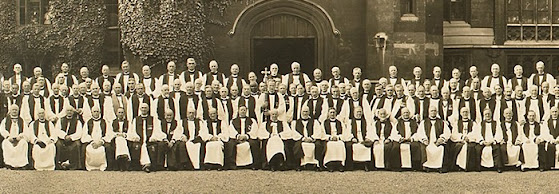
Some endangered Primates at the Lambeth Conference, London, 1930.  The once almost exclusively white, male and middle class world of Anglican bishops has in recent decades become increasingly black, evangelical and even female.  It seems likely it may also become increasingly gay.  Although rarely spoken of, it's an open secret the Anglican church in England depends for its operation on its many gay clergy and it may be it will require only the natural processes of generational change for gay bishops to become an accepted thing.  Before that, a state of tolerance or peaceful co-existence may be next step.

Anglican usage styles the bishop who heads an independent church as its primate, though they always hold some other title (archbishop, bishop, or moderator).  In Anglicanism, a primate’s authority is not universally defined; some are executives while others can do little more than preside over conferences or councils and represent the church ceremonially.  However, the when the Anglicans convene a Primates' Meeting, the chief bishop of each of the thirty-eight churches that compose the Anglican Communion acts as its primate, though they may not be that within their own church.  For example, the various United Churches of the sub-continent are represented at the meetings by their moderators though they become primates for the purposes of Anglican conferences.  Primates are thus created for photo-opportunities.

Winds of change: Primates at the Global Anglican Future Conference (GAFCON), Jerusalem, 2018.

In both the Churches of England and Ireland, two bishops have the title of primate: the archbishops of Canterbury and York in England and of Armagh and Dublin in Ireland.  The Archbishop of Canterbury, considered primus inter pares (first among equals) of all the participants, convenes meetings and issues invitations.  The title of primate in the Church of England has no direct relationship with the ex-officio right of twenty-six bishops to sit in the House of Lords; were the church to do away with the title, it would not at all affect the constitutional position.

The Orthodox Church

In the Orthodox Church, a primate is the presiding bishop of an ecclesiastical jurisdiction or region.  Usually, the expression primate refers to the first hierarch of an autocephalous or autonomous Orthodox Church although, less often, it’s used to refer to the ruling bishop of an archdiocese or diocese.  In the first hierarch, the primate is the first among equals of all his brother bishops of the jurisdiction or diocese of which he is first, or primary, hierarch, and he is usually elected by the Holy Synod in which he will serve.  All bishops are equal sacramentally, but the most important administrative tasks are undertaken by the bishop of the most honored diocese.  The primate of an autocephalous church supervises the internal and external welfare of that church and represents it in its relations with other autocephalous Orthodox churches, religious organizations, and secular authorities.  During liturgical services, his name will be mentioned by the other bishops of the autocephalous church and the primate mentions the names of the other heads of autocephalous Orthodox churches at Divine services.  Although political tensions have of late (re-)intruded, historically, it was the office of the ecumenical patriarch of Constantinople which was considered primus inter pares.

The liturgical duties vary between jurisdictions but, normally, the hierarch is responsible for such tasks as the consecration and distribution of the Holy Chrism and providing the diocesan bishops with the holy relics necessary for the consecration of church altars and holy antimins.  To this may extend other administrative duties including convening and presiding over the meetings of the Holy Synods and other councils, receiving petitions for admission of clergy from other Orthodox churches, initiating the action to fill vacancies in the office of diocesan bishops, and issuing pastoral letters addressed to the bishops, clergy, and laity of the Church.  He will also advise his brother bishops, and when required, submits their cases to the Holy Synod. He has the honor of pastoral initiative and guidance, and, when necessary, the right of pastoral intervention, in all matters concerning the life of the Church within the structure of the holy canons.

Sunday, December 17, 2023

Pernoctate

Pernoctate (pronounced per-nok-tait)

(1) In Christianity, to pass the night in vigil or prayer, prior to a feast (archaic).

(2) To stay (somewhere) all night (now a secular, jocular form).

1610s: From the Latin pernoctat- (spent the night), from pernoctatus, past participle of the verb pernoctare, the construct being per- (through) + noct-, nox (night).  In Christianity, the use of pernoctation to describe “a religious watch kept during normal sleeping hours, during which prayers or other ceremonies are performed” is now rare even in ecclesiastical use and has been supplant by vigil.  Vigil was from the Middle English vigile (a devotional watching), from the Old French vigile, from the Latin vigilia (wakefulness, watch), from vigil (awake), from the primitive Indo-European weǵ- (to be strong, lively, awake).  The English wake was from the same root.  Vigil was related to vigour (vigor the US spelling) (and more distantly to vital), from the Middle English vigour, from the Old French vigour, from vigor, from the Latin vigor, from vigeo (thrive, flourish), again from the primitive Indo-European weǵ-.  Pernoctate, pernoctates, pernoctating & pernoctated are verbs, pernoctation is a noun and the noun plural is pernoctations.

Lindsay Lohan at dawn, resting in a Cadillac Escalade after pernoctating, Los Angeles, May 2007 (right).  The church having adopted vigil, pernoctate and related forms are now words used amusingly to refer to nights spent in decadent pursuits.  The church and the faithful now inhabit the day and the sinners the night.

Beginning apparently during the second century of the existence of the Christian Church, during the night before every feast, a vigil (Vigilia in the Latin; pannychis in the Greek), was kept.  On those evenings, the faithful would gather in the church or wherever it was the feast was to be celebrated and prepared themselves by prayers, readings from Holy Writ (now the Offices of Vespers and Matins); sometimes a sermon would be read (as on fast days in general, Mass was celebrated in the evening, before the Vespers of the following day).  Towards dawn, the people dispersed to the streets and houses near the church, to await the solemn services of the forenoon. This was a formalized structure but in places the intermission gave rise to grave abuses; people would assemble, play music and dance in the streets: clear improprieties.  In the way such things happen, the volume of feasts multiplied so the number of vigils was greatly reduced but the abuses could be stopped only by abolishing the vigils and where they remained, they were shifted to begin in the afternoon, a synod held at Rouen in 1231 prohibited all vigils except those before the patronal feast of a church.  The number of vigils in the Roman Catholic Calendar (besides Holy Saturday) is now seventeen: the eves of Christmas, the Epiphany, the Ascension, Pentecost, the Immaculate Conception, the Assumption, the eight feasts of the Apostles, St. John the Baptist, St. Laurence, and All Saints although some dioceses and religious orders have particular vigils.

Pope Benedict XVI (1927–2022; pope 2005-2013, pope emeritus 2013-2022) baptizes a Japanese faithful during the Easter Vigil ceremony, Saint Peter's Basilica, the Vatican, 15 April 2006.

In the Christian tradition, a vigil is now understood as a period of purposeful wakefulness devoted to prayer or ceremonies and although vigils may happen at any time, historically they came to be observed during darkness and became quite common before being restricted to special occasions, such as feasts, solemnities, or important liturgical events.  No longer conducted overnight, during a vigil, participants may engage in prayer, reflection, scripture reading, and hymn singing and the direction of a vigil should be thematic, the purpose to prepare spiritually for a significant religious event or to commemorate a particular occasion.  The best known in Christianity is the Easter Vigil, which takes place on the evening of Holy Saturday, commemorating the Resurrection of Jesus Christ and is the most important liturgy of the entire liturgical year.  Typically it will include the blessing of the Easter fire, the lighting of the Paschal candle, scripture readings recounting salvation history and the celebration of the Eucharist.  The reason for the significance of the Easter vigil is that the Resurrection of Christ is the central event of Christianity.  If one accepts the Resurrection, then the internal logic of Christianity is perfect but if not, while the tenants may still appeal as a guide to morality, it’s just another set of competing arguments.  Rationalists who want both can adopt the view of the more radical of the nineteenth century theologians: “One need not believe, one needs only to accept”.

Saturday, January 1, 2022

Tomos

Tomos (pronounced tomm-oss)

In Orthodox Christianity, an ecclesiastical document, promulgated usually by a synod and used to communicate or announce important information.

1510-1520: From the French, from the Latin tomus, from the Ancient Greek τόμος (tomos) (section, slice, roll of paper or papyrus, volume), from τέμνω (témnō or témnein) (I cut, separate); a doublet of tome which persists in English and is used to refer to heavy, large, or learned books.  Tomos is a noun; the noun plural is tomoi.  In geology, the noun tomo describes a shaft formed in limestone rock dissolved by groundwater (use restricted almost wholly to technical use in New Zealand) and the noun plural is tomos.

The Ukraine and the Moscow–Constantinople Schism of 2018

Bartholomew I, Ecumenical Patriarch Bartholomew of Constantinople since 1991 (Dimitrios Arhondonis, b 1940) executes the Tomos; watching over his shoulder is Metropolitan Epiphaniusa I of Kyiv and All Ukraine since 2019 (Serhii Petrovych Dumenko, v 1979), Patriarchal Church of St. George, Istanbul (Constantinople), 5 January 2019.

In Istanbul (the old Constantinople), on Saturday 5 January 2019, Ecumenical Patriarch Bartholomew signed a Tomos, an act formalizing his decision in October  2020 to create an independent Ukrainian Orthodox Church, thus splitting it from the Russian church to which it has been tied since 1686.  Until the decree, the Orthodox Church in Ukraine that was a branch of the Russian Church was considered legitimate and two others were regarded as schismatic. The new church unites the two formerly schismatic bodies with what is now the official Ukrainian Orthodox Church.


Ecumenical Patriarch Bartholomew I (left) presents the Tomos sanctifying the Ukrainian church's independence to Metropolitan Epiphanius (right) at the conclusion of the ceremony.

The most immediate implication of the signing of the Tomos is that Ukrainian clerics are forced immediately to pick sides, needing to choose between the Moscow-backed and the newly independent Ukrainian churches, a choice that will have to be taken with fighting in eastern Ukraine between government forces and Russia-backed rebels as a backdrop.  Although there’s no formal link of establishment between church and state in Ukraine, Petro Poroshenko (b 1965; president of Ukraine 2014-2019) attended the signing ceremony and immediately declared “the Tomos is one more act declaring the independence of Ukraine”.  In the aftermath it appeared some two-thirds of the Ukrainian churches have sundered their relationship with Moscow.

Tomos of autocephaly of the Orthodox Church of Ukraine, signed by the Ecumenical Patriarch Bartholomew I on 5 January 2019.

Neither the Kremlin nor Kirill (or Cyril) Patriarch of Moscow and all Rus' and Primate of the Russian Orthodox Church since 2009 (Vladimir Mikhailovich Gundyayev, b 1946) were best pleased with Bartholomew granting the Ukrainian church autocephaly (independence) and the Russian church immediately severed ties with Constantinople, the centre of the Orthodox world.  A spokesman for the Russia-affiliated faction of the Church in Ukraine issued a statement saying the Tomos was “anti-canonical” and will visit upon the Ukraine nothing but “trouble, separation and sin”.  In this, Moscow concurred, one archbishop adding that “instead of healing the schism, instead of uniting Orthodoxy, we got an even greater schism that exists solely for political reasons.”  Although Orthodoxy was itself born of a schism and this latest split, already described as the Moscow–Constantinople Schism of 2018 is but the latest, the political and military situation in which it exists doesn’t auger well for a peaceful resolution.  In the Kremlin, Mr Putin (Vladimir Putin; b 1952; president or prime minister of Russia since 1999) thinks much about trouble, separation and sin” and no good will come of this.

Thursday, November 11, 2021

Syllabus

Syllabus (pronounce sil-a-bis)

(1) In the Roman Catholic Church, a formally issued list.

(2) In education, a summary of topics which will be covered during an academic course, or a text or lecture.

(3) In law reports, the headnote of a reported case containing a summary of the the points of law determined, prefixed to a reported case.

1650s: From the Medieval Latin syllabus (list) which actually arose as a misprint, its accusative plural syllabos appearing in place of sittybas (or perhaps sittubas) in an edition of Cicero's Ad Atticum (Letters to Atticus), printed during the 1470s.  The corrupt form was influenced by the stem of the Ancient Greek συλλαμβάνω (sullambánō) (put together), source of σλλβή (sullab) (syllable); the true etymon is σιττύβα (sittúba) (parchment label; table of contents”) of unknown origin.  As was not unknown with medieval errors of transcription, the name stuck and it too came to mean "a label for a papyrus roll" before morphing into its current usual meaning (an outline or other brief statement of the main points of a discourse, the subjects of a course of lectures, the contents of a curriculum), a shift established by the mid seventeenth century.  Had it been a real word, the proper plural would be syllabi.  Syllabus is a noun; the noun plural is syllabi or syllabuses.

Mean Girls (2004): Now on the syllabus.

Since the 1980s, there has been criticism of some of the more novel courses which have appeared on University syllabuses.  While there has always been something of a hierarchy in the perception of the intellectual robustness demanded by various courses (physics, engineering and such higher on most pecking orders than social work, media studies, gender studies etc) such has been the emergence of what’s regarded as academic promiscuity (some say prefer prostitution) that the term “Mickey Mouse courses” was coined to describe some of the newest entries.  The use of “Mickey Mouse” as a pejorative is an example of dysphemism (an expression with connotations derogatory either about the subject matter or to the audience) and was from the French dysphémisme, modelled on euphémisme (euphemism), modified by the substitution of the prefix dys-, from the Ancient Greek δυσ- (dus-) (expressing the idea of difficulty, or bad status).  Interestingly, in Australia, “Mickey Mouse” was also used as a slang form meaning “very good”, apparently as a form of rhyming slang (“Jack Lang in the local parlance”) based on “full house”, a most desirable hand in poker.  The use operated as late as the 1960s in parallel with “Mickey Mouse” meaning “poor quality” attributed to the cheap, unreliable (and fake) Mickey Mouse watches which were sold in great quantity during World War II (1939-1945).

In some cases, the criticism is probably unfair because university economics departments coining the term “Swiftonomics” to describe the micro-economic effect on regional economies of Taylor Swift’s (b 1989) tour seems something most suitable for students to study.  It would be the ideal template as a case study; not only does her tour have a beginning, a middle and an end but it would offer something onto which could be mapped most of the tools of social and economic analysis including the dreaded econometrics which most of us regard as having “a marginal propensity to confuse”.  Boston’s Northeastern University is taking Swiftonomics most seriously.  At least the reaction to the announcement of Swiftonomics wasn’t as cruel as a course in the sociological importance of football being dismissed as “David Beckham studies” and something designed to attract enrolments from paying students rather than a “real” course of study.

Mean Girls has appeared on a number of syllabuses and objectively, there’s no reason why the same tools of deconstruction and analysis used of any of the texts more traditionally part of university course shouldn’t be used and Mean Girls content has been noted in fields such as media studies, cultural studies, gender studies and film studies.  In 2015, Colorado College attracted attention for offered a Mean Girls themed class in which 13 students could gain credits for exploring the "motives behind why women seek authority and the actions they are willing to take in order to hold onto it."  Once can see why the department choose Mean Girls to dissect that sort of realpolitik and the course included structural comparisons with tales from Greek mythology.  Those who are snobby about the so-called “Mickey Mouse” courses on syllabuses and blame it on a decline in standards should recall astrology and alchemy once appeared on the degree rolls of many respectable institutions.

Pius IX, modernity and the Syllabus of Errors

Thou shalt not: Pope Pius IX

Most famous syllabus to emerge from the Vatican was that issued by Pope Pius IX (Giovanni Maria Mastai Ferretti, 1792–1878; pope 1846-1878) in 1864 as Syllabus Errorum (Syllabus of Errors), a usefully comprehensive list of the faults of modernity in which His Holiness listed eighty propositions he condemned erroneous.  Though controversial, even today, it is by the standards of the Holy See a pleasingly brief document and defines a coherent world-view in a few pages; some subsequent pronouncements from Rome have been more verbose and said less.  The pontificate of Pius IX remains the longest in history.  Since the election of Pope Francis (b 1936; pope since 2013), Pius IX has attracted a new audience of admirers, in the curia and beyond.  This is at least in part because of the certainty of his positions and the unambiguity in his words.  His most memorable quotes are succinct:

Liberal Catholics are the worst enemies of the Church.  If a future Pope teaches anything contrary to the Catholic Faith, do not follow him.

However, there can be consequences for those who decide not to follow a pope thought to be teaching things “contrary to the Catholic faith”.  In November 2023, it was announced Pope Francis had sacked (“removed from the pastoral care of the diocese” as the Holy See puts such things) US Bishop Joseph Strickland (b 1958; Bishop of the Diocese of Tyler, Texas 2012-2023) and appointed an interim apostolic administrator.  Whether related or not, the announcement was made only a couple of days after the Vatican’s Dicastery for the Doctrine of the Faith (the DDF, the latest name for the Inquisition) issued a statement confirming an adult who identifies as transgender can receive the sacrament of Baptism under the same conditions as any adult, as long as “there is no risk of causing scandal or confusion to other Catholics”.  To clarify the matter, the DDF added that children or adolescents experiencing transgender identity issues may also receive Baptism “if well prepared and willing”.  This remarkable statement was one of several answers to sacrament-based questions relating to those who identify as transgender or are in same-sex relationships which were generated in response to questions to the DDF posed in July 2023 by Bishop José Negri (b 1959; Bishop of Santo Amaro, Sao Paulo, Brazil since 2015).  All such statements from the Vatican (especially those which in any way touch on LGBTQQIAAOP issues) must be assessed as part of the pope’s response to the recent sessions of the Synod on Synodality and of great interest was the response about whether transgender-identifying people or those in homosexual relationships (1) can be godparents or (2) witness a marriage and (3) whether children adopted or born through assisted reproduction to same-sex couples can be baptised.  To that last matter the DDF quoted the relevant section of the Code of Canon law, saying “For the child to be baptised there must be a well-founded hope that he or she will be educated in the Catholic religion”.  Lambeth Palace would have been proud of a fudge like that but it anyway means transgender-identifying people can be baptized and witness marriages.

Bishop Strickland (appointed to his position in 2012 by Benedict XVI (1927–2022; pope 2005-2013, pope emeritus 2013-2022)) is said to be one of the WWJD (what would Jesus do?) school and on 12 May 2023 had tweeted (ie to the whole world) “I believe Pope Francis is the pope, but it is time for me to say that I reject his program of undermining the Deposit of Faith.  Follow Jesus."  It would have been a nice touch had he’d added “Follow Pius IX” but he resisted that temptation.  The tweet was enough for the Vatican to launch an investigation, in response to which on more than one occasion Bishop Strickland asserted he would not voluntarily resign.  The investigation was remarkably quick by the standards of the Holy See and early in November a spokesman for the Archdiocese of Galveston-Houston revealed the tribunal had advised His Holiness “the continuation in office of Bishop Strickland was not feasible.”  The pope requested the bishop resign but he declined, thus the rare sacking.

In many ways, it’s not the sacking (though rare) which is remarkable but that it took so long to happen.  Strickland had long argued the Roman Catholic Church has become “weak” under Francis and openly challenged the pope to dismiss him, something which observers of the Vatican suspect might have happened some time ago had not Benedict lived as long as he did.  Just to make sure however, shortly after Benedict was entombed, Strickland re-tweeted a video which condemned Francis as a “diabolically disoriented clown” but despite that, he was quoted as blaming the dismissal on his refusal to implement one of Francis’ progressive reforms restricting the old Latin Mass.  An issue which quietly has been simmering since Second Vatican Council (Vatican II; 1962-1965 (which Strickland probably regards as heretical)) Strickland insisted the Latin rituals must remain “because I can’t starve out part of my flock", adding, “I feel very much at peace in the Lord and the truth that he died for.

Nor is Strickland without support because early in his pontificate, some theologians and cardinals went dangerously close to accusing Francis of being a heretic and after the sacking, perhaps sniffing blood, the editor of The Remnant (a most traditional Catholic newspaper) took to X (formerly known as Twitter) called the firing “total war”, adding “Francis is a clear and present danger not only to Catholics the world over but also to the whole world itself."   No doubt he agreed with Strickland who tweeted: “Rejoice always that…no matter what the day brings Jesus Christ is the Way, the Truth and the Life, yesterday, today and forever. May the saints and the Blessed Virgin Mary always inspire us to return to Christ no matter how we may wander into darkness. Jesus is Light from Light."  That is a WWJD motif: “Where there is darkness, Jesus will make the light”.

Francis has certainly become more assertive since the death of Benedict, condemning the “backwardness” of some conservative Catholic leaders (notably in Germany and the US), saying what they believed in was not faith but political ideology” and that Church doctrine on issues like abortion and same-sex marriage can change.  Changing something with two thousand-odd years of inertia and institutional memory won’t be easy but Francis has the priceless advantage enjoyed by probably no other head of government or state currently in office: he sits atop a theocracy as an absolute sovereign, whatever he says, goes; he has the last word.  Interestingly, whenever some matter is clearly contentious, he does increasingly mention the word “doctrine”, conscious no doubt that he and everybody else knows that if he chooses to speak ex cathedra, that invokes papal infallibility and means not only is his ruling final but that objections may no longer be even discussed.  Defined dogmatically under Pius IX at the First Vatican Council (Vatican I; 1869–1870 (although it was then claimed it had actually existed and been acknowledged for over a thousand years), no pope has spoken ex cathedra since Pius XII (1876-1958; pope 1939-1958) in 1950 but for Francis it remains his thermo-nuclear option.

The Syllaus of Errors, Pope Pius IX, 1864

I. PANTHEISM, NATURALISM AND ABSOLUTE RATIONALISM

1. There exists no Supreme, all-wise, all-provident Divine Being, distinct from the universe, and God is identical with the nature of things, and is, therefore, subject to changes. In effect, God is produced in man and in the world, and all things are God and have the very substance of God, and God is one and the same thing with the world, and, therefore, spirit with matter, necessity with liberty, good with evil, justice with injustice. -- Allocution "Maxima quidem," June 9, 1862.

2. All action of God upon man and the world is to be denied. -- Ibid.

3. Human reason, without any reference whatsoever to God, is the sole arbiter of truth and falsehood, and of good and evil; it is law to itself, and suffices, by its natural force, to secure the welfare of men and of nations. -- Ibid.

4. All the truths of religion proceed from the innate strength of human reason; hence reason is the ultimate standard by which man can and ought to arrive at the knowledge of all truths of every kind. -- Ibid. and Encyclical "Qui pluribus," Nov. 9, 1846, etc.

5. Divine revelation is imperfect, and therefore subject to a continual and indefinite progress, corresponding with the advancement of human reason. -- Ibid.

6. The faith of Christ is in opposition to human reason and divine revelation not only is not useful, but is even hurtful to the perfection of man. -- Ibid.

7. The prophecies and miracles set forth and recorded in the Sacred Scriptures are the fiction of poets, and the mysteries of the Christian faith the result of philosophical investigations. In the books of the Old and the New Testament there are contained mythical inventions, and Jesus Christ is Himself a myth.

II. MODERATE RATIONALISM

8. As human reason is placed on a level with religion itself, so theological must be treated in the same manner as philosophical sciences. -- Allocution "Singulari quadam," Dec. 9, 1854.

9. All the dogmas of the Christian religion are indiscriminately the object of natural science or philosophy, and human reason, enlightened solely in an historical way, is able, by its own natural strength and principles, to attain to the true science of even the most abstruse dogmas; provided only that such dogmas be proposed to reason itself as its object. -- Letters to the Archbishop of Munich, "Gravissimas inter," Dec. 11, 1862, and "Tuas libenter," Dec. 21, 1863.

10. As the philosopher is one thing, and philosophy another, so it is the right and duty of the philosopher to subject himself to the authority which he shall have proved to be true; but philosophy neither can nor ought to submit to any such authority. -- Ibid., Dec. 11, 1862.

11. The Church not only ought never to pass judgment on philosophy, but ought to tolerate the errors of philosophy, leaving it to correct itself. -- Ibid., Dec. 21, 1863.

12. The decrees of the Apostolic See and of the Roman congregations impede the true progress of science. -- Ibid.

13. The method and principles by which the old scholastic doctors cultivated theology are no longer suitable to the demands of our times and to the progress of the sciences. -- Ibid.

14. Philosophy is to be treated without taking any account of supernatural revelation. -- Ibid.

III. INDIFFERENTISM, LATITUDINARIANISM

15. Every man is free to embrace and profess that religion which, guided by the light of reason, he shall consider true. -- Allocution "Maxima quidem," June 9, 1862; Damnatio "Multiplices inter," June 10, 1851.

16. Man may, in the observance of any religion whatever, find the way of eternal salvation, and arrive at eternal salvation. -- Encyclical "Qui pluribus," Nov. 9, 1846.

17. Good hope at least is to be entertained of the eternal salvation of all those who are not at all in the true Church of Christ. -- Encyclical "Quanto conficiamur," Aug. 10, 1863, etc.

18. Protestantism is nothing more than another form of the same true Christian religion, in which form it is given to please God equally as in the Catholic Church. -- Encyclical "Noscitis," Dec. 8, 1849.

IV. SOCIALISM, COMMUNISM, SECRET SOCIETIES, BIBLICAL SOCIETIES, CLERICO-LIBERAL SOCIETIES

Pests of this kind are frequently reprobated in the severest terms in the Encyclical "Qui pluribus," Nov. 9, 1846, Allocution "Quibus quantisque," April 20, 1849, Encyclical "Noscitis et nobiscum," Dec. 8, 1849, Allocution "Singulari quadam," Dec. 9, 1854, Encyclical "Quanto conficiamur," Aug. 10, 1863.

V. ERRORS CONCERNING THE CHURCH AND HER RIGHTS

19. The Church is not a true and perfect society, entirely free- nor is she endowed with proper and perpetual rights of her own, conferred upon her by her Divine Founder; but it appertains to the civil power to define what are the rights of the Church, and the limits within which she may exercise those rights. -- Allocution "Singulari quadam,&quuot; Dec. 9, 1854, etc.

20. The ecclesiastical power ought not to exercise its authority without the permission and assent of the civil government. -- Allocution "Meminit unusquisque," Sept. 30, 1861.

21. The Church has not the power of defining dogmatically that the religion of the Catholic Church is the only true religion. -- Damnatio "Multiplices inter," June 10, 1851.

22. The obligation by which Catholic teachers and authors are strictly bound is confined to those things only which are proposed to universal belief as dogmas of faith by the infallible judgment of the Church. -- Letter to the Archbishop of Munich, "Tuas libenter," Dec. 21, 1863.

23. Roman pontiffs and ecumenical councils have wandered outside the limits of their powers, have usurped the rights of princes, and have even erred in defining matters of faith and morals. -- Damnatio "Multiplices inter," June 10, 1851.

24. The Church has not the power of using force, nor has she any temporal power, direct or indirect. -- Apostolic Letter "Ad Apostolicae," Aug. 22, 1851.

25. Besides the power inherent in the episcopate, other temporal power has been attributed to it by the civil authority granted either explicitly or tacitly, which on that account is revocable by the civil authority whenever it thinks fit. -- Ibid.

26. The Church has no innate and legitimate right of acquiring and possessing property. -- Allocution "Nunquam fore," Dec. 15, 1856; Encyclical "Incredibili," Sept. 7, 1863.

27. The sacred ministers of the Church and the Roman pontiff are to be absolutely excluded from every charge and dominion over temporal affairs. -- Allocution "Maxima quidem," June 9, 1862.

28. It is not lawful for bishops to publish even letters Apostolic without the permission of Government. -- Allocution "Nunquam fore," Dec. 15, 1856.

29. Favours granted by the Roman pontiff ought to be considered null, unless they have been sought for through the civil government. -- Ibid.

30. The immunity of the Church and of ecclesiastical persons derived its origin from civil law. -- Damnatio "Multiplices inter," June 10, 1851.

31. The ecclesiastical forum or tribunal for the temporal causes, whether civil or criminal, of clerics, ought by all means to be abolished, even without consulting and against the protest of the Holy See. -- Allocution "Nunquam fore," Dec. 15, 1856; Allocution "Acerbissimum," Sept. 27, 1852.

32. The personal immunity by which clerics are exonerated from military conscription and service in the army may be abolished without violation either of natural right or equity. Its abolition is called for by civil progress, especially in a society framed on the model of a liberal government. -- Letter to the Bishop of Monreale "Singularis nobisque," Sept. 29, 1864.

33. It does not appertain exclusively to the power of ecclesiastical jurisdiction by right, proper and innate, to direct the teaching of theological questions. -- Letter to the Archbishop of Munich, "Tuas libenter," Dec. 21, 1863.

34. The teaching of those who compare the Sovereign Pontiff to a prince, free and acting in the universal Church, is a doctrine which prevailed in the Middle Ages. -- Apostolic Letter "Ad Apostolicae," Aug. 22, 1851.

35. There is nothing to prevent the decree of a general council, or the act of all peoples, from transferring the supreme pontificate from the bishop and city of Rome to another bishop and another city. -- Ibid.

36. The definition of a national council does not admit of any subsequent discussion, and the civil authority car assume this principle as the basis of its acts. -- Ibid.

37. National churches, withdrawn from the authority of the Roman pontiff and altogether separated, can be established. -- Allocution "Multis gravibusque," Dec. 17, 1860.

38. The Roman pontiffs have, by their too arbitrary conduct, contributed to the division of the Church into Eastern and Western. -- Apostolic Letter "Ad Apostolicae," Aug. 22, 1851.

VI. ERRORS ABOUT CIVIL SOCIETY, CONSIDERED BOTH IN ITSELF AND IN ITS RELATION TO THE CHURCH

39. The State, as being the origin and source of all rights, is endowed with a certain right not circumscribed by any limits. -- Allocution "Maxima quidem," June 9, 1862.

40. The teaching of the Catholic Church is hostile to the well- being and interests of society. -- Encyclical "Qui pluribus," Nov. 9, 1846; Allocution "Quibus quantisque," April 20, 1849.

41. The civil government, even when in the hands of an infidel sovereign, has a right to an indirect negative power over religious affairs. It therefore possesses not only the right called that of "exsequatur," but also that of appeal, called "appellatio ab abusu." -- Apostolic Letter "Ad Apostolicae," Aug. 22, 1851

42. In the case of conflicting laws enacted by the two powers, the civil law prevails. -- Ibid.

43. The secular Dower has authority to rescind, declare and render null, solemn conventions, commonly called concordats, entered into with the Apostolic See, regarding the use of rights appertaining to ecclesiastical immunity, without the consent of the Apostolic See, and even in spite of its protest. -- Allocution "Multis gravibusque," Dec. 17, 1860; Allocution "In consistoriali," Nov. 1, 1850.

44. The civil authority may interfere in matters relating to religion, morality and spiritual government: hence, it can pass judgment on the instructions issued for the guidance of consciences, conformably with their mission, by the pastors of the Church. Further, it has the right to make enactments regarding the administration of the divine sacraments, and the dispositions necessary for receiving them. -- Allocutions "In consistoriali," Nov. 1, 1850, and "Maxima quidem," June 9, 1862.

45. The entire government of public schools in which the youth- of a Christian state is educated, except (to a certain extent) in the case of episcopal seminaries, may and ought to appertain to the civil power, and belong to it so far that no other authority whatsoever shall be recognized as having any right to interfere in the discipline of the schools, the arrangement of the studies, the conferring of degrees, in the choice or approval of the teachers. -- Allocutions "Quibus luctuosissimmis," Sept. 5, 1851, and "In consistoriali," Nov. 1, 1850.

46. Moreover, even in ecclesiastical seminaries, the method of studies to be adopted is subject to the civil authority. -- Allocution "Nunquam fore," Dec. 15, 1856.

47. The best theory of civil society requires that popular schools open to children of every class of the people, and, generally, all public institutes intended for instruction in letters and philosophical sciences and for carrying on the education of youth, should be freed from all ecclesiastical authority, control and interference, and should be fully subjected to the civil and political power at the pleasure of the rulers, and according to the standard of the prevalent opinions of the age. -- Epistle to the Archbishop of Freiburg, "Cum non sine," July 14, 1864.

48. Catholics may approve of the system of educating youth unconnected with Catholic faith and the power of the Church, and which regards the knowledge of merely natural things, and only, or at least primarily, the ends of earthly social life. -- Ibid.

49. The civil power may prevent the prelates of the Church and the faithful from communicating freely and mutually with the Roman pontiff. -- Allocution "Maxima quidem," June 9, 1862.

50. Lay authority possesses of itself the right of presenting bishops, and may require of them to undertake the administration of the diocese before they receive canonical institution, and the Letters Apostolic from the Holy See. -- Allocution "Nunquam fore," Dec. 15, 1856.

51. And, further, the lay government has the right of deposing bishops from their pastoral functions, and is not bound to obey the Roman pontiff in those things which relate to the institution of bishoprics and the appointment of bishops. -- Allocution "Acerbissimum," Sept. 27, 1852, Damnatio "Multiplices inter," June 10, 1851.

52. Government can, by its own right, alter the age prescribed by the Church for the religious profession of women and men; and may require of all religious orders to admit no person to take solemn vows without its permission. -- Allocution "Nunquam fore," Dec. 15, 1856.

53. The laws enacted for the protection of religious orders and regarding their rights and duties ought to be abolished; nay, more, civil Government may lend its assistance to all who desire to renounce the obligation which they have undertaken of a religious life, and to break their vows. Government may also suppress the said religious orders, as likewise collegiate churches and simple benefices, even those of advowson and subject their property and revenues to the administration and pleasure of the civil power. -- Allocutions "Acerbissimum," Sept. 27, 1852; "Probe memineritis," Jan. 22, 1855; "Cum saepe," July 26, 1855.

54. Kings and princes are not only exempt from the jurisdiction of the Church, but are superior to the Church in deciding questions of jurisdiction. -- Damnatio "Multiplices inter," June 10, 1851.

55. The Church ought to be separated from the .State, and the State from the Church. -- Allocution "Acerbissimum," Sept. 27, 1852.

VII. ERRORS CONCERNING NATURAL AND CHRISTIAN ETHICS

56. Moral laws do not stand in need of the divine sanction, and it is not at all necessary that human laws should be made conformable to the laws of nature and receive their power of binding from God. -- Allocution "Maxima quidem," June 9, 1862.

57. The science of philosophical things and morals and also civil laws may and ought to keep aloof from divine and ecclesiastical authority. -- Ibid.

58. No other forces are to be recognized except those which reside in matter, and all the rectitude and excellence of morality ought to be placed in the accumulation and increase of riches by every possible means, and the gratification of pleasure. -- Ibid.; Encyclical "Quanto conficiamur," Aug. 10, 1863.

59. Right consists in the material fact. All human duties are an empty word, and all human facts have the force of right. -- Allocution "Maxima quidem," June 9, 1862.

60. Authority is nothing else but numbers and the sum total of material forces. -- Ibid.

61. The injustice of an act when successful inflicts no injury on the sanctity of right. -- Allocution "Jamdudum cernimus," March 18, 1861.

62. The principle of non-intervention, as it is called, ought to be proclaimed and observed. -- Allocution "Novos et ante," Sept. 28, 1860.

63. It is lawful to refuse obedience to legitimate princes, and even to rebel against them. -- Encyclical "Qui pluribus," Nov. 9, 1864; Allocution "Quibusque vestrum," Oct. 4, 1847; "Noscitis et Nobiscum," Dec. 8, 1849; Apostolic Letter "Cum Catholica."

64. The violation of any solemn oath, as well as any wicked and flagitious action repugnant to the eternal law, is not only not blamable but is altogether lawful and worthy of the highest praise when done through love of country. -- Allocution "Quibus quantisque," April 20, 1849.

VIII. ERRORS CONCERNING CHRISTIAN MARRIAGE

65. The doctrine that Christ has raised marriage to the dignity of a sacrament cannot be at all tolerated. -- Apostolic Letter "Ad Apostolicae," Aug. 22, 1851.

66. The Sacrament of Marriage is only a something accessory to the contract and separate from it, and the sacrament itself consists in the nuptial benediction alone. -- Ibid.

67. By the law of nature, the marriage tie is not indissoluble, and in many cases divorce properly so called may be decreed by the civil authority. -- Ibid.; Allocution "Acerbissimum," Sept. 27, 1852.

68. The Church has not the power of establishing diriment impediments of marriage, but such a power belongs to the civil authority by which existing impediments are to be removed. -- Damnatio "Multiplices inter," June 10, 1851.

69. In the dark ages the Church began to establish diriment impediments, not by her own right, but by using a power borrowed from the State. -- Apostolic Letter "Ad Apostolicae," Aug. 22, 1851.

70. The canons of the Council of Trent, which anathematize those who dare to deny to the Church the right of establishing diriment impediments, either are not dogmatic or must be understood as referring to such borrowed power. -- Ibid.

71. The form of solemnizing marriage prescribed by the Council of Trent, under pain of nullity, does not bind in cases where the civil law lays down another form, and declares that when this new form is used the marriage shall be valid.

72. Boniface VIII was the first who declared that the vow of chastity taken at ordination renders marriage void. -- Ibid.

73. In force of a merely civil contract there may exist between Christians a real marriage, and it is false to say either that the marriage contract between Christians is always a sacrament, or that there is no contract if the sacrament be excluded. -- Ibid.; Letter to the King of Sardinia, Sept. 9, 1852; Allocutions "Acerbissimum," Sept. 27, 1852, "Multis gravibusque," Dec. 17, 1860.

74. Matrimonial causes and espousals belong by their nature to civil tribunals. -- Encyclical "Qui pluribus," Nov. 9 1846; Damnatio "Multiplices inter," June 10, 1851, "Ad Apostolicae," Aug. 22, 1851; Allocution "Acerbissimum," Sept. 27, 1852.

IX. ERRORS REGARDING THE CIVIL POWER OF THE SOVEREIGN PONTIFF

75. The children of the Christian and Catholic Church are divided amongst themselves about the compatibility of the temporal with the spiritual power. -- "Ad Apostolicae," Aug. 22, 1851.

76. The abolition of the temporal power of which the Apostolic See is possessed would contribute in the greatest degree to the liberty and prosperity of the Church. -- Allocutions "Quibus quantisque," April 20, 1849, "Si semper antea," May 20, 1850.

X. ERRORS HAVING REFERENCE TO MODERN LIBERALISM

77. In the present day it is no longer expedient that the Catholic religion should be held as the only religion of the State, to the exclusion of all other forms of worship. -- Allocution "Nemo vestrum," July 26, 1855.

78. Hence it has been wisely decided by law, in some Catholic countries, that persons coming to reside therein shall enjoy the public exercise of their own peculiar worship. -- Allocution "Acerbissimum," Sept. 27, 1852.

79. Moreover, it is false that the civil liberty of every form of worship, and the full power, given to all, of overtly and publicly manifesting any opinions whatsoever and thoughts, conduce more easily to corrupt the morals and minds of the people, and to propagate the pest of indifferentism. -- Allocution "Nunquam fore," Dec. 15, 1856.

80. The Roman Pontiff can, and ought to, reconcile himself, and come to terms with progress, liberalism and modern civilization.- -Allocution "Jamdudum cernimus," March 18, 1861.

The faith teaches us and human reason demonstrates that a double order of things exists, and that we must therefore distinguish between the two earthly powers, the one of natural origin which provides for secular affairs and the tranquillity of human society, the other of supernatural origin, which presides over the City of God, that is to say the Church of Christ, which has been divinely instituted for the sake of souls and of eternal salvation.... The duties of this twofold power are most wisely ordered in such a way that to God is given what is God's (Matt. 22:21), and because of God to Caesar what is Caesar's, who is great because he is smaller than heaven. Certainly the Church has never disobeyed this divine command, the Church which always and everywhere instructs the faithful to show the respect which they should inviolably have for the supreme authority and its secular rights....

. . . Venerable Brethren, you see clearly enough how sad and full of perils is the condition of Catholics in the regions of Europe which We have mentioned. Nor are things any better or circumstances calmer in America, where some regions are so hostile to Catholics that their governments seem to deny by their actions the Catholic faith they claim to profess. In fact, there, for the last few years, a ferocious war on the Church, its institutions and the rights of the Apostolic See has been raging.... Venerable Brothers, it is surprising that in our time such a great war is being waged against the Catholic Church. But anyone who knows the nature, desires and intentions of the sects, whether they be called masonic or bear another name, and compares them with the nature the systems and the vastness of the obstacles by which the Church has been assailed almost everywhere, cannot doubt that the present misfortune must mainly be imputed to the frauds and machinations of these sects. It is from them that the synagogue of Satan, which gathers its troops against the Church of Christ, takes its strength. In the past Our predecessors, vigilant even from the beginning in Israel, had already denounced them to the kings and the nations, and had condemned them time and time again, and even We have not failed in this duty. If those who would have been able to avert such a deadly scourge had only had more faith in the supreme Pastors of the Church! But this scourge, winding through sinuous caverns, . . . deceiving many with astute frauds, finally has arrived at the point where it comes forth impetuously from its hiding places and triumphs as a powerful master. Since the throng of its propagandists has grown enormously, these wicked groups think that they have already become masters of the world and that they have almost reached their pre-established goal. Having sometimes obtained what they desired, and that is power, in several countries, they boldly turn the help of powers and authorities which they have secured to trying to submit the Church of God to the most cruel servitude, to undermine the foundations on which it rests, to contaminate its splendid qualities; and, moreover, to strike it with frequent blows, to shake it, to overthrow it, and, if possible, to make it disappear completely from the earth. Things being thus, Venerable Brothers, make every effort to defend the faithful which are entrusted to you against the insidious contagion of these sects and to save from perdition those who unfortunately have inscribed themselves in such sects. Make known and attack those who, whether suffering from, or planning, deception, are not afraid to affirm that these shady congregations aim only at the profit of society, at progress and mutual benefit. Explain to them often and impress deeply on their souls the Papal constitutions on this subject and teach, them that the masonic associations are anathematized by them not only in Europe but also in America and wherever they may be in the whole world.

To the Archbishops and Bishops of Prussia concerning the situation of the Catholic Church faced with persecution by that Government....

But although they (the bishops resisting persecution) should be praised rather than pitied, the scorn of episcopal dignity, the violation of the liberty and the rights of the Church, the ill treatment which does not only oppress those dioceses, but also the others of the Kingdom of Prussia, demand that We, owing to the Apostolic office with which God has entrusted us in spite of Our insufficient merit, protest against laws which have produced such great evils and make one fear even greater ones; and as far as we are able to do so with the sacred authority of divine law, We vindicate for the Church the freedom which has been trodden underfoot with sacrilegious violence. That is why by this letter we intend to do Our duty by announcing openly to all those whom this matter concerns and to the whole Catholic world, that these laws are null and void because they are absolutely contrary to the divine constitution of the Church. In fact, with respect to matters which concern the holy ministry, Our Lord did not put the mighty of this century in charge, but Saint Peter, whom he entrusted not only with feeding his sheep, but also the goats; therefore no power in the world, however great it may be, can deprive of the pastoral office those whom the Holy Ghost has made Bishops in order to feed the Church of God.