Dwarf (pronounced dwawrf)
(1) A
person of abnormally small stature owing to a pathological condition,
especially one suffering from cretinism or some other disease that produces
disproportion or deformation of features and limbs. In human pathology, dwarfism is usually
defined, inter-alia, as an adult height less than 1.47 m (4 ft 10 in).
(2) In
zoology & botany, an animal or plant much smaller than the average of its
kind or species.
(3) In European
folklore, a being in the form of a small, often misshapen and ugly, man,
usually having magic powers.
(4) In
Norse mythology, any member of a race of beings from (especially Scandinavian
and other Germanic) folklore, usually depicted as having some sort of
supernatural powers and being skilled in crafting and metalworking, often as
short with long beards, and sometimes as clashing with elves.
(5) In
astronomy, a small version of a celestial body (planet, moon, galaxy, star etc).
(6) Of unusually
small stature or size; diminutive; to become stunted or smaller.
Pre 900:
From the Middle English dwerf, dwergh,
dwerw & dwerȝ, from
the Old English dweorh & dweorg (dwarf),
replacing the Middle English dwerg and
ultimately from the Proto-Germanic dwergaz. It was
cognate with the Scots dwerch,
the Old High German twerg & twerc (German Zwerg), the Old Norse dvergr
(Swedish dvärg), the Old Frisian dwirg (West Frisian dwerch), the Middle
Low German dwerch, dwarch & twerg (German & Low German Dwarg & Dwarch) and the Middle Dutch dwerch
& dworch (Dutch dwerg).
The Modern English noun has undergone complex phonetic changes. The form
dwarf is the regular continuation of Old English dweorg, but the plural dweorgas
gave rise to dwarrows and the oblique
stem dweorge which led to dwery, forms sometimes found as the
nominative singular in Middle English texts and in English dialects. Dwarf is a noun and verb, dwarfness & dwarfishness
are nouns, dwarfish & dwarflike are adjectives and dwarfishly is an adverb; the noun plural is dwarfs or dwarves. Dwarfs was long the common plural in English
but after JRR Tolkien (1892-1973) used dwarves, his influence was enough to
become the standard plural form for mythological beings. For purposes non-mythological, dwarfs remains
the preferred form.
The M
Word
1972 MG
Midget (RWA) in BRG (British Racing Green).
Dwarf seems still to be an acceptable term to describe those with dwarfism
and LPA (Little People of America), the world’s oldest and largest dwarfism
support organization (which maintains an international, membership-based
organization for people with dwarfism and their families) has long campaigned
to abolish the use of the word “midget” in the context of short humans. The objection to midget is associative. It was never part of the language of medicine
and was never adopted as official term to identify people with dwarfism, but
was used to label used those of short stature who were on public display for
curiosity and sport, most notoriously in the so-called “freak shows”. Calling people “midgets” is thus regarded as derogatory. Midget remains an apparently acceptable word to
use in a historic context (midget submarine, MG Midget etc) or to describe machinery
(midget car racing; the Midget Mustang aerobatic sports airplane) but no new adoptions
have in recent years been registered years. The
LPA is also reporting some supportive gestures, noting with approval the
decision of the AMS (Agricultural Marketing Service) of the USDA's (US Department of
Agriculture) to revise the nomenclature used in the US standards for grades
of processed raisins by removing five references to the term “midget”. Although obviously a historically benign use
of the word, its removal was a welcome display of cultural sensitivity although the practices vary on a case-by-case basis, the "deaf community" said to prefer "deaf" to any of the suggested alternatives.
An
interesting outlier outlier in the "labeling wars" was "midget wrestling", a field in which the
participants are said enthusiastically to support the label, citing its long
traditions and the marketing value of the brand. Although in the late twentieth century,
midget wrestling’s popularity diminished, there’s been a resurgence
of interest and the sport is now a noted content provider for the streaming
platforms which run live and recorded footage. Since the 1970s, midget wrestling has included
styles other than the purely technical form with routines extending from choreographed
parody and slapstick performances to simulated sexual assault(!). These innovations attracted criticism and
the suggestion the "sport" was returning to the freak shows of earlier centuries but
audiences in the target demographic seem appreciative and, noting the success
of a number of tours and operators, MLW (Major League Wrestling) in 2022 announced
the creation of a midget division.
The MG Midget

Where it began: 1930 MG M-Type Midget Roadster.
The earliest cars to wear MG badge (the name originally “Morris Garages”, an operation which had the same relationship to Morris as AMG does to Mercedes-Benz (ie high-performance variants)) were tuned (and often re-bodied) editions of existing Morris models but in 1928 the 8/33 M.G Midget Sports Series M (truncated usually to “M Type”) was displayed at the 1928 London Olympia Motor Show, series production commencing the next season. The first of a long line of tiny roadsters, 3,232 would be made between 1929-1932 and the one in the photographs above is fitted with coachwork typical of the era: an open two-seater in the fashionable “boat-tail” style, constructed by Carbodies of Coventry using construction technique which began in aviation, the panels a mix of steel and fabric-covered plywood over an ash frame. The fabric soft-top was stored under the rear deck along its frame, tools and a spare wheel. In the spirit of the age, a rakish two-piece windshield was fitted and there was no provision for a heater (folk then a hardier breed). Despite the minimalist accommodation, the specification was surprisingly advanced, the four-cylinder engine using a bevel-gear-driven single overhead cam turning off the vertically mounted generator, 27 horsepower at a then impressive 5400 rpm generated from a displacement of 847 cm3 (51.68 cubic inches). A footnote in the Midget’s history is that the first exported to the US was in 1930 bought by Edsel Ford (1893–1943; president of the Ford Motor Company (FoMoCo) 1919–1943), then titular head of his father’s (Henry Ford (1863-1947)) eponymous Motor company which, by the million, built larger vehicles.

1960
Austin-Healey Sprite Mark I (top left), 1966 MG Midget Mark II (top right),
1973 MG Midget Mark III (RWA, bottom left) and 1979 MG Midget Mark IV (bottom
right).
For a new generation (1961-1979) of diminutive roadsters, MG revived the Midget name last used on the M-Type. MG was by
the 1950s part of BMC (British Motor Corporation, 1952-1967) which later would
be absorbed by the doomed British Leyland (1968–1990)) and a corporate companion
marquee was Austin-Healey which between 1958-1961 produced the Sprite (known
variously as the “bugeye” or “frogeye”), a small sports car, built on the familiar
template of economy car underpinnings with a stylish body. After the release of the MGA (1955-1962), MG
no longer had a competitor in the low-price segment so BMC took the decision
that the two companies would share the model, yet another example of the “badge
engineering” which BMC pragmatically (and for a while lucratively) would
exploit until the process descended into self-defeating absurdity. When the Mark II Sprites were released in
1961 (without the distinctive headlights which were the source of the
nicknames), simultaneously there was the debut of the Midget, the latter
slightly more expensive and better equipped, although both remained basic
roadsters in the old tradition, lacking fittings such as side windows and
external door-handles. The Sprite would
continue in three versions (Mark II; 1961-1964, Mark III; 1964-1966, Mark IV
1966-1971) before, following the end of BMC’s contractual arrangement with Donald
Healey (1898–1988), briefly it was sold as the Austin Sprite (1971-1972) before
the name was retired and the segment was left to MG. In the decade they’d been companion models,
the pair significantly had been improved, gaining power, refinement and
creature comforts (the overdue door handles and side windows part of the Mark
II upgrades) but what never changed were the dimensions, the things always
small, something the balanced styling tended to disguise, the compactness best
appreciated when one was seen parked next to a more typically sized vehicle; the
Sprite and Midget being dwarfed.

1962 MG Midget with Ace-Mercury wheel discs. Although the model will of course be statuesque, the Midget (and Austin-Healey Sprite on which it was based) truly was small. The LWD (little white dress) is a Joanna from Madeleine's Daughter's Adora collection. Though willowy, a lithe model could fold herself into a Midget but would find the cockpit cramped and uncomfortable. Almost
130,000 Sprites were built while Midget production (which lasted until 1980) totalled
some 225,000, the most numerous being the later models (Mk III; 1966–1974: 100,246
units & 1500; 1974–1979: 81,916 units).
A decade before production ended it was already outdated but such was
the charm (and lack of competition) that demand remained strong almost to the
end. The most fancied Midgets are the
so-called RWA (round wheel arch) models produced between 1972-1974; these adopted
the design used on the rear of the bugeyes and are considered the best looking (as well as
making the use of wider rear tyres easier) but in 1974 MG had to revert to the
squared-off look because the strength gain from the additional metal was
necessary to support the large “rubber” bumpers added to conform with US
regulations; the RWA bodywork was found to be prone to damage when the
rear-impact tests were conducted. Even
before the huge bumpers unhappily had been grafted, US market cars had for some
months had large rubber “buffers” bolted to the chrome bumpers, known in the US
as “Dagmars” and in the UK as “Sabrinas” both names tributes to the hardly vague
anatomical similarity with two pop culture figures. Along with the big bumpers, to comply with
minimum headlight height regulations in the US, the suspension height was
raised by about an inch (25 mm) which raised the centre of gravity
and thus affected the handling characteristics, something adjustments to the anti-roll
bars only partially ameliorated. Visually,
the increased height was disguised by lowering curve of the front wheel arch.

Checkpoint Charlie,
Berlin 1961 (left) and 1963 (right). The
“Berlin crisis of 1961” was a “tank standoff” lasting from 4 June to 9 November,
during which, in August, the Berlin Wall was erected. The Soviet tanks are T-54s, distinguishable
from the T-55 because of the mushroom-shaped dome in front of the loader’s
hatch.
During the
crisis, contact between the two sides was minimized beyond what was essential
(Berlin’s interconnected sewerage system, the running of Spandau Prison, air
traffic control etc) and it ended with Washington and Moscow withdrawing their tanks
to ensure tensions would subside. Even
though what happened in 1961 was nothing like the Cuban Missile Crisis (16-28
October, 1962) when the world did at times seem on the brink of nuclear war, people
were concerned, Albert Speer (1905–1981; Nazi court architect 1934-1942; Nazi
minister of armaments and war production 1942-1945) in an entry of 2 November,
1961 in his clandestine prison diary (Spandauer Tagebücher (Spandau: The Secret
Diaries) (1975)) noting: “We recognized our Soviet director Andrysev in a photograph
in which he is shown conducting negotiations at Checkpoint Charley (sic)
with American
officers; the tanks drawn up on both sides show how tense the situation is. From the caption it is evident that he is really chief of the
military police in East Berlin. According
to the declarations of all sides involved, we are almost on the brink of a war; but in the prison mess the antagonists meet every few
days and toast one another.” Two days later, he added: “Our Russian
guards are anxious. Kargin interrupted me today: ‘If war, everything
kaputt! Wife kaputt, children kaputt, houses kaputt,
Kargin kaputtl!” Spitefully, he added, ‘Kennedy
kaputt too, Khrushchev kaputt. Ha, ha,
ha!” I laughed along with him. Turning suddenly serious, he asked, ‘Why you
laugh?’ I said: ‘Prison kaputt too.’”
In 1961,
alarmed that some 3.5 million citizens of the GDR (Deutsche Demokratische
Republik (German Democratic Republic; the old East Germany, 1949-1990)) had
used the porous border to slip through to the FRG (Bundesrepublik Deutschland
(Federal Republic of Germany; the old West Germany, 1949-1990)), the
governments in East Berlin and Moscow applied the brute-force approach preferred
for most matters and built the Berlin Wall, delineated first with
pre-fabricated barbed-wire fence sections, construction of the brick and
concrete structure that would stand until 1989 beginning four days later. Some 87 miles (143 km) long with a “no-man’s
land” between the main wall and a secondary fence, it was the world’s most
heavily-guarded border with more troops per km than even the Korean DMZ (Demilitarized
Zone), the strip of land (intersecting the 38th parallel north)
dividing the DPRK (Democratic Republic of Korea (North Korea)) from the RoK
(Republic of Korea (South Korea)); those GDR troops had a “shoot to kill” order
and over 140 were killed attempting to escape at the wall itself with more than
a thousand more dying at the internal German border. Despite the difficulties and dangers,
thousands did make it west of the wall, three of whom did so using the improbable
device of an Austin-Healy Sprite.

Not many cars were smaller than the Midget & Sprite; the
Isetta was one.
Then aged
20, in 1963, Austrian Hans Meixner was working in West Berlin and was familiar with
the already famous Checkpoint Charlie from his visits to the East on a tourist
visa, something often granted (except during periods of “heightened tensions”)
because of the regime’s need for “hard currency”; during one of these visits,
he’d met and fallen in love with Fraulein Margarete Thurau. Herr Meixner’s plan to bring his fiancé west
was rejected by the authorities in the GDR though they did say he was welcome
to join her and become a good comrade but, having seen enough of life east of
the wall not to be tempted, he adopted plan B and began plotting ways to spirit
her across the fortified divide. While
some succeeded using exotic means such as hot-air balloons, Herr Meixner opted
for a simple approach: driving through the border without stopping. Early
in the days of the wall, that approach had sometimes worked but the guards had
become more thorough in their searching, meaning the chance of discovery
increased although one imaginative soul did persevere, modifying a BMW Isetta
(small even by micro-car standards) by removing the air filter, heating system,
spare tire, re-routing the exhaust system replacing the standard 13-litre fuel
tank with a 2-liter canister- enough to make it across Checkpoint Charlie but
not much further. In the space made
available behind the rear seat was installed a custom-made shell (emulating the
look of a standard Isetta) with just enough room for an adult to fold
themselves into. It was cramped but, for
the short distance between East & West, was manageable and between 1964 and
the fall of the wall in 1989 nine ex-comrades were smuggled through Checkpoint
Charlie in the little Isetta, a replica of which is now on display at the
capital's Berlin Wall Museum. Herr Meixner's task would however have been beyond even a modified Isetta's extended capacity, because complicating things, Frauline’s
Thurau also wanted the escape to include her mother; while one of the
attractions of getting a bride from the GDR was that it meant a mother-in-law
was safely behind the wall, the fiancé insisted it was “love me, love my mother” so the plan’s intricacy increased.

Herr Meixner (with fiancée and future mother-in-law) explaining to an FRG official how it was done (left) and the intrepid trio re-creating the arrangement for a press photographer (right).
So the
specification for a car in which to cross the heaving guarded border now
demanded it must be able to carry two passengers sufficiently well-concealed as
to not be noticed until reaching the barrier gate at which the final
inspections would be undertaken. What
convinced Herr Meixner to choose a diminutive Austin-Healey Sprite was he had
noticed a flaw in the final barrier: it was not a solid structure extending low
to the ground one with a a gap he estimated might be as much as one
metre (39 inches). To be certain, on one
visit, he pretended his scooter had stalled while next to the barrier, managing
surreptitiously to measure the gap that proved to be .9525 m (37.5
inches). That was not much and no
road car then easily available would fit but some research revealed a Berlin
rental-car company had on its books an Austin-Healey Sprite and it, without
its soft-top erected, stood 1.225 m (48.25 inches) high. That was by most standards low but obviously still
too tall to fit. However, all that secured
the windscreen to the body was four posidrive screws, two on either side at the
base of the frame; removal demanded only a couple of minutes and one suitable screwdriver. With the screen removed,
the little roadster stood at .902 m (35.5 inches), leaving a generous 50 mm (2 inches) to
spare as the iron curtain was crossed. A
screenless Sprite was one of the few cars suitable for the task and even later,
famously low-slung machines like the Ford GT40 (1964-1969 at 1.029 m (40.5 inches)) and Lotus Europa (1966–1975 at 1.080 m (42.5 in)) would have been too high to fit.

The right-side windscreen mounting (left), showing the ease with which the structure could be removed (as often was done for racing) and Herr Meixner re-enacting the daring escape for the press (right).
It was
after midnight (the plan depended on not having to queue) on 17 May, 1963 that
Herr Meixner approached passport control in his Sprite ohne Windschutzscheibed (without windscreen) with fiancée stashed
under a blanket on the parcel shelf and future mother-in-law crammed into the
trunk (boot), the latter afforded protection from the 7.62 mm bullets from the guards’ AK47s
by the strategic placement of some bricks, something not hard to find in what
was still a war-battered city. At the passport
checkpoint, the official was suspicious about someone driving a car without any
protection from the elements on such a chilly evening but accepted the explanation
it was just an example of Western eccentricity so waived the Sprite
through. However, instead of proceeding
slowly as was required, Herr Meixner accelerated ("spritely" as it were) around the bollards and then,
at full-throttle, ducking low, sped limbo-like under the barrier; it all
happened too quickly for the startled guards to react. The escape was well-publicized but remarkably,
two months later, an Argentine national rented the same(!) Sprite and also managed
to spirit his fiancée through the iron curtain although he deflected suspicion by keeping the windshield attached until the last
possible moment. At that point, the GDR
authorities called in the welders to attach unyielding steel bars beneath the
barrier, closing the barn door after one mare and two fillies had bolted.
Triumph Spitfire, also a midget-sized roadster

A
midget (with a small “m”) dwarfed by two behemoths: A 1977 Triumph Spitfire between
two Ford Super Duty F-450 pick-up trucks. When used for their intended purpose (carrying or towing
heavy payloads) Ford’s Super Duty pick-ups perform well but such is
the consumer appeal they’re a not uncommon sight used as passenger vehicles,
even in cities; they can thus be both a personal and political statement,
owners delighted Ford has made pick-ups great again (MPUGA).
Adopted for
the range in 1999, Ford between 1958-1981 had previously used the “Super Duty”
label on three large displacement (401, 477 & 534 cubic inch (6.6, 7.8
& 8.8 litre) gas (petrol) V8s, the family one of a remarkable variety of
different V8s the corporation produced during the 1950s & 1960s. Big, heavy and low-revving, the Super Duty V8
were legendarily robust and famed for their longevity but were doomed
ultimately by their prodigious thirst.
They were intended only for heavy-duty, industrial use and in that very
different from the Pontiac Super Duty (SD) V8s which were high-performance
units, the early versions in the 1960s optimized for drag racing while the
revival the next decade was the final fling of the original muscle car era
(1964-1974). The 389 & 421 cubic
inch (6.4 & 6.9 litre) versions were offered between 1960-1963 while the
455 (7.5) appeared in 1973-1974 and had it not been for the 455 SD Pontiac
Firebirds in those years, the muscle car era would have been regarded as having
ended in 1972. The Watergate-era 455 SD
is also a footnote in the history of environmental law because Pontiac (in a
preview of Volkswagen’s later “Dieselgate”) used a device to “cheat” on
emission testing being undertaken as part of the certification process. Caught re-handed, Pontiac, guilty as sin, was
compelled to remove the “cheat gear” and re-submit a vehicle for testing; that’s
the reason the 1973-1974 455 SD was rated at 290 horsepower (HP) rather than
the 310 of the original (and more toxic) engine.

The 1961 Pontiac Bonneville was once (outside the US) dubbed a "yank tank" because it was big compared with most cars. These days, in a typical Walmart car park, it'd look quite compact, even when parked between pick-ups not as gargantuan as some.
It’s probably unfair to use the Spitfire as a point of comparison with the modern US taste for big pick-up trucks and a better juxtaposition would be one of the original “yank tanks” between a pair of modern pick-ups. The 1961 Pontiac Bonneville, although a little bit trimmer than the extravagances Detroit produced in 1959-1960, was a classic example of what people in places like the UK, Europe and Australia would call “yank tanks”. Quite when the expression “yank tank” came into vogue isn’t certain but it was certainly around in the mid-1960s and may have been in oral use earlier. The related “land yacht” came from the 1970s and they were a sub-set of the yank tank, being large machines with a focus on luxury, designed to isolate the occupants from what was outside and fitted with large engines to propel the cars effortless down freeways, as if “floating along in a yacht”. The big PLCs (personal luxury coupe) by Cadillac, Lincoln and Imperial were the exemplars of the lost art.

1967 Excalibur Series 1 Roadster. This is one of the early models, inspired by the
Mercedes-Benz SSK, thus the "cycle fenders" and lack of side windows.
A curious
footnote in the long history of the MG Midget is that its windscreen, cowl (scuttle),
doors and A-pillars were a perfect size and shape for manufacturers producing neoclassical
cars. In this context, “neoclassical” never
was exactly defined but generally it meant the adoption of the motifs of the
sporting or luxury automobiles of the 1930s (separate fenders, flowing lines,
headlights in external pods etc) atop a modern mechanical structure. Although there was over the years a bit of
mission creep as the “retro” movement gained traction the idea still is
understood to me “in the style of the 1930s”.
The trend seems to have begun in 1963 with the release of the Excalibur
which recalled the Mercedes-Benz SSK (W06, 1928-1932) and it proved remarkably
successful with later versions closer in style to the W29 (500K, 1934-1936
& 540K 1936-1940) and despite an increasingly challenging regulatory
environment, brushes with bankruptcy and changes of ownership, enough customers
were found for Excalibur to survive for decades, the last not leaving the line
until 1997.

1978 Clénet 120 Series 1. The styling was more of a pastiche than that used for the Excaliburs, being a mash-up of cues from the SSK and 540K.
The
best-known user of the parts donated by Midgets was Clénet, a California-based concern
which in the 1970s and 1980s entered the niche created by Excalibur although its
interpretation of neoclassicism was “generic 1930s” rather than a reprise of a
specific model. While the typical path
of many low-volume specialists was to purchase usually “unseen” components such
as engines, transmissions, sus[ension systems or even entire platforms (the business
model of Excalibur, Clénet and others), it was also common to adapt many more
visible parts including seats, handles, switchgear, lights and such. Although 3D printing has lowered the
development & production costs of “bits & pieces”, custom parts still often
remain not attractive at low volumes; advances in technology have shifted the
math of economies of scale but it still exists.
Doors were an attractive component to buy “off the shelf” because they
are expensive to produce, being multi part and including ancillary parts such
as windows, seals, handles, locking mechanisms and wiring.

Doors, cowl and windscreen by MG: 1978 MG Midget (left) and 1978 Clénet 120 Series 1.
Even the “most neoclassical” of all, Panther
Westwinds’ De Ville (1974-1985) which (sort of) followed the lines of the
glorious failure that was the Bugatti Royale (1927-1933), used the four doors
seen originally on BMC’s modest 1800 (ADO 17,
1963-1975) and recycled on the Austin Maxi (1969-1981), Austin 3 Litre (1967-1971)
and the Antipodean Austin X6 (Kimberley & Tasman, 1970-1972). At least Panther Westwinds made no secret of
the origin of the doors (they had no choice because upon release, their inclusion
in what was then the UK’s most expensive car attracted some wry comment). By contrast, when English coachbuilder Crayford
released details of its cabriolet version of the Mercedes-Benz C123 (1977-1985),
what wasn’t mentioned in the press releases or publicity material was the
folding soft-tops had been salvaged by Crayford’s agents from 1973 Ford Mustang
convertibles found in US wrecking yards.
Serendipitously, the Mustang’s apparatus was dimensionally perfect for
the purpose whereas Panther Westwinds designed the De Ville “around the 1800’s
doors”.

2005 “twin-cabin” roadster in the Clénet style. Presumably (and hopefully) unique, two innocent MG Midgets were harmed in the making of this. Those in the rear compartment were denied the triple windscreen wipers but their doors did have the unusual feature of an external key-lock. A V16, V24 or V32 could have fitted under that hood (bonnet) and although the stainless steel, flexible external ducts and long side-pipes of the “exhaust system” was impressive, the whole apparatus was fake.
The neoclassical
look of the Excalibur and Clénet didn’t impress all but for decades enough
liked them to sustain the business model and the latter may still be available
because the operation was absorbed into another concern. Deliberately extravagant, it might have been
thought the “standard” Clénet was “enough” but one customer in 2004 commissioned
a “twin-cabin” version of a machine which, while not a Clénet, was in that vein
and it used two sets of the Midgets doors and associated components. Though comfortably seating only four, it was
some 23 feet (7 metres) in length and built in 2004-2005 on the extended chassis
of a Mercury Grand Marquis (on the Panther platform, 1979-2011) but benefited
from the used of the earlier 460 cubic inch (7.5 litre) big-block V8, never
offered by Ford in Panther-based cars.
The twin cabin configuration was unusual and although used in airframes,
boats and specialist commercial military vehicles, even in the innovative 1930s
such a thing would have been thought bizarre.
While it’s true there were a number of “twin cowl” convertibles,
cabriolets & phaetons built during the inter-war years, they tended to be on
the same wheelbase as the conventionally-bodied vehicles, the only distinction
being a separate windscreen for the rear compartment. The invoice price in 2005 was apparently some
US$200,000 and, in the spirit of the pre-war coach-builders, both cabins were
trimmed with Connolly leather, Wilton cut-pile wool carpets and timber veneer dashboard
fascias. Neither the state of tune of
the 460 V8 nor power or performance figures were disclosed but the speedometer
was calibrated to 120 mph (195 km/h) which might give some pause for
thought. Were it to be taken to the
annual Bonneville Salt Flats SpeedWeek (at which since 1949 various categories
of land speed records have been contested), the organizers might be tempted to
create a new category: “Unlimited Displacement, Twin-Cabin, Neoclassical
Roadsters”.

Early-build Vickers Wellesley with twin cabins.
Although
(at least prior to 2005) the notion of “twin-cabin neoclassical roadster” might
have been thought “the answer to the question nobody asked”, in other fields the
arrangement was a functional solution. Vickers’
first geodesic aircraft, the Wellesley, entered service in 1937 and the
following year, three of them, making use of the massive fuel capacity the then
novel structure made possible, flew non-stop from Ismailia in Egypt to Darwin
in Australia, setting a new world record distance of 7,158 miles (11,265 km),
a record that stood until broken in 1946 by a Boeing B-29
Superfortress; it remains to this day the record for a single-engined aircraft
with a piston engine, and also for aircraft flying in formation. The intriguing twin-cabin design was later in
the build replaced with a single, elongated structure (although the latter are
sometimes informally dubbed “Mark II”, there was only ever a single
version). A effective medium bomber and long-range
reconnaissance platform, the Wellesley might have gone on to enjoy a long
service life but such was the acceleration in airframe development because of
the demands of war, as it was, rapidly it was rendered obsolescent with the
last withdrawn from active service in 1943. Historians of aviation acknowledge the Wellesley as an invaluable
exercise in design and construction.

1967 Triumph Spitfire Mark II (left) and 1972 Triumph Spitfire Mark IV (with after-market exhaust tips, right).
The Triumph
Spitfire had the same relationship to the larger TR sports cars (1952-1976) as
the Midget did to the MGB. Produced in
five distinct generations between 1962-1980, like the Sprite & Midget, the
Spitfire featured a stylish body atop the platform of a high-volume model and
for the coachwork Triumph out-sourced the job to Italy, Giovanni Michelotti
(1921–1980) producing a shape which owed nothing to the little Herald
(1959-1971) on which it was based. In continuous
production in five versions (Mark I; 1962–1964, Mark II; 1965–1967, Mark III; 1967–1970,
Mark IV; 1970–1974 & 1500; 1974–1980), almost 315,000 were built with the
later models the most popular, the some 96,000 of the 1500s sold. Like the Midget, the Spitfire was over the
years improved although the things did at least stagnate in the post-1974 US
models which became heavier, slower and uglier although in the 1970s that was a
general industry trend. The Although soon under the same corporate umbrella, the Midget & Spitfire were competitors (in the showroom and on the circuits) for almost two decades and when Road & Track magazine in their September 1967 edition published a comparison test, they couldn't decide which was best, concluding: "...whichever one the buyer chooses, he is assured of many miles of motoring pleasure in the great sports car tradition. They're good cars, both of them. You can't go wrong." For the readers that may not have been a great deal of help and the phrasing must have been force of habit because the two little roadsters had always enjoyed some popularity among women.

The photograph run in 1959 with the caption “Hark the Herald’s axles swing” (left) and a Mark I Spitfire's swing axles displaying the same behavior.
The Spitfires of
the 1960s were a bit more lively but that description wasn’t always a
compliment because, based on the Herald, what was inherited was the swing-axle
rear suspension and swing the axles certainly could, leading to a “lively rear”. When the British motoring press first tested
the Herald they noted the behaviour of the swing axles under extreme load and
had a photographer appropriately positioned: The caption “Hark the Herald’s
axles swing” became famous. None of
that deterred Triumph which in 1962 introduced a more powerful version (dibbe Vitesse) powered
by a 1.6 litre (97 cubic inch) straight six.
That meant a faster car which meant the behaviour of the swing axles could
be experienced at a higher speed (with all that implies) but the car sold well
which was encouraging so Triumph in 1966 fitted a 2.0 litre (122 cubic inch)
six. It was not until 1968 the rear
suspension was revised and this curative solved the errant characteristics to a
degree which impressed even the usually sceptical motoring journalists; sales remained strong until production ended in 1971. Offered only in four-cylinder form, the
revisions to the Spitfire’s rear suspension were less complex but when tested
on the Mark IV in 1970, the improvement was apparent and from this point,
criticism ceased of of road-holding at the limit.

1967 Triumph GT6 Mark I (also with after-market exhaust tips, left) and 1979 Triumph Spitfire 1500 (right). With production ending in 1973, the GT6 was spared from being disfigured by the battering-ram like bumpers & dagmars imposed on the Spitfire, those on the last of the line (1979-1980) the biggest.
While the
roadster never gained six-cylinder power, Triumph from 1966 offered a coupé version
(with a convenient hatchback, al la the Jaguar E-Type (XKE, 1961-1974) called
the GT6. Mechanically it followed the
Vitesse except it was only ever fitted with the 2.0 litre engine and didn’t
receive the suspension fix until the Mark II in 1969 and that transformed things
although, being relatively complex, it must have been deemed too expensive to
justify on a low-volume model so, with the release of the Mark
III in 1970, a version of that used on the Spitfire was substituted and it
proved just as effective. Sales of the
GT6 never matched the company’s expectation and the market preferred the MGB GT
(1965-1980) which used the same concept for the body. Noting the costs which would have been incurred
to make the GT6 compliant with the US regulations to take effect from 1974, production
ended in late 1973. Because the considerably more powerful (especially the fuel-injected versions sold outside the US) 2.5 litre six Triumph used in the TR5 (which, with twin carburetors, was in North America sold as the TR-250), TR6, 2.5 PI & 2500 is a relatively easy swap, quite a few GT6s have been so upgraded although some attention does need to be paid to the brakes and chassis to achieve a completely satisfactory road car.
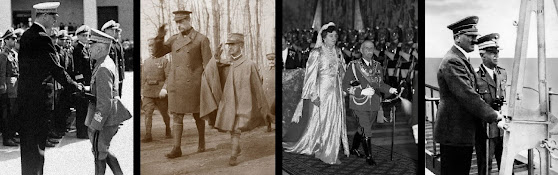
The short stature of Victor Emmanuel III (1869–1947; King of Italy 1900-1946) with (left to right), with Aimone of Savoy, King of Croatia (Rome, 1943), with the elongated Albert I, King of the Belgians (France, 1915), with his wife, Princess Elena of Montenegro (Rome 1937) & with Adolf Hitler (1889-1945; Führer (leader) and German head of government 1933-1945 & head of state 1934-1945), observing the Italian navy conduct manoeuvres, Gulf of Naples, 1938. Note the King of Italy's sometimes DPRKesque hats.
Technically, Victor Emmanuel didn’t fit the definition of dwarfism which sets a threshold of adult height at 4 feet 10 inches (1.47 m), the king about 2 inches (50 mm) taller (or less short) and it’s thought the inbreeding not uncommon among European royalty might have been a factor, both his parents and grandparents being first cousins. However, although not technically a dwarf, that didn’t stop his detractors in Italy’s fascist government calling him (behind his back) il nano (the dwarf), a habit soon picked up the Nazis as der Zwerg (the dwarf) (although Hermann Göring (1893–1946; leading Nazi 1922-1945, Hitler's designated successor & Reichsmarschall 1940-1945) was said to have preferred der Pygmäe (the pygmy)). In court circles he was knows also (apparently affectionately) as la piccola sciabola (the little sabre) a nickname actually literal in origin because the royal swordsmith had to forge a ceremonial sabre with an unusually short blade for the diminutive sovereign to wear with his many military uniforms. His French-speaking wife (Princess Elena of Montenegro (1873–1952; Queen of Italy 1900-1946)) stood a statuesque six feet (1.8 m) tall and always called him mon petit roi (my little king). It was a long and happy marriage and genetically helpful too, his son and successor (who enjoyed only a brief reign) very much taller although his was to be a tortured existence. Still, in his unhappiness the scion stood tall and that would have been appreciated by the late Prince Philip, Duke of Edinburgh (1921–2021) who initially approved of the marriage of Lady Diana Spencer (1960-1997) to the Prince of Wales (b 1948) on the basis that she “would breed some height into the line”.

In
cosmology, the word dwarf is applied to especially small versions of celestial
bodies. A dwarf galaxy is a small galaxy
of between several hundred and several billion stars, (the Milky Way may have
as many as billion) and astronomers have identified many sub-types of dwarf
galaxies, based on shape and composition.
A dwarf planet is a small, planetary-mass object is in direct orbit of a
star, smaller than any of the eight classical planets but still a world in its
own right. Best-known dwarf planet is now
Pluto which used to be a planet proper but was in 2006 unfortunately
down-graded by the humorless cosmic clerks at the IAU (International Astronomical Union) who are in charge of such things.
It’s hoped one day this decision will be reversed so Pluto will again be
classified a planet. Dwarf planets are
of interest to planetary geologists because despite their size, they may be geologically
active bodies. The term dwarf star was coined
when it was realized the reddest stars could be classified as brighter or
dimmer than our sun and they were created the categories “giant star”
(brighter) and dwarf star (dimmer). As
observational astronomy improved, thing further were refined.
With
the development of infrared astronomy there were refinements to the model to
include (1) the dwarf star (the “generic” main-sequence star), (2) the red
dwarf (low-mass main-sequence star), (3) the yellow dwarfs are (main-sequence stars
with masses comparable to that of the Sun, (4) the orange dwarf (between a red
dwarf and yellow/white stars), (5) the controversial blue dwarf which is a hypothesized
class of very-low-mass stars that increase in temperature as they near the end
of their main-sequence lifetime, (6) the white dwarf which is the remains of a
dead star, composed of electron-degenerate matter and thought to be the final
stage in the evolution of stars not massive enough to collapse into a neutron
star or black hole, (7) the black dwarf which is theorized as a white dwarf
that has cooled to the point it no longer emits visible light (it’s thought the
universe is not old enough for any white dwarf to have yet cooled to black and (8) the brown dwarf, a sub-stellar object not massive enough to ever fuse
hydrogen into helium, but still massive enough to fuse deuterium.
Coolest
dwarf of all is (9) the ultra-cool dwarf (first defined in 1997), somewhat
deceptively named for non cosmologists given the effective temperature can be
as high as 2,700 K (2,430°C; 4,400°F); in space, everything is relative. Because of their slow hydrogen fusion
compared to other types of low-mass stars, their life spans are estimated at
several hundred billion years, with the smallest lasting for about 12 trillion
years. As the age of the universe is thought
to be only 13.8 billion years, all ultra-cool dwarf stars are relatively young
and models predict that at the ends of their lives the smallest of these stars
will become blue dwarfs instead of expanding into red giants.

Disney's seven dwarfs; they're now cancelled.
The events
towards the conclusion of the nineteenth century German fairy tale Snow White and the Seven Dwarfs make
ideal reading for young children. Her
evil step-mother has apparently killed poor Snow White so the seven disappointed
dwarfs lay her body in a glass coffin. The
very next day, a handsome prince happens upon the dwarfs’ house in the forest and
is so captivated by her beauty he asks to take her body back to his castle. To this the dwarfs agree but while on the
journey, a slight jolt makes Snow White come to life and the prince, hopelessly
in love, proposes and Snow White accepts. Back at the palace, the prince invites to the
wedding all in the land except Snow White's evil stepmother.

Snow White and the Seven Dwarfs, even Happy looking sad.
The
step-mother however crashes the wedding and discovers the beautiful Snow White
is the bride. Enraged, she again attempts murder but the prince protects her and, learning the truth from his
bride, forces the step-mother to wear a pair of red-hot iron slippers and dance in
them until she dies; that takes not
long and once she has the decency to drop dead, the nuptials resume. In the way things happen in fairy tales, the prince and Snow White live happily ever
after.
DEI (diversity, equity and inclusion)
The condition achondroplasiaphobia describes those with a “fear of little people". The construct is achondroplasia (the Latin a- (not) + the Ancient Greek chondro- (cartilage) + the New Latin -plasia (growth); the genetic disorder that causes dwarfism) + phobia (from the New Latin, from the Classical Latin, from the Ancient Greek -φοβία (-phobía) from φόβος (phóbos) (fear). The condition, at least to the extent of being clinically significant, is thought rare and like many of the especially irrational phobias is induced either by (1) a traumatic experience, (2) depictions in popular culture or (3) reasons unknown. Achondroplasiaphobia has never appeared in the American Psychiatric Association’s (APA) Diagnostic and Statistical Manual of Mental Disorders (DSM). In 2006, it was reported that while dining at the Chateau Marmont hotel in Los Angeles, after noticing two people of short stature had entered the restaurant, Lindsay Lohan suffered an "anxiety attack" and hyperventilated to the extent she had to take "an anti-anxiety pill" to calm down. To her companions she repeatedly said "I’m so scared of them!" A spokesperson for the LPA responded by suggesting Ms Lohan should "...treat her fear the same as she would a fear of any other protected minority population. If that fails, she might find diversity training to be useful." Almost immediately the story appeared, it was debunked by a representative for Ms Lohan who issued a statement saying she is not achondroplasiaphobic and not in any way scared of little people, adding "Lindsay loves all people."

Prince Charming's non-consensual
kiss of Snow White on her "
lips red as blood".
In
February 2025, Luis Rubiales (b 1977), the former president of the Royal
Spanish Football Federation was found guilty of sexual assault for kissing
player Jenni Hermoso (b 1990) without her consent and was fined €10,800 so, at least in some jurisdictions, the
matter of consenting to a kiss is not mere legal theory.
Among
critics and industry analysts, the consensus seem to be that in late 1919 when
the project was approved, for Disney to allocate a budget of US$200 million (it
ended up being booked at around US$250 million) to a remake of Snow White and the Seven Dwarfs (1937) probably
was a good idea. Based on the German
fairy tale Sneewittchen which first
appeared in print early in the nineteenth century, Disney’s 1937 production was
the first animated, full-length feature film made in the US and it was both
critically acclaimed and a great commercial success, becoming the
highest-grossing film of 1938; adjusted for inflation, it’s success then and
since has made it one of the most profitable films ever made.
The
elements in its success were (1) the quality of the studio’s work, (2) advances
in the technology delivering sight and sound which made the audience's experience so vivid and (3) the threads of the story which are fairy tale classics: A wicked queen, jealous of
her stepdaughter’s beauty orders her murder, only to discover she’s hiding out
in a cottage with seven dwarves so she poisons her with an adulterated apple, inducing
a deep sleep from which she eventually is awoken by the kiss of a handsome prince. In 1937, had the word “problematic” then been
in use, it wouldn't have been applied to anything in the plot but by the early 2020s,
things had changed. In the pre Trump 2.0
era, when DEI (diversity, equity & inclusion) was compulsory, having Snow
White gaining her name because her skin was as “white as snow” and the very
existence of dwarfs were both definitely “problematic” so the challenge was to
keep the “Snow White” in the title while
changing troublesome content as required. That's been done before and had the 2024 US presidential election elected
someone (probably anyone) other than Donald Trump (b 1946; POTUS 2017-2021 and since 2025), Snow White could have appeared in cinemas to
lukewarm reviews but a solid box office based on 7-11 year old girls still
impressed at Meghan Markle (Meghan, Duchess of Sussex; b 1981) having proved
its not only in fairy tales that princes rescue middle-class girls from dreary
lives. Only Fox News would much have bothered with a condemnation.

Times have changed. Whether it's Snow White or Sleeping Beauty, for a man (whether or not a prince) to kiss an unresponsive female, it's now usually some sort of assault. An unresponsive female cannot grant consent.
So for
Disney, the timing of events was unfortunate but the race and cultural controversies
which swirled around the earlier remakes of Mulan
(2020) and The Little Mermaid (2023)
should have been a warning. Most jarring
perhaps was the absence of “dwarfs” (in the historic sense of the word). While Snow White is of course the
protagonist, in casting terms there was only one of her and seven of them so the
substitution of the heptad with “magical creatures” was always going to attract
a critique of its own. According to the
studio, it consulted members of the dwarfism community (the so-called “little
people”) “to
avoid reinforcing stereotypes” before the re-casting but, given the
production was, according to many, replete with cultural, sexist and chauvinist
tropes, the cancelled dwarfs received less attention than might have been
expected. With reviewers using phrases
like “exhaustingly awful reboot” and “tiresome pseudo-progressive additions”, expectations
of success for Snow White have been
lowered.