Barracuda (pronounced bar-uh-koo-duh)
(1) Any
of several elongated, predaceous marine fishes of the
genus Sphyraena, certain species of
which are used for food. The large fish are notoriously voracious and are found world-wide in tropical & sub-tropical waters; the collective noun is "battery".
(2) In slang, a treacherous, greedy person (obsolete).
(3) In slang, one who uses harsh or predatory means to compete.
(3) A
car produced by the Plymouth division of Chrysler Corporation in three
generations between 1964-1974 (as both Barracuda and 'Cuda).
1670-1680:
From American Spanish, thought derived from customary use in the Caribbean, borrowed
from the Latin American Spanish barracuda, perhaps from a Cariban word, most
likely the Valencian-Catalan barracó (snaggletooth), first recorded as barracoutha. There was the suggestion barracó may come from Latin in which the word barra could be used to mean "bar", the idea being this was a reference to to the elongated, bar-like shape of the fish; the theory is regarded as speculative. Barracuda is a noun and barracudalike is an adjective; the noun plural is is barracuda or barracudas.
The plural of fish is an illustration of the inconsistency of English. As the plural form, “fish” & “fishes” are often (and harmlessly) used interchangeably but in zoology, there is a distinction, fish (1) the noun singular & (2) the plural when referring to multiple individuals from a single species while fishes is the noun plural used to describe different species or species groups. The differentiation is thus similar to that between people and peoples yet different from the use adopted when speaking of sheep and, although opinion is divided on which is misleading (the depictions vary), those born under the zodiac sign Pisces are referred to variously as both fish & fishes. So, for most folk, the best advice if a plural of "barracuda'" is needed is to (1) use which ever produces the most elegant sentence and (2) be consistent in use. However, ichthyologists (and probably zoologists in general) will note the barracuda genus "Sphyraena" consists of 29 species and will use "barracuda" if speaking of many fish of the one species and "barracudas" if fish of more than one species are involved.
The
danger presented by barracuda in open water is well documented. The US Navy's heavy cruiser USS Indianapolis
(CA-35) was the warship which in July 1945 delivered to Tinian Naval Base the
critical components for "Little Boy"
the atomic bomb (a uranium device, for decades a genuine one-off, all other
nuclear weapons built with plutonium until (it’s suspected) the DPRK (North
Korea) used uranium for at least one of its tests) and it was torpedoed and sunk
by an Imperial Japanese Navy submarine.
Because of wartime circumstances, the sinking remained unknown for some
four days and of the crew of 1195, only 316 survived of the 890 who made it
into the water, many of the rest taken by “sharks and five-foot long barracudas.”

Barracuda (1977) was US horror movie
set on the Florida coast. The plot-line
involved the inhabitants of a small town being menaced by batteries of
barracuda which have become highly aggressive because of chemical intervention
by a former military doctor who has gone mad while conducting secret government
research into hypoglycaemia and its effect on human behavior. The film was not well-reviewed and critics
noted the "derivative
& dubious plot, poorly executed special effects and lack of focus on the
title character (the fish)".
The Plymouth Barracuda & 'Cuda, 1964-1974
While
the 1964 Ford Mustang is credited with creating the pony-car market, it was
actually the Plymouth Barracuda which came first, released seventeen days earlier. Ford’s used the approach of draping a sexy new body over
an existing, low-cost, platform and drive-train and Chrysler chose the same
route, using the sub-compact Valiant as Ford were using their Falcon. In the years to come, there would be many who adopted the method, often with great success and on both sides of the Atlantic, there other manufacturers would create their own "pony cars". Despite the chronology, it's the Mustang which deserves the credit for the linguistic innovation, the term "pony car" an allusion to the equine association in the Ford's name and a nod also to the thing being (in US terms at the time), a "smaller" car. If was only after the Mustang had both created and defined the segment the Barracuda came to be called a pony car.
1965 Ford Mustang "notchback".
Unfortunately,
despite the project having been in the works for years, a sudden awareness Ford
were well advanced meant Chrysler’s lower-budget development was rushed. Despite the Valiant’s platform and drive-train
being in many aspects technically superior to the less ambitious Falcon, Plymouth’s
Barracuda was a bit of a flop, outsold by its competitor initially by around ten
to one, numbers which got worse as "Mustangmania" overtook the land. While
the Mustang got what was called “the body from central casting”, from the
windscreen forward, the Barracuda retained the sheet-metal from the mundane
Valiant, onto which was grafted a rear end which was adventurous but
stylistically disconnected from the front.
1964 Plymouth Barracuda.It was an awkward discombobulation although, with the back-seat able to
be folded down to transform the rear passenger compartment into a large luggage
space, it was clever, practical design. Although in the years to come, the notion of such lines being used for a "liftback" or "hatchback" would appear, even during the design process, it was never envisaged that the rear window might be made to open. At the time, the matter of of installing the big, heavy piece of glass and its edging was thought challenge enough without adding the engineering the necessary hinges and body-mounting points. Although not a stressed panel, the glass did contribute to structural rigidity which was good but it also produced much heat-soak into the interior; driving an early Barracuda on a hot' sunny day could be a "sticky" experience, vinyl upholstery a standard fitting and air-conditioning expensive and a generation away from becoming commonplace.
1971 Jensen FF Mark III, one of 15 built.
The
novelty of the Barracuda's rear-end was a giant window which, at 14.4 square feet
(1.34m3), was at the time the largest ever installed in a production
car. In 1966, even grander glazing was seen on the Jensen Interceptor, styled by Italy’s Carrozzeria Touring,
but there it was ascetically successful, the lines of the big trans-Atlantic
hybrid more suited to such an expanse of glass. Unlike Plymouth, Jensen took advantage of the possibilities offered and had the glass double as a giant, glazed trunk (boot) lid. It didn't quite create one of the shooting brakes so adored by the gentry but it did enhance the practicality. Using Chrysler's big-block V8s and (but for a handful built with manual gearboxes) TorqueFlite automatic transmission, the Interceptor was no thoroughbred but it offered effortless performance and the bullet-proof reliability for which the US power-trains of the era were renowned.
1968 Plymouth Barracuda hardtop.
The
extraordinary success of the Mustang nevertheless encouraged Chrysler to
persist and the Barracuda, though still on the Valiant platform, was re-styled
for 1967, this time with the vaguely Italianesque influences (noticed probably more by Americans than Italians) seen also in 1966 with the release of the second series of Chevrolet’s doomed, rear-engined Corvair. Although the rear-engine configuration proved a cul-de-sac, aesthetically, the later Corvairs were among the finest US designs of the era and, unusually, the lovely lines were implemented as successfully in four-door form as on the coupe. Visually, the revised Barracuda didn't quite scale the heights achieved by Chevrolet but greatly it improved on the original and was offered with both
notchback and convertible coachwork, as well as the fastback the Mustang had made popular but, because of the
economic necessity of retaining some aspects of the Valiant’s structure, it wasn’t
possible to realise the short-deck, long-hood look with which the Mustang had
established the pony car design motif used still today.

1969 Pontiac Firebird Trans Am.
General
Motors’ (GM) answer to the Mustang wasn’t as constrained by the fiscal
frugality which had imposed so many compromises on the Barracuda, the Chevrolet
Camaro and the substantially similar Pontiac Firebird both introduced in 1966 with
a curvaceous interpretation of the short-deck, long-hood idea which maintained
a relationship with the GM’s then voguish “cokebottle” designs. In a twist on the pony car
process, the Camaro and Firebird were built on an entirely new platform which would
later be used for Chevrolet’s new competitor for the Valiant and Falcon, the
Nova. Just as the pedestrian platforms
had restricted the freedom to design the Barracuda, so the Camaro’s
underpinnings imposed compromises in space utilization on the Nova, a few
inches of the passenger compartment sacrificed to fashion. For 1967, Ford released an updated Mustang, visually
similar to the original but notably wider, matching the Camaro and Firebird in
easily accommodating big-block engines, not something Chrysler easily could do with the Barracuda.

1969 Plymouth 'Cuda 440.
However,
this was the 1960s and though Chrysler couldn’t easily install a big-block, they
could with difficulty and so they did, most with a 383 cubic inch (6.3 litre)
V8 and, in 1969, in a package now called ‘Cuda, (the name adopted for the hig-performance versions) a few with the 440 (7.2
litre). At first glance it looked a bargain, the big engine not all that expensive but having ticked the box, the buyer then found added a number of "mandatory options" so the total package did add a hefty premium to the basic cost. The bulk of the big-block 440 was such
that the plumbing needed for disc brakes wouldn’t fit so the monster had to be
stopped with the antiquated drum-type and nor was there space for power
steering, quite a sacrifice in a car with so much weight sitting atop the front
wheels. The prototype built with a
manual gearbox frequently snapped so many rear suspension components the
engineers were forced to insist on an automatic transmission, the fluid cushion softening
the impact between torque and tarmac.
Still, in a straight line, the things were quick enough to entice almost 350 buyers, many of whom tended to enjoy the experience a ¼ mile
(402 metres) at a time, the drag-strip it's native environment. To this day the 440 remains the second-largest engine used in a pony car, only Pontiac's later 455 (7.5) offering more displacement.

1968 Plymouth Barracuda convertible.
For what most people did most of the time (which included turning corners), the
better choice, introduced late in 1967, was an enlarged version of Chrysler’s small-block V8 (LA), now bored-out to 340 cubic inches (5.6 litres); it wouldn’t
be the biggest of the LA series but it was the best. A high-revving, free-breathing thing from the
days when only the most rudimentary emission controls were required, the toxic
little (a relative term) 340 gave the Barracuda performance in a straight line not markedly inferior to the 440, coupled with markedly improved braking and cornering
prowess. One of the outstanding engines
of the era and certainly one of Detroit's best small-block V8s, it lasted, gradually detuned,
until 1973 by which time interest in performance cars had declined in parallel
with the engineers ability economically to produce them while also complying with the
increasingly onerous anti-pollution rules.
1968 Hemi Barracuda, supplied ex factory with un-painted black fibreglass.
Of
course, for some even a 440 ‘Cuda wouldn't be enough and anticipating this, in 1968, Plymouth took the metaphorical shoehorn and installed the 426 cubic
inch (6.9 litre) Street Hemi V8, a (slightly) civilised version of their racing
engine. Fifty were built (though one
normally reliable source claims it was seventy) and with fibreglass panels and all manner of acid-dipping tricks to reduce weight, Plymouth didn’t even
try to pretend the things were intended for anywhere except the drag
strip. The power-to-weight ratio of the
1968 Hemi Barracudas remains the highest of the era. The things sometimes are described as "1968 Hemi 'Cudas" but in the factory documentation they were only ever referred to as "Hemi Barracuda" because the 'Cuda name wasn't introduced until the next season.
1971 Plymouth 'Cuda coupe.
The
third and final iteration of the Barracuda was introduced as a 1970 model and
lasted until 1974. Abandoning both the
delicate lines of the second generation and the fastback body, the lines were
influenced more by the Camaro than the Mustang and it was wide enough for any
engine in the inventory. This time the range comprised (1) the Barracuda which could be configured with either of the two slant sixes (198 (3.2) & 225 (3.6) or one of the milder V8s, (2) the Gran 'Cuda which offered slightly more powerful V8s and some additional luxury appointments including the novelty of an overhead console (obviously not available in the convertible) and (3) the 'Cuda which was oriented towards high-performance and available with the 340, 383, 440 and 426 units, the wide (E-body) platform able to handle any engine/transmission
combination. Perhaps the best looking of
all the pony cars, sales encouragingly spiked for 1970, even the Hemi ‘Cuda
attracting over 650 buyers, despite the big engine increasing the price by about a third and it would have been more popular still, had not the insurance premiums for such machines risen so high. With this level of success, the
future of the car seemed assured although the reaction of the press was not
uncritical, one review of the Dodge Hemi Challenger (the ‘Cuda’s substantially
similar stable-mate), finding it an example of “…lavish execution with little
thought to practical application”. Still, even if in some ways derivative (and as the subsequent, second generation Chevrolet Camaro & Pontiac Firebird would at the time suggest, outdated), the styling (the team led by John Herlitz (1942–2008)) has since been acknowledged as a masterpiece and when the "retro" take on the Challenger was released in the next century, those were the lines reprised, the new Mustang and Camaro also following the 1960s, not the 1970s.

1970
Plymouth Barracuda with 225 cubic inch (3.7 litre) slant-6 (left) and 1970
Plymouth Barracuda Gran Coupe (right).
It's the most powerful (The
Hemis and triple-carburetor 440s) of the third generation Barracudas which are
best remembered but production of those things (produced only for 1970 &
1971) never reached four figures. Of the
105,000 Barracudas (some 26,000 of which were 'Cudas) made between 1970-1974,
most were fitted with more pedestrian power-plants like the long-serving 318 cubic
in (5.2 litre) V8 and the 198 & 225 (3.2 & 3.7) Slant-6, the latter pair
serving what used to called the "grocery-getter" market (which in
those less-enlightened times was known also as the “secretary's” or “women's”
market); the sales breakdown for the other pony cars (Mustang, Camaro,
Firebird, Challenger & Javelin) all revealed the same trend to some
degree. The Gran Coupe was the “luxury”
version of the Barracuda, the engine options limited to the 225, 318 & 383
but with a better-trimmed interior, (something welcome in what was otherwise a
quite austere environment of hard, unforgiving plastic) and some exterior bling
including body sill, wheel lip and belt-line moldings. The most notable fitting in the Gran Coupe
was the overhead console, something earlier seen in the Ford Thunderbird. A fairly large fitting for its limited
utility (it included little more than an overhead light, low-fuel and door-ajar
warning lights), other manufacturers would extend their functionality. The overhead console wasn't available in the convertible
version which was still sold as a "Gran Coupe", Plymouth using
"coupe" as just another model name, applying it to two and four-door
sedans and well as the blinged-up Grans pair.

1970 Plymouth AAR 'Cuda in "Lemon Twist" over black.
In 1970,
there was a run of “AAR ‘Cudas”, a promotional model which tied in with the
cars run in the Trans-Am series by the “All American Racers” (AAR) team run by US
driver Dan Gurney (1931-2018). Unlike
the earlier cars produced in a certain volume in order to fulfil homologation
requirements for eligibility in the Trans-Am (the Chevrolet Camaro Z28 (1967) (which
in the factory’s early documents appeared as both Z-28 & Z/28) and Fords
Boss 302 Mustang (1969), the AAR ‘Cudas were built in a more permissive
regulatory environment, the requirement to homologate an engine within the 5.0
litre (305 cubic inch) limit dropped, the teams permitted to “de-stroke” larger
mass-produced units. The change was made
explicitly to tempt Chrysler to compete, removing the expensive business of
developing a special engine, exactly what Chevrolet and Ford had earlier been
compelled to do and the spirit of compromise was at the time in their, the
NASCAR (National Association for Stock Car Auto Racing) recently having nudged
their 7.0 litre (quoted as 427 cubic inchs) to 430 to accommodate Ford’s new 429 (the 385 series V8). So, although homologated, the AAR ‘Cudas didn’t have as close a relationship with what Gurney’s
operation ran on the circuit compared with that enjoyed by the earlier Z28
Camaros and Boss Mustangs.

Underbody of 1970 Plymouth AAR 'Cuda in "Lemon Twist" over black.
The much admired side exhausts emulated the look of the (unlawful) "cut-out" systems some hot-rodders used but the AAR units were ducted using special mufflers with inlets & outlets both at the front. Something of an affectation and probably a structural inefficiency in terms of gas-flow, they were undeniably a sexy look and AMG in the twenty-first century would adopt the "cut-out" look for the Mercedes-Benz G55 & G63 although without the convoluted path.
They did
however look the part, equipped with a black fibreglass hood (bonnet) complete
with lock-pins and a functional scoop, rear & (optional) front spoilers and a very
sexy “side exhaust system” exiting just behind the doors. Uniquely, the 340 in the “Trans-Am” cars ran
a triple carburetor induction system (unlike the actual 5.0 litre race cars
which were limited to a single four-barrel) and was rated at 290 (gross or SAE
(Society of Automotive Engineers)) horsepower, a somewhat understated figure arrived at apparently because that was what was quoted for the Camaro Z28 and Boss 302 Mustang. The engine genuinely was improved, the block
a “special run” using an alloy of cast iron with a higher nickel content and
including extra metal to permit the race teams to install four-bolt main
bearings (none of the AAR road cars so configured). Just to make sure buyers got the message, the
front tyres were fat Goodyear E60x15s while the rears were an even beefier G60x15,
a mix which was a first for Detroit and produced a pronounced forward rake. So even if the AAR ‘Cudas really weren’t “race-ready”,
they looked like they were which was of course the point of the whole exercise
and they proved popular, Plymouth making 2724 (all coupes), 1604 of which were
fitted with the TorqueFlite 727 automatic transmission, something not seen on
the Trans-Am circuits but which was ideally suited to street use. Dodge’s companion “homologation special” was
the Challenger T/A in an identical configuration and of the 2400 coupes made,
1411 were automatics.

1970 Plymouth AAR 'Cuda with dealer-fitted (or re-production) front "chin" spoiler (option code J78) (left) and 1970 Plymouth AAR 'Cuda with standard rear "ducktail" spoiler (mandatory option J82) (right).
The
black ABS plastic rear "ducktail" spoiler (mandatory option code J82) was
standard on the AAR 'Cudas (and differed from the "wing" style unit
optional on other 'Cudas) while the pair of front "chin" spoilers
(J78) were optional. The chin spoilers
were not fitted by the factory but supplied as a "dealer-install kit"
and shipped in the car's trunk (boot), the result being some variations in the
mounting position so cars so configured.
The chin spoilers are available as re-productions (some even including
the original Mopar part-number) and because they were dealer-installed it can
be hard to tell whether they are original equipment, the slight variations in
the positioning of the originals further muddying the waters. For the “originality police” for whom “matching
numbers” is the marker of the highest form of collectability, the small ABS protuberances
are thus a challenge because while a rare dealer receipt or shipping list from
1970 can prove the provenance, an alleged authenticity can be difficult to
disprove because there are now documented techniques by which plastic can be “aged”,
a la the tricks art forgers once used to make a recent painting appear
centuries old. Scientific analysis
presumably could be applied to determine the truth; there’s no record of the originality
police ever having resorted to that but it may happen because in the collector
market the difference in value between “original”
and “not original” can be significant.

1970 Plymouth Barracuda Option M46 detail sheet (left) and 1970 Plymouth Barracuda with M46 (or re-production) rear (non-functional) quarter-panel (sill) scoop (right).
The
reproduction of obscure and once rarely ordered options has meant there doubtlessly
are more AAR ‘Cudas with the chin spoilers than were ever sold in that form and
even the less desirable Barracudas are serviced by the industry. In 1970 there was option code M46 which
included (1) an Elastomeric (elastomer a rubbery material composed of long,
chain-like molecules (or polymers) capable of recovering their original shape
after suffering an impact) rear quarter-panel (sill) air scoop in front of the
rear wheels, (2) matte black lower-body trim with white and red pinstripes, (3)
a rear-panel black-out (similar to that used on the ‘Cuda), complemented with
chrome trim from the Gran Coupe (the “luxury” version of the Barracuda which,
despite the name, was available also as a convertible) and (4) blacked-out front
& rear valences. Offered only for
1970 Barracudas, Chrysler’s records indicate fewer than 450 were built but the
reproduction scoops are sometimes seen even on later models including ‘Cudas on
which they were never available. Unlike
the AAR’s chin spoilers, option code M46 was factory-fitted so authenticity can
be verified by the fender tag. Unlike
the spoilers (which would have had some aerodynamic effect), option M46 was
purely a “dress-up”, the quarter-panel
scoop “non-functional” and only emulating the “rear-brake cooling ducts” sometimes used on race cars or exotic machines.

1971 Plymouth 'Cuda convertible.
Circumstances conspired to doom the ‘Cuda, the 426 Hemi, the Challenger and almost the
whole muscle car ecosystem. Some of the
pony cars would survive but for quite some time mostly only as caricatures of their wild
predecessors. Rapidly piling up were
safety and emission control regulations which were consuming an increasing
proportion of manufacturers’ budgets but just as lethal was the crackdown by
the insurance industry on what were admittedly dangerously overpowered cars
which, by international standards, were extraordinarily cheap and often within
the price range of the 17-25 year old males most prone to high-speed accidents
on highways. During 1970, the insurance
industry looked at the data and adjusted the premiums. By late 1970, were it possible to buy
insurance for a Hemi ‘Cuda and its ilk, it was prohibitively expensive and
sales flopped from around 650 in 1970 to barely more than a hundred the next
year, of which but a dozen-odd were convertibles. Retired with the Hemi was the triple carburetor option for the 440; 1971 was the last time such a configuration would appear on a US-built vehicle.
It was
nearly over. Although in 1972 the Barracuda & Challenger were granted a stay of execution, the convertible and the big-block engines didn’t re-appear after 1971
and the once vibrant 340 was soon replaced by a more placid 360. Sales continued to fall, soon below the point
where the expensive to produce E-body was viable, production of both
Barracuda and Challenger ending in 1974. From a corporate point-of-view, the whole E-Body project had proved a fiasco: not only did it turn out to be labour-intensive to build, it was only ever used by the Barracuda & Challenger, a financial death sentence in an industry where production line rationalization was created by "platform-sharing". Even without the factors which led to the extinction however, the first
oil-crisis, which began in October 1973, would likely have finished them off,
the Mustang having (temporarily) vacated that market segment and the Camaro and
Firebird survived only because they were cheaper to build so GM could profitably maintain
production at lower levels. Later in the decade, GM would be glad about that for the Camaro and Firebird enjoyed long, profitable Indian summers. That career wasn't shared by the Javelin, American Motors’ belated pony car which, although actually more successful than
the Barracuda, outlived it only by months.

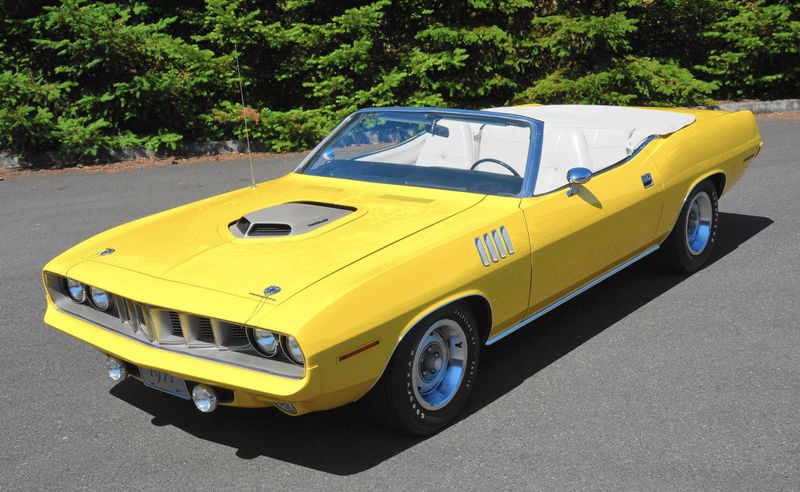
1971 Hemi 'Cuda convertible at 2021 auction. Note the "gills" on the front fender, an allusion to the "fish" theme although anatomically recalling a shark more than a barracuda.
It was as
an extinct species the third generations ‘Cudas achieved their greatest success...
as used cars. In 2014, one of the twelve 1971 Hemi ‘Cuda convertibles sold at auction for US$3.5 million and in 2021,
another attracted a bit of US$4.8 million without reaching the reserve. In the collector market, numbers do "bounce around a bit" and while the "post-COVID" ecosystem was buoyant, by 2024 it appears things are more subdued but, like Ferrari's Dino 246GT & GTS, the 1971 Hemi 'Cuda convertibles remains a "litmus-paper" car which is regarded as indicative of the state of the market. The next time one is offered for sale, the fall of the hammer will be watched with interest.

Sphyraena barracuda (great barracuda).
The barracuda,
most notably the Sphyraena barracuda (great barracuda), can grow quite large
with lengths of 3-5 feet (0.9-1.5 metres) being common but specimens have been
verified at just over 6 feet (1.8 metres), weighing in excess of 100 lb (45 KG)
although most caught by recreational fishers tend to be around 20-30 lb (9-14 KG). They’re a fast, powerful predator, making
them a much sought-after target for the more adventurous anglers, attracted by their
aggressive strikes, impressive speed, and challenging fights, most hunting done
in warmer coastal waters. The techniques
employed include including trolling, casting with artificial lures and live
bait fishing but because of their sharp teeth and aggressive nature, specialized
equipment such as wire leaders is often used to prevent them cutting through
fishing lines. Among recreational
fishers, the pursuit is often on the basis of “the thrill of the chase” because
the species can pose genuine health risks if eaten because of ciguatera
poisoning, a toxin which accumulates in the fish’s flesh when they consume
smaller, contaminated fish.

Hofit Golan (b 1985; left) and Lindsay Lohan (b 1968; right) fishing off Sardinia, July 2016 (left). Fortunately perhaps, Ms Lohan didn’t hook a
barracuda and caught something less threatening. Apparently also fishing for “the thrill of
the chase” (right), she posted on Instagram: “Bonding with nature. I let my little friend swim away
after.”