Tuesday, November 28, 2023

Sedevacantism

Sedevacantism (pronounced sed-ah- vey-kuhnt-niz-uhm)

In Christianity, the belief (maintained by a faction of conservative Roman Catholics) that the present occupant of the Holy See is not the true pope and the see has been vacant since the Second Vatican Council (Vatican II (1962-1965)).

Circa 1965: the construct was the Latin phrase sede vacante +‎ -ism.  The Latin phrase sede vacante (vacant chair) is from canon law term sedes vacans which describes the period during which there is no appointee to an episcopal see.  It thus applies to any vacant bishopric but is most associated with that of the Bishop of Rome (the Roman Catholic Pope) where it’s part of formal processes associated with any interregnum.  The construct of sedes (seat, chair (and used sometimes also to mean “place, residence, settlement, habitation, abode”)) was sedeō (I sit) +‎ -ēs (the suffix used to form a third-declension feminine abstract noun designating the result of an action from a verb root or conceived root form).  Etymologists note that like caedēs (slaughter) from caedō (I kill or cut), sedes is an outlier and like the proto-Italian, Latin tended not productively to form nouns from verbs by changing the vowel grade.  They consider the word's lengthened grade as similar to the Proto-Germanic sētiją (seat) and likely ultimately from a common source although the origin remains murky.  Vacante was the ablative (masculine, feminine & neuter) singular of vacāns (emptying, vacating; idling) (genitive vacantis), the present active participle of vacō.  The –ism suffix was from the Ancient Greek ισμός (ismós) & -isma noun suffixes, often directly, sometimes through the Latin –ismus & isma (from where English picked up ize) and sometimes through the French –isme or the German –ismus, all ultimately from the Ancient Greek (where it tended more specifically to express a finished act or thing done).  It appeared in loanwords from Greek, where it was used to form abstract nouns of action, state, condition or doctrine from verbs and on this model, was used as a productive suffix in the formation of nouns denoting action or practice, state or condition, principles, doctrines, a usage or characteristic, devotion or adherence (criticism; barbarism; Darwinism; despotism; plagiarism; realism; witticism etc).  Sedevacantism and sedevacantist are nouns; the common noun plural is Sedevacantists.

Pope Francis (b 1936; pope since 2013) is a very busy man and it not know if he has much time to open the Bible but it may be that recently he felt constrained to turn to Galatians 6:7 and ponder the passage in which Paul the Apostle in his Epistle to the Galatians wrote: “Be not deceived; God is not mocked: for whatsoever a man soweth, that shall he also reap. King James Version (KJV, 1611).  Francis certainly has been sowing.  Recently, the Vatican’s Dicastery for the Doctrine of the Faith (the DDF, the latest name for the Inquisition) issued a statement confirming an adult who identifies as transgender can receive the sacrament of Baptism under the same conditions as any adult, as long as “there is no risk of causing scandal or confusion to other Catholics”.  To clarify the matter, the DDF added that children or adolescents experiencing transgender identity issues may also receive Baptism “if well prepared and willing”.  Within days of that announcement, Francis played host to a group of transgender women (many of them sex workers or migrants from Latin America) who were among the 1200 impoverished or homeless who attended a luncheon held in the papal audience hall (the Vatican Press Office noting the catering extended to “a full meal and dessert”) to mark the Church’s “World Day of the Poor”.  Apparently, the pontiff has been in contact with the transgender women since he organized assistance for the during the COVID-19 lockdowns when they were unable to practice their trade.  Meetings are said now to be monthly with His Holiness providing funds, medicine and shampoo.

A pope giving shampoo (and hopefully conditioner) to the needy need not be controversial but news of that largess came at a time when dissent was swirling about the DDF’s announcement (signed by Francis) which confirmed trans-men & women can also witness marriages and be named as godparents under certain circumstances.  In the tradition of the Inquisition, the DDF’s document was legalistic although many noticed a vague “clarification” which seemed rather to verge on the ambiguous: That for individuals with gender-identity afflictions to be baptized, it must not cause “scandal” or “disorientation”.  However, the very idea seemed to scandalize some bishops and theologians who noted there had apparently been no change to the Church’s traditional teaching that gender ideology and transgender lifestyles are a "grave disorder" in need of correction through spiritual and secular therapy.

The DDF issued its statement in response to a dubia (a respectful request for clarification regarding about certain established teachings), one of quite a few which have ended up in the Vatican’s post-box (dubias are always on paper) in this pontificate.  The most celebrated of these letters of dissent (the more searchingly serious of which are in exquisitely polite Latin) were signed by four cardinals and received in September 2016, asking (1) Whether those living in sin were now to be granted Holy Communion, (2) Whether the Church had overturned Saint John Paul II’s (1920–2005; pope 1978-2005) 1993 encyclical Veritatis splendor (The Splendor of the Truth) which laid down certain fundamentals of the Church's role in moral teaching, (3) Whether there were changes in what constituted certain sins, (4) Whether circumstances or intentions can now transform an act intrinsically evil by virtue of its object into an act subjectively good or defensible as a choice and (5), Whether the church no longer excludes any creative interpretation of the role of conscience and now accepts that conscience can be authorized to permit legitimate exceptions to absolute moral norms that prohibit intrinsically evil acts by virtue of their object?

Francis neither acknowledged nor replied to the cardinals' respectful dubia, perhaps wondering if the long tradition in the Church of England of hoping problems might go away if one pretends they don’t exist might be the best course to follow.  However, some months later a less deferential letter arrived in which several dozen Catholic theologians, priests and academics went further than the cardinals and formally accused Pope Francis of spreading heresy, a document the like of which hadn't been sent to a pope since the 1300s.  Stunningly, it was one step short of actually accusing the pontiff of being a heretic.

Apparently unfazed, His Holiness has continued along a path of greater inclusiveness of which “shampoo diplomacy” is a part, dealing with dissenters as he goes.  In In November 2023, it was announced he had sacked (“removed from the pastoral care of the diocese” as the Holy See puts such things) US Bishop Joseph Strickland (b 1958; Bishop of the Diocese of Tyler, Texas 2012-2023) and appointed an interim apostolic administrator.  Bishop Strickland (appointed to his position in 2012 by Benedict XVI (1927–2022; pope 2005-2013, pope emeritus 2013-2022)) is said to be one of the WWJD (what would Jesus do?) school and on 12 May 2023 had tweeted (ie to the whole world) “I believe Pope Francis is the pope, but it is time for me to say that I reject his program of undermining the Deposit of Faith.  Follow Jesus."  The tweet was enough for the Vatican to launch an investigation, in response to which on more than one occasion Bishop Strickland asserted he would not voluntarily resign.  The investigation was remarkably quick by the standards of the Holy See and early in November a spokesman for the Archdiocese of Galveston-Houston revealed the tribunal had advised His Holiness “the continuation in office of Bishop Strickland was not feasible.  The pope requested the bishop resign but he declined, thus the rare sacking.  Strickland stating “I believe Pope Francis is the pope” was of some significance, a clear statement he was not a sedevacantist.  Sedevacantism is a belief maintained by a faction of conservative Roman Catholics that the present occupant of the Holy See is not the true pope and the see has been vacant since the Second Vatican Council (Vatican II (1962-1965)).  The sedevacantists disapprove of the changes in Church rituals, procedures brought about by Vatican II but the essence of their movement is that popes since the death of Pope Pius XII (1876-1958; pope 1939-1958) have espoused one or more heresies.

Pope Francis at the traditional Wednesday General Audience, St. Peter's Square, Vatican City, 8 March 2023.

Dissenters and sedevacantists are two problems facing the pope but he needs also to deal with rumblings from those who may well believe they are “working towards Francis” (or at least where they would like Francis to go).  What shampoo diplomacy seems to have done is unleash forces which would like to impose on the Church a “modernizing” beyond anything which would have been recognizable as an implication of Vatican II.  In late October 2023, the Vatican acted with rare decisiveness to block attempts by German prelates to change doctrine regarding homosexual relationships and female clergy.  Sedevacantism wasn’t mentioned by Rome by the other “S word” appeared, the German hierarchy warned they were “approaching schism” in their moves to diverge from the Catholic Church's teachings and that “radical propositions” such as the approval of homosexual relationships and the ordination of women priests must be abandoned.

What presumably also miffed Rome was that the objectionable German document was entitled “German Synodal Way”, something chosen deliberately as a reference to Pope Francis's global “Synod on Synodality”.  That was either cheeky or provocative but having sown the wind, Francis is reaping the whirlwind; having given the Germans ideas, he now has to draw the line and draw it he did, telling the bishops in Bonn that regarding the matters they are contesting: there is no possibility of arriving at a different assessment”, adding it “…must be made clear from the outset that these issues are of varying relevance and cannot all be placed on the same level.”  Whether or not it much mollified the Germans, it was further noted that while some matters cannot even be discussed, other “…aspects can be subjected to joint in-depth discussion.

Monday, November 27, 2023

Usurp

Usurp (pronounced yoo-surp or you-zurp (US))

(1) Forcibly or illegally to seize and hold a throne, an office, institution or position. 

(2) To use without authority or right; wrongfully to employ.

(3) To encroach or infringe upon another’s rights.

(4) To make use of quotations (obsolete except for historic reference).

1275–1325: From the Middle English, from the Old French usurper, from the Latin ūsūrpāre (to take possession through use), the Latin origin of which is undocumented but the construct is believed ūsus (use) + rapere (to seize).  The forms nonusurping, unusurped, unusurping, usurpingly and nonusurpingly exist but are so rare as to be practically extinct.  The seemingly strange but inventive strange verb selfusurp (or self-usurp) seems to have picked up the modern meaning that it applies to things happening between one and one’s digital avatar.  Usurp is a verb, usurper & usurpation are nouns, usurpative & usurpatory are adjectives, usurped is a verb, usurping is a noun & verb; usurpatively is an adverb.  Common in historic documents, the plural forms usurpers & usurpations are in modern use seen when reporting a coup d'état.

Manchester Corporation v Manchester Palace of Varieties Ltd [1955] 1 All ER 387

Lindsay Lohan usurping the escutcheon of the Secret Society of the Les Clefs d’Or (digitally altered image).

In London, in December 1954, for the first time in two centuries, the High Court of Chivalry was summoned to hear the case of a municipal council claiming their coat of arms had been usurped by a private company displaying it on their theatre.  Before substantive matters were introduced, the judge had to rule whether the ancient court still existed and if so, if it was the appropriate body to hear the case.  The judge found the court extant and possessed valid jurisdiction, his reasons a succinct sketch of the UK’s unwritten constitution in operation and a tale of how law and language interacted over several centuries.  The important principle established was to confirm, even in the modern era, there existed an enforceable law of arms and the law takes as much notice of bad heraldic manners as it does of more violent discourtesies, the judge disapproving of the “prevalent” notion that something cannot be unethical if it’s lawful.  That theme has of late been noted by royal commissioners though perhaps not politicians; in the judgement, the temptation to comment on whether chivalry was dead was resisted.

The Manchester Corporation won and the court has not since sat but in 2012,  the council of the Welsh university city of Aberystwyth issued a statement saying they were prepared to lodge a writ related a Facebook page they alleged was usurping its coat of arms.  Before the council made clear whether they were intending to sue facebook.com or the author(s) of the page, the offending image had been removed.  As one of the findings in 1955 had been the High Court of Chivalry could be abolished only by an act of parliament, because New Labour’s judicial reforms didn’t do this, it appears the court would have to be convened in some form to hear similar matters although it's thought the marvellously flexible British constitution would allow a judge at an appropriate level to declare that their court was "sitting as the Court of Chivalry for the purposes of this case".

Saturday, November 25, 2023

Saint

Saint (pronounced seynt)

(1) Any of certain persons, said to be of exceptional holiness of life, formally recognized as such by churches by act of canonization (with doctrinal and procedural differences between denominations).

(2) In secular use, figuratively, a person of extraordinary virtue or who performed acts of extraordinary virtue (often as secular saint).

(3) As patron-saint, the founder, sponsor, inspiration or patron, as of a movement or organization (used formally by churches and informally otherwise).

(4) A religious icon or relic (archaic).

Pre 1000; A borrowing from the Old French, it existed in English as seint, sainct, seinct, sanct & senct, derived from the Latin sānctus (sacred; holy), adjectival use of past participle of sancīre (to hallow; to consecrate), the construct being sanc (akin to sacer (sacred)) + tus (past participle suffix).  The French borrowing replaced the Old English sanct which had been drawn from the Latin.  Variations were adopted by most Germanic languages; it was sankt in the Old Frisian, sint in Dutch and sanct in German; the Italian is santa.  As a verb in the sense of "to enroll (someone) among the saints", use was common by the late fourteenth century and the adjectival forms saintly & saintliness emerged in the 1620s.  Universal abbreviation is St and now often without full-stop, a welcome reduction in clutter.  One quirk in English is the name St John (Christian or surname) is properly pronounced sin-jin.

Originally an adjective prefixed to the name of a canonized person, by circa 1300 it had become a noun.    Saint Bernard, to describe the breed of mastiff dogs, was used first in 1839, the name adopted because the monks of the hospice of the pass of St Bernard (between Italy and Switzerland) sent them to rescue snowbound travelers.  The term secular-saint remains in wide use, the first known example being St Elmo's Fire (named for the patron saint of Mediterranean sailors, a corruption of the name of St Erasmus (fuoco di Sant'Elmo in the Italian), an Italian bishop martyred in 303) in the 1560s.  The phenomenon of weather is known also as corposants or corpusants, from the Portuguese corpo santo (holy body), and was described as long ago as Antiquity, mentioned in Os Lusíadas (The Lusiads (1572), a Portuguese epic poem written by Luís Vaz de Camões (circa 1524-1580) and earlier alluded to by the Greek poet Xenophanes of Colophon (circa 570–circa 478 BC).

The Ecstasy of Saint Teresa

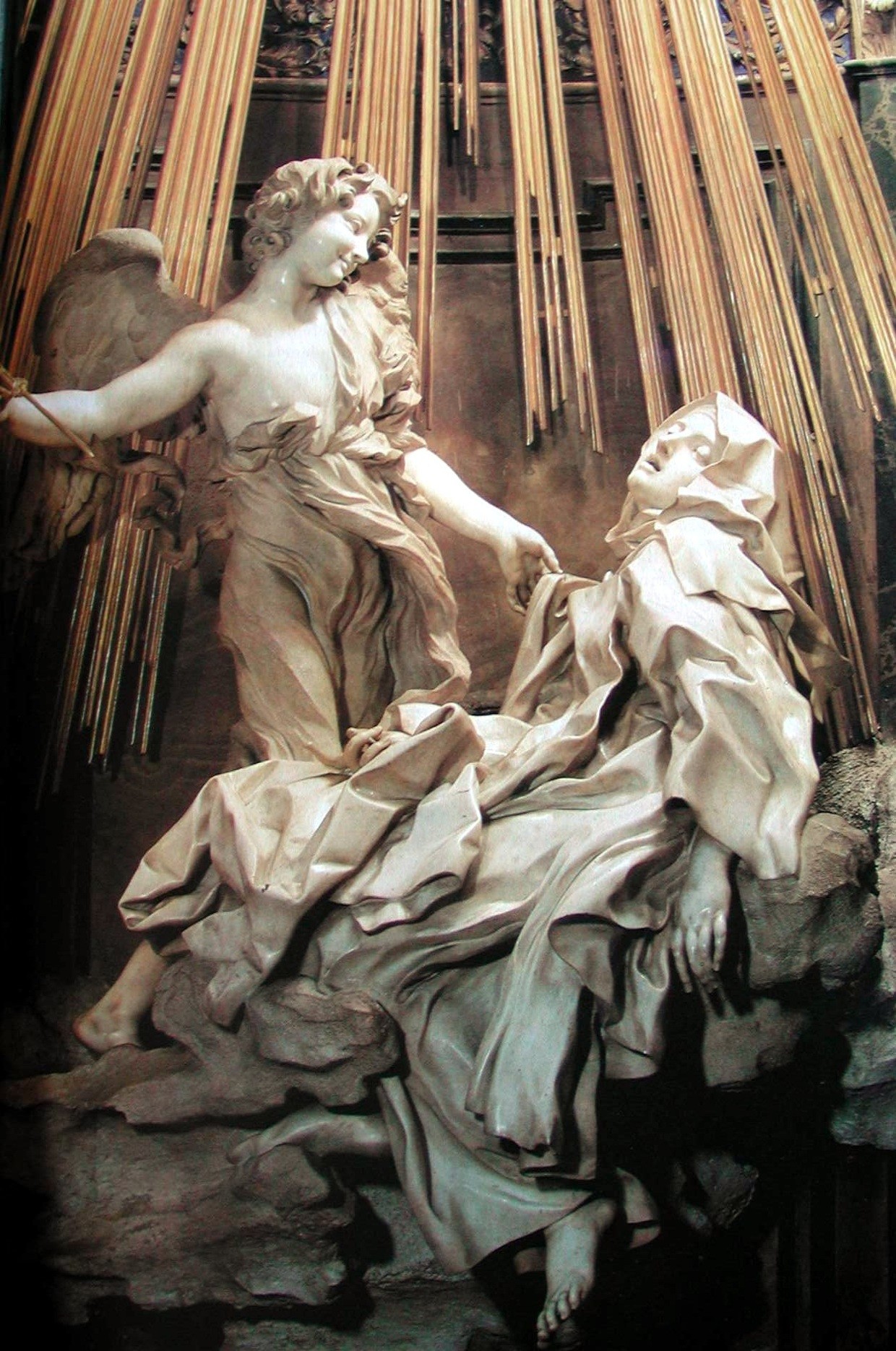
Unlike many of the buildings usually included in the standard tourist itinerary of Rome, the Cornaro Chapel (1626), at Santa Maria della Vittoria, close to the Repubblica metro station, is tiny.  In this intimate space is an elevated aedicule on which sits the little church’s famous installation, L'Estasi di Santa Teresa (The Ecstasy of Saint Teresa; sometimes called The Transverberation of Saint Teresa), a sculptural group in white marble, carved by Gianlorenzo Bernini (1598-1680) in 1652.

The interior of the church, also the work of Bernini, is sumptuously decorated, gilded stucco and multi-colored marble arranged so that barely a surface or crevice is left naked, this lushness the best setting imaginable for this masterpiece of high Roman baroque.  Bernini dismissed the suggestion he use an enclosed chapel and instead presented his composition as a theatre, cleverly lit by a window hidden by the pediment with, on the flanking walls, two opera-boxes containing sculptured representations of the family of his patron, the Venetian Cardinal Federico Cornaro (1579–1653). 

Bernini had reason to be grateful to the cardinal.  The work was completed during the pontificate of Innocent X (1574–1655; Giovanni Battista Pamphilj, pope 1644-1655) and Bernini had been the court architect of the previous pope, Urban VIII (circa 1568–1644; Maffeo Barberini, pope 1623-1644), regarded by Innocent as profligate.  With papal patronage withdrawn, Bernini was again an artist for hire and the cardinal granted the commission.  Teresa of Ávila, the Spanish founder of the Discalced Carmelite nuns, is depicted seated on clouds as if on a bed.  She is captured during the ecstasy she described in her mystical autobiography, experiencing an angel piercing her heart with a dart of divine love, causing both immense joy and pain.  Considering the long tradition of statuary in the Roman Catholic Church, that of Saint Teresa is quite a departure, her contorted posture and the ambiguous smile of the angel lending the scene a rare mix of passion and voluptuousness.  It’s reputed also to be the only Roman Catholic church with a painting depicting a battle scene above the alter and soldiers instead of angels holding up the organ, a legacy of the celebrations at the end of the Thirty Years War (1618-1648).

Saint Teresa in white marble, 1652 (left) and Lindsay Lohan resting in a Cadillac Escalade, Los Angeles, May 2007 (right).  The striking similarity between the two saintly souls inspired one of 2007's most widely-shared memes.

Friday, November 24, 2023

Hoodie

Hoodie (pronounced hood-ee or hoo-dee (Scots))

(1) An originally informal term for a hooded sweatshirt, sweater, or jacket.

(2) A young person who wears a hooded sweatshirt, regarded by those who read London's Daily Telegraph as someone either (1) committing a crime, (2) on their way to a crime, (3) coming from a crime or (4) planning a crime.

1789: Hoodie was originally a familiar term for the hooded crow (Corvus cornix), a Eurasian bird species in the Corvus genus, known also (regionally) as the Scotch crow and Danish crow, the slang shortening of hooded sweatshirt first noted in 1991 (sometimes written as hoody).  The word is still a slang term but has also become the accepted proper description of the garment which can even be a fashion item.   

Hood was from the pre-900 Middle English hood & hod, from the Old English hād & hōd (a hood, soft covering for the head" (usually extending over the back of the neck and often attached to a garment worn about the body), from the Proto-Germanic hōdaz (source also of the Old Saxon & Old Frisian hoed & hod (hood), the Saterland Frisian Houd, the Middle Dutch hoet, the Dutch hoed (hat), the Old High German huot (helmet, hat), the German Hut (hat) and the Old Frisian hode (guard, protection), which is of uncertain etymology, possibly from the Latin cassis (hat), the ultimate root likely the primitive Indo-European kadh- (to cover (and related to “hat)).  It was cognate with the Proto-Iranian xawdah (hat), the Avestan (xåda) and the Old Persian xaudā, also from the primitive Indo-European kadh.  The suffix -ie was a variant spelling of -ee, -ey & -and was used to form diminutive or affectionate forms of nouns or names.  It was used also (sometimes in a derogatory sense to form colloquial nouns signifying the person associated with the suffixed noun or verb (eg bike: bikie, surf: surfie, hood: hoodie etc).  The –y suffix is from the Middle English –y & -i, from the Old English -iġ (-y, -ic), from the Proto-Germanic -īgaz (-y, -ic), from the primitive Indo-European -kos, -ikos, & -ios (-y, -ic).  It was cognate with the Scots -ie (-y), the West Frisian -ich (-y), the Dutch -ig (-y), the Low German -ig (-y), the German -ig (-y), the Swedish -ig (-y), the Latin -icus (-y, -ic) and the Ancient Greek -ικός (-ikós); a doublet of -ic.  The –y suffix was added to (1) nouns and adjectives to form adjectives meaning “having the quality of” and (2) verbs to form adjectives meaning "inclined to".

Amanda Seyfried (b 1985) in hoodie in Red Riding Hood (2011).  Little Red Riding Hood is a 1729 translation of Charles Perrault's Petit Chaperon Rouge (Contes du Temps Passé (1697)).

The modern spelling dates emerged in the early 1400s and reflected the "long" vowel, the spelling enduring although hood is no longer pronounced as such.  Use extended to hood-like-things or animal parts from the mid-seventeenth century and the meaning “foldable or removable cover for a carriage to protect the occupants" is from 1826, extended to "sunshade of a baby-carriage" by 1866.  The meaning "hinged cover for an automobile engine" attested from 1905 and is the standard use in North America but elsewhere in the English-speaking world, the preferred term is “bonnet”; confusingly, hood can also refer the folding roof of a convertible, otherwise called a folding-top or soft-top

Lindsay Lohan in Vetements hoodie with asymmetric cold shoulder.

As an American English shortening of hoodlum, use is attested from as early as 1866 but it became popular only with the emergence in popular culture of the stereotypical gangster in the 1920s.  As a shortened form of neighbourhood, use in the African-American vernacular is noted from 1987 and it’s recently been identified as a racial slur in certain contexts.  In nautical use, a hood is one of the endmost planks (or, one of the ends of the planks) in a ship’s bottom at the bow or stern.  In ophiology, a hood is an expansion on the sides of the neck typical for many elapids (eg some cobras) and (in colloquial use) the osseous or cartilaginous marginal extension behind the back of many a dinosaur such as a ceratopsid and reptiles such as Chlamydosaurus kingie is often referred to as "the hood".  In the human hand, the hood is the extensor digitorum, an expansion of the extensor tendon over the metacarpophalangeal joint.  Hood has been a most productive accessory in English (extractor hood, hoodie, hoodwink, range hood, under the hood, neighbourhood, girlhood etc).  In clothing, hoods (variously named) have of course existed for thousands of years, adopted and adapted to provide protection from the elements (wind, sun, snow, rain etc).  The hoods used in executions, often worn (though for different reasons) by both executioner and the condemned can't be thought of as hoodies because the purpose in such situations was to conceal the face.

A hoodie offers a (pre-lingual) comment on David Cameron's (b 1966; UK prime-minister 2010-2016) "Hug-a-Hoodie" speech in which (while prime-minister), he advocated a softer approach to social justice.  He is now Lord Cameron, having been ennobled so he can sit in the House of Lords and serve as foreign secretary, there evidently being no Tory in either the Lords or the Commons with the required talent (or whatever else is required) for the job.  He's the first former prime-minister since Lord Home (Alec Douglas-Home; UK prime minister 1963-1964) in 1970 to return to cabinet and all wish him well.

In many cultures, hoods were added to garments for purposes other than mere functionality and depending on factors such as color, style, the volume or design of the materials used, they could indicate things like rank, membership of an order, length of service or academic status.  Hoods were part of imperial regalia, court dress, academic gowns, military dress uniforms, ecclesiastical garb and of course, cults like the Freemasons.  The pragmatic adoption of the hoodie by petty criminals as a means of concealment in late 1980s London appears related to the increasingly widespread use of CCTV (closed-circuit television) surveillance systems and advances in AI (artificial intelligence) mean software now has the ability to "see through" hoodies and this means it is inevitable hoodies will be available with some form of "cloaking" material within; it's just another arms race.  The popularity with (career and aspiring) criminals and certain social groups (distinctions between the two somewhat fluid) appears imitative, the adoption of the symbols of petty crime actually a status-symbol to some and a way of asserting group identity.

It was mere coincidence that the words "hoodie" and "hoodlum" appeared within a few years of each other, the early US use (dating from 1866 but not widely used until the stereotypical Chicago gangster became a staple of popular culture during the 1920s) of hoodlum appearing wholly unrelated to hood.  There are etymologists who list the origin as uncertain and offer other possibilities but the most plausible origin of hoodlum is probably that cited by Herbert Asbury (1889-1963) in The Barbary Coast: An Informal History of the San Francisco Underworld (1933).  He believed the word an imperfect echoic originating in San Francisco from a particular street gang's call to unemployed Irishmen to "huddle 'em" (to beat up Chinese migrants).  San Francisco newspapers then took to calling street gangs hoodlums, that being the best they could make of the Irish accent.

Thursday, November 23, 2023

Cannon

Cannon (pronounced kan-uhn)

(1) In ordnance, heavy artillery: a mounted gun for firing heavy projectiles; a gun, howitzer, or mortar,

(2) In machinery, a heavy tube or drum, especially one that can rotate freely on the shaft by which it is supported (also known as a quill).

(3) In armor, a cylindrical or semi-cylindrical piece of plate armor for the upper arm or forearm; a vambrace or rerebrace (the avant-bras in French and sometimes known as lower cannons in the Middle Ages).

(4) In saddlery, as cannon bit or canon bit, the part of a bit in the horse's mouth.

(5) In the design of bells, the metal loop at the top of a bell, from which it is hung.

(6) In zoology, as the cannon bone or the part of the leg in which the cannon bone is located.

(7) In billiards, a British term for a carom (a shot in which the cue ball is caused to contact one object ball after another); the points scored by this; a rebound or bouncing back, as of a ball off a wall.

(8) In underworld slang, a pickpocket (archaic).

1375–1425: From the late Middle English canon, from the earlier Anglo-Latin and Anglo-French canon, from the Italian cannone (large-tube barrel), the construct being cann(a) (tube) + -one (the augmentative suffix).  The Ancient Greek κάννα (kánna) (reed) was from the Akkadian qanû (reed), from the Sumerian gi.na; a doublet of canyon.  The original meaning was an "artillery piece, mounted gun for throwing projectiles by force of gunpowder" the spelling canon in a variety of languages all from the Italian cannone, augmentative of the Latin canna but the use of the double -n- spelling didn’t emerge until circa 1800.  Cannon is a noun and the plural is cannons but, in military use, when speaking of cannons collectively (especially when assembled in a battery), cannon is often used.

The artillery piece revolutionised warfare, the famous walls which for centuries had protected Constantinople were breached soon after cannon were first deployed and the city fell.  The weapon also influenced language.  Cannon fodder, first noted in 1847, describes the infantry or cavalry deployed against cannon-fire and exists in German as kanonenfutter, echoing William Shakespeare's (1564–1616) “food for gun powder” speech in Henry IV, Part 1 (circa 1596), Act 4 Scene 2) where Falstaff dismisses concern for his soldiers by saying they’re “good enough to toss; food for powder, food for powder. They’ll fill a pit as well as better”.  Cannon-shot (distance a cannon will throw a ball) is from the 1570s and was an important measure in admiralty and (embryonic) international law, the old three-mile (and the later twelve-mile) maritime limits of national borders reflect the range of shore-based cannons at various times.  It was used also from the 1590s to describe the iron-ball fired from a weapon but this by the 1660s came to be replaced by cannon-ball.  A cannonade (a continued discharge of artillery) is from the 1650s as a noun and as a verb (attack with artillery), a decade later.  The contemporary French was cannonade and the Italian cannonata, the related forms being cannonaded and cannonading.  Cannonade was exclusively a army term which was later replace by barrage; the Admiralty always preferred broadside.

The figurative “loose cannon” seems to have be popularised from its appearance in Victor Hugo's (1802–1885) late Ninety Three (1874) to describe someone “wildly irresponsible, unpredictable or freed from usual restraint", based on the literal sense of dread sailors on old warships felt when a cannon already primed to fire became detached from its mounts and began rolling about the deck.  When a loose cannon discharges, bloody carnage can ensue. 

Naval Cannons

USS Iowa firing nine-gun broadside in an August 1984 test-firing during the sea-trials conducted after being recommissioned as part of the military build-up ordered during Ronald Reagan's (1911-2004, US president 1981-1989) first term.

The US Navy’s four Iowa-class battleships, Iowa, Missouri, Wisconsin & New Jersey (the commissioned Illinois and Kentucky were never launched because of the changing nature of naval warfare) were the last battleships used in US fleets, all other dreadnoughts & super-dreadnoughts decommissioned by 1947 and when finally retired, they had for three decades been the last battleships afloat.  Noted for their longevity, their service variously lasting (including periods in reserve) from 1943 until 1992, they’re among the best-remembered battleships but they were neither the biggest (and certainly not the widest, the beam at around 108 feet (33 m) dictated by the need to pass through the Panama Canal) nor the most heavily gunned.  The Iowas were built with nine 16 inch (406 mm) naval cannons in three 3-gun turrets and could fire both high explosive and armour-piercing shells around 23 nautical miles (27.6 miles; 44.5 km).  A novel later innovation was an adaptation of the W19 nuclear artillery shell was adapted to suit the 16-inch bore.  With a yield of 15 to 20 kilotons of TNT (roughly the same as the A-bomb used against Nagasaki), they remain the world's largest nuclear artillery although, because of the Pentagon’s policy of refusing to confirm or deny the presence of nuclear weaponry aboard its ships, it’s unknown if any of the shells were ever carried while the ships were in active service.  Like the US Marine Corps (USMC), the navy was never much enthused at the prospect of nuclear weapons being carried by the surface fleet, regarding the weapons as ideally suited to submarines.  The entire US nuclear artillery inventory was later decommissioned and (officially) dismantled.

Yamato, 1944.

The Imperial Japanese Navy’s Yamato-class battleships, Yamato and Musashi, in service between 1942-1945, were bigger and heavier than the Iowas and also used bigger cannons, each having nine 18.1 inch (460 mm) guns in three triple turrets with a shell-range of 26 miles (42 km).  The big guns had been considered for the Iowas during the design process but were sacrificed as part of the speed/range/armour/firepower compromise which naval architects have to apply to every warship.  Interestingly, for a variety of reasons, even the Iowa's never-built successors (the Montana-class), maintained the 16-inch armament, designed around twelve cannons arrayed in four 3-gun turrets.

German conceptual H-45 battleship.

Before reality bit hard, Adolf Hitler (1889-1945; Führer (leader) and German head of government 1933-1945 & head of state 1934-1945) left physics to the engineers and wasn't too bothered by economics.  After being disappointed the proposals the successors to the Bismarck-class ships would have their main armament increased only from eight 15-inch (380 mm) to eight 16 inch cannons, he ordered OKM (Oberkommando der Marine; the Naval High Command) to design bigger ships.  That directive emerged as the ambitious Plan Z which would have demanded so much steel, essentially nothing else in the Reich could have been built.  Although not one vessel in Plan Z ever left the slipway (the facilities even to lay down the keels non-existent), such a fleet would have been impressive, the largest (the H-44) fitted with eight 20-inch (508 mm) cannons.  Even more to the Führer’s liking was the concept of the H-45, equipped with eight 31.5 inch (800 mm) Gustav siege guns.  However, although he never lost faith in the key to success on the battlefield being bigger and bigger tanks, the experience of surface warfare at sea convinced Hitler the days of the big ships were over and he would even try to persuade the navy to retire all their capital ships and devote more resources to the submarines which, as late as 1945, he hoped might still prolong the war.  Had he imposed such priorities in 1937-1938 so the German Navy could have entered World War II (1939-1945) with the ability permanently to have 100 submarines engaged in high-seas raiding rather than barely a dozen, the early course of the war might radically have been different.

Wednesday, November 22, 2023

Unconscionable

Unconscionable (pronounced un-kno-shon-ible)

(1) Not guided by conscience; unscrupulous.

(2) Not in accordance with what is just or reasonable:

(3) Excessive; extortionate, imprudent or unreasonable

1560s: The construct was un- + conscionable.  The un- prefix was from the Middle English un-, from the Old English un-, from the Proto-West Germanic un-, from the Proto-Germanic un-, from the primitive Indo-European n̥-.  It was cognate with the Scots un- & on-, the North Frisian ün-, the Saterland Frisian uun-, the West Frisian ûn- &  on-, the Dutch on-, the Low German un- & on-, the German un-, the Danish u-, the Swedish o-, the Norwegian u- and the Icelandic ó-.  It was (distantly) related to the Latin in- and the Ancient Greek - (a-), source of the English a-, the Modern Greek α- (a-) and the Sanskrit - (a-).  Conscionable was from the Middle English conscions (the third-person singular simple present indicative form of conscion), an obsolete variant of conscience, + -able.  The suffix -able was from the Middle English -able, from the Old French -able, from the Latin -ābilis (capable or worthy of being acted upon), from the primitive Indo-European i-stem forms -dahli- or -dahlom (instrumental suffix); it was used to create adjectives.  Conscience was from the Middle English conscience, from the Old French conscience, from the Latin conscientia (knowledge within oneself), from consciens, present participle of conscire (to know, to be conscious (of wrong)), the construct being com- (together) + scire (to know).  The suffix -able was from the Middle English -able, from the Old French -able, from the Latin -ābilis (capable or worthy of being acted upon), from the primitive Indo-European i-stem forms -dahli- of -dahlom (instrumental suffix); it was used to create adjectives.  Unconscionable is an adjedtive, unconscionableness is a noun and unconscionably is an adverb; the noun plural is unconscionabilities.

Like disgruntled, unconscionable is one of those strange words in English where the derivation has flourished while the source word is effective extinct.  That said, English is defined and constructed by being used and the word conscionable (in accordance with conscience; defensible; proper) remains good English; it has merely faded from use and is described by some dictionaries as obsolete, archaic or at least, since the eighteenth century, a fossilized form of its surviving negative: unconscionable. Conscionable in the 1540s meant "having a conscience", the meaning expanding by the 1580s to refer to actions "consonant with right or duty" and by the 1640s to persons, "governed by conscience".  The Oxford English Dictionary (OED) notes both conscious & conscioned were probably popular formations from conscion, taken as a singular of conscien-ce by a misapprehension of the "s" sound as a plural inflection. The related form was (and is) conscionably.

Unconscionability in the law

Unconscionability is a legal doctrine (most often applied in contact law) which permits courts to strike-out or write-down clauses or agreements which are unduly harsh or so grossly unfair that that it would offend legal principles for them to be enforced.  When a court uses the word "unconscionable" to describe conduct, it means the conduct does not conform to the dictates of conscience as defined in law; it makes no judgment about whether they are at variance with other ethical constructs (although there will often be overlap).  In addition, when something is judged unconscionable, a court will refuse to allow the perpetrator of the conduct to benefit.  If need be, entire contracts can be set-aside or declared void, even if they are otherwise constructed wholly in conformity with the rules of contract.  A contract therefore can be found to be "legal" yet still be voided because it's held to be unconscionable in the same way a contract (for example an agreement between two parties in which one is paid to murder a third part can be held to be a "legal contract" yet be declared  "void for illegality".

Lindsay Lohan and her lawyer in court, Los Angeles, December 2011.  

Unconscionability is determined by examining the circumstances of the parties when the contract was made; these circumstances may include the bargaining power, age, and mental capacity of the parties and the doctrine is applied only where it would be an affront to the integrity of the judicial system to enforce a contracts.  At law, as in moral theology, the concept of unconscionability is probably absolute; something is either unconscionable or not.  However, cases are considered on their merits and the circumstances in which the unconscionable arose might color the detail of a judge’s verdict.

Portrait of King Charles II in his Garter robes (circa 1667), oil on canvas by Sir Peter Lely (1618-80).

The Most Noble Order of the Garter, an order of chivalry and the senior order of knighthood in the UK’s honors system, was founded by Edward III (1312–1377; King of England 1327-1377).  Appointments are exclusively in the gift of the sovereign and limited to two dozen living members (apart from royal appointees).  The Garter was of great significance to Charles II (1630–1685; King of Scotland 1649-1651, King of Scotland, England and Ireland 1660-1685) as it had been his father, Charles I (1600–1649; King of England, Scotland & Ireland 1625-1649) who awarded it as something symbolic of the binding tie with his favored aristocrats.  For Charles II, as the only dignity he was able to confer upon his adherents while in exile during the interregnum (1649-1660), it was a potent symbol, proof the King still retained the mystique and the power of monarchy.  Charles II suffered a sudden apoplectic fit on the morning of 2 February 1685 and his doctors expected him to have the decency to die within the hour.  Instead he lingered another four days before expiring and just before, he apologised to those around him, his last words being:You must pardon me, gentlemen, for being a most unconscionable time a-dying.”  In this, as in many other things, he was unlike his father Charles I, who died suddenly, executed by having his head cut off.

Monday, November 20, 2023

Backdrop

Backdrop (pronounced bak-drop)

(1) In theatre, the rear curtain of a stage setting (in the UK, often known as the back-cloth.

(2) The background of an event; the setting; the background to any scene or situation.

(3) In photography etc, to provide a setting or background for shots.

(4) Figuratively, any background situation.

(5) In gymnastics, a manoeuvre in which a trampolinist jumps in the air, lands on the back with the arms and legs pointed upward, and then springs up to a standing position.

(6) In professional (choreographed entertainment) wrestling, a self explanatory set piece move.

(7) To serve as a backdrop for.

1883: From the London theatrical argot meaning “the painted cloth hung at the back of a stage as part of the scenery”, the construct being the adjective back + the noun drop.  The word was adopted in the US theatre circa 1915.  Back was from the Middle English bak, from the Old English bæc (rear part of the body), from the Proto-West Germanic bak, from the Proto-Germanic baką & bakam, possibly from the primitive Indo-European bhago- (to bend; to curve) and may be compared with the Middle Low German bak (back), from the Old Saxon bak, the West Frisian bekling (chair back), the Old High German bah, and the Swedish and Norwegian bak.  It was cognate with the German Bache (sow (adult female hog)).  Drop was from the Middle English droppe & drope (small quantity of liquid; small or least amount of something; pendant jewel; dripping of a liquid; a shower; nasal flow, catarrh; speck, spot; blemish; disease causing spots on the skin), from the Old English dropa (a drop), from the Proto-West Germanic dropō (drop (of liquid)), from the Proto-Germanic drupô (drop (of liquid)), from the primitive Indo-European drewb- (to crumble, grind).  Figuratively, backdrop is used as a reference to something happening concurrently with whatever is being discussed.  It provides a background context which can be used to explain events or situations and in many cases can be thought of as a parallel narrative such as : “The 1968 US presidential election was conducted with the war in Vietnam as the backdrop.”  The word backdroppery is an irregular formation used in criticism of “political spin”.  Backdrop is a noun & verb, backdropped, backdropt & backdropping are verbs; the noun plural is backdrops.

Stage backdrop for Mean Girls the Musical by Scott Pask Studios, August Wilson Theatre, Broadway, New York, December 2018.

The theatre began as background used live theatre, creating a three-dimensional effect which meant the audience had the impression of the stage having greater depth.  Originally, they were large pieces of material or assembled cardboard, the designs of which interacted with the stage lighting and in larger theatres, for each performance, there may have been several backdrops, each raised or lowered as demanded by scene changes.  In recent years, the development of high definition lighting projection has meant backdrops are often virtualized and the deployment of LEDs (light emitting diodes) has meant extraordinary degrees of realism are now possible.

Lindsay Lohan on the red carpet in front of media walls.

Media walls are a particular type of backdrop which are constructed usually as flat surfaces, their sole purpose almost always being the display of corporate logos.  The dimensions of media walls are dictated by the positioning of the cameras which will record images of those who appear in front of them.  In some circumstances, they can be only a few feet wide and little taller than human height but usually they’re much larger.  Like theatre or photographic backdrops, media wall designers in recent years have embraced electronics as advances have meant striking effects have become possible at a lower price point, an important consideration give that while theatre backdrops might serve for weeks, months or even years, media walls are one-off creations which tend to have a life-span of hours.  Thus, digital screens, LED panels, or projections to showcase dynamic content are now sometimes included in media walls but such designers do have to be cognizant of the purpose; media walls still usually there as a backdrop for filming or photography.

Weddings, parties etc: Static backdrops for hire.

Static backdrops are provided (and often hired) for specific events, typically domestic celebrations such as weddings and birthday parties.  They are thus optimized for photography and tend to be on the small scale which accommodates the camera lens.  They can be as simple as a curtain or a fake window (sometime even with a built-in panorama of rolling hills, oceans etc) or can be as kitsch as one’s imagination can descend to.