Saturday, August 22, 2020

Omicron

Omicron (pronounced om-i-kron or oh-mi-kron)

(1) The fifteenth letter of the Classical and Modern Greek alphabet and the sixteenth in Ancient archaic Greek; a short vowel, transliterated as o.

(2) The vowel sound represented by this letter.

(3) The common name designated (on 26 November 2021 by the World Health Organization’s (WHO) Technical Advisory Group on Virus Evolution (TAG-VE)) for the variant B.1.1.529 of the SARS-CoV-2 virus which causes the condition COVID-19.

(4) In English, as “o” & “O” (fifteenth letter of the alphabet), a letter used for various grammatical and technical purposes.

Circa 1400: The fifteenth letter of the Greek alphabet (oʊmɪkrɒn; the symbol Oo), literally "small o" ( μικρόν (ò mikrón)), the construct being o + the Ancient Greek (s)mikros (small (source of the modern micro-) and so-called because the vowel was "short" in ancient Greek.  Omega (O) was thus the “long” (O) and omicron the “short” (o).  It’s from omicron both Latin and Cyrillic gained “O”.  Depending on the context in which it’s being written, the plural is omicrons or omicra.

The fifteenth letter of the Greek alphabet was derived from a character which in Phoenician was called 'ain or ayin (literally "eye") and represented by what most dictionaries record as something like "a most peculiar and to us unpronounceable guttural sound".  The Greeks also lacked the sound, so when they adopted characters from the Phoenician alphabet, arbitrarily they changed O's value to a vowel.  Despite the medieval belief, there is no evidence to support the idea the form of the letter represents the shape the mouth assumes in pronouncing it.  The Greeks later added a special character for the "long" O (omega), and the original thus became the "little o" (omicron).  In Middle English and later colloquial use, o or o' has a special use as an abbreviation of “on” or “of”, and remains literary still in some constructions (o'clock, Jack-o'-lantern, tam-o'-shanter, cat-o'-nine-tails, will-o'-the-wisp etc).  The technical use in genealogy is best represented by Irish surnames, the “O’” from the Irish ó (ua), which in the Old Irish was au (ui) and meant "descendant".

As a connective, -o- is the most common connecting vowel in compounds either taken or formed from Greek, where it is often the vowel in the stem.  English being what it is, it’s affixed, not only to constructions purely Greek in origin, but also those derived from Latin (Latin compounds of which would have been formed with the L. connecting or reduced thematic vowel, -i).  The Oxford English Dictionary (OED) adds the usage note that this occurred especially when what was wanted were compounds with a sense of Latin composition, which even if technically possible, would not be warranted but, were correct under the principles of Greek composition.  Similarly, blood type-O was in 1926 originally designated “0” (zero)" denoting the absence of any type-A & B agglutinogens but the letter O was adopted to align the group with existing nomenclature.  The standardized scale in railroads (O=1:48 (1:25 gauges)) dates from 1905.

As the character to represent the numerical value "zero", in Arabic numerals it is attested from circa 1600, the use based on the similarity of shape.  The similarity would later cause a Gaëtan Dugas (1952–1984), a Québécois Canadian flight attendant, mistakenly to be identified as "Patient Zero" (the primary case for HIV/AIDS in the United States).  The error happened because of a mistake made in 1984 in either the reading or transcription of a database maintained by the Center for Disease Control and Prevention (CDC) which tracked the sexual liaisons and practices of gay and bisexual men, mostly those from California and New York. Dugas, because he was statistically unusual in having no relevant connections with either state, was coded as "Patient O" (indicating out-of-state) but this was at some point misinterpreted as "Patient 0 (Zero)".  Dugas was later identified as "Patient Zero" (ie the person who introduced HIV/AIDS to North America) in Randy Shilts's (1951-1994) book And the Band Played On: Politics, People, and the AIDS Epidemic (1987) which explored the outbreak of the AIDS epidemic in the United States.  Shilts would later dismiss the significance of the technical error, claiming it made no difference to his point that Dugas engaged in behavior by which he either carelessly, recklessly or intentionally infected his many sexual partners with HIV (a claim subsequently contested by others).  Shilts died in 1994 from an AIDS-related condition.

Flirting with risk of exposure to, inter-alia, Omicron: Lindsay Lohan in facemask during the Covid-19 pandemic.

The authorities discourage the use of masks with the one-way, non-return valves (this one a twin-valve model) during epidemics & pandemics because, while affording the usual protection to the wearer, there is a slight reduction in their effectiveness in reducing the risk of infecting others.

A variant of the original SARS-CoV-2 virus which causes Covid-19, Omicron (B.1.1.529) was first reported to the World Health Organization (WHO) in November 2021 after being detected in Botswana.  Rapidly, it out-competed other SARS-CoV-2 strains to become the predominant variant in circulation, the primary transmission vector of that thought to be international air travel.  The WHO’s Technical Advisory Group on Virus Evolution (TAG-VE) named variant B.1.1.529 “Omicron” in November 2021, skipping the Greek letters next in sequence (nu (Ν, ν) & xi (Ξ ξ)), the former not used because of the confusion envisaged by virtue of the English pronunciation (“new” virus) and the latter avoided so the feelings of Xi Jinping (b 1953; general secretary of the Chinese Communist Party (CCP) and paramount leader of the People's Republic of China (PRC) since 2013) weren’t hurt, the origins of Covid-19 being a sensitive issue among the CCP’s Central Committee.

Flirting virus: Omicron FLiRT variant.

Although a number of Omicron sub-variants have subsequently been identified, none has been found so structurally dissimilar that the TAG-VE felt constrained to allocate a different Greek letter.  Instead, such variants were tagged alpha-numerically according to the group’s established convention (BA.1, BA.2 etc; identified sub-variants of BA.5 listed in a BQ.n sequence).  By June 2024, Omicron and its sub-variants remain dominant globally although new strains continue to emerge, notably the “FLiRT" which sounds encouraging but the US Centre for Disease Control (CDC) provided a rather dry explanation: “F for L at position 456, and R for T at position 346 (references to specific mutations in the virus’s spike protein).  The FLiRT variants are sub-variants of the Omicron JN.1 strain and include notable strains such as KP.2, KP.3, and KP.1.1.  The FLiRT variants now account for a significant portion of cases in the United States.

The Omicron and others: Notable Lancias

1981 Lancia Beta Spyder (Zagato).

Vincenzo Lancia (1881–1937) used letters from the Greek alphabet (Alpha, Beta, Lambda, Kappa, Omicron etc) as model names for many of his early vehicles and in 1953 returned to the practice for a one-off range based on a commercial chassis.  However, when the Beta (1972-1984) was released in 1972 it was the first time since 1945 the company had used letters from the Greek to designate a passenger vehicle.  It wasn’t Lancia’s first use of Beta, that had been the 1909 car which replaced the Alpha (also Alfa) and, although the 1972 car had been intended to be the model which would symbolize Lancia’s re-birth (il risorgimento), Beta rather than Alfa was chosen to avoid confusion with Alfa Romeo.  Over time, the Beta would be offered with two four-door saloon bodies and a coupé from which two variants were derived: (1) a three-door estate labeled HPE (high-performance estate) in the tradition of the "shooting brake" (a la the Reliant Scimitar etc) and (2) as a co-project with Lombardy-based coach-builder Zagato, a targa-style convertible with a structural arrangement vaguely similar to that used by the Triumph Stag.  In some markets, in an attempt to enhance the image, the Montecarlo sports car was badged as a Beta.  The survival rate of the Betas was low because of chronic rust but the oft-told tale the steel was of poor quality (described as “porous” and obtained in some sort of barter transaction between Italy and the Soviet Union) has been debunked, the Betas (like to contemporary Alfa Romeo Alfasud) crumbling away because of design flaws, inadequate corrosion-prevention measures and poor build quality, the latter due in part to the appalling state of the relations between capital & labor during the troubled 1970s.

1987 Lancia Thema 8·32.

By the standards of European front wheel drive mass-production, the Lancia Thema (1984-1994 and available as a four-door saloon, a five door estate and a low-volume long wheelbase (LWD) limousine) was completely conventional and mostly unexceptional but there was one memorable diversion: the Thema 8·32.  Introduced at the 1986 Turin Motor Show, instead of the predictable variety of four & six-cylinder petrol and diesel engines used in the mainstream range, the 8·32 was fitted with a version of the 3.0 litre V8 Ferrari used in their 308 and Mondial models.  By the mid-1980s, although it was no longer novel to put powerful engines into previously nondescript saloons, the 8·32 was in the avant garde of the more extreme, pre-dating the BMW M5 (E28) by some months and the Mercedes-Benz 500E (W124) by seven years but what made it truly bizarre was it retained the Thema’s front wheel drive (FWD) configuration.  That probably sounds like the daftest idea since Oldsmobile and Cadillac in the mid 1960s decided to offer big FWD "personal coupes" (which eventually would be offered with V8 engines as large as 500 cubic inches (8.2 litre)) but journalists who tested the 8·32 declared it a surprisingly good good road car although those who tried them on racetracks did note the prodigious understeer.  Ferrari supplying Lancia with a V8 was actually returning a favor: In 1954, it was the Lancia D50 Formula One car which became the first Ferrari V8.  By 1986, even the V8-powered Cadillac DeVille range had switched to FWD but it was a very different machine from the 8·32 and many DeVille owners probably neither noticed nor cared the configuration had changed although they would have appreciated the flat floor and additional interior space.

1974 Lancia Stratos HF.

The 8·32 experiment (which Lancia opted not the repeat) wasn’t the first time Ferrari had provided engines for a Lancia. The Stratos HF (1973-1978, the HF standing for "High Fidelity", a moniker sometimes attached to Lancia’s high performance variations) was named after the Stratos Zero, a 1970 show car designed by Bertone’s Marcello Gandini (1938–2024) although, except conceptually, the production vehicle bore little resemblance to that which lent the name.  The diminutive wedge was powered by the 2.4 litre V6 with which Ferrari used in the Dino 246 (1969-1974) and it was one of the outstanding rally cars of the 1970s, winning the 1974 Targa Florio and taking the World Rally Championship (WRC) in 1974, 1975 & 1976.  Still competitive in the late 1970s when factory support was withdrawn because Fiat, the conglomerate which by then owned Lancia, wished to use its activities in motorsport to promote more mainstream models, it continued in private hands to win events into the 1980s and replicas have since been produced.  Such is the appeal of the Stratos that Torino-based coach-builder Manifattura Automobili in 2018 announced a run (said to be limited to 25) of the "New Stratos", based on the (shortened) platform of a Ferrari 430 Scuderia (2007). 

1971 Lancia 2000 Coupé.

The Lancia Flavia was in production between 1961 and 1971 before it was re-named the 2000, a reference to the two litre flat-four, introduced in 1969, an enlarged version of the power-plant which, in 1.5 and 1.8 litre form had powered the Flavia.  Although a decade old at its introduction, the 2000 was still of an advanced specification including the then still uncommon option of fuel-injection.  Although the earlier Flavias were built as four-door saloons, two-door coupés & convertibles (including a quite strange looking coupé by Zagato), the 2000 was offered only with saloon and coupé coachwork, the latter so elegant that most were prepared to forgive the FWD beneath, something the Lancia cognoscenti (a most devoted crew) inexplicably believe is a good idea.

1983 Lancia 037.

The last rear-wheel drive car to win the WRC, the 037 (the mysterious name merely a carry-over of the original project code) was a highly modified version of the Montecarlo, a Pininfarina-designed mid-engined coupé produced between 1975 to 1981 (in some markets called the Beta Montecarlo to maintain a link with the more mainstream Beta models and in North America sold as the Scorpion).  The Montecarlo had begun life as a project undertaken by Pininfarina to replace Fiat’s much admired but outdated 124 Coupé but Bertone’s X1/9 design was thought so outstanding it was instead chosen for immediate production while the 124 continued.  Pininfarina’s bigger, heavier car was then designated the Fiat X1/8, envisaged to compete as an up-market, mid-engined, three litre V6 sports car.  However, after the first oil shock in 1973, the market was re-evaluated and, now code-named named X1/20, it was re-positioned as a two litre, four cylinder car and handed to Lancia to become the Montecarlo.  In development since 1980, the competition version, the Lancia Rally 037, was released late the next year and in its first competitive season in Group 5 rallying proved fast but still fragile although, it was certainly promising enough for the factory to return in 1983 when, fully developed, it won the WRC.  It was however the end of an era, the 037 out-classed late in the season by the all-wheel-drive competition which has since dominated the WRC.  In one aspect however it remains a WRC benchmark: no competitor since has looked as good.

1971 Lancia Fulvia 1.3 Coupé.

The slightly frumpy looking Fulvia saloon was the mass-selling (a relative term) model of Lancia’s range between 1963-1976 but the memorable version was the exquisite coupé (1965-1977).  Mechanically similar to the saloon except that it was on a short wheelbase  (SWB) platform and the FWD Fulvias were only ever offered with V4 engines of modest displacement (1.1-1.6 litres), the relatively high-performance achieved by virtue of light weight, high specific output and, in the two-door versions, a surprisingly efficient aerodynamic profile, belying the rather angular appearance (except for the usual special coupes by Zagato which managed almost to look attractive, not something which could be guaranteed to emerge from their drawing boards).  The HF versions were built for competition with more spartan interior trim, aluminum doors & non-structural panels, the engines tuned for higher power.  Produced in small runs, the early Flavia HFs used quite highly-strung 1.2 & 1.3 litre engines (the last batch gaining a five-speed gearbox) but the definitive competition HF was released in 1969 with a 1.6 litre engine and nicknamed Fanalona (big headlamps), an allusion to the seven inch units which had replaced the earlier five inch versions.  Almost mass-produced by earlier standards, over thirteen hundred were build and it delivered for the factory-supported Squadra Corse team, winning the 1972 Monte Carlo Rally.  The success inspired the factory to capitalize on the car’s success, a purely road-going version, the 1600 HF Lusso (Luxury) with additional interior appointments and without the lightweight parts manufactured between 1970-1973.  This one really was mass-produced; nearly four thousand were made and they remain much coveted.

1930 Lancia Omicron Autoalveolari with two and a half deck arrangement and a clerestoried upper-deck windscreen.

The Lancia Omicron was a bus chassis produced between 1927-1936; over 600 were built in different wheelbase lengths with both two and three-axle configurations.  Most used Lancia's long-serving, six-cylinder commercial engine but, as early as 1933, some had been equipped with diesel engines which were tested in North Africa where they proved durable and, in the Sudan, Ethiopia, Libya and Algeria, once petrol powered Omicron chassis were being re-powered with diesel power-plants from a variety of manufacturers as late as the 1960s.  Typically of bus use, coachbuilders fabricated many different styles of body but, in addition to the usual single and double deck arrangements, the Omicron is noted for a number of “double deck and a half” models, the elevated third deck (a layer architects would probably class as a “mezzanine”) configured usually as a first-class compartment but in at least three which operated in Italy, they were advertised as “smoking rooms”, the implication presumably that the rest of the passenger compartment was smoke-free.  History doesn't record if the bus operators were any more successful in enforcing smoking bans than the usual Italian experience.  Domestically, those with the so-called “double deck and a half” coachwork were known as the Autoalveolari (honeycombs) and that yet again proves how just about anything sounds better in Italian.


Autoalveolari on the streets of il Duce's Roma.

The Autoalveolari were intended to be used as short range, mass-transit buses to transport workers between Rome and its outskirts but although the passenger capacity was impressive, when laden, they proved quite unsuited to the city’s hilly terrain, the claimed top speed of 45 km/h (28 mph) rarely attained with at least part of most journeys undertaken at less than 20 Km/h (12 mph).  Given that, plans to build extended versions able to carry and ambitious 190 passengers never materialized.  Interestingly, the big busses were envisaged only as a stop-gap.  As part of the project to modernize Italy (remembered, if misleadingly as part of “making the trains run on time”) the fascist regime of Benito Mussolini (1883-1945; Duce (leader) & prime-minister of Italy 1922-1943) in mid-1920s embarked on a capital works programme to replace the steam tramways lines which, like much of Italy’s infrastructure, were in a state of decay.  Thus the attraction of large-capacity busses but reality soon prevailed and fleets rapidly had to re-equip with more, smaller units.

Lancia proved both imaginative and inventive when naming their bus and truck chassis.  One backbone of the nation’s post-war transportation system was the Lancia Esatau, some 13,000 of which were delivered between 1947-1973 and that name was a blend using the Italian pronunciation of the Greek letter Σ (Sigma) and the letter T (Tau) (thus esa + tau).  There was also the Lancia Esagamma, produced between 1962-1973, the name another blend.  In Italian, the term esa corresponds to the Greek & Latin prefix hexa- (six) while gamma (sixth letter in the Greek alphabet) was often used to mean “range” or “series” which, as a suffix, was often appended to indicate a generation or class of products.  In the case of the Esagamma, the name was constructed to focus on the new six-cylinder diesel engines used in the chassis, their novelty being what was in the era their unusually light weight which reduced fuel consumption and thus operating costs.  Highly regarded though Lancia’s truck and bus chassis were, the Esagamma was the company’s last design as an independent entity, the financial troubles afflicting other divisions leading to Fiat taking control and Lancia’s commercial vehicle division was later absorbed into Fiat Veicoli Industriali (Fiat’s commercial vehicle division).

The 1959 Plymouth.

In the industry, Lancia was far from unique in creating compound words for product names and linguistically, Chrysler was more adventurous still in 1956 with the release of TorqueFlite, the new automatic transmission, the use of the first element obvious, torque from the Latin torqueō (to twist), from the Proto-Italic torkeō, from the primitive Indo-European terk- (to turn).  The companion value of power, torque is a measure at a certain point of the force something’s rotational or twisting effect and it’s transmitted (and, with some engineering, “multiplied”) by a transmission.  The element “flite” however was a distinctive spelling a la “nite” or “lite”, something often seen in commerce and Chrysler meant it in the sense of “flight”, implying speed.  Presumably the corporation assumed not many would explore the historic meaning of flite because it meant variously (1) a dispute, quarrel, wrangle or brawl, (2) to scold or jeer and (3) to make a complaint.  Flite was either from (1) the Middle English flit, from the Old English flit & ġeflit (strife, contention), from the Proto-West Germanic flit or (2) the Middle English flyten (to argue, quarrel), from the Old English flītan (to strive, contend), from the Proto-West Germanic flītan (to strive, contend).  Chrysler need not have been concerned about any tarring with the linguistically associative brush, the TorqueFlite transmission attracting few complaints, being robust and, by the standards of the time, efficient.

After a hiatus, TorqueFlite returned.

The practice of forming compound words while retaining the capitalization of the original components is called CamelCase (when the capitalization follows an internal hump (iPhone)) or PascalCase (when each word starts with a capital letter (PowerPoint)).  The “camel” is a reference to the visual clue of a hump (and upper case character) appearing in the middle of a word) and in the broader linguistic or typographic sense, the class is called “intercapping”, the general term for inserting capital letters within a word (such as TorqueFlite) and now most associated with IT products and terminology.  Chrysler made the choice just to gain a marketing gimmick (although the corporation would also use Torqueflite, Torque-flite  & Torque-Flite) but the tradition in IT was to some degree technologically deterministic, the file systems in many early operating systems not supporting the gap between characters created at the application level by tapping a keyboards space-bar (and some file systems didn’t use lower case characters).  From that CamelCase became something of a signature for IT products including variants: (1) lowerCamelCase (eBay), (2) StudlyCaps (seemingly random capitalization within a word, often for stylistic or meme purposes (iNiQUiTY BBS), (3) the self-explanatory aLtErNaTiNg CaPs and (4) Snake_Case (file_name) which began as a work-around in those cases where a visual break between two elements in a text string was desired but a space either wouldn’t have been recognized by the system or would have created an internal conflict.


Visualizing CamelCase variants makes it possible to interpret unseparated text strings like those sometimes on license plates.  Different meanings are conveyed by "A nu start" and "Anus tart"


The elegant Fiat 130s (left) and the dull Lancia Gammas (right).

When the Beta was released in 1971, Lancia revived the pre-war tradition of borrowing from the Greek alphabet and, by now part of the Fiat conglomerate, they returned to Greek also when naming their new up-market sedan and coupé.  Fiat had dabbled in the sector between 1969-1977 with the 130 range but, although dynamically in many ways impressive (and the styling of the 130 Coupé was a rectilinear masterpiece), that it was marketed as a Fiat proved a handicap in a market segment where the names Mercedes-Benz, BMW and Jaguar carried such cachet.  Making the Gamma (1976-1984) a Lancia certainly made sense but unlike the 130s, the Gamma was front-wheel-drive (FWD) which tended to be associated with small, low-powered machines and the Gamma, in an expanded market, proved little more successful than the 130. 

1928 Lancia Lambda series 7 tipo Siluro Bateaux (torpedo) "Casaro".

One of the most innovative designs of the 1920s, the Lamba was produced between 1922-1931 and was the first car to enter volume production using a stressed, unitary body.  It featured very effective four-wheel brakes (something surprisingly rare at the time) and independent front suspension, the competence of which was such that it was able to more than match the point-to-point performance of many cars much more powerful but with more brutishly simple solid axles attached to a chassis.  However, because it was so attractive, demand much exceeded Lancia’s capacity to build sufficient numbers and the factory was forced to offer a model with a conventional chassis so coach-builders could provide bodies to fill the supply gap.  All Lambdas were powered by advanced, compact narrow-angle aluminum overhead camshaft V4 engines between 2.1-2.6 litres and over 11,000 were built.

Friday, August 21, 2020

Bogus

Bogus (pronounced boh-guhs)

(1) Not genuine; counterfeit item; something spurious; a sham; based on false or misleading information or unjustified assumptions.

(2) In printing. a matter set (by union requirement) by a compositor and later discarded, duplicating the text of an advertisement for which a plate has been supplied or type set by another publisher.

(3) In computer programming, anything wrong, broken, unlinked, useless etc).

(4) In philately, a fictitious issue printed for exclusively for collectors, often issued as if from a non-existent territory or country (as opposed to a forgery, which is an illegitimate copy of a genuine stamp).

(5) As calibogus, a US dialectical word describing a liquor made from rum and molasses (sometimes rum and spruce beer).

1827: An invention of US English, coined originally by the underworld to describe an apparatus for coining counterfeit currency.  The origin is unknown, etymologists noting the Hausa boko (to fake) and because bogus first appeared in the US, it’s possible the source arrived on a slave ship from West Africa.  An alternative speculation is it was a clipped form of the nineteenth century criminal slang tantrabogus (a menacing object), from a late eighteenth century colloquial Vermont word for any odd-looking object (which in the following century was used also in Protestant churches to mean "the devil").  The New England form may be connected to tantarabobs (a regionalism recorded in Devonshire name for the devil) although the most obvious link (for which there’s no evidence) is to bogy or bogey (in the sense of “the bogeyman”).  In this sense, bogus might thus be related to bogle (a traditional trickster from the Scottish Borders, noted for achieving acts of household trickery which sometimes operated at the level of petty crime.  The use of bogy & bogie by the military is thought unrelated because the evidence is it didn’t pre-date the use of radar (a bogie being an unidentified aircraft or missile, especially one detected as a blip on a radar display).

The noun came first, the Oxford English Dictionary (OED) tracing the first use to describe the counterfeiting apparatus to Ohio in 1927, the products of the nefarious minting having also picked up the name by at least 1838, adjectival use (counterfeit, spurious, sham) adopted the following year.  Later, bogus came to be applied to anything of poor quality, even if not something misrepresenting a brand-name (ie bogus in intended function).  The adoption by computer programmers (apparently in the 1980s) to refer to anything wrong, broken, unlinked, useless etc was an example of English in action; they could have chosen any of bogus’s many synonyms but it was the word of choice and hackers use it too.  Bogus is an adjective and (an occasional) noun, bogotic is an adjective, bogusly is an adverb and bogusness a noun.

From the nerdy humor of programmers came the related bogon, the construct being bog(us) (fake, phony) + -on (the suffix used to form names of elementary particles or fundamental units) (the noun plural being bogons).  To programmers, the bogon was the the imaginary elementary particle of bogosity; the anti-particle to the cluon (the construct being clue (idea, notion, inkling) + -on (the plural being cluons) which was the imaginary elementary particle of cluefulness and thus the anti-particle to the bogon.  The slightly less nerdy network engineers adopted bogan to refer to an invalid Internet Protocol (IP) packet, especially one sent from an address not in use.  Clutron proved useful, a clutron an especially clever or well-informed nerd although it was also picked-up in the misogynistic word of on-line gaming where a slutron was a highly skilled female player a combination where meant she attracted hatred rather than admiration a make would usually enjoy.

The surname Bogus was borrowed from the Polish (masculine & feminine) forms Bogus & Boguś, or the Romanian Boguș (the plural of the proper noun being Boguses).  In the British Isles it was initially most common in Scotland before spreading south and is thought ultimately related to other named beginning with Bog- (Bogumił, Bogusław, Bogdan et al).  In Polish, Boguś is also a given name and listed as a back-formation (as a diminutive) from either Bogusław, Bogdan, Bogumił or Bogusław (+ -uś).

A real Ferrari 1963 250 GTO (left) and Temporoa's superbly made replica of a 1962 model (right).  US$70 million vs US$1.2 million. 

The synonyms can include fraudulent, pseudo, fake, faux, phony, false, fictitious, forged, fraudulent, sham, spurious, artificial, dummy, ersatz, imitation, pretended, pseudo, simulated, counterfeit but bogus is what’s known as a “loaded word”.  Bogus implies fake (and less commonly “of poor quality”) but just because something isn’t real doesn’t mean it need be thought bogus.  Ferrari made only 39 (it can also be calculated at 36 or 41 depending on definitions) 250 GTOs and one has sold for US$70 million but it’s possible for experts to create an almost exact replica (indeed one of higher quality than an original although given the standard of some of the welding done in the factory in those years that's really not surprising) but it will only ever be worth a fraction of the real thing (a fine example offered for US$1.2 million).  Whether such a thing should be regarded as a replica, recreation, clone or whatever is something about which there's debate but few would dismiss such a work as bogus.  It really hangs on disclosure and representation.  With only so many 250 GTOs on the planet, all with well-documented provenance, it’s not possible to claim a replica is authentic but there are cars which have been produced in the hundreds or even thousands which some try to pass off as genuine; in these cases, they have created something as bogus as knock-off handbags.  One popular use of bogus is to describe various members of royal families who parade themselves in the dress military uniforms of generals or admirals, despite often having never served on been near a combat zone.

Ferrari 250 GTB production count, 1961-1964.  

With something digital, just about anyone can create an exact duplicate, indistinguishable from the source, hence the attraction of the non-fungible token (NFT) which, thus far, can’t be forged.  NFTs have been linked to real-world objects, as a sort of proof of ownership which seems strange given that actual possession or some physical certificate is usually sufficient, certainly for those with a 250 GTO in the garage but there are implications for the property conveyancing industry, NFTs possibly a way for real-estate transactions to be handled more efficiently.  For those producing items which attract bogus items (running shoes, handbags etc), there’s interest in attaching NFTs as a method of verification.

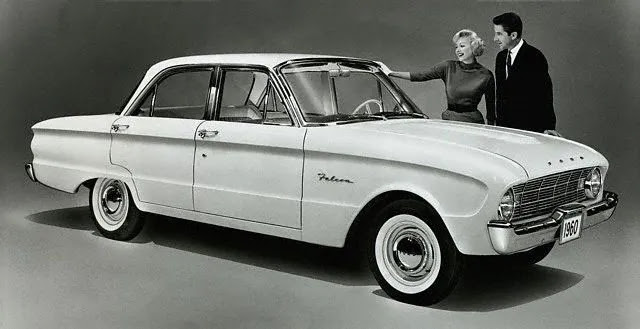
Humble beginnings: Publicity shot for the 1960 Ford Falcon.

When Ford released the Falcon in 1960, it was modest in just about every way except the expectations the company had that it successfully would counter the intrusion of the increasingly popular smaller cars which, worryingly, many buyers seemed to prefer to the increasingly large offerings from Detroit.  A success in its own right, the Falcon would provide the platform for the Mustang, the Fairlane, the Mercury Cougar and other variations which, collectively, sold in numbers which would dwarf those achieved by the original; it was one of the more profitable and enduring platforms of the twentieth century.  In the US, it was retired after a truncated appearance in 1970 but it lived on in South America and Australia, the nameplate in the latter market lasting until 2016, a run of over half a century during which the platform had been offered in seven generations in configurations as diverse as sedans, vans & pick-ups (utes), hardtop coupés, 4WDs, station wagons and long wheelbase executive cars.

Ford Falcon GTHO Phase I leading three Holden Monaro (HT) GTS 350s, Bathurst 1969.

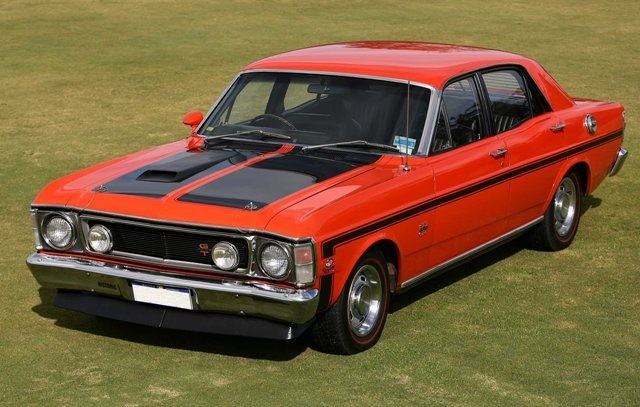
Most memorably however, between 1969-1972, it was also the basis of a number of thinly disguised racing cars, production of which was limited to not much more than was required by the rules of the time to homologate the strengthened or high-performance parts needed for use in competition.  The Falcon GT had been introduced in 1967 and had proved effective but the next year faced competition from General Motors’ (GM) Holden Monaro GTS which, with a 327 cubic inch (5.3 litre) Chevrolet V8 out-performed the Ford which had by then had benefited from an increase in displacement from 289 cubic inches (4.7 litres) to 302 (4.9) which proved not enough.  The conclusion reached by both Ford & GM was of course to increase power so for 1969 the Falcon and Monaro appears with 351 cubic inch (5.8 litre) and 350 (5.7) V8s; the power race was on.  Ford however decided to make sure of things and developed homologation-special with more power, some modification to improve durability and, with endurance racing in mind, a 36 (imperial) gallon (164 litre) fuel tank, quickly (and inexpensively) fabricated by welding together two standard tanks.  The car was called the GTHO (written variously in documents as also as G*T*H*O, GT-HO & G.T.H.O. (and as GT·HO on the glovebox lid)), HO apparently understood by the Ford engineers to mean “high output” but presented to the public as “handling options”, the company not wishing to frighten the horses with fears of racing cars being sold for use on the streets (and such a furore did ensue in 1972 which proved the GTHO’s death knell.

1970 Falcon GTHO Phase II.

If the 1967 GT had been something beyond what Ford in 1960 thought the Falcon might become, the GTHO would have been beyond their wildest imaginings.  Still usable as a road car, it also worked on the circuits although, because of a bad choice of tyre which was unsuited to the techniques of the drivers, it failed to win the annual Bathurst 500, then (as now), the race which really mattered.  Determined to win the 500, a revised GTHO was prepared and, in a novel move, was known as the Phase II (the original retrospectively re-christened the Phase I), the most obvious highlight of the revised specification a switch to Ford’s new Cleveland 351 V8 which, heavier and more powerful, replaced the Windsor 351.  Underneath however, there were changes which were just as significant with the suspension re-calibrated to suit both racing tyres and the driving style used in competition.  Said to have been developed with “a bucket of Ford’s money in one hand and a relief map of the Bathurst circuit in the other”, the Phase II drove like a real racer and probably few cars sold to the public have deliberately been engineered to produce so much oversteer.  On the track it worked and victory at Bathurst followed, something which drew attention from the early unreliability of the Cleveland 351, the implications of it’s less elaborate lubrication system not for some months appreciated.

1971 Ford Falcon GTHO Phase III (Clone).

The Phase III followed in 1971 with increased power, the propensity to oversteer toned down and it proved even more successful, the legacy due to be continued by a Phase IV with four-wheel disk brakes (something probably more helpful than more power) but the project was abandoned after a moral panic induced by a Sydney newspaper which ran a front page which alleged “160mph (257 km/h) supercars” were about to fall into the hands of teenagers to use on city streets and highways.  That certainly frightened the horses and politicians, always susceptible to anything which appears in a tabloid, vowed to act and prevailed on the manufacturers to abandon the homologation specials.  Thus ended the era of the GTHO and also the similar machines being prepared by GM and Chrysler, the handful of Phase IV GTHOs built quietly sold off, never to see a race track although one did, most improbably, enjoy a brief, doomed career as a rally car.

1972 Ford Falcon GTHO Phase IV.

Over the decades, as used cars, the surviving GTHOs (many destroyed in accidents on and off the track) have become collectable and of the 1222 made (including circa 115 of the (unofficial) Phase 1.5 with a milder (hydraulic valve lifters) Cleveland engine), it’s the Phase III (300 built) which is the most coveted at auction (the handful of Phase IVs seem to change hands mostly in private sales and the record is said to be circa Aus$2 million) and while the prices achieved track the state of the economy, the current record is believed to be Aus$1.3 million.  Based on what was essentially a taxicab which was produced in the hundreds of thousands, there’s an after-market ecosystem which produces all the parts required for one exactly (except for tags and serial numbers) to create one’s own GTHO at considerably less than what a real one now costs so it’s no surprise there are many acknowledged replicas (also described as clones, tributes etc) but the odd bogus example has also been unearthed.

Ford Falcon GTHO Phase IVs being prepared for racing, Melbourne, 1972.

Quite how many of the 287 Phase IIs survive isn’t known and the prices are high so it’s little surprise some have been tempted to misrepresent a bogus example as something real and there are legal implications to this, both criminal and civil.  There are even examples of the less desirable Falcon GTs and in 2011, in a judgment handed down in the District Court of Queensland (Sammut v De Rome [2011] QDC 294), a couple was ordered to pay the plaintiff AU$108,394.04 (US$107,200 at the then favorable exchange rate).  The defendants had sold to the plaintiff what they advertised as a 1969 Ford Falcon GT, a vehicle they had in 2006 purchased for Aus$18,000.  The plaintiff undertook due diligence, inspecting the car in person and in the company of a expert in bodywork before verifying with Ford Australia that the VIN (vehicle identification number) was legitimate car.  Once the VIN had been confirmed as belonging to a 1969 Falcon GT, a sale price of Aus$90,000 was agreed and the sale executed, the buyer having the car transported by trailer to Sydney.

Bogus & blotchy: Lindsay Lohan with fake tan.

Two years later, when the plaintiff attempted to sell the car, a detailed inspection revealed it was a bogus GT, a real GT’s VIN having been used to replace the one mounted on an ordinary 1969 Falcon, an x-ray examination of the firewall confirming the cutting and welding associated with the swap.  It was never determined who was responsible for creating the bogus GT and expert testimony given to the court confirmed that then, a non-GT Falcon of this year and condition was worth between Aus$10-15,000 while the value of an authentic GT was between Aus$65-70,000.  Accordingly, the plaintiff sued for breach of contract, requesting to be compensated to the extent of the difference between what he paid for the car and its current value, plus associated matters such as transport, interest and court costs.  The court found for the plaintiff in the sum of Aus$108,394.04 although the trial judge did note that the defendants likely didn't know the car was bogus, thereby opening for them the possibility of commencing action against the party from whom they purchased the thing, his honor mentioned that because of the civil statute of limitations, they had less than a month in which to file suit.  It's to be hoped they kept the car because in 2022, well-executed replicas of XW Falcon GTs are being advertised at more than Aus$125,000.

Thursday, August 20, 2020

Ambrosia

Ambrosia (pronouced am-bro-zia)

(1) In classical mythology, the food (sometimes called nectar) of the gods and said to bestow immortality.

(2) Something especially delicious to taste or smell.

(3) A fruit dish made of oranges and shredded coconut.  Sometimes includes pineapple.

(4) Alternative name for beebread.

(5) Any of various herbaceous plants constituting the genus Ambrosia, mostly native to America but widely naturalized: family Asteraceae (composites).  The genus includes the ragweeds.

1545-1555.  From the Middle English, from the Old French ambroise, from the Latin ambrosia (favored food or drink of the gods) from the Ancient Greek ambrosia (food of the gods), noun use of the feminine of ambrosious (thought to mean literally "of the imortals") from ambrotos (immoratlity; immortal, imperishable).  The construct was a- (not) + mbrotos (related to mortos (mortal), from the primitive Indo-European root mer- (to rub away, to harm (also "to die" and used widely when forming words referring to death and to beings subject to death).  Writers in Antiquity woud use the word when speaking of theit favorite herbs and it's been used in English to describe delectable foods (though originally of fruit drinks) since the 1680s and came to be used figuratively for anything delightful by the 1730s.  Applied to certain herbs by Pliny and Dioscorides; used of various foods for mortals since 1680s (originally of fruit drinks); used figuratively for "anything delightful" by 1731.  The adjective ambrosial dates from the 1590s in the sense of "immortal, divine, of the quality of ambrosia", the sense of "fragrant, delicious" developed by the 1660s.  The other adjectival forms were ambrosiac (circa 1600) & ambrosian (1630s).

Ambrose was the masculine proper name, from the Latin Ambrosius, from the Ancient Greek ambrosios (immortal, belonging to the immortals),  The Biblioteca Ambrosian (Ambrosian Library) in Milan (1609), established by Cardinal Federico Borromeo (1564–1631), is named for Saint Ambrose of Milan (circa 339–397) Bishop of Milan 374-397.

Cupid, Psyche and the Nectar of the Gods

In Greek mythology, Psyche was the youngest and loveliest of a king’s three daughters.  So haunting was Psyche’s beauty that people travelled from afar to pay homage, neglecting the worship of Venus (Aphrodite), the goddess of love and beauty, instead venerating the nymph.  Venus became enraged at finding her altars deserted, men instead turning their devotions to the young virgin, watching as she passed, singing her praises and strewing her way with chaplets and flowers.

Indignant at the exaltation of a mortal, Venus began her righteous rant.  "Am I then to be eclipsed in my honors by a mere mortal girl?  In vain then did that royal shepherd, whose judgment was approved by Jove himself, give me the palm of beauty over my illustrious rivals, Pallas and Juno. But she shall not so quietly usurp my honors. I will give her cause to repent of so unlawful a beauty."  Venus summoned her winged son, the mischievous Cupid and telling him of Psyche, ordered her revenge.  "My dear son, punish that contumacious beauty; give your mother a revenge as sweet as her injuries are great; infuse into the bosom of that haughty girl a passion for some low, mean, unworthy being, so that she may reap a mortification as great as her present exultation and triumph."

Obediently, Cupid set to his task.  In the garden of Venus lay two fountains, one of sweet waters, the other of bitter.  Cupid filled two amber phials, one from each fountain and suspending them from the top of his quiver, hastened to the chamber of Psyche, finding her asleep.  He shed a few drops from the bitter fountain over her lips and although though the sight of her moved him almost to pity, touched her side with the point of his arrow.  At the touch she awoke and her eyes gazed upon the invisible Cupid which so enchanted him he became confused and pricked himself with his own arrow.  Helplessly in love, his only thought now was to repair the mischief he had done and he poured the balmy drops of joy over all her silken blonde ringlets.

Psyche, henceforth frowned upon by Venus, gained no benefit from her charms.  While all cast covetous eyes upon her and all spoke her praises, not prince, plebeian or peasant ever asked for her hand in marriage.  Her two sisters had become betrothed to princes but Psyche sat in solitude, feeling cursed by the beauty which had failed to awaken love.  The king and queen, thinking they had incurred the wrath of the gods turned for guidance to the oracle of Apollo who answered: “The virgin is destined for the bride of no mortal lover. Her future husband awaits her on the top of the mountain. He is a monster whom neither gods nor men can resist."

Her parents, distraught, abandoned themselves to grief but Psyche was fatalistic, saying "Why, my dear parents, do you now lament me? You should rather have grieved when the people showered upon me undeserved honors, and with one voice called me a Venus. I now perceive I am victim to that name.  I submit.  Lead me to that rock to which my unhappy fate has destined me."  Accordingly, amid the lamentations of all, she was taken to the peak of the mountain and there left alone.  When the tearful girl stood at the summit, the gentle Zephyr raised her from the earth and carried her on the breeze, bringing her to rest in a flowery dale where she laid down to sleep.  When she awoke, refreshed, she looked around and beheld nearby a grove of tall and stately trees.  Entering the forest, she discovered in its midst a fountain from which bubbled crystal-clear waters and nearby, a splendid palace, so magnificent she knew it the work not of mortal hands, but the retreat of some god.  Drawn by admiration and wonder, she ventured to enter the door.  Amazed at what she saw, she walked along a marble floor so polished it shimmered, golden pillars supported a vaulted roof, walls were enriched with carvings and paintings of fantastic beasts.  Everything upon which her eye fell delighted her.

Soon, although she saw no one, she heard a voice.  "Sovereign lady, all that you see is yours. We whose voices you hear are your servants and shall obey all your commands with utmost care.  Retire, should you please, to your chamber, recline upon your bed of down and when you see fit, repair to the bath.  Your supper awaits in the alcove”.  Psyche took her bath and seated herself in the alcove, whereupon a table appeared laden with extraordinary delicacies of food and nectarous wines.   While she ate, she heard the playing of lute and harp and the harmony of song.

That night she met he husband but he came only in the darkness, fleeing before the dawn, but his words and caresses were of love and inspired in her a like passion.  Often she would beg him to stay so she might behold him in the light but he refused, telling her never to attempt to see him, for no good would come of it and that he would rather have her love him as a man than adore him as a god.  This, Psyche accepted but the days grew long and lonely and she began to feel she was living in a gilded cage.  One night, when her husband came, she told him of her distress, her charms enough to coax from him his unwilling acquiescence that her sisters could visit.  Delighted, she summoned the obedient Zephyr who brought them to the mountain and in happiness, they embraced.

The splendor and celestial delights of Psyche’s palace astonished her sisters but also aroused their envy and they began to pepper her with questions about her husband and she told them he was a beautiful youth who spent his days hunting in the mountains.  Unconvinced, the soon drew from her that she had never seen him and they began to fill her mind with dark suspicions, recalling the Pythian oracle had declared her doomed to marry a direful and tremendous monster.  Psyche protested but they told her the folk living in the valley say the husband is a terrible and monstrous serpent, amusing himself while nourishing her with dainties that he may by and by devour her.  They told to one night to take with her a lamp and sharp blade so that when he slept she might light the lamp and see his true form.  If truly he is a monster they told her, "hesitate not and cut off its head".

Psyche tried to resist her sisters’ persuasions but knew she was curious and that night she took to bed a lamp and a long, sharp knife.  When he had fallen to sleep, silently she arose and lit her lamp, beholding but the most beautiful of the gods, his golden ringlets falling over his snowy neck, two dewy wings on his shoulders whiter than snow, with shining feathers like the tender blossoms of spring.  Entranced, as she moved her lamp better to see his face, a drop of hot oil fell on the shoulder of the god and startled, he opened his eyes and fixed them upon her.  They both were frozen for a few seconds, then suddenly and without a word, he spread his wings and flew out of the window.  Psyche, crying in despair, in vain endeavored to follow but fell from the window to the ground below.

Hearing her fall, Cupid for a moment paused in his flight and turned to her saying, "Oh faithless Psyche, is it thus you repay my love? After I disobeyed my mother's commands and made you my wife, will you think me a monster and would cut off my head?  Go, return to your sisters, who you trust more than me.  I punish you no more than to forever leave you for love cannot dwell with suspicion."  With those words, he flew off, leaving poor Psyche crying into the earth.  For hours she sobbed and then looked around, but her palace and gardens had vanished and she found herself in a field in the city where her sisters dwelt.  She repaired thither and told them her story at which, though pretending to grieve with her, the two evil sisters inwardly rejoiced for both thought as one: that Cupid might now choose one of them.  Both the next morning silently arose and snuck secretly to the mountain where each called upon Zephyr to bear them to his lord but leaping up, there was no Zephyr to carry them on the breeze and each fell down the precipice to their deaths.

The devastated Psyche meanwhile wandered.  Day and night, without food or rest, she searched for her husband and one evening saw in the distance a magnificent temple atop a lofty mountain and she felt her heart beat, wondering if perhaps there was Cupid.  She walked to the temple and there saw heaps of corn, some in loose ears and some in sheaves, mingled with ears of barley.  Scattered about, lay sickles and rakes, the instruments of harvest, without order, as if thrown carelessly from the weary reapers' hands in the sultry hours of the day.  This unseemly confusion disturbed the neat and tidy Psyche and she put herself to work, separating and sorting everything and putting all in its proper place, believing she ought to neglect none of the gods, but prove by her piety to prove she was worthy of their help.  The holy Ceres, whose temple it was, finding her so religiously employed, thus spoke to her, "Oh Psyche, truly your are worthy of our pity, though I cannot shield you from the frowns of Venus, I can teach you how best to allay her displeasure. Go, then, and voluntarily surrender yourself to your lady and sovereign, and try by modesty and submission to win her forgiveness, and perhaps her favor will restore you the husband you have lost."  Filled with both fear and hope, Psyche made her way to the temple of Venus.

Venus met her with anger.  "Most undutiful and faithless of servants," said she, "do you at last remember you have a mistress or have you come to see your sick husband, the one injured by the wound given him by his worthless wife?  You are so ill favored you can be worthy of your lover only by showing industry and diligence.  I shall put you to work".  She led Psyche to temple’s storehouse in which sat vast piles of wheat, barley, vetches, beans and lentils, the food for her birds.  Separate these grains, put them all in sacks and have it done by night” she commanded, leaving her to the task.  Shocked, Psyche sat silent, moving not a finger.  While she despaired, Cupid ordered an ant, a native of the fields, to bring all ants from the anthill and they gathered on the piles.  Quickly and with the efficiency of their breed, they took grain by grain, making perfect parcels of each and when done, vanished from sight.  As twilight fell, Venus returned from a banquet of the gods and seeing the sacks neatly stacked, became enraged.  "This is no work of yours, wicked one, but his, whom to your own and his misfortune you have enticed."  So saying, she threw her a piece of black bread for her supper and stormed off.

Next morning Venus ordered Psyche to be called and said to her, "Behold yonder grove which stretches along the margin of the water.  There you will find sheep feeding without a shepherd, with golden-shining fleeces on their backs.  Go now, fetch me some of that precious wool gathered from every one of their fleeces."  Standing on the riverbank, wondering at the difficulty of her task, Psyche was about to cross but river god made the reeds speak, telling her "Oh maiden, tempt not the dangerous flood, nor venture among those rams for as long as the sun shines, they burn with a cruel rage to destroy mortals with their sharp horns or rude teeth.  But when the noontide sun has driven them to the shade, and the serene spirit of the flood has lulled them to rest, you may then cross in safety, and you will find the woolly gold sticking to the bushes and the trunks of the trees."  Psyche did as they said and returned with her arms full of the golden fleece but Venus was not pleased.  "Well I know it is by none of your own doings that you have succeeded I do not believe you are of use but I have another task for you.  Here, take this box and go your way to the infernal shades, and give this box to Proserpine and say, 'my mistress Venus desires you to send her a little of your beauty, for in tending her sick son she has lost some of her own'.  Be not too long on your errand, for I must paint myself with it to appear this evening at the circle of the gods."

Psyche now believed her own destruction was at hand and, with no wish to delay what was not to be avoided, dashed to the top of a high tower, preparing to cast herself headlong, thus to descend the shortest way to the shades below.  But then, a voice from the tower said to her, "Why, poor unlucky girl, do you design to put an end to your days in so dreadful a manner? And what cowardice makes you sink under this last danger when you have been so miraculously supported in all your former?"  Then the voice told her how by a certain cave she might reach the realms of Pluto, and how to avoid all the dangers of the road, to pass by Cerberus, the three-headed dog, and prevail on Charon, the ferryman, to take her across the black river and bring her back again. But the voice also cautioned, "When Proserpine has given you the box filled with her beauty, you must never once open or look into the box nor allow your curiosity to pry into the treasure of the beauty of the goddesses."

Encouraged, Psyche obeyed the advice and travelled safely to the kingdom of Pluto. Admitted to the palace of Proserpine, she delivered her message from Venus and soon, she was handed the box, shut and filled with the precious commodity. Then she returned the way she came, glad once more to be in the light of day.  But as she walked along the path, a longing desire overcame her, an urge to look into the box for, as she imagined, a touch of the divine beauty would make her more desired by Cupid so, delicately, she opened the box.  But in there was nothing of beauty but only an infernal and truly Stygian sleep which, being set free from its prison, took possession of her, and she fell in the road where she stood, plunged into a deep sleep, lying there without sense or motion.

But Cupid was now recovered and could no longer bear the absence of his beloved Psyche and slipping through a crack in the window, he flew to where Psyche lay.  He gathered up the sleep from her and closed it again in the box, waking her with the gentlest touch of one of his arrows. "Again," said he, "have you almost perished by the same curiosity.  But now perform exactly the task imposed on you by my mother, and I will take care of the rest."  Then Cupid, as swift as lightning, presented himself before Jupiter with his supplication.  Jupiter was impressed and so earnestly did he plead the cause of the lovers that he won the consent of Venus and on hearing this, sent Mercury to bring Psyche up to the heavenly assembly, and when she arrived, he handed her a goblet ambrosia saying, "Drink this, Psyche, and be immortal; nor shall Cupid ever break away from the knot in which he is tied, but these nuptials shall be perpetual."  Thus Psyche became at last united to Cupid, and in time, born to them was a daughter whose name was Pleasure.

Wedding Banquet of Cupid and Psyche (circa 1517) by Raphael (1483–1520).

The story of Cupid and the OCD Psyche is told by the Roman writer Apuleius (circa 124-circa 170) in three chapters in his rather risqué picaresque novel, The Metamorphoses of Apuleius (which Saint Augustine dubbed Asinus aureus (The Golden Ass (by which it’s today known)).  The Golden Ass is notable as the only full-length work of fiction in Classical Latin to have survived in its entirety and is a work with aspects which would be regarded as novel centuries later, including fantastical imagery, passages like fairy tales and elements which would now be called magic realism.  Like many modern fairy tales, there is a moral to the story and for Apuleius it was that it is love which makes to soul immortal and there was no need for subtlety, Cupid the son of the goddess of desire and Psyche's name originally meant soul.

With the re-discovery (and some re-invention) of much of antiquity during the Renaissance, the story gained much popularity and attracted the interest of artists and from Raphael’s (Raffaello Sanzio da Urbino, 1483–1520) studio came the best known evocation.  One of the scenes is the wedding feast, painted in the form of a hanging tapestry.  Psyche’s guest list was a roll-call of the gods, Ganymede, Apollo, Bacchus and Jupiter are all at the table, the Graces and the Hours in attendance.  The artists (for some the work was executed by professional painters under Raphael’s guidance) do have some fun, very much in the spirit of Apuleius for above the flying Mercury sits, artfully arranged, a suggestive conjunction of certain vegetables and fruits.

The Wedding Feast of Cupid and Psyche (1532) by Giulio Romano.

The romance of Cupid and Psyche drew other artists including the Italian Giulio Romano (Giulio Pippi, circa 1499-1546), a student of Raphael whose influence permeates.  While not highly regarded by critics and better remembered as an architect, Romano is of note because he was among the earliest of the artists whose work can be called Mannerist and certainly his wedding feast painting includes the mythological, a staged and theatrical setting, eroticism and an unusual sense of perspective; all characteristic of Mannerist art although he remained entirely naturalistic in the callipygian rendering of Psyche’s buttocks.

In Shakespeare's late drama The Winter's Tale there’s an allusion to Romano as “that rare Italian master” but despite the bard’s apparent admiration, historians of art treat him as little more than a footnote; the shadow Raphael cast was long.  Some critics seem determined to devalue his work, the Catholic Encyclopaedia (1913) noting it was “prolific and workmanlike, always competent…” but with “…no originality; as a painter, he is merely a temperament, a prodigious worker. His manual dexterity is unaccompanied by any greatness of conception or high moral principle.  His lively but superficial fancy, incapable of deep emotion, of religious feeling, or even of observation, attracted him to neutral subjects, to mythological paintings, and imaginary scenes from the world of fable. Therein under the cloak of humanism, he gave expression to a sensualism rather libertine than poetical, an epicureanism unredeemed by any elevated or noble quality.  It is this which wins for Giulio his distinctive place in art.  His conception of form was never quite original; it was always a clever and bookish compromise between Raphael and Michelangelo.  His sense of color grows ever louder and uglier, his ideas are void of finesse, whatever brilliancy they show is second-hand. His single distinctive characteristic is the doubtful ease with which he played with the commonplaces of pagandom.  In this respect at least, paintings like those of the Hall of Psyche (1532) are historical landmarks.  It is the first time that an appeal is made to the senses with all the brutal frankness of a modern work”. 

Damning with faint praise perhaps.  Grudgingly, the editors did concede that despite being “…distinguished by such characteristics and marked by such defects, Romano occupies nevertheless an important place in the history of art. More than any other, he aided in propagating the pseudo-classical, half-pagan style of art so fashionable during the seventeenth century. It’s mainly through his influence that after the year 1600 we find so few religious painters in Europe”.

One could hardly expect The Catholic Encyclopedia (sub-titled An International work of reference on the constitution, doctrine, discipline and history of the Catholic Church), to find much worthy in a mannerist (or perhaps anything modern).  Mannerism, novel in some ways as it was, was rarely original in form or content.  It was a reaction against the perceived perfection of the neo-classicism of the High Renaissance and artists from Romano on were drawn to Greek mythology, characters like Psyche and Echo able simply and unambiguously to represent the psychological problems muddied by Christian theology.