Showing posts sorted by date for query Slant. Sort by relevance Show all posts

Saturday, January 31, 2026

Palinode

Palinode (pronounced pal-uh-nohd)

(1) A poem in which the poet retracts something said in an earlier poem.

(2) A recantation (used loosely and now rare).

(3) In Scots law, a recantation of a defamatory statement.

1590–1600: From the sixteenth century French palinode (poetical recantation, poem in which the poet retracts invective contained in a former satire), from the Middle French palinode, from the Late Latin palinōdia (palinode, recantation), from the Ancient Greek παλινῳδία (palinōidía) (poetic retraction), the construct being πάλιν (pálin) (again, back) + ᾠδή (ōid) (ode, song) + -ia (from the Latin -ia and the Ancient Greek -ία (-ía) & -εια (-eia), which form abstract nouns of feminine gender.  It was used when names of countries, diseases, species etc and occasionally collections of stuff).  The alternative form palinody is obsolete.  Palinode & palinodist are nouns, palinodial, palinodical & palinodic are adjectives and palinodically is a (non-standard) adverb; the noun plural is palinodes).

Although the palinode is now usually defined as meaning “a poem in which the palinodist (ie the poet) retracts something said in an earlier poem”, the French in the sixteenth century seem mostly to have use the word of works in which the writer “retracts invective contained in a former satire”.  It thus had an obviously political slant and it seems likely at least some palinodes were penned to stave of threats of legal action (or something worse).  Although it endures in literary use (and among political scientists with a feeling for classical forms), the word has long been obscure and the OED (Oxford English Dictionary) lists the adjective palinodical as obsolete with its only known instance of use dating from 1602 when it appeared in a work by the English poet, playwright and pamphleteer Thomas Dekker (circa 1572-1632).  The “other” species of palinode was the “ode to Sarah Palin” (b 1964; Republican nominee for VPOTUS 2008) of which there were several including some set to music.

The palinode became associated with poetry because verse (in one form or another) was once a more common form of written expression.  It has however been applied to any retraction or recantation (formal or otherwise), especially one that publicly withdraws an earlier statement, belief or work.  For reasons of ecclesiastical practice, theological palinodes tended to be in verse but there were exceptions including by John Milton (1608–1674) who in The Reason of Church-Government (1642) retracted his earlier advocacy of episcopacy (the bishops and their role), acknowledging his views had changed; for years it remained a rare example of its type.  Beyond poetry proper, use has been quite loose and memorable palinodes have been political, scientific and literary, some especially of the latter described variously as “insincere”, “back-handed” or “bitchy”.  Much of their charm lies in some retractions becoming famous while the original text doubtlessly would have been forgotten were it not for the palinode.

The Death of Socrates (1787), oil on canvas by Jacques-Louis David (1748–1825), Metropolitan Museum of Art, New York City.  Had Socrates just dashed off a palinode, maybe he'd never have had to take his dish of hemlock.

The archetypal palinode dates from the sixth century BC and it set the template.  According to legend, the Greek lyric poet Stesichorus (Στησίχορος, circa 630–555 BC) blamed Helen of Troy for the Trojan War and almost at once was struck blind.  He then composed a (“it was not true…”) palinode absolving Helen of guilt, the words of the encomium (praise, eulogy) said to have come to him in a dream.  His sight was restored, thus the understanding the use of the device as a means of undoing moral or divine offense.  The texts from Antiquity have of course survived only in fragmentary form but clearly there were palinodes, Plato (circa 427-348 BC) in his Phaedrus (a dialogue between Socrates (circa 470–399 BC) and Phaedrus (circa 444–393 BC)) he recounted how Socrates first delivers a speech condemning love, then explicitly retracts it with a second passage praising divine madness and erotic love.  Plato explicitly called the second speech “a palinode”, making it one of philosophy’s earliest known self-conscious retractions and, it has to be admitted, only those for whom martyrdom is a calling would think it not preferable to taking hemlock.

Geoffrey Chaucer (circa 1344-1400), right at the end of The Canterbury Tales (1387-1400), as a formal retraction, disowned those earlier passages he had come to think sinful or frivolous and begged forgiveness for having written them.  It's considered one of Medieval literature’s most explicit and sincere palinodes and presumably he also asked God and at least one priest for absolution for those unworthy thoughts, this likely the course of action taken also by the English journalist Malcolm Muggeridge (1903–1990) who wrote long pieces disavowing earlier having welcomed communism and opposed censorship.  One long-established tradition (transgress with enthusiasm in youth; reform with piety as one contemplates mortality) is a movement owing much to Saint Augustine of Hippo (354–430) who in Confessiones (Confessions, 397-400) wrote: Da mihi castitatem et continentiam, sed noli modo (Lord, give me chastity and continence, but not yet), an exemplar of that school of the palinodic being George W Bush (George XLIII, b 1946; POTUS 2001-2009) who abandoned whiskey and much else.  As he might have put it in a Bushism”: I spent my youth misunfortunatistically.  The whole “born-again” movement in Christianity seems often something of a life lived palinodically.

Galileo before the Holy Office (1847), oil on canvas by Joseph-Nicolas Robert-Fleury (1797-1890).

The element “Holy Office” was first applied to the official designation for the Inquisition during the thirteenth century and after that there were a number of variant constructions before in 1965, it was renamed the Congregation for the Doctrine of the Faith (CDF), the most famous of the latter-day inquisitors being Benedict XVI (1927–2022; pope 2005-2013, pope emeritus 2013-2022) who, with some relish, discharged the role between 1981-2005.  Since 2022, the Inquisition has been styled the Dicastery for the Doctrine of the Faith (DDF).  Coincidentally, DDF is also the acronym for “drug & disease free” and (in gaming) “Doom definition file” while there’s also the DDF Network which is an aggregator of pornography content.  The Holy See may be aware of these uses but probably takes the view the target markets are different and, given the DDF Network appears not to offer any “gay male” content, if one author’s conclusions are accepted, the site is unlikely often to be accessed by priests, bishops, cardinals and such.

Some palinodes have become among the more famous statements made by an accused before a court.  Under courts run by the Nazis and the Soviet Union they were of course legion (the scripts often written by the prosecutors) but the most famous was probably the retraction the Roman Inquisition in 1633 extracted from the Italian physicist and pioneering astronomer Galileo Galilei (1564–1642); under threat of torture (words to be taken seriously if from the lips of an inquisitor), he abjured his support for heliocentrism; the defendant's legendary mutter: “Eppur si muove” (although it does move) almost certainly apocryphal.  After that, palinodes came thick and fast, the Swiss philosopher Jean-Jacques Rousseau (1712–1778) in Les Confessions (Confessions of Jean-Jacques Rousseau (1770, published 1782)) not only his retracted many of his earlier stances (especially in matters of religion and education) but did so repeatedly, sometimes in the same chapter.  More than a decade in the writing, Les Confessions functions as something of a “rolling palinode”, his intellectual past constantly revised.  More nuanced in this approach was the English naturalist Charles Darwin (1809-1882) who, in later editions of On the Origin of Species by Means of Natural Selection, or the Preservation of Favoured Races in the Struggle for Life (1859), toned down or even withdrew some claims regarding human evolution and teleology.  These revisions can be considered “partial palinodes” but they were really merely a reflection of the modern scientific method which updates theories as new evidence emerges; a matter of correct intellectual caution.

Agitprop poster of comrade Stalin (1878-1953; Soviet leader 1924-1953, left) greeting comrade Trofim Lysenko (1898-1976, right).  The Russian slogan (РАБОТАТЬ ТАК, ЧТОБЫ ТОВАРИЩ СТАЛИН СПАСИБО СКАЗАЛ!) translates best as “Work in such a way that comrade Stalin will say ‘thank you.’”  In comrade Stalin’s Soviet Union, wise comrades followed this sound advice.  For students of the techniques used in the propaganda of personality cults, it should be noted comrade Stalin stood around 1.65 metres (5 foot, 5 inches) tall.

In the matter of scientific and intellectual palinodes, others can do the retractions which can be thought of as palinodes by proxy or (more flippantly) Munchausen palinodes by proxy.  To avoid damage to his reputation, Sir Isaac Newton’s (1642–1727) executors and later editors suppressed and implicitly retracted his alchemical writings and similar judicious editing has excised from the records of some their embrace of the once intellectually respectable field of astrology.  Actually, Newton wasn’t wholly wrong on the science; at the molecular level there is little difference between lead and gold and although traditional chemical alchemy seems impossible, recent experiments have, atom-by-atom, transformed lead into gold, the problem being that to transform a few atoms (and even these often short-lived radioactive isotopes rather than stable Au-197) demanded the use of a huge and expensive particle accelerator; unless there’s some unanticipated breakthrough, the process cannot be scaled up so gold must continue to be dug up.  Communism systems too belatedly made something of an art of the palinode.

In the Soviet Union, after the death of comrade Stalin, a number of “scientific orthodoxies” supported by the late leader abruptly were cancelled, notably the dotty, pseudoscientific “theories” of agronomist Trofim Lysenko whose doctrine of Lysenkoism set back Soviet agriculture by decades.  The evidence suggests comrade Stalin was well aware comrade Lysenko was likely a comrade charlatan but, uniquely among the many Soviet apparatchiks, the dodgy agronomist achieved a great rapport with the peasants who were being most tiresome.  It was Lysenko’s remarkable success in convincing peasants to accept the Kremlin’s imposition of collectivized farming that make him Stalin’s invaluable asset.  In China, when comrade Chairman Mao (Mao Zedong 1893–1976; chairman of the CCP, 1949-1976) instituted many of Lysenko’s “agricultural reforms” (which included applying Karl Marx's (1818-1883) theories of class consciousness to the thought processes of seeds), in the great famine which followed, it's believed between 40-45 million may have starved to death.  The Kremlin was at least precise in who or what got cancelled whereas the CCP (Chinese Communist Party) were a little vague although the Chinese people understood their language.  Long skilled at “reading between the Central Committee’s lines”, when they heard it admitted comrade Chairman Mao’s legacy was “70% good and 30% bad”, the meaning was clear.  As a judgment it may have been generous but if applied to some leaders in the West, would the numbers be any more favorable?

Lindsay Lohan on the cover of Vogue Czechoslovakia, May 2025.

So palinody has a long tradition but while figures like Rousseau, Darwin and Muggeridge had years or even decades “agonizingly to reappraise” their position, in the social media age, it can within the hour be necessary to recant.  In 2006, Lindsay Lohan granted an interview to Vanity Fair in which she acknowledged: “I knew I had a problem and I couldn't admit it.  “I was making myself sick.  I was sick and I had people sit me down and say: 'You're going to die if you don't take care of yourself'”, adding she used drugs: “a little”.  On reflection, and possibly after seeking advice, he publicist the next day contacted the magazine in an attempt to get the “drug confession” retracted.  Later, she would also recant her claims her earlier (and by some much-admired) weight-loss had been achieved by D&E (diet & exercise), admitting it was the consequence of an eating disorder.  Ms Lohan has issued a few palinodes (but although also a song-writer, none have been in poetic verse) and as well as drug use, the correctives have covered topics such as the MeToo movement, Harvey Weinstein (b 1952), Donald Trump (b 1946; US president 2017-2021 and since 2025) and her attitudes to motherhood.

Ye (b 1977, the artist formerly known as Kanye West).

The first notable palinode of 2026 was interesting for a number of reasons, the first of which was structural.  Although the once vibrant industry of print journalism has in the West been hollowed out by successive strikes from the internet, social media and AI (artificial intelligence), in a tactic guaranteed to ensure maximum cross-platform coverage, the multi-media personality, rap singer and apparel designer Ye chose as the host for his latest announcement not Instagram or X (formerly known as Twitter) but a full-page advertisement in Rupert Murdoch’s WSJ (Wall Street Journal).  As a “commercial, in confidence” arrangement, it’s not certain how much the WSJ would have invoiced to run the copy but advertising in the paper remains at “premium level” because of its national circulation and readership with a high proportion in the still much-prized “A”, “B1” & “B2” demographics.  Industry sources suggest that, depending on the day of the week and other variables, a full-page advertisement (black & white) placement in the WSJ’s national edition typically would cost between US$160,000–$220,000 for a “one-off” (ie no re-runs or ongoing contract).

That’s obviously rather more than a post on Instagram or X but what a still “prestigious” legacy title like the WSJ confers is a certain “authority” because, as Marshall McLuhan (1911-1980) explained in Understanding Media: The Extensions of Man (1964): “The medium is the message”.  If one conveys one’s message through a whole page of the WSJ, regardless of the text’s content, the message is different compared with the same words appearing on a social media platform: anyone can post a palinode on Instagram but only a few can pay Rupert Murdoch US$200,000-odd to print it in the WSJ.  The point about Mr Ye using the WSJ was the message was aimed not only at his usual audience but those in finance and industry who interact with the music and apparel businesses.  While some consumers of rap music or his other “projects” may be WSJ readers or even subscribers, the publication’s base has a very different profile and it will be a certain few of those Mr Ye wishes his message to reach.

Marigold Counseling's Bipolar Disorder chart.

Headed “To those I’ve hurt”, his palinode was more than a simple retraction and was an apology for his previous “reckless” anti-Semitism; whether “reckless” carefully was chosen from the spectrum (careless; reckless; intentional) used by disciplinary bodies in sporting competitions wasn’t discussed.  By way of explanation, Mr Ye revealed that some 25 years earlier, he’d suffered an injury to the “right frontal lobe” of his brain and, because the medical focus at the time was on the “immediate physical trauma”, “comprehensive scans were not done” meaning “the deeper injury, the one inside my skull, went unnoticed.  It seems that not until 2023 was his condition correctly assessed, the injury linked to his diagnosis with Bipolar Disorder type-1 (the old “manic depressive disorder”).  Clinicians distinguish between type 1 and type 2 Bipolar thus: (1) In Bipolar I disorder there must be at least one manic episode that may come before or after hypomanic or major depressive episodes (in some cases, mania may cause a dissociation from reality (psychosis)) and (2) In Bipolar II disorder there must be at least one depressive episode and at least one hypomanic episode but never any psychosis.  (Cyclothymic Disorder involves periods of hypomania and depression not sufficiently severe to be classified as full episodes).  As Mr Ye explained: “Bipolar disorder comes with its own defense system. Denial.  When you’re manic, you don’t think you’re sick. You think everyone else is overreacting.  You feel like you’re seeing the world more clearly than ever, when in reality you’re losing your grip entirely.  Once people label you as ‘crazy’ you feel as if you cannot contribute anything meaningful to the world.  It’s easy for people to joke and laugh it off when in fact this is a very serious debilitating disease you can die from.

As he further noted: “The scariest thing about this disorder is how persuasive it is when it tells you:  You don’t need help. It makes you blind, but convinced you have insight. You feel powerful, certain, unstoppable.  I lost touch with reality. Things got worse the longer I ignored the problem.  I said and did things I deeply regret.  Some of the people I love the most, I treated the worst. You endured fear, confusion, humiliation, and the exhaustion of trying to have someone who was, at times, unrecognizable. Looking back, I became detached from my true self.  In that fractured state, I gravitated toward the most destructive symbol I could find, the swastika, and even sold T-shirts bearing it. One of the difficult aspects of having bipolar type-1 are the disconnected moments - many of which I still cannot recall - that led to poor judgment and reckless behavior that oftentimes feels like an out-of-body-experience.  I regret and am deeply mortified by my actions in that state, and am committed to accountability, treatment, and meaningful change. It does not excuse what I did though. I am not a Nazi or an antisemite. I love Jewish people.  He also included remarks intended explicitly for the black community, which he acknowledged “held [him] down through all of the highs and lows and the darkest of times.  The black community is, unquestionably, the foundation of who I am. I am so sorry to have let you down. I love us.  My words as a leader in my community have global impact and influence.  In my mania, I lost complete sight of that.

He made a comment also about what is a sometimes misunderstood aspect of Bipolar Disorder: “Having bipolar disorder is notable state of constant mental illness.  When you go into a manic episode, you are ill at that point. When you are not in an episode, you are completely ‘normal’.  And that’s when the wreckage from the illness hits the hardest.  Hitting rock bottom a few months ago, my wife encouraged me to finally get help.  My words as a leader in my community have global impact and influence. In my mania, I lost complete sight of that.  As I find my new baseline and new center through an effective regime of medication, therapy, exercise and clean living, I have newfound, much-needed clarity. I am pouring my energy into positive, meaningful art: music, clothing, design and other new ideas to help the world.  He concluded by saying: “I’m not asking for sympathy, or a free pass, though I aspire to earn your forgiveness.  I write today simply to ask for your patience and understanding as I find my way home.  The message was signed “With love, Ye.

Mr Ye with his wife, Australian architect & model Bianca Censori (b 1995) in “WET” themed top (which she wears well), Huacai Intercontinental Hotel, Beijing, China, September 2024.  Ms Censori works for Yeezy as an Architectural Designer.

What Mr Ye placed in the WSJ was a certain type of palinode, one in which there’s a retraction and definitely an apology but also an explanation.  Although, commendably, he included the words “…It does not excuse what I did…”, documenting the long-undiagnosed traumatic brain injury does provide an explanation for his conduct so, the piece is not a true mea culpa (from the Latin meā culpā (through my fault) and taken from the Confiteor, a traditional penitential prayer in Western Christianity; it’s best translated as “I am to blame”.  Mr Ye’s point was that what he did was wrong but “he” was not to blame in the sense that what he did was the result of the Bipolar Disorder induced by his injury.  What that means is that there was no mens rea (a construct from the Latin mēns + reus (literally “guilty mind”), the phrase a clipping of the precept in English common law: Actus non facit reum nisi mens rea sit (The act does not make a person guilty unless the mind is also guilty).  In other words: “I didn’t do it, the Bipolar Disorder did it”.  As a defence the approach is well-known but what Mr Ye is suggesting is supported in the medical literature, there being a number of documented cases of individuals whose behavior suddenly and radically changed for the worse as a result of a condition affecting the brain (either traumatic injury or an illness such as a tumor).  Despite his caveat, his diagnosed Bipolar Disorder, as well as explaining things, may well “excuse what I did”.

However, as an exercise in “reputational recovery” (one of the forks of “crisis management”), Mr Ye does have “a bit of previous” for which to atone including donning a “White Lives Matter” T-shirt which was controversial because there is no political or moral equivalence between that and the implications of “Black Lives Matter”.  In isolation, such a thing might have been thought just a publicity device and, in another time, the dark irony may have caught on in sections of the black community but in the atmosphere of 2022 it was the wrong item at the wrong time.  Worse was to come because later that year Mr Ye tweeted he was going “death con 3” on the Jews, the play on words assumed an adaptation of the DEFCON (Defense Readiness Condition) status levels used by the US military:

DEFCON 5: Normal peacetime readiness (lowest level).

DEFCON 4: Increased intelligence gathering and strengthened security.

DEFCON 3: Heightened readiness; forces ready for increased alert.

DEFCON 2: One step from nuclear war; forces ready to deploy at six hours notice.

DEFCON 1: Maximum readiness; imminent nuclear war or attack underway.

Fashion statement: Mr Ye in black capirote.

So it could have been worse, assuming his “death con 3” implied only “heightened readiness; forces ready for increased alert”.  The Pentagon invoked DEFCON 2 during the Cuban Missile Crisis (16-28 October 1962) and has never (as far as is known) triggered DEFCON 1.  However, “death con 3” was thought bad enough and a number of corporations sundered their contractual arrangements with Mr Ye, the loss of the agreement with Adidas believed financially the most damaging.  The next year, to his “Vultures album (re-titled Vultures 1 for the packaged release in 2024) listening party” Mr Ye wore a black Ku Klux Klan hood.  The use of black rather the while of the KKK in popular imagination attracted some comment from those who seek meaning in such things but it was historically authentic, the original, Reconstruction-era Klan (1865-1871) not having a standardized or even defined garb.  In the 1860s, members used whatever fabric was available, bed-sheets, blankets, sackcloth, and women’s dresses all re-purposed with no apparent interest in patterns or color co-ordination and animal hides or even face paint were used if no fabric was to hand.  The choices were pragmatic, the purposes concealment and intimidation, not visual uniformity.  The now familiar capirote (pointed hood) atop a white robe didn’t become emblematic of the KKK until the heyday of the so-called “Second Klan” between 1915 and the 1940s and although white deliberately was chosen as a symbol of “purity” and white supremacy, there’s nothing to suggest Mr Ye was seeking to vest his garment with similar denotations.

Fashion statement: Mr Ye in the now deleted “Swastika T-shirt” (the Yeezy part-number was HH01). 

Most provocative however was doubtlessly his adoption of the swastika for various purposes and his effuse praise for Hitler and Nazism.  In humanity’s long and depressing roll-call of evil and depravity, there is Adolf Hitler (1889-1945; Führer (leader) and German head of government 1933-1945 & head of state 1934-1945) and there is “everybody else” so selling “swastika T-shirts” at US$20 (promoted in an advertisement at the 2025 Super Bowl) and “dropping a tune” titled Heil Hitler was never likely to be a good career move.  The product code for the T-shirts was “HH01” and those who recalled his comment: “There’s a lot of things that I love about Hitler" in a December 2022 podcast with the since bankrupted host Alex Jones (b 1974) probably deconstructed that to mean “Heil Hitler” although to remove any doubt he also tweeted: “I love Hitler” and “I'm a Nazi”.  Swastika T-shirts were just too much for Shopify which took down the page, issuing a statement saying Mr Ye had “violated” the company's T&Cs (terms & conditions).  It was an example of the dangers inherent in having a site administered by AI with humans checking the content only in reaction to complaints.

Forbes magazine, 31 August 2019.  Forbes had just anointed Mr Ye a billionaire”.

Those with some generosity of spirit will attribute honorable motives to Mr Ye’s palinode while cynics will note the financial hit suffered as a consequence of his recent conduct.  In 2020, he complained to Forbes magazine it had neglected to include him on their much-anticipated “Billionaires List” (he may have been peeved his then wife (the estimable Kim Kardashian (b 1980)) had made the cut) and duly the publication re-crunched its numbers, including him in a revised edition.  In the wake of his troubles, Forbes “wrote down” the value of his brand and after the “Adidas fallout”, he didn’t appear on the 2023 list.  As he said in the WSJ advertisement, he is “pouring my energy into positive, meaningful art: music, clothing, design and other new ideas to help the world” and all these products, appropriately branded, need to be sold at a profit but having a brand tainted by an association with Nazism and anti-Semitism makes things a “harder sell”.  Hopefully, all will be forgiven and Yeezy-branded hoodies, running shoes and such will again ship in volume; Rupert Murdoch can be proud of the WSJ’s latest contribution to American commerce.

Monday, November 24, 2025

Vexillology

Vexillology (pronounced vek-suh-lol-uh-jee)

The study of and the collection of information about flags.

1957 (and in print since 1959): The construct was vexill(um) + -ology.  Vexillum (the plural vexilla) was from the Latin vēxillum (flag, banner), from the Proto-Italic wekslolom (and synchronically a diminutive form of vēlum), from the Proto-Italic wekslom, from the primitive Indo-European wegslom, from weg- (to weave, bind) and cognate with the English wick.  The Latin vexillum translated literally as “flag; banner” but in English was used to mean (1) a flag, banner, or standard, (2) in military use a formation company of troops serving under one standard, (3) the sign of the cross, (4) in botany, the upper petal of a papilionaceous flower and (5) in ornithology, the rhachis and web of a feather taken together.  The suffix -ology was formed from -o- (as an interconsonantal vowel) +‎ -logy.  The origin in English of the -logy suffix lies with loanwords from the Ancient Greek, usually via Latin and French, where the suffix (-λογία) is an integral part of the word loaned (eg astrology from astrologia) since the sixteenth century.  French picked up -logie from the Latin -logia, from the Ancient Greek -λογία (-logía).  Within Greek, the suffix is an -ία (-ía) abstract from λόγος (lógos) (account, explanation, narrative), and that a verbal noun from λέγω (légō) (I say, speak, converse, tell a story).  In English the suffix became extraordinarily productive, used notably to form names of sciences or disciplines of study, analogous to the names traditionally borrowed from the Latin (eg astrology from astrologia; geology from geologia) and by the late eighteenth century, the practice (despite the disapproval of the pedants) extended to terms with no connection to Greek or Latin such as those building on French or German bases (eg insectology (1766) after the French insectologie; terminology (1801) after the German Terminologie).  Within a few decades of the intrusion of modern languages, combinations emerged using English terms (eg undergroundology (1820); hatology (1837)).  In this evolution, the development may be though similar to the latter-day proliferation of “-isms” (fascism; feminism etc).  Vexillology, vexillologist vexillographer, vexillophilia, vexillophile & vexillolatry are nouns, vexillological & vexillologic are adjectives; the most common noun plural is vexillologists.

A vexillographer is one who designs flags, standards & banners, a vexillophile is (1) someone who collects and displays flags and (2) one who studies flags, their history and meaning.  Although there are vexillophiles, there is in medicine no recognized condition known as vexillophilia (which would be a paraphilia describing the sexualized objectification of flags (ie flag) although following the convention established in recent revisions to the American Psychiatric Association's (APA) Diagnostic and Statistical Manual of Mental Disorders (DSM) (DSM-5 (2013) & DSM-5-TR (2022)), the correct clinical description would now be "flag partialism"; vexillophiles anyway prefer to describe themselves as "flag nerds".  Nor is there any record of there being instances of vexillophobia (a morbid fear of flags); there are those opposed to what flags represent  but that's not the same as being a vexillophobe which would be something specific about this type of bunting in general.  In political science, there is the word flagophobe (also as flagphobe), a derogatory term used usually by those on the right (and other nationalists) as a slur suggesting a want of patriotism in an opponent they’ve usually already labelled as “liberal”.  It's based on a metaphorical connection between a national flag and pride in one's country and is thus not a reference to a fear of flags in general.  To vexillize (or vexillate) can mean (1) to gather or to lead an army under a flag, (2) to organize or to lead people under a common cause or goal, (3) to make a flag (sewing, printing, digitally distributing etc), (4) to design a flag or (5) to introduce a specific depiction on a flag.

Wrapped: Vexillologist Lindsay Lohan and the stars & stripes.  The phrase “wrapping themselves self in the flag” is used of politicians who attempt to disguise their self-serving motives by presenting something as being in the national interest or being done for patriotic reasons.  The companion term is “patriotism is the last refuge of the scoundrel”, a observation made in 1775 by Samuel Johnson (1709-1784) of the hypocrisy of William Pitt (1708-1778 (Pitt the Elder); First Earl of Chatham & UK prime-minister 1766-1768).

Quite when the first flag was flown is not known but so simple is the concept and so minimal the technology required for fabrication that as forms of identification or communication they may have been among the earliest examples of symbolic representation.  Although the nation-state as its now understood is a relatively new creation (barely a thousand years old), prior to that there had for millennia been organized settlements with distinct identities and there is evidence from surviving works of art and drawings that something like a flag existed in the Mediterranean region as long ago as the fourth century BC and it’s possible such things were in use in China even earlier.  The familiar concept of the national flag evolved as the modern nation state emerged in Europe in the late Middle Ages and early modern period and traditionally, Denmark's Dannebrog is cited as the oldest national flag extant, having being in continuous use (though not always as the symbol of state) since the thirteenth century.

An array of Denmark's Dannebrog (usually translated as "the cloth of the Danes") on flagpoles.

The legend is that during a battle on 15 June 1219 in what is modern-day Estonia, the Danish army was on the defensive and defeat seemed imminent when suddenly, a red banner with a white cross fell from the sky.  As a result, the fortunes of war shifted, the Danish army won the battle and Denmark gained a flag.  The implication was of course the symbol was a "sign from God" and countless armies have rallied from difficult positions if soldiers can be persuaded victory can be won "with God on our side". 

Inherently, a small piece of colored glass three metres in the air can have no effect on a passing car yet the use of red, amber & green traffic lights is what makes modern road systems function as efficiently as they do.  They work because people (usually) respond as they should through the lens of semiotics, the signifier being the color of the light, the signified the instructions conveyed (green=”go”; amber=”prepare to stop or proceed with caution” & red=”stop”) and the referent the physical need to go, proceed only with caution or stop.  The power of the glass lies wholly in its symbolism and the implied consequences of ignoring its message.  Flags, mere pieces of fabric, have no inherent political or military force yet have for millennia been among the most valued and contested of symbols; men have died defending pieces of bunting which could have been replaced with a tick of a supply sergeant’s pen, simply because of the symbolism.  Because so much of the structure was fake, symbolism was integral to the appeal of Nazism (and fascism in general) and by the early summer of 1942, on a map, the military position of Nazi Germany looked impressive, its forces still maintaining a presence in North Africa, control extending to the Arctic Circle, most of Western Europe occupied from Norway to the south of France and the territorial gains from Operation Barbarossa (1941) reaching well into the Soviet Union.  However, the map substantially reflected the gains which had been made in 1941 and by mid-1942 it was clear to the German military they had under-estimated the ability of the Soviet armies to absorb losses and recover.  It was clear Germany no longer had the strength successfully to advance along the massive front created by Barbarossa and even Adolf Hitler (1889-1945; Führer (leader) and German head of government 1933-1945 & head of state 1934-1945) realized that, at least temporarily, more modest strategic aims would have to be pursued.

What Hitler set in train was a multi-pronged operation which would have been strategically sound had (1) the resources been available to sustain it and (2) there had not been such a gross under-estimation of the available Soviet military capacity.  Originally, the plan had been to advance on the Caucasus after the encirclement and destruction of the defending forces in the Stalingrad region and the occupation of the city itself.  This was changed, splitting the attacking force to allow the city and the Caucasus simultaneously to be conquered and the area envisaged was vast, including the eastern coast of the Black Sea, the forbidding Caucasian mountain passes and the oil fields of Grozny & Baku, far to the south.  The German generals didn’t need much more than the back of an envelope to work out it simply couldn’t be done and that rather than undertaking sound planning based on reliable intelligence, the Führer was indulging in little more than wishing & guessing.  Wishing & guessing” was General George Marshall’s (1880–1959; US Army chief of staff 1939-1945) critique of Winston Churchill’s (1875-1965; UK prime-minister 1940-1945 & 1951-1955) dabblings in military matters and the comment wasn’t unjustified but the difference was that while the Allied high command was able to restrain (and if need be, veto) the prime-minister’s romantic (essentially Napoleonic) adventurism, the Wehrmacht’s generals and admirals had by 1942 long been dominated by Hitler.  The German army was however generally the most effective ground force of the war and remarkably, achieved some early tactical gains but such were the distances involved and the disparity of forces available that the offensive was not only doomed but culminated in the loss of some 230,000 troops at Stalingrad, a calamity from which the army never quite recovered and among the German people damaged the prestige of the regime to an extent no previous setback had done.

Third Reich War Flag, Mount Elbrus, August 1942.

Hitler, at least in 1942, wasn’t delusional and understood he was running a risk but his gambler’s instincts had for twenty years served him well and he still clung to the belief a strength of will could overcome many disadvantages, even on the battlefield.  Early in the war, that had worked when he was facing divided, unimaginative or weak opponents but those days were over and he was well-aware (regardless of what he told the generals) he was playing for high stakes from with a bad hand.  That he was under great pressure and wracked by uncertainty (whatever might have been his outward displays of confidence) was probably the cause of a celebrated over-reaction to what was one of the war’s more trivial incidents: the planting of the Nazi war flag on the peak of Mount Elbrus, at 5,642 m (18,510 feet) the highest point in Europe.  Hitler thought pursuits like mountain climbing and skiing absurd but, like any practical politician, he liked a good photo-opportunity and had in peacetime been pleased to be photographed with those who had raised the swastika on some mountain or other (something which dedicated Nazis had been doing since the 1920s, long before the party in 1933 plotted and swindled their way into office).  On 21 August 1942, the Third’s Reich’s war flag, along with the divisional flags of the 1st and 4th Divisions fluttered in the wind on the roof of Europe and news of the triumph was transmitted to FHQ (Führer Headquarters).

In the throes of the offensive driving towards Stalingrad and the Caucases, the alpine troops who climbed the peak to plant the flag doubtless though they were “working towards the Führer” and providing him a priceless propaganda piece.  They probably expected medals or at least thanks but Hitler was focused on his military objectives and knew he needed every available man to be devoted to his job and upon hearing two-dozen soldiers had decided to ignore their orders and instead climb a hill of no strategic value, just to climb down again, his reaction was visceral, recalled in his memoirs by Albert Speer (1905–1981; Nazi court architect 1934-1942; Nazi minister of armaments and war production 1942-1945), then at FHQ:

I often saw Hitler furious but seldom did his anger erupt from him as it did when this report came in. For hours he raged as if his entire plan of the campaign had been ruined by this bit of sport. Days later he went on railing to all and sundry about “those crazy mountain climbers” who “belong before a court-martial.” They were pursuing their idiotic hobbies in the midst of a war, he exclaimed indignantly, occupying an idiotic peak even though he had commanded that all efforts must be concentrated upon Sukhumi.”

The famous (and subtlety edited) photograph of the Soviet flag being raised over the Reichstag on 30 April 1945 during the Battle of Berlin (actually a staged-shot  taken on 2 May).

The Germans never made it to Sukhumi and the high-altitude sideshow by a handful of troops of course in no way affected the campaign but the reaction at FHQ was an indication of the pressure felt by Hitler.  The planting of a symbolic flag was also though symptomatic of the arrogance which had permeated the German military under the Nazis and it anyway proved a pyrrhic act of conquest, the standard torn down and replaced by the Soviet flag within six months; that the Russian army took the trouble to do that amid the clatter of war illustrates potency of national flags as propaganda devices.  One of the most famous photographs of the conflict was that of the Soviet flag in May 1945 being placed over the Reichstag in Berlin, a symbol of defeat of Nazism.  Interestingly, so important to the Kremlin was the image that the act was actually re-staged the next day, this time with a photographer in place to shoot a roll of film so the perfect shot could be selected and the Russians are not the only ones to have re-staged famous flag raisings.

A banner used in Croatia between 925-1102 (left), the current Croatian flag adopted after independence in 1990 (centre) and the Croatian naval ensign (1990).

One of the most ancient symbols to endure in modern nation flags is the red & white checkered pattern used to this day on the flag of Croatia.  The oldest known example dates from 925 and the pattern was used (with the odd interruption) for centuries, even when the country was a non-sovereign component of supranational states such as the Habsburg Empire.  A red star was used instead when Croatia was a part of comrade Marshall Tito’s (1892-1980) Jugoslavija (Yugoslavia) between 1945-1990 but the red & white checks were restored when independence was regained in 1990.

Applied vexillologist Ivana Knoll at the FIFA World Cup in Qatar.

Noted Instagram influencer Ivana Knoll (b 1992) was a finalist in the Miss Croatia beauty contest in 2016 and for her appearances at the 2022 FIFA World Cup in Qatar, chose a number of outfits using the national symbol of the red and white checkerboard (matching the home strip worn by the team), taken from the Croatian national flag.  By the standards of Instagram, the design of the hoodie she donned for Croatia's game against Morocco at the Al-Bayat stadium wasn't particularly revealing but it certainly caught the eye.  As if Gianni Infantino (b 1970; president of FIFA (Fédération Internationale de Football Association (International Federation of Association Football) since 2016) doesn't have enough to ponder, the former Miss Croatia finalist tagged FIFA in her posts, fearing perhaps the president may not be among her 600,000 Instagram followers and her strategy seems to have had the desired effect although whether the design which, does cover her hair, shoulders and legs really was sufficiently demur to satisfy the local rules may have been contested by some imams.  The guidance provided by FIFA indicated non-Qatari women don’t need to wear the abaya (the long, black robe), tops must cover their midriff and shoulders, and skirts, dresses or trousers must cover the knees and clothing should not be tight or reveal any cleavage.  In accordance with the rules or not, Ms Knoll proved a popular accessory for Qatari men seeking selfies.

Four Citroën GS “Drapeaux” on the 400 metre athletics track at the Olympic Stadium, Munich, FRG (Bundesrepublik Deutschland (Federal Republic of Germany; the old West Germany) 1949-1990) for the 1971 “The Car Without Borders” press event.

National flags sometimes appear on cars and while that’s done usually with badges, the bunting represented either in the singular (including the Triumph TR6 (1968-1976)) or in multiples for that “international flavour” (such as Cutlass Ciera emblem used by Oldsmobile between the mid-1970s and mid-1990s), in 1971 Citroën used the whole car as a harlequinesque canvas.  Based on mechanically standard GS hatchback and station wagon (Break) models, the flags which adorned the bodywork were those of the twelve nations which participated in voting for the 1971 (ECotY) European Car of the Year, won by the GS.  As well as the four created for the event in Munich, a number of replica GS Drapeaux were built (it’s not clear how many but it may have been as many as 24) for a continent-wide promotional tour, co-ordinated with Citroën dealers.  The voting for the 1971 ECotY was undertaken by a jury of 44 journalists and while not exactly a kind of “automotive Eurovision”, when the numbers were tallied the GS had received a majority in Czechoslovakia, Denmark, the FRG, the Netherlands and the UK, enough to take the title.  The French drapeaux was the plural of drapeau (flag), from the Old French drapel.  In the French dialectical form spoken in Louisiana, a drapeau was a diaper (nappy).

1971 Citroën GS 1220 Club Break in “Drapeaux” trim.

That the ECotY’s jury is made up of specialist automotive journalists has always tended to slant things towards the technically interesting which accounts for winners or place-getters including the NSU Ro80 (1967-1977 and the Wankel-engined winner in 1968 which effectively bankrupted its maker), the Jensen FF (1966-1974 and the first production road car with ABS & AWD (all-wheel-drive and then still called 4WD (four-wheel-drive)) and third in 1967) and the Oldsmobile Toronado (1965-1978 in its original configuration and third in (1966 despite using a 425 cubic inch (7.0 litre) V8 with FWD! (front-wheel-drive) and being as unsuited to the European market as just about anything ever made)).  The ECotY award winners haven’t always been a success in the market but did reflect the sort of machines which appealed to the particular profile of automotive journalists, a breed quite different from those who actually buy new cars.  Nor were the winners necessarily the “best” (admittedly a difficult quality to define), illustrated by the 1990 award when the outstanding Mercedes-Benz R129 (1988-2001) was runner up to the dreary Citroën XM (1989-2000).  By historic standards the GS (1970-1986) was a pretty good choice because not was it only an inspired design but also one which proved a success over a long period, unlike the runner up Volkswagen K70 (1970-1974) and third-placed Citroën SM (1970-1975).  The K70 had actually been inherited by VW when the moribund NSU was absorbed but the many troubles of the SM contributed to Citroën’s bankruptcy though probably not to the same extent as the GS Birotor (1973-1975 and known also as the CX) which used a Wankel engine. 

Flag of Mozambique (left) and flag of the Hezbollah (right).

The flag of the Hezbollah (right), the public display of which is banned in some jurisdictions where both the organization's political & military wings are listed as "terrorist organizations" includes a depiction of  Kalashnikov AK-47 assault rifle but that of Mozambique (left) is the only national flag to feature the famous weapon and the Africans fixed a bayonet to the barrel which was a nice touch.  Mozambique gained independence from Portugal in 1975 although the flag wasn’t officially adopted until 1983 as a modified version of what was essentially the battle flag of the Frente de Libertação de Moçambique (FRELIMO, the Mozambique Liberation Front, the Marxist (later styled “democratic socialist”) resistance movement which fought a war of liberation (1964-1974) against the Portuguese colonial forces).  Artistically, just as Marxism (notably often in Stalinist form) had been politically influential in post-colonial Africa, the hammer & sickle exerted an artistic appeal.  The flag of Mozambique has an AK-47 crossed by a hoe sitting atop an open book and is the only national flag upon which appears a modern firearm, the handful of others with guns all using historic relics like muskets or muzzle-loaded cannons.  The Angolan flag has a machete crossing a half gear wheel and both these African examples follow the symbolic model of the hammer and sickle, representing variously the armed struggle against repression, the industrial workers and the peasantry.

Tuesday, November 11, 2025

Harlequin

Harlequin (pronounced hahr-luh-kwin or hahr-luh-kin)

(1) A stock comic character, depicted usually wearing a black mask and dressed in multicolored, diamond-patterned tights, often with a wooden sword or magic wand (often with initial capital)

(2) In theater, the most famous of the zanni (the comic servant characters) from the Italian commedia dell'arte (from the Italian Arlecchino or one of its many variants (Arlechin, Arlechì etc) which was associated with the city of Bergamo.  In English the character is best known as the foppish lover of Columbine in the English harlequinade.  The original spelling in Italian was Harlicken.

(3) A jester; a buffoon or oaf-like character; the pantomime fool.

(4) Any of various small snakes having bright diamond-pattern scales.

(5) Anything fancifully varied in color, decoration etc and in commerce sometimes of a specific product (such as harlequin ice-cream) and the eighteenth century English adjective particoloured is a reference to the absurdity of a Harlequin’s costume.

(6) Of a greenish-chartreuse color (a specialized use in certain industries and used sometimes both as harlequin-green & harlequin-yellow).

(7) A clipping of “harlequin's mask”.

(8) In writing, something comic, ludicrous or absurd.

(9) In geology, a classification of opal,

(10) In fashion, the use of multi-color combinations in other than an obviously discernible pattern.

(11) In medicine, as harlequin-type ichthyosis, (also clipped as harlequin ichthyosis), a severe genetic disorder that results in thickened skin over nearly the entire body at birth (“harlequin baby” & “harlequin foetus” the historic medical slang although use of both is now often discouraged.

(12) In zoology (as a modifier in the names of certain animals) having a white or light-hued coat with irregular patches of black or other dark colors including various snakes, ducks (used informally), a bat, a moth, a species of darter fish, the mantis shrimp, some insects & beetles and any of various riodinid butterflies of the genera Taxila and Praetaxila.

(13) To remove or conjure away, as if by a harlequin's trick; to perform antics or play ludicrous tricks.

1580–1590: From the French harlequin, from the Middle French arlequin & harlequin, semantically (and in part phonetically), from the Italian arlecchino, from the Middle French, phonetically continuing unattested the Old French mesniee Herlequin (more often appearing as la maisnie Hellequin (the household of Hellequin) although the spellings Harlequin, Halequin, Herlequin, Hierlekin & Hellekin also appear) (a malevolent spirit; leader of band of demon horsemen who rode at night (literally “Hellequin's escort”)), perhaps from the Middle English Herle (the (unattested) King Herle, a figure of legend identified with Woden), from the Old English Herla Cyning (or Herela Cyning; Helle cyn) (King Herle), rendered in the Anglo-Latin as Herla rex and related to the Middle English Hurlewain (a mischievous sprite or goblin).  Although it’s uncertain, etymologists think it likely the Old English forms were related to the Old Frisian helle kin and the Old Norse heljar kyn (the kindred of Hell).  One quirk noted in the theatrical history is the earliest known depictions of Harlequin are of a crass and bumbling servant rather than the amusing and magical hero familiar in the nineteenth century which would imply the accepted story of the origin being with the world of demonic horsemen and dark spirits might be suspect.  The other curiosity is the earliest known reference in a French text but it lists him among Italian characters, so the Italian origin remains probable.  .  Because of its origin in the name of an Italian theatrical character, Harlequin is often used as a proper noun (although the appearance of the initial capital is often incorrect).  Harlequin is a noun & adjective, harlequinade, harlequinery & harlequinism are nouns, harlequining & harlequined are verbs and harlequinesque & harlequin-like are adjectives; the noun plural is harlequins.

The logo and home-kit colors of Harlequin Football Club (1866).  A rugby union club and usually referred to as “Harlequins”, they're based at the Twickenham Stoop in south-west London.

The Germanic links includes the Old High German Herilo (a personal name, derivative of heri (armed forces) and the ultimate source of the Modern German Herres (Army), thus the World War II (1939-1945) institution OKH (Oberkommando des Heeres; the army high command), the companion structures being OKL (Oberkommando der Luftwaffe: the air force high command) & OKM (Oberkommando der Marine: the navy high command), all three structurally subordinate to OKW (Oberkommando der Wehrmacht: the armed forces high command).  To the Allies that was a familiar military structure and it was only after the war it came to be understood how little coordination was imposed by OKW.

Clockwise from main image: Arlecchino, Arlequine, Arlequin & Colombine.  Commedia dell'arte costumes from Maurice Sand's Masques et Bouffons (Masks & Jesters), Paris 1860.

The English comic theatrical genre harlequinade evolved between the seventeen & nineteenth centuries and was a form in which clowns (not all of them in traditional harlequin garb) were the principal protagonists & antagonists.  Originally a physical form of comedy very much in the tradition of the Italian commedia dell'arte in which there were five main characters, the most celebrated of which were Harlequin and his lover Columbine, it evolved from a mime performance with music and a form of dance which, although choreographed, was designed to appear to the audience as unstructured and sometimes chaotic.  Dialogue was introduced as the appeal began to wane but the focus was always on the colorful visual spectacle, usually as relatively brief, intense performances being staged as a prelude to longer musicals, operas or even ballet.  In English theatre, the popularity of harlequinade endured until World War I (1914-1918), historians of theatre noting its successful adaptation to changing conditions in what was becoming a more crowded environment by incorporating increasingly elaborate stage effects.  The advent of cinema in the 1920s was the death knell for harlequinade which, labor-intensive and demanding a large inventory of props and equipment, had become an expensive production although the legacy lingers in the some aspects of the Christmas pantomimes which in the UK remain popular annual events.  The words pantomime entered English in the sixteenth or seventeenth century and was from the Latin pantomīmus, from the Ancient Greek παντόμιμος (pantómimos), the construct being πς (pâs), (each, all) + μιμέομαι (miméomai) (I mimic), thus analyzed as “all on stage miming”, the name persisting as a generic description even after dialogue had been introduced to the performances.

Volkswagen and the Harlekin

1960s Volkswagen advertising in the US: inverted snobbery.

In a brief era of unprecedented and not since repeated general affluence, Volkswagen in 1960s America wasn’t able to compete with the domestic manufacturers with advertising emphasizing the qualities they liked to project: power, speed, style and in some cases, sheer size.  Instead they used a technique the industry called “inverted snobbery” which wasn’t new but the Volkswagen advertising of the time is thought still a classic example of the type.  Knowing the Beetle had a reputation for being slow, small and anything by stylish, the campaign took those perceptions and presented them as virtues, with wry humor emphasizing practicality and economy of operation.

1960s Volkswagen advertising in the US, the first VW “Harlequin” (the term not then used).

Also, at a time when Detroit made annual changes, often with no purpose other than to ensure the new cars in the showrooms looked different for last year’s model so status-conscious buyers would be stimulated to update, Volkswagen made a point of the Beetle looking much the same from season-to-season, one from 1954 barely distinguishable from the 1964 model.  For a number of reasons, the company choose usually to run the copy in black & white but there was one which really had to be in color: it featured a Beetle assembled with various panels from models made over five years, each in a different color, the harlequinesque effect said to have been achieved with physical paint on metal rather than air-brushing a photograph (doubts have be cast).  As well as the subliminal messaging about timelessness, there was the practical aspect of parts interchangeability which, so it was asserted, made spare parts more readily available, something which should presumably was intended to work in unison with the advertisement suggesting the most likely need for those parts would be if one let one’s wife drive.  That one might not be published today.

Der Polo Harlekin: Home market propaganda, 1995.

Whether carefully bolted together or just an air-brushed photograph, the harlequinesque Beetle might have remained a footnote in the annals of advertising had not something apparently unrelated appeared in the 1990s.  It’s all a bit murky but it’s clear that somewhere within Volkswagen (the tales vary), as an allusion to the soon to be announced “block construction” concept (green=paintwork; blue=engines & chassis; yellow=interior; red=special equipment), ten of the new VW Polos were built using panels of four different colors (Chagallblau (Chagall Blue, LD5D), Flashrot (Flash Red, LP3G), Ginstergelb (Ginster Yellow, L132) & Pistazie-grün (Pistachio Green, LD6D) for use as promotional vehicles.  A popular attraction after first appearing at the Frankfurt Motor Show, the much photographed cars generated so much publicity a further ten were built the following year to meet the demand from dealers who wanted one to display in their showrooms.  Selfies weren’t then a thing but many turned up to be snapped by a camera wielding companion and, most unexpectedly, dealers were reporting customers actually wanting to buy one.

Polo Harlekin color chart.

Despite this, Volkswagen’s corporate management wasn’t convinced there would be sufficient demand to make a production run viable but the inquiries from the public continued so a market study was conducted which confirmed the cult was real and it was announced that if 1000 were ordered, 1000 would be produced.  As a novelty, there were also 1000 key-chains with numbered certificates and this was to rationalize the production process because the buyers couldn’t choose the base color (ie the core structure to which was added doors and such).  The color of the "chassis" was identified by the roof, C-pillars, rocker panels & what lay beneath the plastic moldings, carpets and engine bay which was of some legal significance because the base color was associated with the title of ownership title and VIN (Vehicle Identification Number).  The 1000 were thus produced but in a what sounds a remarkably inefficient way, each Polo Harlekin painted as used on the standard production-line in the base color and then, by hand, disassembled and reassembled in accordance with the schedule of the Polo Harlekin color chart, the trick being that no two removable panels of the same color were touching.  In the 1960s, the colors had been an allusion to production-line standardization; by the 1990s, it was all about art (and commerce), though in a Prussian way (although the Harlekins were built in the south west), there being nothing random about which color went where.

Polo Harlekin brochure.  The look does seem something which wouldn't appeal to the stereotypical German; it may be they sold well to Bavarians, it being hard to imagine a Prussian driving one.  Otto von Bismarck (1815-1989; chancellor of the German Empire (the so-called “Second Reich”) 1871-1890) described a Bavarian as “halfway between an Austrian and a human being” and had the "blood & iron chancellor" lived to see der Polo Harlekin he'd have said something like “Es ist sicherzustellen, dass sämtliche Paneele die gleiche Farbgebung aufweisen” (It must be ensured that all panels have the same colour scheme).    

Harlekin thematics: The colorful decal & shifter knob.

Despite the labor intensive nature of production, presumably the accountants would have calculated things and worked out it was less expensive than disrupting the production lines, the same conclusion reached by the Ford Motor Company (FoMoCo) when arranging two small runs of Mustangs (857 in 1969 & 499 in 1970) with the Boss 429 engine.  In the manner typical of such “specials”, added touches included a bright blue leather for the steering wheel, “Joker” plaid upholstery for the sport seats (so admired it would later appear in the “Joker” edition Polo), a Harlekin sticker on the hatch, blue piped floor mats, and Harlekin gear-shift knob.  The other options were the usual array for the Polo, the only surprise for one being which of the four color combinations one would receive when arriving to collect one’s Polo Harlekin.  The 1000 however didn’t satisfy demand so a further 2806 ended up being built, some even with right-hand-drive (RHD), all of which appear to have been sold in the UK, buyers in Australia, Japan and New Zealand denied the pleasure of their own Polo Harlekin.

1996 Volkswagen Golf Harlequin (US market).  The Americans didn't take to the cult as the Europeans had.

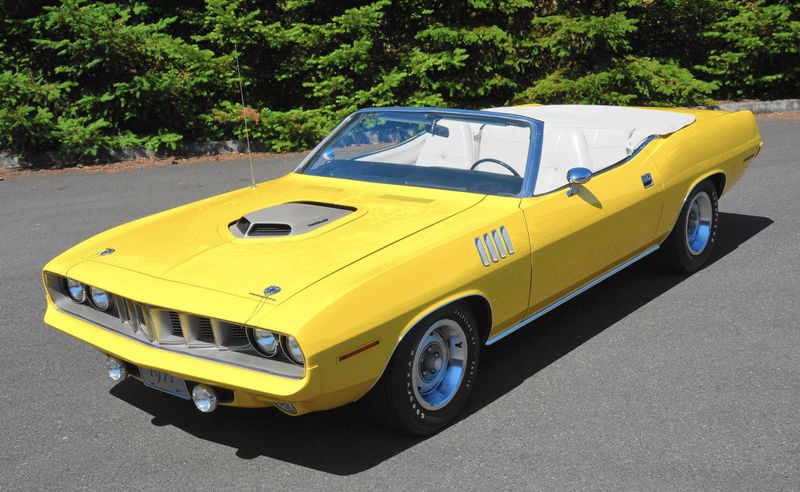
Inspired by the European’s embrace of the Harlekin concept, Volkswagen’s North American operation decided the new world too shouldn’t be denied the particoloured treat and in 1996, 264 Mark 3 Golfs (the VW formerly and briefly later known as the Rabbit) were produced for sale in the US, all of course configured with left-hand-drive (LHD), the main visual difference being the use of Tornadorot (Tornado Red, LY3D) while in accordance with local habits, most had automatic gearboxes.  Demand never went close to matching that in Europe and some sat unwanted in showrooms, one dealer in Georgia with eight on his hands had them re-made into single-color cars to attract buyers, the only remaining hint of difference the unique pattern in the grey upholstery.  That echoed what some Plymouth dealers resorted to in 1970 & 1971 to shift the remaining, outlandish Superbirds (now expensive collectables), buyers of the standard Road Runner then easier to find.  The Golf Harlequins haven’t attained quite that status but the oddballs have a following among VW enthusiasts and seem now to command a small price premium.

Made in Mexico: 1996 Volkswagen Beetle Harlequin.  All were originally LHD, this one converted in the UK to RHD.  

There was one more Volkswagen Harlequin and it was the rarest of all.  Although production in Germany ended in 1978 (the last cabriolets sold in the US the following year), Beetle production in Brazil lasted until 1996 and in Mexico until 2003.  Officially, all of the Beetle Harlequins (all of which were fitted with Digifant fuel injection) were produced in VW's Puebla plant and sold in the the home market, hand painted on Ginster Yellow bases.  Some have been photographed in Brazil but the factory denied involvement and, given Brazil’s long tradition of improvisation in such matters, it’s likely they were efforts by enterprising owners although it’s not impossible at least some were imported Mexican originals.

Margot Robbie (b 1990) in costume as Harley Quinn (a comic book character created by DC Comics), Suicide Squad (2016. left) and General Ratko Mladić (b 1942) admires the quiff of Dr Radovan Karadžić (b 1945; President of Republika Srpska 1992-1996) (right).  In the Balkans, this hairstyle is now called “The Karadžić”.

In Suicide Squad, Harley Quinn (the name a play on words based on the harlequins from the Italian theater commedia dell'arte) was a psychiatrist in an asylum for the criminally insane, led astray by one of her patients, later joining him in a life of crime.  In fiction, there have been depictions of frightening psychiatrists, notably Dr Hannibal Lecter, created by US novelist Thomas Harris (b 1940) and made infamous in the film The Silence of the Lambs (1991) but IRL (in real life), there have also been some less than admirable practitioners.  Dr Radovan Karadžić was a practicing psychiatrist before taking up politics and, after being convicted of genocide, crimes against humanity and war crimes by the International Criminal Tribunal for the former Yugoslavia (ICTY), is now serving a life sentence.  His military commander, General Ratko Mladić was convicted on the same charges and received the same sentence.  As a region the Balkans is unusual in that while most parts of the world have been places where war occasionally breaks out, in the Balkans there are really just intervals between wars.  Students of such things can decide whether Harley Quinn was a worse character than Dr Karadžić but as far as is known she never wrote dull poetry so there’s that to be said for her.

Sonia Delaunay: The colors and shapes of orphism 

Nu en Jaune (Nude in Yellow (1908)), oil on canvas by Sonia Delaunay, Musée d'Arts de Nantes (The Museum of fine arts, Nantes, France).

In the sense the colourful Volkswagens are understood, “harlequin” cars predate not only the ventures of the 1990s which came at the dawn of the internet as a mass-market commodity but even the advertisement of 1960.  French artist Sonia Delaunay (1885–1979) was born in Odessa but was adopted by a rich uncle, became multi-lingual, toured the great capitals of Europe and at 18 entered the Staatliche Akademie der Bildenden Künste Karlsruhe (Karlsruhe State Academy of Art) in Baden-Württemberg, Germany.  After two years, she enrolled at the Académie de La Palette (The Palette Academy; 1888-1925) in Paris which had begun as a progressive art school but early in the century it evolved into a kind of finishing school (an “un foutu terrain de reproduction” (a damned breeding ground) according to some critics) for the avant-garde; the alumni of this short-lived institution is a notable list.

The Ball (1913 and originally Le Bal Bullier (the name of a Parisian ballroom)), oil on canvas by Sonia Delaunay, Centre Pompidou, Paris.  Some 3½ m (12 feet) wide, it is a classic piece in the school of Orphism.

Delaunay’s early work reflected both her academic training and the influences swirling around her but what was always striking was her use of color and a reluctance to adhere to the naturalistic.  These tendencies manifested especially in her role as one of the leading practitioners of Orphism, a fork of Cubism which usually is described as an exercise in pure abstraction rendered in vivid colors.  It was in part a reaction to the focus of the mainstream cubist artists on substantive subjects such as people or physical objects and their obvious aversion to using multiple color but as often seems to happen, Orphism did seem to evolve into of l'art pour l'art (art for art's sake).  Orphism seems to have been the at least the conduit through which Delaunay left the world of fine art an applied her talents to fashion, publications, fabrics, wallpaper industrial structures and machines, some of the most memorable of which were cars.

Escarpins (Court Shoes) (1925) by Sonia Delaunay, Musée de la mode et du textile, Paris (Museum of Fashion and Textiles, 1905-1986) (left) and Propeller (Air Pavilion) (1937), oil on canvas by Sonia Delaunay, a wall-sized work painted for the 1937 Paris Exposition Internationale des Arts et Techniques (International Exhibition of Arts and Techniques Applied to Modern Life) (right). 

From Orphism she brought what she called “simultaneity”, the exercise of the interplay of colors, shapes and textures within the one visual space", a dynamic she would play with when posing with some of her creations, wearing clothing also rendered in the “simultaneity” style.  Even early in the century there had been “stunts” and debates about “what is art” and there is much in what Delaunay produced which can be seen as a precursor to later movements like surrealism and pop art although for those who want to deconstruct as reductively as the record allows, in a sense the path from some elements in prehistoric cave drawings to Dame Vivienne Westwood (1941–2022)  is lineal (with the odd diversion).

Vogue, January 1925, cover art by Georges Lepape.

Cars were among the many machines Delaunay decorated.  Triangles (and the diamond shapes they could combine to create) were one of the notable motifs of the art deco era.  From the start, Vogue was of course about frocks, shoes and such but its influence extended over the years to fields as diverse as interior decorating and industrial design.  The work of Georges Lepape (1887-1971) has long been strangely neglected in the history of art deco but he was a fine practitioner whose reputation probably suffered because his compositions have always been regarded as derivative or imitative which seems unfair given there are many who are more highly regarded despite being hardly original.  His cover art for Vogue’s edition of 1 January 1925 juxtaposed one of Delaunay’s (1885–1979) "simultaneous" pattern dresses and a Voisin roadster she'd decorated with an art deco motif.

1927 Voisin C14 Lumineuse.

One collector in 2015 was so taken with Pepape’s image that when refurbishing his Voisin C14 Lumineuse (literally “light”, an allusion to the Voisin’s greenhouse-inspired design which allowed natural light to fill the interior), he commissioned Dutch artist Bernadette Ramaekers to hand-paint a geometric triangular pattern in sympathy with that on the Vogue cover in 1925.  Ms Ramaekers took six months to complete the project and in 2022 the car sold at auction for £202,500 (US$230,000).  Produced during the whole inter-war period (1919-1939), the Voisin cars were among the most strikingly memorable of the era although for a variety of reasons, commercial viability was often marginal.  The demise was unfortunate because a manufacturer which once contemplated production of a straight-twelve engine deserved to survive.

Making the strange stranger.

There have been a few French cars which looked weirder than the Matra 530 (1967-1973 and not to be confused with the rather faster Matra R.530 air-to-air missile after which it was named) but the small, mid-engined sports car was visually strange enough although, almost sixty years on, it has aged rather well and the appearance would by most plausibly be accepted as something decades younger.  In 1968, Matra's CEO Jean-Luc Lagardère (1928–2003) commissioned Delaunay to use a 530 as a canvas and she delivered a harlequinesque creation.  Her take on the 530 is sometimes displayed though it wasn’t an exhibit at the Sonia Delaunay Tate Modern retrospective (April-August 2015), remarkably the first time her work had been showcased by an English gallery.  Had she been a man, it’s likely she’d be more celebrated.

Four Citroën GS “Drapeaux” on the 400 metre athletics track at the Olympic Stadium, Munich, FRG (Bundesrepublik Deutschland (Federal Republic of Germany; the old West Germany) 1949-1990) for the 1971 “The Car Without Borders” press event.

A variant of the harlequin idea is the use of national flags and while that’s done usually with badges, the bunting represented either in the singular (including the Triumph TR6 (1968-1976)) or in multiples for that “international flavour” (such as Cutlass Ciera emblem used by Oldsmobile between the mid-1970s and mid-1990s) but in 1971 Citroën used the whole car as a canvas.  Based on mechanically standard GS hatchback and station wagon (Break) models, the flags which adorned the bodywork were those of the twelve nations which participated in voting for the 1971 (ECotY) European Car of the Year, won by the GS.  As well as the four created for the event in Munich, a number of replica GS Drapeaux were built (it’s not clear how many but it may have been as many as 24) for a continent-wide promotional tour, co-ordinated with Citroën dealers.  The voting for the 1971 ECotY was undertaken by a jury of 44 journalists and while not exactly a kind of “automotive Eurovision”, when the numbers were tallied the GS had received a majority in Czechoslovakia, Denmark, the FRG, the Netherlands and the UK, enough to take the title.  The French drapeaux was the plural of drapeau (flag), from the Old French drapel.  In the French dialectical form spoken in Louisiana, a drapeau was a diaper (nappy).

1971 Citroën GS 1220 Club Break in “Drapeaux” trim.

That the ECotY’s jury is made up of specialist automotive journalists has always tended to slant things towards the technically interesting which accounts for winners or place-getters including the NSU Ro80 (1967-1977 and the Wankel-engined winner in 1968 which effectively bankrupted its maker), the Jensen FF (1966-1974 and the first production road car with ABS & AWD (all-wheel-drive and then still called 4WD (four-wheel-drive)) and third in 1967) and the Oldsmobile Toronado (1965-1978 in its original configuration and third in 1966 despite using a 425 cubic inch (7.0 litre) V8 with FWD! (front-wheel-drive) and being as unsuited to the European market as just about anything ever made)).  The ECotY award winners haven’t always been a success in the market but did reflect the sort of machines which appealed to the particular profile of automotive journalists, a breed quite different from those who actually buy new cars.  Nor were the winners necessarily the “best” (admittedly a difficult quality to define), illustrated by the 1990 award when the outstanding Mercedes-Benz R129 (1988-2001) was runner up to the dreary Citroën XM (1989-2000).  By historic standards the GS (1970-1986) was a pretty good choice because not was it only an inspired design but also one which proved a success over a long period, unlike the runner up Volkswagen K70 (1970-1974) and third-placed Citroën SM (1970-1975).  The K70 had actually been inherited by VW when the moribund NSU was absorbed but the many troubles of the SM contributed to Citroën’s bankruptcy though probably not to the same extent as the GS Birotor (1973-1975 and known also as the CX) which used a Wankel engine.  

Lindsay Lohan in harlequin mode.  How fashion critics will react to anything beyond the defined parameters of what's thought within their range of "right" is hard to predict: most seemed to like this.

Lindsay Lohan in November 2022 appeared on ABC’s Good Morning America to promote the Netflix movie, Falling for Christmas.  What caught the eye was her outfit, the harlequinesque suit in a gallimaufry of colors from Law Roach’s (b 1978) Akris’ fall 2022 ready-to-wear collection, the agglomeration including a wide-lapelled jacket, turtleneck and boot cut pants fabricated in a green, yellow, red & orange drei teile (three parts) print in an irregular geometric pattern.  The distinctive look was paired with a similarly eclectic combination of accessories, chunky gold hoop earrings, a crossbody Anouk envelope handbag, and Giuseppe Zanotti platform heels.  The enveloping flare of the trousers concealed the shoes which was a shame, the Giuseppe Zanotti (b 1957) Bebe-style pumps in gloss metallic burgundy leather distinguished by 2-inch (50 mm) soles, 6-inch (150 mm) heels, open vamp, rakish counters and surprisingly delicate ankle straps.  The designer's desire for the cut of the trousers to reach to the ground is noted but the shoes deserved to be seen.