Showing posts sorted by relevance for query Paramount. Sort by date Show all posts

Monday, December 13, 2021

Paramount

Paramount (pronounced par-uh-mount)

(1) Chief in importance or impact; supreme; pre-eminent; of the highest importance.

(2) Above others in rank or authority; superior in power or jurisdiction.

(3) A supreme ruler; overlord (now rare thought often in historic texts).

(4) In law (in a hierarchy of rights), having precedence over or superior to another.

1525-1526: From the Anglo-Norman paramount & paramount (pre-eminent; above), the construct being the Old French par & per (by) + amont & amunt (upward).  Par was from the Latin per (by means of, through), from the primitive Indo-European per- (to go through; to carry forth, fare).  Amont & amunt were from the Latin ad montem (to the mountain; upward), the construct being ad (up to), ultimately from the primitive Indo-European héd (at; to) + montem (the accusative singular of mōns (mount, mountain), ultimately from the primitive Indo-European men- (to stand out, tower).  Synonyms include predominant, preeminent, outstanding, capital, cardinal, chief, commanding, controlling, crowning, dominant, eminent, first, foremost, leading, main, overbearing, predominate, premier, preponderant utmost & prevalent while the most common antonyms are insignificant, secondary & unimportant (in historic land law, the antonym paravail was from the Old French par aval (below), the construct being par + aval (down), the construct being the Latin a(d) + val (a valley), from the Latin vallis; of feudal tenants, it referred to those at the bottom of the hierarchy of rights).  Paramount is a noun & adjective, paramountcy paramountship & paramountness are nouns, paramountly is an adverb; the noun plural is paramounts.

Land law and freehold title

Paramount Pictures promotional poster for Mean Girls (2004).  Then part of Viacom, it was one of the rare times the Paramount logo was rendered in pink.

Paramount was originally a term in feudal land-title law.  It described the lord paramount, the one who held absolute title to his fiefdom, not as a grant dependent upon (or revocable by) a superior lord.  A paramount lord was thus superior to a mesne lord (a landlord who has tenants holding under him, while himself the subject of the holding of a superior lord (a kind of sub-letting), mesne being the general legal principle of something intermediate or intervening) whose title to a fief existed ultimately at the pleasure of a superior. The concept endures in modern land law where titles are listed in documents and, even today, there exist jurisdictions where land, said to enjoy an indefeasible title, can still be subject to “paramount interests” which, although unregistered, can prevail over those formally registered.  In land law, a lord paramount could be male or female but in a charming quirk, in the sport of archery, the noun "lady paramount" (the plural being ladies paramount) is the title awarded to the woman who achieves the highest score.

Paramount logo of the Viacom era.

Introduced in 1914 and now the oldest Hollywood film studio logo still in use, the Paramount Pictures “mountain peak” logo was based on a sketch of Ben Lomond, Utah (elevation 9716 feet (2961 m); a peak in the northern portion of the Wasatch Mountains) by William (W.W.) Wadsworth Hodkinson (1881-1971), the founder of Paramount Pictures.  Many versions have appeared over the years and the text used in conjunction with the image has varied with the company’s ownership structure.  The semi-circles of stars which partially encircle the peak originally numbered 24, an allusion to the two-dozen film stars then signed to Paramount under the Hollywood studios’ “star system” (a restrictive contractual arrangement which, in much diminished form, lasted until the 1960s).

In Australia, the lord paramount is not the crown but the person of the sovereign.  In the strict legal sense, the king or queen (of Australia) “owns” all the land that constitutes the nation of Australia and those who “own” their own little piece by virtue of holding a valid freehold title (fee simple), in the narrow technical sense, actually hold only a revocable grant from the crown (via some instrument of the state) exercising rights delegated by the sovereign (the king or queen).  Although of no practical significance, it’s not a legal fiction and the position of Queen Elizabeth II (1926-2022; Queen of the UK and other places, 1952-2022) as lord paramount in the system of land tenure in Australia was affirmed by the High Court of Australia in Mabo v Queensland (No 2) (1992), one of the landmark cases which entrenched in Australian law the concept of native title.

Monday, January 31, 2022

Longevity

Longevity (pronounced lon-jev-i-tee)

(1) A long individual life; great duration of individual life.

(2) The length or duration of life.

(3) Length of service, tenure etc; seniority.

(4) Duration of an individual life beyond the norm for the species.

1605-1615: From the Late Latin longaevitatem (nominative longaevitās), from longaevus (ancient, aged; long-lived (the feminine was longaeva and the neuter longaevum)), the construct being longus (long) + aevum (age) (from PIE primitive Indo-European root aiw- (vital force, life; long life, eternity); longevous was the adjective.  The construct of longaevitās was longaevus + -itās (the suffix from the Proto-Italic -itāts & -otāts (-tās added to i-stems or o-stems, later used freely) and ultimately from the primitive Indo-European -tehats.  The adjectival form, the Latin longevous (also as longevously) is now rare in English but does occasionally appear as a poetic or literary device.  (the comparative more longevous, the superlative most longevous).  The less common antonym is shortgevity and the plural longevities; there’s not an exact synonym, the closest being probably durability, endurance & lastingness.  Longevity is a noun; the noun plural is longevities

Reader's Digest Kids Letter Writer Book & Stationary Set, one of Lindsay Lohan’s early (in 1994, then aged seven) modelling jobs.

Among monarchs, longevity is not uncommon, Louis XIV (1638–1715; le Roi Soleil (the Sun King), King of France 1643-1715) holding the world record by setting the mark at 72 years, 110 days.  All a latter day king, queen or emperor need to have a crack the record is (1) assume the throne at an early and age and avoid (1) dropping dead, (2) suffering regicide, (3) being compelled th abdicate because of some scandal or (4) being deposed and historically most have managed most or all of those but, despite that, Louis XIV’s record had stood for more than three centuries.  In fields where “what one does” rather than “how long one stays alive” determines longevity, long careers are less common but many do long endure.  In the minds of some, Lindsay Lohan (b 1986 must seem to have “been around forever” and in terms of her industry, that’s a reasonable way of putting it.  Signed at the age of three to the agency Ford Models, her early gigs were in print advertising before she appeared in dozens of television commercials and at seven, she was in episode 3358 (29 March 1995) of Sesame Street which first aired in the US in 1969.  By 2026, aged 39, Ms Lohan had been in the business for 36 years and counting.  On paper, there have been impressively long military careers but many are a bit of a fudge because of the tradition “a field marshal does not retire”.  Field Marshal August von Mackensen (1849–1945) joined the Prussian Army in 1869 so over three-quarters of a century, his career spanned service to Kingdom of Prussia, the North German Confederation, the German Empire, the Weimar Republic, the Third Reich, the so-called “Dönitz administration” and the post-war Allied occupation.

Field Marshal August von Mackensen (colorization by Richard White) in fur busby with Totenkopf.  Busby is the English name for the Hungarian prémes csákó (fur shako) or kucsma, a military head-dress and the German Totenkopf (literally “dead person's head”) and widely used in the sense of “death’s head”.

Politics being a sordid, nasty business, old Enoch Powell’s (1912–1998) dictum that “all political careers end in failure” is fulfilled often enough to be thought a rule but circumstances can occur which can make even a relatively brief seem impressively long.  Remarkably, Schwerin von Krosigk (1887-1977) served continuously in cabinet as finance minister between 1932-1945, ending his government service as chancellor (prime minister), the previous appointee to that role Dr Joseph Goebbels (1897-1945; Nazi propaganda minister 1933-1945) having committed suicide, something at the time fashionable among Nazis.  Von Krosigk thus served as a minister under the Weimar Republic, the Third Reich and the Dönitz administration, proving something of a “Vicar of Bray” in troubled times; he was quite a survivor and Winston Churchill (1875-1965; UK prime-minister 1940-1945 & 1951-1955) even contemplated maintaining the Dönitz administration as a short-term German government so briefly there was the prospect of von Krosigk serving yet another master.  Churchill also benefited from the times coming to suit him.  As early as 1929 his political career had been dismissed as “a failure” yet it was the dramatic events of 1939-1945 which revived his prospects and late in life, his success was extraordinary.  First holding office in “the glittering Liberal ministry” of Sir Henry Campbell-Bannerman (1836–1908; UK prime minister 1905-1908), 50 years later he finally retired (not entirely willingly) from the premiership.  In politics, longevity of half a century-odd (off and on) is not unique but certainly untypical.

In political terms, Vladimir Vladimirovich Putin (Vladimirovich the patronymic, Putin the family name, b 1952; president or prime minister of Russia since 1999) has displayed an extraordinary longevity.  While it's true some of his Tsarist and Soviet predecessors ruled for longer, they were operating under systems, though sometimes violently dangerous, which made the maintenance and retention of power in many ways a different sort of task.  Since 1999 he has served either as prime-minister or president of Russia, at one point swapping between the offices to circumvent a tiresome constitutional clause which placed limitations on consecutive presidential terms.  In 2021, after a well-done referendum, constitutional amendments were effected which will permit Mr Putin to seek election twice more which, providing the elections are well-run, means he could retain the presidency until 2036.  Should he defy the odds which tend to increase against any politician as the years roll by and still be in rude good health as 2036 looms, there is the suggestion he might be unwilling to relinquish office; there may be a need for more constitutional reform.

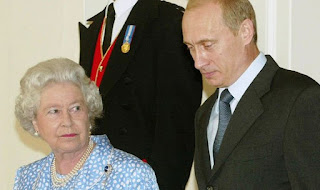
With Elizabeth II (1926-2022; Queen of the UK and other places, 1952-2022).

With Muammar Gaddafi (circa 1942–2011; leader of Libya 1969-2011).

With Yasser Arafat (1929–2004; leader of the PLO (Palestine Liberation Organization) 1969-2004).

With John Paul II (1920-2005; pope 1978-2013).

With Jiang Zemin (1926–2022; General Secretary of the Chinese Communist Party (CCP) (and thus paramount leader) 1989-2002 and President of the People's Republic of China 1993-2003).

With Boris Yeltsin (1931–2007; President of Russia 1991-1999).

With Bill Clinton (b 1946; President of US 1993-2001).

With Rudy Giuliani (b 1944; Mayor of New York City 1994-2001).

With Silvio Berlusconi (1936-2023; prime minister of Italy 1994-1995, 2001-2006 & 2008-2011).

With Kim Jong-Il (Kim II, 1941-2011; Dear Leader of DPRK (Democratic People's Republic of Korea (North Korea)) 1994-2011).

With Jacques Chirac (1932–2019; President of France 1995-2007) & Gerhard Schröder (b 1944; Chancellor of Germany 1998-2005).

With John Howard (b 1939; Prime-Minister of Australian 1996-2007).

With Benjamin Netanyahu (b 1949; prime-minister of Israel 1996-1999, 2009-2021 and since 2022).

With Tony Blair (b 1953; Prime-Minister of UK 1997-2007.

With Yoshirō Mori (b 1937; Prime-Minister of Japan 2000-2001).

With Bashar al-Assad (b 1965; President of Syria 2000-2024).

With Junichiro Koizumi (b 1942; Prime-Minister of Japan 2001-2006).

With Ariel Sharon (1928–2014) Prime Minister of Israel 2001-2006).

With George W Bush (b 1946; President of US 2001-2009).

With Hu Jintao (b 1942; general secretary of the Chinese Communist Party (CCP) 2002 to 2012 (and thus paramount leader), president of the PRC (People's Republic of China) 2003-2013).

With Benedict XVI (1927–2022; pope 2005-2013, pope emeritus 2013-2022).

With Angela Merkel (b 1954; Chancellor of Germany 2005-2021).

With Nicolas Sarközy (b 1955, President of France 2007-2012).

With Barack Obama (b 1961; President of US 2009-2017).

With crooked Hillary Clinton (b 1947; US secretary of state 2009-2013).

With Kim Jong-Un (Kim III, b 1982; Supreme Leader of DPRK (Democratic People's Republic of Korea (North Korea)) since 2011).

With Xi Jinping (b 1953; general secretary of the Chinese Communist Party (CCP) and paramount leader of the People's Republic of China (PRC) since 2012).

With Francis (1936-2025; pope 2013-2025).

With Tony Abbott (b 1957; Prime-minister of Australia 2013-2015).

With Narendra Modi (b 1950; Prime-Minister of Indian since 2014).

With Theresa May (b 1956; Prime Minister of the UK 2016-2019).


With Donald Trump (b 1946; US president 2017-2021 and since 2025).

With Emmanuel Macron (b 1977; President of France since 2017).

With Boris Johnson (b 1964; UK prime-minister 2019-2022).

With Joe Biden (b 1942; President of US 2021-2025).

Tuesday, August 1, 2023

Lagniappe

Lagniappe (pronounced lan-yap or lanny-yap)

(1) A small gift given with a purchase to a customer, by way of compliment or for good measure; bonus (mostly southern Louisiana and south-east Texas).

(2) Something given or obtained as a gratuity (tip) or bonus

(3) A gratuity or tip.

(4) An unexpected or indirect benefit.

(5) A windfall, an unexpected turn of good fortune

1840s: An Americanism, from the Cajun French lagniappe, from the Latin American Spanish la ñapa or la yapa, the construct being la- (the feminine definite article) + a variant of ñapa or yapa (small gift or additional quantity given to a valued customer), from the Quechua (known also as Runasimi (people's language), an indigenous language family spoken by the Quechua peoples of the Peruvian Andes) yápa (addition; that which is added; increase, supplement (which existed also in the form yapay (addition; sum).  The word (in its various spellings) is found most commonly in southern Louisiana and south-east Texas but exists also in Mississippi and Trinidad & Tobago).  The synonyms include pasella (South Africa), brotus (southern US) and tilly or luck penny (Ireland).  The idea was in England institutionalized as “the baker’s dozen” whereby the standard quantity of items sold by the dozen (12) was set at 13.  The first documented record of the word dates from 1849 in the sense of “something extra, given by a merchant to a customer to reward or encourage patronage” and it was a part of transactional New Orleans Creole.  Mark Twain (1835-1910) in Life on the Mississippi (1883) noted the practice was universal among Louisiana shopkeepers and to his ear, the pronunciation was lanny-yap although variations have been noted throughout the southern US and the Caribbean.  Twain observed the practice frequently and recorded the way people would use the word wryly to describe some historic transactions: "The English were trading beads and blankets to them [the native Americans] for a consideration and throwing in civilization & whiskey 'for lagniappe'."    The alternative spellings are lagnappe, lanyap & lanyappe.  Lagniappe is a noun; the noun plural is lagniappes.

In Japanese commerce, the concept of the lagniappe was long a part of the retailing low-cost, mass-produced items and was known as御負け (omake) and while the small “giveaways” were intended originally to stimulate sales, the industry came to realize that if produced as sets the additional inclusions could in themselves become desirable collectables and it wasn’t unknown for purchases to being made not for the purpose of obtaining the notionally priced item but instead the free gift.  The highest form of this concept was wrapping or otherwise concealing the gift so that people had to keep purchasing until they managed to “snag” the missing part of the set.  Controversial among consumer organizations (especially with products appealing to children), the trick is still used, both in Japan and beyond.  A variation of the idea (as an ad-hoc form of the baker’s dozen) is the “bundle”, the classic example of which is the inclusion of extra material (tracks, interviews, deleted scenes, bloopers etc) on optical (CD, DVD, Blu-Ray) releases of films or music.  The bundle actually remains one of the most common forms of convincing consumers they’re benefiting from “added value”, the trick being that the “free” extras can be advertised as being worth their recommended retail price (which in many cases, for many reasons, the manufacturer or retailer has worked out they have few prospects of ever realizing), a value vastly higher than their actual cost or the even lower book value.  In the days when cars had vast option lists, the US manufacturers were past masters at "bundling", stocks of slow-selling items off-loaded in seemingly attractively priced "bundles".

Mean Girls Special Collector's Edition (2004) on DVD, Paramount Pictures (part number D341604D).

Bundled extras: There’s no defined standard for what is included in “special” editions of commercially released films but unlike “director’s cut” versions which to some extent change the actual content of the original releases (cinema, optical, TV or streaming), “special editions” tend to be the original plus a bundle of “extras”.  Assembled usually as “featurettes”, typically, the additional content will consist of interviews with the cast, director or writers, out-takes, bloopers, deleted scenes, advertising and other promotional material and sometimes commentaries from critics or commentators with expertise in some issue of interest.  For nerds, there’s sometimes even content about technical aspects of production, an addition most often seen with product made with much use of special effects but discussions about matters such as fashion or history might also appear.

The Mean Girls Special Collector's Edition included (1) discussions about casting, (2) an interview with Rosalind Wiseman (b 1969), author of Queen Bees and Wannabes (2002) on which the Mean Girls screenplay was based, (3) commentary by the writers and producers, (4) “Word Vomit” (the Blooper Reel), (5) deleted scenes with commentary, (6) “Plastic Fashion” (a discussion about costume design and the use of clothing as a metaphor for character development), (7) interstitials (advertising material created with original material not used in the final cut) and (8) promotional trailers for other Paramount films.

Democratic Party campaign material: 1996 US presidential election.

Lagniappe: In some countries, politicians literally buy votes with physical cash.  In this West this happens but the process is sanitized and degrees of remoteness introduced.  There are also more abstract forms such as the Democratic Party including campaign material in the 1996 US presidential election which essentially offered “a free copy of crooked Hillary with a re-elected Bill.  Whether the voters thought this “added value” isn’t clear but Bill Clinton (with some help from Ross Perot (1930-2019) won with almost 50% of the vote so there's that.  Intriguingly, whether because or despite of being bundled with free copy of crooked Hillary, polls at the time indicated that had (post-Monica) Bill been able to run in 2000 for a third term, he'd have won even more handsomely.

Sunday, April 16, 2023

Androgynous

Androgynous (pronounced an-droj-uh-nuhs)

(1) Being both male and female; hermaphroditic (archaic).

(2) Having both masculine and feminine characteristics.

(3) Having an ambiguous sexual identity.

(4) Neither clearly masculine nor clearly feminine in appearance.

(5) In botany, having staminate and pistillate flowers in the same inflorescence.

1622: From the Latin androgynus (androgyne + ous), derived from Greek androgynos (hermaphrodite, male and female in one, womanish man).  Historically used as an adjective (of baths) with meaning "common to men and women," from andros, genitive of aner (male) (see anthropo) + gyne (woman).  Gyne is ultimate root of queen.  Related forms include androgyny, androgenous, androgynous. Androgyny was first used as a noun circa 1850, nominalizing the adjective androgynous.  Adjectival use dates from the early seventeenth century, derived from the older French and English terms, androgyne.  The older androgyne is still in use as a noun with overlapping meanings.  Androgynous is an adjective, androgyny is a noun, androgynously is an adverb; the noun plural is androgynies.

Marlene Dietrich (1901–1992) as Amy Jolly in Morocco (1930).

In an amusing political conjunction, it appears the Central Committee of the PRC’s (People’s Republic of China) ruling Communist Party (CCP) seems now to agree with California’s most recent Republican governor, Arnold Schwarzenegger (b 1947; governor of California 2003-2011), that “girly men” are a bit of a problem.  The committee has been for some time concerned with the habits of the young and in addition to cracking down on ideologically unreliable actresses, introduced restrictions on the amount of time the young could spend frittering away their (ie the state’s) time playing video games instead of studying agricultural techniques, developing surveillance systems or something useful.  Around the republic, it’s suspected parents gave thanks to the committee for at least attempting to achieve what their years pleas and nagging failed to achieve although, being an inventive and clever lot, no one is expecting the caffeine-fuelled youth easily to abandon their obsession.  Work-arounds are expected soon to emerge. 

The Guangzhou Circle (the doughnut).

Fashionistas and rabid gamers weren’t the committee’s only target, an actual culture war declared on androgyny, many young men deemed too effeminate banned from the wildly popular television genre they seem to have co-invented with the TV broadcasters impressed by the ratings.  Having called in the executives to tell them to promote "revolutionary culture" instead of Western decadence, the crackdown on girly men is seemingly part of President Xi Jinping’s (b 1953; paramount leader of China since 2012) campaign to tighten control over business and society so the CCP can impose and enforce an official morality.  The president’s vision is certainly all-encompassing.  As well as “deviant” young men, Mr Xi also doesn’t like the “weird architecture” he’s noticed is part of the world’s biggest ever building boom, disapproving of intriguing structures like the doughnut-shaped Guangzhou Circle skyscraper by Italian architect Joseph di Pasquale (b 1968) and to demonstrate it’s not merely a criticism of foreign influence, he’s also condemned some of the works by Chinese designers.  The president expects buildings to be like Chinese youth: cost-conscious, structurally sound, functional and environmentally friendly.  That’s it; no deviation allowed.      

The new headquarters of the state media’s China Daily during construction.  When finished if looked less confronting but one can see why the president was concerned.

But the architects got off lightly compared with the androgynous, the state’s regulator of television content ruling that broadcasters must "resolutely put an end to sissy men and other abnormal aesthetics", telling them to ban from the screens the niang pao (derisive slang for girly men which translates literally as "girlie guns”).  Culturally, the new interest shouldn’t be surprising given a narrow definition of gender roles has long been a theme in the identity and propaganda of authoritarian administrations, the imagery, campaigns and policies of twentieth century communist & fascist regimes being well documented, those not conforming suffering much.

Lindsay Lohan is androgynous mode.

Like the West, modern China has some history with LGBTQQIAAOP issues and, certainly in the twentieth century, many in the LGBTQQIAAOP communities were treated as mentally ill undesirables and sometimes prosecuted but, reflecting changes in the West, in 1997, Beijing decriminalized homosexuality and in 2001 removed it from the official list of mental disorders.  Before long, officially recognized gay bars appeared in Shanghai and gay pride marches were held and it appeared state tolerance of such things had become, if not state policy, then certainly the practice.  However, under President Xi, things began to change, films and other material with LGBTQQIAAOP themes often censored or actually banned, universities compiling lists of students who identify as gay and the pride marches have been cancelled although this was officially a COVID-19 infection-prevention measure.  In a prelude to the committee’s statement on the suppression of androgyny, in July 2021, the government ordered the Tencent-owned messaging app WeChat to delete accounts connected to LGBTQQIAAOP groups.

Wrong: The androgynous men on Chinese TV.

Some medical experts have suggested the government is under no illusion about homosexuality and understand it’s always going to exist but they just want it to remain invisible; in the closet as it were, something done behind closed doors between consenting adults but something which dare not speak its name, must less be shown on television.  Others suspect the crackdown on degeneracy may reflect the regime’s fiscal and demographic concerns, a feeling the younger generation are suffering from the “curse of plenty”.  Having grown up knowing little but relative affluence and abundance, youth and working-age adults are starting to rebel against the heavy workload they’ll have to bear for the rest of their lives to maintain an aging population, a cultural movement called "lying flat" identified which rejects the “996” (working 9am-9pm 6 days a week, ie 72 hours) culture.  The party seems to have realised 996 may not be something helpful for regime survival and, in August 2021, arranged for the Supreme People's Court on to declare it illegal.  However, that doesn’t mean it doesn’t endure as a cultural expectation, especially in companies employing younger workers.

996: When first seen by US pilots over Korean skies in 1950, the Mikoyan-Gurevich (MiG-15  (NATO reporting name=Fagot)) made an impact like few others.  Unlike the British and Americans who had trouble keeping things secret from the Soviets, the MiG-15's existence was unknown and unexpected.  Clearly influenced by the German war-time experience and the North-American F86 Sabre, it used an (illegal) copy of a Rolls-Royce turbojet and so instantly did it transform the control of the Korean War skies that the Americans were compelled to rush squadrons of Sabres to the theatre to augment the now out-paced P51 Mustangs.  MiG-15 996 (NX996) was first assigned to the USSR Air Force but in 1955 was transferred to the People's Liberation Army Navy (the then correct term for the Chinese Navy).

Right: The manly men of the CCP’s Central Committee.

Making connections between the strands has been a rich environment for conspiracy theorists searching for hidden agendas and ulterior motives.  Blaming video games, entertainment, and androgyny for making men "too soft to work hard" is said to be just blame-shifting for the consequences of the 996 culture burning out whole generations.  State-sanctioned statistics do show extraordinary gains in productivity over the last dozen years, economic output having doubled but the gains disproportionately have been accrued by a relatively few oligarchs and those well-connected to the senior echelons of the party with even many in the upper middle-class complaining the purchasing power of their incomes are consistently falling, not keeping pace with the rising cost of housing and raising children.  Reaction to the party’s announcement that the one-child policy was finished and couples should now have two or three was thus muted; in the absence of anything actually to help parents afford to have another child, a baby-boom is not soon expected.  Still, one of the advantages of living in a communist state running a regulated capitalism as a sort of public-private partnership, is the compulsory education in Marxist theory so at least the people will understand where the alienated surplus profits from their labour went and the party does seem aware of the problem, another of their crackdowns directed against the oligarchs.  However, unlike the androgynous, they’re not expected to be banned, instead they’ll be “encouraged” to spread the wealth.  Just a little.

Friday, July 23, 2021

Zeitgeist

Zeitgeist (pronounced tsahyt-gahyst)

A German noun, the spirit of the time; general trend of thought or feeling characteristic of a particular period of time, historically especially as reflected in literature and philosophy although now also used to reference popular culture.

1835: From the German, Zeit + Geist, literally "time spirit (or ghost)", a calque of Latin genius sēculī, and best translated as “spirit of the age”.  It’s not commonly pluralized but the plural of Geist (ghost; spirit) is Geister, thus in English the irregular noun zeitgeister (also often in the plural), sometimes used of those who write of the fads in contemporary culture. Zeitgeist is a noun and zeitgeisty, zeitgeistier & zeitgeistiest are adjectives; the (rare) plural is zeitgeists.  Hopefully, zeitgeistesque never becomes a thing.  

Spirit of the age

A concept from eighteenth & nineteenth century German philosophy, best translated as "spirit of the age", it refers to the invisible forces dominating or defining the characteristics of a given epoch in history.  Although now most associated with German philosopher Georg Wilhelm Friedrich Hegel (1770-1831), especially in contrast with the Hegelian concepts of volksgeist (national spirit) and weltgeist (world-spirit), the coinage predates Hegel and appears in the work of Johann Gottfried Herder (1744–1803), Johann Wolfgang von Goethe ("Goethe"; 1749–1832), Herbert Spencer (1820–1903) and Voltaire (François-Marie Arouet; 1694–1778).  Hegel, in Phenomenology of the Spirit (1807), did write of the idea but preferred the phrase Geist der Zeiten (spirit of the times) over the compound Zeitgeist.  Most sources acknowledge the first documented use being in the writings of Herder.

Portrait of GWF Hegel (circa 1839), steel engraving by Lazarus Gottlieb Sichling (1812–1863) after an aquarel (watercolor) lithograph (1828) by Julius Ludwig Sebbers (circa 1785-1893).

Until recently, zeitgeist tended to be used retrospectively, in the manner of geochronology where an epoch has a known end date before labels are applied.  Of late, with its (perhaps over-enthusiastic) adoption by those who write of pop-culture, it’s come to be attached to just about anything, however fleeting.  Some criticize this but that's probably intellectual snobbery; in a sense Hegel et al were also writing of a type of popular culture.  Appropriately then, zeitgeist should now be considered and English word, having been thoroughly assimilated and not capitalized unless used in a way which references its continental origins (of Hegel, Voltaire etc) in which case it remains German and as a noun picks up an initial capital.  Because it remains both a German and English word, it can be spoken as written or translated, depending on the effect desired and in this it's a variant of the conventions which guide the way written text is handled in oral speech.  Where a word or phrase, however familiar in English, remains foreign it should when spoken, be rendered in translation: the written text “Hillary Clinton is, inter alia, crooked”, is spoken as “Hillary Clinton is, among other things, crooked”.  Where a foreign word or phrase has been assimilated into English it is treated as native so the written text “Hillary Clinton’s statement was the usual mix of lies, half-truths, evasions etc” is spoken as “Hillary Clinton’s statement was the usual mix of lies, half-truths, evasions etcetera.”  Note the usual shortened form (etc) has traditionally always been followed by a full-stop but there is a welcome revisionist movement which argues it too has become an English word (as etcetera is an anglicized form of the Latin et cetera) and thus needs no longer to be treated as a truncation.

Of the zeitgeist, early in the third millennium: Paramount Pictures promotional poster for Mean Girls (2004).

Where a foreign word or phrase, however familiar in English, depends for technical or other reasons on the original form to convey its meaning, it should be spoken as written.  Words of this class are often legal Latin such as obiter dictum (from the Latin and literally "something said in passing and not critically to what's being discussed" and in law describing a judge's expression of opinion not essential to the verdict and thus not binding as a precedent) and habeas corpus (from the Latin habeas corpus ad subjiciendum (literally "You (shall) have the body to be subjected to (examination)" and now a mechanism to challenge the lawfulness of a detention (ie the detainee must be brought before a court).  Status quo (from the Latin status (state) (sometimes used in the ablative statū) + quō (in which), the ablative of quī (which)) is well-known and widely used as kind of verbal shorthand to avoid clumsy English constructions yet the Status Quo is an Ottoman era firman (from the Ottoman Turkish فرمان‎ (ferman), from the Persian فرمان‎ (farmân) (command, order, decree)) which defines certain unchanging understandings among religious communities with respect to nine shared religious sites in Jerusalem and Bethlehem and to translate this to anything else would rob it of the meaning which relies on its historic context.  So, words evolve to be defined as assimilated into English or not according to "rules" which are a bit vague but in use there's probably a consensus things like "obiter dictum" and "habeas corpus" remain ways of expressing something with a foreign phrase because they're still used in their original (legal) context whereas "status quo" has become an English phrase because use is so diverse and distant from its origins.