Showing posts sorted by relevance for query Pizza. Sort by date Show all posts

Monday, August 31, 2020

Pizza

Pizza (pronounced peet-suh)

A flat, open-faced baked pie of Italian origin, consisting of a thin layer of bread dough topped with spiced tomato sauce and cheese, often garnished with anchovies, sausage slices, mushrooms etc and baked in a very hot oven; also called pizza pie.

Pre 1000: From the Modern Neapolitan Italian pizza (a variant of pitta (a flat bread)), the origin of which is uncertain.  Although unattested, it may be related to the Vulgar Latin picea, from the Classical Latin piceus (relating to pitch).  An alternative, and more likely, etymology traces it back to the Byzantine Greek πίτα (pita) (cake, pie) which exists in Modern Greek as pitta (cake), the ultimate root being the Ancient Greek pḗtea (bran) and pētítēs (bran; bread).  More speculative is the suggested link with the Langobardic (an ancient German language in northern Italy), from a Germanic source akin to the Old High German pizzo or bizzo (mouthful; morsel; bite) from the proto-Germanic biton (bit).

The first documented use of the word pizza appears to have been AD 997 in Gaeta and then later in different parts of Central and Southern Italy although it’s unclear whether it refers to something which would now be called a pizza.  The official Italian view remains that published in 1907 in the two volume Vocabolario Etimologico della Lingua Italiana (Etymological Vocabulary of the Italian language) that the origin lies in the dialectal pinza (clamp) from the Latin pinsere (to pound or stamp).  The word appears not to have entered general use in English use until the early 1800s although it was known, English linguist, poet & lexicographer John Florio (1552-1625; aka Giovanni Florio) included an entry in his Italian-English Dictionary (A Worlde of Wordes, or Dictionarie of the Italian and English tongues (1598)) defining pizza as “a small cake or wafer”.

Lindsay Lohan with slice of pizza.

The concept of a flat piece of bread dough, covered with savory toppings, is so obviously a convenient and economical way of preparing a meal using pre-modern technology that pizza-like dishes were probably included in the meals of many cultures, the cooking method doubtless quite ancient.  From Greek and Roman records it’s apparent it was known in antiquity a doubtless pre-dates even those civilizations, the Armenians famously having staked a claim to its invention but as part of modernity, it’s long been regarded as one of Italy’s many gifts to the world.  Within Italy, it’s the Neapolitans who most regard it as their own and some are quite proprietorial, appalled by some of the variations (especially those favored by English-speaking barbarians) which appear around the planet, the most infamous probably the ham and pineapple pizza, apparently a Canadian innovation from 1962.  The Neapolitans have allies in their battle for culinary hygiene, Iceland's president, Guðni Jóhannesson (b 1968, President of Iceland since 2016) in 2017 saying he’d like to ban pineapple on pizza.  He later confirmed to do so wasn’t within the constitutional authority of his office and admitted it wasn’t a desirable power of a head of state to possess.  Thinking it an abomination, the Neapolitans are probably more dictatorial and would ban it if they could, insisting that all may appear atop a pizza base is:

Plum tomatoes
Tomato puree (optional)
A sprinkling of table or sea salt
Freshly ground black pepper
Fresh Mozzarella balls
Parmesan cheese
A drizzle of Olive Oil
A hand-full of fresh basil leaves

The pizzeria (shop where pizzas are made, sold, or eaten) seems to have been a US coining, noted from 1928 in New York City, the number of restaurant using the name proliferating quickly there before spreading in the US and beyond.  In the 1920s and 1930s, “pizzeria” was used also to describe the dish itself.  The shortened for “za” was US student slang for pizza, two syllables just too much for the hippies of the time.

Crooked Hillary Clinton eating pizza: crookedly.

Pizzagate was a conspiracy theory that circulated during the 2016 US presidential campaign, sparked by WikiLeaks publishing a tranche of emails from within the Democrat Party machine.  According to some, encoded in the text of the emails was a series of messages between highly-placed members of the party who were involved in a pedophile ring, even detailing crooked Hillary Clinton’s part in the ritualistic sexual abuse of children in the basement of a certain pizzeria in Washington DC.  The named pizzeria didn’t actually have a basement but the story for a while caused a stir, later integrated (though with less specificity) into the cultural phenomenon which would next year emerge as QAnon.  QAnon may have started as satire in the wake of pizzagate, an absurdist parody of conspiracy theories with claims only simpletons would take seriously but it turned out there were a lot of them about and QAnon soon gained critical mass, assuming a life of its own.  What its rapid traction did suggest was those asserting something unbelievably evil or bizarre need only to claim crooked Hillary Clinton is in some way involved to make it sound creditable.  Had it not been for the perception of crooked Hillary's crooked crookedness, the whole QAnon thing may never have become a thing.

Donald Trump with Sarah Palin (b 1964; 2008 Republican vice presidential nominee), eating pizza with knife & fork.

The Italians (who should know), maintain the correct way to eat pizza is with a knife & fork, starting at the triangular tip and working towards the crust.  Only when what remains is a small remnant of crust, resistant to the prod of the fork, is it thought good form to pick it up with the fingers.  Folding, a popular recommendation among those concerned with cheese-loss, is also frowned upon.  In Italian a folded slice of pizza is known as a calzone (literally “stocking; trouser”) and even those should be eaten with knife & fork.

Donald Trump eating pizza, tip first.

Pizza etiquette is an inexact science but in the West there are few prepared to argue the correct technique is anything but some variation on holding it at the crust-end and eating from the tip although there are some bases so thin and floppy they defy any method short of being rolled into a sushi-like cylinder: for these it’s whatever works.  Generally though, hold the pizza by the crust and begin.  If it’s a thin base and droops towards the tip, lift it higher and lower the tip to the mouth; as the width of what’s left increases, structural integrity will improve and by at least half-way through, it’ll be rigid enough to be eaten horizontally.  Using the thumb, index and middle finger, the slice can slightly be curved (the edges raised) to prevent cheese or other topping sliding off.  In New York City, locals often insist this is called the “New York fold” but, having claimed authorship of the Martini (disputed) and the club sandwich (probably true), many assume if it’s in NYC, they own it.

Advertising agency BBDO's concept paper (3 August 1995) for Pizza Hut’s Stuffed Crust campaign (Donald & Ivana Trump).

Proving that Donald Trump (b 1946; US president 2017-2021) will do just about anything for money, in 1995 he and ex-wife (#1; the divorce granted in 1990) Ivana (née Zelníčková, 1949–2022)  starred in a commercial for Pizza Hut’s new “Stuffed Crust” pizza, encouraging consumers to eat the things “crust first”.   He knew it was wrong but did it anyway, something some critics suggest is an element in much of Mr Trump's conduct.

Recommended pizza toppings

Silverbeet, broccolini & mozzarella
Sweet potato, goat's cheese & pine nuts
Crab, roasted capsicum & pesto
Grilled aubergine (eggplant) & parmigiana
Blue cheese & roast pumpkin
Polenta, cheese & mushroom
Asparagus & artichoke pesto
Turkey, sticky onion & tart cranberry relish
Grilled aubergine (eggplant) & artichoke
Caramelized pineapple & bacon
Smoked salmon & brie
Pumpkin & zucchini with basil
Zucchini, capsicum & cashew
Gorgonzola, potato & bacon

Sunday, January 4, 2026

Thunk

Thunk (pronounced thunk)

(1) Onomatopoeic slang for sounds (such as the impressive thud when the doors close on pre-modern Mercedes-Benz), representing the dull sound of the impact of a heavy object striking another and coming to an immediate standstill, with neither object being broken by the impact.

(2) In computer programming, a delayed computation (known also as a closure routine.

(3) In computing, in the Scheme programming language, a function or procedure taking no arguments.

(4) In computing, a specialized subroutine in operating systems where one software module is used to execute code in another or inject an additional calculation into another subroutine; a mapping of machine data from one system-specific form to another, usually for compatibility reasons, to allow a 16-bit program to run on a 32-bit operating system.

(5) In computing, to execute code by means of a thunk.

(6) As “get thunked” or “go thunk yourself”, an affectionate insult among the nerdiest of programmers.

(7) In colloquial use, a past tense form of think (the standard form being "thought").  Usually it's used humorously but, if erroneous, it's polite not to correct the mistake.

1876: The first documented instance as incorrect English is from 1876 but doubtlessly it had been used before and there’s speculation it may have be a dialectical form in one or more places before dying out.  There being no oral records and with nothing in writing prior to 1876, the history is unknown.  As an echoic of the sound of impact, it’s attested from 1952.  Although occasionally heard in jocular form, except in computing, thunk is non-standard English, used as a past tense or past participle of think.  The mistake is understandable given the existence of drink/drunk, sink/sunk etc so perhaps it’s a shame (like brung from bring) that it’s not a standard form except in computing.  The plural is thunks, the present participle thunking and the simple past and past participle thunked.  The numerical value of thunk in Chaldean Numerology is 4; the value in Pythagorean Numerology is 2.  Thunk & thunking are nouns & verbs, thunker is a noun and thunked is a verb; the noun plural is thunks.  The adjective thunkish is non-standard but is used in engineering and programming circles.

Getting thunked

The origin of the word to describe a number of variations of tricks in programming is contested, the earliest dating from 1961 as onomatopoeic abstractions of computer programming.  One holds a thunk is the (virtual) sound of data hitting the stack (some say hitting the accumulator).  Another suggestion is that it’s the sound of the expression being unfrozen at argument-evaluation time. The most inventive in that it was said to have been coined during an after-midnight programming session when it was realized a type of an argument in Algol 60 could be figured out in advance with a little compile-time thought, simplifying the evaluation machinery.  In other words, it had "already been thought of"; thus it was christened a "thunk", which is “the past tense of ‘think’ at two in the morning when most good programming is done on a diet of Coca-Cola and pizza”.


Door closing on 1967 Mercedes-Benz 230 S.  Until the 1990s, the quality of even the low-end Mercedes-Benz models was outstanding and the doors closed with a satisfying thunk.

Thunking as a programming concept does seem to have been invented in 1961 as “a chunk of code which provides an address”, a way of binding parameters to their formal definitions in procedure calls.  If a procedure is called with an expression in the place of a formal parameter, the compiler generates a thunk which computes the expression and leaves the address of the result in some standard location.  It usefulness was such it was soon generalised into: an expression, frozen with its environment for later evaluation if and when needed (that point being the closure), the process of unfreezing thunks called forcing.  As operating systems evolved into overlay-rich environments, the thunk became a vital stub-routine to load and jump to the correct overlay, Microsoft and IBM both defining the mapping of the 16-bit Intel environment with segment registers and 64K address limits whereas 32 & 64-bit systems had flat addressing and semi-real memory management.  Thunking permits multiple environments to run on the same computer and operating system and to achieve this, there’s the universal thunk, the generic thunk and the flat thunk, the fine distinctions of which only programmers get.  In another example of nerd humor, a person can be said to have their activities scheduled in a thunk-like manner, the idea being they need “frequently to be forced to completion”, especially if the task is boring.

Lindsay Lohan and her lawyer in court, Los Angeles, December 2011.

So it’s a bit nerdy but modern operating systems need thunking because 8, 16, 32 and 64-bit routines can need to run both concurrently and interactively on the same machine (real or virtual).  If a 32-bit application sends something with precision data types to a 64-bit handler, without thunking, the call will fail because the precise address can’t be resolved.  Although not literally true, it’s easiest to visualise thunking as a translation layer.

IBM OS/2 2.0 in shrink-wrap, 1992.

Thunking first entered consumer computing at scale with IBM’s OS/2 in 1987, an operating system still in surprisingly wide use and supported by IBM until early in the century.  Interestingly, although both OS/2 (and its successor eCom) have been unavailable for years, in August 2017, a private project released ArcaOS, an x86 operating system derived from OS/2 and, for personal use, it retails at US$129.00.  Like OS/2, it has some features which are truly unique such as, for the handful of souls on the planet who either need or wish simultaneously to run multiple 8, 16 and 32-bit text-mode sessions, (including those internally booting different operating systems in segregated memory) in their hundreds on the one physical machine.  First done in 1992 on OS/2 2.0, it’s still quite a trick and the on-line OS/2 Museum hosts an active community, development continuing.

Wednesday, March 6, 2024

Utopia & Dystopia

Utopia (pronounced yoo-toh-pee-uh)

(1) An imaginary island described in Sir Thomas More's Utopia, a place enjoying perfection in law, society and politics; such a place cannot exist.

(2) An ideal place or state of being.

(3) Any visionary system of political or social perfection.

(4) A popular product name in the illicit drug industry.

1516: From the New Latin utopia (literally "nowhere"), coined by Sir Thomas More (1478–1535) and used as title of his 1516 book about an imaginary island enjoying perfect legal, social, and political systems although the author’s meaning was rather more nuanced than that the casual use of “utopia” is used usually to convey.  The construct was the Ancient Greek οὐ (ou) (not) +‎ τόπος (topos) (place; region) + ia (from the Classical Latin ia and the Ancient Greek ία (ía) & εια (eia) which form abstract nouns of feminine gender).  The meaning was extended to "any perfect place" by the early seventeenth century.  Marx used the word in disparagement of the “…useless utopian myths…” he thought infected the schools of socialist too remote from political and economic reality.  The French form was utopie.  Utopia, utopographer, utopianizer, utopianization & utopianism are nouns, utopian & utopist are nouns & adjectives, utopianize is a verb, utopianistic is an adjective, utopianly is an adverb; the noun plural is utopias.

Dystopia (pronounced dis-toh-pee-uh)

(1) A society characterized by human misery, as squalor, oppression, disease, and overcrowding.

(2) Any imaginary place or state of being where everything is bad.

1868: A compound word dys + (u)topia, the word coined by the English philosopher John Stuart Mill (1806–1873) and its first public use was in one of his speeches delivered in the House of Commons.  The construct was the Ancient Greek δυσ (dus) (bad) + τόπος (tópos) (place; region) + ia (from the Classical Latin ia and the Ancient Greek ία (ía) & εια (eia) which form abstract nouns of feminine gender). It’s since usually been used in the sense of any bad place, real or imagined.  In popular culture, depictions of dystopia have tended to follow the concerns of the time; pandemics, nuclear war, alien invasion, dictatorial régimes and climate change.  The spelling distopia is erroneous but not uncommon.  Dystopia, dystopographer, dystopianizer, dystopianization & dystopianism are nouns, dystopian & dystopist are nouns & adjectives, dystopianize is a verb, dystopianistic is an adjective and dystopianly is an adverb; the noun plural is dystopias.  The constructs follow the model of those derived from utopia although in use, most are rare.

Urban future by noted practitioner of dystopian art, Polina Kulagina.  There is an entire genre of dystopian art and literature.

For something which More insisted can't exist, utopia has survived well and it's proved a popular building block.  A gaytopia is the sort of place (real or imagined) which is (for whatever reason) a paradise for the LGBTQQIAAOP community and the hetrotopia was apparently a right-wing reaction to that, the idea being a "gay-free" zone.  A pornotopia is a place (real or virtual) in which every form of pornography however depraved was available; it was a specialized form of an infotopia which was something like the original vision of some for the WorldWideWeb (WWW) back when Al Gore (b 1948; US vice president (VPOTUS) 1993-2001 & in 2000 the next president of the United States (NPOTUS)) called it the "information superhighway".  Apparently he invented the internet so it's reasonable he assumed naming rights.  Pornotopia was originally used to describe a imagined world where all were willing (even anxious) to engage in all forms of sexual activity while an intimatopia was a fantasy world serving as an ideal setting for sexually charged relationships involving a high degree of sustained emotional intimacy.  The romantopia was a world imagined by women as the ideal setting for romantic love (it has dismissively been called millsandboonatopia).  A cyberutopia is a kind of heaven for nerds, a place full of cables, computers, routers and coffee machines where Coca-Cola & pizza are free.  The technoutopia is much the same sort of place and one inhabited by technoutopians and technoutopists dedicated to the pursuit of technoutopism.  An autopia was envisaged as an urban landscape designed around the use of the automobile and it's long been used as a critique of certain cities of which Los Angeles is the best-known example although there are many cities where traffic management is far, far worse.  The negative forms can be a bit fuzzy (and remember More's Utopia was used as an internally negated concept).  Dystopia is well known but there is also unutopia & anti-utopia, all appearing to mean "the antithesis of utopia".  On the rare occasions anti-utopia & unutopia appear, it's advised to deconstruct the context.

The dystopian vision of Dante's Inferno: The Fifth Circle (1587) by Stradanus (1523-1605)), depicting Virgil and Dante on the River Styx in the fifth circle of Hell where the wrathful are for eternity condemned to splash around on the surface, fighting each other.  Dante Alighieri's (circa 1265–1321), Divine Comedy was written between 1307-1321 and helping the pair cross is the infernal ferryman Phlegyas.  Stradanus was one of the many names under which the Flemish artist Jan van der Straet painted, the others including Giovanni della Strada, Johannes della Strada, Giovanni Stradano, Johannes Stradano, Giovanni Stradanus, Johannes Stradanus, Jan van Straeten & Jan van Straten.

So influential has been Robert Bolt’s (1924–1995) play A Man for All Seasons (1960) in forming the public perception of Sir Thomas More that he seems now remembered as a kind of proto-liberal.  It is true he held opinions which would have been shared by few (lord) chancellors of the last 500-odd years including a condemnation of private property and the idea that the very structure of English society was a “conspiracy of the rich”.  Centuries before Karl Marx (1818-1883), he discussed the surplus value of labor and the mechanisms by which working people were alienated for this value so it could be absorbed by the already rich to add to their wealth.  So he ticks many boxes of wokeness but he also held views on women and their place that would make social media identity Andrew Tate (b 1986) follow his X (formerly known as Twitter) account.

More’s book Utopia is similarly misunderstood, the modern use of the word meaning many who have never read it merely assume what it means.  Structurally, it was influential because it contains threads identifiable as both science fiction (SF) and fantasy and in both these genres, authors have often described “utopias”, usually either as (1) places of unrestricted self-indulgence or (2) places in which everything is so antiseptically perfect that humans, with their inherent imperfections, just “don’t fit in”.  In these alternative universes, being fictional, something has to happen and what often occurs is that they turn into dystopias, the ultimately inadequate human inhabitants dealt with; that which doesn't "fit in" must be "thrown out".  More wasn’t quite so theatrical; his original title for the book was in Latin and is best translated as something like “the Best State of a Commonwealth on the New Island of Utopia” and, living in troubled times, his book explored ways society might be arranged in another way that would ensure the intrigue, corruption and scandal with which he was familiar might be avoided.  Unlike England with its then quite rigid hierarchical structure, Utopia was a communal venture and one in which forms of wealth existed but only as a means to ensure things run smoothly.  Not only was the quest to accumulate wealth not pursued, the very idea was absurd because it would fulfil no useful purpose.  Unfortunately, such is the nature of man that it seems such a place can never exist, or at least not long survive, thus the choice of the name Utopia (“nowhere” in the New Latin).

Tuesday, March 5, 2024

Robot

Robot (pronounced roh-bot)

(1) A machine resembling a human, designed to perform certain functions.  Originally, the most popular were the “intelligent” mechanical beings which appeared in science fiction (SF) but of late advances in technology have encouraged manufacturers to build robots in humanoid form, the advantage being they can be applied to replace human labor using without the need to change existing infrastructure.

(2) A person who acts and responds in a mechanical, routine manner, usually subject to another's will; an automaton (often a figurative use).

(3) A device operating automatically, in a pre-programmed fashion.

(4) As a non-physical device (in software), a program which to some extent (including beyond) can duplicate or emulate human actions; now often called “bots”.

(5) As a modifier, a device not (directly) controlled by a human; something automated within certain parameters (such devices sometimes called “robot” in colloquial use).

(6) In surveying, a specialized form of theodolite which follows the movements of a prism and can thus be used by a single operator.

(7) In various forms of modern & modernist dance, a style in which dancers imitate the stiff and jerky movements of a stereotypical fictional robot.

(8) In various on-line communities, a habitual user who posts content of dubious or no value (in this case a human, not a bot in the modern sense)  In the earlier era of the bulletin boards an equivalent term was “slug” (which was probably worse than being labeled a “file pig”).

(9) In internet use (1) a computer-controlled character in a video game, especially a multiplayer one, (2) a dreadfully inempt player of video games and (3) a person thought to have no independent capacity for thought.

(10) Figuratively, a person who seems not to have emotions.

1920: Robot first appears (in the modern sense) in the play R.U.R. (Rossum's Universal Robots (1920)) by Czech writer Karel Čapek (1890–1938), the word suggested by his brother, the artist, writer & poet Josef Čapek (1887–1945).  R.U.R. was Čapek's first international success and was a dystopian vision of an industrial society and while sometimes compared to Charlie Chaplin’s (1889–1977) Modern Times (1936), thematically, they’re quite different.  Typically, the word was brought unchanged into English but such was the simplicity of form that many languages have also retained the spelling, the odd variation including the Japanese robotto (ロボット) and the Swahili roboti.  Surprisingly, despite what must be a temptation, ROBOT is a rare construction as an acronym.  Robot, robotics, robotism, robotry, roboticization & roboticist are nouns, robotic, robotistic, robotical & robotlike (and the non-standard robotesque) are adjectives, robotize (also as roboticise) is a verb and robotically is an adverb; the noun plural is robots.

The Czech-derived robot (mechanical person, also “person whose work or activities are entirely mechanical”) was from robota (drudgery, servitude, compulsory labor) and robotník (the landless peasant so employed (although that was also sometimes applied to “richer peasants” (al la the Russian кула́к (kulák) (wealthy peasant) who employed their own roboniks), from robotiti (to work, drudge), from an Old Czech source akin to the Old Church Slavonic rabota (servitude), from rabu (slave), from the Old Slavic orbu-, from the primitive Indo-European orbh- (pass from one status to another (and related to the later English “orphan”)).  The German noun Robot, was used to refer to a system of serfdom in Central Europe, under which a tenant's rent was paid in forced labor and the Slavic thread is related to the German Arbeit (work), from the Old High German arabeit. 

Several derived forms entered the language after appearing in Liar! (1941, a short story by Russian-born US SF author Isaac Asimov (1920-1992) including the adjective robotic (of or characteristic of robots) and the nouns robopsychologist (one who studies or practices the discipline of robopsychology) & robotics (the science of robots, their construction and use) and earlier, in Robbie (1940 and first published as Strange Playfellow), he’d introduced roboticist (one who conceptualizes, designs, builds, programs, and experiments with robots).  Asimov’s Three Laws of Robotics (1968) is often quoted as the basic framework of protocols which should be adopted as a regulatory environment for the industry.

Daleks: The original BBC series was broadcast in black & white which made life easier for the props department but the cyborg Daleks later came in designer colors.

“Bot” has become familiar in the internet era to describe software implementations which appear (sometimes deliberately) to be actual humans but it has a long history.  According to the authoritative Online Etymology Dictionary, “bot” as a head-clipping of “robot” was unknown until around the turn of the twenty-first century and remarkably: “The method of minting new slang by clipping the heads off words does not seem to be old or widespread in English.  The examples (za from pizza, zels from pretzels, rents from parents, burbs from suburbs) are American English student or teen slang and seem to date back no further than the late 1960s.”  Bot has flourished as have (cy)borg & (an)droid and there is sometimes genuine linguistic innovation in the field:  The name of the cyborg (a combination of robotics and a biological intelligence) Daleks in the BBC Dr Who television series was an invention with no etymological basis.

Long before computers and robots, “bot” had a history.  In the early sixteenth century, in what was thought an alteration of the Scottish Gaelic boiteag (maggot), in both England a Scotland, bot (and bott) meant “the larva of a botfly, which infests the skin of various mammals, producing warbles, or the nasal passage of sheep, or the stomach of horses”.  Unrelated to that (hopefully), was the eighteenth century English slang (often as the verbs botting & botted) meaning “to buggar” (ie the old criminal offence of “the abominable crime of buggery”).  Presumably an independent evolution was the now obsolete Australian slang meaning “to ask for and be given something with the direct intention of exploiting the thing’s usefulness” and dictionaries of slang suggest it was used almost exclusively of cigarettes (ie “can I bot a smoke?” a alternative form of “can I bum a smoke?”, the latter form now rare but still heard.  The World War I (1914-1918) era slang in Australia & New Zealand indicating a “"worthless, troublesome person” is extinct.  Strangely, given the document fondness for clippings & abbreviations in the camp lexicon, “bot” seems never to have emerged as a form of “bottom” which, in gay (male) slang, is the companion term for “top”.

Lindsay Lohan in the stop motion-animated sketch comedy Robot Chicken (2005-).  The character was voiced by Breckin Meyer (b 1974).

Of late, additions to the language have included robothood (the state or condition of being a robot; an environment largely or exclusively inhabited by robots), robotless (a place, institution or device in which robots are not used) and fembot (a female version of a robot).  Note that fembot is used in different ways.  In SF, fembots could genuinely be “female robots” for in the genre not only could there be actual genders (as opposed to the mere representation of characteristics) but there was not of necessity any need for the number of different sexes to be restricted to two.  In real-world use, voice fembots were among the earliest widely to be deployed and that was because the research made clear the female voice tended to be preferred (by men and women), thus the “talking clocks”, automated switchboard attendants etc usually being feminine.  In (derogatory) figurative use, fembot was used also to suggest a docile, unthinking and conformist woman (something like a mature version of the “basic bitch”), the idea explored in Ira Levin’s (1929—2007) The Stepford Wives (1972); the “feminist horror” genre remains still sadly neglected.  Advances in artificial intelligence (AI), robotics and sensors have in recent years made fembots notably more “realistic” and fembots have already been deployed in two of the oldest of the “feminized” professions: sex work & health care.

In medicine, the possibilities had been discussed for decades but the first products emerged in the 1980s as technology caught up with the most simple of the ambitions, robotic arms for use in simple procedures the first commercially available.  Progress was incremental until the last ten years although robotics did make a significant contribution to research, not only taking the place of human labor but making possible projects which would never otherwise have been possible because some of the big data analysis would have required so much labor that funding would never have been available.  The evolutionary pattern in the industry will likely follow the same path as in the legal professional in that the first human jobs to go are those in back-office and other administrative functions before ancillary roles are also absorbed by machines.  The clinicians will be last to be thinned from the hollowed-out middle while at the upper end, executive roles will continue and perhaps even expand while at the lowest level, cleaners, porters, security guards and such may endure, not because machines can’t be built to do the jobs but the nature of the duties is such the attrition rate will for the foreseeable future make human labor cheaper.

Grace the bot, coming to a hospital near you.

The use of fembots as ancillaries in clinical health care will of course be the thin end of the wedge because a fembot can instantly recall the complete medical history of all patients in a hospital while simultaneously possessing an unparalleled degree of medical knowledge, dynamically updated minute by minute.  Already, machines are proving better than humans in fields such as the analysis of diagnostic imagery and in the near to mid-term, the only obvious disciplines in the field where they’re likely to remain at a disadvantage is in certain surgeries and other activities where physical dexterity or the ability to execute intricate movements is at a premium.  Years from now (and there’s genuine debate about how many), those wishing to pursue a career in medicine might find psychiatry remains the last human preserve, at least for those tending to the rich; the poor will be relegated to pacifying drugs and bots. 

A Harmony 2.0 in completed form.

As sex dolls, progress has been followed with great interest and the most interesting aspect has been the extent of the focus on communication, the manufacturers clearly responding to demand from men for a “relationship” and not merely a more elaborate and life-like sex toy.  The phenomenon of “lonely Japanese men” has for some time been well-documented and it’s unlikely the problem is culturally specific so such demand is likely to exist also in other markets.  Manufacturers in the Far East have been active but so are players in Europe and the US and with the mechanical challenges “substantially” solved, attention has turned to emotions and their physical manifestations.  In April 2023, US-based Abyss Creations displayed what was described as a “new generation sexbot”, “Harmony 2.0” said to have the ability to learn from “her human companion” a greater range of emotions which subsequently can be generated, including tears.  Technology site CNET reported Harmony can be customized and is interactive, conversations able to be conducted, the quality of which will improve over time because the sexbot will learn from the experience; thus the emotional range of one Harmony 2.0 will differ from another which has been interacting with a different companion.  Memory is persistent and Abyss have indicated that at some time in the future, a greater range of “pre-loaded personalities” will be available, users able to choose “their type”, some presumably preferring a quiet and deferential sexbot, others something more highly strung.  Like anything, it’s all a question of what one wants from life (a male version is said to be “in development”) and being a software download, the implication is that if the personality of one’s Harmony 2.0 proves unsatisfactory, the memory can be over-written with something which hopefully proves better.  By default, Harmony has 18 distinct personality traits such as such as “shyness” or “strong sexual desire”; there seems no proneness to headaches although, at the software level, there’s no reason why one couldn’t be trained to display anything from aversion to sex to actual frigidity.  Again, it’s all a matter of what one wants from life and one can map one’s kinks onto one’s Harmony 2.0.

Mix & match: Being modular, there is a Harmony app (a subscription service) with which users can “build their bot”, customizing it according to one’s preferences (appearance and personality).

A Harmony 2.0 requires some 80 hours of labor to complete and every detail is said to be “perfect” (ie conforming to the desired specification) and the devices are modular.  This is familiar from the model used to build industrial robots where the one core design could be adapted to welding, component placing, painting or a range of other activities, simply by swapping attachments like arms and changing software instruction sets.  With sexbots, the modularity focuses more on aesthetic elements such as hair, eyes, mouths, breasts and such.  At the time of release, Abyss listed Harmony 2.0 at US$6,500 while the “tearful” version was US$12,000, reflecting both the development costs and the additional hardware (presumably plumbing including a “tear reservoir”) required.  Sexbots may only ever be a market niche but in a sense, it’s the oldest niche in the world.

Wednesday, August 6, 2025

Camembert & Brie

Camembert (pronounced kam-uhm-bair or ka-mahn-ber (French))

(1) A village in the Normandy region of France.

(2) A mellow, soft cheese, the centre of which is creamy and of a golden cream color, made from cow's milk.

1867 (the cheese): The cheese is named after Camembert, the village near Argentan, Normandy where it originated.  The village name was from the Medieval Latin Maimberti (field of Maimbert), a West Germanic personal name derived from the Proto-Germanic maginą (strength, power, might) and the Proto-Germanic berhtaz (bright).  A rich, sweet, yellowish cream-cheese with the name Camembert was first sold in 1867, but the familiar, modern form of the cheese dates from 1791.  Camembert is a masculine form; there is no plural.

Camembert labels from the Serge Schéhadé collection.

A tyrosemiophile is one for whom collecting the colorful (usually round) labels affixed to wooden boxes of Camembert cheese wheels is (depending on where they sit on the spectrum) variously a hobby, calling or obsession.  The practice is called tyrosemiophilia (the construct being the Ancient Greek tyro (cheese) + semio (sign; label) + philos (love) and while there appears to be no documented use of tyrosemiophobia (morbid dread or aversion to Camembert cheese labels), there’s no reason why someone who suffered some disturbing experience with a wheel of Camembert wouldn’t become a tyrosemiophobe.  Collecting objects with a high degree of structural similarity (Camembert cheese labels, beer bottle tops etc) has much appeal for some and in cultural studies is classed as “connoisseurial collecting”, described as a collecting focused on variations within a narrow type (which can be structural, thematic chronologic etc but tends to exclude much within the field collected by those casting a wider net).  The hobby (or whatever) falls under the rubric of “typological accumulation” in which objects are exemplars of a “type” and while each is to some degree different, their attraction lies in the similarity, something like Karl Marx’s (1818-1883) exasperated description of peasants as “…like a sack of potatoes, all the same, yet all different”.

Camembert labels from the Serge Schéhadé collection.

Whether such things especially draw “obsessional collectors” doesn’t seem to have been studied but the characteristics of the stuff (Camembert cheese labels a classic example): (1) structurally similar objects, (2) tiny differences (colors, typography etc) and (3) adaptability to being stored or displayed in a precise, geometrical form may hint at the personality type attracted.  Cognitive psychology has identified how pleasing some find “variation within sameness” and that seemed in some way linked to PRDW (pattern recognition dopamine reward) in which the brain rewards the subject for creating, modifying or spotting subtle distinctions within a structured set.  Cheese production being an ongoing business, the collecting of Camembert labels is obviously not a closed system but within the whole, it can be possible to achieve “complete sets” (a single producer, region, period etc) and this aspect too is a thing among collectors.

Camembert labels from the Serge Schéhadé collection.

Among producers, there is something of a tradition of making the labels miniature “works of art” with themes including, florals, farm animals, fields of grass, famous (dead) figures from history and, of course, comely milkmaids in period costumes.  There is in France the CTF (Club Tyrosémiophile de France), which has existed since 1960 and still conducts annual conferences (a significant part of which are the “swap-meet” sessions at which members can sell or exchange labels and like any commodity, based on desirability (the prime determinate usually rarity), the value of items varies.  Collectively the club’s inventory now includes several million labels, many of which are on display at the Camembert Museum in Vimoutiers, Normandy and there are plans to digitize the collection and make them publicly accessible.  That millions of different cheese labels exist may not surprise those who recall the (apparently apocryphal) quote attributed to Charles de Gaulle (1890-1970; President of France 1959-1969): “How can one govern a country which has 246 varieties of cheese?” because, even in Le Général’s time, the true count was well into four figures.  In a sign of the times, as the CTF’s membership roll dies off, numbers are shrinking because the young seem not attracted to the cause.  Interestingly, it’s said the artistic labels (called étiquettes in French) date from circa 1910 where they were used as means of attracting children, the idea being the same as the little trinkets distributed in breakfast cereal boxes; the small proto-consumers being trained as “influencers” there to persuade their parents to buy more cheese so they could afforce their label collection.

La persistència de la memòria (1931).

La persistència de la memòria (The Persistence of Memory) is Salvador Dalí’s (1904-1989) most reproduced and best-known painting.   Completed in 1931 and first exhibited in 1932, since 1934 it’s hung in New York’s MoMA (Museum of Modern Art) and in popular culture, the work is often referred to as the more evocative “Melting Clocks”.  Despite the gushing of some critics, surrealism's intellectual undercoating was patchy, some of the latter output being openly imitative but with Dalí, critics seemed often ready to find something.  His "theory of softness and hardness" has been called "central to his artistic thinking" at the time The Persistence of Memory was painted and some suggested the flaccidity of the watches is an allusion to Albert Einstein's (1879-1955) theory of special relativity (1905), a surreal pondering of the implications of relativity on our once-fixed notions of time and space.  Dalí was earthier, claiming the flaccidity of the clocks was inspired not by Einstein but by imagining a wheel of camembert cheese melting in the Catalan sun, although in Conquest of the Irrational (1935) he did write:  Conquest of the Irrational (1935): “The famous soft watches are nothing else than the tender, extravagant, solitary paranoiac-critical camembert of time and space.”  Dali's distortions were of course a deliberate device.  Celebrities who manage inadvertently to produce their own by not quite mastering Photoshop or other image-editing software quickly find the internet an unforgiving critic.  For better or worse, AI (artificial intelligence) has now reached the point where such manipulation is often close to undetectable.

Brie (pronounced bree)

(1) A mainly agricultural region in north-east France, between the Seine and the Marne, noted especially for its cheese.

(2) A salted, creamy, white, soft cheese, ripened with bacterial action, originating in Brie and made from cow's milk.

(3) A female given name (with the spelling variant Bree), from the French geographical region but also as a truncation of Brianna.

1848 (the cheese): The name of the cheese is derived from the name of the district in department Seine-et-Marne, southeast of Paris, the source being the Gaulish briga (hill, height).  The English brier (a type of tobacco pipe introduced circa 1859) is unrelated to the cheese or the region in France which shares the name.  The pipes were made from the root of the Erica arborea shrub from the south of France and Corsica, from the French bruyère (heath plant) from the twelfth century Old French bruiere (heather, briar, heathland, moor), from the Gallo-Roman brucaria, from the Late Latin brucus (heather), from the Gaulish bruko- (thought linked with the Breton brug (heath), the Welsh brwg and the Old Irish froech).  The noun plural is bries.

Lindsay Lohan with cheese board, rendered by Vovsoft as a pen drawing: Clockwise from top left, Camembert, Shropshire, Morbier, Nerina & Appenzeller.

Before the French crown assumed full-control in the thirteenth century, the region of Brie was from the ninth century divided into three sections ruled by different feudal lords, (1) the western Brie française (controlled by the King of France), corresponding approximately to the modern department of Seine-et-Marne in the Île-de-France region, (2) the eastern Brie champenoise (controlled by the Duke of Champagne), forming a portion of the modern department of Marne in the historic region of Champagne (part of modern-day Grand Est) and (3) the northern Brie pouilleuse, forming part of the modern department of Aisne in Picardy.  As well as the cheese, Brie is noted for the culturing of roses, introduced circa 1795 by the French explorer Admiral Louis-Antoine, Comte de Bougainville (1729–1811).  Papua New Guinea’s (PNG) Bougainville Island and the Bougainvillea flower were both named after him.

Whipped Brie dip.

A trick of commercial caterers, wedding planners and others who have to gain the maximum visual value from the food budget is whipped Brie dip.  Often a feature of charcuterie boards or a flourish at wine & cheese events, apart from the taste, the main attraction is that aerating Brie almost doubles its volume, making it a cost-effective component.  Technically, the reason the technique works so well as a base is the aeration increases the surface area of the material which comes into contact with the taste receptors.  There are few rules about what goes into a whipped Brie dip although honey, salty bacon & lemon-infused thyme tend often to be used, some including crushed walnuts.  Timing has to be managed because it’s at its best just after being prepared and served at room temperature; if it’s chilled it sets hard and becomes difficult to spread and will break any cracker being dipped.  So, it can be a last-minute task but preparation time is brief and it’s worth it.

Brie & Camembert

Wheel of Camembert.

Both thought delicious by cheese fiends, Brie & Camembert are often confused because the appearance is so similar, both soft, creamy cheeses with an edible white rind and tending to be sold in wheels (squat little cylinders) though it’s easier to tell the difference with cheeses made in France because there they usually maintain the convention that a Camembert will be smaller (unless it’s a baby Brie or petit Brie which will be indicated on the label).  Because most Brie is matured in larger wheels, it’s often sold in wedges, rare among Camembert because the wheels are so small.  However, in the barbaric English-speaking world where anything goes, Brie is sometimes sold in smaller sizes.  Traditionally, like most, they were farmhouse cheeses, but have long been produced mostly in larger artisanal cheeseries or on an industrial scale.

Wheel of Brie.

Both originally created using unpasteurized cow's milk, thanks to the dictatorial ways of humorless EU eurocrats and their vendetta against raw milk, they’re now almost always made with pasteurized milk although there remain two AOP (Appellation d'origine protégée (Protected designation of origin)) unpasteurised Bries, Brie de Meaux & Brie de Melun and one AOP Camembert, Camembert de Normandie, said best to be enjoyed with French cider.  As a cheese, Brie is characterized as being refined, polite and smooth whereas a Camembert is more rustic, the taste and texture earthier (food critics like to say it has more of a “mushroomy taste”), cream being added to the curd of Brie which lends it a milder, more buttery finish and double and triple Brie are even more so.  To ensure the integrity of the brand, French agricultural law demands that a double-cream cheese must contain 60-70% butterfat (which results a fat content around 30%+ in the finished product.  Although variations exist, according to calorieking.com.au, Brie contains 30.5g fat and 18.5g protein per 100g and the same amount of Camembert, 25g fat and 19.5g protein.

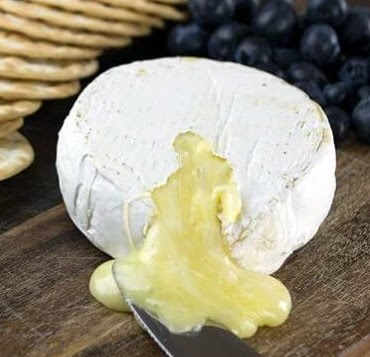
Visually, if left for a while at room temperature, it’s easier to tell the difference because a Camembert will melt whereas Brie will retain its structure.  Because of the marked propensity to melt into something truly gooey, Camembert is often used in cooking, sometimes baked and paired with cranberry sauce or walnuts but. Like Brie, is also a staple of cheese plates, served with things like grapes or figs and eaten with crackers, crusty bread and just about any variety of wine.  One local tradition in the Brie region was the Brie Noir (a type of longer-ripened Brie) which villagers dipped into their café au lait over breakfast.

Turkey, Camembert and cranberry pizza (serves 4)

Ingredients

4 medium pita breads
Olive oil spray
120ml cranberry sauce
1 small garlic clove, minced
80g Camembert, sliced and torn
200g lean shaved turkey breast
8 table spoons parmesan cheese
1 cup rocket leaves

Instructions

(1) Heat oven to 390°F (200°C) conventional or 360°F (180°C) fan-forced and line 2 oven trays with baking paper.

(2) Place pita bread on trays and spray lightly with olive oil.

(3) Mix cranberry sauce with garlic and smear onto the pita bread.

(4) Top with Camembert, shaved turkey and finish with a sprinkling of parmesan.

(5) Bake in the oven for 10-15 minutes until golden and the cheese has melted.

(6) Remove from the oven, sprinkle over rocket leaves and serve.

Phyllo-Wrapped Brie With Hot Honey and Anchovies (serves 10-12)

Ingredients

¼ cup chopped roasted red bell pepper (pre-packaged is fine as well as fresh)
3 oil-packed anchovy fillets, minced
1 garlic clove, finely grated or minced
¾ teaspoon finely grated lemon zest
1 pound phyllo (or filo) dough (must be thawed if bought frozen)
10 tablespoons (1¼ sticks) unsalted butter, melted
1 large (about 26 ounces (750 grams)) wheel of Brie
Hot honey (or regular honey (see below)) for serving
Crackers and/or sliced bread, for serving

Instructions

(1) Heat the oven to 425°F (220°F). In a small bowl, stir together the roasted bell pepper, anchovies, garlic, and lemon zest. Set aside.

(2) On a clean work surface, lay out the phyllo dough and cover it with a barely damp kitchen towel to keep it from drying out. Take 2 phyllo sheets and lay them in an 11 × 17-inch rimmed baking sheet. Brush the top sheet generously with melted butter, then lay another 2 phyllo sheets on top the opposite way, so they cross in the centre and are perpendicular to the first two (like making a plus sign). Brush the top sheet with butter. Repeat the layers, reserving 4 sheets of phyllo.

(3) Using a long sharp kitchen knife, halve the Brie horizontally and lay one half, cut-side up, in the centre of the phyllo (you will probably need another set of hands to help lift off the top layer of cheese). Then spread the red pepper mixture all over the top. Cover with the other half of Brie, cut-side down, and then fold the phyllo pieces up around the Brie. There will be a space in the centre on top where the Brie is uncovered, and that’s okay.

(4) Lightly crumple one of the remaining sheets of phyllo and place it on top of the phyllo/Brie package to cover up that space. Drizzle a little butter on top, then repeat with the remaining phyllo sheets, scattering them over the top of the pastry and drizzling a little butter each time. It may look messy but will bake up into gorgeous golden waves of pastry, so fear not.

(5) Bake until the phyllo is golden, 20 to 25 minutes. Remove it from the oven and let it rest for about 15 minutes before drizzling it with the hot honey. Slice (it will be runny) and serve with crackers or bread, and with more hot honey as needed.

Most baked Bries tend to the sweet with layers of jam or chutney beneath the crust but this is a savoury variation using anchovies, garlic, and roasted bell peppers.  A drizzle of honey and the pinch of lemon zest lends the dish a complexity and for the best effect it should be served straight from the oven because that’s when the Brie is at its most seductively gooey.  It’s ideal with crisp crackers or crusty bread for crunch.  The hot honey is a bit of a novelty and those who want to enhance or tone-down the effect can create their own by stirring a pinch or more of cayenne into any mild honey.