Monday, September 18, 2023

Unrequited

Unrequited (pronounced uhn-ri-kwahy-tid)

(1) Of love, not returned or reciprocated.

(2) Not avenged or retaliated.

(3) Not repaid or satisfied.

1535–1545: The construct was un- + the past participle of requit (ie +-ed).  The un- prefix was from the Middle English un-, from the Old English un-, from the Proto-West Germanic un-, from the Proto-Germanic un-, from the primitive Indo-European n̥-.  It was cognate with the Scots un- & on-, the North Frisian ün-, the Saterland Frisian uun-, the West Frisian ûn- &  on-, the Dutch on-, the Low German un- & on-, the German un-, the Danish u-, the Swedish o-, the Norwegian u- and the Icelandic ó-.  It was (distantly) related to the Latin in- and the Ancient Greek - (a-), source of the English a-, the Modern Greek α- (a-) and the Sanskrit - (a-).  The verb requite dates from circa 1400 in the sense of "repay" (for good or ill), the construct being re- (back) + the Middle English quite (clear, pay up), an early variant of the verb quit preserved in this word.  The –ed suffix was from the Middle English –ede & -eden, from the Old English –ode & -odon (weak past ending), from the Proto-Germanic -ōd- & -ōdēdun.  It was cognate with the Saterland Frisian -ede (-ed) (first person singular past indicative ending), the Swedish -ade (-ed) and the Icelandic -aði.  The suffix was used to form past tenses of (regular) verbs. In linguistics, it remains used for the base form of any past form.  Unrequited is an adjective.  In English, from the 1540s, the earliest reference of the Middle English requiten (to repay), from Old French requiter, is to love affairs.

Probably few were as suited to the calling of suffering as Sylvia Plath (1932-1963) so in taking Ted Hughes (1930–1998; Poet Laureate 1984-2008) as a husband, she made a good career move.

When you give someone your whole heart and he doesn't want it, you cannot take it back. It's gone forever.  Sylvia Plath, The Bell Jar (1963).

Path's only novel, The Bell Jar was first published in the UK under the pen-name "Victoria Lucas" and is usually described as "semi-autobiographical", names of people & places changed to protect the innocent and the guilty, a literary genre known as a Roman à clef (from the French and literally "novel with a key"), the notion of the "key" being that certain knowledge allows a reader to "unlock" the truth, a instance of "reading between the lines" and the technique has widely been used for reasons both personal and legal.  Within a month of publication, Plath would take her own life and it wasn't until 1967 The Bell Jar was re-released under her name.  Dr Heather Clark's (b 1974) recent biography of Plath (Red Comet (2021)) was outstanding.

Emily Brontë (1818–1848) receives insufficient credit for inventing the modern emo and there are more strands of her in them than there are of the brooding German romantics who tend to be more acknowledged.  Were they here today, Cathy and Heathcliff would be in their darkened bedrooms, on their phones, friending and un-friending each other.

You loved me-then what right had you to leave me? What right-answer me-for the poor fancy you felt for Linton?  Because misery and degradation, and death, and nothing that God or Satan could inflict would have parted us, you, of your own will, did it. I have not broken your heart - you have broken it; and in breaking it, you have broken mine.  Emily Brontë, Wuthering Heights (1847).

Her only novel, Wuthering Heights was first published under the ambiguous pen name "Ellis Bell", a hint at the attitudes of many in the literary establishment (and not a few publishers) towards women writers.  Tellingly, critics at the time were often not kind and while the power of the text was noted, for most it seems to have been too raw to be thought "respectable" fiction and it's latter day reputation as one of the classics of English literature evolved only in the twentieth century under the influence of modernist writing and proto-feminism.  Wuthering Heights is one of those books best read when young because if too long delayed, the historic moment may have passed.  That said, there have probably been some young ladies who read it while at their most impressionable and never quite recovered.

There are many portraits of William Shakespeare (1564–1616) but all are of at least dubious provenance and although there is a contemporary reference to a painting or drawing existing during his lifetime, it's thought all known images were probably created after his death.

If asked to distil from Shakespeare’s works the two most frequent themes, one might suggest "low skulduggery" and "unrequited love" though that’s something which might be said of many literary traditions.  In unrequited love Shakespeare saw comedic potential as well as tragedy because it’s as present in Much Ado About Nothing (1598) & All’s Well that Ends Well (1602) as it is in Romeo & Juliet (1594) where youthful agonies are laid bare.  Sometimes there’s overlap between the tragic and the comic: Malvolio’s desire for the affections Olivia in Twelfth Night (1602) are played for laughs although there’s something cruel about the way things end.  In Cymbeline (1609), it’s a tangle with a flavour of a modern TV talk show, Cloten besotted with Imogen, his mother’s husband’s daughter (ie his step-sister).  Queen Katharine (Catherine of Aragon) in Henry VIII (1613) was the first of the king’s many wives and was both abandoned and bewildered why her love was unrequited but Henry had his own agenda and was in some was perhaps closer to Falstaff in The Merry Wives of Windsor (1597) where it’s really an unrequited lust.  Low skulduggery and unrequited love are both explored in Othello (1603), Roderigo’s longing for Desdemona rendering him vulnerable to manipulation by the evil Iago who harbours his own desires.  In Measure for Measure (1603) there’s a reward for Mariana enduring “five years” of unrequited love for “thou cruel Angelo” who cancelled their engagement because he dowery wasn’t enough: “Her promised proportions / Came short of composition”.  Angelo however is outwitted and Mariana gets her man.  In that case, for her at least, all was well that ends well.  So in Shakespeare there is plenty of unrequited love but he seems to have found the Norse and other Germanic myths emotionally over-wrought and was more pragmatic:

Why then, O brawling love! O loving hate!
O any thing, of nothing first create!
O heavy lightness, serious vanity,
Misshapen chaos of well-seeming forms,
Feather of lead, bright smoke, cold fire, sick health,
Still-waking sleep, that is not what it is!
This love feel I, that feel no love in this.
William Shakespeare,
 Romeo and Juliet (1594)


The Roman Poet Ovid (Publius Ovidius Naso; 43 BC–17 AD) in the 814 line Remedia Amoris ("Love's Remedy", circa 2 AD) offered a cure for pining youth suffering the pangs of unrequited love.  His solutions included travel, teetotalism, gardening and, without any apparent sense of irony, the avoidance of love poets.

Lindsay Lohan, Something That I Never Had from Speak (2004).

Do you see me?
Do you feel me like I feel you?
Call your number
I cannot get through
You don't hear me
And I don't understand
When I reach out
Well, I don't find your hand
 
Were they wasted words?
And did they mean a thing
And all that precious time
But I still feel so in-between
 
Someday, I just keep pretending
That you'll stay
Dreaming of a different ending
I wanna hold on
But it hurts so bad
And I can't keep something that I never had
 
Well, I keep tellin' myself
Things can turn around with time
And if I wait it out
You could always change your mind
Like a fairytale
Where it works out in the end
Can I close my eyes?
Have you lying here again

Lindsay Lohan's Something That I Never Had was a tale of the agony of unrequited love.  She should have read from Part XIII of Ovid's Remedia Amoris:

Remembering reopens love, the wound’s newly re-opened:
trifling errors damage the weak-minded.
Consider how, if you touch ashes that are almost dead
with sulphur, they revive, and a tall flame comes from nothing.
So, if you don’t avoid whatever reawakens love,
the flames will light again that once were quenched.

Sunday, September 17, 2023

Caucus & Primary

Caucus (pronounced kaw-kuhs)

(1) In US politics, a meeting of party members within a legislative body to select leaders and determine strategy; a meeting to select candidates, elect convention delegates, etc (now mostly replaced by primaries); a faction within a legislative body that pursues its interests through the legislative process (often initial capital letter).  Also used to a lesser extent in the UK.

(2) Any group or meeting organized to further a special interest or cause.

(3) As a verb, such a meeting (with or without the object).

(4) In Australian, Canadian and New Zealand politics, a meeting of a party (in NZ use restricted to Labour, in Australia to Labor). 

1755–1765, An Americanism; etymologists contest the origin.  It may have been inspired by a private club in colonial Boston at which politicians met to discuss politics and, because the men consumed much tobacco and drink, the source may be the Medieval Latin caucus (drinking vessel), from the Late Latin caucum from the Greek kaûkos.  An alternative view links it to the Virginia Algonquian word cawaassough or caucauasu (counselor, elder, adviser) but this has little scholarly support.  An analogical Latin-type plural cauc is occasionally used but the almost universal plural form is caucuses.

Nibblin' Joe Biden (b 1942; US president since 2021) and his wife, Dr Jill Biden (b 1951) at a campaign stop during the Iowa Caucuses, Council Bluffs, Iowa, 30 November, 2019.

Primary (pronounced prahy-mer-ee or prahy-muh-ree)

(1) First or highest in rank or importance; chief; principal; first in order in any series, sequence etc; first in time; earliest; primitive; constituting or belonging to the first stage in any process.

(2) Of, relating to, or characteristic of primary school, the entry level for formal childhood education.

(3) Of the nature of the ultimate or simpler constituents of which something complex is made up.

(4) Original; not derived or subordinate; fundamental; basic.

(5) In scholarship, pertaining to or being a first-hand account, original data etc, or based on direct knowledge, as in primary source; primary research.

(6) Immediate or direct, or not involving intermediate agency:

(7) In sociology, pertaining to social values or ideals, conceived as derived from the primary group and culturally defined as being necessary to the welfare of the individual and society.

(8) In ornithology, pertaining to any of the set of flight feathers situated on the distal segment of a bird's wing.

(9) In electrical engineering pertaining to the circuit, coil, winding, or current that induces current in secondary windings in a coil, transformer, or the like.

(10) In chemistry, involving or obtained by replacement of one atom or group; noting or containing a carbon atom united to no other or to only one other carbon atom in a molecule.

(11) In linguistics (of a derivative), having a root as the underlying form (ie derived from a word that is not a derivation but the ultimate form itself); As applied in the Latin, Greek, Sanskrit tenses, having reference to present or future time (as opposed to secondary).

(12) In US politics, (also known as a primary election), a preliminary election in which voters of each party nominate candidates for office, party officers. 

(13) As primary (red, yellow, blue) colors, those which cannot be created by mixing other colors.  In digital printing these exist as the CMYK set (cyan, magenta, yellow, and black).

(14) In astronomy, a body in relation to a smaller body or bodies revolving around it, as a planet in relation to its satellites; the brighter of the two stars comprising a double star.

(15) Of production or industry, involving the extraction or winning of such products (agriculture, fishing, forestry, hunting, and mining).

(16) In geology, relating to magmas that have not experienced fractional crystallization or crystal contamination.

(17) In the healthcare industry, the family doctor (US) or GP (Commonwealth), a patient’s initial payment point to enter the system.

1425–1475: Late Middle English, from the Latin prīmārius (of the first rank; chief, principal; excellent), from prīmus (first) + -ārius, the Latin suffix used to form adjectives from nouns or numerals from the primitive Indo-European relational adjectival suffix -yós (belonging to); from this English gained the suffix –ary.  In French the borrowing from the Latin became primaire, primer, and premier.

The Latin prīmārius is a derivation of prīmus (leading, foremost, furthest out, extreme, earliest, first) prīmus was formed from the primitive Indo-European per (forward, in front, through) and variants of the root appear in the Latin prefix, adverb, and preposition prae- & prae (in front, ahead) (adopted as pre- in English) and prō-, prō (implying forward motion, making an opening, priority in time or importance (source of English pro-).  Variants of per appear in the Greek prōtos (first) and the Germanic (Old English) forma, formest, forth, furthra, fyrst, which, in English, became former, foremost, forth, further, first.

Lindsay Lohan in primary colors: yellow, red & blue.

Primary colors are the base set which can be mixed to create other colors.  The classic three were red, blue & yellow but the advent of digital displays meant the model had to be refined and for most purposes the two systems are (1) CMKY and (2) RGB.  The CMKY (cyan, magenta, yellow & key (black)) system is used in painting and printing and is a subtractive model, meaning that colors are created through absorbing wavelengths of visible light.  Wavelengths not absorbed are reflected; that reflected light is the visible color spectrum.  The RGB (red, green & blue) system applies to computers, televisions and other electronic displays.  RGB is an additive model which means colors are created through light waves being combined in certain combinations.

US Caucuses and primaries

In presidential campaigns, a caucus is a system of local gatherings where people decide by public vote which candidate to support and select delegates for nominating conventions.  Caucuses were once the most common way of choosing presidential nominees but now only five remain: Iowa, Kentucky, Nevada, North Dakota and Wyoming.  Most often, only registered voters can participate in a caucus, and they are limited to the caucus of the party with which they are affiliated.  Primaries are a direct, state-wide process of selecting candidates and delegates and, to the voter, differ hardly from other elections.  Primaries come in two basic forms.  In an open primary, all registered voters can vote for any candidate, regardless of their political affiliation.  In a closed primary, voters may vote only for candidates of the party with which they are registered.

Friday, September 15, 2023

Zoanthropy

Zoanthropy (pronounced zoh-an-thruh-pee)

In clinical psychiatry, a mental disorder; a delusion in which the patient believes themselves transformed into one of the lower animals; historically treated as a form of insanity in which one imagines themselves to be another type of beast.

1845: From the French zoanthrope (one who suffers from zoanthropy) or directly from the Modern Latin zoanthropia, the construct being zo-, from the Ancient Greek ζο (zôion) (animal, beast), from the Proto-Hellenic ďyyon, from the Pre-Hellenic gwyōwyon, from the primitive Indo-European gwyeh₃w-y-om, from gwei (to live) + anthrōpos (man); the use in English can thus be analyzed as zo(o)- + -anthropy.  The Greek ζώο (the plural ζώα)) translated literally as “animal, beast, creature” but among citizens was used as an insult to label someone was “a brute; stupid”.  In modern zoological use, it’s used to refer to mammals.  Zoanthropy is a noun and zoanthropic is an adjective; the nous plural is zoanthropies.

The modern terms (covering all animal-delusions and apparently extending to alien life-forms) are Species Identity Disorder & Species Dysphoria, sub-sets of the category Dissociative Identity Disorder (DID) while the historic companion terms of Zoanthropy were Lycanthropy & Boanthropy.  Lycanthropy was from the Ancient Greek λυκανθρωπία (lukanthrōpía), from λυκάνθρωπος (lukánthrōpos) and in the mythology of Antiquity it described the state of being a lycanthrope (or werewolf), one who could shape-shift between being human and wolf, something often claimed to happen involuntarily during a full moon; werewolfdom has for centuries been a staple of writers of things supernatural.  In mythology, by extension, the word was used also to describe those able to shape-shift between the form of a human being and an animal, whether or not a wolf.  In modern psychiatry, it’s sometimes used to refer to the delusion in which one believes oneself to be a wolf or other wild animal.  Boanthropy is the delusion one is an ox or cow, the word derived from bovine, from the Late Latin bovīnus (relating to cattle), from the Classical Latin bōs (ox).  The terms Species Identity Disorder & Species Dysphoria are useful for clinicians who no longer have to deal with the proliferation of species-specific labels for the syndrome including Cynanthropy (dogs) & Ophidianthropy (snakes).  Presumably, while there might be behavioral variations between patients (one believing themselves to be a horse should move differently to one thinking they’re a frog), the treatment regimes will little differ so the names are really of more interest to word nerds than clinicians who have recorded, inter-alia, instances of delusional bees, cats, foxes & chickens.           

Reviews of the literature suggest Zoanthropy is a rare delusion.  There are countless folk who identify with animals and regard them as their spirit being (charismatic creatures like dolphins, eagles and the big cats being popular choices) but a zoanthrope actually believes themselves to be an animal, at least on occasions.  In the last two-hundred odd years, it seems there have been only a few dozen documented cases, three-quarters of whom also suffered some other mental disorders including schizophrenia, psychotic depression & bipolar disorder (the old manic-depression).  Patients suffered both permanent and transitory afflictions which could last only minutes or endure for decades.

Zoanthropic NFT: Lindsay Lohan's Furry canine (some suggested it was wolf-like) was rendered in dolichocephalic form.  The Lohanic fursona was first mentioned in September 2021 but not minted until October.

The fifth edition of the American Psychiatric Association’s Diagnostic and Statistical Manual of Mental Disorders (DSM-5 (2013)) noted (1) it was an inherently psychotic delusion because human metamorphosis into an animal is not possible (as opposed to other delusions which may seem bizarre but which are physically possible) and it seemed overwhelmingly to be associated with instances of monomania (excessive interest or concentration on a singular object or subject; a pathological obsession with one person, thing or idea; an excessive interest with a single subject).  Monomania (the plural monomanias or monomaniæ) was from the French monomanie or the Modern Latin monomania, the construct being mono-, from the Ancient Greek μόνος (mónos) (alone, only, sole, single) + mania.  The suffix –mania was from the Latin mania, from the Ancient Greek μανία (mania) (madness).  In modern use in psychiatry it is used to describe a state of abnormally elevated or irritable mood, arousal, and/or energy levels and as a suffix appended as required.  In general use, under the influence of the historic meaning (violent derangement of mind; madness; insanity), it’s applied to describe any “excessive or unreasonable desire; a passion or fanaticism” which can be used even of unthreatening behaviors such as “a mania for flower arranging, basket weaving etc”.  As a suffix, it’s often appended with the interfix -o- make pronunciation more natural.

Bizarre delusions have traditionally been associated with conditions such as Schizophrenia but the DSM-5 cast a wider net, noting with interest the frequency with which the metaphorical and symbolic language of biblical and other religious texts were mentioned by patients, especially in the specific type of zoanthropy known as boanthropy, the delusion which causes a patient to believe themselves to be a bovine, the fate of Nebuchadnezzar II of Babylon.  According to the Biblical prophet Daniel, Nebuchadnezzar was punished by God and lost his sanity for a period of 7 years:

Immediately the word concerning Nebuchadnezzar was fulfilled; and he was driven away from mankind and began eating grass like cattle, and his body was drenched with the dew of heaven until his hair had grown like eagles’ feathers and his nails like birds’ claws.” (Daniel 4:33)

There has had been speculation Nebuchadnezzar’s behavior may have been a manifestation of clinical Lycanthropy (the delusion of being a wolf) and the Bible makes 13 references to wolves, usually as metaphors for greed and destructiveness although what’s in scripture appears to be more consistent with Boanthropy and that would more align with the agricultural and historical contexts, cattle more common than wolves in the religious motifs and presumably also more numerous in ancient Babylon.

There are variations on the syndrome.  One man in Japan spent a reputed ¥2 million (US$13,500) on a bespoke dog costume to fulfill his desire to “become an animal”.  Known only as Toco, he has a YouTube channel (with some 56,000 subscribers and 3 million views) with footage of him being taken for a walk in a park, rolling on the ground, playing fetch and sniffing other dogs.  He also does a little twerking which will probably disturb as many as it delights.  Toco said he felt some nervousness before his first venture outside but that he’d since become more confident because of the warmth shown to him by people and, interestingly, (some) other dogs.  He added that he enjoys “doing things that only dogs do” without expanding on the comment.  There are practical difficulties Toco has faced including care of the costume which the specialist supplier Zeppet (best-known among film directors for creating sculptures and models for film, television commercials) took some weeks to fabricate before delivery in 2022.  Styled to look like a collie because that was his favorite breed, when outside he wears sandals to protect the feet from wear and stop the “fur” from getting too dirty.  Better to render his experience as a canine more “dog-like”, in February 2023, he acquired a cage and rather than wandering the house at night, Toco is locked in the cage although apparently not on a leash.  Had a leash been used however, that probably wouldn't have been thought an aspect of another syndrome because it was being used only in the context of "dogginess" rather than anything BDSM related.

Dog san: Part of an “interview” by German TV station RTL, 2022.

Predictably, his lifestyle choice has attracted both supporters and detractors but it appears not to be a case of zooanthropy (specifically Cynanthropy) because Toco describes his behavior as “play-acting like a collie”.  He those doesn’t believe himself to be a dog; he just enjoys appearing as one and interacting with others (people and dogs) on that basis, adding it was his “hobby”, one which “makes me happy and other people happy, too.” And what he does is notably less invasive than those who have undergone plastic surgery to give them the characteristic features of various creatures.  In an interview, Toco revealed he had been “dreaming of transforming into a dog since he was a child” so the interesting question is whether he should be considered a harmless eccentric or someone with some form of Dissociative Identity Disorder though clearly not classical zoanthropy.

Non-zoanthropic role-playing.  One astronaut took a gorilla-suit to the ISS (International Space Station).

Thursday, September 14, 2023

Defenestration

Defenestration (pronounced dee-fen-uh-strey-shuhn)

(1) The act of throwing a person out of a window.

(2) In casual, often humorous use, to throw anything out of a window.

(3) A sardonic term in the business of politics which refers to an act which deposes a leader).

(4) In nerd humor, the act of removing the Microsoft Windows operating system from a computer in order to install an alternative.

1618: From New Latin dēfenestrātiō, the construct being dē (from; out) + fenestra (window) + -atio (the suffix indicating an action or process).  It was borrowed also by the Middle French défenestrer (which persists in Modern French) & défenestration.  The German form is Fenstersturz; the verb defenestrate formed later.  The related forms are defenestrate (1915) & defenestrated (1620).  Derived terms (which seem only ever used sardonically) include autodefenestration (the act of hurling oneself from a window), dedefenestration (the act of hurling someone back through the window from which recently they were defenestrationed and redefenestration (hurling someone from a window for a second time, possibly just after their dedefenestration).  Use of these coinings is obviously limited.

The de- prefix was from the Latin -, from the preposition (of; from)  It was used in the sense of “reversal, undoing, removing”; the similar prefix in Old English was æf-.  The –ation suffix is from the Middle English –acioun & -acion, from the Old French acion & -ation, from the Latin -ātiō, an alternative form of -tiō (from which Modern English gained -tion).  It was used variously to create the forms describing (1) an action or process, (2) the result of an action or process or (3) a state or quality.  Fenestra is of unknown origin.  Some etymologists link fenestra with the Greek verb phainein (to show) while others suggest an Etruscan borrowing, based on the suffix -(s)tra, as in the Latin loan-words aplustre (the carved stern of a ship with its ornaments), genista (the plant broom) or lanista (trainer of gladiators).  Fenestration dates from 1870 in the anatomical sense, a noun of action from the Latin fenestrare, from fenestra (window, opening for light).  The now rare but once familiar meaning "arrangement of windows" dates from 1846 and described a certain design element in architecture.  The related form is fenestrated.

Second Defenestration of Prague (circa 1618), woodcut by Matthäus Merian der Ältere (1593–1650).

Although it was already known in the Middle French, defenestrate entered English to lament (or celebrate, depending on one’s view of such things) the Defenestration of Prague in 1618, when Two Roman Catholic regents of Ferdinand II, representing the Holy Roman Emperor in the Bohemian national assembly, were tossed from a third floor window of Hradshin Castle by Protestant radicals who accused them of suppressing their rights.  All three survived, landing either in a moat or rubbish heap defending on one’s choice of history book and thus began the Thirty Years’ War.  The artist called his painting the "Second Defenestration" because he was one of the school which attaches no significance to the 1438 event most historians now regard as the second of three.

The defenestration of 1618 that triggered the Thirty Years’ War wasn’t the first, indeed it was at the time said it had been done in "…good Bohemian style" by those who recalled earlier defenestrations, although, in fairness, the practice wasn’t exclusively Bohemian, noted in the Bible and not uncommon in Medieval and early modern times, lynching and mob violence a cross-cultural political language for centuries.  The first governmental defenestration occurred in 1419, second in 1483 and the third in 1618, although the term "Defenestration of Prague" is applied exclusively to the last.  The first and last are remembered because they trigged long wars of religion in Bohemia and beyond, the Hussite Wars (1419-1435) associated with the first and the Thirty Years’ War (1618-1648) with the Third.  The neglected second ushered in the religious peace of Kutná Hora which lasted decades, clearly not something to remember.  The 1618 event is the third defenestration of Prague).

The word has become popular as a vivid descriptor of political back-stabbing and is best understood sequentially, the churn-rate of recent Australian prime-ministers a good example: (1) Julia Gillard (b 1961) defenestrated Kevin Rudd (b 1957), (2) Kevin Rudd defenestrated Julia Gillard, (3) Malcolm Turnbull (b 1954) defenestrated Tony Abbott (b 1957), (4) Peter Dutton (b 1970) defenestrated Malcolm Turnbull (although that didn’t work out quite as planned, Mr Dutton turning out to be the hapless proxy for Scott Morrison (b 1968)).  Given the recent history it's surprising no one has bother to coin the adjective defenestrative to describe Australian politics although given it's likely there are more defenestrations will be to come, that may yet happen.  Mr Dutton, currently the leader of the Liberal Party of Australia, has never denied being a Freemason.

Some great moments in defenestration

King John of England (1166-1216) killed his nephew, Arthur of Brittany (1187-1203), by defenestration from the castle at Rouen, France, in 1203 (the method contested though not the death).

In 1378, the crafts and their leader Wouter van der Leyden occupied the Leuven city hall and seized the Leuven government.  In an attempt to regain absolute control, they had van der Leyden assassinated in Brussels. Seeking revenge, the crafts handed over the patrician to a furious crowd. The crowd stormed the city hall and threw the patricians out of the window. At least 15 patricians were killed during this defenestration of Leuven.

In 1383, Bishop Dom Martinho (1485-1547) was defenestrated by the citizens of Lisbon, having been suspected of conspiring with the enemy when Lisbon was besieged by the Castilians.

In 1419 Hussite mob defenestrates a judge, the burgomaster, and some thirteen members of the town council of New Town of Prague. (First defenestration of Prague).

Death of Jezebel (1866) by Gustave Doré (1832–1883).

In the Bible, Jezebel was defenestrated at Jezreel by her own servants at the urging of Jehu. (2 Kings 9:33).  Jezabel is used today to as one of the many ways to heap opprobrium upon women although it now suggests loose virtue, rather than the heresy or doctrinal sloppiness mentioned in the Bible.

Jezebel encouraged the worship of Baal and Asherah, as well as purging the prophets of Yahweh from Israel.  This so damaged the house of Omride that the dynasty fell.  Ever since, the Jews have damned Jezabel as power-hungry, violent and whorish.  However, she was one of the few women of power in the Bible and there is something of a scriptural dislike of powerful women, an influence which seems still to linger among the secular.

In the Book of Revelation (2:20-23), Jezebel's name is linked with false prophets:

20 Nevertheless, I have this against you: You tolerate that woman Jezebel, who calls herself a prophet. By her teaching she misleads my servants into sexual immorality and the eating of food sacrificed to idols.

21 I have given her time to repent of her immorality, but she is unwilling.

22 So I will cast her on a bed of suffering, and I will make those who commit adultery with her suffer intensely, unless they repent of her ways.

23 I will strike her children dead. Then all the churches will know that I am he who searches hearts and minds, and I will repay each of you according to your deeds.

Lorenzo de' Medici (circa 1534) by Giorgio Vasari (1511-1574).

On 26 April 1478, after the failure of the "Pazzi conspiracy" to murder the ruler of Florence, Lorenzo di Piero de' Medici (Lorenzo the Magnificent 1449–1492), Jacopo de' Pazzi (1423-1478) was defenestrated.

In 1483, Prague's Old-Town, the bodies of seven murdered New-Town aldermen were defenestrated.  (Second defenestration of Prague).

On 16 May 1562, Adham Khan (1531-1652), The Mughal emperor Akbar the Great’s (1542-1605) general and foster brother, was defenestrated (twice!) for murdering a rival general, Ataga Khan (d 1562).  Akbar was woken up in the tumult after the murder. He struck Adham Khan down personally with his fist and immediately ordered his defenestration by royal order. The first time, his legs were broken but he remained alive.  Akbar ordered his defenestration a second time, killing him. Adham Khan had wrongly counted on the influence of his mother and Akbar's wet nurse, Maham Anga (d 1562) to save him as she was almost an unofficial regent in the days of Akbar's youth.  Akbar personally informed Maham Anga of her son's death, to which, famously, she commented, “You have done well”.  After forty days and forty nights, she died of acute depression.

On the morning of 1 December 1640, in Lisbon, a group of supporters of the Duke of Braganza party found Miguel de Vasconcelos (1590-1640), the hated Portuguese Secretary of State of the Habsburg Philip III (1605-1665), hidden in a closet, killed and defenestrated him.  His corpse was left to the public outrage.

On 11 June 1903, a group of Serbian army officers murdered and defenestrated King Alexander (1876-1903) and Queen Draga (1866-1903).

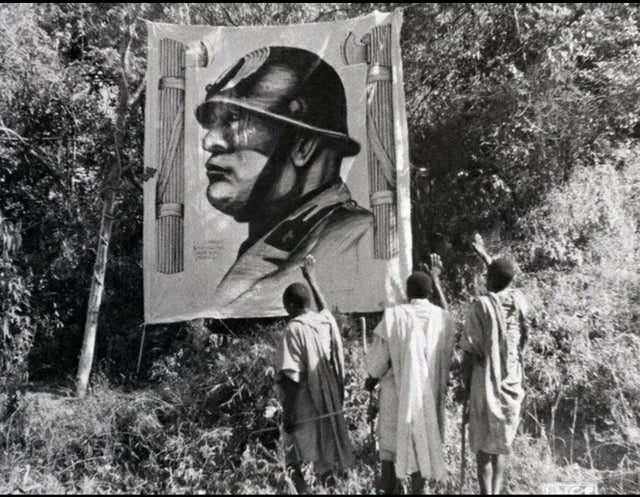
Poster of Benito Mussolini (1883-1945; Duce (leader) & prime-minister of Italy 1922-1943), Ethiopia, 1936.

In 1922, Italian politician and writer Gabriele d'Annunzio (1863-1938) was temporarily crippled after falling from a window, possibly pushed by a follower of Benito Mussolini.  The Duce might almost have been grateful had he suffered the illustrious fate of defenestration, the end of not a few kings and princes.   Instead, Italian communist partisans found him hiding in the back of a truck with his mistress Clara Petacci (1912-1945), attempting to flee to neutral Switzerland.  Taken to a village near Lake Como, on 28 April 1945, both were summarily executed by firing squad, their bodies hung upside down outside a petrol station where the corpses were abused by the mob.  When Hitler saw the photographs, he quickly summoned Otto Günsche (1917–2003), his personal SS adjutant, repeating his instruction that nothing must remain of him after his suicide.

On 10 March 10 1948, the Czechoslovakian minister of foreign affairs Jan Masaryk (1886-1948) was found dead (in his pajamas), in the courtyard of the Foreign Ministry below his bathroom window. The initial (KGB) investigation stated that he committed suicide by jumping out of the window although a 2004 police investigation concluded that he was defenestrated by the KGB.  Mr Putin (Vladimir Vladimirovich Putin; b 1952; president or prime minister of Russia since 1999) started life in the KGB and may have learned his lessons well.

In 1968, the son of the PRC's (People's Republic of China) future paramount leader Deng Xiaoping (2004-1997), Deng Pufang (b 1944), was thrown from a window by Red Guards during the Cultural Revolution (1966-1976).

In 1977, as a result of political backlash against his album Zombie, musician Fela Kuti's (1938-1997) mother (Chief Funmilayo Ransome-Kuti, 1900-1978) was thrown from a window during a military raid on his compound.  In addition, the commanding officer defecated on her head, while the soldiers burned down the compound, destroying his musical equipment, studio and master tapes.  Adding insult to injury, they later jailed him for being a subversive.

On 2 March 2007, Russian investigative journalist Ivan Safronov (1956-2007), who was researching the Kremlin's covert arms deals, fell to his death from a fifth floor window.  There was an investigation and the death was ruled to be suicide, a cause of death which of late has become uncommonly common in Russia, people these days often falling from windows high above the ground.

Dominion Centre, Toronto.

On 9 July 1993, in an unusual case of self-defenestration, Toronto attorney Garry Hoy (1955-1993) fell from a window after a playful attempt to prove to a group of new legal interns that the windows of Toronto’s Dominion Centre were unbreakable.  The glass sustained the manufacturer’s claim but, intact, popped out of the frame, the unfortunate lawyer plunging to his death.  Mr Hoy also held an engineering degree and is said to have many times performed the amusing stunt.  Unfortunately he didn’t live to explain to the interns how the accumulation of stresses from his many impacts may have contributed to the structural failure.

Wednesday, September 13, 2023

Mercenary & Condottiere

Mercenary (pronounced mur-suh-ner-ee)

(1) Working or acting merely for money or other reward; venal; influenced by greed or desire for gain (now less common except in fields like professional politics or corporate structures).

(2) Hired to serve in a foreign army, guerrilla organization etc; a professional soldier hired to serve in a foreign army.

(3) Any hireling (now rare).

(4) In figurative use, one paid to use skills in an ideological, political or commercial conflict in which they have otherwise no interest (often applied in a derogatory sense).

1350–1400: From the Middle English mercenarie (one who works only for hire, one who has no higher motive to work than love of gain), from the thirteenth century Old French mercenaire (mercenary, hireling) from the Latin mercēnnārius (working for pay, hired worker, mercenary, thought perhaps related to the earlier mercēnārius, the construct being mercēdin- (stem of mercēdō, a by-form of mercēs (wages), from mercēd- (payment, wage (akin to merx (goods) and source of the modern merchant)) + -ārius- (ary) (feminine -āria, neuter -ārium), the Latin first/second-declension suffix used to form adjectives from nouns or numerals. 

The original meaning was "working or acting for reward, serving only for gain", hence the association with "sordid motives; ready to accept dishonorable gain", a sense noted from the 1530s.  The most familiar use in modern English, describing the age-old profession, that of "a professional soldier available for hire by any (often foreign) service able to pay" is from the mid-seventeenth century.  Though once use as a neutral descriptor the connotations, of civilians and the military, now almost always tend to the negative.  Mercenary is a noun and adjective, mercenarily is an adverb and mercenariness is a noun.  While not always exactly synonymous, related words include acquisitive, selfish, unscrupulous, warrior, grasping, hireling, legionnaire, slave, avaricious, bribable, corrupt, covetous, grabby, miserly, money-grubbing, sordid, stingy, unethical, unprincipled & venal; those in the opposite sense being altruistic, idealistic & unselfish.  The noun plural is mercenaries.

Condottiere (pronounced kawn-duh-tyair-ey, kawn-duh--tyair-ee (Italian: kawn-dawt-tye-re))

(1) A leader of a private band of mercenary soldiers in Italy, especially between the thirteenth & sixteenth centuries.

(2) Often (though technically imprecise) used to describe any mercenary; soldier of fortune.

1794: From the Italian condotto (leadership), from condurre (to lead), the construct being condott(o) (from the Latin conductus (hired man, past participle of condūcere (to conduce (source of the modern conduct)) + -iere (from the Latin suffix –ārius (-ary).  The noun plural is condottieri or the anglicized condottieres.  The verb conduce dates from circa 1400 although the original sense "to lead, to conduct" is now obsolete.  It was from the Latin condūcere (to lead or bring together, contribute, serve), from an assimilated form of com (with, together) + ducere (to lead (from the primitive Indo-European root deuk- (to lead).  The intransitive sense of "aid in or contribute toward a result" is from the 1580s.

Statute of Garibaldi (1895) by Ettore Ximenes (1855–1926) & Augusto Guidini (1853-1928), Largo Cairoli, Milan, Italy.

Giuseppe Garibaldi (1807-1882) was an Italian nationalist general and politician.  As a condottiere, Garibaldi has been called the "hero of the two worlds" because of his military enterprises in Brazil, Uruguay and Europe and is best remembered for his personal command of many of the military campaigns which led eventually to Italian unification in 1871.  His reputation as a romantic revolutionary has flourished because historians have seemed always anxious to present his military adventures as noble causes rather than apply the standards imposed on others, certainly since the Nuremberg trial (1945-1946) codified matters such as “planning aggressive wars” and “waging aggressive wars”.  Clearly, when deciding where things lie on the shifting spectrum of international morality, context matters.

Garibaldi and the Garibaldians (1907), oil on canvas by Plinio Nomellini (1866–1943), Museo Civico Giovanni Fattori, Livorno, Italy.  Garibaldi (on horseback) and the bugler are both in calf-length riding boots.

Garibaldi was certainly an appealing actor in a drama-filled century of European history.  Even had he felt the political unification of the peninsular was either desirable or inevitable, Count Cavour (1810–1861), prime ,inister of Piedmont–Sardinia, showed no interest in pursuing the matter because, as an astute politician of what would come to be known as the power-realist school, knew the difficulties were insurmountable and the implications of any attempt to achieve the goal were likely dark.  Garibaldi was interested in a united Italy, believed in miracles and knew they could make real the the impossible.  The unusual combination of circumstances at home and abroad which existed in the aftermath of all that had happened between the Congress of Vienna (1814-1815) and the revolutions of 1848 were made Garibaldi’s project actually possible but it was the natural genius he possessed as a condottiere which assured success.  Notably, Cavour, sniffing the political winds stirred when suddenly Garibaldi was by revolutionary means unifying Italy from the south in a way Cavour knew couldn’t be achieved by diplomatic means from the north, staged what would now be called a political flip-flop, ceasing trying to thwart Garibaldi and instead claimed the whole campaign was his policy.

Lindsay Lohan in garibaldino shirt and knee-high boots.

Garibaldi’s part in the movement for Italian unification (known as il Risorgimento (Rising Again)) also produced a footnote in para-military fashion.  His followers were known as the Garibaldini and in lieu of a uniform, they wore the red shirts he favored, the popular legend being it was to ensure they weren’t distracted from fighting were their blood to be spilled.  It was also an indication the campaign was a popular insurrection, not one fought by conventional military maneuvers or with traditional formations because, as the red-coated British soldiers had discovered, red wasn’t a good color to wear on a battlefield.  The word Garibaldino (plural Garibaldini) is used to refer to any volunteer soldier who served in the cause and the red shirts (which were never standardized in shade, style or cut) are often called garibaldino shirts or just garibaldinos.

The Swiss Guard

One of the oldest military formations in continuous active service, The Pontificia Cohors (Pontifical Swiss Guard; also often referred to as Papal Guard or, most commonly, Swiss Guard) is the ceremonial and armed force of the Holy See.  Based in the Vatican, it provides security for the Pope and Apostolic Palace.  The tradition of The Swiss Guard can be traced back to the pontificate of Sixtus IV (1414-1484; pope 1471-1484) when an alliance was formed with the Swiss Confederacy, barracks built in the Papal States should the need arise to hire Swiss mercenaries.  The treaty was renewed under subsequent popes and the guard did see active service at times when the pope was in alliance with France but it was under the Borgia popes of the late fifteenth century it was reorganized as a conventional military formation, fielded not only by the Holy See but used also to augment the armies of France and the Holy Roman Empire.  Their performance in battle during the war between France and Naples was noted by Cardinal Giuliano Della Rovere (1443-1513), a military-minded priest later nicknamed the warrior pope, his name chosen to render honor unto Julius Caesar.  Upon assuming the papacy as Julius II (pope 1503-1513), he requested the Swiss Diet (parliament) furnish a battalion (about two-hundred soldiers) of mercenaries for his protection.  They entered barracks in 1506 and this is regarded as the formation of the Papal Swiss Guard.

Francis (1936-2025; pope 2013-2025) inspects the Swiss Guard.

The colors blue and yellow have been in use since the sixteenth century and are believed to represent the Della Rovere coat of arms of Julius II, the red appended to represent the Medici coat of arms of Leo X (1475–1521; pope 1513-1521).  While historians suspect it apocryphal, Leo X is remembered for the quip "God has given us the papacy, let us enjoy it".  Even if those words never passed the lips of the Medici Pope, his pontificate was conducted in that spirit.  Although from time-to-time the guard has been disbanded and after heavy battlefield losses was for a time even replaced by German mercenaries ("the Visigoths are back at the gates of Rome" as the locals wryly would note), the formation has for centuries been an almost constant presence in the Vatican.  Having long ceased to be a military unit, their increasingly ceremonial role was reassessed in the late twentieth century as the threat profile evolved.  The guard is now a professional security and personal protection operation, all members having undergone firearms and related training by Swiss army instructors.