Saturday, February 13, 2021

Concordat

Concordat (pronounced kon-kawr-dat)

(1) An agreement or compact, especially an official one Agreement between things; mutual fitness; harmony.

(2) A formal agreement between two parties, especially between a church and a state.

(3) In Roman Catholic canon law, a pact, treaty or agreement between the Holy See and a secular government regarding the regulation of church matters.  In early use it was sometimes a personal agreement between pope and sovereign.

1610–1620: From the the sixteenth century French conciordat, replacing concordate from the Medieval Latin concordātum (something agreed), a noun use of the Latin concordatum, neuter of concordātus, past participle of concordāre (to be in agreement; to be of one mind), from concors (genitive concordis) (of one mind)  from concors (genitive concordis) (of one mind).  The original definition in Roman Catholic canon law was "an agreement between Church and state on a mutual matter".  Concordat is a noun, the noun plural is concordats and concordatory is an adjective.  Concord dates from 1250-1300, from the Middle English and Old French concorde from the Latin concordia, (harmonious), genitive concordis (of the same mind, literally “hearts together”).  Concordat is a noun and concordant an adjective; the noun plural is concordats.

The Duce, Benito Mussolini (1883–1945; Prime Minister of Italy 1922-1943, right) and Cardinal Pietro Gasparri (1852–1934; Cardinal Secretary of State 1914-1930, left) signing the Lateran Concordat in 1929.

The concordat, a formal agreement between the Holy See and a sovereign state, dates from a time when the relationship between the Church and sovereign entities was different than what now exists.  Indeed, the dynamics of the relationships have changed much over the centuries but, at any given moment, concordats have always been practical application of Church-state relations and, like all politics, were an expression of the art of the possible, a concordat not necessarily what a pope wanted, but certainly the best he could at the time manage, the best known tending to be the controversial, notably (1) the treaty of 1801 with Napoleon Bonaparte (1769–1821; leader of the French Republic 1799-1804 & Emperor of the French from 1804-1814 & 1815), (2) the Lateran Accord agreed in 1929 with Mussolini which created the modern city-state of the Vatican and which was the final step in Italian unification and (3) The Reich Concordat of 1933, the accommodation with Hitler’s Germany which was supposed to resolve the issue of relations which had been unsettled since Otto von Bismarck's (1815-1989; Chancellor of the German Empire 1871-1890) time but which Berlin repeatedly violated.

La Signature du Concordat aux Tuileries 15 juillet 1801 (The Signing of the Concordat at the Tuileries, 15 July 1801) (1803-1804) by François Pascal Simon Gérard (1770–1837) (titled as Baron Gérard in 1809); the original hangs in the Musée National des Châteaux de Versailles et de Trianon, Versailles.  

At least those violations weren’t wholly unexpected.  Cardinal Eugenio Pacelli (1876–1958; Pope Pius XII 1939-1958) had been Apostolic Nuncio (ambassador; 1926-1929) to Berlin and was Cardinal Secretary of State (foreign minister; 1930–1939) when the Reich Concordat was signed and he was under no illusion.  When it was said to him that the Nazis were unlikely to honor the terms, he replied with a smile that was true but that they would probably not violate all its articles at the same time.  The sardonic realism would serve the cardinal well in the years ahead when often he would required to choose the lesser of many competing evils.  Some though, for a while, retained hope if not faith.  As late as 1937, Archbishop Conrad Gröber (1872–1948; Archbishop of Freiburg 1932-1948) thought the Reich Concordat proof that “…two powers, totalitarian in their character, can find agreement, if their domains are separate.  Adolf Hitler (1889-1945; German head of government 1933-1945 & head of state 1934-1945), another cynic though then still a realist, viewed the concordat much as Hermann Göring (1893-1946) would in his trial at Nuremberg describe all the treaties executed by the Nazis: “so much toilet paper”.  Actually an admirer of the Roman Catholic Church which had survived two-thousand years of European rough and tumble, he was resigned to a co-existence but one on his terms, noting the day would come when there would be a reckoning with those black crows.

Two of the twentieth century's great survivors, German vice chancellor Franz von Papen (1879-1969) (second from left) and the Holy See's secretary of state Cardinal Eugenio Pacelli (the future Pope Pius XII) (head of the table) meet in the Vatican on 20 July 1933 to sign the Reischskonkordat which some six weeks later was ratified by the Nazi-dominated Reichstag (the German parliament).  The cardinal calculated the Church would gain from the arrangement but had few illusions about the Nazis.  Later, when being driven through Rome where he saw two men fighting in the street, he remarked to his companion "I imagine they've probably just signed a concordat".

That’s not to say there haven’t always been theorists who wandered a bit beyond the possible.  After the Reformation, there were those in the Church who held that the Church sits above the state in all things (the “regalist” position), while others (maintaining the “curialist” position) held that although the Church is superior to the state, the Church may grant certain privileges to the state through agreements such as concordats.  In the modern age, the accepted understanding of concordats is that the Church and the various sovereign states are both legal entities able to enter into bilateral agreements.  Concordats are thus no different than other treaties & agreements in that being executed under international law, they are enforceable according to legal principles.  Church and state may in some ways not be co-equal but canon law does recognise the two exist in distinct spheres and is explicit in respecting the bilateral agreements that the Holy See has entered into with other nation-states.  The Code of Canon Law states unambiguously that concordats override any contrary norms in canon law: “The canons of the Code neither abrogate nor derogate from the agreements entered into by the Apostolic See with nations or other political societies. These agreements therefore continue in force exactly as at present, notwithstanding contrary prescripts of this Code.”  This is an unexceptional statement familiar in many constitutional arrangements where two legal systems interact, the need being to define, where conflict may exist, which has precedence and is no more than an application of a legal maxim known to both canon and secular law: pacta sunt servanda (agreements must be honored).  Concordats can both protect and clarify the rights of the Church by precisely defining relationship between the Church and a state, expressed by the Second Vatican Council’s (Vatican II 1962-1965) pastoral constitution on the Church in the modern world, Gaudium et spes (Joay and Hope) in the statement:

The Church herself makes use of temporal things insofar as her own mission requires it.  She, for her part, does not place her trust in the privileges offered by civil authority.  She will even give up the exercise of certain rights which have been legitimately acquired, if it becomes clear that their use will cast doubt on the sincerity of her witness or that new ways of life demand new methods.”

In other words, “if you can’t beat them, join them”, or, at least, enter into peaceful co-existence with them, a position in the modern age possible, if not uncontroversial with sovereign and sub-national entities notionally with Catholic majority populations (eg Bavaria 1966, Austria 1969, Italy 1985) but also with countries where Christians exist only as tiny minorities (eg Tunisia 1964, Morocco 1985, Israel 1993).  Nor does a concordat need to be a complete codification, the agreement between the Holy See and Tel Aviv noting that in certain matters, agreement had not been reached and discussions need to continue.  Such “framework” or “stepping-stone” agreements have been in the diplomatic toolkit for centuries but they’re a statement of professed intent and in the decades since there’s been little apparent progress in many of the unresolved matters important to the Holy See regarding physical property in the Holy Land and the “working document” was never ratified by the Israeli parliament (the Knesset).  At least partially filling this diplomatic lacuna was something which has thus far proved a coda to the Holy See’s official recognition in 2012 of the State of Palestine.  In 2015, The Vatican concluded a concordat with “the State of Palestine” (sic), supporting a two-state solution to the conflict between Palestine and Israel “on the basis of the 1967 borders”.  According to Rome, the provisions in the agreement concern technical (ie financial & legal) aspects of the legal status of Catholic facilities and personnel on the West Bank and the Gaza Strip.  That may be as boringly procedural as it sounds but what’s aroused interest is that the Vatican has refused to publish the text or comment on the details, thus arousing suspicion that the treaty between with the Palestinians might, at least in part, contradict the earlier concordat with Israel.  From Washington to Tel Aviv, many are interested in the small print.

Rome 1929: The Duce reads the Lateran Concordat's small print.

Interestingly, Vatican II struck the term concordat from canon law, apparently in a nod to the Council's declaration on religious liberty, Dignitatis humanae (Of the Dignity of the Human Person) which mused on the evolution of a “…different model of relations between the Vatican and various states [which] is still evolving.”  Whatever might have been intended to be the implications of that, it reappeared with the Polish Concordat of 1993 and seems to be here to stay.

The term concordat can be used of any arrangement by which parties achieve some sort of entente cordiale and it’s sometimes only in retrospect (which can take decades) their true from can be understood variously as a reconciliation (Paris Hilton & Lindsay Lohan), marriage of convenience (Turkey’s (now the Republic of Türkiye) membership of NATO (North Atlantic Treaty Alliance) or a cynical expediency (the Ribbentrop-Molotov (Nazi-Soviet) Pact (1939)).

Friday, February 12, 2021

Lord

Lord (pronounced lawrd)

(1) In historic use, the master of the servants of a household; the master of a feudal manor (obsolete).

(2) A person who has authority, control, or power over others; a master or chief (now used only informally).

(3) A person who exercises authority from property rights; an owner of land, houses etc (a concept which persists in British & (some) Commonwealth land law in the title of Lord Paramount; in historical use, a feudal tenant holding his manor directly of the monarch.

(4) Informally, a person who is a leader or has great influence in a chosen profession; a magnate of a trade or profession (tobacco lords, press lords etc).

(5) In medieval Europe, a feudal superior, especially the master of a manor.

(6) In the UK peerage, a courtesy title granted to the sons of senior peers.

(7) The Lords Spiritual and Lords Temporal comprising the UK's House of Lords (always plural).

(8) In the UK, the ceremonial title of certain officials (used with some other title, name, or the like) such as Lord Chancellor, Lord Chief Justice etc.

(9) As “my Lord Bishop”, the polite title of a bishop (obsolete).

(10) In the peerage of the UK, the title informally substituted for baron, viscount, earl or marquis.

(11) The Supreme Being; God; Jehovah (initial capital letter).

(12) The Savior, Jesus Christ (initial capital letter).

(13) In astrology, a planet having dominating influence.

(14) Slang for a husband considered as head of the household (archaic except in the facetious phrase lord and master although use persists in some fundamentalist sects).

(15) In UK slang, a hunchback (obsolete).

(16) In Australian slang sixpence (the five cent piece) (obsolete).

1300s: From the fourteenth century Middle English lord and lorde, from the thirteenth century lourde and other variants which dropped the intervocalic consonant of the earlier lowerd, louerd, loverd, laford & lhoaverd, all derived from the Old English hlāford, from hlāfweard, the construct being hlāf (bread) + weard (keeper, guardian).  The term was already being applied broadly prior to the literary development of Old English and was influenced by its common use to translate Latin dominus.  The equivalent Scots form laird (lord), preserved a separate vowel development (which was the influence of the northern (Scottish & Middle English lard & laverd)), like the Old English compound hlāf-ǣta (servant (literally “bread-eater”)) and the modern English lady, from the Old English hlǣfdīġe (bread-kneader).  The Old English hlaford was a contraction of earlier hlafweard (literally "one who guards the loaves), the construct being from hlaf (bread, loaf) + weard (keeper, guardian), from the primitive Indo-European root wer- (perceive, watch out for).  The Middle English word laford entered Icelandic, where it survives as lávarður.  The modern monosyllabic form emerged in the fourteenth century and was used as an interjection from late in the century, the Lord's Prayer dating from the 1540s and although the Old English hlaford (master of a household, ruler, superior) also used to describe God (translating the Latin Dominus), the Old English drihten was much more common.

Warts & all: Portrait of Oliver Cromwell (1599–1658; Lord Protector of the Commonwealth 1653-1658) (1650), oil on canvas by Samuel Cooper (1609-1672).

The meaning "an owner of land, houses etc” dates from circa 1300, originally in the sense of “a landlord”.  As “my lord”, it was by 1540 (in England) the usual polite form when addressing a nobleman under the rank of a duke and a bishop" as was an interjection from the late fourteenth century.  As a general term of convenience used for the "peers of England" (especially those represented in parliaments), the use emerged in the mid-fifteenth century.  The Lord's Prayer was from the 1540s and the phrase "Year of our Lord" (ie AD, (translating the Latin anno domini) came into use from the late fourteenth century.  The expressions conveying a state of ignorance (Lord knows” & “Lord only knows” (both often appended with who, what, why etc)) seem first to have been recorded in 1711 although in oral use there may be a long tradition.  The phrase “drinks like a lord”, was from the 1620s, presumably an either allusion to the cost of strong drink or the habits of the gentry.

The verb lord dates from circa 1300 in the sense of "to exercise lordship, rule as a lord" and was directly from the noun, the intransitive meaning "to play the lord, domineer" emerging late in the fourteenth century, the phrase “to lord it over” first recorded in the 1570.  The interjection lordy was first noted in 1832 in imitation of African-American vernacular and was an extended form of the noun.  The noun lordling (puny or contemptible lord) was a late term of disparagement and is long obsolete.  An ancient calling, the noun warlord was coined only in 1856 and was usually considered a translation of the German Kriegsherr or the Chinese junfa.  The early fourteenth century adjective lordly originally had the sense of "haughty, imperious; of or pertaining to lords, noble” and was used as an adverb to convey “despotically” but by the 1530s was used to demote “magnificent, on a grand scale, fit for a lord”.  Lordship was from circa 1300 and was a direct translation of the Old English hlafordscipe (authority, rule, dominion (translating the Latin dominatio) and in common law developed as part of the system of land title.  As a form of address to nobles, judges etc, use emerged and was gradually formalized from the late fifteenth century.  The noun landlord (owner of a tenement, one who rents land or property to a tenant) dates from the early fifteenth century and by then Lord had been a surname for over a hundred years, best known now from the London cricket ground.  The Scottish laird (landed proprietor or hereditary estate-holder) emerged in the mid-fifteenth century, having been used a surname since the thirteenth, both forms a Scottish and northern England dialectal variant of lord.  Lord is a noun, proper noun, verb & interjection, lorded is a verb, lording is a noun & verb, lordy is an interjection and lordly is an adjective & adverb; the noun plural is lords.

Keith Miller (1919-2004), fourth Victory Test, Lord’s, August 1945.

The origin of Lord's Cricket Ground, in St John's Wood, London has nothing to do with the peerage.  It’s named after its founder, Thomas Lord (1755-1832) and is the third of three grounds he established between 1787 and 1814.  Lord was approached in 1786 by leading members of the White Conduit Club who wanted a more private venue and offered to underwrite the project so in May 1787, Lord acquired seven acres (28,000 m²) off Dorset Square for his first ground and White Conduit relocated there, soon becoming part of the new Marylebone Cricket Club (MCC).  When the lease ended in 1810, Lord secured an eighty-year lease on two fields, the Brick and Great Fields at North Bank, St John's Wood.  The second venue, now referred to as Lord's Middle ground, was built by 1809 but in 1813, Parliament requisitioned the land for Regent's Canal, thereby necessitating a further move.  Lord then moved his ground to the present site, literally rolling up the turf from the old and transplanting it to the new.

Following our Lord and Savior: Lindsay Lohan depicted as a Christ-like figure, draped in a white robe, arms outstretched, crucifixion-style, complete with crown of thorns (a nice touch), Lindsay Lohan, Purple Fashion magazine, Spring-Summer edition, 2010.

The image was one of a series by Terry Richardson (b 1965) and appeared on the cover of the spring-summer 2010 edition of the French magazine Purple Fashion, the photo-shoot featuring clothes by a number of designers including Zac Posen, Alexander McQueen & Emmanuel Ungaro but predictably it was the invocation of our Lord Jesus which attracted most interest.  A spokesman for the French Catholic League was quoted as saying "Not only is the pose inappropriate, the timing is offensive." (the magazine was released on the eve of Lent, the most sacred season in the Christian liturgical calendar).  Although Ms Lohan at the time had not much been associated with penitence and abstinence, not long before she had tweeted that she believed it's "...all about karma...what goes around comes around."  In Hinduism and Buddhism, karma is an expression which describes the cyclical nature of an individual's thoughts & actions in this and previous lives, something which decides their fate in future existences.  Noting that, The League's spokesman said "If she believes that, then it behooves her to apologize to Christians before it's too late.", adding that she is "...spiritually homeless..." and "...would benefit by converting to Christianity."  Ms Lohan did not respond to the comments.

Thursday, February 11, 2021

Chicane

Chicane (pronounced shi-keyn or chi-keyn)

(1) In bridge, a hand without trumps.

(2) In motor sport, one bend or a short section of sharp bends formed either by the design of the track or by barriers placed on the circuit.

(3) To quibble over; cavil at (now rare, probably extinct).

(4) A less common word for chicanery (deception; trickery); to use chicanery, tricks or subterfuge (rare).

1665-1675: A borrowing from the French chicane, from chicaner (to quibble (of obscure origin)), from the Middle French chicaner, from the Middle Low German schicken & schikken (to arrange), ultimately from the Proto-Germanic skikkijaną, origin of modern French chic.  The word has been used in English in various senses, including as an "act of chicanery” (the art of gaining advantage by using evasions or cheating tricks) from the 1670s.  The now most familiar sense, "obstacles on a roadway" didn’t emerge until 1955 (quickly spreading to motor-racing circuits) although it had been a technical term in bridge design since the 1880s.  All the English forms are from the archaic verb chicane (to trick), first noted in the 1660s, from the sixteenth century French chicane (trickery) from chicaner (to pettifog, to quibble).  Chicane, chicanery & chicaner are nouns, chicanerous is an adjective and chicaned & chicaning are verbs; the noun plural is chicanes.

Chicanery & low skullduggery: The film Mean Girls (2004) was based on Rosalind Wiseman's (b 1969) book Queen Bees and Wannabes: Helping Your Daughter Survive Cliques, Gossip, Boyfriends, and Other Realities of Adolescence (2002) which explored the interaction of the shifting social cliques formed by school girls.

Of the chicanery of the FIA

The FIA (Fédération Internationale de l'Automobile (International Automobile Federation)) has since 1904 been involved in the organisation and regulation of motor-racing.  The FIA used to be mostly harmless but in recent decades has degenerated into about the most dopey regulatory body in sport, making the men of World Rugby’s (the old International Rugby Board (IRB)) standing Laws Committee look like chaps of rare skill and talent.  For a long time the FIA have approved not at all of any interesting form of motor-racing, their response always to make things slower and more processional, a curious approach in a sport about speed.  Although most obsessed with publishing volumes of complex regulations which require the employment of FIA officials to administer, the FIA also has an almost fetishistic relationship with chicanes.  A chicane is essentially an obstruction which requires a racing car to slow to negotiate.  While curves, climbs and corners have always been part of just about any form of motor-racing, the FIA seems never convinced there are enough.  It’s suspected if the FIA had their way, there would be no straights on motor-racing circuits, just corners.

Le Mans, before and after.

Mulsanne Straight (Ligne Droite des Hunaudières in French) at Circuit de la Sarthe where the annual Twenty-Four Hours of Le Mans (24 Heures du Mans) is run was once 3.7 miles (6 km) in length.  It was one of the sport’s great institutions, the speeds attained a benchmark of progress in engineering and aerodynamics.


These achievements impressed most but not the FIA which, for reasons of their own, decided to sabotage things, initially by reducing the maximum engine capacity in the premier class, firstly from seven litres to five and later to three.  When this didn’t prove sufficient to nobble the engineers, they insisted two chicanes be added to Mulsanne Straight.  They were installed in 1990 and proved effective, no car since has, in the race, come within 20 mph (32 km/h) of the marks set in the late 1980s and speeds in excess of 200 mph (320 km/h) are now rare.  The FIA has emasculated other circuits too; in 1987 a chicane (the Chase) imposed upon Conrod Straight at Mount Panorama, Bathurst in Australia.  Quite why the FIA remains involved in motor-racing isn’t clear when it’s apparent they'd be better suited to the administration of something like competitive basket-weaving.

Wednesday, February 10, 2021

Recursive

Recursive (pronounced ri-kur-siv)

(1) Pertaining to or using a rule or procedure that can be applied repeatedly; periodically recurring.

(2) Drawing upon itself, referring back.

(3) In mathematics, of an expression, each term of which is determined by applying a formula to preceding terms

(4) In computing, of a program or function that calls itself (often in the form of an endlessly repeating script).

(5) In computing theory, of a function which can be computed by a theoretical model of a computer, in a finite amount of time.

(6) In computing, a set whose characteristic function is recursive.

(7) In linguistics (as recursive acronym), an acronym in which the first letter of the first word represented by the acronym is the acronym itself.

1790: From the stem of Latin recursus, perfect passive participle of recurrō (I run or hasten back; I return, revert, recur), the construct being recurs(ion) + -ive.  The –ive suffix is from the Anglo-Norman -if (feminine -ive), from the Latin -ivus; the related forms are the adverb recursively and the noun recursiveness.  Until the fourteenth century, all Middle English loanwords from the Anglo-Norman ended in -if (actif, natif, sensitif, pensif etc) and, under the influence of literary Neolatin, both languages introduced the form -ive.  Those forms that have not been replaced were subsequently changed to end in -y (hasty, from hastif, jolly, from jolif etc).  Like the Latin suffix -io (genitive -ionis), the Latin suffix -ivus is appended to the perfect passive participle to form an adjective of action.  The use in mathematics dates from 1934.  Recursive is an adjective inflected form of recursion which is a noun.  Recursive is an adjective, recursivity & recursiveness are nouns and recursively is an adverb; the noun plural is recursivities.  

The recursive acronym

Although recursive acronyms had existed before, appearing in fiction as early as 1968, the term first gained wider attention when discussed in US physicist’s Douglas Hofstadter's (b 1945) 1979 book Gödel, Escher, Bach: an Eternal Golden Braid.  Recursive acronyms typically form backwardly: either an existing ordinary acronym is given a new explanation or, a name is turned into an acronym by giving the letters an explanation of what they stand for, in each case with the first letter standing recursively for the whole acronym.

Not an easy txt to absorb for those without a helpful background, even the title of Gödel, Escher, Bach is at first glance misleading because it’s not a look at the relationships between art, music and mathematics but instead an exploration of the abstract structures which exist within each.  These Hofstadter called “strange loops”, the logician Kurt Friedrich Gödel (1906–1978) having demonstrated their existence in any mathematical system of sufficient complexity.

Relativity, lithograph (1953) by MC Escher (1898–1972).

Hofstadter pursued these structural imperatives in music and art, suggesting it’s strange loops which creates consciousness, the connections and chemicals in the human brain creating the fundamental base of the framework on which are hung ideas, feelings, hopes and desires, all of which manifest further up the framework.  Consciousness became possible (and there are those who suggested inevitable) because the hierarchy clinging to the framework can twist back on itself: higher and lower levels influencing and interacting so the lower which once must have entirely determined the upper is also changed, ideas and feelings having an actual physical impact, this tangling of hierarchies being our sense of self.

Others, tentatively had posed similar questions.  Eugene Charniak’s (b 1946) strangely neglected PhD thesis (MIT, 1974) at least hinted it might be fruitful to explore the relationship of knowledge and inference to natural language understanding and Gödel, Escher, Bach is a playful, clever, if sometimes obviously contrived way to offer one explanation of how cognition emerges from a mechanistic structure which is reflected in work that cognition can allow to be created.  As a technical point, remarkably for a piece so dependent on the nuances and interplay of language, Gödel, Escher, Bach has been translated.

Many recursive acronyms come from the field of computing; it’s nerd humor.

TLA: Three Letter Acronym

AROS: AROS Research Operating System

BAMF: BAMF Application Matching Framework

BIRD: BIRD Internet Routing Daemon

GNU: GNU's Not Unix

KGS: KGS Go Server

LAME: LAME Ain't an MP3 Encoder

MINT: MINT Is Not TRAC

MiNT: MiNT is Not TOS (which later became MiNT is Now TOS)

TIARA: TIARA is a recursive acronym

UIRA: UIRA Isn't a Recursive Acronym

WINE: WINE Is Not an Emulator (was originally Windows Emulator)

XINU: Xinu Is Not Unix

XNA: XNA's Not Acronymed

XNU: X is Not Unix

Tuesday, February 9, 2021

Cooper

Cooper (pronounced koo-per or koop-er)

(1) A person who makes or repairs casks, barrels, etc.

(2) A drink of half stout and half porter (obsolete).

1350–1400: From the Middle English couper (craftsman who makes barrels, tubs, and other vessels from wooden staves and metal hoops), which etymologists are convinced would have come from an Old English form but it has proved elusive.  Both the English words are almost certainly related to the Middle Low German kūper, the East Frisian kuperor and Middle Dutch cūper, from the Low German kupe (cask, tub, vat), from the Medieval Latin cūpārius, the construct being cūp(a) (cask or vat) + ārius. (from the The nominative neuter form -arium which, when appended to nouns, formed derivative nouns denoting a “place where things are kept”).

The meaning "craftsman who makes wooden vessels" was originally associated with the word couper, cooper a later construct of coop + er.  Coop is from the Middle English coupe & cupe, from the Old English cȳpe (basket; cask) or possibly the Middle Dutch cûpe (related to the modern Dutch kuip, Saterland Frisian kupe & Middle Low German kûpe), from the Old Saxon kûpa & côpa (cask), related to the Middle Low German kôpe, the Old High German chôfa & chuofa, the Middle High German kuofe, the modern German kufe (feminine form of cask), which most sources trace back to the Classical Latin cūpa & Medieval Latin cōpa (cask) although the OED has cast doubt on this etymology because of the mysterious umlaut in Old English cýpe.  The er agent (noun-formation) suffix is from the Middle English er & ere, from the Old English ere, from the Proto-Germanic ārijaz.  It’s thought a borrowing from the Latin ārius; cognate with the Dutch er and aar, the Low German er, the German er, the Swedish are, the Icelandic ari and the Gothic areis.  Related too are the Ancient Greek ήριος (rios) and Old Church Slavonic арь (arĭ) and although synonymous, actually unrelated is the Old French or & eor (the Anglo-Norman variant is our) which is from the Latin (ā)tor, derived from the primitive Indo-European tōr.

As a surname, the name is attested from the late twelfth century, either from the unattested Old English or a Low German source akin to Middle Dutch cuper , East Frisian kuper, ultimate source the Low German kupe (which became kufe in German), cognate with the Medieval Latin cupa.  A now rare variation is hooper although it remains common as a surname.  Within the profession, a dry cooper makes casks to hold dry goods, a wet cooper those to contain liquids and a white cooper, pails, tubs, and the like for domestic or dairy use.  The surname Cowper is pronounced koo-per or koop-er everywhere except Australia which preserved the fifteenth century spelling but modified the pronunciation to cow-pah.  The Australian federal electorate of Cowper was created in 1900 as one of the original sixty-five divisions and is named after Sir Charles Cowper (1807–1875) who was on five occasions between 1856-1870 the premier of the colony of New South Wales (NSW), Australia.

The Maserati Formula 1 V12, 1956-1957 & 1966-1969

1954 Maserati 250F "short nose".

Remarkably, the three litre Maserati V12 used by Cooper to win Grand Prix races in 1966 & 1967 was an update (developed out of necessity) of a 2.5 litre engine used (once) in 1956.  Maserati’s new straight-six 250F had enjoyed a stunning start to its career, enjoying victories in the first two Grands Prix of the 1954 season but was soon eclipsed by the Lancia D50 and particularly the Mercedes-Benz W196, both with more powerful eight cylinder engines and advanced aerodynamics.

1955 Maserati 250F Streamliner.

Maserati responded and, taking note of the all-enveloping "streamliner" bodywork Mercedes-Benz used on the W196s used on the faster circuits, developed a quasi-enveloping shape, the emphasis wholly on reducing drag (downforce would attract the interest of a later generation).  For the slower tracks, there was also an aerodynamic refinement of the open-wheeler, the “long-nose” which proved such a success it would become the definitive 250F.  The more slippery shapes helped but the problem of the power deficit remained, the advanced Mercedes-Benz engine, built with the benefit of experience gained with the wartime aero engines, used fuel-injection and a desmodromic valve-train which permitted sustained high-speed operation.  Maserati’s engineers devoted time to devise a fuel injection system and borrowed an innovation from the roadsters built for the Indianapolis 500, an off-set installation of the engine in the chassis which permitted the driveshaft to be to run beside rather than beneath the driver, lowering the seat and thus improving both aerodynamics and weight-distribution.

1954 Maserati 250F "long nose".

Two grand prix wins in 1956 suggested progress was being made but, although Mercedes-Benz withdrew from racing after 1955, competition from other constructors was growing so Maserati turned its attention to both chassis and engine.  An all-new multi-tubular space-frame chassis was designed, lighter and stronger than its more conventional predecessor, it retained the double wishbone front and De Dion rear suspension and, perhaps surprisingly, the engineers resisted the more efficient and now well-proven disc brakes, the revised drums instead aided by enhanced cooling.  The new engine was not ready for 1956 so the straight-six was again fielded although the off-set layout was discarded.  The new chassis was called Tipo 2.

Maserati 250F (Typo 2), on the  carousel, Juan Manuel Fangio (1911–1995), German Grand Prix,  Nürburgring, 1957.

Developed specifically for the Tipo 2 was the V12, its twin camshafts driven by front-mounted gears with the novelty of the Weber carburetors being mounted between the camshafts.  Maintaining a Maserati tradition, a twin spark ignition system was fitted, the 24 spark-plugs fed by two sturdy magnetos, again gear-driven and linked by 24 individual coils.  In many ways the state of 1950s engineering art, the marvelously intricate 2.5 litre V12 produced 320 bhp at what was then a startling 12,000 rpm, an increase of 50 bhp over the 2.5 litre straight six.  With the V12 still being developed, the team started the 1957 season with the 250F Tipo 2 and the straight six.  The faithful six was reliable and proved powerful enough to prevail over the Ferraris and the cars which unexpectedly emerged as the most impressive competition: the British Vanwalls.  The season would be Maserati’s finest, Juan Manuel Fangio winning his fifth world championship (at the age of forty-five) and, had there been a constructors title (not awarded until 1958), Maserati would have taken that trophy too.  The season is remembered also for Fangio’s famous victory in the German Grand Prix at the Nürburgring, in which he broke the lap record ten times in twenty-two laps, the Tipo 2’s straight six clearly good enough.

1956 Maserati 250F Tipo 2 V12.

The success of the straight-six afforded the engineers a wealth of time thoroughly to develop the V12.  After early tests showed the power delivery, although impressive, was too brutal to deliver the flexibility needed in a racing car, attention was devoted to widening the torque curve.  Three Tipo 2 chassis were built for the V12 engine, one ready in time for the final Grand Prix of the year, the symbolically important home event, the Italian Grand Prix at Monza.  A redesigned gearbox housing again allowed an off-set mounting which, although improving weight distribution, made the body sit so low on the frame, two bulges had to be formed in the bonnet to clear the carburetor intakes.  It looked fast and it was.  However, in scenes reminiscent of the troubles suffered by the ferociously powerful Auto-Unions and Mercedes-Benz of the pre-war years, the V12 250F, although fast, suffered high tyre-wear, the rear tyres clearly not able long to endure the abrasive demands of 320 bhp.  Still, it had been an encouraging debut, even if a lubrication problem had prematurely ended the venture.

Lindsay Lohan in Mini Cooper, Mauritius, 2016.

Unfortunately, there would not for a decade be another chance to run the V12 in a Grand Prix.  Financially challenged, Maserati retired from international racing at the end of the 1957 season, the remaining 250Fs sold to privateers either with the straight six or as a rolling chassis.  How competitive a fully-developed Tipo 2 V12 might have been in 1958 will never be known but the credentials were there and, against the dominant Ferraris and Vanwalls, it would have been an interesting contest, the 1958 season the end of an era, the last year either the drivers’ or constructors’ championships would be won using front-engined cars.  On paper, the Maserati V12 was the most powerful engine fielded during Formula One’s 2.5 litre era.

Cooper-Maserati T81, Guy Ligier (1930–2015), Belgium Grand Prix, Spa-Francorchamps, 1967.

Although it did see some use in sports-car racing, the V12’s most (briefly) illustrious second life came when, in 1965, a doubling of engine displacement to three litres was announced for the next Formula One season, the 1.5 litre voiturettes used between 1961-1965 exquisitely engineered but lacking the noise, speed and spectacle with which others were attracting interest.   This created a scramble for competitive engines and with renewed interest in the mothballed V12, Maserati dusted-off the cobwebs.  Cooper adopted it and enjoyed early success with the advantage of being the first team running cars with a full three litres, the reliability of the old V12 adding another edge over others still shaking down their initially fragile new engines.

Cooper-Maserati T81b, Pedro Rodríguez (1940–1971),  German Grand Prix, Nürburgring, 1967.

Soon however, Cooper were running a decade-old design against much newer competition and the antiquity began to tell.  Although some updating had been done, early experiments with six and even a remarkable twelve carburettors quickly abandoned for the even by then de rigueur fuel injection, in that decade, several generations of engineering had passed and the V12 was looking pre-historic.  Unable to change anything fundamental, Maserati bolted on what it could, including 18-valve cylinder heads that added weight and complexity, but did little to narrow the widening gap.  Rumors of 24-valve heads and even three spark-plugs per cylinder never came to fruition but the latter did prompt some wry comments questioning the efficiency of Maserati's combustion chamber design if that many fires needed to be lit.  Maserati withdrew from Formula One during the 1968 season and Cooper soon followed.

Sunday, February 7, 2021

Niche

Niche (pronounced nĭch (U) or nēsh (Non-U))

(1) In architecture, a cavity, hollow or recess, generally within the thickness of a wall and usually semi-circular in plan and arched, for a statue, bust, or other erect ornament; in interior decorating the synonym is nook.

(2) Any similar recess, such as one in a rock face.

(3) Figuratively, any similar position such as (1) a place or position suitable or appropriate for a person or thing or (2) a distinct or specialised segment of a market.

(4) In ecology, the role of a plant or animal within its community and habitat which determines its activities and relationships with other organisms.

(5) In contrast radiography, an eroded or ulcerated area.

(6) In Islam, an arrow woven into a Muslim prayer rug pointing in the direction of Mecca (qibla).

(7) In the funeral industry, as cremation niche; a columbarium.

1605-1615: From the Middle English niche (shallow recess in a wall), probably from the Old & Middle French niche (recess (for a dog), kennel), a back formation from nicher (to make a nest), from the unattested Vulgar Latin nīdiculāre, from the Classical Latin nīdus (nest), the words niche & nicher enduring in Modern French.  Niche was a doublet of nidus and nide via the Latin and the related nest via the primitive Indo-European and was related also to nyas.  Some etymologists are not convinced by the notion of a direct Latin root and trace the French niche (recess (for a dog), kennel) to a fourteenth century borrowing from the Italian nicchia (niche, nook) derived from nicchio (seashell).  The dissidents note the link to the Latin mitulus (mussel) but also the lack of any documentary evidence for the change of -m- to -n-.  The origin in the Old French noun derived from nichier is said to come via the Gallo-Romance nidicare from Latin nidus (nest) but it remains one of those insoluble disputes in linguistics.  The figurative sense was first recorded in 1725, the use in ecology dating from 1927 and contemporary coinings like niche market, multi-niche & niche player are all from the twentieth century.  Niche is a noun and nicher, nichering & nichered are verbs; the noun plural is niches.

Pronunciation

While the origin of niche is of interest only to the profession, the dispute over pronunciation has a wider audience: nĭch (the U version and phonetically nich) or nēsh (non-U and neesh)?  Many dictionaries (especially the descriptive) list both but those which offer only one (the prescriptive) insist on nitch.  The descriptive (and thus linguistically promiscuous) Merriam-Webster’s on-line presence lists several pronunciations for niche: nitch, neesh and nish, in a deliberate attempt to reflect English as it’s actually spoken while Webster’s more prescriptive print edition continues to insist on nich.  The Gallic-influenced neesh is said now to be the preferred US use.

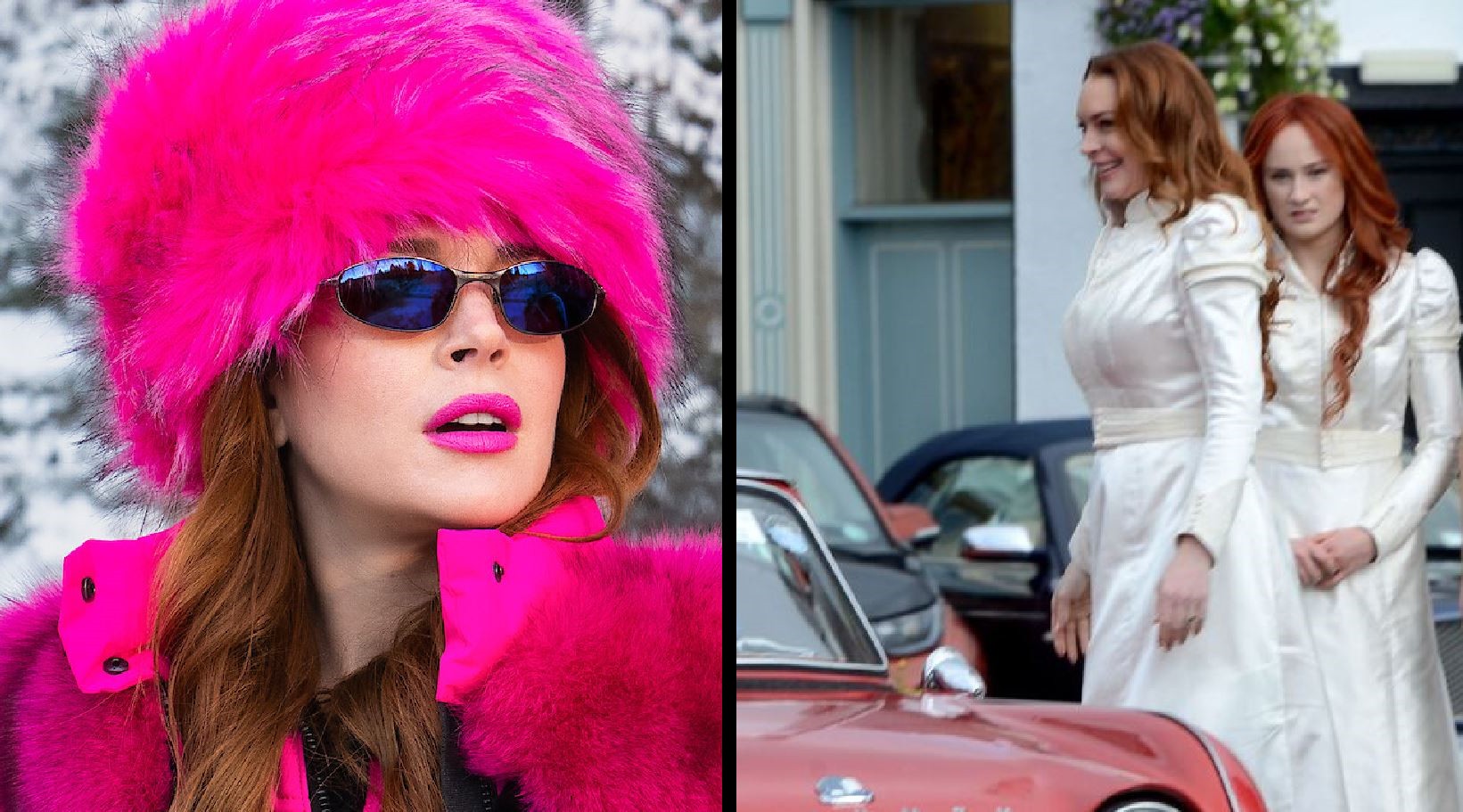
Lindsay Lohan in Falling for Christmas (left) and Irish Wish with Triumph TR4 and body double (right).  In film, a niche differs from a franchise in that the former is a conceptual genre and independent of the characters, the latter thematic and generally dependent on the continuity of at least one character.  Lindsay Lohan’s two recent Netflix productions, Falling for Christmas (2022) & Irish Wish (slated for 2023) are in the rom-com (romantic comedy) niche.

There are two types of dictionaries: prescriptive and descriptive and most modern dictionaries are descriptive, meaning they attempt to describe the language as it’s used, including, explicitly or by implication, all pronunciation variants of a word used by educated speakers.  This approach does upset some purists but this is how English has always evolved, a slut of a language which picks up words which seem useful, uses them as required and dumps them when they’re outlived their usefulness.  It’s tempting to suggest those who read Anthony Trollope (1815-1882) say nith, those who watch TikTok prefer neesh but if ever that was true, it may no longer be but, when in doubt, stick to the classics: niche should be pronounced nich.

Niche, nitch & the W113 notch

So things started with niche and later there came nitch which was (1) an alternative form of knitch (a small bundle), (2) a blend of nick + notch (a dialectal form meaning "a small notch or incision") and (3) a simple misspelling of niche which caught on.  In the collector car market there are many niches and while there’s overlap and some multi-niche players, niches are often siloed, one being the Mercedes-Benz W113.  The W113 was a small roadster of spare, elegant lines which was produced in 3 versions (230 SL, 250 SL & 280 SL) between 1963-1971 and is known among the cognoscenti as the “pagoda” an allusion to the unusual curve of the roof of the detachable hard-top.  Upon release, the slight concave effect was sometimes misunderstood and the factory was at pains to point out it was the side windows which had been raised, not the centre of roof lowered.  The look had great aesthetic appeal but it also (1) permitted easier ingress & egress and (2) enhanced structural rigidity, allowing the use of thinner pillars which provided better visibility.  The successor roadster (the R107, 1971-1989) used a similar roof design but the pagoda moniker is unique to the W113.

1971 Mercedes-Benz 280 SL in Silver over Black Leather (left) and 1970 280 SL in Midnight Blue over Blue Leather (right).  

Also unique to the W113 niche is the cult of the notch.  Part of the charm of the W113 and a proof it came from a time when Mercedes-Benz were rather more “hand-made” than now, were the leaded-seam “fender notches”, small creases in the fender, inboard of the headlights, which workers on the assembly line hand-shaped with tin, their purpose being to ensure the notch matched both the kink in the headlight surround and the crease on the outside of the fender.  That ensured perfect alignment (this was a time when the factory took seriously such intricate details of quality control) but were thought at the time just part of the manufacturing process and not publicized.

By their notches shall they be known: Headlight notches (left & right) on US market 1969 Mercedes-Benz 280 SL in Anthracite Grey Metallic over Gray Leather.  

Thus, in the decades before the W113 became a collectable and long before originality became a fetish, when replacing fenders (supplied from the factory without a notch), repair shops unfamiliar with the breed sometimes wouldn’t fashion a notch one to match the one replaced, unaware perhaps even of their existence (and "asymmetric" W113s have been seen with an single notch).  There were tales too of the factory’s notches even being smoothed-out as a “fix” by W113 neophytes thinking the grooves a manufacturing defect or the result of accident damage although these stories may be apocryphal.  However, those who have had a replacement fender “notched” exactly to match the one removed may still not satisfy the originality police because the inner fender spot welds which affix the fender to the structure are said to have been done in a manner almost impossible to replicate.  It’s metal so it can be done but it’s not easy to convince the experts who judge such things and they are tough judges.