Thursday, March 5, 2020

Exiguous

Exiguous (pronounced ig-zig-yoo-uhs or ik-sig-yoo-uhs)

Scanty; meagre; small; slender.

1645–1655: From the Latin exiguus (small, petty, paltry, scanty in measure or number (feminine exigua; neuter exiguum)), from exigere (to drive out, take out & to weigh out; to finish; to measure against a standard), the construct being exig(ere ) + -uus (the deverbal adjectival suffix).  The construct of exigere was ex- (out) + agere (to set in motion, drive, drive forward; to do; to perform) from the primitive Indo-European root ag- (to drive, draw out or forth, move), a root extraordinarily productive in English, forming all or part of: act; action; active; actor; actual; actuary; actuate; agency; agenda; agent; agile; agitation; agony; ambagious; ambassador; ambiguous; anagogical; antagonize; apagoge; assay; Auriga; auto-da-fe; axiom; cache; castigate; coagulate; cogent; cogitation; counteract; demagogue; embassy; epact; essay; exact; exacta; examine; exigency; exiguous; fumigation; glucagon; hypnagogic; interact; intransigent; isagoge; litigate; litigation; mitigate; mystagogue; navigate; objurgate; pedagogue; plutogogue; prodigal; protagonist; purge; react; redact; retroactive; squat; strategy; synagogue; transact; transaction & variegate.

Exiguous fashion: Recent landmarks in clothes for warmer climates

2010 Christina Hendricks at the Primetime Emmy Awards.

2012 Anja Rubik at the Met Gala.

2013 Jaimie Alexander.

2013 Jessica Simpson at the MTV Awards.

2014 Emily Blunt.

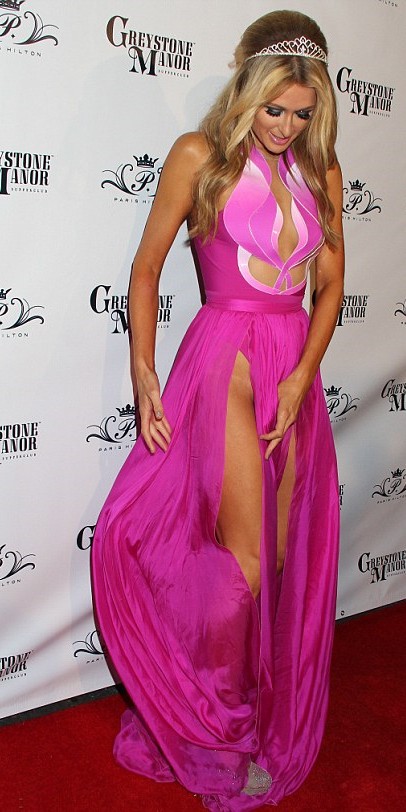
2014 Paris Hilton at her 33rd birthday party.

2015 Alessandra Ambrosio.

2015 Amanda Cerny at the MTV Awards.

2015 Ariel Winter at the SAG Awards.

2015 Britney Spears at the MTV Awards.

2015 Gigi Hadid at the Cannes Film Festival.

2015 Gloria Govan at the premiere of The Wedding Ringer.

2015 Kendall Jenner at the Met Gala 2015.

2015 Lily Aldridge at the MTV Awards.

2015 Lindsay Lohan at the premiere of Liz & Dick.

2015 Nazanin Boniardi at the Emmy Awards.

2015 Nicky Hilton at the Versace Autumn Winter Show.

2015 Nicole Trunfio at the ELLE Awards.

2015 Rosie Huntington-Whiteley at the Met Gala.

2015 Salma Hayek at the Evening Standard Theatre Awards.

2015 Gigi Hadid at the Academy Awards.

2016 Alesha Dixon at the Bafta Awards.

2016 Alessandra Ambrosio at Malibu Beach.

2016 Amber Rose.

2016 Ashley Graham at the Vanity Fair Academy Awards Party.

2016 Bella Hadid at the Grammy Awards.

2016 Charlize Theron at the Academy Awards.

2016 Charlotte Mckinney in Las Vegas.

2016 Dayane Mello at the Venice Film Festival.

2016 Emily Ratajkowski.

2016 Giulia Salemie at the Venice Film Festival.

2016 Hannah Ferguson at the Sports Illustrated swimsuit issue launch.

2016 Kara Del Toro at the premiere of
Undrafted.

2016 Karlie Kloss at the Metropolitan Museum of Art.

2016 Kendall Jenner at the Cannes Film Festival.

2016 Manika at the Grammy Awards.

2016 Margot Robbie at the Metropolitan Museum of Art.

2016 Miranda Kerr at the Vanity Fair Academy Awards Party.

2016 Bella Hadid at the Cannes Film Festival.  Thus far, the dress of the twenty-first century.

2016 Rita Ora at the MTV Awards.  The dress of the century re-imagined.

2017 Allana Ferguson at the NSWRL Awards.

2017 Demi Rose.

2017 Kendall Jenner at the Met Gala.

2017 Lady Gaga.

2017 Nicki Minaj.

2017 Rose Byrne at the Met Gala.

2018 Alexis Skyy.

2018 Ariel Winter at the Palm Springs International Film Festival.

2018 Charlotte McKinney.

2018 Elsa Hosk at the Vanity Fair Academy Award Party.

2018 Halsey at the amFAR Gala.

2018 Jennifer Lawrence.

2018 Jennifer Lopez.

2019 Emily Ratajkowski at the Tony Awards.

2019 Kim Kardsahian.

2019 Taylor Mega at the Venice Film Festival.

2020 Lauren Goodger.

2021 Lindsey Pelas.

2021 Anna Paul.

2021 Becky G at the E! People's Choice Awards.

2021 Bella Hadid at the Cannes Film Festival.

2021 Demi Ros.

2021 Dixie D'Amelio at the MTV Awards.

2021 Kate Hudson at the Venice Film Festival.

2021 Margarita Smith.

2021 Maya Henry at Paris Fashion Week.

2021 Megan Fox at the Met Gala.

2021 Olivia Rodrigo.

2021 Saweetie at the MTV Awards.

2021 Zoe Kravitz at the Met Gala.

2022 Anna McEvoy at Melbourne Fashion Week.

2022 Elsa Hosk at the Vanity Fair Academy Awards Party.

2022 Halsey at the iHeartRadio Music Awards.

2022 Heidi Klum at the Vanity Fair Academy Awards Party.

2022 Janelle Monae at the Vanity Fair Academy Awards Party.

2022 Jenna Dewan at the Vanity Fair Party.

2022 Kristen Wiig at the Critics Choice Awards.

Wednesday, March 4, 2020

Shibboleth

Shibboleth (pronounced shib-uh-lith or shib-uh-leth)

(1) A belief, principle, or practice which is commonly adhered to but which is thought by some people to be inappropriate or out of date.

(2) A custom, phrase, or use of language that acts as a test of belonging to, or as a stumbling block to becoming a member of, a particular social class, profession etc.

(3) A slogan; catchword.

Circa 1300s: From the Hebrew שִׁבֹּלֶת (shibbólet) (ear of grain (the part of a plant containing grain, such as the head of a stalk of wheat or rye) (and more rarely "stream, flood or torrent")).  The word was used as a password by the Gileadites as a test to detect the fleeing Ephraimites, who could not pronounce the sound sh (Judges 12:4–6).  From this emerged by the 1630s the figurative sense of "watchword", the additional meaning "outmoded slogan still adhered to" noted by 1862.

The Ephraimites and the Gileadites

The story behind the word is in the Old Testament’s Book of Judges (12:1-15).  In ancient Hebrew, shibboleth translated literally as “ear of grain” (stream, flood or torrent in some translations), some groups pronouncing it with a "sh" sound, but speakers of related dialects pronounced it with a hard s.  In the story, two Semitic tribes, the Ephraimites and the Gileadites, fight a great battle.  The Gileadites defeat the Ephraimites, and set up a blockade across the Jordan River to catch the fleeing Ephraimites who were trying to get back to their territory.  The sentries asked each person who wanted to cross the river to say the word shibboleth. The Ephraimites, who had no "sh" sound in their language, pronounced the word with a hard s and were thereby unmasked as the enemy and slaughtered.

12:4 Then Jephthah gathered together all the men of Gilead, and fought with Ephraim: and the men of Gilead smote Ephraim, because they said, Ye Gileadites are fugitives of Ephraim among the Ephraimites, and among the Manassites.

12:5 And the Gileadites took the passages of Jordan before the Ephraimites: and it was so, that when those Ephraimites which were escaped said, Let me go over; that the men of Gilead said unto him, art thou an Ephraimite? If he say Nay;

12:6 Then said they unto him, Say now Shibboleth: and he said Sibboleth: for he could not frame to pronounce it right. Then they took him, and slew him at the passages of Jordan: and there fell at that time of the Ephraimites forty and two thousand.

As a technique to identify foreigners, the use may have predated  the biblical tale of the Gileadites and Ephraimites and there are many instances in history.  The Italians used the test-word cicera (chick pease) to identify the French during the massacre called the Sicilian Vespers (1282).  

1941 Chrysler New Yorker Three Passenger Coupe.

During WWII, while conducting training exercises on Pavuvu and Guadalcanal, the Marines improved battlefield security not with a password, but by an identification procedure described as "sign and countersign", the technique being sequentially to interrogate an unknown friend or foe with the name of an automobile which required the "L" sound in vocalization.  The response was required to be a cognomen for another automobile uttered in the same manner and in an accent definitely American; those who answered call out "Chryswer" or "Cadiwac" likely to be shot.  Jamie Lee Curtis (b 1958) revealed she once used a variation of the technique.  Upon receiving a text message (“Hi, Jamie, it's Linds”) apparently from Lindsay Lohan (b 1986), to verify it really was her, she responded: “What was the name of the song that you and I were learning the rap to while we were stuck in the car all day doing the French fry scene? What was the song we were fast-forwarding and rewinding to write down the lyrics of the rap to?  Upon receiving the correct answer (Like I Love You (2002) by Justin Timberlake (b 1981), the text exchange resumed.

A loaf of Ukranian palyanitsa.

The ancient use of a shibboleth to allow the detection of enemies within was revived in 2022 during the Russian invasion of Ukraine.  Ukrainians, if suspecting someone might be a Russian, challenge them to say the word palyanitsa”, a soft wheat bread with a crispy crust, natives of the two nations pronouncing it differently and it's said to be difficult for Russians to master the Ukrainian form. 

Tuesday, March 3, 2020

Martini

Martini (pronounced mahr-tee-nee)

(1) A surname of Italian origin.

(2) A breech mechanism for a rifle (a clipping of “Martini-Henry”, a lever action, breech-loading single-shot rifle in service with the British Army 1871-1918).

(3) A rifle using similar features.

(4) A cocktail made with a mix of gin (or vodka) & dry vermouth, served usually with a green olive (the twist of lemon a more recent alternative and a dozen or more variations like peppermintini, chocolatini dirty martini and pornstar martini(!) have proliferated).

1885-1890:  Origin disputed; it may be an alteration of Martinez (an earlier alternate name of the drink) but is probably by association with the vermouth manufacturer Martini, Sola & Co. (later Martini & Rossi). Another theory holds it’s a corruption of Martinez, California, town where the drink was said to have originated.  Others claim it was first mixed in New York but then NYC claims lots of things happened there first.  Martini is a noun; the noun plural is martinis.

CCTV image capture, New York City, 24 July 2012.  Noted one-time (and since reformed) martini aficionado Lindsay Lohan enjoys a vodka martini.

By 1922 the martini had assumed its modern, recognizable form: London dry gin and dry vermouth in a ratio 2:1, stirred in a mixing glass with ice cubes, sometimes with addition aromatic bitters, then strained into a chilled cocktail glass.  Green olives were the expected garnish by the onset of World War II (1939-1945) with a twist of lemon peel often seen by the 1950s and from the 1930s, the amount of vermouth tended steadily to drop as the cult of the dry martini prevailed.  Today, a typical dry martini is made with a ration between 6:1 and 12:1.  Some were more extreme, the playwright Noël Coward (1899–1973) suggesting filling a glass with gin, then lifting it in the general direction of the vermouth factories in Italy.  The author Ian Fleming (1908–1964) had James Bond follow Harry Craddock's (1876–1963; long-time barman (now bar attendant) at London's Savoy Hotel) shaken, not stirred directive from The Savoy Cocktail Book (1930) but contemporaries, the author Somerset Maugham (1874–1965) and Franklin Roosevelt (1882–1945; US president 1933-1945), neither a stranger to a Martini, both recommended stirring although chemists observe the concept of “bruising the gin” has no basis in chemistry or any other branch of science.  The vodka martini came later.  It was first noted in the 1950s when known as the kangaroo cocktail, a hint at its disreputable colonial origins but normally reliable sources commend the blueberry vodka martini and purists concede this is the only martini to benefit from using sweet vermouth.  In 1966, the American Standards Association (ASA) released K100.1-1966, "Safety Code and Requirements for Dry Martinis," a humorous account of how to make a "standard" dry martini. The latest revision of this document, K100.1-1974, was published by American National Standards Institute (ANSI).  Flippant they may have been but they’re good guides to the classic method.
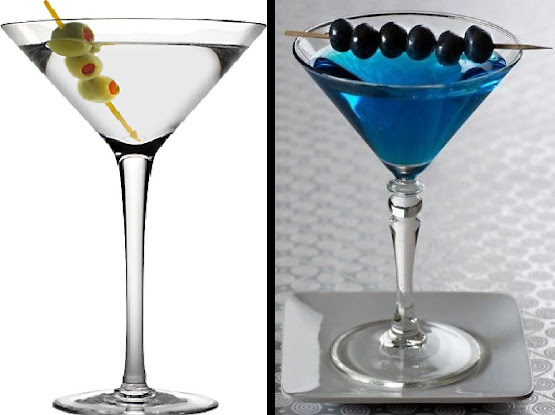
Compare & contrast: A classic gin martini (left) and a Stoli blueberry vodka martini (right)

Stoli Blueberry Vodka Martini Recipe

Ingredients

60 ml (2 oz) Stoli Blueberi Vodka
60 ml (2 oz) sweet vermouth
15 ml (½ oz) lemon Juice
3-5 fresh blueberries
Ice Cubes

Instructions

(1) Pour Stioli Blueberi Vodka, sweet vermouth and lemon juice into cocktail shaker and middle blueberries.
(2) Add ice cubes until shaker is two-thirds full.
(3) Shake thoroughly until mixture is icy.
(4) Strain and pour into chilled martini glasses.
(5) Skew blueberries with cocktail pick, garnish martini and serve.
(6) Add a little blueberry juice to lend a bluish tincture (optional).

Cocktail Party by Laurence Fellows (1885-1964), Esquire magazine, September 1937.

Unfairly or not, cocktail parties in drawing rooms at which Martinis were served gain a reputation as sometimes louche affairs.  Note the elegantly sceptical expressions on the faces of the women, all of whom have become immured to the tricks of “charming men in suits”.  For women, sherry parties were more welcoming places.

Martini Racing, the Porsche 917 and the Pink Pig

Porsche 917LH, Le Mans, 1970.

Unlike some teams which maintained a standard livery, Martini Racing sometimes fielded other designs.  One noted departure was the “hippie” or “psychedelic” color scheme applied to the Porsche 917LH (Langheck (Longtail)) which placed second at Le Mans in 1970 and proved so popular that the factory received requests from race organizers requesting it be entered.  Weeks later, across the Atlantic, the organizers of the Watkins Glen Six Hours wanted their own ‘hippie’ 917 but with the car in Stuttgart, Martini Racing took over another team’s car and raced in ‘hippie’ colors to ninth place on one day and sixth the next.

Porsche 917K, 1970.

Subsequently the scheme was reprised in another, even more lurid combination of yellow & red in another psychedelic design, this time to match the corporate colors of Shell, the teams sponsor.  This remains the only surviving psychedelic car, the factory’s Langheck 917 being converted to 1971 specifications and painted in Gulf Oil’s livery for Le Mans.  Like many other used 917s, subsequently it was scrapped by an unsentimental Porsche management.

Pink Pig Porsche 917-20, 1971.

Although it raced only once, the “Pink Pig” (917-20) remains one of the best remembered 917s.  In the never-ending quest to find the optimal compromise between the down-force needed to adhere to the road and a low-drag profile to increase speed, a collaboration between Porsche and France's Société d’Etudes et de Réalisations Automobiles (SERA, the Society for the Study of Automotive Achievement) was formed to explore a design combine the slipperiness of the 917-LH with the stability of the 917-K.  Porsche actually had their internal styling staff work on the concept at the same time, the project being something of a Franco-German contest.  The German work produced something streamlined & futuristic with fully enclosed wheels and a split rear wing but despite the promise, the French design was preferred.  The reasons for this have never been clarified but there may have been concerns the in-house effort was too radical a departure from what had been homologated on the basis of an earlier inspection and that getting such a different shape through scrutineering, claiming it still an “evolution” of the original 917, might have been a stretch.  No such problems confronted the French design; SERA's Monsieur Charles Deutsch (1911-1980) was Le Mans race director.  On the day, the SERA 917 passed inspection without comment.
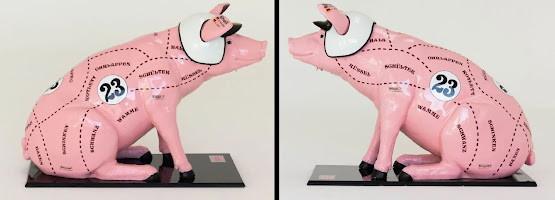
Der Trüffeljäger von Zuffenhausen (The Trufflehunter from Zuffenhausen), a fibreglass display (some 45 inches (1150 mm) in length) finished in the Pink Pig’s livery.  It includes battery-operated LED (light emitting diode) fixtures within the nostrils, activated by a toggle switch under an access panel on the neck.  Weighing some 50 lb (23 kg), it measures (length x width x height) 45 inches x 20 x 32 (1140 x 510 x 810 mm).  In an on-line auction in 2024, it sold for US$3800.

Pink Pig Porsche 917-20, Le Mans, 1971.

At 87 vs 78 inches (2200 mm vs 2000 mm), the SERA car was much wider than a standard 917K, the additional width shaped to minimize air flow disruption across the wheel openings.  The nose was shorter, as was the tail which used a deeper concave than the “fin” tail the factory had added in 1971.  Whatever the aerodynamic gains, compared to the lean, purposeful 917-K, it looked fat, stubby and vaguely porcine; back in Stuttgart, the Germans, never happy about losing to the French, dubbed it Das Schwein (the pig).  Initially unconvincing in testing, the design responded to a few tweaks, the factory content to enter it in a three hour event where it dominated until sidelined by electrical gremlins.  Returned to the wind tunnel, the results were inconclusive although suggesting it wasn't significantly different from a 917K and suffered from a higher drag than the 917-LH.  It was an indication of what the engineers had long suspected: the 917K's shape was about ideal.
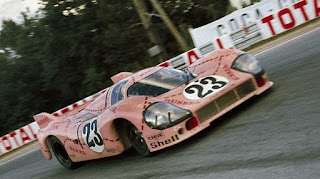
Pink Pig Porsche 917-20, Le Mans, 1971.

For the 1971 Le Mans race, the artist responsible for the psychedelia of 1970 applied the butcher’s chart lines to the body which had been painted pink.  In the practice and qualifying sessions, the Pig ran in pink with the dotted lines but not yet the decals naming the cuts; those (in the Pretoria typeface), being applied just before the race and atop each front fender was a white pig-shaped decal announcing: Trüfel Jäger von Zuffenhausen (the truffel hunter from Zuffenhausen); the Pink Pig had arrived.  Corpulent or not, in practice, it qualified a creditable seventh, two seconds slower than the 917-K that ultimately won and, in the race, ran well, running as high as third but a crash ended things.  Still in the butcher's shop livery, it's now on display in the Porsche museum.

Pink Pig Porsche 917-20, 1971.

Scuttlebutt has always surrounded the Pink Pig.  It's said the decals with the names of the cuts of pork and bacon were applied furtively were applied, just to avoid anyone demanding their removal.  Unlike the two other factory Porsches entered under the Martini banner, the Pink Pig carried no Martini decals, the rumor being the Martini & Rossi board, their aesthetic sensibilities appalled by the porcine lines, refused to associate the brand with the thing.  Finally, although never confirmed by anyone, it's long been assumed the livery was created, not with any sense of levity but as a spiteful swipe at SERA although it may have been something light-hearted, nobody ever having proved Germans have no sense of humor.

A coffee table in Pink Pig livery built on a M28 Porsche V8 engine (introduced in 1977 for use in the new 928 and, much updated, still in production).

Coffee tables in this form are not uncommon as display or promotional pieces and are sometimes advertised as “the gift for the man who has everything”; whether the pink paint will extend the attraction to many women seems improbable but, despite the perceptions, there are women who share the stereotypically male attachment to cars and their components.  Almost all coffee tables built around engine blocks use a glass top so the interesting bits are visible; if there’s thus a flat surface they are as functional as any of the same dimensions.  Some however have some of the mechanical bits protruding, usually just for visual impact although there have been some V8s and V12s where the heads are not installed, the open cylinders used as somewhere to place jars of sauces, dressings and such.  On this table, the intake manifold extends above the table-top through a surface cut-out so it reduces the usable area but the tubular intake rams are there to be admired.  Although all-aluminium, the M28 was built for robustness and was no lightweight: the table weighs some 240 lb (110 kg) and measures (length x width x height) 43 x 20 x 32 inches (1090 x 940 x 432 mm).  In an on-line auction in 2024, it sold for US$5300.
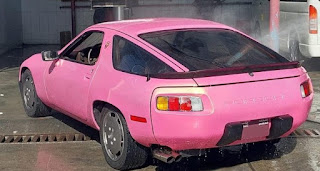
In the pink: 1983 Porsche 928S in  a “rauchquarzmetallic” wrap.  The 928 was the first Porsche to use the M28 V8. 

In production between 1977-1995, with a front-mounted, water-cooled V8, the 928 was a radical departure from the configuration of their previous road cars, all air-cooled flat fours or sixes and mostly with a true rear engine layout (the power-plant installed aft of the rear axle).  By the early 1970s the Porsche management team had come to believe (1) the fundamental limitations and compromises physics imposed on cars with so much weight at the rear extreme meant such engineering was a cul-de-sac, (2) demand for the by then decade-old 911 would continue to decline and (3) US regulators (then much in the mood to regulate) would soon outlaw rear engines and air-cooling, along with convertibles.  As things turned out, the election of Ronald Reagan (1911-2004; US president 1981-1989), a one-time Hollywood film star with fond memories of convertibles and some distaste for “excessive and intrusive regulations” was elected with the (never explicitly stated but well-understood) agenda to make America great again and a new mood prevailed in Washington, convertibles and much else surviving the expected fall of the axe.  The 928 was well-received by the press but like Toyota’s Lexus which never quite managed to achieve the reputation it deserved because it was “not a Mercedes-Benz” (actually perhaps “not what a Mercedes-Benz used to be”), the 928 suffered from being “not a 911”.  Although the 928 joined the list of machines out-lived by those which they were intended to replace, it was a success and in production for some eighteen years although in the twenty-first century depressed values in the after-market meant it became associated with drug dealers and people with maxed-out credit cards (at some points, certain used 928s were the cheapest 160 mph (260 km/h) cars on the market).  The perception has now improved and around the planet there are solid 928 communities although the members have nothing like the devotional feelings of the 911 congregation.
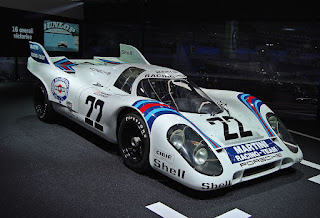
Porsche 917KH, 1971.

Using the 917KH (Kurz (Short)), the factory team in 1970 gained Porsche its first outright victory in the Le Mans twenty-four classic.  In the following year's race, Martini Racing won using a 917KH with a similar specification, running this time in the standard corporate livery.  The refinements to the 917K's aerodynamic properties had tamed whatever idiosyncrasies remained from the fast but unstable original and with still could have been extracted from the enlarged flat-12 but with the FIA (Fédération Internationale de l'Automobile (International Automobile Federation); international sport’s dopiest regulatory body), again changing the rules, the run in 1971 would be the 917’s last official appearance at Le Mans.

Porsche 917-10, 1972.

Although the bloodless bureaucrats at the FIA probably thought they'd killed off the 917, there was still much potential to be exploited and Porsche now devoted the programme to the Can-AM (Canadian-American Challenge Cup), conducted on North American circuits for unlimited displacement sports cars.  Run under Group 7 regulations, what few rules existed mostly were easy simultaneously to conform with while ignoring which is why the Can-Am between 1966-1973 is remembered as one of the golden eras of the sport.  Now turbocharged (as 917-10 & 917-30), in their ultimate form the cars were tuned in qualifying trim for some 1500 horsepower and raced usually with over 1000.  So dominant were the 917s that the previously successful McLaren team (their cars powered by aluminium big-block Chevrolet V8s as large as 509 cubic inches (8.3 litres) withdrew to focus on Formula One and there were doubts about the future of the series but as it turned out, the interplay of geopolitics and economics that was the first oil crisis meant excesses such as unlimited displacement racing was soon sacrificed.
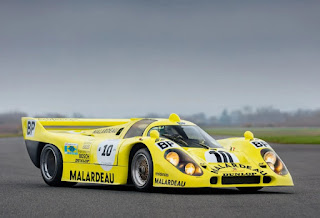
Porsche 917K-81 (Kremer).

However, the 917 was allowed one final fling as an unintended consequence of rule changes for the 1981 sports car season.  It was a sort of revenge on the FIA because although never intended as a loophole through which the now ancient Porsche could pass, for one team the chance again to run the 917 at Le Mans proved irresistible.  The factory had retired the 917 after its win in the 1973 Can-Am, moving to the 936 platform for 1975 and while aware of the implications of the rule changes, weren't tempted by what they regarded a nostalgic cul-de-sac but those at Kremer Racing (founded in Cologne, FRG (Federal Republic of Germany, the old West Germany) by brothers Erwin (1937-2006) and Manfred Kremer (1940-2021)) were intrigued and, with factory support, built a new 917 to Group 6 specifications (enclosed bodywork and a 5.0 litre flat-12), labeling it the 917K-81.  Using Kremer own aluminium spaceframe, at the 1981 Le Mans 24 hour it was fast enough to qualify in the top ten and run with the leaders until a suspension failure forced retirement (the car eventually classified: 38th, DNF (did not finish).  The pace displayed was sufficiently encouraging for the car to be entered in that year's 1000 km event at Brand Hatch where it proved fast but, lacking the factory support, also fragile and it again recorded a DNF.  That was the end of the line for the 917 but, fast and loud, they remain a popular attraction whenever they appear.

Monday, March 2, 2020

Shtreimel

Shtreimel (pronounced stremm-ill)

A fur hat worn by many married Haredi Jewish men on the Sabbath, during Jewish holidays, weddings and other festive occasions.

Late 1500s: From the Yiddish שטרײַמל‎ (shtrayml) of unknown origin.  The plural form is either שטרײַמלעך (shtraymlekh) or שטרײַמלען (shtraymlen) and when rendered in English it should probably be shtreimlech but shtreimels is regularly seen and is now probably more prevalent in commerce.  Shtreimel is a noun; the noun plural is shtreimels.

A quartet of Jewish men in shtreimels.

In the sixteenth century, Eastern Europeans fought the Mongol hordes invading from the east, eventually driving them out.  The Mongols had worn a fur headgear akin to shtreimlach and, after the victory, the Europeans, never fond of the Jews whom they regarded as outsiders as foreign as the invaders, compelled them to wear similar hats to degrade and set them apart.  From this improbable origin came first the acceptance and later the actual code of dress adopted by European Jewry and Chassidim (also known as Hasidism or Hasidic Judaism, a strictly orthodox Jewish sect which opposed Hellenizing influences on their faith).  By the nineteenth century it had spread around the world.

A shtreimel is worn usually on Shabbat, Jewish holidays and other festive occasions and although typically restricted to married men, in some communities, it’s worn from the age of bar mitzvah.  Although it’s long been a custom for Jewish males to cover their heads, under Jewish law there is no special significance to the shtreimel compared to other head coverings but adopting two is thought to add spiritual merit, a shtreimel worn always over a kippah (or yarmulke, the Jewish skullcap).  Sometimes more controversial is the materialist aspect, the intricate craftsmanship of the more expensive shtreimlech does, for some, add to their appeal and they can be displayed as a status-symbol, a conspicuous consumption not approved by all .  The best shtreimlech are bespoke creations for the wearer, made from the tips of the tails of Canadian or Russian sable, stone marten, pine marten or American gray fox and, by tradition, a bride's father purchases a shtreimel for the groom upon his wedding.  These range in price from US$1,000-$6,000 although reproductions in synthetic fur can be bought for a fraction of this, the choice dependent on family circumstances rather than religious tradition.  Never part of everyday apparel, a shtreimel is worn only in conjunction with the clothes worn on the Shabbos (the Jewish Sabbath).  While there are no official rules as to when a shtreimel is worn, it’s usually restricted to religious holidays, weddings and at a brit milah (the Jewish religious male circumcision ceremony).

Democratic People's Republic of Korea (DPRK; North Korea): female soldiers.  Although the resemblance is striking, it's not believed the hats worn as part of the uniforms by female members of the Democratic People's Republic or Korea (DPRK; North Korea were modelled after the shtreimel and it's mere sartorial coincidence.  

Like his father (Kim Jong-il (1941–2011; The DPRK's Dear Leader, 1994-2011) and grandfather, (Kim Il-sung (1912-1994; The DPRK's Great Leader, 1948-1994), Kim Jong-un (b 1983; The DPRK's Supreme Leader (originally The Great Successor) since 2011) likes women in heels.  Because the whole DPRK military seems to be run by someone in the vein of General Scheisskopf (in German, literally "shit-head", the character in Joseph Heller's (1923-1999) Catch-22 (1961) who was obsessed with marching), the heels really are functional and better than combat boots.

The real fur shtreimels attracted the interest of the animal rights pressure group, People for the Ethical Treatment of Animals (PETA) which in 2013 supported Rabbi Shlomo Pappenheim (b 1926), leader of an ultra-Orthodox Jewish sect, when he delivered a speech at an animal rights conference in Israel, calling on Hasidic Jews to stop wearing real fur shtreimel hats.  According to the rabbi, each shtreimel, which demands the slaughter of up to thirty sables, minks, martens, or foxes, violates the Jewish law of tza’ar ba’alei chayim, which prohibits causing animals unnecessary pain adding that as a matter of Jewish law, flaunting real fur hats amounts to Chilul Hashem (desecration of God’s name) because the cruelty of the fur industry is so notorious.  He concluded his address by saying Jewish culture must evolve to the point where it becomes a matter of shame to wear “anything but a synthetic shtreimel.”

PETA honorary director Pamela Anderson (b 1967) in poster for PETA’s “I’d Rather Go Naked Than Wear Fur” campaign.  Ms Anderson’s involvement is said to have extended to making a personal appeal to then prime-minister Benjamin Netanyahu (b 1949; Israeli prime minister 1996-1999, 2009-2021 and since 2022).

Whether it was Rabbi Pappenheim’s thoughts or Ms Anderson’s persuasion which was most influential isn’t known but the campaign seemed to have some effect, Israel in 2021 becoming the first country to ban fur.  However, as cynics noted, it was a typical piece of cleverness by the Knesset (the Israeli parliament) in that the ban doesn’t apply to those most likely to wear the furry hats, the legislation still permitting the import of sable shtreimels, worn by many Haredi men, the amendment to the Wildlife Protection Law (1976) allowing permits for importation to be issued if the pelts are to be used for “religion, religious tradition, scientific research, education or teaching.”  As in many aspects of secular laws passed by the Knesset, this loophole effectively exempts ultra-Orthodox Jews from its operation although importers will now need to apply for special permits, something thought “not an obstacle.”  The law may thus have little practical effect; given its climate, garments using fur are rarely seen in Israel except as shtreimels.

Harold Macmillan (1894–1986; UK prime-minister 1957-1963) and comrade Nikita Khrushchev (1894–1971; Soviet leader 1953-1964), on the tarmac at Moscow airport, February 1959 (left) and Lindsay Lohan in Netflix's Falling for Christmas (2023).  In many religions, it's not uncommon for what were once purely functional or pragmatic garments or practices to become symbols of religious observance and it seems likely the origin of the shtreimel was in headgear designed to provide warmth.

Macmillan’s visit, the first to Russia by a British PM since Winston Churchill's (1875-1965; UK prime-minister 1940-1945 & 1951-1955) wartime trips, started with him making what he hoped would be a friendly gesture, wearing a Russian white fur hat (ushanka) but this was soon swapped for a black one because a foreign office advisor suggested the white, dating from his last visit to Russia during the Russo-Finnish War (the so-called "Winter War", 1939-1940) might cause offence, the conflict not a happy memory in the Kremlin.  The foreign office was correct but (and this does happen with the FO) for the wrong reason, the white fur purely a fashion faux pas.  When Macmillan's predecessor (Anthony Eden, 1897–1977; UK prime-minister 1955-1957), visited Moscow in 1941 while foreign secretary, comrade Vyacheslav Molotov (1890–1986; USSR foreign minister 1939-1949 & 1953-1956), showing an untypical concern for the details of protocol, told Eden "Á Moscou, Excellence, on ne porte pas la casquette de fourrure blanche" (In Moscow, Your Excellency, you don't wear a white fur hat).   

Twenty-odd years on however, the Russians seemed either not to notice or be unconcerned, the white fur attracting no comment on arrival and the prime-minister’s sartorial flourishes continued, choosing practical plus fours for his tour of collective farm, and, in a nice touch, a Guards Regiment tie when visiting a nuclear facility.  Lavish banquets followed around tables laden with champagne, vodka, caviar, salmon and Cuban cigars and all went well although, regarding the vodka, perhaps a little too well, as Macmillan would later note.

While the prime-minister was touring a Moscow research institute, comrade Khrushchev was in Berlin where he delivered a truculent speech intending use Macmillan’s visit to destabilize NATO.  The next day’s Anglo-Soviet discussions were “angry and fraught”, an atmosphere not helped by both delegations being “rather drunk”.  To express his displeasure with a snub, Khrushchev the next day issued a statement saying he was taking no part in that day’s activities because he had “toothache” and the Western press promptly, and gleefully, coined the phrase “diplomatic toothache”.  Just to add emphasis, despite being indisposed by his “toothache”, the Kremlin made it known comrade Khrushchev had spent the day in meetings with a visiting delegation from Iraq.  Macmillan rescued the situation with some typically cynical British diplomacy and comrade Khrushchev quickly resumed his role of genial host, telling everyone his toothache had been cured “by a British drill”.  Although achievements had been modest, both sides considered the visit a success, something in this field measured less by anything attained than unpleasantness avoided.

The ushanka never goes out of style: Adolf Hitler (1889-1945; Führer (leader) and German head of government 1933-1945 & head of state 1934-1945) admiring the headgear of Crown Prince Wilhelm (1882-1951), Tag von Potsdam (Potsdam Day), 21 March 1933.  Potsdam day was a ceremony conducted on March 21, 1933 in Potsdam to mark the re-convening of the Reichstag, the fire which gutted the building on 27 February 1933 never fully explained although conspiracy theories suggesting the act of arson was a Nazi plot have little support among mainstream historians, the consensus being the regime simply took advantage of the unexpected event to conduct the first of many purges of their opponents.