Bustle
dresses obviously pre-dated modern synthetic fabrics which can be engineered
to assume and retain a defined shape so were created by using an internal
frame, an exoskeleton assembled usually from metal, cane or bone using essentially
the same technique as coachbuilders in the twentieth century, the space frame
providing support and describing the arc of the desired curves. The earliest of the breed were less
exaggerated that what was to follow, used more to allow the fabric to fan-out
and create a train and it was later, in the mid-nineteenth century, that the
loops and hoops grew in number and size to allow the multi-gathered layers now
most associated with the style. It was
about this time that trains began to retreat and the shape of the bustle
adopted the more pronounced humped shape on the back of the skirt immediately
below the waist, the voluminous material tending now to fall straight to the
floor in a cut designers at the time called the “waterfall effect”. A wonderfully elegant style in which a lady could
waft around a ballroom, taking a seat could be difficult, trips to the loo
presumably a matter of gymnastics.

Bridal gown promotional image.
As a
piece of fashion, the bustle rose and fell in popularity, its most dramatic flourish in
the late 1880s when the most extreme of the bustles were built with proportions even more extraordinary than the originals of the late 1700s. Absurdity having been achieved, the bigger bustle quickly was banished to the wedding gown business dress where it remains to this day, used both better to display a clinched
waist and sometimes support the fall of a train.
The engineering however endured into the twentieth century, structural
support still required for what was were now only slightly exaggerated
interpretations of the female form but by 1908 it was noted that but for
wedding dresses, the bustle was extinct, supplanted by the long corset.
Portrait
of Maria Carolina of Austria (1752-1814), circa 1767, by Martin van Meytens
(1695–1770).
In the late 1700s, the bustle was actually quite modest
compared with the earlier pannier which seems to have existed only as court
dress and then rarely, reserved for the most formal occasions. Offering the advantage of rendering the skirt
as a large, almost flat, square or rectangular shape in the manner of
a painting, it permitted a large surface on which elaborate designs or embroidery
could be displayed, transforming the wearer into something of a walking (or at
least standing) billboard.
The
style began somewhere in Europe in the early 1700s, historians of fashion in
several countries laying claim although whether that's as a proud boast or admission of
guilt isn’t clear. The term seems to
have been applied retrospectively as a point of differentiation from the
bustle, “pannier dresses” not described as such until 1869. In their most imposing iterations, the panniers
could extend the skirt by almost a metre (39 inches) either side so there may
be a comeback for what would presumably be a practical garment in the #metoo
era. The word pannier dates from circa
1300, from the Old French panier
& paniere (basket), from the Latin
pānārium (breadbasket), the construct
being pānis (bread) + ārium (place for).
As originally used in French, panniers were the wicker
baskets slung either side of a beast of burden, the name still used to describe
the side-mounted containers available as accessories for bicycles and motor-bikes.

Un dimanche après-midi à l'Île de la Grande Jatte (A
Sunday Afternoon on the Island of La Grande Jatte) (1884-1886) by Georges
Seurat (1859-1891).
Seurat’s most famous
painting is an indication of the state of the bustle art in the 1880s but is best
remembered as an exemplar of the technique of divisionism (sometimes called chromoluminarism),
most associated with Neo-Impressionist painting and defined by the colors being
separated into individual dots or daubs, the optical result created in the
brain of the viewer. The eye is an
outgrowth of the brain and, having “learned” the nature of color, what the eye
sees, the brain intuitively blends and mixes, seeing the painting not as an
agglomeration of dots but as an image.
The final processing is not by the painter but the viewer, an early example of a deconstruction of the the reader constructing the text, a direction of thought which would come to intrigue many theorists, some of whom unfortunately pursued the concept a little too long and much too often.
Nancy Cameron with
parasol,
Playboy magazine, May 1976.
In
what was presumably intended as a post-modern touch, Playboy magazine
superimposed an image of a slightly bustled Nancy Cameron on the painting for
their May 1976 cover, the bunny logo hidden among the dots. It’s not known how many of Playboy's readers
were sufficiently taken with divisionism to devote much time to rabbit hunting. Previously, Nancy Cameron (b 1954) had been
chosen as the 20th Anniversary Playmate of the Month (PotM) for the January
1974 issue and, uniquely, enjoys the distinction of being the only PotM to have
been honoured with a “double-sided centrefold”, her nude front & back both visible. She looked good coming or going.
1928 Mercedes-Benz
Nürburg 460 K Pullman Limousine (W08).
The origin of the bustle-back style on motor
cars was organic, a evolution from the luggage trunks which, borrowing from the
practice used with horse-drawn carriages of many types, were attached to the
rear, a practical arrangement which afforded easy access and didn’t impinge on
passenger space. Sometimes the trunks
were provided by the manufacturer or coachbuilder but often, especially on
lower-prices vehicles, were from third-party suppliers and not always
specifically designed for the purpose, being made variously from steel, timber or leather and even woven with wicker.
1936
Studebaker Dictator 4-door sedan.
As all-metal bodies gradually replaced the
mixture of steel, wood and fabric which had typified construction in the early days
of the industry, the function of the once separate trunk was retained but
integrated into the coachwork. Ascetically,
some were more successful than others but the trend did coincide with the move
towards more sloping rear coachwork, replacing the upright designs which had
been a direct inheritance from the horse-drawn stage coaches and this would
have an important influence on what came to be known as the bustle-back motif.

1939
Lincoln Zephyr V12 Coupe (left) and 1937 Mercedes-Benz 540K (W29) Special Roadster (originally delivered to Mohammad Zahir Shah (1914–2007; the last King of Afghanistan 1933-1973).
The
sweep of the fastback line did present an obvious stylistic challenge. To augment one with the bustled trunk would
defeat the purpose but the functional advantages of the added storage had come
to be appreciated so the solution was complete integration, the once
discernibly separate trunk now wholly encapsulated. The price to be paid for that was the
elongation of the rear body but, in the era of streamlining, the market took well to this latest incarnation
of modernism and the style turned into a profitable niche for Detroit, the
two-door “business coupe” long a favorite of travelling salesmen who were
happy with the sacrifice of the back seat to provide an even more commodious
trunk (boot) with which to secure samples of wares.

1953
Ford Zodiac (Mark 1) & 1959 Mercedes-Benz 220 SE (W180).
By the
early 1950s, a “three-box” form had evolved and it would become for several
generations the standard for the mainstream sedan. Typified by the Ford Zephyr & Zodiac
(1951-1956) and the Mercedes-Benz “pontoons” (W105 / W120 / W121 /W128 / W180)
(1951-1962), the style was described as “one loaf of bread atop another”. Although many
couldn’t resist embellishing the simplicity with fins and other unnecessary
stuff, the basic outline endured for decades although it did tend to the "longer, lower and wider".

1954 Bentley
Mark IV (left), 1963 Rolls-Royce Silver Cloud III (centre) & 1968 Daimler DS420 (right).
Not all
however saw the need to advance beyond the bustle which, by an accident of economics, had come to define the
traditional English limousine. While mass-market vehicles evolved quickly with model cycles as little as 3-4 years, the low-volume and substantially hand-made limousines typically remained in production for sometimes a decade or more, reflecting the time it took to amortize the capital investment. In the post-war years, Austin, Armstrong
Siddeley, Bentley, Daimler, Rolls-Royce & Vanden Plas all persisted although production
levels, never high, dwindled increasingly as the bustle-back came to be seen as
an antiquated relic and by 1965, even Rolls-Royce had all but abandoned the
bustle, only the low-volume Phantom V still maintaining the link to the pre-war
style.

The choices in 1968: Vanden Plas Princess 4-litre Limousine (left), NSU Ro80 (centre) & Daimler Majestic Major DR450 (right).
Emblematic of the troubles which beset British industry in the era, the most obviously antique of the English bustle-backs, the Vanden Plas Princess 4-litre Limousine, was still on sale in 1968 by which time that glimpse of the next century, the NSU Ro80, had been in showrooms for over a year. The Princess, still with a split windscreen, was a (mildly) updated version of the Austin Sheerline, introduced in 1947 when it was a genuinely new design although even then, few would have been surprised had they been told it came from before the war. The eventual longevity wasn't planned but rather a product of the uncertainty in the future of corporate structure the industry would assume, plans for a successor put on hold, the same fate which befell the only slightly more modern-looking but remarkably rapid Daimler Majestic Major which also enjoyed a stay of execution until 1968.
However, their new rarity made
the bustle-back eventually an attraction, the very exclusivity creating a receptive and surprisingly
wide market segment which included undertakers, wedding planners, Lord
Mayors and anyone else to whom the sense of lost
elegance and whiff of wealth appealed.
Jaguar understood and responded in 1968 with the Daimler DS420 which didn’t
encourage any imitators but there was room for one and it enjoyed a long, lucrative life, remaining in production until 1992. Over five thousand were
built.

1966 Mercedes-Benz 600 (W100, left) & 1962 Rolls-Royce Phantom V by Mulliner Park Ward (right).
The
traditionalists didn’t however always insist on tradition. Even before Mercedes-Benz had shown their 600
at the 1963 Frankfurt Motor Show, coachbuilders Mulliner Park Ward had built some of the 832 Rolls-Royce Phantom Vs without the pronounced bustle-back which adorned
most. Nothing of course matched the
austerity of line of the 600, the most severe interpretation the “three-box”
form ever applied to a limousine and, as an alternative to the bustle-back, MPW offered "de-bustled" variations on the theme until the last of the 374 Phantom VIs was built in 1990.
Rolls-Royce
prefers turtleback
Actually,
although bustleback seems to have become the generally used term, the coachbuilders
always preferred “turtleback”, a term used of many forms which recall (sometimes
vaguely) the shape of a turtle’s back (ie the curve of the shell). Examples of use include:
(1) The shape
used in the tail section of certain cars (ie synonymous with bustleback).
(2) In nautical
use, a convex deck at the bow or stern of a vessel, designed to quickly shed
seawater.
(3) In
military use, (armoured vehicles & warships), a layout of external armor in
which the slope of the structure is used to deflect shells on trajectories
close to horizontal. The classic example
of effectiveness was the World War II (1939-1945) Soviet T-34 tank (a platform
which remains in service with several militaries.
(3) A primitive
stone celt formed to suggest the back of a turtle.
(4) In
publishing, a library binding of a mass market paperback with a generic
hardcover.
(5) Any
plant of the genus Psathyrotes of annual and perennial forbs and low sub-shrubs
native to dry areas of south-western North America.

1965
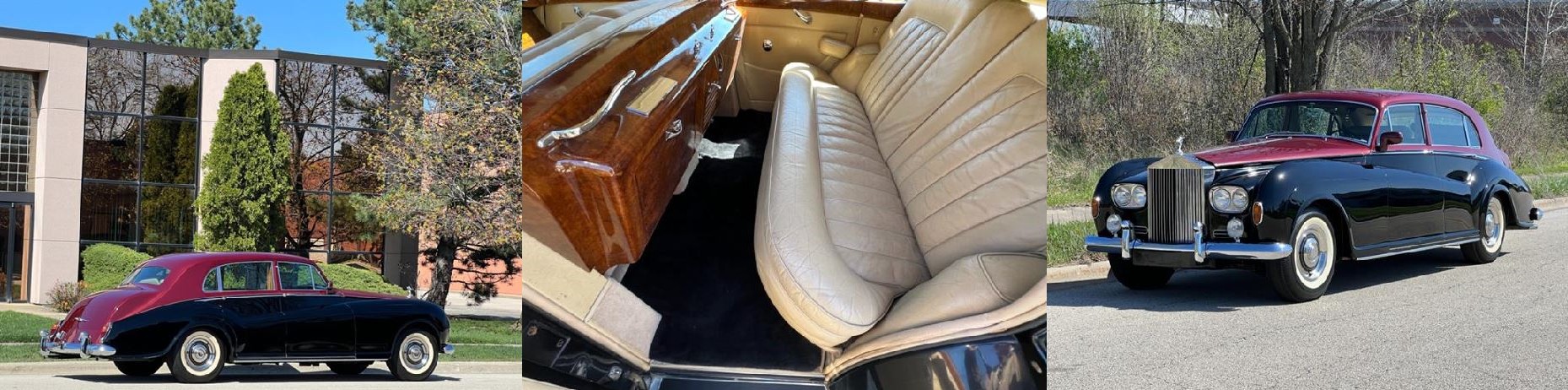
Rolls-Royce Silver Cloud III Touring Limousine by James Young.
In the catalogue of coachbuilder
James Young, one rarely ordered version of the Rolls-Royce Silver Cloud (1955-1966)
was the long wheelbase (LWB) SCT100, described as the “Touring Limousine”. In the industry slang, it was the “Baby
Phantom”, an allusion to the much larger Phantom V (1959-1968) & Phantom VI
(1968-1990) models which, on a larger scale, were visually similar. Interestingly, although when the SCT100 designation was adopted the UK was still years away from adopting the metric system (and not until the Camargue (1975-1986) did the factory release a car designed to metric dimensions), the "100" was a reference to the wheelbase being extended by 100mm (4 inches). The touring limousines were almost always fitted
with a glass division between the front & rear passenger compartments and
were noted too for featuring larger than typical rear fascias in burl walnut which
housed tray tables and air-conditioning controls (at least one even included a
duplicate fuel gauge which was an unusual addition although clocks, thermometers
and speedometers were sometimes specified in the rear of many limousines). As well as the James Young production, Rolls-Royce's
in-house coachbuilder Park Ward (later Mulliner Park Ward) in London fabricated
some touring limousines on the LWB chassis, returning the cars to the Crewe
factory for finishing. In Rolls-Royce
collector circles, these are “turtlebacks”.

1965
Oldsmobile 98 two-door hardtop.
Fins began to shrink from the “three box” US cars in the early 1960s and were gone by mid-decade. Having to go in some direction, the tails of the full-sized US cars noticeably lengthened, matching
the growth at the front. Aesthetically, the long hoods
(bonnets) did have their attraction but were hardly an engineering necessity.
Although the biggest US V8s were wide and heavy, they weren’t, by either
historic or even contemporary European standards, especially long yet in some
of the full-sized cars of the era, a V16 would have fitted and there were those
at Cadillac, recalling the genuine exclusivity the sixteen cylinder engines
lent the marquee during the 1930s, who hankered for one and they actually built
some V12 prototypes before corporate reality bit. They contented themselves instead with a
gargantuan 500 cubic inch (8.2 litre) V8 although another reality would soon
bite that too.

The 1961 Cadillac: The long (left) and slightly less long (right) of it.
Whether
in response to or in anticipation of some owners preferring their Cadillac in a
more conveniently sized package, between 1961-1963, a “short-deck” option was
made available on certain body styles.
Offered first on the six-window Sedan deVille, an encouraging 3,756 were
built so the option was in 1962 offered on the four-window Sixty Two Town Sedan
but sales actually dropped to 2600, the decline in interest confirmed the next
year when only 1575 of the four-window Park Avenue Sedan deVille were
sold. Using the same 129.5 inch (3289 mm) wheelbase as the regular models but eight inches (200 mm) shorter in overall length (215 vs 223
inches (5461 vs 5664 mm)), space utilization was obviously a little better but
the market had spoken. With fewer than
eight-thousand of the short-deck models sold across three seasons while the
standard editions shipped in the tens of thousands, the flirtation with (slightly) more
efficient packaging was abandoned for 1964; in the course of the following
decade, Cadillacs would grow another seven inches (178 mm) and gain over 400 lb
(181 kg).

1971 Holden HG Premier (left) & 1968 Holden HK Brougham (right).
In
Australia, Holden, General Motors's (GM) local outpost, took the opposite approach, the
Brougham (1968-1971) created by extending the tail of the less exalted Premier by 8 inches (200 mm), the
strange elongation a hurried and far from successful response to the Ford Fairlane
(1967-2007). The 1967 Fairlane had been
crafted by stretching the wheelbase of the Falcon sedan from 111 inches (2819
mm) to 116 (2946 mm) and tarting-up the interior. Ford had since 1965 been locally assembling
the full-sized Galaxies for the executive market but tariffs and the
maintenance of the Australian currency peg at US$1.12 meant profitability was marginal,
the locally concocted Fairlane, much more lucrative, produced as it was with
high local content and a miniscule development cost. The Fairlane name was chosen because of the
success the company had had in selling first the full-sized Fairlanes
(nicknamed by locals as the “tank Fairlane”) between 1959-1962 and later
the compact version (1962-1965).

1977 Ford LTD Silver Monarch (P6).
The
massive success of the 1967 car and its successors prompted Ford to cease local
assembly of the Galaxie and revert to importing fully built-up cars for the
small segment of the market which wanted the bigger vehicles, including the
government executive fleets. Available
with both small and big-block V8s, the Galaxies, now badged as Galaxie-LTDs,
would remain available until 1973 when Ford Australia created their own LTD
(1973-2007), giving the Falcon’s wheelbase a final stretch to 121 inches (3073
mm) and adding the novelty of a 24 hour analogue clock, lashings of real
leather and fake timber along with that status symbol of the 1970s: the padded
vinyl roof.

Lindsay Lohan photo-shoot by Tom Munro (b 1964) for Bustle, March 2024.
The
“malaise era” bustle-backs (1980-1987) by Cadillac, Imperial and Lincoln.
The US
cars of the decade between 1973-1983 (some say it lasted a bit longer) were
called “malaise era” cars, named after a thoughtful but perhaps unfortunate speech
President Jimmy Carter (1924-2024; US president 1977-1981) delivered in July
1979. Carter’s
“malaise” remains emblematic the America of the late 1970s, the time of
stagflation, energy shortages, 18% interest rates and general gloom, but the
details have become blurred. The use of
the word “malaise” emerged from a retreat the president had convened at the
Camp David retreat after concluding neither he, his advisors or the entire machinery
of government could come up with solution to the nation’s many problems. Attended by notables from the clergy,
academia and other realms including the governor of Arkansas, Bill Clinton (b
1946; US president 1993-2001), the curious event prompted one historian to
describe it as “…the
most remarkable exercise in presidential navel-gazing in American history…”
but what did lodge in Carter’s memory was an observation by the pollster
Patrick Caddell (1950–2019) that after some fifteen years of trauma including
assassinations, race riots, the war in Vietnam and Watergate, the nation was
experiencing a “malaise”
and the president decided this notion would be the centrepiece of his address
to the people. The word “malaise” may
not have appeared in the speech in July but, replete with phrases like “…strikes at the very
heart and soul and spirit of our national will…” & “…crisis of
confidence…”, the tone was clear and almost universally the press called
it the “malaise speech”. Despite what
has long been the popular perception, at the time the speech was not a disaster
and was well-received, Carter’s approval ratings surging; it was only as the
year unfolded he came to be damned by his own words and if any single term is now associated with his unhappy single term, it's "malaise". The "malaise era" cars were so named because compared with the previous generations, they were heavier, slower, thirstier and less pleasant to drive, a collection of characteristics which weren't the fault of President Carter but he had the misfortune to be in the White House at the same time. In that era, while not yet able substantively much to
improve the dynamics of the cars, Cadillac thought of a distraction: the
bustle-back. It proved a short-lived fad
although one better remembered that some of what had gone before and much of
what would follow.

1980 Cadillac Seville.
The
1980 Cadillac Seville was first, the advertising copy even trying to justify
the appearance by claiming the design offered “more usable trunk space”,
something which could neither be proved nor disproved which was good, given it
offered 14.47 (.409 m3) cubic feet of space whereas last year’s
model had 14.9 (.421 m3).
Still, what one got was “more usable”.
Cadillac were explicit about their plagiarism, the Seville’s lines based
not on just any bustle-back but one with the most severe lines, the Hooper-bodied
Rolls-Royces of the post-war years. The
critics were divided: some not liking it and some hating it, a spread of
opinion seemingly shared by buyers, sales never matching those of its more
conventional predecessor although there were other factors in the lukewarm
response such as the switch to front wheel drive and some reliability issues
with the power-train. Production of the bustle-back
Seville ceased in 1985; sales of its successor were higher.
Chrysler
always claimed the design of the 1981 Imperial was locked-in long before their
designers had laid eyes on the new Seville but it wasn’t until 1981 it was in
the showrooms.
Based on the competent J-body
Cordoba platform, it was offered only as a two-door coupé with a fuel-injected 318
cubic inch (5.2 litre) V8 and an automatic transmission.
After 1955, Chrysler had run Imperial as a
separate division in an attempt to gain the cachet of Cadillac and Lincoln but,
despite early success, the experiment failed and the brand was retired in
1975.
The bustle-back Imperial
(1981-1983) ostensibly revived the division and the car was well-equipped, including bits and pieces from Cartier although its best-remembered
association with celebrity was the “Frank Sinatra Edition”. Unexpectedly, a brief foray onto the fastest of the NASCAR ovals proved
the bustle-back’s aerodynamic efficiency; it achieved an impressive top-speed despite
not using the highest-powered engine. It wasn’t enough to save the brand which was shut down for the last time in 1983 although Chrysler did continue to use “Imperial” on the odd tarted-up model and surprised everyone in 2006 by presenting an Imperial concept car. Criticized at the time because it was so obviously influenced by
the Rolls-Royce Phantom (the retrospective VII) and a pastiche of many clichés, if one didn't mind that sort of thing, it seemed a quite accomplished execution.

Ford’s
retro-take arrived last in 1982 but the Lincoln lingered longest, not replaced
until 1987.
The bustle-back Lincoln
actually used the most restrained implementation of the idea but, unable to
resist the temptation to add lipstick, the designers applied to the trunk the faux
spare tyre bump which had been on so many Continentals since the 1955 Mark II
first sought to pay tribute to the 1940 original although this was the first
time a Lincoln without a Continental badge had been humped. In common with
the experience of the other manufacturers, the car attracted fewer buyers than
its predecessor or successor and, while Detroit have pursued some other retro-projects with mixed results, none have attempted another
reprise of the bustle-back.

Pre and
post butt-lift, the 2001 and 2009 BMW 7 Series.
Nor has anyone else. Although the 2001 BMW 7 Series (E65) is sometimes
labelled a bustle-back (or, in more twenty-first century style, a bustle-butt),
it really never was although, having allowed a decent interval to elapse so as
not to (further) upset the designer, at the first facelift, it was toned down a
little.