Thermidor (pronounced thur-mi-dawr or ter-mee-dawr (French))
(1) In the French Revolutionary calendar, the eleventh month
of the year (19 (or 20) July to 17 (or 18) August); it was also called Fervidor
(both terms now only of historic interest).
(2) As Thermidorian Reaction, a counterrevolution or coup
d'état in some way recalling the events in Paris in July 1794.
(3) As lobster thermidor (both elements sometimes
capitalized), a method of preparing the unfortunate crustacean for consumption.
Borrowed from French thermidor,
from the Ancient Greek θέρμη (thérmē)
(hot; heat) + δῶρον (dôron) (gift), the construct thus construct being thérm(ē) + (i) + dôr(on).
Thermidor is a noun & proper noun, thermion is a noun, thermidorien
& thermidorian are nouns & adjective and thermionic is an adjective;
the noun plural is thermidors.
In the history of revolutionary France, the noun thermidorian is used to refer to (1) a member of the politically moderate (a relative term) group who participated in the events of the 9th Thermidor (27 July 1794) and (2) a supporter of the reactionary movement following the coup d'état. The use in political discourse was named after the play Thermidor (1891) by Victorien Sardou (1831–1908), itself named for the eleventh month of the French Republican Calendar. The Coup d'état of 9 Thermidor (remembered in many reports as “the Fall of Maximilien Robespierre” (1758–1794)) was triggered by Robespierre's address to the National Convention on 26 July 1794), a speech which prompted his arrest the next day and his death on the guillotine the day after. Due process is a quick business in revolutionary times. Robespierre’s fateful words included a reference to “internal enemies, conspirators, and calumniators” within revolutionary movement but he declined to name names, giving rise among his colleagues to fears he was plotting another great purge of their numbers.

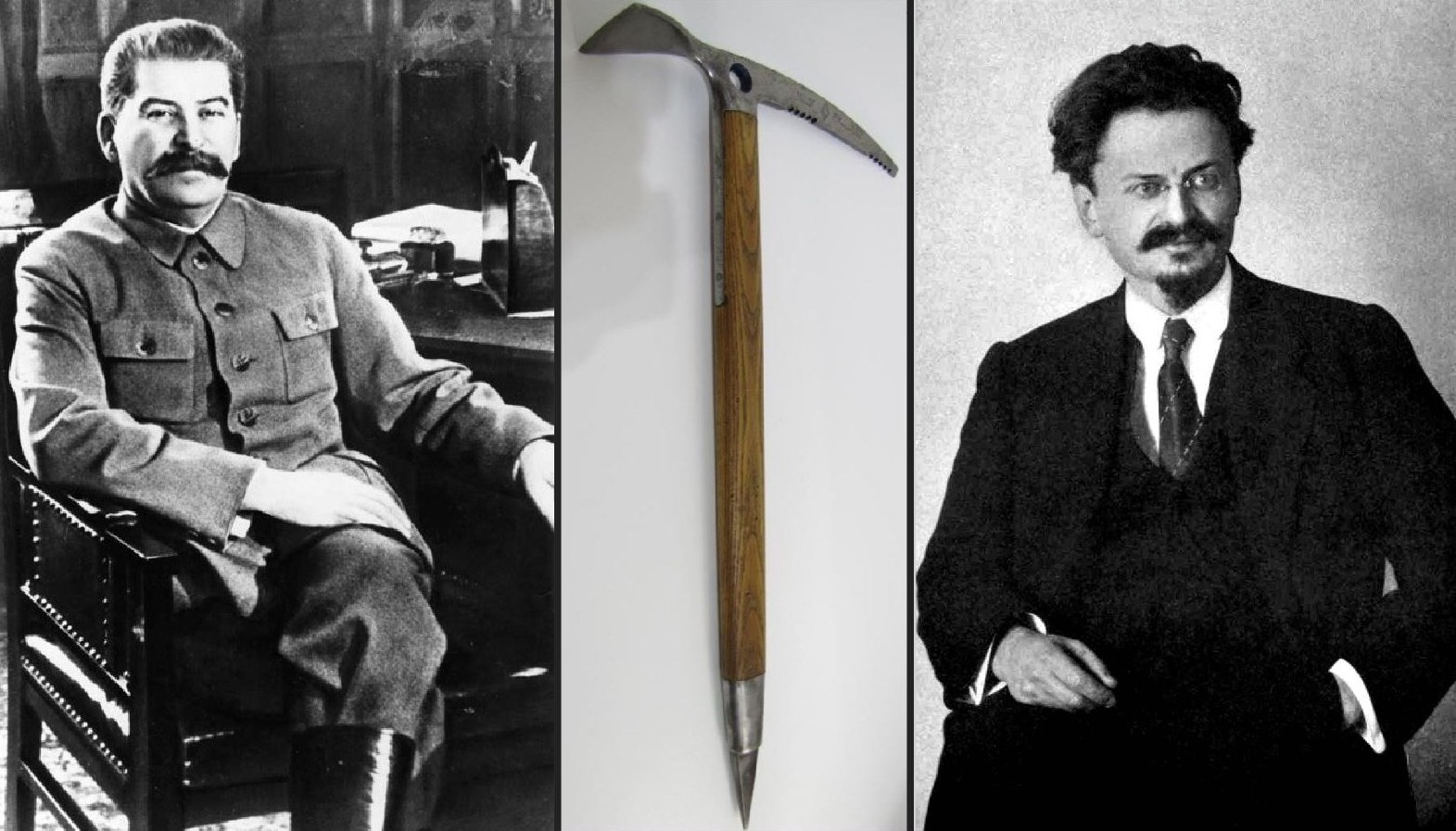
Comrade Stalin (left), an ice axe (centre) and comrade Trotsky (right). The standard-length ice axe is ideal for its intended purpose but to large easily to be concealed under clothing and too cumbersome to comfortably to wield in a confined space.
Comrade Leon Trotsky (1879-1940; founder of the Fourth International) in The Revolution Betrayed: What Is the Soviet Union and Where Is It Going? (1936) had a feeling for a memorable phrase and labelled the state created by comrade Stalin (1878-1953; Soviet leader 1924-1953) a “Soviet Thermidor” because although the Tsarist era mix of feudalism and proto-capitalism wasn’t re-created (a la the monarchy in France not being restored in the 1790s), the combination of a bureaucracy supporting a personality cult (even if the latter was in 1936 still somewhat disguised) was “a counterrevolutionary regression” which betrayed what was achieved by comrade Vladimir Lenin (1870–1924; leader of Russia or the Soviet Union 1917-1924). The vivid phrases caught the imagination of many, notably those in the Partido Obrero de Unificación Marxista (The POUM, the Workers' Party of Marxist Unification), a non-communist Marxist party (a surprisingly populated fork of left-wing thought) which comrade Stalin correctly associated with Trotskyism. The POUM was highly productive in thought but drifted increasingly far from the moorings of political reality although rhetoric which included polemics like “Stalinist Thermidorians have established in Russia the bureaucratic regime of a poisoned dictator.” Agents of the Narodný komissariat vnutrennih del (NKVD, The People's Commissariat for Internal Affairs and one of the many predecessors to the KGB), answerable only to comrade Stalin, killed dozens of POUM’s Central Committee which ended the organization’s effectiveness for a generation. In his prodigious memory, comrade Stalin filed away phrases he found variously annoying, tiresome or threatening and in 1940 had comrade Trotsky murdered. The murder weapon was what would become history's most famous ice axe.
Even by the standards of political assassinations (a long tale of the brutal and bizarre), the events surrounding Trotsky’s death were unusual. Although, living in exile in Mexico, comrade Trotsky’s influence on those in the Soviet Union (or anywhere else) was negligible, not only was comrade Stalin a great hater who nursed his many grudges until circumstances permitted a good opportunity for vengeance but he also thought ahead; concerned Trotsky and his heretical writings might one day be a real threat, years before the assassin’s visit, he’d decided his erstwhile associate must die. The NKVD had already succeeded in killing Trotsky’s son (imaginatively disguised as “medical misadventure” during a routine appendectomy) and, more dramatically, had decapitated his secretary in his Paris apartment but operations beyond Europe were more complex and the agent allocated the task was the Moscow-trained Spanish communist Ramón Mercader (1913–1978), also living in exile in Mexico City under the pseudonym Frank Jacson. Diligently watching his residence and researching the habits of his target, comrade Mercader posed as the lover of Trotsky's courier and was convincing enough to be welcomed into the impressively fortified villa on the city’s outskirts. Either the NKVD’s training in such matters was first-rate or Mercader had a flair for the business because, after bringing Trotsky’s grandchildren presents and playing games with them in the garden, over the course of weeks, he became a valued house-guest, often engaging his intended victim in earnest discussions about politics and international affairs, careful always to ensure his host could assume the role of wise oracle.
Early on Tuesday, 20 August 1940, on the pretext of asking if an article he’d drafted was ready for publication, the assassin handed over the manuscript which Trotsky took to his desk and began reading, his back to the author. Although also carrying a dagger and revolver, Mercader choose as the murder weapon the ice axe he’d be able to conceal under his raincoat by shortening it (sawing off half the wooden handle), his reasonable rationale being (1) it should be more effective than the knife and (2) it would be quieter than discharging the gun. In seconds, Mercader drove the pick into the back of Trotsky’s skull and although the injury would prove mortal, it was not instantly fatal, the immediate aftermath described by the killer during a subsequent police interview: “[He] screamed in such a way that I will never forget it as long as I live. His scream was Aaaaa . . . very long, infinitely long and it still seems to me as if that scream were piercing my brain. I saw Trotsky get up like a madman. He threw himself at me and bit my hand…” Mercader would likely have been beaten to death by Trotsky’s bodyguards but was saved by the dying man ordering them to stop because he wanted to have him admit his evil deed had been done on the orders of comrade Stalin. The next day, in hospital, he succumbed to a traumatic brain injury but not before cursing Stalin as his killer.

Ten years after: rootless cosmopolitan comrade Trotsky (left) talking to comrade Stalin (right), Moscow, 1930 (left) and Mexican police showing the "sawn-off" ice axe used in the murder (right).
By the standards of NKVD “wet operations” (clandestine, “authorized” executions) the “Mexico business” was messy with (1) the assassin arrested, (2) the murder weapon taken as evidence, (3) the body not disposed of and (4) the cause of death certainly not able to be classed as “an accident”, “misadventure” or “natural causes”. The suspect however did not implicate the NKVD, initially claiming he’d killed Trotsky over a dispute they were having on a doctrinal matter relating to Marxist interpretation and later changing the story to allege it was over something more personal; this he maintained while serving his 20 year sentence in a Mexico prison; Moscow denied having anything to do the matter, even expressing condolences to the family. That was of course is an MRDA in the spirit of: “Something cannot be thought proven true until the Kremlin denies it” which, as the later events would confirm, remains a dictum valid still in this century. Still, analysts today conclude comrade Stalin may not have been wholly unhappy at the “botched” operation because (1) he had “plausible deniability” of involvement and (2) the murder made headlines around the word so those likely to be “trouble-makers” would know NKVD agents were capable of liquidating high-level, well-protected targets, well beyond the borders of the Soviet Union. So there was a silver lining, unlike the later “botched” dispatch of dissident Saudi Arabian journalist Jamal Khashoggi (1958-2018) in the Saudi consulate in Istanbul, Türkiye.
Unannounced and for decades not revealed, comrade Stalin decorated comrade Mercader in absentia, presumably for “services to the state” although publicly he denounced him as a “dangerous Trotskyist”, disavowing any involvement in the crime. After serving nearly all his sentence, Mercader was released, in 1961 returning to the Soviet Union after a brief sojourn in Cuba, then under new management following comrade Fidel Castro’s (1926–2016; prime-minister or president of Cuba 1959-2008) communist revolution. In Moscow, the KGB presented him with the nation’s highest awards (Hero of the Soviet Union & the Order of Lenin), after which he enjoyed two decades odd of comfortable semi-retirement in a number of sinecures in the Ministry of Foreign Affairs. It was only after dissolution of the Soviet Union in 1991 when, for a brief few years the state’s archives were open to Western researchers, that documents were discovered confirming the assassination had been a NKVD operation authorized “at the highest level in Moscow” (ie comrade Stalin signed the death warrant, his hand well-practiced at such things).

Described by retailers as a “great beginner frog” (the reason for that presumably understood by collectors) and “best kept in pairs”, a typical RRP (recommended retail price) in the US seems to range between US$79-99. The adjective tinctorious (from the noun tincture) dates from the late eighteenth century and appears first to have been used of colorful plants. Even in horticulture it has become rare but an echo survives in the Dendrobates Tinctorius, a frog much prized by collectors and photographers for its striking colors and patterns. Unsurprisingly referred to by the standard abbreviation “tincs”, Dendrobates Tinctorius is one of the largest species of poison dart frogs, although in global terms still hardly large, the largest some 2 inches (50 mm) length. They are native to the rainforests of South America and appear in dramatic color combinations including hues of blue, black, yellow and orange but safely can be kept by hobbyists because in captivity they're not poisonous, the toxicity in the wild by virtue of their preferred diet of small invertebrates, not consumed in a captive environment. Prices of adults in the most desired color mixes can exceed US$200.
Although prized by batrachophiles (frog enthusiasts) and giggers (those who collect or hunt wild frogs (by hand for those wanting live specimens; others resorting usually to a pronged spear), the Dart frog mostly had been obscure amphibians until, in February 2026, a collective statement by the intelligence agencies of four European nations (France, Germany the Netherlands & Sweden) and the UK) released the results of an inquiry which found Russian opposition leader Alexei Navalny (1976-2024) had been murdered by the use of a deadly toxin found in the skin of Ecuadorian dart frogs (epibatidine). The investigators concluded the murder was committed by an agent or agents of the Russian state, Mr Navalny dying while imprisoned in a remote Arctic penal colony where he was serving a 19-year sentence; tissue samples from his body were secured prior to his burial and it was these which were analysed in Western laboratories. A statement from the British government added that as well as the “barbaric” assassination, the use of a toxin was a “…flagrant violation by Russia of the CWC” (chemical weapons convention) and it would be lodging a report with the OPCW (Organisation for the Prohibition of Chemical Weapons).

Stating what was, given Mr Navalny’s incarceration in the arctic, the obvious, the statement made the point: “Only the Russian state had the means, motive and opportunity to deploy this lethal toxin to target Navalny during his imprisonment in a Russian penal colony in Siberia, and we hold it responsible for his death. Epibatidine can be found naturally in dart frogs in the wild in South America. Dart frogs in captivity do not produce this toxin and it is not found naturally in Russia. There is no innocent explanation for its presence in Navalny’s body.” Additionally, it was noted each little frog had in its skin little more than a microgram of the toxin and a laboratory would need to have harvested hundreds of them to extract the volume sufficient to produce a deliverable dose of sufficient potency to kill a healthy, adult human. Even had Mr Navalny been permitted to keep in his cell a colony of a dozen Dart frogs which he force-fed with small invertebrates, they’d not have posed a danger. Although the KGB (including its precursor organizations and various franchises within the Warsaw Pact) once favored traditional murder weapons (clubs, bullets, ice axes, daggers, bare hands etc), of late they’ve gone more “high tech” and as well frog toxins, use has extended to (1) ricin (a highly toxic protein derived from castor beans) delivered by a dart gun (disguised as a umbrella!) which was used to kill dissident author Georgi Markov (1929-1978), (2) radioactive polonium served (in a cup of tea!) to defector Alexander Litvinenko (1962-2006) and (3) the Russian-developed Novichok (nerve agent) although former KGB spy Sergei Skripal (b 1951) survived that attempt on his life. All three of those incidents occurred in London, the KGB liking to remind dissidents, defectors and other trouble-makers that they’re safe nowhere. Despite the history, the Kremlin continued to maintain Mr Navalny died from “natural causes” and claimed the allegations were just: “A planted story and attempt by Western governments to distract attention from their many problems.” The denial from Moscow was treated by western analysts as a tacit admission of guilt on the basis of the Cold War dictum: “Something cannot be thought proven true until the Kremlin denies it.”

Replica of “Umbrella gun” produced by the KGB’s Moscow laboratory, 1978, International museum of spying. One of the most commonly carried accessories in London, a “special” umbrella was an ideal murder weapon in that city, able to be “hidden in plain sight” whereas an an ice axe might be conspicuous. This is one of the best-known dart guns.
Russians famously enjoy dark humor but it’s not known if they chose to deliver the Dart Frog toxin with a dart gun although that would have been a fitting nod to “special umbrella” used in 1978 to target Georgi Markov as crossed the Thames, walking across Waterloo Bridge; there was a time when the notion of “dart frog juice in a dart gun” would much have pleased those in the Lubyanka but perhaps things are now more corporatized. However it was done, the death of Alexei Navalny is one chapter in the long (and still growing) list of assassinations by the Russian or Soviet State and, as a piece of applied statecraft, the practice dates from at least Russia's early monarchical era which began in the 860s. It was however under comrade Stalin (1878-1953; Soviet leader 1924-1953) that state-sanctioned murder was undertaken on an industrial scale (indeed, so large was the death toll most historians estimate the body-count only by rounding (usually up) to the closest million) and of the many victims, it's comrade Trotsky who remains the most celebrated.
Lobster Thermidor
Lobster Thermidor is a creamy, cheesy mixture of cooked
lobster meat, egg yolks, and cognac or sherry, stuffed into a lobster shell and
served usually with a an oven-browned cheese crust. In restaurants, it’s an expensive dish
because lobsters are now high-priced (there was a time when they were eaten almost
only by the working class) but especially because it’s something with a high
labor component. Cooked at home, without
the need to charge out labor, it’s a form of extravagance on a budget and it’s
a favorite among the dinner party set and the ideal thing to serve as a prelude
to discussions about house prices.
Ingredients
2 lobsters
2 tablespoons unsalted butter
2 tablespoons minced shallots
½ teaspoon minced garlic
2 tablespoons cognac or brandy
¾ cup milk
1 tablespoon finely chopped fresh tarragon leaves
2 teaspoons finely chopped parsley, plus additional for
garnish
¼ cup shredded gruyere cheese

Lobster Thermidor is a signature dish at Texas-based Prime Steak & Seafood and their web-site includes photographs to encourage bookings.
Instructions (cooking lobster)
(1) Fill a large, deep stock pot with about 3-4 inches (75-100
mm) of water and add enough sea-salt to make it as salty as sea-water. Some add aromatics like herbs or lemon to
enhance the flavor but thermidor purists insist thing shouldn’t be done and
that all such work must be done by the sauce.
Only ever cook live lobsters. If
this is not practical, pre-cooked lobsters are available.
(2) Once the water
has been brought to the boil, add the lobsters (head first) to the pot. Steaming is the best way to cook lobster
because the meat becomes less waterlogged and less flavor in lost to the liquid.
(3) Cover tightly and steam lobsters for 8 minutes per
pound (.454 kg), for the first pound and then an additional 3 minutes per
pound. Thus, if the total weight being
cooked is 2 lb, cooking time will be about 10 minutes.
(4) Using tongs, remove lobsters from the pot and check to
ensure they are cooked. A fully cooked
lobster will register 135-140˚F (57-60˚C) when a quick-read thermometer is
inserted into the thickest part of the tail (always insert device into the tail’s
underside).
Instructions (lobster thermidor)
(5) Preheat oven to 375˚F (190˚C).
(6) Line a baking sheet with aluminium foil and set aside.
(7) Cut lobsters in half (length-wise and a sharp blade
will be needed) and remove the tail meat.
(8) Gently twist claws from the body and gently crack
with the back of a heavy knife to remove the meat. Gently pull the front legs from the shell and
discard (some retain them for decorative purposes.
(9) Chop the tail meat and claw meat into bite sized
pieces and set aside.
(10) Place the halved lobster shells on the baking sheet
and set aside.
(11) Melt butter in a deep skillet over medium heat. Add shallots and garlic, stirring, until
fragrant (about 30 seconds). Add the
flour and whisk to combine.
(12) Cook the flour mixture, stirring constantly to make
a light roux (approximately 2 minutes).
(13) Add cognac and cook for 10 seconds, stirring
constantly.
(14) Slowly add milk, stirring constantly until combined.
Bring to a boil, reduce the heat, and
simmer until thick enough to coat the back of a spoon (approximately 2-3
minutes).
(15) Slowly add cream, stirring constantly, until
thoroughly combined. Continue cooking
while stirring over medium heat for 1 minute (done correctly, this will have
produced a very thick mix. Season with
salt and pepper.
(16) Remove from heat and stir in the parmesan cheese,
mustard, tarragon, and parsley. Fold in
the lobster meat.
(17) Divide the mixture among the lobster shells and
place stuffed side up on a clean baking sheet.
(18) Sprinkle the top of each lobster with the gruyere
and broil until the top is golden brown (should take 5-6 minutes).
(19) Place 1 lobster half on each plate, garnish with
additional parsley, and serve immediately.
Lindsay Lohan rescues a lobster from the ice, saving it from becoming lobster thermidor (the crustacean’s ultimate fate is unknown). Lohan Beach Club, 2019.