Establishment (pronounced ih-stab-lish-muhnt)
(1) The act or an instance of establishing.
(2) The state or fact of being established.
(3) Something established; a constituted order or system.
(4) The existing power structure in society; the dominant
groups in society and their customs or institutions; institutional authority
(ie “the Establishment” in the popular imagination which in this context should
be used with an initial capital). “The
Establishment” is a nuanced synecdoche for “ruling class” with the emphasis on
a dedication to the preservation of the status quo.
(5) As a modifier, belonging to or characteristic of “the
Establishment” (the dominant or hegemonic “power elite” in a field of endeavor,
organization etc (“the political establishment”, “the literary establishment”
etc) or their “world view” (the “establishment interpretation of history”).
(6) A household; place of residence including its
furnishings, grounds etc; a body of employees or servants
(7) A place of business together with its employees,
merchandise, plant, equipment etc.
(8) A permanent civil, military, or other force or
organization (often used to describe the defined number of personnel, in
aggregate or sectionally, the “establishment” being the approved size,
composition, and equipment of a unit. In
the military, the word is often modified (peacetime-establisnment,
war-establishment, overseas-establishment etc).
(9) Any institution (university, hospital, library etc).
(10) The recognition by a state of a church as the state
church. In Christianity, the church so
recognized, the term most associated with the Church of England (and
historically the Church of Wales and Church of Ireland).
(11) A fixed or settled income (archaic).
1475–1485: A compound word, the construct being establish
+ -ment, from the Middle English establishment,
stablishment & stablisshement,
from the Old French establissement (which
endures in Modern French as établissement),
from the verb establir. The noun establishment was from the late
fourteenth century verb establish, from the Old French establiss-, the present participle stem of the twelfth century establir (cause to stand still,
establish, stipulate, set up, erect, build), (which endures in Modern French as
établir), from the Latin stabilire (make stable), from stabilis (stable). The -ment suffix was from the Middle English -ment, from the Late Latin -amentum, from -mentum which came via Old French -ment. It was used to form
nouns from verbs, the nouns having the sense of "the action or result of
what is denoted by the verb". The
suffix is most often attached to the stem without change, except when the stem
ends in -dge, where the -e is sometimes dropped (abridgment, acknowledgment,
judgment, lodgement etc), with the forms without -e preferred in American
English. The most widely known example
of the spelling variation is probably judgment vs judgement. In modern use, judgement is said to be a
"free variation" word where either spelling is considered acceptable
as long as use is consistent. Like enquiry
vs inquiry, this can be a handy where a convention of use can be structured to
impart great clarity: judgment used when referring to judicial rulings and
judgement for all other purposes although the approach is not without
disadvantage given one might write of the judgement a judge exercised before
delivering their judgment. To those not
aware of the convention, it could look just like a typo. Establishment is a noun; the
noun plural is establishments.
The noun establishmentarian describes “an adherent of the
principle of an established church” dates from 1839 which of course begat the
noun establishmentarianism (the doctrine of the establishmentarians). What came first however was antidisestablishmentarianism,
every schoolboy’s favorite long word although in scientific English there are
constructions longer still and even the most alphabetically prolifically forms
in English are short compared to those in languages such as Welsh, German and
Maori. It’s not clear who coined antidisestablishmentarianism
but William Ewart Gladstone (1809–1898; prime-minister 1868–1874, 1880–1885,
Feb-July 1886 & 1892–1894) used the word in his two volume work The state in its relations with the church
(1841), a critique of “the ecclesiastical system established by law”
and specifically the status of Church of England; it was a discussion of the
implications of disestablishment (the act of withdrawing the church from its
privileged relation to the state). As
words, neither establishmentarianism nor antidisestablishmentarianism now much
disturb the thoughts of many in England and the only role for the latter has
long been as a entry in the internet’s many lists of long, obscure or weird
words. In the narrow technical sense, the
curious beast that is the Church of England became “an established church” only
after the Act of Settlement (1701) and the subsequent Acts of Union (1707)
which formalized the status of the institution, first in England and later Great
Britain. Functionally however, the
English church can be considered “established” since the Act of Supremacy (1534)
which abolished papal authority in England and declared Henry VIII (1491–1547;
King of England (and Ireland after 1541) 1509-1547) Supreme Head of the Church
of England, the culmination of a process the king had triggered in 1527 when Clement VII (1478–1534; pope 1523-1534) proved tiresome in the matter of
divorce law. Although other sixteenth
century statutes (notably the Act of Supremacy (1558) & Act of Uniformity (1558)
which usually are referred to collectively as the “Elizabethan Religious
Settlement”) added to the framework, the changes were mechanistic and
procedural rather than substantive and simply built upon what had since 1534
been the established “state church” while the eighteenth century acts were
essentially codifications which formalized the position in constitutional
law. Legally, little since has changed
and 26 Church of England bishops (all appointed by the prime-minister (on the
recommendation of the Archbishop of Canterbury)) continue (as the “Lords
Spiritual”, their lay colleagues being the “Lords Temporal”) to sit in the House of Lords.
In English, establishment's original fifteenth century meaning was “a
finalized and settled arrangement” (ie of income or property) while the sense
of “the established church” entered the language in 1731, reflecting what had been
the legal position since 1534. The sense
of “a place of business” emerged in the early 1830s while the idea of “a social
matrix of ruling people and institutions” was in use as early as the mid 1920s
although the phrase “the Establishment” (in the socio-political sense) didn’t
enter popular use until the late 1950s, influenced by the publication in 1956
of The Power Elite by US sociologist Charles
Wright Mills (1916–1962 and usually styled C Wright Mills). Mills took a structuralist approach and
explored the clusters of elites and how their relationships and interactions
work to enable them to exert (whether overtly or organically) an essentially
dictatorial control over US society and its economy. Mills, while acknowledging some overlap between
the groups, identified six clusters of elites: (1) those who ran the large
corporations, (2) those who owned the corporations, (3) popular culture
celebrities including the news media, (4) the upper-strata of wealth-owning
families, (5) the military establishment (centred on the Pentagon’s Joint
Chiefs of Staff) and (6), the upper echelons of government (the executives, the
legislatures the judges, the senior bureaucracy and the duopoly of the two
established political parties. The
overlaps he noted did not in any way diminish the value of his description,
instead illustrating its operation.

When the establishment fractured: Republican (for Goldwater, left) & Democratic (against Goldwater, right), 1964 presidential campaign buttons, 1964. This was before the color coding (Republican red, Democratic blue) was standardized in 2000 by the arbitrary choice of the TV networks.
The term “Establishment Republican” (a “moderate” or “liberal”
member of the US Republican Party (as opposed to the right-wing fanatics who
staged a hostile take-over) emerged in the 1980s to replace “Rockefeller
Republican”. Nelson Rockefeller
(1908–1979; US vice president 1974-1977) was the archetype of the “liberal
republican” in the decade between crazy old Barry Goldwater (1909–1998) losing
the 1964 presidential election and crooked old Richard Nixon (1913-1994; US
president 1969-1974) in 1974 resigning from office in the wake of the Watergate
scandal. It was in those years the
right-wing began their “march through the party establishment”, a
process accelerated during the Reagan (Ronald Reagan (1911-2004; US president
1981-1989) years and the moderates came to prefer the term “Establishment
Republican” because Rockefeller was tainted by his association with the
north-east, something with less appeal as the party’s centre of gravity shifted
to the Mid-West and south of the Mason-Dixon Line. The few surviving Establishment Republicans
are now derided by the right wing fanatics as RINOs (Republicans in name only)
and in 2024 the more useful descriptors are probably “pre-Trump Republican”
& “post-Trump Republican”. That
linguistic moment may pass but the party at this time shows little inclination
of seeking to find the centre ground, a wisdom advocated even by
Richard Nixon. In the pre-Thatcher (Margaret Thatcher (1925–2013; UK
prime-minister 1979-1990)) UK, where the existence of “the Establishment” was
quite obvious, it was the journalist Henry Fairlie (1924-1990) who popularized the
term, explaining the concept as a kind of individual & institutional symbiosis
by which “the
right chaps” came to control the country’s “levers of power, influence and social
authority”, exercised through social connections established between
families or at the elite schools such men attended: “By the 'Establishment' I do not mean only
the centers of official power—though they are certainly part of it—but rather
the whole matrix of official and social relations within which power is
exercised. The exercise of power in Britain (more specifically, in England)
cannot be understood unless it is recognised that it is exercised socially.”
The Rover P5B, the car of the Establishment
In the UK, the Establishment had
survived two world wars, the Great Depression, an abdication and even a couple
of Labour governments but, by the 1960s, the acceptance of its once effortless
hegemony was being challenged, not because people were becoming convinced by
the writings of political theorists but as a consequence of the antics of those
from the very heart of the Establishment (the Profumo scandal, the “Cambridge Five” spies etc). In retrospect, it
was the ten-odd years prior to 1973 that were the last halcyon days of the “old
Establishment” for after that the UK’s anyway troubled “old” economy stagnated,
triggering a series of events, notably the assault on the system from
within by the improbable anti-Establishment figure of Margaret Thatcher. The changes wrought in the last five decades
shouldn’t be overstated because what happened was one Establishment was
replaced by another and there was a substantial overlap in institutional and
individual membership but it’s now a very different apparatus from that of the 1960s.
In A Spy Among Friends: Kim Philby and the
Great Betrayal (2014), Ben Macintyre (b 1963) told the tale of the most
famous of the Cambridge Five (Kim Philby (1912-1988)) and recounted a classic
example of the establishment in operation.
One of the intelligence officers employed by the SIS (Secret
Intelligence Service and popularly known as MI6) was summoned to an interview
by the service’s newly appointed head of internal security (ie a spy who spied
on spies) who was vetting all staff:
Security
Officer: “Sit
down, I’d like to have a frank talk with you.”
Intelligence
Officer: “As
you wish colonel.”
SO:
“Does your
wife know what you do?”
IO:
“Yes.”
SO:
“How did that
come about?”
IO:
“She was my
secretary for two years and I think the penny may have dropped.”
SO:
“Quite
so. What about your mother?”
IO:
“She thinks I’m
in something called SIS which she believes stands for the Secret Intelligence
Service.”
SO:
“Good God! How did she come to know that?”
IO:
“A member of
the War Cabinet told her at a cocktail party.”
SO:
“Then what
about your father?”
IO:
“He thinks I’m
a spy.”
SO:
“Why should he
think you’re a spy?”
IO:
“Because the
Chief [of SIS] told him in the bar at White’s.”
A passage
that could have appeared as a vignette in a Graham Greene (1904-1991) novel, the
exchange encapsulates the way the establishment worked and illustrates why the
Cambridge Five went so long undetected: it would never have occurred to most to suspect them and those who did were for years ignored or "shunted off somewhere". The London club White’s,
the SIS and the Cabinet were all part of the establishment and the members of
each were a kind of family (in a very modern sense of the word none of them
would have understood) connected by a shared background of “right” (the right
schools, the right universities, the right hobbies, the right families etc). While between members of the establishment
there were fueds, hatreds and much low skulduggery, as an institution it
survived for so long because it was so effective at self-replication and
keeping out outsiders. Although the word
is often used, it’s misleading to speak of the Cambridge Five as having “infiltrated”
the security services: they were invited to join and welcomed aboard; they were “one of us”. In his memoir, (My Silent War (1968)), Philby noted what most protected the Cambridge five from suspicion was the "...genuine mental block which stubbornly resisted the belief that respected members of the establishment could do such things."

Rover 3.5 Coupé.
One charming Establishment symbol
from those years which are for most not in living memory was the ultimate
“Establishment car”, one which while not the biggest, fastest, or most
expensive available, possessed the qualities to appeal to the “right
chaps”. The Rover P5 was in production
between 1958-1973, running from around the time that old patrician Harold Macmillan (1894–1986; UK
prime-minister 1957-1963) told the working class “…most of you have never had it so good” to the
last days before the first oil shock ended the West’s long, post-war economic
prosperity (although the British experience of that was patchy). The P5’s presence throughout was somehow reassuring
because from its debut it embodied the virtues for which Rovers had during the
1950s come to be valued: solidity, quality, comfort and an indifference to
fashions and fads. The P5 was a presence
also in parts of the old British Empire and it enjoyed a following in both
Australia & New Zealand, valued because it had an “Establishment air” yet was
not flashy like a Pontiac or Jaguar (the mostly badge-engineered Daimlers a
remarkably effective piece of product differentiation) or a statement of wealth
like a Mercedes-Benz would by the mid-1960s become.

Rover 3 Litre engine schematic.
The
P5 was sold originally as the 3 Litre in three releases (Mark 1, 1958-1962;
Mark II, 1962-1965 & Mark III 1965-1967), using a 3.0 litre (183 cubic
inch) straight-six with an implementation of the “F-head” design in which the
inlet valve sat at the top of the combustion chamber with a side-mounted exhaust
valve, an arrangement which offered some advantages when designing combustion chambers suited to the lower octane fuel then used in many markets and allowed the use of larger valves than would have been possible with a
conventional OHV (overhead valve) arrangement).
The latter was a matter of some significance because the Rover six came
from a time when the taxation regime was based on bore diameter, something
which resulted in generations of British small bore, long-stroke engines and the
3 litre six was a famously smooth device, the advertising sometimes
showing a circular coin sitting (on its edge) on the air-cleaner with the
engine running, the coin not even vibrating. Technologically though, for passenger
vehicles, it was a cul-de-sac and more modern power-plants from the US, Europe
(and even the UK) were out-performing the old F-Head.
What transformed the P5 was the
adoption of the 3.5 litre (215 cid) V8 which Rover had purchased from General
Motors (GM) which, in versions made by Buick, Oldsmobile & Pontiac (BOP), had
been used for the new compact lines between 1961-1963. The UK’s industry made many mistakes in the
post-war years but what became the Rover V8 was an inspired purchase, remaining
in production in displacements between 3.5 litres (215 cubic inch) and 5.0
(305) from 1967 until 2006, powering everything from the original Range Rovers
to executive sedans and sports cars It
was related also to the Oldsmobile version (Rover used Buick’s variant) on
which Repco in Australia based the 3.0 litre (193 cubic inch) SOHC (single overhead
camshaft) V8 the Brabham team would use to secure the Formula One drivers &
constructors championships in 1966 & 1967.

Look of the past; glimpse of the
future: 1967 Rover 3.5 Saloon (left) and 1967 NSU Ro80 (right). In fairness, what lay under the Rover's hood (bonnet) would last well into the next century while the NSU's Wankel engine would, in automotive applications, prove a cul-de-sac. More enduring were the Ro80's lines which would for decades be influential.
It was in late 1967 the Rover 3.5
was released and the press reception was generally favourable, the improvements
in performance and fuel consumption (not something often achieved when adding
cylinders and displacement) attributed to a combination of greater mechanical
efficiency and reduced weight, the all-aluminum V8 some 200 lb (90 kg) lighter
than the hefty old six although some did note the new engine couldn’t quite
match the legendary smoothness of the old. By 1967
however the testers seemed to be aware that whatever its charms, it was a
design from the drawing boards of the mid-1950s and the world had moved on although to be fair, Rover
had too, it’s P6 (2000), released in 1963 was very much a modernist take (and
one which would in 1968 also be transformed by the V8, becoming the 3500
(1968-1976)). Between 1967 and the end
of production in 1967, the flavor of the press commentary about the 3.5 was very much: “outmoded but satisfying”.

Released in September 1967: NSU Ro80 (left) and Rover 3.5 saloon (right), partially exposed at October's International Motor Show, Earls Court, London.
Like the 3.5, the NSU Ro80 had been
released in September that year and the contrast was obviously between the past
and the future, the German car influencing design for more than a generation
(with the obvious exception of the ill-fated Wankel engine) while what the
Rover represented was already almost extinct, few of the others in its market
segment (the Vanden Plas Farinas, the Humber Super Snipe, the Vauxhall
Viscount, the Daimler Majestic Major and the Austin 3 Litre) to see the
1970s. Nor did other manufacturers make
much effort to compete for buyers who clearly wanted something lighter and more
modern although, after taking over Rootes Group, to replace the defunct Super
Snipe and Imperial, Chrysler did embark on a quixotic venture to prove demand
still existed by taking advantage of the old Commonwealth tariff preference
scheme (the last relic of the chimera of imperial free trade) by importing the Australian-built Valiant (built on the US A-Body) in
both straight-six & V8 form. Even before the first oil shock hit the West in 1973 it registered barely a blip on the sales charts although, remarkably, the range remained available until 1976 by which time the writing was on the wall for
Chrysler’s entire European operation and the UK had for three years been a member of the Common Market.

A UK government 3.5 saloon waiting outside No
10 Downing Street (left) and Harold Wilson about to enter his (right).
For many however, the Rover’s reassuring presence was
more appealing than modernity (although the rakish Rostyle wheels may have been
a shock for some). It certainly appealed
to those at the heart of the establishment and the first prime minister to have
been driven in one was the pipe-smoking Harold Wilson (1916–1995; UK prime
minister 1964-1970 & 1974-1976) who, although he’d once promised to
revitalize the economy with the “white heat of technological change”, was a
cautious and conservative character; the car suited him and he appreciated the
custom-built ashtray which held his pipe.
Edward "Ted" Heath (1916-2005; UK prime-minister 1970-1974), James
"Jim" Callaghan (1912–2005; prime minister of the UK 1979-1979) and
Mrs Thatcher followed him into the backseat, something made possible because
the Ministry of Supply (advised production was ending in 1973), purchased a
batch from the final run, stockpiling them for future VIP use, the same tactic
some police forces would later adopt to secure warehouses full of Rover SD1s
(another recipient of the ex-Buick V8), the FWD (front-wheel-drive)
replacements they knew were in the pipeline not a compelling choice for the
highway patrol. Not until 1981 was Mrs
Thatcher's Rover retired and replaced with a Daimler.

1955
Chrysler C-300 (top left and dubbed retrospectively the 300A), 1970 Mercedes-Benz 280 SE 3.5 Coupé (top right),
Rover 3.5 Coupé (bottom left) and Rover 3.5 Saloon (bottom right).
On sale
only during the 1955-1956 seasons, the restrained lines of Chrysler’s elegant “Forward Look”
range didn’t last long in the US as an early case of "irrational exuberance" washed over Detroit's studios but the
influence endured longer in Europe, both the Mercedes-Benz W111 (1961-1971) &
W112 Coupes (1962-1967) and the Rover P5 (1958-1967) & P5B (1967-1973)
interpreting the shape. The Rover was a tale
of two rooflines: the “Establishment” Saloon and the rakish Coupé, the latter the sort of thing described in barristers' slang as a "co-respondent's car" (ie the type driven by the sort of chap inclined to sleep with other men's wives and thus be cited in divorce proceedings while the man with the unfaithful wife would have driven a 3.5 Saloon).
US-delivered 1965 Rover 3 Litre Coupé with California "blue plate".
Prior
to 1967 when safety and emissions legislation rendered continuing sales of the low-volume model unviable, Rover did ship
a small number of P5s to the US, made possible because the line was anyway
produced in LHD (left-hand-drive) for European sale. There were a number of changes such as the
amber turn-indicators being replaced with red lens but although, sensibly, the
Americans spelled “coupe” without the l'accent aigu (acute accent), the “Coupé”
badge was retained. California between 1969-1987 issued licence plates with yellow characters over a blue background so, because P5s were last sold in the US in early 1968, this one may not originally have had a "blue plate" unless it shifted interstate. However, the California DMV (Department of Motor Vehicles) has for some years offered the CLLPP (California Legacy License Plate Program) which allows owners to order replica blue and yellow plates and the scheme is popular among those wanting a "period correct look".
In automobiles, by the 1960s, the English-speaking world
had (more or less) agreed a coupé was a two door car with a fixed roof and (if
based on a sedan), often a shorter wheelbase, designed put a premium on style
over utility. There were hold-outs among
a few UK manufacturers who insisted there were fixed head coupés (FHC) and drop
head coupés (DHC), the latter described by most others as convertibles or
cabriolets but mostly the term had come to be well-understood. It was thus a surprise when Rover in 1962
displayed a “four-door coupé”, essentially their 3 Litre sedan with a lower
roof-line and a few “sporty” touches such as a tachometer and a full set of
gauges. One intriguing part of the tale
was why, defying the conventions of the time, the low-roof variation of the
four-door was called a coupé (and Rover did use the l'accent aigu to ensure the “traditional pronunciation” was imposed although the
Americans were no more persuaded by the spelling than the car). The rakish lines, including more steeply
sloped front and rear glass were much admired although the original vision had
been more ambitious still, the intention being a four-door hardtop with no
central pillar. Strangely, although the
Americans and Germans had managed this satisfactorily for mass-production, a solution eluded Rover which
had to be content with a more slender B-pillar.

Lindsay Lohan with Porsche Panamera 4S four-door coupé (the factory doesn't use the designation but many do), Los Angeles,
2012.
The etymology of coupé is that
it’s from couper (to cut off) but the original use in the context of
horse-drawn coaches referred to the platform being shortened, not lowered. Others too have been inventive, Cadillac for decades offering the Coupe De
Ville (they used also Coupe DeVille) and usually it was built to exactly the
same dimensions as the Sedan De Ville, differing on in the door count.
So Rover probably felt entitled to cut where they preferred; in their
case it was the roof and in the early twentieth century, the four-door coupe
became a thing, the debut in 2004 of the Mercedes-Benz CLS influencing other
including BMW, Porsche, Volkswagen and Audi.
The moment for the style clearly hasn’t passed because when CLS
production ended in August 2023, the lines were carried over to the new E-Class
(W214, 2023-) but there are no longer references to a “four-door coupé”.

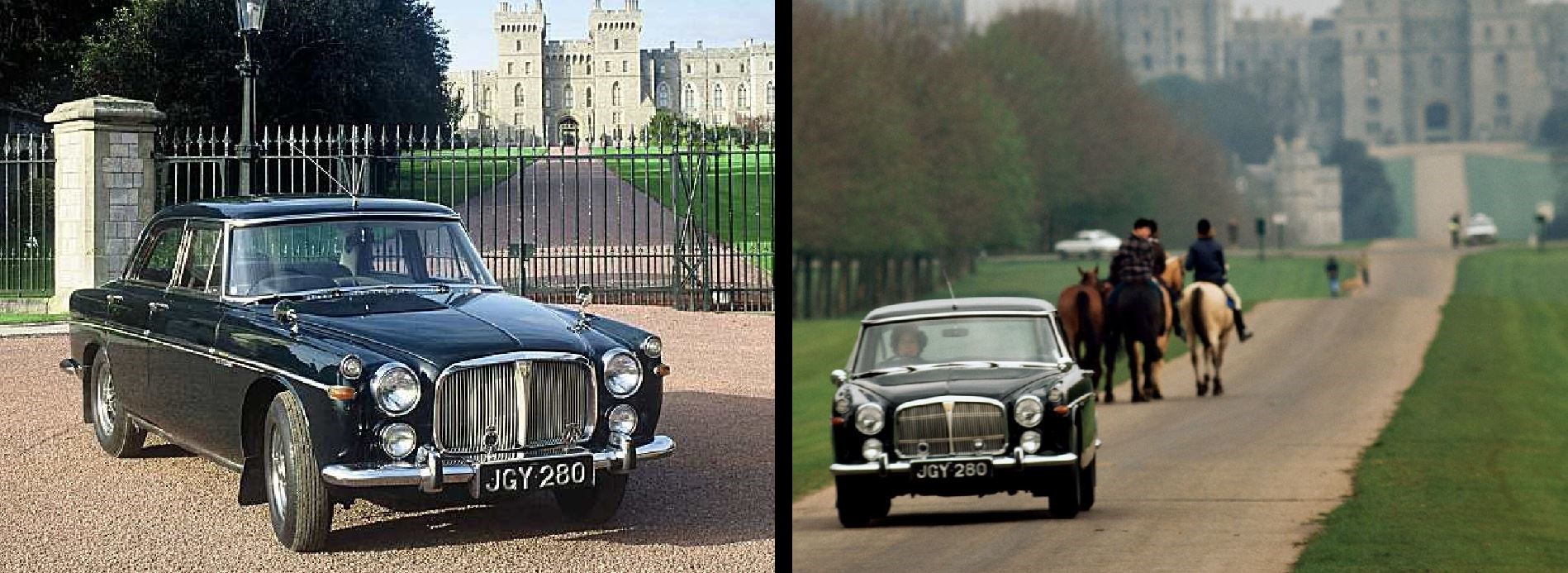
JGY 280: Windsor Castle, London.
One of Elizabeth II's (1926-2022; Queen of the UK and other places, 1952-2022) P5B Saloons outside the gates of
Windsor Castle (left) and the sovereign at the wheel (right), reputedly
on the way to church. While one of her 3.5s won’t quite be “only driven to
church on Sunday by little old lady”, being in the Royal Mews, it would have
been well-maintained and nor would it have long-lingered outside, Her Majesty not approving of vicars prone to prolixity and believing a service should take no more than 40 minutes. Although for almost 20 years a fixture outside No 10
Downing Street, the most famous P5B owner was Elizabeth II who in 1968 upgraded from a 3 Litre and,
although not noted for being sentimental about machinery, until 1987 ran one of
the several maintained in the Royal Mews during her reign of over 70 years. Like her ministers, Her Majesty drove only the saloons, although they usually had a chauffeur who, in the new, democratic age, were styled "drivers".

Rover P5B headrests (left & right) and the mounting assembly
for the reading lamps in the front units (centre).
Most of the focus on the Rover 3.5 has always been about
the transformative engine or the more illustrious of the passengers but one detail of note is the unusual bulk of the headrests, optional fittings in most markets. Quite why they were so big isn’t clear although the shape of the rear units presumably made for an easier mounting through the parcel shelf, meaning the seat's frames & covers needed no modification and it’s apparently not an urban myth some used by the British government had a
bullet-proof panel inserted; there was certainly the space to accommodate even
a thick metal plate. The front headrests
were used also to house the optional reading lamps, the wiring harness within well
concealed. Should any historian of such things ever write the book "Landmarks in Headrest Design", the Rover P5 will merit a page or two.