Trans (pronounced trans or tranz)
(1) A
person who identifies as transgender (though now the polite use seems to be as
a modifier (trans-man, trans-woman, trans-gender and not always hyphenated),
the prefix denoting “on the other side of,” referring to the misalignment of
one’s gender identity with one's sex assigned at birth.
(2) As
an offensive slur, a historic term for a transsexual (itself a now less common
term) and often used as “trannie” (which tended to be non-offensive if used
within the transsexual community). As a
slur, both trans and trannie are sometimes used (often technically incorrectly)
as expressions of general disapprobation of anybody perceived as maintaining an
identity outside traditionally constructed gender norms.
(3) In chemistry,
in (or constituting, forming, or describing) a double bond in which the greater
radical on both ends is on the opposite side of the bond.
(4) In chemistry,
in (or constituting, forming, or describing) a coordination compound in which
the two instances of a particular ligand are on opposite sides of the central
atom (eg the trans effect is the labilization of ligands which are trans to
certain other ligands).
(5) In cytology,
of the side of the Golgi apparatus farther from the endoplasmic reticulum.
(6) In
the slang of mechanics and certain mechanical engineers, a shorting of
“transmission” (an intermediate input/output device between a power unit and its
eventual delivery), sometimes also truncated as “tranny” (both dating back at
least decades).
Mid-late
twentieth century: Transsexual appears in
the literature in 1953 but then it had the meaning "intense desire to
change one's sexual status, including the anatomical structure" but as
early as 1941 “transsexuality” was being used to describe both "homosexuality
& bisexuality". In the current
sense it has existed since 1955 but for decades the older uses overlapped. The prefix trans- is from the Latin trāns (adverb and preposition) (across,
beyond, through) from the Proto-Italic trānts,
from the primitive Indo-European tr̥h-n̥ts, from terh-
(through, throughout, over). It was
cognate with the English through, the Scots throch
(through), the West Frisian troch
(through), the Dutch door (through), the
German durch (through), the Gothic þairh (through), the Albanian tërthor (through, around) and the Welsh tra (through). Trans is a
noun and adjective, the noun plural historically was transes but as trans has
become a notable component of identity politics, trans is now often used, especially
collectively. The noun transness is a
recent coining and although they’re still non-standard forms, (sometimes
jocular) creations such as transbionic & transnessness) have and will
continue to be created but it doesn’t seem that transitivity (either (1) the
rule in formal grammar which defines the degree in which any one verb can
take/govern objects or (2) in mathematics and formal logic, the property of
being transitive) has yet in this context been re-purposed.
The prefix
trans- most occurs in loanwords from the Latin (transcend; transfix) and the
model imparts meanings related to “across,” “beyond,” “through,” “changing
thoroughly,” “transverse,” in combination with elements of any origin: transubstantiation;
trans-Siberian; transempirical etc. In chemistry,
the prefix indicating that a chemical compound has a molecular structure in
which two groups or atoms are on opposite sides of a double bond trans-butadiene
and there does seem to be a widely followed convention in chemistry that trans
is written in italics. In astronomy the prefix
denotes something farther from the sun (than a given planet), thus the terms trans-Martian;
trans-Neptunian etc. In genetics, it
refers to having two genes, each carrying a mutation, located on opposite
chromosomes of a homologous pair. Transylvania
(literally "beyond the forest) was from the Medieval Latin, the construct
being trans- + sylva (the geographical area referenced); it was so-called in
reference to the wooded mountains that surround it. The pop-culture associations with vampires
make the place famous. The title of
Giuseppe Verdi's (1813–1901) 1853 Opera La
traviata (literally “the woman led astray”) but usually translated as “The
Fallen Woman” is from traviata ("to
lead beyond the way”) from tra- (across,
beyond), from the Latin trāns. English has many words either influenced by or
which trans is a part including Trans-Atlantic, trans-oceanic, transnational, transsexual,
translocation, transpontine, transliteration, transept, transect, transducer, transmit,
transfer, transit, transmute, translucent, transform, transverse, transfuse, transitive,
transcribe, transubstantiation, transplant, transcend, transfigure, transgress,
transfix, transact, transmutation, transpire, transient, transfusion, transparent,
transport, travesty, transpose, transgression, translate, transmigration, transaction
& trajectory.
The
state commonly called Jordan (الأردن in the
the Arabic (Al-ʾUrdunn))
is officially the Hashemite Kingdom of Jordan.
In one of the classic colonial fixes at which the British (through long
practice) used to be really good, the Emirate of Transjordan was created in 1921 as a British
protectorate, independence granted in 1946 as the Hashemite Kingdom of
Transjordan, renamed in 1949 to its present name to celebrate the capture of
the West Bank during the 1948 Arab–Israeli War, held as annexed territory until
lost in the six-day war in 1967, the claim not renounced until 1988 as part of
a peace treaty with the state of Israel.
The name of Jordan is from the Jordan River which forms much of its northwestern
border, the name though derived from the Hebrew ירד (Yarad)
(one who descends), a reference to the waterway’s physical geography. The name “Transjordan” wasn’t actually an
invention of the British Colonial Office but an adoption of a geographical
expression in use for centuries meaning “across the Jordan” and used,
historically, to denote the lands east of the river.
The
trans wars
The
terms transgender and trans (in this context) are technically interchangeable
but so fraught are the politics of identity that some may have objections to
either and the general rule is to conform to whichever preference is expressed. The developments have been so rapid in the
early twenty-first century that trans has attracted the interest of the
linguistics community and its been noted there are transgender people who prefer
writing trans compounds as two words (ie trans man, trans woman, trans person),
and when used as an open compound with a space, trans functions as an adjective
modifying a noun. Although to many it
may seem a fine distinction, spelling these words as closed or hyphenated
compounds (transmale, trans-woman etc) loses the distinction between trans as a
descriptive adjective and man, woman, or person as a human being and on that
basis cis male and cis female would be preferred although there’s no evidence
of concern from the CIS community except those who assert the concept is
unnecessary and add nothing to male & female.

There
is also trans+, dating from 2003, which doesn’t as such add a new category to
gender fluidity but instead acts (mostly adjectively) as an expression of
inclusiveness, an all-encompassing blanket term covering all specific gender
identities which are not cisgender and (more controversially), is used by some
even to include "allies" (in the sense of the second "A" in LGBTQQIAAOP) from the among
the CIS. The emergence of the concept of
trans+ may have been political, a desire to avoid the internal divisions which have been documented between the LGBTQQIAAOP factions although the
extent to which another constructed (and by some perhaps imposed) label can be effective in limiting the fissiparousness
which may to some extent have been at least encouraged by the dictatorial implications of the label LGBTQQIAAOP
is debatable.
What trans+ does is add to the (narrowly defined ) trans community (the range of gender identities including transgender, genderqueer, gender-fluid etc) the genderless, the agender, the subgender, the postgender, the bigender, the varigender and (presumably) whatever other flavors may emerge from the seemingly expanding spectrum(s) among the non-cisgender. Another intriguing innovation, noted first in 2017 was the appending of the asterisk, presumably as a wildcard as used (since circa 1969) when handling the searching of computer file systems but linguistically, trans*, trans+* & trans*+ don’t appear in any way to change the meaning of trans+ and should probably be thought of as a strengthening of the denotation of inclusiveness. That said, within any community (however defined), there will always be those who long for (an exclusionary) exclusivity for their faction so it’s not impossible that trans+ may yet fracture. Transgender Day of Visibility is celebrated every 31 March, the day set aside to advocate for and celebrate the accomplishments of transgender persons, one right wing US politician who made no secret of their transphobia opining that if it has to exist, it should be moved to 29 February.

TERF but not teal: The photogenic Katherine Deves for whom green is green and blue is blue and never the twain shall meet.
Unexpectedly, transphobia emerged as an issue in the 2022 Australian general election. Ms Katherine Deves (b 1978; lawyer and candidate (Liberal) for the division of Warringah (NSW)), the personal selection (“captain’s pick” in the sporting parlance borrowed by politics) as candidate by Prime Minister Scott Morrison (b 1968; prime-minister since 2018) excited controversy firstly by expressing a view that trans-women should not be allowed to compete in sporting competition against cis-women because of the advantages in strength she said their origins as cis-men inherently conferred, regardless of any subsequent treatment. That was enough to excite a reaction on twitter but things really erupted when historic social media posts were leaked, including “half of all males with trans identities are sex offenders”, referring to (gay) surrogacy as “prostitution”, suggesting a link between “transvestism and serial killers”, claiming trans teenagers were “surgically mutilated” and describing a gay magazine as “… just a mouthpiece for misogynists and the Rainbow Reich.” Given comparing anything to the Nazis is best left to consenting historians behind closed doors, that might have been expected to trigger another twitterstorm but reaction was untypically subdued, the issue of transphobia seemingly drowning out everything else. The US president had also caught her eye. Disturbed by his pro-trans position, she posted that she didn't "...believe Biden is capable of thinking much at all, he’s clearly showing signs of dementia’’ although she refused to accept his views were sincere and he was forced by political necessity to pander to the “very powerful and incredibly dangerous” transgender activists within the Democratic Party.

Demonstration in the Warringah electorate by the Community Action for Rainbow Rights to protest the Liberal Party’s endorsement of Ms Deves as their candidate.
Ms Deves, a self-described TERF (trans exclusionary radical feminist) issued a statement in which she acknowledged that “…trying to prosecute arguments about complex, nuanced and difficult subjects ... should not take place on a platform that propagates offence and division and hurt.” “Going forward…” she added, “I will be conducting myself in a dignified and respectful fashion”, noting that twitter “…was not the appropriate platform to do so.” “I have removed myself from that platform, and I will not be going back there again.” “With this issue, we have a collision of rights and thus far the voices of women and girls have not been heard. And when we have a collision of rights in liberal democracies, we debate them in a reasonable, measured fashion – that's what should have taken place here.”
It wasn’t a difficult statement to deconstruct, Ms Deves, who previously had also condemned surrogacy as a “human rights violation” not retreating from or recanting her expressed opinions, just saying they’d no longer appear on twitter. Mr Morrison, not previously noted for any contribution to feminist thought, seemed grateful finally to have stumbled on such a champion of women’s rights and declared “She is a woman standing up for women and girls and their access to fair sport in this country”, adding “I am not going to allow her to be silenced.”
Nor it seems, shortly, will twitter. Ms Deves may be joyful about libertarian Elon Musk's (b 1971) plans to overthrow the censorious ancien régime at twitter and may yet return to the platform but it may be a moot
point whether her advocacy in the matter of women’s sport is anyway an example of transphobia. That discussion is solely about
participation in sporting competitions restricted to “women”, there being no
debate about the right of trans-persons to enter events restricted to
“men”. The issue therefore is not one of
a generalized transphobia but rather "transwomanphobia" although that does seem no less objectionable. However, regardless of
the syntax, it’s not something which is going to go away soon because the
medical and legal devices adopted by sporting codes and the
anti-doping agencies have not satisfied everybody and it may be no such
solution exists. The dispute remains afoot.
The Warringah electorate has existed in essentially its present form since a 1922 redistribution (re-districting) and has been associated with some notable characters in political history. The member (as an independent and for the Liberal Party and its predecessors) between 1937-1951 was Sir Percy Spender (1897–1985; foreign minister 1949-1951; Ambassador to the United States 1951–1958; member of the International Court of Justice 1958–1967 (president 1964-1967)). Sir Percy was the grandfather of Allegra Spender (b 1978), a Sydney business identity & heiress who is standing as one of the so-called “teal independents” (teal presumably the idea of mixing a “blue-blood” establishment background with a “green” environmental consciousness) targeting those Liberal-held seats thought vulnerable because the voters’ profile tends to a more progressive agenda. Throughout his career at the bar, in politics and on the bench, Sir Percy was noted, though not always praised, for his independence of mind and one suspects he might have approved of his grand-daughter’s designs on his old seat.

Sunday at Clontarf Beach (1979), oil on canvas, by Salvatore Zofrea (b 1946).
Edward (Ted) St John (1916-1994; a practicing QC) (confusingly pronounced sin-gin in one of the historic quirks of Anglo-French) held the seat for three turbulent years between 1966-1969, during which he managed to upset two prime-ministers and not a few others repelled by his moralizing although, despite his prudish and puritanical reputation, he was a doughty defender of free speech and appeared for the defense in the Oz and Thurunka obscenity cases (which saw him, bizarrely, labeled "a pornographer") and would later in his legal chambers hang Salvatore Zofrea’s Sunday at Clontarf Beach, something a little more explicit than what usually adored the walls of the Sydney bar. His memoir (A Time to Speak (1969)) was uncompromising but well-written.
Less impressive was the tenure of Michael MacKellar (1938–2015) who kept the plum seat in his grasp between 1969-1994. Due more to the effluxion of time than any obvious talent, he served as an undistinguished member of the Fraser government (1975-1983) but is now remembered only for an attempt to evade duty on imported goods, an event blamed, as is traditional, on a mistake by a member of staff apparently employed by the taxpayer also to attend to the minister’s personal paperwork. In an example of how cover-ups tend to be worse than the original indiscretions, a fellow Minister, John Moore (b 1936; MP 1975-2001, minister in the Fraser and Howard governments), attempted a cover-up, the consequence being they both were compelled to resign their offices. Whatever might be the criticisms of Malcolm Fraser (1930–2015; prime-minister 1975-1983), he did maintain high standards of ministerial propriety which have for some time, essentially ceased to exist and the decline in the enforcement of those standards does mean subsequently there have been plenty of second and third acts in Australian politics. Although he never again held office, Mr Mackellar did return to serve on the opposition front bench and thrice unsuccessfully sought the deputy leadership of the Liberal Party.
Mr Moore’s story was even more amusing.
In opposition between 1983-1996, he served in the shadow cabinet while
also making a few unsuccessful attempts to become deputy leader but his most
notable contribution was as one of a triumvirate of malcontents who (quite
competently it must be admitted) in 1989 arranged the knifing in the back of John
Howard’s (b 1939; prime-minister 1996-2007) leadership and the re-installation
of (the previously and subsequently) unsuccessful Andrew Peacock (1939–2021; leader
of the opposition 1983–1985 & 1989–1990).
Mr Howard proved remarkably forgiving (or just desperate to afforce his team
with some experience, none except him, Moore and one other ever having served
in a cabinet), appointing Mr Moore to cabinet in 1996 and even (in a sign of
the declining standards which have since further been eroded) not sacking him
when he was found to have breached the ministerial code of conduct. His usefulness to Mr Howard over by 2001, he
was dropped from cabinet and Mr Moore resigned his seat at a point when the
party’s fortunes were at a low ebb, the subsequent by-election delivering to
the Labor Party what had hitherto been a safe Liberal seat. In 2015, in what came to be known as the “snouts in the trough” case, Mr Moore and
three other former MPs took to the High Court the claim that some (slight)
limits placed on some taxpayer-funded allowances (to which they claimed they
were for life entitled) were unconstitutional.
They lost.
MacKellar’s
successor was Tony Abbott (b 1957; prime-minister 2013-2015) who held Warringah
between 1994-2019, always for the Liberal Party although his views seemed more
often to reflect those of the Democratic Labor Party (DLP or "Vatican down-under" as it's better understood) which many assumed was his true spiritual home. Mr Abbott,
in what may prove either an aberration or emblematic of something of a shift in
political alignments, in 2019 lost the seat to Zali Steggall (b 1974; lawyer
and former Winter Olympian) who stood as an independent on a platform which
focused on the matter of climate change (the scientific validity of which Mr Abbott once famously dismissed as "crap").
Ms Steggal will in the 2022 poll be re-contesting Warringah, joining Ms
Spender as one of the “teal independents”.
The
Trans-Am

The Trans-Am Series is a motorsport competition in North America (thus the name trans- (across) + America(s)). Sanctioned by the Sports Car Club of America (SCCA). It was first held in 1966, its classic years between 1966-1970, an era in which many of the US manufacturers provided factory backing to the participating teams and there was a symbiotic relationship with the SCCA which came to adjust the rules to suit the available machinery, a reversal of the original model in which the regulations were laid down and the cars were required to conform.

Popular
from the start, the rules were designed to attract the interest of the baby
boomers who were buying versions of the cars raced, and it was originally a
series for FIA Group 2 Touring Cars, (slightly) modified standard production vehicles
within certain size constraints and built in a certain volume in two capacity
classes (122 cubic inches (2.0 litre) and 305 cubic inches (5.0 litre)), both
running together on the track. As
intended, it attracted the entries of the US "pony cars" (Plymouth
Barracuda, Ford Mustang and their imitators) and the high-performance versions
of the European machinery sold in the US.
Bizarrely as it now sounds, the latter class included the then two-litre
Porsche 911 because the Germans had prevailed on the SCCA to classify it as a
"sedan" but it was then a different sort of vehicle and, cognizant of
its evolution, it was later re-classified as a "sports car". The two litre class was interesting and
fiercely contested but it was the noise and fury of the V8 powered pony cars which attracted sponsorship and crowds.

The
series is remembered for the competition between pony cars such as the Ford
Mustang, Mercury Cougar, Chevrolet Camaro, Pontiac Firebird, Dodge Challenger, Plymouth
Barracuda & AMC Javelin but it didn't long last as something for the
typical cars bought from showrooms in the tens of thousands. The victory of the Mustang in the first two
years of the championship had done much for Ford's image and in response, with
a pot of money in one hand and a copy of the SCCA rule-book in the other,
Chevrolet built a special version of their new pony car, the Camaro Z/28 which
featured a unique 302 cubic inch version of the small-block V8 which, highly
strung and noisy, obviously wasn’t intended for anywhere but a race
track. To this, Ford responded. They had enlarged their mainstream
small-block V8 to 302 cubic inches but it wasn't race-ready like the Z/28 so
what was concocted was one of the wilder power-plants of the era, the tunnel-port
302 although, despite the company's assurances, it was never produced in
sufficient numbers to conform with the SCCA's rules but of greater concern was
the way it was prone to blowing up. What Ford
had done was to take a technique which had proved successful on the bigger FE engine,
which in 427 cubic inch (7.0 litre) form had been reliable enough twice to win
the Le Mans twenty-four classic, solving a problem inherent to pushrod engines;
the limitations imposed on intake port size by the need to provide a passage
for the pushrod tube. A tunnel-port was,
as the name implied, a tunnel for the pushrod which passed directly through the
port which could now be made as large as possible. Surprisingly, the tubular tunnels proved to
have no adverse effect on gas flow, the tunnel-port 302s producing prodigious
power and, satisfied what they'd seen on the dynamometer was indicative of
a race-winning engine, Ford went racing.
Unfortunately, those big ports which guaranteed the stunning top-end
power actually inhibited low and mid-range torque and that was what was
required on the twisty road courses and street circuits where the Trans-Am cars
ran and the high-revving tunnel ports, away from the static environment of the dynamometer
test rig, generated much stress and components began frequently to break. Chevrolet won the next two Trans-Am
titles. Ford came up with a better idea
the next year, the Boss 302 sacrificing some of the tunnel-port's intoxicating
high range response but delivering its power over a range actually usable by race
drivers and Ford duly won the 1970 championship.

The
writing however was on the wall for the practice of putting race-engines in
road cars. The world was changing and
the manufacturers were being forced to divert resources away from motorsport to
more prosaic pursuits like safety and emission control, racing budgets shrinking
or evaporating. In response, the SCCA
changed the rules so that it was no longer necessary for manufacturers to
produce and sell a specified number of the sometimes cantankerous race-bred
mills, instead allowing them to modify just what was used in the race-cars,
even increasing or reducing capacity as required. Thus the exotic 302s (and Pontiac's stillborn
303) were retired and Chrysler was encouraged to enter the fray, the race teams de-stroking
their LA 340 cubic inch (5.5 litre) V8 to meet the limit.
The pragmatic approach sustained interest for another couple of years
but by 1973 the manufacturers had withdrawn support to concentrate on things
more essential and the first oil shock that year guaranteed the corporate gaze would
remain averted from the circuits. The
Trans-Am series however, under a variety of names, continued and is still run
although it's never again captured the imagination the way it did in that first
half-decade.
The Pontiac Trans Am

Over four generations, the Pontiac Firebird was produced
between 1967-2002 but is best remembered for the Trans Am versions, introduced
in 1969. The original intention had been
that like Chevrolet’s Camaro Z/28, the Firebird Trans Am would be a genuine
race-ready package, the centrepiece of which would be a short-stroke, 303 cubic
inch V8. Unfortunately, development of
the 303 was delayed and by the time a reputed twenty-five odd had been
installed in pre-production vehicles, the SCCA had changed the rules and the
special race engines were no longer required but, having invested so much
already in the other parts, Pontiac decided anyway to proceed which meant (1)
the true Trans Am never actually took part in the series after which it was named and (2) the production
version was really just a Firebird which looked like a racing car. Fortunately, it transpired that was exactly what the market
really wanted and for decades the Trans Am was usually Pontiac’s most profitable
range, the bottom like dented only slightly by the US$5.00 per unit paid to the SCCA as
a licensing fee for the use of the name (although Pontiac deleted the hyphen).

Perhaps
the most famous of the Trans Ams were those produced in 1973-1974 and fitted
with the SD-455 engine (455 cubic inches (7.5 litre)), an unexpected throwback to high-performance in an era
when outputs were in decline and it was thought both the industry and buyers
had lost interest in such things.
Resurrecting the SD (Super-Duty) moniker which Pontiac had used as a
high-performance designator in the early 1960s, the SD-455 is infamous for the trick with which Pontiac tried to fool the EPA’s (Environmental
Protection Agency) inspectors, a primitive version of dieselgate which in the
twenty-first century would cost Volkswagen and others (all also guilty as sin) billions. Pontiac’s engineers had studied the parameters
of the EPA’s tailpipe-emission test cycle and, noting it ran for fifty seconds, devised an
ingenious system which after 53 seconds deactivated the critical anti-emission
plumbing. Under this regime, the SD-455
was able to produce the 310 horsepower which was by then the top rating in the
industry while still receiving the vital EPA certification required legally to
sell the thing. Unfortunately, the EPA’s
engineers turned out to be just as clever and detected the ruse, a more
impressive performance than that of the later eurocrats who “caught” Volkswagen
only because Mercedes-Benz snitched on them in exchange for immunity from
prosecution. Those were more forgiving
times and instead of being pursued through the courts, Pontiac was required
only to follow the rules and although the SD-455 had to be detuned a little,
the resulting 290 horsepower was still more than anyone else could
manage in those years.
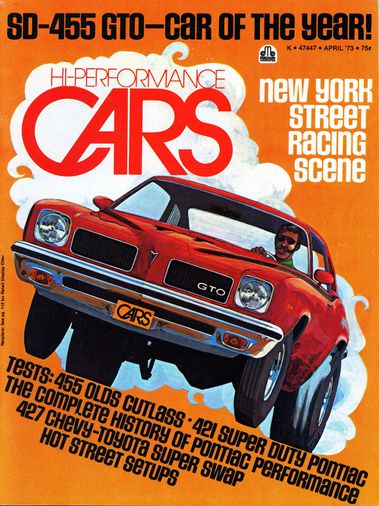
SD-455 production numbers were low, 295 in 1973 (252 in Trans Ams & 43 in Firebird Formulas) and 1001 in 1974 (943 Trans Ams & 58 Formulas) and after the troubles with the EPA, plans to offer the engine in other models were abandoned although not until after some pre-production (310 horsepower) Trans Ams and one GTO (a larger, four-seat coupé) had been given to the press for testing and publicity. The SD-455 Trans Am’s reputation is thus probably a little inflated because many of the performance numbers quoted come from the early tests of the machines with the anti-EPA cheat gear attached but more embarrassing was that Hi-Performance Cars magazine, impressed with the SD-455 GTO they'd tested, announced it as the winner of their 1973 Car of The Year Award, the magazine hitting the news-stands just the decision was taken not to produce the thing. As the "last of the original muscle cars", the SD-455 Trans Am went on to become a collectable and fine examples typically now attract US$125-150,000 although in 2023 one exceptional specimen at auction realized US$200,000; pristine copies of the April 1973 edition of Hi-Performance Cars have been advertised for over US$50.


