Swastika (pronounced swos-ti-kuh
(Germanic) or swas-ti-kuh
(English-speaking world)).
(1) A
figure used as a symbol or an ornament in the Old World and in America since
prehistoric times, consisting of a cross with arms of equal length, each arm
having a continuation at right angles.
(2) The
official emblem of the Nationalsozialistische Deutsche Arbeiterpartei (The NSDAP, the National Socialist German Workers' Party better known as the Nazi Party (1920-1945)) and (after 1935) the German state (Third Reich).
1850–1855:
From the Sanskrit स्वस्तिक (svastika), from svasti (prosperity), the construct being सु- (su-) (good, well (cognate with Greek eu-) + अस्ति (asti) (that being as- (be) + -ti- (the abstract
noun suffix)) + क (ka) (the diminutive suffix), hence "little
thing associated with well-being", best understood in modern use as “a lucky
charm". It was first attested in English
in 1871, a Sanskritism which replaced the Grecian gammadion. After adoption in
the early 1920s by the German National Socialist Workers’ Party (the Nazis),
swastika was increasingly used to refer to the visually similar hooked cross which
in German was the Hakenkreuz (literally
"hook-cross"), English use first noted in 1932. The su-
element is from the primitive Indo-European (e)su- (good), a suffixed
form of the root es- ("to be”);
the asti element is from the same
root. It was known in Byzantium as the gammadion and in medieval heraldry as
the cross cramponnee, Thor's hammer, and (although this is contested), the fylfot,
a similar shape though most usually rendered in mirror image to the swastika. Swastika is a noun (the rare adjective swastikaed is non-standard); the noun plural is swastikas.

Crate label advertising, Swastika brand fruit, L.V.W. Brown Estate, Riverside, California, 1930s.
For
thousands of years, the swastika was used by almost every culture as a symbol
of good fortune before, in the Western world, becoming synonymous the Nazis and
thus a byword for racism and barbarism. Translated
literally as "well-being" in the ancient Indian language of Sanskrit
and for millennia shared between Hindus, Buddhists and Jains, it was the
positive connotations associated with the shape, as well as its pleasing,
adaptive geometry which inspired the early Western travelers visiting Asia to
bring it home, examples found in the archaeological record of the Ancient
Greeks, Celts, and Anglo-Saxons, some of the oldest examples in eastern Europe,
stretching from the Baltic to the Balkans.
In the 1800s it became a popular shape among jewelry designers and by
the turn of the twentieth century there was quite a fad for it among graphic
designers who applied it from everything from tiled floors, fabrics,
architectural motifs and advertising.
Carlsberg and Coca-Cola both used it on their bottles and Swastika was
the title of the magazine of the Girls' Club of America, the young ladies being
awarded swastika badges to wear as a prize for selling copies. In one especially interesting example of
timing and placement, some war planes of both the Aeronautical Division of the US Signal Corps (predecessor
of USSAF & USAF) and
the UK’s Royal Air Force (RAF) were adorned with swastikas, beginning in the
1920s. Use declined, obviously, during
the 1930s but there’s evidence the symbol was used as late as 1939. The Finnish Air Force adopted it in 1918,
discretely painting over the last examples in 1945 but the symbol continues to
be used by some squadrons and on decorations.

Dirty laundry: Darty
Laundry electric delivery van, rendered by Raidió
Teilifís Éireann, (RTE, Radio & Television of Ireland, the Irish public
service broadcaster) in “Swastika Laundry”
livery for the television series Caught
in a Free State (1983) a four-part drama about German spies in neutral
Ireland during World War II (1939-1945), an event known in Ireland as “The Emergency”. As late as the 1970s there were at least 600
electric delivery vehicles on the streets of Dublin alone, their numbers
declining as private ownership of cars, washing machines, refrigerators and
such increased. In the UK, when milk was still every day delivered to houses, some 85% of deliveries were made by electric vehicles.
Anwar Sadat
(1918–1981; president of Egypt 1970-1981, left) and Israeli foreign minister
(and former IDF (Israeli Defence Force) general) Moshe Dayan (1915-1981, right),
King David Hotel, Jerusalem, 19 November 1977.
It was the first visit to Israel by an Egyptian president and although
the visit was successful, the “swastika” tie he on one occasion wore attracted comment. During the visit he
also chose neckwear in stripes and polka-dots so there were mixed messages but
in Washington DC, on 26 March 1979, some 16 months after the visit and
following the 1978 Camp David Accords, the Egypt–Israel treaty was signed,
providing for mutual recognition and a cessation of the state of war that had
existed since the 1948 Arab–Israeli War. Maybe, sometimes a tie is just a tie.

Playing cards, New, York, 1920s.
The
Nazi’s use of the swastika is another example of the quasi-scientific links
they claimed existed between Germans and ancient civilizations. Nineteenth century German scholars
translating old Indian texts had notice the structural similarities between
their language and Sanskrit; their conclusions were equivocal but the some
among the Nazis concluded this was proof of a shared ancestry with a race of
white warriors they called Aryans. Even
at the time, the linguists and anthropologists were appalled at the misappropriation
of their work; their findings had been about the structure of language and
nothing more. The Nazis however grasped
at straws wherever they fell. Single
swastikas began to appear in the Neolithic Vinca culture across south-eastern
Europe around some 7,000 years ago and during the Bronze Age were widespread
across the continent but, when clay pots embossed with swastikas dating from
circa 2000 BC were looted after the occupation of Kiev in WWII and were
exhibited in Berlin as evidence of a shared Aryan ancestry. Displays of the swastika have been banned in
Germany since the end of the war but attempts to extend the ban EU-wide have
never succeeded.

A K-R-I-T
bus in New York City, taking a jury to luncheon, October 1912. The matter on which the jury sat was a police
corruption trial, the murder of Herman Rosenthal (1874–1912) who ran several
small casinos which were subject to raids by the police who, in exchange for “protection
money” (claimed to be 20% of the day’s take) allowed them illegally to operate,
the money spread among police, Tammany Hall (headquarters of the Democratic
Party machine) and some corrupt politicians (in NYC at the time, something of a
tautology), New York Police Department
(NYPD) Lieutenant Charles Becker (1870–1915) and four members of the Lenox
Avenue Gang ultimately were convicted of murder and “got the chair”, the
executions carried out in 1915 in Sing Sing Prison’s death chamber.

US Army Air
Corps Boeing P12 (F4B) (1929-1942), circa 1964 (left) and the flying jacket of a US Army
observer, 45th Infantry Division, circa 1939 (right).
Obviously the swastika livery didn't endure but it wasn't the end of the
symbol appearing on US and British warplanes, small versions of the symbol
often stencilled onto the fuselage to indicate the count of a pilot's
"kills".
Finnish Air
Force Morane-Saulnier M.S.406 fighters, Latva Airfield, East Karelia, 9 September,
1943.
The Finnish Air Force introduced the blue swastika in 1918; it was known as the hakaristi, the
construct being haka (hook) +
risti (cross). The Morane-Saulnier M.S.406 was
a French fighter, based on an airframe which first flew in 1935 and it was only
marginally improved by 1938 when the pre-production models first
flew. Like some other aircraft in what
was a transitional period, the construction was a mix of old and new, the rear
steel-tube frame fabric-covered in the conventional manner but the remainder
had a skin of plymax, (a plywood veneer bonded to light alloy). Under-powered and lacking firepower, it was
hardly state of the art but was valuable export for the French industry, two
sent to Switzerland to be used as templates for local production and 30 to
Turkey while 160 had been sold to Poland but the timing was unfortunate because
they were in the process of delivery when the German invasion began in
1939. Just before the fall of France, 30
had been dispatched to Finland and the Germans would later augment this with a
further batch of 57 confiscated from the Armée de l-Air (the French Air Force),
distributing others to Croatia and Italy.
As the combat record in the Battle of France suggests (400 losses for
175 kills), the M.S.406 was outclassed by more capable German designs and in
the conflicts with the Soviet Union (1939-1940 & 1941-1944) Finnish
pilots found then agile but under-powered as well as unreliable as a gun
platform, instability noted when firing and the weapons of dubious
reliability. The solution for the lack
of power was typical of the improvisations often adopted during war-time:
re-fitting the sturdy airframe with the more powerful Soviet Klimov M-105 or
M-103 engines, both in plentiful supply from crashed enemy aircraft and stocks
captured by the Germans during the early successes in the invasion of Russia in
1941. A typical Soviet rip-off, the
Klimovs were improved versions of the Hispano-Suzia 12Y-31 V12 used in the M.S.406 and
were thus able to be re-purposed with relatively little effort. The change transformed the Finnish fighters, giving them a performance second only to the Messerschmitt BF-109s also in the fleet.
Years before there was a Nazi Party, the trademark
of the short-lived (1909-1916), Detroit-based motor car company K-R-I-T
(derived from Kenneth Crittenden (1889-1972) who provided financial backing and
contributed to the design) was the swastika.
K-R-I-T (the name was simplified to Krit after 1912) was one of some
2000 concerns which entered the US motor industry during the first two decades of
the twentieth century but the ancient symbol of good fortune, chosen “to ensure
favor of auspicious gods” failed the export-dependent company and World War I
(1914-1918) proved the final nail in the coffin. That Mr Crittenden was born in the same year
as Adolf Hitler (1889-1945; Führer (leader) and German head of government
1933-1945 & head of state 1934-1945) is one of history's many coincidences
and he went on to a long career in the industry, in 1928 joining Chrysler where
he remained until his retirement in the mid-1960s.

1912
K-R-I-T Model A Roadster. From the automotive
“brass era”, its fittings included a firewall mounted Solar acetylene
spotlight, twin Solar acetylene headlight, E&J kerosene sidelights, tufted
black leather upholstery, wood spoke wheels with 30 x 3½ inch tires and a cylindrical
bolster fuel tank.
Krit’s business model was one which for more than a century
has lured major manufacturers, independents and start-ups when came and went: “the modestly
priced, full-featured automobile”.
Such a product obviously has huge market appeal and thus the possibility
of achieving compelling economies of scale but it also attracts players so the
sector tends to become crowded, accounting for a hundred-odd years of
industrial churn. Depending on the
configuration, the K-R-I-T Model A was advertised between US$800-1000, just a
little more expensive than Henry Ford’s (1863-1947) Model T (1908-1927) but
offered more power from an engine almost identical in specification (177 cubic
inch, L-head, in-line four-cylinder) and a three-speed sliding gear
transmission, easier to use and affording greater flexibility than the Ford’s
two-speed planetary gearbox. Unfortunately
for Krit, demand in its most receptive and lucrative domestic market fell precipitously
after widespread crop-failure in the US west in 1913 and the outbreak of war in
Europe some months later killed demand there; Europe had absorbed more than 80%
of of the company’s export business.
Production ceased in 1915 and after for some month trying. And failing, to
raise new capital, the concern was dissolved.

The K-R-I-T badge (1908, left) and The Nazi's Goldenes Parteiabzeichen (Golden Party Badge (1933, right).
That the detailing in some
of Krit's swastika emblems was so similar to that adopted by the Nationalsozialistische Deutsche Arbeiterpartei
(The NSDAP, the National Socialist German Workers' Party better known as the
Nazi Party (1920-1945)) is not surprising because the color combinations and
aspect ratios which most appeal to one graphic artist are likely to be judged
as pleasing by another. Adolf Hitler
claimed he personally designed the escutcheon his movement would make infamous
and while he told many lies and there are many myths about his role in the
party’s early days, his claim is thought to be true and throughout his
political career, even in the depths of war when thing were bad, he never
ceased sketching and designing; he was a competent (if uninspired) artist
(although the human form eluded him) and likely would have be a proficient
architect. Nor did Hitler claim his
conceptual notions were original, admitting the combination of red, white and
black was something he “stole” from the posters of his enemies, the German communists
(whose propagandists seem to have settled on the scheme because it was used for
the flag of the German Empire (the so-called “Second Reich” (1871-1918). Especially among the right-wing, the symbol had been much used in the German Empire.

Grounds of the Mercedes-Benz factory decorated in honor of a visit to Stuttgart by Adolf Hitler (1889-1945; Führer (leader) and German head of government 1933-1945 & head of state 1934-1945), the display visible from his aircraft (1936, top left), a Mercedes-Benz showroom in Munich, Lenbachplaz (1935, top right) and 1938 Mercedes-Benz W125 Rekordwagen (bottom). Although, tucked away in a corner of the corporate website there is a single page which contains a rather perfunctory acknowledgement of company’s complicity in some of the crimes against humanity committed by the Nazi regime between 1933-1939 there’s little attempt to discuss the matter, an understandable reticence and quite a gap in the otherwise extensively documented history which dates back to 1886 with the debut of what is claimed to be the world’s “first automobile”. Brand-management can be as much about what is left unsaid or hidden as what is projected.
When used in events other straight-line speed record attempts (ie where corners needed to be negotiated) the streamlined version of the W125 Formel-Rennwagen (race car built in accord with defined rules) didn’t use the spats (fender-skirts) covering the wheels. It was used thus on Berlin’s high-speed Avusrennen with its two, uniquely long straights and differed from the conventional W125 in that it was powered by V12 engine rather than the usual big-bore straight-eight, the lower hood (bonnet) line further reducing drag. Fitted with the spats, W125 Rekordwagen (record car) was used in 1938 to achieve a speed of 432.7 km/h (269 mph) over the flying kilometre, then the fastest timed speed achieved on a public road and a record which stood until 2017. It’s now on display in the Mercedes-Benz Museum in Stuttgart, although, the swastika with which it was once adorned has been removed from the aluminum skin (displays of the swastika banned in Germany except as authorized).

German U-boat (submarine) U-576 (left) flying the Kriegsmarine’s (German navy) War Ensign (1935-1945).
U-Boat U-576 was sunk on 15 July 1942, 30 miles (48 km) off Cape Hatteras,
Hatteras Island, North Carolina. The Kriegsmarine’s
(German navy) War Ensign, flown from all combat vessels between 1935-1945, was raised when submarines were entering or leaving port but
otherwise rarely displayed. The swastika
was never painted on the hulls, a point of some legal consequence in the first
Nuremberg trial (1945-1946, heard before an IMT (International Military Tribunal) to try the surviving leading Nazis) when evidence was presented in the matter of the steam
trawler Noreen Mary, sunk by gunfire
from U-247 about 20 miles (32 km) west of Cape Wrath on the north Coast of Scotland. The witness provided sworn testimony he saw a
swastika painted on the submarine’s conning tower but it was proved no U-Boat
had ever been so decorated and, combined with other evidence, this weakened the prosecution case against Großadmiral
Karl Dönitz (1891–1980; Supreme Commander of the Kriegsmarine 1943-1945).

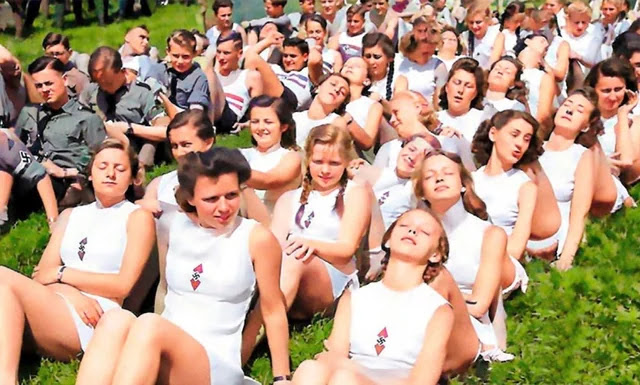
Hitler Youth & BDM members on camp together, circa 1937.
The Bund
Deutscher Mädel (League of German Girls) was the girls' wing of the Hitlerjugend (Hitler Youth), the Nazi
Party's youth movement (membership of which, like much in the Third Reich, was close to obligatory), intended to train boys to be ready to become good
soldiers and prepare girls for their traditional role of motherhood; it was abbreviated as BDM. Perhaps unfortunately, some mixed
activities such as the girls and boys going on camps together resulted in much
practical preparation for motherhood, revelations of this promiscuity leading Germans
to conclude BDM might better be understood as the Bund Deutscher Matratzen (League of German
Mattresses).

Bromide
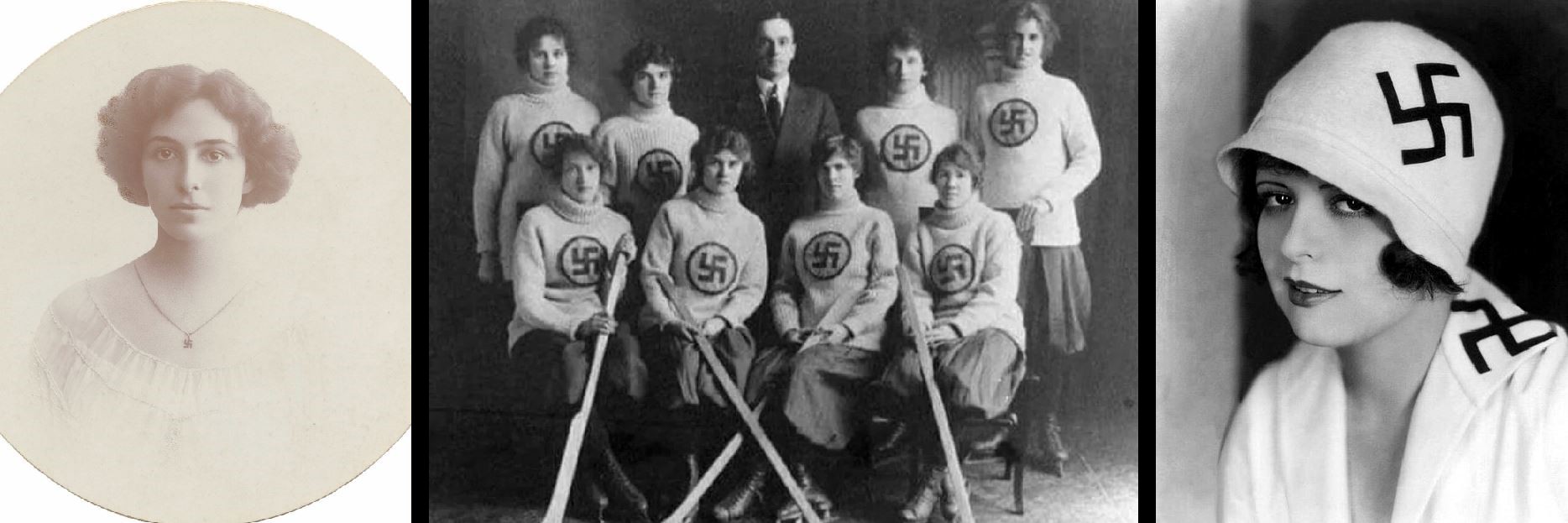
press print (circa 1911) of portrait by unknown photographer of Olave St Clair
Baden-Powell (née Soames), Lady Baden-Powell (1889-1977), Leader of the world
Girl Guide movement and wife of Lord Baden-Powell, founder of the Boy Scouts
movement, National Portrait Gallery, London (left), the Edmonton Swastikas ice
hockey team, 1916 (centre), and US actress Clara Bow (1905–1965) adorned in
swastikas to ward off the bad luck of Friday the 13th, photo-shoot
for “Ancient Cross Defies Jinx Day”
published on page 27 of the Los Angeles Times, 13 April 1928 (right).
Although in the West now
most associated with the BDM, before the evilness of the Nazis tainted the
association, girls had been wearing swastikas for centuries, sometimes because
of the association with good fortune and sometimes because it was just another bolt
shape, the distinctiveness of which made it adaptable to fashion. As well as the Edmonton operation, there were
two other Canadian ice hockey teams, the Fernie Swastikas out of Fernie, British
Columbia and the Windsor Swastikas of Windsor, Nova Scotia. In Nazi Germany, the Boy Scouts and Girl Guides
movements associated with Lord & Lady Baden-Powell were absorbed respectively
into the HJ & BDM and although many of the activities were carried over
(tying knots, outdoor survival skills, pitching tents and all that), the political
nature of the indoctrination was different.
Tellingly, although the Nazis had been marching under the swastika since
1920 and were already in Germany & Austria a byword for intolerance and violence,
the LA Times in April 1928 made not one mention of events in Europe and it’s
doubtful the movement, then still obscure in the US and well-known only to the
few interested in international events, much registered in public
consciousness. Ms Bow seems never to
have been interested in the politics of the right or left but she did in 1933 visit
Germany on her honeymoon and film buff Hitler (like many, a Clara Bow fan)
presented her a copy of his autobiographical manifesto Mein Kampf (My Struggle, 1925); it’s thought like most, Ms Bow
probably didn’t trouble to read the work.
The swastika did not ward off her bad luck and she later went mad (suffering
what would now be called “mental health issues”).
Mr Ye and
Ms Censori, annual Grammy Awards, Los Angeles, 2 February 2025. Most intriguing has been the suggestion Ms Censori is being paid by Mr Ye on a "per outfit" basis and is thus a kind of "walking installation". That would make it a very "modern" marriage and one of which not all would approve but there have been relationships (artistic and otherwise) based on more dubious arrangements.
In recent
years, the US rapper, singer, songwriter, record producer, hip hop identity
& fashion designer Ye, formerly known as Kanye West (b 1977) has (in a
sense) “re-created” Australian architect & model Bianca Censori (b 1995) as
a series of installations (which probably isn’t quite the right word but on the model of the
art business, it’s close); the two may (at least in some jurisdictions) be
married, the reports are contradictory.
What Mr Ye has done is to create photo opportunities using Ms Censori as
a lure by having her dress (again that may not be quite the right word) in a
style likely to attract photographers, vloggers, magazine editors and other
content aggregators. As an installation
there to be photographed, the well-qualified Ms Censori certainly draws the
lens and has taken the “nude dress” trend of the last decade-odd almost to its
logical conclusion and whether the concept can be taken further than her recent
appearance at the 2025 Grammy Awards has been debated; it certainly wouldn’t
demand much fabric. Although the
coverage (in the media, not of Ms Censori’s skin) has been extensive, whether
Mr Ye is much benefiting isn’t clear because the focus is, predictably, very much
on the installation rather than the artist and the only mention he seems to gain
is being condemned as exploitative or worse.
All the attention devoted to Ms Censori may also have engendered in him
what Gareth Evans (b 1944; Australian
Labor Party (ALP) senator or MP 1978-1999, sometime attorney-general &
foreign minister) called RDS (relevance deprivation syndrome) because his latest
on-line project is selling “swastika T-shirts” at US$20; it's a niche market but, given recent events, he may regard it as a growing one and the reaction to his venture was certainly
focused on him. The product code for the T-shirts was "HH01" and those who recall his comment: “There’s a lot of things that I love about Hitler" in a December 2022 podcast with the since bankrupted host Alex Jones (1974) probably deconstructed the code to mean “Heil Hitler” although to remove any doubt he also tweeted: “I love Hitler” and “I'm a Nazi”. Swastika T-shirts must have been too much for Shopify which took down the page, issuing a statement saying Mr Ye had "violated" the company's terms. It was an example of the dangers inherent in having a site administered by AI (artificial intelligence) with humans checking the content only in reaction to complaints. The AI will improve but whether Mr Ye has thought better of offering the range remains to be seen, yeezy.com now displaying only the stylized message YEEZY STORES COMING SOON♡.
The artist formerly known as Kanye West in shirt, Los Angeles, February 2025. As a device to attract photographers and generate an ongoing presence in print and on-line, a well-placed swastika remains potent.

In architecture and design, the swastika has been used for thousands of years. Top row:
Lampposts, Glendale, California, USA 1924-1927 (left), the unexpected juxtaposition
of a swastika atop a Jewish Star of David (centre) and Coronado Naval Base, San
Diego, California (not the “Albert Speer Memorial Retirement Home” as it has
been tagged on the internet), (right). Bottom row:
Skillman Branch Library (1931), Detroit, Michigan, USA (left), nineteenth
century floor in Roman Catholic church, Tamaulipas, Mexico (centre) and a floor
mosaic with geometrical designs and swastikas, laid in the second or third
century AD, Tarraco (ancient name of the city of Tarragona, Catalonia, Spain),
Archaeological Museum of Tarragon, Spain, (right).
The "Swasticar"
Elon Musk at the 2025 US Presidential Inauguration, Washington DC, January 2025.
So moved by
the moment when on stage at the inauguration ceremony marking the beginning of Donald
Trump’s (b 1946; US president 2017-2021 and since 2025) second coming (as the
MAGA devotes seem to regard it) was tech titan Elon Musk FRS (b 1971) that to express
to the adoring crowd “My heart goes to you”, spontaneously he gave a gesture
which many noted was similar to the many “Sieg Heil!” (Hail Victory!) moments made
infamous by Adolf Hitler (1889-1945; Führer (leader) and German head of
government 1933-1945 & head of state 1934-1945) in Nazi Germany
(1933-1945). To reinforce his point, Mr
Musk then turned to the crowd behind and repeated the gesture. He did first place his right hand over his heart (as per the US Pledge of Allegiance's current protocol) but arm was raised ("palm-down" (as used by the Nazis)) rather than "palm-up" (the pre-1942 US protocol) although probably no intent should be inferred from this because the raised palm procedure hadn't be in use for almost two generations before Mr Musk was born.

The
reaction was swift and widespread.
Predictably, memes appeared but there was also direct action, Tesla
dealerships picketed and the cars vandalized, sometimes by being daubed with
swastikas, sometimes by being torched, a disturbing trend given they’re fitted
with lithium-ion batteries which, when they burn, burn for hours. The shift in the political association
attached to the flagship of electric vehicles was remarkable. Once it had been V8-powered pick-up owners
south of Mason-Dixon Line who had despised the things, their suspicion being
Teslas encapsulated much that was a threat to the American way of life:
homosexuality, New York, California, trans-gender rights, environmentalism,
Freemasonry and the Democratic Party; suddenly, it was the Tesla-driving (or
aspiring) liberals embarrassed (or fearful) to be associated with the brand,
some resorting to gluing on Honda or Hyundai badges to deter the attacks.

One of the
most striking was an image by Portuguese graphic artist Ves Vaz (b 1986) which was
based on the famous photograph of “Tank man” standing in front of PLA (People's
Liberation Army) tanks sent in June 1989 by the CCP (Chinese Communist Party)
to “deal with” crowds of protesters gathered in Beijing's Tiananmen Square. The photograph was taken by AP (associated
Press) photographer Jeff Widener (b 1956) who initially was displeased at “tank
Man” appearing in frame for what looked like a perfectly composed shot. As things turned out, it became one of the
best known images of the century and one often re-published when the Tiananmen
Square Massacre (the “June Fourth Incident according to the CCP) is discussed. For cartoonists and artists like Ves Vaz the
Cybertruck is a gift because the shape is so distinctive instantly it’s
recognizable as a Tesla, even by those unable to tell a Ferrari from a
F-150. Of course, that also means it’s
pointless to stick on a Toyota badge which can make more anonymous looking
Teslas “blend in”, to some degree protecting them from roving anti-MAGA vandals.

Soon, on
London bus shelters there appeared posters dubbing Teslas “Swasticars” and
urging people not to buy them, the political messaging including references to white
supremacy, autocracy and allusions to the Third Reich. Swastikas seem not to have appeared,
presumable to avoid possible legal challenges although even without them, the meaning
was lost on few.

Digital projection on Tesla Gigafactory, Berlin, Germany.
Other forms
of direct action included the Tesla’s Gigafactory in Berlin having a depiction
of Mr Musk’s “My heart goes to you” moment projected onto the façade with a
“Heil” prefixed to the illumined “Tesla” although no swastika was added, the
symbol banned in Germany for all but a few special purposes. Interestingly, Tesla was there already the
subject of controversy on environmental and social grounds, having a year
earlier suffered an arson attack but the opposition has swelled after Mr Musk
association with the second Trump administration has fuelled a growing
perception of an alignment with the far-right. Although computers would have made the stunt easier, this would have taken much preparation and some physical testing.

Hailing cab with dog on leash: Gloria Walker (b 1937), PotM (Playmate of the Month), Playboy magazine, June 1956; photograph by Herman Leonard (1923-2010). Whether waving to someone or hailing a cab, the raised arm is one of humanity's more common gestures, meaning jurisdictions banning the act must base prosecutions on context and intent rather than merely the act.

2024
Tesla Cybertruck AWD Foundation Series (left) and the suspect cant rail. The term “cant rail” came from architecture
and railway engineering and referred to an angled or sloped surface. Cant rails (also often seen in fence
construction) are those parts which are tilted or positioned at an angle rather
than being strictly vertical or horizontal.
In automobile design specifically, a cant rail is the (sometimes
structural and sometimes cosmetic) section running along the top edge of the
side windows, connecting the A-pillar to the B-
C- or D-pillar; visually, it defines the roofline and can contribute to
strength. The early automobiles picked
up the name from the reinforced horizontal member supporting the upper structure
on railway carriages & horse-drawn carriages because the early techniques
of construction were essentially the same.
To add to
Tesla’s woes, in March 2025 came the news the company’s Cybertruck was subject
to a global recall, needed to rectify a fault in which large stainless steel body
panels can unexpectedly detach and (if the vehicle is in motion) “fly off”. The recall notice issued by the NHTSA (National
Highway Traffic Safety Administration) revealed the affected Cybertrucks were
the 46,096 built between November 2023 & February 2025 and the issue was
the adhesive used: “The Cybertruck is equipped with a cosmetic applique along
the exterior of the vehicle, known as the cant rail, which is an assembly
comprised of an electro-coated steel stamping joined to a stainless steel panel
with structural adhesive. The cant rail assembly is affixed to the vehicle with
fasteners. On affected vehicles, the cant rail stainless steel panel may
delaminate at the adhesive joint, which may cause the panel to separate from
the vehicle.” According to a
Tesla communiqué, the adhesive was “susceptible to environmental embrittlement”
which pleased word nerds; although “embrittlement” is rare, it’s not a recent
tech industry neologism and is seen most commonly as “hydrogen embrittlement”
(HE), known also as “hydrogen-assisted cracking” (HAC) or “hydrogen-induced
cracking: Hydrogen
embrittlement (HE), also known as hydrogen-assisted cracking or hydrogen-induced
cracking” (HIC), all of which describe the absorption of hydrogen into a metal,
and subsequent weakening, as part of a pickling process.

1945
Heinkel He 162 Salamander (Volksjäger) National Air and Space Museum,
Washington DC.
Recalls and
“fix bulletins” from Tesla have not been uncommon but most have involved the
need to patch software and these have been handled remotely. The “flying panels” will however require a
visit to a Tesla Service Center. The
company has thus far acknowledged 151 warranty claims related to the failed
glue but said it was “not aware of any collisions, fatalities, or injuries.” Coincidently, it was problems with an
adhesive which afflicted the Heinkel He 162 Volksjäger (People's Fighter), a jet-powered
fighter aircraft the Luftwaffe late in World War II (1939-1945) planned to be
flown by aviators from the Hitlerjugend (HJ, the Hitler Youth) who had the
benefit of a few hours training flying gliders.
For those intrepid youth, going from that to a jet-fighter was about as
ill-advised as it sounds but by 1945 the Germany’s military position was dire
and in many fields the bottom of the barrel was being scraped. Heinkel used Salamander as the project name
for the wing program and it’s that which military historians came to prefer
despite the whole project being called Spatz (Sparrow), while the Air
Ministry’s preferred Volksjäger never caught on. With aviation-standard metals in short
supply, the He 162 was built substantially from wood with only critical
components such as the fuselage skin and wing edges made from aluminium. This made it not only cheap to produce but also
a genuinely “disposable” aircraft with damaged units intended to be discarded
and replaced. Remarkably, the first
prototype flew in December 1944 only 38 days after the factory received the
blueprints but while the early tests proved it was a capable (if sometimes
tricky to handle because of the unusual layout) short-range interceptor, after
only days structural failures in flight began to occur, leading to
fatalities. The issue was traced to environmental
embrittlement, an acid in the adhesive used to bond the wood panels causing
delamination of the layers, the subsequent fragmentation meaning vital parts
would “fly off”
compromising structural integrity.
Between February-May 1945, some 120 of the 1000-odd air-fames were
delivered to Luftwaffe units but few ever saw combat and losses (most from
accidents or structural failures) exceeded the small number of Allied aircraft
it claimed.
With the
anti-Tesla movement growing and sales declining by as much as half in some places,
the company turned to what may seem an improbable but untapped market: The Kingdom
of Saudi Arabia (KSA). In invitations
sent to prospective customers in the kingdom, recipients were requested to RSVP
to a launch event at the Bujairi Terrace on 10 April 2025 where they could “Explore our
global best-selling line-up and step into a world powered by solar energy,
sustained by batteries, and driven by electric vehicles” and “Experience the
future of autonomous driving with Cybercab, and meet Optimus, our humanoid
robot, as we showcase what's next in AI and robotics.” Assured real humans would be on hand to
answer questions about “Tesla ownership, home charging and more”, the
select few were urged: “RSVP now. Space is limited.” Tesla’s previous neglect of Saudi Arabia was
not related to the kingdom being one of the planet’s major producers of fossil
fuels (and one which not long ago pledged to extract and sell “every last molecule”). Instead, the estrangement dated from a 2018 rift
between Mr Musk and Saudi Arabia’s PIF (Public Investment Fund the kingdom’s sovereign
wealth fund) over the failure of a funding deal which would have enabled him to
take the company private. To add insult to
injury, the PIF subsequently invested in EV (electric vehicle) start-up Lucid,
taking a majority stake and later announcing an intention to purchase as many as
100,000 Lucid EVs over a decade, apparently as part of an effort to reduce the
government’s dependence on oil. All that
may not sound encouraging for Tesla and EV sales in Saudi Arabia constitute not
even 1% of total but elsewhere in the Gulf, EV penetration in the taxi and ride-hailing
sector has been impressive so, coming off a low base, there clearly some scope
for growth and even before Tesla’s recent troubles, relations between the
parties did seem to be improving. Apart
from all else, Mr Musk is one of nature’s optimists.
Mr Musk is
known for his optimism, recently suggesting it was feasible for a settlement on
Mars to be established, able to sustain a permanent population of a million
people. That does show an engineer’s
faith in technological advances (as well as fiscal provision) because (1) to
transport even one person to Mars would take well over a year (thus far the
longest duration of one ways trips to somewhere else is the three-odd days it
took the twelve Apollo programme astronauts over six trips in 1969-1972), (2)
on Mars there is no breathable atmosphere, no known food sources and the
availability of usable water is uncertain and (3) the climate is mostly not
hospitable for human life with only the equatorial regions ever sometimes
rising to what on Earth would be thought temperate (highs between 20°C (68°F) -
35°C (95°F) recorded at noon during summer but typically the whole place is
cold especially the poles (-153°C (–243° F) and it’s there water sources (as
ice) may exist. So it’s a challenging
place for human habitation and the extent of the challenge is emphasised here
on earth with simply a rise on the global average temperature by 3oC
threatening to render certain regions economically unviable for a permanent
human presence to be maintained. It was
in an interview with Ted Cruz (b 1970; US senator (Republican-Texas) since
2013) in which Mr Musk speculated about a million folk living on Mars under
“glass domes” and the senator is well-aware of the difficulties of coping with
extreme cold, having once jetted out of an icy Texas during a cold snap to
enjoy the warmth of a Mexico beach, somewhat to the chagrin of the shivering
voters he deserted. On Mars, there are
no sun-drenched beaches and whatever Mr Musk’s million souls find when they get
there, that’s their life.
The "fascist salute"

The fascist salute has become so associated with Hitler and Nazism that in recent years some jurisdictions have banned its use, emulating the prohibition which has existed in Germany (the sanction pre-dating unification in 1990) for decades. Because the salute is the same gesture as that used for purposes ranging from waving to one's mother to hailing a taxi, prosecutions are expected to be initiated only in cases of blatant anti-Semitism or other offensive acts. The "salute" is so widely used that photographs exist of just about every politician in the act and they're often published; usually it's just a cheap journalistic trick but if carefully juxtaposed with something, it can be effective.

Lindsay Lohan: Sometimes, a wave is just a wave.
Benito Mussolini's (1883-1945; Duce (leader) & prime-minister of Italy 1922-1943) reverence for the Ancient Rome of popular imagination accounts at least in part for the Fascists' adoption of the so-called "Roman salute" although the Duce did also object to the shaking of hands on the basis it was “effete, un-Italian and un-hygienic” and as the reduced infection rates of just about everything during the “elbow-bumping” era of the COVID-19 social isolation illustrated, on that last point, he had a point. Other fascist regimes and movements also adopted the salute, most infamously the Nazis although none were as devoted as Hitler who, quite plausibly, claimed to have spent hours a day for weeks using a spring-loaded “chest expander” he’d obtained by mail-order so he’d strengthen his shoulder muscles sufficiently to enable him to stand, sometimes for a hour or more with his right arm extended as parades of soldiers passed before him.

A much-published image of the Duce, raising his arm in the fascist salute next to the bronze statue of Nerva (Marcus Cocceius Nerva) (30–98; Roman emperor 96-98) in the Roman Forum. Often published as an example of the fascist salute's lineage, the emperor is actually holding what's believed to be a scroll.
However, historians maintain there’s simply no evidence anything like the fascist salute of the twentieth century was a part of the culture of Ancient Rome, either among the ruling class or any other part of the population. Whether the adoption as a alleged emulation of Roman ways was an act of cynicism of self-delusion on the part of the Duce isn’t known although he may have been impressed by the presence of the gesture in neo-classical painting, something interesting because it wasn’t a motif in use prior to the eighteenth century. This “manufacturing” of Antiquity wasn’t even then something new; the revival of interest in Greece and Rome during the Renaissance resulted in much of the material which in the last few hundred years has informed and defined in the popular imagination how the period looked and what life was like. By the twentieth century, it was this art which was reflected in the props and sets used in the newly accessible medium of film and the salute, like the architecture, was part of the verisimilitude. Mussolini enjoyed films and to be fair, there were in Italy a number of statutes from the epoch in which generals, emperors, senators and other worthies had a arm raised although historians can find no evidence which suggests the works were a representation of a cultural practice anything like a salute. Indeed, an analysis of many statues revealed that rather than salutes, many of the raised arms were actually holding things and one of the best known was revealed to have been repaired after the spear once in the hand had been damaged.

Adolf Hitler showing the "long arm" & "short arm" variants of the fascist salute (left) and examples of the long arm & short arm penalty being awarded in rugby union (right).
In fascist use, what evolved was the “long-arm” salute used on formal occasions or for photo opportunities and a “short-arm” variation which was a gesture which referenced the formal salute which was little more than a bending of the elbow and involved the hand rising at a 45o angle only to the level of the shoulder; in that the relationship of the short to the long can be thought symbiotic. Amusingly and wholly unrelated to fascism, the concept was re-appropriated in the refereeing of rugby union where a “short-arm” penalty (officially a “free-kick”) is a penalty awarded for a minor infringement of the games many rules. Whereas a “full-arm” penalty offers the team the choice of kicking for goal, kicking for touch or taking a tap to resume play, a “short-arm” penalty allows a kick at goal, a kick for touch or the option of setting a scrum instead of a lineout. The referee signals a “short-arm” penalty by raising their arm at an angle of 45o.

How it was done: Mussolini, Hitler and Victor Emmanuel III show their interpretations of the fascist salute, the technique varying according to their commitment to the cause. The trio are reviewing an Italian military parade, Rome, May, 1938.
Front row: Benito Mussolini (left), Adolf Hitler (centre) and Victor Emmanuel III (1869–1947; King of Italy 1900-1946) (right).
Second row: Joachim von Ribbentrop (1893–1946; Nazi foreign minister 1938-1945, far left), Count Galeazzo Ciano (1903–1944; Italian foreign minister 1936-1943, centre left), Dr Joseph Goebbels (1897-1945; Nazi propaganda minister 1933-1945, centre right) and Rudolf Hess (1894–1987; Nazi deputy Führer 1933-1941, far right).
Back row: The WAGs (wives & girlfriends).
Of the seven men in this image, only Victor Emmanuel would die from natural causes, in exile succumbing to pulmonary edema (fluid in the lungs) some 18 months after being compelled to abdicate. While on the run, the deposed Mussolini would be executed by Italian partisans, Hitler & his new wife would commit suicide in the Berlin Führerbunker with Soviet troops only blocks away, von Ribbentrop would be hanged at Nuremberg after being found guilty of planning aggressive war, waging aggressive war, war crimes & crimes against humanity, Ciano would be executed on the orders of Mussolini (his father-in-law!), Goebbels & his wife would commit suicide (after murdering six of their seven children (aged 5-14)) shortly after the death of Hitler and Hess, sentenced to life imprisonment at Nuremberg for planning & waging aggressive war, committed suicide aged 93, after 46 years in captivity.
A most unfortunate conjunction of imagery: Adolf Hitler on Berlin's newly opened East-West Axis in his Mercedes-Benz 770 K Grosser Cabriolet F open tourer (W150; 1938-1943) in a parade marking his 50th birthday, opposite the Technical High School, 20 April 1939 (left) and David Bowie in his Mercedes-Benz 600 (W100, 1963-1981) Pullman Landaulet, Victoria Station, London, 2 May 1976 (right).
Sometimes a wave is just an excuse. The pop star David Bowie (1947-2016) understood he was an influential figure in music but on more than one occasion explained to interviewers: “I am not an original thinker”. Trawling pop-culture for inspiration nevertheless served him well but he later came to regret dabbling with history slightly less recent. Not impressed with the state of British society and its economy in the troubled mid-1970s, he was quoted variously as suggesting the country would benefit for “an ultra right-wing government” or “a fascist leader”. Although he would later claim he was captivated more by the fashions (the long leather coats said to be a favorite) than the policies of the Third Reich, the most celebrated event of this period came in 1976 in what remains known as the "Victoria Station incident". Mr Bowie staged a media event, arriving standing in an open Mercedes-Benz 600 Pullman Landaulet, recalling for many the way in which Hitler so often appeared in his 770 K. Unfortunately, a photographer captured a shot in what the singer later claimed was “mid wave” and it certainly resembled a Nazi salute. He later attributed all that happened during this stage of his career to too many hard drugs which had caused his interest in the aesthetics of inter-war Berlin to turn into an obsession with politics of the period. All was however quickly forgiven and his audience awaited the next album which is an interesting contrast to the cancel culture created by the shark-feeding dynamic of the social media era.
Now, were a pop star to tell interviewers: “Britain could benefit from a fascist leader” and “I believe very strongly in fascism … Adolf Hitler was one of the first rock stars”, their future career prospects might be "nasty, solitary, brutish and short". Despite that orthodoxy however, the multi-media personality Ye (the artist formerly known as Kanye West (b 1977)) has expressed what seem to be pro-Hitler sentiments and been photographed wearing a "swastika T-shirt", even (briefly) offering them for sale on the (now apparently in abeyance) Yeezy website. Rather than having him cancelled, Mr Ye's comments and products seem to have had at least a financial upside because in a post on X (formerly known as Twitter) he stated: "...AND I MADE 40 MILLION THE NEXT DAY BETWEEN MY DIFFERENT BUSINESS. THERE'S I LOT OF JEWISH PEOPLE I KNOW AND LOVE AND STILL WORK WITH. THE POINT I MADE AND SHOWED IS THAT I AM NOT UNDER JEWISH CONTROL ANYMORE IN WAR YOU TAKE A COUPLE LOSES..." That would seem to suggest that in the right circumstances, the Irish writer Oscar Wilde (1854–1900) and Dr Joseph Goebbels (1897-1975; Nazi propaganda minister 1933-1945) were right: "It doesn't matter what people are saying about you as long as they're saying something."
The US Pledge
of Allegiance salute
Children in the US saluting the flag, circa 1892. The non-saluting young chap in the centre of the photo is thought to have been distracted by the camera, rather than attempting to exercise his First Amendment rights.
In the US,
the “Pledge of Allegiance” salute was visually similar to the fascist gesture
but its adoption long predated the Italian and German dictatorships of the
inter-war years. Despite the name, the
origin of the so-called “Bellamy salute” (1892) officially is credited to
someone else and the true “inventor” (adaptor might be a better term) is
contested, there being factions which attribute the honor variously to either
(1) American Christian socialist Baptist preacher Francis Bellamy (1855–1931)
or (2) confessed Freemason James Upham (1845-1905). According to Bellamy's published instructions
for the “National School Celebration of Columbus Day” (as the 400th
anniversary of the “discovery” of America), the salute was first demonstrated
on 21 October, 1892. It should also be
added the text was a revision of the original Pledge of Allegiance, written in
1885 by Captain George Thatcher Balch (1828-1894), an officer in the Union Army
during the US Civil War (1861-1865).

The Freemasons stake their claim to the pledge: Plaque at James Upham's grave.
The
orthodox history long was the palm-out salute was created by Upham as the
gesture to accompany the Pledge of
Allegiance of the United States of America, a text written by Bellamy; known
also as the “flag salute”, it gained the name by which it came to be known
because it was Bellamy who most assiduously advocated its use. Not until several years after Upham's death did
his family found a copy of the pledge’s original draft, written in his hand,
but by then there had already been a ruling attributing credit to Bellamy and a
monument in his name erected. Despite
the documentary evidence, in 1939, a committee of the USFA (US Flag Association)
ruled in favour of Bellamy and a review issued in 1957 by the Library of
Congress in 1957 supported the committee’s findings. The family never succeeded in gaining Upton official
recognition but the Freemasons did have their revenge, “arranging for” the city of Malden to commission a plaque acknowledging
his authorship, installing it at Upham’s gravesite in Forestdale cemetery.
The meme makers had much fun with Mr Musk's “My heart goes to you” moment and earlier, those editing fragments from the film Der Untergang (Downfall (2004), a dramatization of Hitler's last days in the Führerbunker) when making contributions to the Hitler Rants Parodies explored the comedic possibilities of the fascist salute.
Little
disquiet about the salute seem to have been expressed during the 1920s but
fascism, then associated exclusively with Mussolini’s Italy, didn’t yet have
the bad reputation it would gain when the nature of the Nazi regime became better
understood (although not until after the end of World War II (1939-1945) were
the horrors fully comprehended). Interestingly,
as late as June 1942, at the urging of the American Legion and the Veterans of
Foreign Wars, Congress had passed Public Law 77-623, which codified the
etiquette used to display and pledge allegiance to the flag including the
raised arm. However, now at war with the
fascist Axis powers (Germany, Italy & Japan) the controversy increased and,
as a consequence, the protocol was revised by replacing the raised arm with an
instruction the right hand should be placed over the heart when reciting the
pledge, Congress amending the Flag Code on 22 December 22, 1942. Even that wasn’t without controversy because,
after all, the Americans were first and both the USFA and the Daughters of the
American Revolution (then still in its pre-DEI (diversity, equity &
inclusion) phase) asserted it was inappropriate for the nation to have to change
the traditional salute just because foreigners had later adopted a similar
gesture.

Context
is everything.
Top left: Crooked Hillary
Clinton (b 1947; US secretary of state 2009-2013) in Ralph Lauren pantsuit waving
to her fans (it's believed, world-wide, there may be as many as a dozen),
presidential inauguration ceremony, Washington DC, January 2017; Top right: A
kitten, probably stretching but who knows, some cats seem really evil and
these three could be an axis of evil.
Bottom left: Australian sprinter Peter
Norman (1942–2006, left) and US athletes Tommie Smith (b 1944, centre) &
John Carlos (b 1945, right), on the podium after the 200 metres final, Summer
Olympics Mexico City, 1968. Smith and
Carlos displayed the "Black Power" salute (with only one pair of
gloves, Carlos used his left arm) while in solidarity, Norman wore the OPHR
(Olympic Project for Human Rights) badge; Bottom right: Formula One champion
Sir Lewis Hamilton (b 1985) who has adopted the Black Power salute to signify
his support for BLM (the Black Lives
Matter movement).
As well as
the modification to the gesture, there have over the years been changes to the
text and the most controversial by far proved to be the interpolation of “under God”,
a change requested by Dwight Eisenhower (1890-1969; US president 1953-1961),
concerned about the spread of Godless (though more to the point, un-Christian)
communism during the high Cold War. Because
of the “freedom of religion” guaranteed
by the US Constitution (primarily protected by the First Amendment (1791): “Congress shall
make no law respecting an establishment of religion, or prohibiting the free
exercise thereof...”) challenges to that have reached the USSC (US
Supreme Court) but as early as 1940 (in Minersville
School District v. Gobitis, 310 U.S. 586 (1940)) the court ruled 8-1 students
could be compelled to recite the pledge, Harlan Stone (1872–1946; associate
justice US Supreme Court 1925-1941 & chief justice 1941-1946) issuing the
only dissent: “The
guarantees of civil liberty are but guarantees of freedom of the human mind and
spirit and of reasonable freedom and opportunity to express them…The very
essence of the liberty which they guarantee is the freedom of the individual
from compulsion as to what he shall think and what he shall say.”
By implication, the ruling meant the state
could demand at least an expression of obedience to the nation, even if it
conflicted with the doctrine of one’s religion.
Justice Stone’s argument must have been persuasive because in West Virginia State Board of Education v.
Barnette, 319 U.S. 624 (1943), the court held the First Amendment
guaranteed a right to non-participation in flag salutes although to solve several
problems, that case was decided on the basis of protected “free speech” rather than “freedom
of religion”. In the twenty-first
century, the cases (now usually based on the argument the phrase “under God”
was an unconstitutional endorsement of monotheism have continued but none have
succeeded and where possible, judges have found technical (such as a lack of
standing) rather than substantive grounds to dismiss although in a lower court
in 2015, it was ruled that because since 1943 participation has been “optional”, the pledge was thus a voluntary
and patriotic exercise, not a religious one.