Showing posts sorted by date for query Billigung. Sort by relevance Show all posts

Friday, April 3, 2026

Surplus

Surplus (pronounced sur-pluhs)

(1) Something that remains above what is used or needed.

(2) In agricultural economics, produce or a quantity of food grown by a nation or area in excess of its needs, especially such a quantity of food purchased and stored by a governmental program of guaranteeing farmers a specific price for certain crops.

(3) In accounting, the excess of assets over liabilities accumulated throughout the existence of a business, excepting assets against which stock certificates have been issued; excess of net worth over capital-stock value.

(4) In public finance, an excess of government revenues over expenditures during a certain financial year.

(5) In international trade, an excess of receipts over payments on the balance of payments.

(6) In economic theory, an unsold quantity of a good resulting from a lack of equilibrium in a market.  For example, if a price is artificially high, sellers will bring more goods to the market than buyers will be willing to buy.  In classical economics, the opposite of shortage.

(7) In Chancery law (and its successor courts), the remainder of a fund appropriated for a particular purpose.

1325–1375: From the Middle English surplus, from the Old French sorplus (remainder, extra), from the Medieval Latin superplūs (excess, surplus), the construct being super (over) + plūs (more).  The Italian surplus was a borrowing from modern French where surplus had existed since the twelfth century while in English, surplus has been used as an adjective since the fourteenth century.  Enjoying the same pronunciation, surplice and surplus are often confused.  A surplice is a liturgical vestment of the Christian Church, usually styled as a tunic of white linen or cotton material, with wide sleeves and often some lace embellishment or embroidered edges.  Lengths vary; in medieval times it reached almost to the ground but tends now to be shorter; some still retain the longer garments for the ceremonial.  As surplis, it was a thirteenth century Middle-English borrowing from the Anglo-French surpliz, a syncopated variant of Old French surpeliz, derived from the Medieval Latin superpellīcium (vestīmentum) over-pelt (garment), neuter of superpellīcius, the construct being super (over) + pellīt(us) (clothed with skins or fur) + -ius (the adjectival suffix).  A clerical surplice is thus a kind of frock; a clerical surplus means "too many priests".  Surplus is a noun, adjective & verb, surplusage is a noun and surplused & surplussing are verbs; the noun plural is surpluses or surplusses.

Surplus Repression

German-American Herbert Marcuse (1898–1979), a sociologist and philosopher, highly influential in the mid-late twentieth century.  Even today, Marcuse enjoys a cult following and remains a hate-figure for those on the right who trace the ills of Western civilization to the corrosive influence Marxist & neo-Marxists exerted on youth in the newly expanded universities in the 1960s & 1970s.

A critique of capitalism’s culture and economic arrangements, Marcuse's book Eros and Civilization (1955) drew, inter alia, from Karl Marx (1818-1883) and Sigmund Freud (1856-1939) and described an alternative structure for society.  He didn’t reject Freud’s idea that repression of man's instinctive desires was necessary for civilization to endure but Marcuse distinguished between basic (or necessary) repression and surplus repression, detailing the differences between the biological vicissitudes of the instincts and the socially imposed.  His construct was that basic repression was that which man suppresses to permit peaceful societies to form; repression or modification of the instincts being necessary “…for the perpetuation of the human race in civilization.”  Surplus repression meant those “…restrictions necessitated by [the] social domination” of the particular ruling-class or hegemony.  The purpose of surplus repression was to shape the instincts of individuals to conform to the requirements of modern capitalism, a surrender to what Marcuse called the “performance principle”, a construct building on Marx’s theories of alienation and surplus value.

Lindsay Lohan and her lawyer in court, Los Angeles, 2011.

Marcuse's writing did have the attraction of being more accessible than that of Marx or Freud (and certainly that of many neo-Marxists or Freudians) but that also meant it was easier for critics to cherry pick the points they found most objectionable.  For an explanation of why society need to be organized the way it was, conservatives seemed to prefer the rationalization of the "harsh but deliciously cleverEnglish philosopher Thomas Hobbes (1588–1679) best known for his book Leviathan (1651) in which appeared the memorable passage describing the life of man in a world where there existed no restraining authorities forcing people to repress their worst instincts:

In such condition, there is no place for industry; because the fruit thereof is uncertain: and consequently no culture of the earth; no navigation, nor use of the commodities that may be imported by sea; no commodious building; no instruments of moving, and removing, such things as require much force; no knowledge of the face of the earth; no account of time; no arts; no letters; no society; and which is worst of all, continual fear, and danger of violent death; and the life of man, solitary, poor, nasty, brutish, and short.

Such a culture Hobbes called the "state of nature" by which he meant not an environmentally sustainable hippie commune but a place in which there was "bellum omnium contra omnes" (war of all against all) and murder went unpunished except by another murder.  Although the distinction is now an unfashionable one to draw, conservatives liked the way Hobbes seemed to know not all cultures were civilizations and that a little surplus repression was a small price to pay for for its benefits.  Hobbes lived through troubled times and his views on the importance of stable, strong governance should be understood as the writings of one who had seen what the alternative looks like but as a list of exculpatory bullet-points, his world view was one which could be ticked off by by the ayatollahs in Tehran or the CCP (Chinese Communist Party).  Marcuse is not so transportable.

Peace man: PotM (Playmate of the Month) Debbie Ellison (b 1949) on the cover of Playboy magazine, September 1970.  That year's PotY (Playmate of the Year) was Sharon Clark (b 1943).  With due respect to Ms Ellison, sometimes, it really may have been bought for the articles: Michael G Horowitz's profile of Marcuse was published in this edition.  The old curmudgeon of the left wouldn’t have had much sympathy for hippies and their piece sign because neither appeared to be doing much to bring on the revolution and was anyway once heard to remark: “Ach, women!  Useless in a revolutionary situation!

Playboy titled the profile Portrait of the Marxist as an Old Trooper although the author (one of the philosopher's old students) preferred to call the piece a "personality snapshot" and it certainly had a different flavor than what would have been found in the activist press or journals of political science.  Years later, the author would concede some of his critique of Marcuse's work was misplaced and many of the old pessimist's predictions had (unfortunately) transpired.  That said, Marcuse seems never to have complained about the piece, unlike Albert Speer (1905–1981; Nazi court architect 1934-1942; Nazi minister of armaments and war production 1942-1945) whose interview by Eric Norden, conducted over an apparently convivial ten days in the “richly furnished living room of his spacious home” in Heidelberg, was published in Playboy’s June 1971 edition.  Speer would later complain the piece had been “…restructured, with words and formulations entirely foreign to me.  He did however conclude “…on the whole the interview as printed corresponds with my opinions…” by which he meant Nordon was yet another to accept an recycle his core position: “If I didn't see it [the Holocaust], then it was because I didn't want to see it.  That was the so-called “Billigung defense” which Speer since 1945 had, in a masterful manner, used simultaneously to accept a collective guilt yet absolve himself of individuality responsibility.  Others no more guilty but less cunning had been hanged at Nuremberg and the Playboy interview was printed years before material was discovered in the German federal archives documenting his part in the persecution of Jews and the unearthing of private correspondence in which he admitted knowledge of the holocaust and its awful, chilling rationale.  As one of his biographers, Gitta Sereny (1921–2012), rightly pointed out in Albert Speer: His Battle with Truth (1995): “If Speer had said as much in Nuremberg, he would have been hanged.

Marcuse’s work was acknowledged as a landmark in the synthetization of Marxist and psychoanalytic theories but was criticized for being just another of the "pointless utopian myths" written of since antiquity, work cut adrift from the moorings of the political reality which seemed in the 1960s more urgently to demand attention.  Marcuse acknowledged the distance of his work from reality and conceded his theories could reach actualization only by revolution or gradual infiltration of the structures of the power-elite and, after the disappointments of the moments in 1968 when revolution fleetingly was in the air, he preferred the latter.  German student activist Rudi Dutschke (1940–1979) had advocated a "march through the institutions of power", radically to change society from within government and cultural institutions by becoming part of the machinery and structures under which capitalism operated.  This too owed a debt to the theories of hegemony and Marcuse wrote to Dutschke in 1971 saying he “regarded your notion of the "march through the institutions" as the only effective way.”  It all failed.  It was the highly unusual coincidence of political, economic & demographic circumstances in the post war (1948-1973) Western world which briefly in 1968 made the system seem internally vulnerable and the hegemony learned the lesson: they would control who manned the institutions that matter and the trouble-makers could march through things like theatre trusts, literary festivals and art gallery committees.

Friday, July 26, 2024

Appellate

Appellate (pronounced uh-pel-it)

(1) Of or pertaining to that which can be reviewed by a power or authority vested with the necessary jurisdiction.

(2) A court, tribunal or other body having the power or authority to review and decide appeals made against decisions issued by subordinate individuals or institutions; that which legally can be appealed to.

1726: From the Classical Latin appellātus (called upon, summoned), past participle of appellāre (to appeal) and perfect passive participle of appellō (address as, call by name), the construct being ad (to, towards) + pellō (push; impress).  The noun appellant (one who appeals from a lower to a higher court) dates from the 1610s, from the Anglo-French & French appellant, noun use of present participle of the French appeller (make an appeal), from the Old French apeler, from the Latin appellare (appeal to).  Appellate is an adjective and appellant is a noun; the noun plural is appellants.

Unrelated to the hierarchy of courts, there are words used formal grammar and linguistics including the noun appellative (a common noun; an epithet), the adjective appellative (of or pertaining to an appellative noun or common noun; of or pertaining to ascribing names), the noun appellativeness (the state or quality of being appellative), the adverb appellatively (after the manner of appellative nouns; so as to express whole classes or species and the noun appellativization (the process of a proper name becoming a common noun (such as hoover; kleenex; google etc)).  The antonym is proprialization (White House, Grand Canyon etc).  The noun appellation (designation, name given to a person, thing, or class) entered English in the mid-fifteenth century, from the twelfth century Old French apelacion (name, denomination), from the Latin appellationem (nominative appellatio) (an addressing, accosting; an appeal; a name, title), the noun of action from the past-participle stem of appellare (address, appeal to, name).  An appellation is a descriptive and specific term (Joan of Arc’s appellation was Arc; John the Baptist's was Baptist while those who were most associated with the political discussions which culminated in the formation of the United States of America (USA) are given the appellation “Founding Fathers”.  An appellation differs thus from an official or honorary title such as earl, bishop, general, professor etc but technically, these too are appellations.  The adjective appellative dates from the early fifteenth century (of a noun, serving to name or mark out, common (as opposed to proper))," from the Latin appellativus, from appellat-, past-participle stem of appellare (address, name, appeal to).  As a noun, it was in use by at least the 1590s in the sense of “a common” and by the 1630s as a “title or descriptive name”.

Courts of appeal

Appellate courts, usually styled as courts of appeal, are those vested with the jurisdiction to an appeal from a subordinate court within the same hierarchy.  In Australia, as a general principle, the court system exists in three layers (1) a trial court, (2) an intermediate appellate court and (3) a final court of appeal although variations exist and appeals from lower courts are not always of right; in many cases an application for leave to appeal can be declined.  Details of appellate jurisdiction in English courts appear in Sir William Blackstone's (1723–1780) Commentaries on the Laws of England (1765–1769), a matrix which has since been a thing of repeated change.  The hierarchical nature of the appellate food-chain is of significance because ultimately it's the final stage which is decisive: A case might for example be heard by eleven eminent judges, one in the supreme court at first instance, three on a court of appeal and seven at a high court so if the first appeal is decided 3-0 and the final 4-3 then one party can have enjoyed the concurrence of 7 of the 11 yet still lose.  That's how the appellate system works.

The Australian court systems are now unitary which means that, depending on the law(s) involved, the avenue of appeal lies to a state, territory or Commonwealth court, appeals to the Privy Council (actually the Judicial Committee of the Privy Council (JCPC)) in London sundered for Commonwealth matters in 1968 and for those involving the states in 1986 by the Australia Acts although there is one historic relic.  Section 74 of the constitution provides for an appeal from the High Court of Australia (HCA) to the the Privy Council if the court issues a certificate that it is appropriate for the Privy Council to determine an inter se (a case concerning constitutional relations between the Commonwealth and one or more states or between states) matter.  The only such certificate was issued in 1912 and in 1985, the High Court judges (unanimously) observed that the power to grant such a certificate “has long since been spent… and is obsolete".  However, it’s there with full legal force so, in the strict constitutional sense, an appeal from the HCA to the JCPC, however unlikely, remains possible.

In the matter of Grand Theft Auto (GTA5): Lindsay Lohan v Take-Two Interactive Software Inc et al, New York Court of Appeals (No 24, pp1-11, 29 March 2018)

Truly a martyr, Lindsay Lohan hasn't had much luck in appellate courts.  In a case which took an unremarkable four years from filing to reach New York’s highest appellate court, Lindsay Lohan’s suit against the makers of video game Grand Theft Auto V was dismissed.  In a unanimous ruling in March 2018, six judges of the New York Court of Appeals rejected her invasion of privacy claim which alleged one of the game’s characters was based on her.  The judges found the "actress/singer" in the game merely resembled a “generic young woman” rather than anyone specific.  Unfortunately the judges seemed unacquainted with the concept of the “basic white girl” which might have made the judgment more of a fun read.

Beware of imitations: The real Lindsay Lohan and the GTA 5 ersatz, a mere "generic young woman".

Concurring with the 2016 ruling of the New York County Supreme Court which, on appeal, also found for the game’s makers, the judges, as a point of law, accepted the claim a computer game’s character "could be construed a portrait", which "could constitute an invasion of an individual’s privacy" but, on the facts of the case, the likeness was "not sufficiently strong".  The “… artistic renderings are an indistinct, satirical representation of the style, look and persona of a modern, beach-going young woman... that is not recognizable as the plaintiff" Judge Eugene Fahey (b 1951; associate judge of New York Court of Appeals from 2015-2021) wrote in his ruling.  Judge Fahey's words recalled those of Potter Stewart (1915–1985; associate justice of the US Supreme Court 1958-1981) when in Jacobellis v Ohio (378 U.S. 184 (1964) he wrote: I shall not today attempt further to define… and perhaps I could never succeed in intelligibly doing so.  But I know it when I see it…”  Judge Fahey knew a basic white girl when he saw one; he just couldn't name her.  Lindsay Lohan's lawyers did not seek leave to appeal.

In happier times: Gladys Berejiklian (b 1970; Premier (Liberal) of New South Wales 2017-2021) & Daryl Maguire (b 1959, MLA (Liberal) for Wagga Wagga 1999-2018).

Also not having much luck with a matter taken on appeal is former New South Wales (NSW, Australia) Premier Gladys Berejiklian, compelled in 2021 to resign after being found to have committed an act of Billigung, her crucial phrase in a secretly recorded conversation being "I don't need to know about that bit" when her then (secret) lover began to tell her some details of his dubious deals.  To that pertinent observation, Mr Maguire replied "No, you don't".  The suggestion is the premier failed to declare a conflict of interest when dealing with the allocation of taxpayer funds which would be to the benefit of Mr Maguire.

The German Billigung is not so much hard to translate as able to be translated in a number of senses; context is everything.  The way it is used to mean “looking away; avoiding specific knowledge of something which one knows or suspects is happening” was clarified in 1977.  Albert Speer (1905-1981, Nazi Minister for Armaments 1942-1945), the convicted war criminal, had always denied any knowledge of the holocaust and was displeased when sent the English translation of a profile to be published in Die Zeit magazine in which Billigung had been rendered as his “...tacit consent... of the final solution.  This he corrected, explaining Billigung in this context meant looking away.  This meant he averted his gaze from the worst crime of the criminal régime he served in order to be able to deny he knew of it.  Speer, predictably, was able to summon a word to explain this too: Ahnumg (the sensing of something without quite knowing exactly what).  He did at least concede the implication of his translation “...is as grave…” as the original, one biographer noting that had Speer said as much at his trial “…he would have been hanged.”  Other historians and some lawyers disagreed with that but it was an assertion the author was unable to pursue.  When she tried to nudge Speer a little further, pointing out that for one to look away from something, one must first know it's there, he didn’t deny what he’d earlier said but added they “…must never speak of it again".  The moment passed and within weeks he would be dead, dying "on the job" in police slang.  Some have noted the feeling Speer conveyed of always somehow longing to confess his knowledge of the holocaust.  He so often came so close to admitting he knew what he'd always denied, as if the last great act of his life would have been to admit worst of the the guilt he convinced himself (and some others) he'd evaded when the International Military Tribunal (IMT) at the first Nuremberg  Trial (1945-1946) convicted him of war crimes & crimes against humanity (counts 3 & 4) and sentenced him to twenty years imprisonment.  Had he then told the truth, he'd have been hanged.

The words used by Ms Berejiklian"I don't need to know about that bit" are best understood in modern use as an attempt to manufacture "plausible deniability" and may be compared with how Herr Speer described his response in mid-1944 to being warned by a friend "never, under any circumstances" "to accept an invitation to inspect a concentration camp in Upper Silesia".  Speer's friend explained that at that place he'd "...seen something there which he was not permitted to describe and moreover could not describe".  Having received what he claimed was his first knowledge of Auschwitz, Speer asked no questions of anyone, later admitting: "I did not want to know what was happening there".  That was what he later called Billigung.  There's obviously quite some difference between knowledge of the Holocaust and the dodgy dealings of a politician but the Billigung principle is the same. However, the former premier may have been comforted that unlike the IMT at Nuremberg, the ICAC wasn't vested with capital jurisdiction so there was that.

Enjoying their pipes: Albert Speer in conversation with his lawyer Dr Hans Flächsner (1896-dod unrecorded) and a legal associate, Nuremburg, 1945.     

On 1 October 2021, the NSW ICAC (Independent Commission against Corruption) announced an investigation into the former premier's conduct in office, later handing down a finding she had committed serious corrupt conduct.  Interestingly,  despite that, the ICAC made no recommendation criminal charges be pursued because the evidence Ms Berejiklian was required to provide to the ICAC wouldn’t be admissible in a court because there, the rules of evidence are different and a defendant can’t be compelled to provide an answer which might be self-incriminating.  In other words a politician can be forced to tell the truth when before the ICAC but not before a court when charged.  That’s an aspect of the common law’s adversarial system which has been much criticized but it’s one of the doctrines which underpins Western law where there is a presumption of innocence and the onus of proof of guilt beyond reasonable doubt lies with the prosecution.

Ms Berejiklian challenged the findings and validity of the ICAC’s findings, her appeal heard by the NSW Court of Appeal, the state’s highest appellate court.  Her grounds for the appeal were claims (1) the ICAC made errors of law and (2) their report may have been delivered outside its legal authority due the expiration of the term of one of the ICAC’s assistant commissioners prior to the report being delivered.  In a split (2-1) decision handed down in July 2024, the court dismissed the appeal (with costs), the dissenting judge finding that because one assistant commissioner was engaged as a consultant after her term had expired (a role which included assisting in drafting the final report and writing assessments of the credibility of witnesses including Ms Berejiklian) what they did was act outside the limits of the authority conferred on a consultant.  The majority disagreed, finding the appointment as a consultant was in all ways “valid and effective” and also rejected the other grounds cited in the appeal.

So the ICAC’s finding of “serious corrupt conduct” stands.  Responding to the court’s decision, Ms Berejiklian didn’t mention that “c-word) but thanked the court for its consideration given “...the limited nature of a challenge that can be made to ICAC findings by any citizen.  As the court noted, the ICAC Act does not permit a ‘merits’ review of the findings of ICAC.  She also noted the split decision and concluded “Serving the people of NSW was an honour and privilege which I never took for granted. I always worked my hardest to look after the welfare and interests of the people of NSW. 

Appellate courts, the hair police and black letter law

Appellate courts are best known for their rulings in cases of great public interest or legal significance; in the former category these typically are those involving celebrities, sex or anything especially gruesome and in the latter, constitutional matters.  There are exceptions (and some appellate courts do also function in certain specialized matters as courts of first instance) and the US Supreme Court (USSC) has agreed to hear parking-ticket and other minor matters if the law under which a conviction was obtained happened in a jurisdiction where the offence was deemed one of absolute liability and an appeal not permitted.  In those matters, the court held that in the US, a legal principle existed that the state could not convict a citizen of something without granting a means of appealing the decision.  Courts of appeal also hear the quirky and bizarre and in 2022 an appeal was lodged in the Supreme Court of Japan, a young woman in Osaka Prefecture seeking to overturn a ruling from the Osaka High Court that her former high school’s rules and guidance forcing her to dye her brown hair black were lawful.

The young lady had in 2015 enrolled in a high school (operated by the prefectural government) and in the original case (decided by the Osaka District Court) she alleged teachers had at least weekly told her to dye her hair black, instructions which continued despite her explanation she was born with brown hair and it was her natural color.  In September 2016, she began refusing to go to school, her suit against the prefectural government alleging she had suffered mental stress.  In 2021, the district court ordered the prefectural government to pay ¥330,000 (US$3,100) to the former student for certain actions (such as such as removing her name from school rosters after she stopped attending) but ruled also the school’s enforcement of the hair-related regulation exceed the discretionary authority it had been granted.  The plaintiff took the case to Osaka High Court (the first appellate layer) which held that, on the basis: “a wide range of discretion must be permitted for school education in order to allow diversified educational guidance in line with individual and collective conditions”, the ruling of the district court was upheld.  The case was well publicized and attracted much public interest (and comment) and, presumably nudged, the Osaka’s Prefectural Board of Education undertook a survey of rules at high schools under their control but concluded the “compulsory black hair” rule was “necessary”, issuing a statement saying “We will meticulously explain the necessity in order to gain understanding from students’ parents”.  That didn’t please the by now bolshie (former) schoolgirl and in her appeal to the Supreme Court (the next appellate layer) claimed banning brown hair was “unconstitutional”, citing Article 13 of Japan’s Constitution, which stipulates people’s right to pursue happiness.

The case attracted the interest of Doshisha University’s Professor Kayoko Oshima (b 1959) who explained the substantive matter was more the repeated demands the girl “dye her hair black rather than the rule itself”, his point being that the purpose of the rule was to prevent the dying of hair to ensure lurid greens or blues (or, God forbid, blondes) weren’t seen and in the case of someone with natural brown hair, the ruling shouldn’t be enforced.  In other words, for these purposes there should be the legal fiction that “brown is black”, something like the “honorary white” status the Apartheid-era South African government would sometimes grant to visiting PoCs (persons of color; typically athletes or politicians).  The rule, according to the professor, was thus rational but, in certain circumstances, its enforcement was not; an example of the “unintended consequences” which sometimes occur in the application of “black letter law”.

While the matter proceed through Japan's not especially rapid civil system, news organizations began reporting other interesting rules school impose on their female students including mandating white underwear and banning pony-tails on the basis that were the nape of the neck so scandalously to be exposed, it would risk “sexually exciting” male students.  Hair color, length and pony-tails are subject obviously to visual inspection but it's not clear if the underwear dictates are enforced by the same method.  The wide publication of these rules drew much derision and in response, early in 2022, the Tokyo prefecture announced those with natural hair other than black would no longer be required to dye to conform and that underwear need no longer exclusively be white.  The Tokyo authorities took an omnibus approach to reform, announcing also that a wider range of hairstyles would be permitted including the “two-block” (short on the sides and back while long on top) which was interesting because like the also permitted bob, the risk of napes being flaunted was obviously there.  Legal observers commented it was an example of a typically Japanese attempt to be flexible yet not be seen over-turning long defended-rules.  Thus the pony-tail proscription stands even though its rationale was undermined by the new permissiveness extending to the bob; again, black letter law.  Collectively, the “draconian rules” are known in Japan asブラック校則 (buraku kosoku) (black rules) and they have existed since the 1970s when it was noted “foreign influences” were beginning to intrude, resulting in previously unknown "behavioral issues".  As well as hair color and seductive pony tails, the most rigorously policed seems to have been skirt length, particular attention devoted to detecting the devious trick of “skirt-folding”, the standard workaround for those seeking the “above-knee look”.  Knees, it would seem, are thought as potentially provocative as the naked nape of the neck.

Ai Nishida San (b 1992) as she is (left) and as her school decided history would remember her (left).

Interestingly, high-tech Japanese school administrators have proved that even if the day comes when they can no longer make black hair compulsorily, with a little judicious digital editing, retrospectively they can make it seem as if uniformity is maintained.  In 2021, one student circulated a “before & after” pair of images, one her school photograph in untouched form (left), the other as it appeared in her school’s yearbook (right), the latter with hair in an acceptably shiny black.  Commenting on the editing, the former student said the message conveyed by the practice was it “…enforces the idea that black straight hair, a stereotypically Japanese look, is right”, the obvious implication being anything else is wrong and thus un-Japanese.  Her school had actually been accommodating, telling her that because it was her natural color, she was exempt the attention of the hair police and she thought little more about it until she received her 2007 yearbook when she realized she had been rendered “more Japanese”.  Ai Nishida San called the school’s actions “racist” and while, in the narrow technical sense, it might be more correct to suggest the motives were “racialist”, it’s certainly either and hardly in the spirit of the submission Japan’s delegation made to the Paris Peace Conference (1919-1920), arguing for racial equality to be recognized as one of the core concepts underpinning international relations in the post-war (which turned out to be the inter-war) era.

Wednesday, June 28, 2023

Corrupt

Corrupt (pronounced kuh-ruhpt)

(1) Guilty of dishonest practices, as bribery; lacking integrity; crooked; willing to act dishonestly for personal gain; willing to make or take bribes; morally degenerate.

(2) Debased in character; depraved; perverted; wicked; evil.

(3) Of a text, made inferior by errors or alterations.

(4) Something infected or tainted; decayed; putrid; contaminated.

(5) In digital storage (1) stored data that contains errors related to the format or file integrity; a storage device with such errors.

(6) To destroy the integrity of; cause to be dishonest, disloyal, etc, especially by coercion, bribery or other forms of inducement.

(7) Morally to lower in standard; to debase or pervert.

(8) To alter a language, text, etc for the worse (depending on context either by the tone of the content or to render it non-original); to debase.

To mar or spoil something; to infect, contaminate or taint.

To make putrid or putrescent (technically an archaic use but there’s much overlap of meaning in the way terms are used).

(11) In digital storage, introduce errors in stored data when saving, transmitting, or retrieving (technically possible also in dynamic data such as memory).

(12) In English Law, to subject (an attainted person) to corruption of blood (historic use only).

(13) In law (in some jurisdictions) a finding which courts or tribunals can hand down describing certain conduct.

1300–1350: From the Middle English verb corrupten (debased in character), from the Middle French corrupt, from the Old French corropt (unhealthy, corrupt; uncouth (of language)) from the Latin corruptus (rotten, spoiled, decayed, corrupted (and the past participle of corrumpō & corrumpere (to destroy, ruin, injure, spoil (figuratively “corrupt, seduce, bribe” (and literally “break to pieces”)), the construct being cor- (assimilated here as an intensive prefix) + rup- (a variant stem of rumpere (to break into pieces), from a nasalized form of the primitive Indo-European runp- (to break), source also of the Sanskrit rupya- (to suffer from a stomach-ache) and the Old English reofan (to break, tear)) + -tus (the past participle suffix).  The alternative spellings corrumpt, corrump & corroupt are effectively all extinct although dictionaries sometimes list them variously as obsolete, archaic or rare.  Corrupt and corrupted are verbs & adjectives (both used informally by IT nerds as a noun, sometimes with a choice adjective), corruptedness, corruption, corruptible, corruptness, corrupter & corruptor are nouns, corruptest is a verb & adjective, corruptive is an adjective, corrupting is a verb and corruptedly, corruptively & corruptly are adverbs; the most common noun plural is corruptions.  Forms (hyphenated and not) such as incorruptible, non-corrupt, over-corrupt, non-corrupt, pre-corrupt & un-corrupt etc are created as needed.

The verb corrupt in the mid-fourteenth century existed in the sense of “deprave morally, pervert from good to bad which later in the 1300s extended to “contaminate, impair the purity of; seduce or violate (a woman); debase or render impure (a language) by alterations or innovations; influence by a bribe or other wrong motive", reflecting generally the senses of the Latin corruptus.  The meanings “decomposing, putrid, spoiled”, “changed for the worse, debased by admixture or alteration (of texts, language etc) and “guilty of dishonesty involving bribery" all emerged in the late fourteenth century.  The noun corruption was from the mid-fourteenth century corrupcioun which was used of material things, especially dead bodies (human & animal) to convey “act of becoming putrid, dissolution; decay”.  It was applied also to matter of the soul and morality, it being an era when the Church was much concerned with “spiritual contamination, depravity & wickedness”.  The form was from the Latin corruptionem (nominative corruptio) (a corruption, spoiling, seducing; a corrupt condition), the noun of action from the past-participle stem of corrumpere (to destroy; spoil (and figuratively “corrupt, seduce, bribe”.  The use as a synonym for “putrid matter” dates from the late 1300s while as applied to those holding public office being tainted by “bribery or other depraving influence” it was first noted in the early 1400.  The specific technical definition of “a corrupt form of a word” came into use in the 1690s.  The adjective corruptible (subject to decay or putrefaction, perishable) was from either the Old French corroptible or directly from Late Latin corruptibilis (liable to decay, corruptible), from the past-participle stem of corrumpere (to destroy; spoil (and figuratively “corrupt, seduce, bribe”.  In fourteenth century English, it applied first to objects and by the mid fifteenth to those “susceptible of being changed for the worse, tending to moral corruption.  The more blatant sense of “open to bribery” appears in the 1670s.

Boris Johnson, hair by Ms Kelly Jo Dodge MBE.

Corruption is probably a permanent part of politics although it does ebb and flow and exists in different forms in different places.  In the UK, the honors system with its intricate hierarchy and consequent determination on one’s place in the pecking order on the Order of Precedence has real world consequences such as determining whether one sits at dinners with the eldest son of a duke or finds one’s self relegated to a table with the surviving wife of a deceased baronet.  Under some prime-ministers the system was famously corrupt and while things improved in the nineteenth century, under David Lloyd George (1863–1945; UK prime-minister 1916-1922) honors were effectively for sale in a truly scandalous way.  None of his successors were anywhere near as bad although Harold Wilson’s (1916–1995; UK prime minister 1964-1970 & 1974-1976) resignation honors list attracted much comment and did his reputation no good but in recent years it’s been relatively quiet on the honors front.  That was until the resignation list of Boris Johnson (b 1964; UK prime-minister 2019-2022) was published.  It included some names which were unknown to all but a handful of political insiders and many others which were controversial for their own reasons but at the bottom of the list was one entry which all agreed was well deserved: Ms Kelly Jo Dodge, for 27 years the parliamentary hairdresser, was created a Member of the Most Excellent Order of the British Empire (MBE) for parliamentary service.  Over those decades, she can have faced few challenges more onerous than Mr Johnson’s hair yet never once failed to make it an extraordinary example in the (actually technically difficult) “not one hair in place” style known colloquially in her profession as the JBF.  Few honours have been so well deserved and more illustrious decorations have been pinned on many who have done less for the nation.

In being granted a gong Ms Dodge fared better than another parliamentary hairdresser.  Between 1950-1956, the speaker of the Australian House of Representatives (the lower house) was Archie Cameron (1895–1956) and in some aspects his ways seemed almost un-Australian: he didn’t drink, smoke, swear or gamble.  Not approving of anything to do with the turf, he ordered the removal from the wall of the Parliament House barber’s salon a print of racehorse Phar Lap (1926–1932, the thoroughbred which won the 1930 Melbourne Cup) and later served notice on the barber to quit the building, Cameron suspecting (on hard & fast grounds) he was a SP (starting price) bookie.  Before state-run T.A.B.s (Totalisator Agency Board) were in the 1960s established to regulate such activities, SP bookies were a popular (and convenient) way to undertake off course betting and, like Phar Lap, they were born in New Zealand, the first operating there in 1949.

While in some ways not stereotypically Australian, other parts of his character made Cameron a quintessential of the type.  Once, when displeased by one member’s conduct on the floor of the house, he demanded he bow to the chair and apologize.  Not satisfied with the response, he told the transgressor he needed to bow lower and when asked how low was required, replied: “How low can you go?  As speaker he exercised great power over what went on in the building and insisted on dress standards being maintained although he didn’t adhere to his own rules, on hot days often wandering the corridors in shorts and a singlet; the parliamentary cleaning staff were said to resent the habit, fearing that visitors might mistake him for a cleaner and “damage their prestige”.

Official portrait of Speaker Cameron in the traditional horsehair wig and robes of office.  The wig was the one Dr HV Evatt (1894–1965; leader of opposition 1951-1960) had worn while a judge (1930-1940) of the High Court of Australia (HCA) and Cameron wasn’t best pleased about that but it had been presented to the parliament and no other was available so Cameron “contented himself by reflecting that ‘it was time some straight thinking was done under this wig’.

Upon election in 1949, the prime-minister (Sir Robert Menzies (1894–1978; prime-minister of Australia 1939-1941 & 1949-1966) apparently shuddered at the thought of a “loose cannon” like Cameron in cabinet or on the backbench so appointed him speaker, despite being warned by the respected Frank Clifton Green (1890–1974; clerk of the House of Representatives (Australia) 1937-1955) that Cameron’s habit of being “…so consistently wrong with such complete conviction that he was right” made him “the worst possible choice” for the role.”  On hearing of his nomination, old Ben Chifley (1885–1951; prime minister of Australia 1945-1949) predicted “He’ll either be the best speaker ever or the worst”, concluding a few months later: “I think he’s turned out to be the bloody worst.  Once installed, he made himself a fixture and one not easily dislodged.  Although it was in the Westminster system common for speaker to resign if a house voted a dissent from one of their rulings, Cameron suffered five successful motions of dissent against his rulings, one of them moved by the prime-minister himself.  As one member later recounted: “He just shrugged his shoulders and carried on.  He couldn’t care less whether the house supported him or not.  Archie liked being speaker and intended to keep the job.  Keep it he did, dying in office in 1956.  Green summed him up as “…a queer mixture of generosity, prejudice and irresponsibility” and many noted the parliament became a more placid place after he quit the world.

A corrupted fattie

Corrupt, a drug addict and a failure: The Führer and the Reichsmarschall at Carinhall, next to a stature of a beast of the field.  Hitler once told a visitor; “You should visit Göring at Carinhall, a sight worth seeing.”

Hermann Göring (1893–1946; leading Nazi 1922-1945 and Reichsmarschall 1940-1945) was under few illusions about the sentence he would receive from the International Military Tribunal (IMT) at the first Nuremberg Trial (1945-1946) and resented only the method of execution prescribed was to be "hanged by the neck until dead".  Göring thought that fit only for common criminals and as Germany's highest ranked soldier, he deserved the honor of a firing squad; the death of a gentleman.  In the end, he found his own way to elude the noose but history has anyway judged him harshly as richly deserving the gallows.  He heard many bad things said of him at the trial, most of it true and much of it said by his fellow defendants but the statement which most disappointed him was that Adolf Hitler (1889-1945; Führer (leader) and German head of government 1933-1945 & head of state 1934-1945) had condemned him as “corrupt, a drug addict and a failure”.  Once that was publicized, he knew there would be no romantic legend to grow after his execution and his hope that in fifty years there would be statutes of him all over Germany was futile.  In fairness, even in that he’d been a realist, telling the prison psychologist the statutes might be “…small ones maybe, but one in every home”.  Hitler had of course been right; Göring was corrupt, a drug addict and a failure but that could have been said of many of his paladins and countless others in the lower layers of what was essentially a corrupted, gangster-run state.

Corruption is of course though something bad and corrosive to the state but other people's corruption in other states can be helpful.  In 1940, after the fall of France, the British were genuinely alarmed Spain might enter the war on the side of the Axis, tempted by the return of the Rock of Gibraltar and the acquisition of colonial territory in North Africa.  London was right to be concerned because the loss of Gibraltar would have threatened not only the Royal Navy's ability to operate in the Mediterranean but also the very presence of the British in North African and even the supply of oil from the Middle East, vital to the conduct of the war.  Indeed, the "Mediterranean strategy" was supported strongly by German naval strategists and had it successfully been executed, it would have become much more difficult for the British to continue the war.  Contrary to the assertions of some, Adolf Hitler (1889-1945; Führer (leader) and German head of government 1933-1945 & head of state 1934-1945) did understand the enormous strategic advantage which would be achieved by the taking of Gibraltar which would have been a relatively simple undertaking but to do so was possible only with Spanish cooperation, the Germans lacking the naval forces to effect a seaborne invasion.  Hitler did in 1940 meet with the Spanish leader Generalissimo Francisco Franco (1892-1975; Caudillo of Spain 1939-1975) in an attempt to entice his entry into the conflict and even after the Battle of Britain, Hitler would still have preferred peace with the British rather than their defeat, the ongoing existence of the British Empire better suited to his post-war (ie after victory over the USSR) visions. 
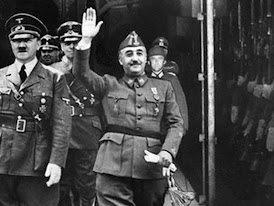
The Führer and the Caudillo at the French railway station in Hendaye, near the Spanish–French border, 23 October 1940.

Franco however was a professional soldier and knew Britain remained an undefeated, dangerous foe and one able to draw on the resources both of her empire and (increasingly) assistance from the US and regarded a victory by the Axis as by no means guaranteed.  Additionally, after a bloody civil war which had waged for four years, the Spanish economy was in no state to wage war and better than most, Franco knew his military was antiquated and unable to sustain operations against a well equipped enemy for even days.  Like many with combat experience, the generalissimo also thought war a ghastly, hateful business best avoided and Hitler left the long meeting after being unable to meet the extraordinary list of conditions demanded to secure Spanish support, declaring he'd "sooner have three teeth pulled than go through that again".  Franco was a practical man who had kept his options open and probably, like the Duce (Benito Mussolini (1883-1945; Duce (leader) & prime-minister of Italy 1922-1943)) would have committed Spain to the cause had a German victory seemed assured.  British spies in Madrid and Lisbon soon understood that and to be sure, the diplomatic arsenal of the UK's ambassador to Madrid, Sir Samuel Hoare (1880-1959), was strengthened with money, the exchequer's investment applied to bribing Spanish generals, admirals and other notables to ensure the forces of peace prevailed.  Surprising neither his friends or enemies, "slippery Sam" proved adept at the dark arts of disinformation, bribery and back-channel deals required to corrupt and although his engaging (if unreliable) memoirs were vague about the details, documents provided by his staff suggest he made payments in the millions at a time a million sterling was a lot of money.  By 1944, the state of the war made it obvious any threat of Spanish belligerency was gone and he returned to London.

The dreaded corrupted FAT

Dating from the mid-1970s, the file allocation table (FAT) is a data structure used by a number of file systems to index and manage the files on storage devices.  First associated with 8 inch (200 mm) floppy diskettes, it became familiar to users when introduced by Microsoft in the early days of PC (personal computer) operating systems (OS) and was used on the precursors to the PC-DOS & MS-DOS OSs which dominated the market during the 1980s.  Over the years there have been a number of implementations, the best known of which are FAT12, FAT16 & FAT32, the evolution essentially to handle the increasing storage capacity of media and the need to interact with enhancements to OSs to accommodate increasing complexities such as longer file names, additional file attributes and special files like sub-directories (now familiar as folders which technically are files which can store other files).

A FAT is almost always stored on the host device itself and is an index in the form of a database which consists of a table with records of information about each file and directory in the file system.  What a FAT does is provide a mapping between the logical file system and the physical location of data on the storage medium so it can be thought of as an address book.  Technically, the FAT keeps track of which clusters (the mechanism by which the data is stored) on the device are linked to each file and directory and this includes unused clusters so a user can determine what free space remains available.  Ultimately, it’s the FAT which maintains a record of the links between the clusters which form a file's data chain and the metadata associated with each file, such as its attributes, creation & modification timestamps, file size etc.  In the same way that when reading a database a user is actually interacting primarily with the index, it’s the FAT which locates the clusters associated with a request to load (or view, delete etc) a file and determine their sequence, enabling efficient read and write operations.  The size, structure and complexity of FATs grew as the capacity of floppy diskettes and then hard disks expanded but the limitations of the approach were well-understood and modern operating systems have increasingly adopted more advanced file systems like HPFS (High Performance File System, developed IBM for OS/2). NTFS (New Technology File System, developed by Microsoft for Windows NT) or exFAT (Extended File Allocation Table, developed by Microsoft as a way of providing simple cross-platform, large capacity storage without the overhead of NTFS) although FAT remains widely used especially on lower capacity and removable devices (USB drives, memory cards etc), the main attraction being the wide cross-platform compatibility.

A corrupted image (JPEG) of Lindsay Lohan.  Files can be corrupted yet appear as correct entries in the FAT and conversely, a corrupted fat will usually contain many uncorrupted files; the files are content and the FAT an index.

The ominous sounding corrupted FAT is a generalized term which references errors in a FAT’s data structure.  There are DBAs (database administrators) who insist all databases are in a constant state of corruption to some degree and when a FAT becomes corrupted, it means that the data has become inconsistent or damaged and this can be induced by system crashes, improper shutdowns, power failures, malware or physical damage to the media.  The consequences can be minor and quickly rectified with no loss of data or varying degrees of the catastrophic (a highly nuanced word among IT nerds) which may result in the loss of one or more files or folders or be indicative of the unrecoverable failure of the storage media.  Modern OSs include tools which can be used to attempt to fix corrupted FATs and when these prove ineffective, there are more intricate third-party products which can operate at a lower level but where the reported corruption is a symptom of hardware failure, such errors often prove terminal, thus the importance of data (and system) backups.

The grey area between corruption and "just politics"

As an adjective, corrupt is used somewhat casually to refer to individuals or institutions thought to have engaged in practices leading to personal gain of some sort (not necessarily financial) which are either morally dubious or actually unlawful and a corrupt politician is the usual example, a corrupted politician presumably one who was once honest but tempted.  The synonyms of corrupt are notoriously difficult to isolate within set parameters, perhaps because politicians have been so involved in framing the definitions in a way which seems rarely to encompass anything they do, however corrupt it may to many appear.  The word dishonest for example obviously includes those who steal stuff but is also used of those who merely lie and there are circumstances in which both might be unlawful but wouldn’t generally to thought corrupt conduct except by the most morally fastidious.  The way politicians have structured the boundaries of acceptable conduct is that it’s possible to be venal in the sense of selling patronage as long as the consideration doesn’t literally end up as the equivalent of cash in the pocket although such benefits can be gained as long as there’s some degree of abstraction between the steps.

Once were happy: Gladys Berejiklian and Daryl Maguire, smiling.

In Australia, news the New South Wales (NSW) Independent Commission against Corruption (ICAC) had handed down a finding that former premier Gladys Berejiklian (b 1970; NSW Premier (Liberal) 2017-2021) had acted corruptly was of course interesting but mystifying to many was that despite that, the commission made no recommendation that criminal charges be considered.  It transpired that was because the evidence Ms Berejiklian was required to provide to the ICAC wouldn’t be admissible in a court because there, the rules of evidence are different and a defendant can’t be compelled to provide an answer which might be self-incriminating.  In other words a politician can be forced to tell the truth when before the ICAC but not before a court when charged.  That’s an aspect of the common law’s adversarial system which has been much criticized but it’s one of the doctrines which underpins Western law where there is a presumption of innocence and the onus of proof of guilt beyond reasonable doubt lies with the prosecution.  Still, what unfolded before the ICAC revealed that Ms Berejiklian seems at the least to have engaged in acts of Billigung (looking the other way to establish a defense of “plausible deniability”).  How corrupt that will be regarded by people will depend on this and that and the reaction of many politicians was to focus on the ICAC’s statement that criminal charges would not be pursed because of a lack of admissible evidence as proof that if there’s no conviction, then there’s no corruption.  Politicians have little interest in the bar being raised.  They were less forgiving of her former boyfriend (with whom she may or not have been in a "relationship" and if one did exist it may or may not have been "serious"), former fellow parliamentarian Daryl Maguire (b 1959, MLA (Liberal) for Wagga Wagga 1999-2018).  Despite legal proceedings against Mr Maguire being afoot, none of his former colleagues seemed reluctant to suggest he was anything but guilty as sin so for those who note such things the comparative is “more corrupt” and the superlative “most corrupt”, both preferable to the clumsy alternatives “corrupter” & “corruptest”.

The release of the ICAC’s findings came a couple of days before the newly created federal equivalent (the National Anti-Corruption Commission (NACC)) commenced operation.  Although the need for such a body had be discussed for decades, it was during the time the government was headed by Scott Morrison (b 1968; Australian prime-minister 2018-2022) that even many doubters were persuaded one would be a good idea.  Mr Morrison’s background was in marketing, three word slogans and other vulgarities so it surprised few a vulgarian government emerged but what was so shocking was that the pork-barreling and partisan allocation of resources became so blatant with only the most perfunctory attempts to hide the trail.  Such conduct was of course not new but it’s doubtful if before it had been attempted at such scale and within Mr Morrison’s world-view the internal logic was perfect.  His intellectual horizons defined by fundamentalist Christianity and mercantilism, his view appeared to be that only those who voted (or might be induced to vote) for the Liberal & National Parties were those who deserved to be part of the customer loyalty scheme that was government spending.  This tied in nicely with the idea those who accept Jesus Christ as the savior getting to go to Heaven, all others condemned to an eternity in Hell.  Not all simplicities are elegant.

As things stand, such an attitude to public finance (ie treating as much spending as possible as party re-election funds) is not unlawful and to most politicians (at least any with some reasonable prospect of sitting on the treasury benches) should not be thought “corrupt”; it’s just “politics” and in NSW, in 1992 it was confirmed that what is “just politics has quite a vista.  Then the ICAC handed down findings against then premier Nick Greiner (b 1947; NSW (Liberal) premier 1988-1992) over the matter of him using the offer of a taxpayer funded position to an independent member of parliament as an inducement to resign, the advantage being the seat might be won by the Liberal party in the consequent by-election.  As the ICAC noted, Mr Greiner had not acted unlawfully nor considered himself to be acting corruptly but that had been the result.  Indeed, none doubted it would never have occurred to Mr Greiner that doing something that was “just politics” and had been thus for centuries could be considered corrupt although remarkably, he did subsequently concede he was “technically corrupt” (not an admission which seems to have appealed to Ms Berejiklian).  The ICAC’s finding against Mr Greiner was subsequently overturned by the NSW Court of Appeal.

So the essence of the problem is just what corruption is.  What the public see as corrupt, politicians regard as “just politics” which, in a practical sense, can be reduced to “what you can get away with” and was rationalized by Ms Berejiklian in an answer to a question by the ICAC about pork-barrelling: "Everybody does it".  Of course that's correct and the differences between politicians are of extent and the ability to conceal but her tu quoque (translated literally as "thou also" and latterly as "you also"; translation in the vernacular is something like "you did it too") defense could be cited by all.  The mechanism of a NACC has potential and already both sides of politics are indicating they intend to use it against their political enemies so it should be amusing for those who enjoy politics as theatre although, unfortunately, the politicians who framed the legislation made sure public hearings would be rare.  One might suspect they want it to be successful but not too successful.  Still, the revelations of the last ten years have provided some scope for the NACC to try to make the accepted understanding of corruption something more aligned with the public’s perception.  Anomalies like a minister’s “partner” being a “partner” for purposes of qualifying for free overseas travel (business class air travel, luxury hotels, lavish dinners etc) yet not be defined a “partner” for purposes of disclosing things which might give rise to a possible conflict of interest for the minister is an example of the sort of thing where standardization might improve confidence.  It probably should be conceded that corruption can’t be codified in the way the speed limits for a nation’s highways can but it’s one of those things that one knows when one sees it and if the NACC can nudge the politicians’ behavior a bit in the direction of public expectation, it’ll be a worthy institution.  On a happier note, Mr Greiner went on to enjoy a lucrative corporate career and Ms Berejiklian (currently with telco Optus) is predicted to follow in his tracks although suggestions posted on social media she'd been offered a partnership at PwC (PricewaterhouseCoopers International Limited) on the basis of her experience making her a "perfect fit for the company" are thought mischievous rather than malicious.