Showing posts sorted by relevance for query Engagement. Sort by date Show all posts

Thursday, March 31, 2022

Engagement

Engagement (pronounced en-geyj-muhnt)

(1) The act of engaging or the state of being engaged.

(2) A mutual pledge of marriage, betrothal.

(3) An appointment or arrangement.

(4) A pledge, obligation, agreement or other condition that binds.

(5) Employment, or a period or post of employment, now especially in the performing arts.

(6) In military use, an encounter, conflict, or battle.

(7) In mechanics, the act or state of interlocking.

(8) In contract law, a promise (archaic).

(9) In economics (usually in the plural), financial obligations (archaic).

(10) In obstetrics, the entrance of the foetal head or presenting part into the upper opening of the maternal pelvis.

1615: The construct was engage + -ment.  Engagier was from the Middle English, from the Old French engagier (under pledge), via Frankish from the Proto-Germanic wadiare (pledge).  The word spread widely in European languages in cluding the Frankish anwadjōn (to pledge), from Proto-Germanic wadjōną (to pledge, secure), wadją (pledge, guarantee).  It was cognate with the Old English anwedd (pledge, security) & weddian (to engage, covenant, undertake), the German wetten (to bet, wager) and the Icelandic veðja (to wager); the word illustrating the general, common evolution of Germanic to French (eg Guillaume from Wilhelm).  The -ment suffix was from the Middle English -ment, from the Late Latin -amentum, from -mentum which came via Old French -ment.  It was used to form nouns from verbs, the nouns having the sense of "the action or result of what is denoted by the verb".  The suffix is most often attached to the stem without change, except when the stem ends in -dge, where the -e is sometimes dropped (abridgment, acknowledgment, judgment, lodgement etc), with the forms without -e preferred in American English.  The most widely known example of the spelling variation is probably judgment vs judgement.  In modern use, judgement is said to be a "free variation" word where either spelling is considered acceptable as long as use is consistent.  Like enquiry vs inquiry, this can be a handy where a convention of use can be structured to impart great clarity: judgment used when referring to judicial rulings and judgement for all other purposes although the approach is not without disadvantage given one might write of the judgement a judge exercised before delivering their judgment.  To those not aware of the convention, it could look just like a typo.  The meaning "attract the attention of" is from 1640s; that of "employ" is from 1640s, derived from "binding as by a pledge."  Specific sense of "promise to marry" is variously cited as dating from between 1610 and 1742 and the military meaning emerged in 1664.  Related forms are the nouns non-engagement and re-engagement, now almost always hyphenated.  Engagement is a noun, engage is a verb, engaging is a noun, verb & adjective and engaged is a verb & adjective; the noun plural is engagements.

A long tradition

The western concept of engagement is derived from the Jewish law (Torah), codified in the last Talmudic tractate of the Nashim (Women) order in which the marriage process is defined in two parts, the erusin (or kiddushin), a betrothal ceremony of sanctification and the nissu'in (or chupah), the formal act of marriage.  This is wholly analogous with the modern tradition of (1) the engagement which reflects a change of relationship between the couple and (2) the marriage which changes their legal status under either, or both, state and church law.  In antiquity, both Hellenic Greece and Rome borrowed and adapted the Hebrew practice with little change.

In the West, canon lawyers proved more exacting, secular lawyers more avaricious and engagements assumed an increasingly contractual form.  While either party could break a betrothal, it was once possible for the spurned partner to sue the other for breach of promise, which, in some jurisdictions, was called heart-balm.  In Australia, these actions were rendered obsolete when Lionel Murphy's (1922–1986; attorney-general of Australia 1972-1975) Family Law Act (1975) replaced the old Matrimonial Causes Act, a matter of some regret to bishops, Liberal Party lawyers and other moralists.  Also affected were publications like Melbourne’s now sadly defunct Truth which, in its divorce reports, published not only salacious details of infidelity but also the photographs produced as evidence, shots taken typically through the windows of St Kilda hotel rooms.

In Australia, in the narrow technical sense, engagements are compulsory in that one month must elapse between the submission of the Notice of Intended Marriage form and the marriage proper although a prescribed authority may approve a shorter notice time in some limited circumstances (such as when former Governor-General Sir John Kerr (1914-1991) wished rapidly to marry his second wife Anne (aka Nancy (née Taggart, previously Robson)).  Engagements in Australia thus, generally, have a statutory minimum duration of one month.  There's no maximum, but there’s no record of one matching the longest known engagement, a sixty-seven year arrangement between a Mexican couple; there may have been commitment issues.

On Sunday 28 November 2021, Lindsay Lohan announced her engagement to her boyfriend of two years, Bader Shammas (b 1987), a Dubai-based vice-president with Credit Suisse.  The announcement was made in the twenty-first century way: Instagram.

Saturday, December 6, 2025

Otrovert

Otrovert (pronounced ott-roh-vert)

A person unable to feel a connection to social groups or collectives; despite being welcomed and included in social settings, they feel like outsiders.

2025: A coining by US psychiatrist Dr Rami Kaminski (b 1954), who first used the word in his book his book The Gift of Not Belonging (2025), the construct being the Spanish otro (other; another) + -vert.  Otro was from the Latin alter, altera & alterum (the other), ultimately from the primitive Indo-European hélteros (the other of two); it may be compared with the Portuguese outro (from the Old Galician-Portuguese outro, from the Latin alterum (the other)) and the French autre (from Old French autre (another), from the Latin alterum).  The –vert suffix was from the Latin vertere (to turn) and was used to refer to a person with a particular personality which manifests when in the presence of others.

Otrovert is a noun; the noun plural is otroverts.  Because otrovert is a “hot word” (newly coined or an adaptation of an existing word and one which has in a short time become popular), most lexicographers are tagging it as “provisional”, the majority of “hot words and phrases” (think “six-seven”) fading from use and never gaining critical mass.  Even the idea of “popular: had (in this context) shifted because whereas once it could take months or years for a word or phrase to spread into general use, on the various platform on the internet, proliferation can be close to instant.  However, the tools used to assess “use” are rather brute-force and often are counting appearances in “lists” rather than “general use”.  For those reasons, in the technical sense, derived forms really don’t (yet) exist but if constructed the list (based on the model of other “-verts”) might include the nouns otrovertist, otroverting & otrovertness, the verb & adjective otroverted, adjectives otrovertish & otrovertesque & otrovertive and the adverbs otrovertedly & otrovertly.

Google ngram (a quantitative and not qualitative measure): Because of the way Google harvests data for their ngrams, they’re not literally a tracking of the use of a word in society but can be usefully indicative of certain trends, (although one is never quite sure which trend(s)), especially over decades.  As a record of actual aggregate use, ngrams are not wholly reliable because: (1) the sub-set of texts Google uses is slanted towards the scientific & academic and (2) the technical limitations imposed by the use of OCR (optical character recognition) when handling older texts of sometime dubious legibility (a process AI should improve).  Where numbers bounce around, this may reflect either: (1) peaks and troughs in use for some reason or (2) some quirk in the data harvested.

An ambivert is a person neither clearly extroverted nor introverted, but has characteristics of each, the construct being ambi- +‎ -vert.  Ambi- was from the Latin ambo (both) and was a doublet of the New Latin amphi-, from the Ancient Greek ἀμφί (amphí) (on both sides).  The dexter element in the Medieval Latin meant “right” and ambidexter thus was understood as “both hands being like a right hand”.  In English, the ambi- prefix is most familiar in “ambidextrous” (possessing an equal or functionally comparable ability to handle objects with both hands (in writing, music, sport etc) although it has from time to time been used figuratively (not taking sides in conflicts or being equally adept in more than one medium, genre, style etc) and even as a humorous synonym for “bisexual”.  When used in psychology, historically, ambiversion described someone with characteristics of both extroversion and introversion and thus suggested a “balanced personality”, the subject choosing to manifest the different characteristics according to what the circumstances seemed to demand.  Ambivert thus does not imply some sort of split personality or the existence of a condition like bi-polar disorder (the old manic depression) but simply reflects an individual able to undertake their social interactions in an appropriate manner.

Because the “vert words” are not really part of academic or clinical physiology, the definitions can be “elastic” and while centovert (being in the middle between introvert and extrovert) may be a synonym of ambivert, it may also be nuanced in that it suggests someone unable (or at least unwilling) to engage in introverted or extroverted behaviour, regardless of the circumstances.  A variant of the ambivert is the omnivert (someone fits into both extremes of the extroversion-introversion personality spectrum), the construct being omni + -vert.  Omni- ultimately was from the Latin omnis (all).  Again, because the “verts” are pop-psychology words there’s little to be gained from attempting to “parse the overlaps” (ie where one ends and another begins) and seems likely omniversion is simply an “enabling pre-condition” for one to possess if one is to attain the desirable “balanced state” of ambiversion.  Nobody seems yet to have coined ultravert, hypervert or ubervert but one need not spend long on social media to see the why such labels might be handy.

A self-described introvert: Lindsay Lohan explains she's an introvert; 2019 interview by broadcaster Howard Stern (b 1954).

Like other “-verts” of this ilk, otrovert was built on the model of the familiar introvert & extravert, the construct being intro + -vert.  An introvert (pronounced in-truh-vurt) is an individual who prefers (sometimes actively seeks) tranquil environments, limits social engagement and tends to a greater than average preference for solitude.  In anatomy & zoology there’s a technical meaning “a part (typically a hollow, cylindrical structure) that is or can be introverted, or turned in on itself (ie invaginate)) but the most commonly used is the psychological sense: a person characterized by concern primarily with their own thoughts and feelings.  Introverts are noted often for having a disposition that finds social engagement at least tiresome (and sometimes threatening), thus the preference for quiet solitude.  Introvert seem first to have appeared in print in the 1660s and was from the New Latin intrōvertere, the construct being intrō (within) + vertere (to turn).  The prefix intro- was from the Latin intro- (inwards) & intrā (within) + -ō (used as a verbalizer).  Although it’s not infrequent for introvert to be used as a synonym for “shy” (and in terms of observed behaviour the two phenomena can appear indistinguishable), they are definitionallly distinct.  While shyness is associated with timidity and social anxiety, introverts have a lack of interest in interpersonal engagement and a limited endurance for social contact; what that means is while the behaviours can often be the same, the underlying motivations differ.

Slaughterhouse-Five (1969) by Kurt Vonnegut.

Introvert & extrovert are popular terms of self-description but they can also be aspirational and while the classic stereotype is of the introvert who “wishes they were more outgoing” there are other types.  The US pediatrician Dr Mark Vonnegut (b 1947) wrote short stories and in one he described his father’s (the author Kurt Vonnegut (1922-2007)) desire to be a cynical, grumpy old man who despaired of humanity but could never quite manage it because of his “inherent optimism”.  As Dr Vonnegut put it, he was “…like an extrovert who wanted to be an introvert, a very social guy who wanted to be a loner, a lucky person who would have preferred to be unlucky. An optimist posing as a pessimist, hoping people will take heed.  Explaining the difference, he added: “Introverts almost never cause me trouble and are usually much better at what they do than extroverts.  Extroverts are too busy slapping one another on the back, team building, and making fun of introverts to get much done.  Extroverts are amazed and baffled by how much some introverts get done and assume that they, the extroverts, are somehow responsible.  On the basis of his clinical experience, he observed: “I understand perfectly why some of my autistic patients scream and flap their arms--it's to frighten off extroverts.

An extrovert (pronounced ek-struh-vurt) is described typically as an outgoing, gregarious person who thrives in dynamic environments and seeks to maximize social engagement; in the jargon of psychology, it refers to someone characterized by extroversion; a person concerned primarily with the physical and social environment, thus the usual presentation as a person with a disposition energized through social engagement who tends to languish or chafe in solitude.  The word extrovert (the alternative spelling extravert (an example of the influence of German on psychology) is now rare) also emerged in the 1660s, the construct being extro- + vert.  In this case, extro- was a pseudo-Latinism prefix based upon the Latin extra- (outside, beyond), under the influence of the distinction between the Latin intro- (inwards) & intra- (inside; within).  In English, formations using the prefix tend to be restricted to words formed as antonyms of terms formed with intro-.

Introvert & extrovert (in their literal senses) were since the late seventeenth century used in science and medicine but both in the twentieth century entered general use when certain works by the Swiss psychiatrist, Carl Jung (1875–1961) were translated from German into English.  What seems to have given the words their greatest impetus was the appearance of commentaries on Jung written for a general audience and for these purposes binary concepts like “introvert” and “extrovert” were useful devices to encapsulate layers of meaning although the trigger may have been the 1918 paper Psycho-Analytic Study of August Comte [1798-1857; a seminal figure in sociology] by psychologist Dr Phyllis Blanchard (1895-1986).  Being a woman, Dr Blanchard has been neglected by history but, like the Austrian psychiatrist Sigmund Freud (1856-1939), Jung became what would now be called a “celebrity” psychoanalyst and that happened because advances in their field (and neurology) had made the public fascinated with the human mind and its processes (especially dreams).  Reflecting what may possibly be a professional distaste at their jargon ending up in pop-psychology texts, technical papers often use the spelling “extravert”, following Jung and his contemporaries.

The Gift of Not Belonging (2025) by Dr Rami Kaminski (b 1954).  Psychiatrist Dr Kaminski is the founder and director of the Institute for Integrative Psychiatry in New York City.

Dr Kaminski describes The Gift of Not Belonging as “…the first book to explore the distinct personality style of the otrovert - someone who lacks the communal impulse and does not fit in with any social group, regardless of its members - and to reveal all the advantages of being an otrovert and how otroverts contribute to the world.”  He explained that while otroverts enjoy deep and fulfilling one-on-one relationships, within groups they feel alienated, uncomfortable, and alone.  Unlike introverts, who crave solitude and are easily drained by social interactions, otroverts can be quite gregarious and rarely tire from one-on-one socialising; unlike loners, or people who have been marginalised based on their identity, otroverts are socially embraced and often popular - yet are unable to conform with what the group collectively thinks or cares about.  Dr Kaminski positions all this as “the great gifts of being an otrovert” by which he means someone with no affinity for a particular group is not constrained by their sense of self-worth being conditioned on the group's approval.  A champion of the otrovert, Dr Kaminski suggests they “must not be harassed to take part, but allowed to revel in their glorious difference.

Despite vying with “psychopath” for the title of “most popular” words from psychology, neither introvert and extrovert have ever been used as diagnostic terms in the American Psychiatric Association's (APA) Diagnostic and Statistical Manual of Mental Disorders (DSM); that doesn’t mean they’re not used by clinicians, just that they’re not part of the formal jargon.  That might seem curious given their not infrequent appearances in the published history of personality psychology including Jung’s original typology (codified in their most refined form in the 1920s), the ubiquitous MBTI (Myers–Briggs Type Indicator) and the Big Five model, where Extraversion is one of the five major personality traits.  These frameworks are however psychological, not psychiatric.  The DSM does of course have an extensive section on personality disorders and many of the traits related to introversion & extraversion appear including in (1) Avoidant Personality Disorder (social inhibition—links superficially to introversion but is not the same thing) and Histrionic or Narcissistic Personality Disorders (social boldness—superficially “extraverted” traits).

However, what the DSM’s editors have in recent decades done is to avoid the use of potentially ambiguous labels and focus instead on behavioural criteria that may indicate impairment or pathology.  Especially since the 1970s, the DSM has acknowledged (even championed) the idea that many “things” once classified as deviant are really part of the “normal” human condition; reflecting that paradigm, introversion & extraversion came to be understood as “normal-range” personality traits, not indicators of disorder.  As a general principle, the DSM appears to restrict the use of terms to instances where they relate to clinically significant impairment (the emphasis on the effect on the patient rather than the mechanics of process).  This approach was institutionalized with the release of DSM-5 (2013) in which the model clearly had become one of trait-based personality assessment.

To make the point, there exists in DSM-5 & DSM-5-TR (2022) the “Alternative DSM-5 Model for Personality Disorders, Section III” which describes personality traits that (more or less) correspond to what popular culture calls extraversion and introversion.  The editors however avoid the two popular words and instead breaks personality into trait domains with pathological versions of ordinary traits.  What general readers think of a “introversion” now appears in the DSM as “Detachment” although this is not pathologized unless it manifests in maladaptive extremes (chronic or persistent withdrawal; avoidance of social interaction; intimacy avoidance; a reluctance to form close relationships; anhedonia (inability to experience pleasure); mistrust of others; restricted affectivity (limited emotional expression)).  So, introverts can to some degree be “happy” with their state and just prefer frequent solitude and what the DSM calls “detachment” is invoked only when the trait is causing significant impairment or distress.

In the popular imagination, “extraversion” is associated with sociability, talkativeness, outgoing behaviour, enthusiasm (ie someone who is the “life of the party”).  That’s also obviously a “spectrum condition” and the DSM has never listed a single domain which could be classed as “high extraversion” which is good because high sociability isn’t intrinsically pathological.  Rather, should extraversion becomes maladaptive or extreme, the DSM classifies it across several domains:

(1) Attention-seeking (a facet of Antagonism) which manifests especially in Histrionic Personality Disorder.  Symptoms include an excessive need for approval, dramatic or provocative behaviour and an Intense desire to be the centre of attention.

(2) Grandiosity (a facet of Antagonism) which is characteristic of Narcissistic Personality Disorder, the symptoms including social boldness (masking fragile self-esteem) and entitlement and arrogance (which, in many cases, doesn’t manifest)

(3) Impulsivity & Risk Taking (a facet of disinhibition).  This is outgoing, sensation-seeking behaviour in its pathological form and is associated with thrill-seeking, poor impulse control and a tendency to act without considering the consequences

(4) Low Detachment: This is acknowledged as the “adaptive end of Detachment” but the editors seem to list it only to “close the circle”; it’s there because logically it has to be but is certainly not treated as a disorder.

So the DSM intentionally avoids the introvert/extrovert dichotomy which is how starkly it’s understood in popular use.  This “either-or” approach obviously doesn’t map onto the way the DSM treats personality traits as spectrums with only the margins (ie the dysfunctional extremes) described.  What that does is acknowledge there is introversion & extraversion which part of the “normal” human condition and not pathological.  Additionally it’s acknowledged the behavior which in one subject may indicate “significant impairment or distress” might in another not be of concern.

Friday, July 17, 2020

Leftover

Leftover (pronounced left-oh-ver)

(1) Usually as leftovers; food remaining uneaten at the end of a meal, especially when saved for later use.

(2) Anything left or remaining from a larger amount; remainder.

(3) A casual (and disparaging) term used in the People's Republic of China to describe women still un-married after the age of twenty-six. 

1878: A compound word left + over; the construct being a noun use of verb phrase left over.  The meaning is always in the sense of left (“remaining, abandoned”) + over (“excess”).  Left is from the Middle English left, luft, leoft, lift & lyft, from the Old English left & lyft (air, atmosphere) from the Proto-Germanic luft with which may be compared the compared the Scots left (left), the North Frisian lefts, left & leefts (left), the West Frisian lofts (left), the dialectal Dutch loof (weak, worthless), and the Low German lucht (left).  Over is from the Middle English over from the Old English ofer from the Proto-Germanic uber (over), from the primitive Indo-European upér, a comparative form of upo; akin to the Dutch over, the German ober & über, the Danish over, the Norwegian over, the Swedish över, the Icelandic yfir, the Faroese yvir, the Gothic ufar, the Latin super, the Ancient Greek πέρ (hupér), the Albanian upri (group of peasants) and the Sanskrit उपरि (upári).  The hyphenated left-over (remaining, not used up) is from 1890 as a noun meaning "something left over" is from 1891.  The sense of (the almost always plural) leftovers “excess food after a meal" (especially if re-served later) dates from 1878.  In this sense, Old English had metelaf.

Leftover women

Sheng nu (剩女; shèngnǚ), most often translated as "leftover women" is a phrase (usually considered derogatory), which describes Chinese women who remain unmarried by their late twenties.  First promulgated by the All-China Women's Federation (ACWF) as a promotion of government programmes, it’s been used in other countries but remains most associated with People's Republic of China (PRC).  As a demographic phenomenon, it was once unexpected because the conjunction of the PRC's one-child policy and the disproportionate abortion of female foetuses had led to a distortion in the historic gender balance.  Births in China since the one-child policy was introduced in 1979 have averaged 120 males for every 100 females compared to a global ratio of 103:107.

A bride with four suspected leftovers.

The term appears to have entered common-use in 2005-2006 and seems first to have appeared in the Chinese edition of Cosmopolitan.  Unlike most of Cosmopolitan’s editorial content, the Chinese Communist Party (CCP) took it seriously and instructed the ACWF (a kind of cross between the CWA (Country Women’s Association) and the PLA (People’s Liberation Army) to publish articles stigmatizing women still unwed by their late twenties.  Borrowing from Maoist tradition (if not theory), the ACWF provided a useful analysis of the problem, concluding that while “pretty girls” didn’t need much education to find a rich partner, “average or ugly” ones who seek higher degrees thinking it will “increase their competitiveness” in the marriage market are delusional; all that happens is they become old “…like yellowed pearls."  The rhetorical flourishes aside, they had a point.  As the numbers of highly educated women rose, the numbers of potential husbands they found acceptable did not.  What the distorted gender balance created by the one-child policy and the selective-sex abortion preferences had produced was an increasingly educated and middle-class female minority not impressed by a less schooled and more rural male majority. 

Geographic distribution of leftover women, People’s Republic of China.

“Leftover women” seemed the choice in print but on the internet, the punchier 3S or 3SW (Single, Seventies (referring to the then prominent 1970s birth cohort) and Stuck) was also used instead of sheng nu.  There is an equivalent term for men, guang gun (bare branches (ie men who do not marry and thus do not add branches to the family tree)); shengnan (leftover men) does exist but is rare.

CCP demographers had expressed concerns about the social and economic implications of the one-child policy as early as the 1990s.  In the new century, the policy was first selectively relaxed, then revised to permit additional children for those selected by the CCP as desirable breeders and, on 31 May 2021, at a meeting of the of the CCP Politburo, the three-child policy (三孩政策) was announced.  The session, chaired by Xi Jinping (b 1953; CCP general secretary 2012- & PRC president 2013-), followed the release of the findings of the seventh national population census which showed the number of births in mainland China in 2020, at twelve million, would be the lowest since 1960, an indication of the demographic trend causing the ageing of the population.  The Xinhua state news agency then announced the three child policy would be accompanied by supportive measures to “maintain China's advantage in human resources” but surveys suggested the section of the population the CCP would like to see produce three children per household were generally unwilling to have even two, the reason overwhelmingly the high cost of living in Chinese cities.  The announcement on 26 July 2021 permitting Chinese couples to have any number of children was thus greeted by most with restrained enthusiasm.

Leftover no longer: Lindsay Lohan's engagement ring.  Ms Lohan announced her engagement in 2021, marring the following year.  In 2023, a post confirmed reports of her pregnancy. 

The problem of re-production is not restricted to the PRC, the birth rate in South Korea now down to around .8 per woman while a rate around 2.1 is necessary if the population is to be sustained.  What exacerbates the problem in the PRC is the simple lack of women of child-bearing age, caused by the distorted male/female live-birth rates in the decades following the imposition of the one-child policy and any vague hope the long stretches of lock-downs may have encouraged procreation were not realized.  Despite that disappointment, the CCP wasn't discouraged and embarked on a new propaganda campaign making it clear to young women that having babies was part of their patriotic duty to the motherland: pregnancy was now compulsory.  In the West, the decline in the birth rate has for some time been thought a problem, largely because of the impending acceleration in the distortion between those of working age (paying into the system) and those not generating income (extracting from the system).  Of late however, influenced by the un-anticipated rapidity in the advances in artificial intelligence (AI) and robotics, theorists are re-visiting the models and pondering the implications.

Thursday, July 30, 2020

Turkey

Turkey (pronounced tur-kee)

(1) A large, gallinaceous bird of the family Meleagrididae, especially Meleagris gallopavo, of America, typically of green, reddish-brown, and yellowish-brown plumage of a metallic luster; domesticated in most parts of the world.

(2) The flesh of this bird, used as food.

(3) Any of a number of other similar birds, so described.

(4) As Turkey, the former name of Türkiye Cumhuriyeti (Republic of Türkiye).

(5) In slang, a person or thing of little appeal; dud; loser; a naive, stupid, or inept person.

(6) In the slang of the theatre, an unsuccessful production; a flop (a synonym of “a bomb” in some countries, an antonym in others); now used beyond the theatre and applied to just about any failed product including political candidates or policies.

(7) In ten-pin bowling, three strikes in succession.

(8) In the (derogatory) slang of clinical medicine, a patient feigning symptoms, illness or injury; a malingerer.

(9) In rural slang (US & Australia), a pack carried by a lumberman; a bindle; also, a large travel bag, a suitcase (archaic).

1545–1555: A short for Turkey cock and Turkey hen (“cock of Turkey” & “hen of Turkey”), applied firstly to guinea fowl (apparently because the bird was brought through Turkish territory) and later (erroneously) to the American bird.  The noun plural is turkeys by depending on context, turkey can be a plural.  The erroneous “turkies” & “turkies” does occasionally appear because of a belief all nouns ending in "y" should form a plural ending in "ies". When a noun ends with [vowel] + y, only an appended "s" is needed to form the plural.
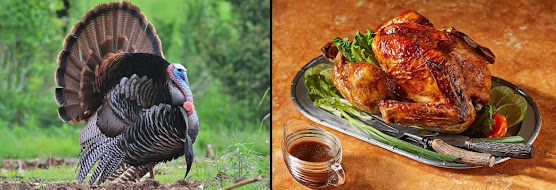
Tararind and honey-glazed roast turkey, before & after.

The clipping of turkey-cock (male) and turkey-hen (female) applied originally to the guinea fowl (Numida meleagris) which was brought to Europe (via Turkey) from Madagascar by Portuguese traders who really were called “turkey merchants”.  In English, the word turkey was first applied to the bird in the 1550s, either because it was identified with or treated as a species of the guinea fowl or because reached wider Europe from Spain by way of North Africa, then under Ottoman (Turkish) rule.  For the same reason, in English, Indian corn was originally “turkey corn” or “turkey wheat”.  The word was subsequently applied to the larger northern American fowl (Meleagris gallopavo) which conquistadors had brought to Spain in 1523 after finding the species had been domesticated by the Aztecs.  The adoption of the name (initially as “wild Turkey”), documented in North American records since 1607, wasn’t until later recognized as a taxonomical error and it’s thought it happened simply because the of the visual similarity between the birds.  There was once speculation that it may have been something more considered, either because the North American turkey was in part introduced through Ottoman territories or else to indicate it was foreign; these theories are now little supported.  It’s a strange linguistic soup because in Turkish the name is hindi (literally "Indian") a use probably influenced by early seventeenth century French dinde (contracted from poulet d'inde (literally "chicken from India", which endures in Modern French as dindon), based on the then-common misconception that the New World (the Americas) was eastern Asia (hence “Red Indians”, “West Indies” etc).  The bird from the Americas may have appeared in England as early as 1524 but documentary evidence confirms its presence in 1534.  Large, tasty, easily fattened and well adapted to the climate, turkey by the late sixteenth century had become the standard fare at an English Christmas dinner.

In an example of the way mistakes in science can linger as orthodoxy if vested with sufficient academic respectability, even after the different biology of the two birds were distinguished and the names differentiated, turkey was erroneously retained for the American bird, instead of the African.  From this confusion, Melagris, the ancient name of the African fowl, was listed as the generic name of the American bird by Carl Linnaeus (1707–1778), the Swedish physician who defined the modern system of taxonomy which applies a binomial nomenclature to botanical and zoological organisms.

Leslie Grace (b 1995) as Batgirl.

In August 2022, it was announced the release of the film Batgirl, commissioned for Warner Bros’ streaming platform HBO Max, had been cancelled.  Although never intended to show in cinemas, such was the negative feedback from test audiences it was sent to editing experts who are said to have declared it irredeemable, the turkey consigned to the Warner Bros vault.  Said to involve the write-off of what sounds a rather inflated US$90 million, cynics immediated speculated Warner Bros' accountants might have calculated the guaranteed profit offered by a tax off-set a more lucrative business model than a release on any platform.  In earlier times the odd turkey did eventually end up a cult-favorite on VCR or DVD but there's no prediction how long it'll take Batgirl to leak out.  In idiomatic use, the sense of “a turkey” meaning "inferior show, a failure" is show business slang dating from 1927, presumably because of the bird's reputation for stupidity, this meaning soon extended to just about any failed product including political candidates or policies.  In this sense, there’s also the slang meaning "stupid, ineffectual person" but surprisingly, there’s no record of use prior to 1951.

Grumman F6F Hellcat.

A turkey shoot was "something easy", slang which is listed as being of World War II-era but most seem to agree it had likely been in oral use much earlier, especially south of the Mason-Dixon Line.  The reference was to (presumably mostly informal) contests of marksmanship in which turkeys were tied behind a log, only their moving heads visible as targets; it sounds barbaric now but it was a different time and to the bird, the experience may have been little different from any other method of dispatch.  The sudden popularity of “turkey shoot” during the war was probably associated with the events in the Battle of the Philippine Sea (19-20 June 1944), the last of the conflict’s big, set-piece carrier battles and the engagement which ended the capacity of the Imperial Japanese Navy strategically to deploy carrier groups.  US Naval aviators described the air battles as “the Great Marianas Turkey Shoot” because of the disproportional loss ratio inflicted upon the Japanese and the ease with which their aircraft could be downed.  The air engagement was a classic example of the approach of the US military: Problems are not merely to be solved but overwhelmed.  It was also a example of how superior technology will tend to prevail, the combination of proximity fuses which meant American gunnery didn’t need to be especially accurate when trained on Japanese aircraft still mostly without self-sealing fuel tanks as decisive a difference as earlier advantages in hardware had been for the British in the Sudan or the Italians in Ethiopia.  To “talk turkey” dates from 1824 and, according to folklore, comes from the tale of a Yankee attempting to swindle a Native American (then called a Red Indian) in dividing a turkey and buzzard as food.

Cold turkey refers both to (1) a sudden and complete withdrawal from a dependent substance (especially narcotics) and (2) the physiological effects of such a withdrawal.  The origin of the term is murky and may date from a number of nineteenth century references to unwelcome guests being served literally cold slices of turkey at Christmas rather than the more pleasing hot, dressed dish.  In that sense it came to refer both to suffering and social ostracization, the meaning in the sense of term and the term "withdrawal from an addictive substance" (originally of heroin) dating from 1921, probably based on the idea of a meal of cold turkey being something served with little preparation.

Lindsay Lohan with president of Türkiye  (formerly Turkey) Recep Tayyip Erdoğan, his wife Emine and Syrian internally displaced person (IDP) Bana Alabed (b 2009), Ankara, January 2017.

The country formerly known as the Republic of Turkey straddles West Asia and South East Europe, the Bosporus (on the banks of which sits Istanbul (formerly known as Constantinople)), an ancient gateway between the two continents.  The Ottoman Empire emerged in Anatolia (the western portion of Asian Turkey) during the thirteenth century, surviving until 1918.  During the sixteenth century, the empire stretched from the Persian Gulf to western Algeria and included most of southeastern Europe, leaving an architectural heritage visible to this day.  Modern Turkey was created in 1923 as a secular state.  The English name of Turkey is ultimately from the Medieval Latin Turchia & Turquia (land of the Turks)but it wasn’t until as recently as the early eighteenth century that the spelling “Turkey” began to be standardized.  In the Middle English the spellings included Turkye, Torke, Turkie & Turky and those who complain about the lack of proof-reading and editing in modern documents should note that it was not unusual for more than one form to appear in the same short text.  The most common form in the Middle English was Turkye, from the Anglo-Norman Turkye, from the Medieval Latin Turcia, from Turcus (usually translated as “Turk” and of unknown origin but many suggest and original meaning of “strength”), from the Byzantine Greek Τορκος (Toûrkos), from the Persian ترک‎ (Turk), from the Middle Persian twlk' (Turk), from the Old Turkic.  The original meaning of the Persian Turk is also uncertain and may have varied with context, various documents suggesting it could be used to mean “warrior”, “beautiful youth”, “barbarian” or “robber” and how wide a net that casts may depend on one's opinion of males aged 17-25.
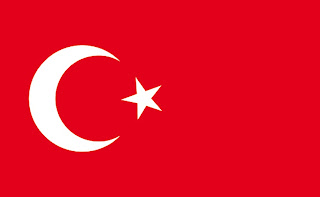
National flag of Türkiye Cumhuriyeti.

In May 2022, the office of the Secretary-General of the United Nations announced the Republic of Turkey had changed its name to Türkiye Cumhuriyeti (Republic of Türkiye).  Whether the authorities in Ankara were much concerned about sharing a name with the large gallinaceous bird native or the colloquial use to describe dud movies or stupid and inept people isn’t clear but certainly, they were no longer happy about an anglicized version of the name being used around the world.  In a press release, President Recep Tayyip Erdoğan (b 1954; prime minister of Turkey 2003-2014, president since 2014) stated “Türkiye is accepted as an umbrella brand for our country in national and international venues...” and the name “…is the best representation and expression of the Turkish people’s culture, civilization, and values.”  Effectively a national re-branding, the change will be reflected in the label “Made in Türkiye” appearing on manufactured goods and adjustments have been made to institutional names such as the nation carrier which would henceforth operate internationally under the name Türk Hava Yolları (Turkish Airlines).

Recent changes of name

2019: The Republic of Macedonia changed to Republic of North Macedonia to resolve some regional disputes.  For a time, because of earlier disputes, it had been known as the Former Yugoslav Republic of Macedonia which was usually written as FYROM (pronounced fire-rom). 

2018: The Kingdom of Swaziland became the Kingdom of Eswatini.

2016: Czechia introduced as country name although Czech Republic remains the state title.

2014: Republic of Cape Verde became Republic of Capo Verde.

2013: The Democratic Republic of Somalia became the Federal Republic of Somalia.

2011: The Great Socialist People’s Libyan Arab Jamahiriya became simply Libya.

2010: The Union of Myanmar became the Republic of the Union of Myanmar although the SLORC at the time issued some contriductory statements and Burma is still widely used.

2009: The Republic of Bolivia became the Plurinational State of Bolivia.

1997: Zaire became the Democratic Republic of Congo (DRC).

1990-1992: New country names were gazetted consequent upon the breakup of Yugoslavia: Bosnia and Herzegovina, Republic of Croatia, Republic of Macedonia, Serbia and Montenegro & Republic of Slovenia

1990-91: New country names were gazetted consequent on the dissolution of the Union of Soviet Socialist Republics (USSR): Republic of Armenia, Republic of Azerbaijan, Republic of Belarus (initially Belorussia, but adopted Belarus in 1992), Republic of Estonia, Georgia, Republic of Kazakhstan, Kyrgyz Republic, Republic of Latvia, Republic of Lithuania, Republic of Moldova (initially Moldavia, but adopted Moldova in 1992), Russian Federation, Republic of Tajikistan, Turkmenistan, Ukraine, Republic of Uzbekistan.

1990: People’s Republic of Benin became Republic of Benin.

1990: Unification of Germany; German Democratic Republic (East Germany, the GDR) absorbed by the Federal Republic of Germany (West Germany, the FRG).

1989: The Union of Burma became the Union of Myanmar, previously Union of Burma.  Confusingly, it appeared the SLORC maintained Burma as the country name for most purposes.

1984: The Republic of Upper Volta became Burkina Faso.

1981: British Honduras became Belize.

1980: Southern Rhodesia became Zimbabwe.

1979:  New Hebrides became the Republic of Vanuatu.

1979: The Imperial State of Iran became the Islamic Republic of Iran.

1972: Ceylon became Sri Lanka.

1971: East Pakistan became Bangladesh; West Pakistan became Pakistan.

1971: Bechuanaland became the Republic of Botswana.

1971: Basutoland became the Kingdom of Lesotho.

1964: Tanganyika and Zanzibar joined to form the United Republic of Tanzania.

1964: Northern Rhodesia became the Republic of Zambia.

1961: Northern Cameroons became part of Nigeria (now Federal Republic of Nigeria) & Southern Cameroons became part of the Federal Republic of Cameroon (now Republic of Cameroon).

1957: The Gold Coast became the Republic of Ghana.

1953: Formation of the Republic of Korea (South Korea, the ROC) and the Democratic People’s Republic of Korea (North Korea, the DPRK).

1949: The Republic of China became the People’s Republic of China (PRC).

1949: Formation of German Democratic Republic (East Germany, the GDR) and the Federal Republic of Germany (West Germany, the FRG).

1949: Transjordan became the Hashemite Kingdom of Jordan.

1947: India became the Republic of India; the Islamic Republic of Pakistan was created (as East Pakistan & West Pakistan).

1939: The Kingdom of Siam becomes the Kingdom of Thailand.

1935: Persia become the Imperial State of Iran.

1929: Vatican City gained independence from Italy as a city-state.

1923: Turkey; Republic of Turkey created after the dissolution of the Ottoman Empire.

Friday, September 3, 2021

Precious

Precious (pronounced presh-uhs)

(1) Of high price or great value; very valuable or costly.

(2) Highly esteemed for some spiritual, nonmaterial, or moral quality.

(3) Affectedly or excessively delicate, refined, or nice; fastidious in speech and manners.

(4) Anything though extreme (now rare and usually used only in clichéd forms).

(5) As precious and semi-precious, descriptors used in the gem-stone trade.

1250–1300: From the Middle English preciose (valuable, of great worth or price, costly) from the eleventh century Old French precios (precious, costly, honourable, of great worth), from the Latin pretiōsus (costly, valuable), the construct being pretium (price, value, worth) + ōsus or ous.  The Latin suffix -ōsus or ous (full, full of) was used to form adjectives from nouns, to denote possession or presence of a quality in any degree, commonly in abundance.  It was picked up in Middle English as -ous, from the Old French –ous & -eux.  The Modern French is précieux.

The meaning "over-refined" dates from the late fourteenth century and Dr Johnson noted it also had a secondary inverted sense of "worthless" whereas today, that’s a pure antonym.  As applied to a "beloved or dear person or object", meaning in that sense was first noted in 1706.  Related forms include preciously (adverb) & preciousness (noun).  The formal division of the gemstone market into precious and semi-precious dates from 1858, adopting the division introduced in the metals trade in 1776, precious metals then defined as gold, silver and sometimes platinum, the parameters being those rare enough to be used as a standard of value yet sufficiently abundant enough to permit use for coinage (the category of the semi-precious metal was introduced in 1818).  The idea of a person or object being precious in the sense of "beloved or highly valued” emerged early in the eighteenth century and was based on the earlier adjectival use.  The now rare noun preciosity (value, great worth, preciousness, quality of being precious) from the Old French preciosite and directly from the Medieval Latin pretiocitas (costliness, a costly thing), from pretiosus was from circa 1400.

The equally rare noun precieuse (pedantic woman, woman aiming at refined delicacy of language and taste) was in 1727 borrowed by English from French and was from the French précieuse, noun use of the feminine of précieux.  In English, it was best known as a stereotypical character in Molière's (Jean-Baptiste Poquelin, circa 1622-1763) 1659 comedy of manners Les Précieuses ridicules (The Affected Young Ladies).

Precious & semi-precious gemstones

Although the notion of a hierarchy pre-dates modern civilization, gemstones were first classified into the categories of precious and semi-precious in the mid-nineteenth century.  Originally an internal system of classification used by the gemstone trade, the distinction became popular and use widespread.

Precious was applied to four types of gems: diamonds, rubies, sapphires, and emeralds.  As early as the 1880s, some traders, doubtlessly seeking commercial advantage, applied the label to other stones including opal, jade and pearls but most of the industry regards this as mere puffery and use has never become persistent or generally accepted.  Nor have buyers been persuaded; diamonds, rubies, sapphires and emeralds account for well over ninety percent of the US$ dollar value of gemstone turnover; although not as widely applied, the four are known also as the cardinal stones.

Semi-precious is used for all varieties of gemstones not categorized as precious and any gemstone suitable for being used in personal adornment can be included. Semi-precious stones include gems fashioned from agate, amber, amethyst, aquamarine, aventurine, chalcedony, chrysocolla, chrysoprase, citrine, garnet, hematite, jade, jasper, jet, kunzite, lapis lazuli, malachite, moonstone, obsidian, onyx, peridot, rhodonite, sunstone, tiger's eye, tanzanite, topaz, turquoise, tourmaline and many other materials.

What can be misleading or confusing is the classification is inherently hierarchical and suggests correlation with cost.  An opal has been sold at US$5500 per carat and both jade cabochons and red beryls have traded US$10,000 a carat, all prices higher than that at which most precious stones sell.  Nor should precious imply scarcity, many semi-precious stones more rare than the precious four; red beryl, ammolite, benitoite, gem silica, demantoid garnet and tsavorite garnet are all found in fewer locations and produced in smaller quantities than any of the precious stones.  Such apparent anomalies are not unusual in classification systems, especially the older sets.  In geology the elements described as rare earths aren’t especially rare and in arboreal taxonomy, the soft, light balsa is a hardwood.  So, although not entirely arbitrary and meaningless, the classification of gemstones is best considered jargon of the trade although the American Gem Trade Association (AGTA) has in their code of ethics a clause that members should avoid the use of the term ”semi-precious” in describing gemstones.  The view of the association is that a term like semi-precious tends to devalue the objects and they’d prefer to have just about all gems thought of as “precious” (and therefore expensive).

Nor does the notion of the four precious gems have long history.  One stone regarded as precious since antiquity was amethyst but it fell from favor when large deposits were found in South America; the introduction of semi-precious into the lexicon corresponding with the new discoveries.  Of all stones, diamond is the most mythologized, mostly of modern origin.  Historically, colored stones such as ruby and sapphire were more highly valued than diamond, because diamond was not particularly rare.   That changed in the twentieth century when, counter-intuitively, large finds in South Africa created an abundant supply of gem-quality diamonds.  Until the South African boom, worldwide production of diamond amounted only to a few kilograms per year.  After huge South African mines opened in 1870, output began to be measured by the ton, causing such a glut the De Beers cartel was formed to control supply.  Quality diamonds are not at all scarce but De Beers’ control kept prices high and their near monopoly endured until 2005; even today they control over a third of world trade.  They also generated demand.  Until De Beers lavished spending on advertising, the diamond engagement ring was almost unknown; now, it’s an almost essential part of the marriage ritual.  The diamond's special position as a precious stone is due largely to monopoly economics and social engineering.

Ruby was from the Middle English ruby, rubie, rubi & rube, from the Old French rubi, from the Latin rubinus lapis (red stone) & rubeus (red) (feminine rubea, neuter rubeum) from rubeō (I am red, reddish).  The Latin rubeus was the source also of the Italian rubino and in related to ruber, from the primitive Indo-European root reudh- (red, ruddy).  It came to be applied as a name for a pure or somewhat crimson-red color from the 1570s.  There’s no etymological explanation for the Modern French rubis (ruby) beyond a assumption the plural was mistaken for the singular and caught on.

A pink to blood-red colored stone, the ruby, like the sapphire, is a variety of the mineral corundum (aluminium oxide).  The ruby’s deep red hue and vibrant glow is because of the presence of the element chromium but, more romantically, it carries the color of love and desire, a quality perhaps reflected in the prices the stone attracts at auction, the ruby tending to command the highest per-carat value of all colored gems.  A particular attraction of the pure ruby are the thin inclusions called needles which, when intersecting in groups, create a phenomenon called “silk” which softens the color causing the light to scatter in intricate patterns across the facets.  Ruby is the birthstone for July and the gem of the fifteenth and fortieth wedding anniversaries.

Emerald was from the early twelfth century Middle English emeraude, from the earlier Old French esmeraude, from the Medieval Latin esmaralda & esmaraldus, from the Classical Latin smaragdus, from the Ancient Greek σμάραγδος (smaragdos) (green gem or malachite), from the Semitic baraq (shine).  It was influenced by the Hebrew bareqeth (emerald) and the Arabic barq (lightning).  The Sanskrit maragdam (emerald) was from the same source, as was Persian zumurrud, from which Turkish gained zümrüd, source of Russian izumrud (emerald).  Historians caution that many mediæval references to the precious stones are not reliable except as a (sometimes vague) reference to color and this is said to apply especially to the emerald.  Ireland, came to be known as the Emerald Isle from 1795, the linkage because, with a high rainfall and a temperate climate, it’s a very green island.  The emerald was the favourite stone of Cleopatra, Queen of Egypt.

A cyclosilicate and a variety of the mineral beryl and colored green by tiny quantities of chromium and sometimes vanadium, emeralds are not an especially tough stone so their resistance to breakage is classified by cutters as poor.  For this reason, jewellers often mount emeralds differently, using the shape or thickness of the supporting metal to afford the stone greater protection.  The particular quality of the structure of the emerald is the often-seen intricate inclusion called the “jardin” (French for “garden”) which appear in multiples and demand a special technique from those cutting the stone; gem cutters thus developed the “emerald cut” which lends the cut stone its distinctive rectangular or square shape.  Those who cut gem stones are formerly styled lapidaries but the more evocative “cutters” seem both preferred and better.  Emerald is the birthstone for May and the gem of the twentieth and thirty-fifth wedding anniversaries.

Sapphire is from the mid-thirteenth century Middle English saphir, from the early thirteenth century Old French saphir, from the Latin sapphir, sappir & sapphīrus (blue), from the Ancient Greek σάπφειρος (sáppheiros) (precious stone, blue gem), from a Semitic language.  The Hebrew סַפִּיר‎ (sappī́r) was perhaps from a non-Semitic source such as the Sanskrit शनिप्रिय (śanipriya) (dark-colored stone, perhaps a sapphire or emerald, literally “dear to Saturn”, the construct being Saturn + priyah (precious).  Some historians have speculated the Ancient Greek sappheiros, although meaning “blue stone" apparently referred to the "lapis lazuli", the modern sapphire being instead signified by the Greek hyakinthos; not all concur.  The Latin sapphirus was the source also of the Spanish zafir and the Italian zaffiro.  Among Renaissance lapidaries, the sapphire was said to cure anger and stupidity and, as sapphiric & sapphirine, assumed the role of adjective since the fifteenth century.

The sapphire is another variety of the mineral corundum, consisting of aluminium oxide with trace quantities of elements such as iron, titanium, chromium, vanadium, or magnesium.  A notably hard stone, the sapphire is third in hardness behind the diamond and moissanite and has some useful optical qualities which is why it’s used also in non-ornamental applications, such as infrared devices, wristwatch crystals and ultra- thin electronic wafers, used as the insulating substrates of specific-purpose solid-state electronics such as integrated circuits and blue LEDs, the latter of such importance the discovery of the processes which permitted its creation gained the responsible scientists the 2014 Nobel Prize for physics.

Although most associated with hues of blue, pure sapphires are actually white, but in the presence of titanium and iron traces they acquire their velvety blue shade and there’s long been a speculation there’s some link between the name and the planet Saturn.  Apart from the classic blue, there are the rarer “fancy sapphires” which exist in just about every color from green to pink (even a highly prized black and there are “parti sapphires” which display two or more colors) except for red; what would technically otherwise be a red sapphire is actually a ruby.  Known as the gemstones of wisdom, truth and justice, sapphire is the birthstone for September and the gem of the fifth and forty-fifth wedding anniversaries.  A sapphire jubilee happens after sixty-five years.

Diamond was from the mid-fourteenth century Middle English diamaunt & dyamaunt, from the Old French diamant, from the Late Latin diamantem (nominative diamas), from the Vulgar Latin adiamantem, from the Classical Latin adamantem (nominative adamans) (the hardest metal, later "diamond"), from the Ancient Greek δάμας (adámas) (genitive adamantos) (diamond).  Adamantos was used also as the name of the hypothetical hardest material, noun use of an adjective meaning "unbreakable, inflexible”).  It was cognate with the Spanish imán (magnet) & diamante, the French aimant (magnet) & diamant, the Italian diamante, and the Portuguese ímã (magnet) and diamante.

Lindsay Lohan's engagement ring.

From the early fifteenth century, in English also picked up another meaning which appeared also in Classical Latin: "a person of great worth".  In mathematics, later in the same century, diamond had come to describe a "geometric figure of four equal straight lines forming two acute and two obtuse angles.  It was used for one of the four suits in playing cards from the 1590s, having been an adjective to describe clusters of diamonds since the 1550s.  In baseball, the use to refer to the square space enclosed within the four bases dates from 1875.

Created when carbon is subject to immense pressure, diamond possess the highest shine of all transparent gemstones and is both the hardest known natural material on earth and the one with the highest thermal conductivity.  Able to be scratched only by another diamond, the cutting of the stones is also done with another diamond.  To determine their quality, diamonds like all precious stones are graded using the 4C system of connoisseurship: carat weight, color, clarity and cut. Diamond is the birthstone for April and the gem of the tenth and sixtieth wedding anniversaries.

Knight's Cross with Golden Oak Leaves, Swords, and Diamonds (1944).

A diamond cluster was an addition late in World War II to the Knight’s Cross, the highest decoration awarded to Germany’s military and paramilitary forces during the Third Reich.  The Knight's Cross with Oak Leaves, Swords, and Diamonds (Ritterkreuz des Eisernen Kreuzes mit Eichenlaub, Schwertern und Brillanten) was gazetted in July 1941.  A final and higher grade, the Knight's Cross with Golden Oak Leaves, Swords, and Diamonds (Ritterkreuz des Eisernen Kreuzes mit Goldenem Eichenlaub, Schwertern und Brillanten) was created in December 1944, intended (somewhat optimistically given that all professional soldiers expected that month's  Unternehmen Wacht am Rhein (Operation Watch on the Rhine and better known as the Ardennes Counteroffensive or the "Battle of the Bulge") to fail (as it did)) to be awarded after Germany's final victory the to the dozen most illustrious soldiers.  Only six were struck, one of which was actually awarded.