Showing posts sorted by relevance for query Fudge. Sort by date Show all posts

Sunday, November 7, 2021

Fudge

Fudge (pronounced fuhj)

(1) A soft candy (sweet) made of sugar, butter, milk (or cream), often including chocolate or nuts.

(2) A polite alternative for “fuck” when used as an expletive (sometimes as “Oh, fudge”).

(3) In euphemistic slang, fecal matter; feces.

(4) In printing, a small stereotype or a few lines of specially prepared type, bearing a newspaper bulletin, for replacing a detachable part of a page plate without the need to re-plate the entire page (often called the “fudge box”).

(5) The bulletin thus printed, often in color.

(6) A machine or attachment for printing such a bulletin.

(7) As a Middle English surname, a diminutive of Fulcher.

(8) Nonsense or foolishness; to talk nonsense (often used as an interjection indicating a mild exclamation of annoyance).  To waffle, equivocate or hedge.

(9) Figuratively, light or frothy nonsense.

(10) To cheat.

(11) To fail to fulfil an obligation (often as “fudged” or fudging”).

(12) To avoid coming to grips with a subject, issue etc; to evade or dodge (often as “fudged” or fudging”); an unsatisfactory compromise reached to evade a difficult problem or controversial issue.

(13) To tamper with, falsify or misrepresent something, in order to produce a desired result or allow leeway for error (often as “a bit of a fudge”).  As a method, in engineering & IT, this is sometimes called the “fudge factor” (a quantity introduced to compensate for uncertainty).

Pre 1750: The verb fudge in the sense of “put together clumsily or dishonestly” may have been in use in the seventeenth century and may have been an alteration of the mid-sixteenth century fadge (make suit, fit), a verb of unknown origin.  In the eighteenth century the verb became associated especially with the language of sailors and it appeared often is ships’ logs.  The romantic story of the etymology of fudge coming to mean “lies! nonsense!” is that there was a certain Captain Fudge, infamous for “always bringing home his owners a good cargo of lies” according to a citation dating from 1700 and published in 1791.  Captain Fudge (a la Donald Trump’s later label for Ted Cruz) was known in the commercial shipping trade as “Lying Fudge”, and it may be his name reinforced this form of fadge in the sense of “contrive without the necessary materials”.  The Middle English surname Fudge was from Fuche, a pet form of the masculine proper name Fulcher, from the Germanic and meaning literally “people-army”.  Fudge is a noun & verb, fudger is a noun, fudged is a verb & adjective, fudgelike & fudgy are adjectives and fudging is a verb; the noun plural is fudges.

The use to describe the candy is mysterious but it certainly emerged in the US in the late nineteenth century and it too may have been linked with fadge (to fit), the idea being that the ingredients “merged together”.  Etymologists note that’s wholly speculative but all agree the sweet treat was first so named in women’s colleges in the US, the earliest known reference being from 1895 and other suggestions for the origin of the use in this context includes the idea of the concoction being “insubstantial” or perhaps the early recipes were “fudged” in the sense they were a product of trial and error, based on the long-time use of “fudge” in schools and colleges to mean a “a made-up story”.  That was a sense-development from Captain Fudge’s lies and “fudgy” stories were those especially implausible or “frothy & insubstantial” and the early form of the candy may have been less dense than the modern recipes produce.  No etymologist appears to support the suggestion there was any connection with “fudging” (ie “breaking or bending”) the dormitory rules in women’s colleges.  Fudge in the 1670s was used to mean “clumsily to contrive” and it’s this use which is thought perhaps an expressive variant of fadge (to fit, agree, do) which was akin to the Middle English feien and the Old English fēgan (to fit together, join, bind).  From this ultimately can be traced the modern uses which relate to “nonsense; fakery etc” but there is the suggestion of a link with the provincial French fuche & feuche (an exclamation of contempt from Low German futsch (begone).  Some sources list fudge as a euphemism for "fuck" but it's really a "polite substitution" because it's an alternative not to a description of the sex act but "fuck" as an expletive (thus "oh fudge", "Fudge!" etc).  Some slang dictionaries have listed fudge in that euphemistic sense but there's scant evidence of use.  

Uranus Fudge Factory, 14400 State Hwy Z, St Robert, Missouri 65584, USA.

In idiomatic use, to fudge something is to alter its true state, usually to conceal or misrepresent something inconvenient or to disguise some flaw but “to fudge” is suggestive of something benign rather than anything dishonest.  The fudge is very much the “white lie” of untruths; one might fudge one’s age or height on Tinder (presumably, other stuff may be fudged on Grindr) and touching-up one’s photograph to look a little better is “fudging it”.  Apparently not widely used in the “G” & “B” factions of the LGBTQQIAAOP community, the various uses of the word based on it being euphemistic slang for fecal matter or feces, are all derogatory.  The “fudge tunnel” is the anus, a “fudge packer” a male homosexual who practices anal sex (either as a top or bottom) and during the act once can be said to be “packing fudge”.  The most infamous use of the gay slur came shortly after “closetgate”, controversy which ensued after the 2005 South Park episode Trapped in the Closet, a parody of the Church of Scientology in which the Scientologist film star Tom Cruise (b 1962) refuses to come out of a closet.  Not discouraged by the threat of writs, South Park later featured an episode in which the actor worked in a confectionery factory, as a fudge packer, packing fudge into cardboard cartons.

The BBC’s Dark Chocolate Fudge

Ingredients

300ml whole milk
350g caster sugar
100g unsalted butter
1 teaspoon vanilla extract
100g dark chocolate, chopped
Optional toppings: chopped nuts, toffee pieces, mini chocolate buttons.

Method

(1) Line 180-200 mm (7-8 inch) square tin with greaseproof paper.

(2) Put the milk, sugar and butter in a heavy-based saucepan.  Heat gently, stirring continuously with a wooden spoon, until the sugar has dissolved and the butter has melted (should take about 7 minutes).

(3) Bring to the boil for 15-22 minutes, stirring the whole time.  The mixture will bubble up and when it does, remove from the heat and keep stirring it until it sinks back down. Then return it to the heat, repeating the process if necessary.

(4) Start to take the temperature after about 15 minutes (but continue to stir or the mix will burn on the bottom).  The time it takes to come up to temperature will vary, depending on ambient conditions.  Once it reaches 115oC (240oF) as measured by a probe) remove from the heat and stir in the vanilla extract and a generous pinch of sea salt.  Leave the mix to cool for 5 minutes.

(5) Vigorously stir in the chopped chocolate and keep stirring until the chocolate has melted (initially it will split but keep stirring and it will come back together).  Quickly pour the mixture into the prepared tin, leaving it to set at room temperature.

(6) When the fudge has cooled to the point of being warm (rather than hot), the optional toppings (nuts, toffees, mini chocolate buttons etc) may carefully be place or scattered according to preference; gently press into the fudge until they stick.  The reason this can’t be done while the fudge is hot is the toppings will be prone to melting.  Once set, cut the fudge into small pieces and store in a sealed container.

Dark chocolate fudge (left) and Mamie Eisenhower's Chocolate Fudge (Million Dollar Fudge) (right). 

For those who prefer something sweeter, the classic choice is Mamie Eisenhower's (1896-1979) Chocolate Fudge, the recipe made famous by the First Lady of Dwight Eisenhower (1890-1969; US president 1953-1961).  One of the few things about which Republicans and Democrats now agree is the creamy and sweet concoction is a fine thing and the recipe has a long history in the US as “Million Dollar Fudge” although despite the connotations in that, it’s attraction was it was quick and easy to prepare and the ingredients were readily available in any corner store in the country.

Getting fudged: Lindsay Lohan before (left) and after (right) the application of fudge.  Such results are not possible with all hair types but this does illustrate what fudge can achieve. 

Hair styling products (collectively called “product”) like fudge, wax, mousse, and gel are all used as a final finish to a hairstyle but serve different purposes, providing various levels of texture, hold and shine and the choice of which to use is dictated by the critical variables of hair length, thickness and the effect desired.  Fudge is thick & creamy to ensure a strong hold is achieved and it’s noted for providing a matte finish.  Fudge is ideal for defined, structured styles which need to remain in place and can work with short hair to achieve a look which is severe without being too spiky.  For the spiky look, the product of choice is either wax or gel.  Wax is thick and sticky product and can be hard to work with but does offer a medium to strong hold and (if properly applied), a natural finish.  Wax has the advantage of being versatile and can be used for a wide range of styles and is the best product for creating texture and separation in short to medium-length hair, especially if a textured, tousled look is desired; many hairdressers will use only wax when creating a JBF.  Gel is a thick, viscous substance which is the go-to product fort slicked-back or spiky styles where the need is for sleek, polished or wet-look hair which needs the maximum hold and control.  If someone’s hair looks like a helmet, that look has probably been attained with gel.  Mousse is different.  It’s lightweight, foamy and essentially allows a framework to be built-into the hair, adding volume although it provides only a light to medium hold and can’t withstand threats like strong breezes.  Mousse is good at adding body and bounce and, if well done, the increase in functional volume can be extraordinary and the dramatic styles applied to some models for static photo-shoots are usually mousse-heavy and despite the appearance, mousse usually leaves a soft, touchable finish.

Wednesday, November 20, 2024

Pisteology

Pisteology (pronounced pi-stol-uh-jee)

(1) In theology, the branch dealing with the place and authority of faith.

(2) In philosophy, a theory or science of faith.

Circa 1870s: From the German Pisteologie, the construct being the Ancient Greek πίστις (píst(is)) (faith) + -eo- (faith) (akin to peíthein to persuade) + -logie.  The English form is thus understood as píst(is) +-e-‎ + -ology.  The Ancient Greek noun πίστις (pístis) (faith) was from the Primitive Indo-European bheydhtis, the construct being πείθω (peíthō) (I persuade) +‎ -τις (-tis); πεῖσῐς (peîsis) was the later formation.  Although in English constructions it’s used as “faith” (in the theological sense), in the original Greek it could impart (1) trust in others, (2) a belief in a higher power, (3) the state of being persuaded of something: belief, confidence, assurance, (4) trust in a commercial sense (credit worthiness), (5) faithfulness, honesty, trustworthiness, fidelity, (6) that which gives assurance: treaty, oath, guarantee, (7) means of persuasion: argument, proof and (8) that which is entrusted.  The suffix -ology was formed from -o- (as an interconsonantal vowel) +‎ -logy.  The origin in English of the -logy suffix lies with loanwords from the Ancient Greek, usually via Latin and French, where the suffix (-λογία) is an integral part of the word loaned (eg astrology from astrologia) since the sixteenth century.  French picked up -logie from the Latin -logia, from the Ancient Greek -λογία (-logía).  Within Greek, the suffix is an -ία (-ía) abstract from λόγος (lógos) (account, explanation, narrative), and that a verbal noun from λέγω (légō) (I say, speak, converse, tell a story).  In English the suffix became extraordinarily productive, used notably to form names of sciences or disciplines of study, analogous to the names traditionally borrowed from the Latin (eg astrology from astrologia; geology from geologia) and by the late eighteenth century, the practice (despite the disapproval of the pedants) extended to terms with no connection to Greek or Latin such as those building on French or German bases (eg insectology (1766) after the French insectologie; terminology (1801) after the German Terminologie).  Within a few decades of the intrusion of modern languages, combinations emerged using English terms (eg undergroundology (1820); hatology (1837)).  In this evolution, the development may be though similar to the latter-day proliferation of “-isms” (fascism; feminism etc).  The alternative spellings are pistology & pistiology.  Pisteology is a noun and pisteological is an adjective; the noun plural is pisteologies.

The early use of pisteology was in the context of theology and it appears in an 1880 essay on the matter of faith by the Congregational minister Alfred Cave (1847–1900).  The Oxford English Dictionary (OED) refers to the word as exclusively theological but in later editions noted it was also used to mean “a theory or science of faith”, reflecting its adoption in academic philosophy although the embrace must have been tentative because pisteology was (and remains) “rare”, listed as such by those lexicographers who give it a mention though what is clear is that it seems never to have been cross-cultural, remaining implicitly a thing of Christendom.  In a sense, it’s surprising it hasn’t appeared more, especially in the troubled twentieth century when matters of “faith and doubt” were questioned and explored in a flurry of published works.  Perhaps it was a division of academic responsibility, the devoted studying belief and the scholars the institution, the pragmatic settling for the Vatican’s (unofficial) fudge: “You don’t have to believe it but you must accept it.”

Pondering cross-cultural pisteology: Lindsay Lohan carrying the Holy Qur'an (Koran), Brooklyn, New York, May 2015.

While clearly the universities got involved and the intersection between pisteology epistemology (the study of knowledge and belief) does seem obvious to the point when the former might be thought a fork of the latter, its roots and concerns remained theological and Christian, exploring how faith functions in religious traditions, doctrines, and human understanding of the divine and many famous thinkers have written works which may be thought pisteological landmarks.  Saint Augustine of Hippo (354–430) wrote so widely it’s probably possible to find something which tracks the path of some direction in Christianity but underling it all was his famous admission: “I believe in order to understand”, more than a subtle hint that faith is a prerequisite for true comprehension of divine truth.  Saint Thomas Aquinas (1225–1274) lived 800-odd year later and was better acquainted with the philosophers of the Classical age.  Aquinas is sometimes said to have “integrated” Aristotelian philosophy with Christian theology and while this is misleading, he understood the spirit of reasoning from Antiquity was compelling and in a way that’s influential still, he argued faith and reason complement each other, defined faith as a virtue by which the intellect assents to divine truth under the influence of the will.  A central figure in Reformed theology, John Calvin (1509-1564) explored faith extensively in his Institutes of the Christian Religion. He described faith as a firm and certain knowledge of God's benevolence toward us, founded on the promise of the gospel and revealed by the Holy Spirit.  Martin Luther (1483–1546) probably thought this not so much a fudge as a needless layer, arguing that it was faith alone (rather than a virtuous life of good works) by which one would on judgement day be judged.  Faith then was the cornerstone of salvation in his doctrine of sola fide (faith alone), a rigor which would have pleased John Calvin (1509–1564).  The philosopher Søren Kierkegaard (1813–1855) was not a theologian but his writings had an influence on theological thought and in a nod to Aquinas highlighted the paradox of faith and what he called “leap of faith” as essential to authentic religious life and although he never explicitly discussed the “You don’t have to believe it but you must accept it” school of thought, it does seem implicit in his paradox.

For the bedside table: Karl Barth’s Kirchliche Dogmatik.

Friedrich Schleiermacher (1768–1834) is often styled “the father of modern liberal theology” and to him faith was an experiential relationship with the divine, rooted in a “feeling of absolute dependence.  More conservative theologians didn’t much object to that notion but they probably thought of him something in the vein William Shakespeare (1564–1616) in Julius Caesar (1599) had Caesar say of Cassius: “He thinks too much: such men are dangerous.  John Henry Newman (1801–1890) was one of those conservatives (albeit something of a convert to the cause who had a strange path to Rome) and he wrote much about the development of doctrine and the role of faith in understanding divine truth but it was the Swiss Protestant theologian Karl Barth (1882-1968) whose Kirchliche Dogmatik (Church Dogmatics (in English translation a fourteen-volume work of some six-million words and published between 1932 and 1967) that appeared the modern world’s most ambitious attempt to recover the proclamation of the word of God as the place where God's message of salvation meets sinful man: faith as an act of trust and obedience to God's self-revelation.  Barth’s contribution to pisteology was a rejection of natural theology, emphasizing faith as a response to God's revelation in Jesus Christ; it wasn’t exactly Martin Luther without the anti-Semitism but the little monk’s ghost does loom over those fourteen volumes.  Pius XII (1879-1958; pope 1939-1958), a fair judge of such things, thought Barth the most important theologian since Aquinas.

Barth though was a formalist, writing for other theologians who breathed rarefied intellectual air and he didn’t make pisteology easy or accessible and although Albert Speer (1905–1981; Nazi court architect 1934-1942; Nazi minister of armaments and war production 1942-1945) claimed to have read all fourteen volumes while serving the twenty year sentence (he was lucky to receive) for war crimes and crimes against humanity, (he had more time than most to devote to the task), he did acknowledge the conceptual and textual difficulties.  Barth seems not to have done much for Speer’s faith in God but, being Speer, he took from the six million works what suited him and decided he was atoning for his sins: “There is much that I still cannot comprehend, chiefly because of the terminology and the subject.  But I have had a curious experience.  The uncomprehended passages exert a tranquilizing effect.  With Barth's help I feel in balance and actually, in spite of all that's oppressive, as if liberated.  Speer continued: “I owe to Barth the insight that man’s responsibility is not relieved just because evil is part of his nature. Man is by nature evil and nevertheless responsible.  It seems to me there is a kind of complement to that idea in Plato’s statement that for a man who has committed a wrong ‘there is only one salvation: punishment.’  Plato continues: ‘Therefore it is better for him to suffer this punishment than to escape it; for it sustains man’s inward being.’

For those who want to explore Christocentric pisteology, Barth’s Kirchliche Dogmatik really isn’t a good place to start because his texts are difficult and that’s not a consequence of the English translation; those who have read the original in German make the same point.  Nor will those tempted by his reputation to try one of his shorter works be likely to find an easier path because his style was always one of dense prose littered with words obscure in meaning to all but those who had spent time in divinity departments.  When writing of German Lutheran theologian Isaak August Dorner (1809–1884) in Protestant Theology in the Nineteenth Century (1946) he wrote: “The assertion of a receptivity in man, the Catholic-type conception of the gratia preveniens which runs alongside this receptivity, the mystical culmination of this pisteology, are all elements of a speculative basic approach which can even be seen here, in Dorner.”  Is it any wonder some might confuse pisteology with piscatology (the study of fishing)?

Monday, September 27, 2021

Limbo

Limbo (pronounced lim-boh)

(1) In (informal) Roman Catholic theology, a region on the border of hell or heaven, serving as the abode after death of unbaptized infants (limbo of infants) and of the righteous who died before the coming of Christ (limbo of the fathers, or limbo of the patriarchs); often with initial capital letter.

(2) A place or state of oblivion to which persons or things are regarded as being relegated when cast aside, forgotten, past, or out of date.

(3) An intermediate, transitional, or midway state or place.

(4) A place or state of imprisonment or confinement.

(5) A dance from the West Indies (originally restricted to men), in which the dancer bends backward from the knees and moves with a shuffling step under a horizontal bar that is lowered after each successive pass.  Among university under-graduates (and other disreputable types), the activity is now often combined with drinking contests where the bar's height is inversely proportional to the contestant’s consumption of alcohol.

(6) Used loosely, a synonym for oblivion, nothingness or nowhere.

(7) In the slang of the military slang, a demilitarized zone (DMZ).

(8) A colloquial form used to refer to a Limburger, a person from Limburg (the southernmost of the twelve provinces of the Netherlands; the French form being Limbourgeois).

1300–1350: From the Middle English, from the Medieval Latin phrase in limbō (“on hell's border” literally “on the edge”), the being construct in + limbō, ablative of limbus (edge, border) the term in Medieval Latin best translated as a “place bordering on hell”.  The West Indian English limba (to bend, easily bending) is relatively recent, emerging 1955-1960 and is of uncertain origin but most etymologists suggest it likely came from Jamaica, probably an alteration of limber as it is a test of physical agility.  Limbo is a noun & verb, limbo-like is an adjective (limbolike is a registered trademark and thus a noun), limboed & limboing are verbs; the noun plural is limbos or limboes.

Medieval conjecture which became informal theology

Surprisingly, despite the place it has in language and popular imagination, limbo has never formerly been part of Roman Catholic doctrine and was a bit of a medieval fudge.  It was championed by Italian Dominican friar, philosopher & theologian Saint Thomas Aquinas (1225–1274), taking hold in the western Church and perhaps most influential in the popularity was the Italian Dante (Dante Alighieri (circa 1265–1321) who, in his Divina Commedia (Divine Comedy (circa 1310-1321)) used limbo as the resting place for virtuous pagans.  Dante sticks in the mind.

In April 2007, early in his papacy, Benedict XVI (1927–2022; pope 2005-2013, pope emeritus 2013-2022) authorized the publication of “The Hope of Salvation for Infants Who Die without Being Baptised” which some suggested appeared to render defunct limbo, the place centuries of tradition and much teaching held was the place the souls of babies who die without baptism were sent.  An explanatory memorandum from the Church’s International Theological Commission accompanied the document, suggesting it was issued to correct what was “…an unduly restrictive view of salvation”.

The commission however stressed there was no change to Church doctrine.  It remains Church teaching that baptism removes original sin which stains all souls since the fall from grace in the Garden of Eden and that its conclusions should not be interpreted as questioning original sin or “…used to negate the necessity of baptism or delay the conferral of the sacrament”.  Instead, the document merely notes “… God is just and merciful and would not …exclude infants, who have no personal sins, from eternal happiness… from the kingdom of heaven”.  It added the need for publication was not without urgency because the number of “…non-baptised infants has grown considerably, and therefore the reflection on the possibility of salvation for these infants has become urgent”.

Christ in Limbo (1510), one of a series of twelve woodcuts (eleven scenes and a title page) from The Large Passion by Albrecht Dürer (1471-1528).

In theology, limbo had long been understood in two senses:  Firstly (denoted as limbus partum) as the temporary place of rest for the souls of the just awaiting the salvation of the Messiah and secondly (limbus infantium or limbus puerorum), as the final state of the souls of those who died without baptism yet without mortal sin.  Because the Church never officially defined this as doctrine, it’s regarded as theological supposition or, as Benedict put it “medieval conjecture”, constructed probably to avoid the creation of a loophole which unworthy sinners and lawyers might exploit to get into heaven.  All the same, scripture does seem explicit, Jesus teaching that no one “can enter into God’s kingdom without being begotten of water and Spirit” (John 3:5), thus the old assertion in the old Catechism that God Himself “…affirms that Baptism is necessary for salvation.” 

The term "in limbo" is now used to describe an uncertain, undecided, transitional (though not indeterminate) state or condition and can be applied to people, things or concepts.

In Constantinople, because the Byzantines were never as in thrall of Augustine as the folk in Rome, Limbo never really bothered the many but over the centuries, the issue attracted the attention of notables.  Saint Gregory Nazianzen (circa 329–390) implied somewhere like limbo might exist, believing the unfortunate infants would neither “…be admitted by the just judge to the glory of Heaven nor condemned to suffer punishment” and Tertullian (155–circa 220) before and Saint Ambrose (circa 340–397) after, concurred.  Saint Augustine of Hippo (354–430) was more stern and said there was no limbo, there was just Heaven and Hell and that of course unbaptized souls are sent to Hell because they were born in original sin and nor could they go to Purgatory since that is a pathway to Heaven.  All he would concede was of those in Hell, the torment of infants would be the mildest although he didn't go into detail.  Eight-hundred odd years later, Aquinas was more generous, noting the original sin was committed by the parents and not by the child and since (1) Hell was the place where unrepentant mortal sinners are sent for eternal punishment (2) only the baptized could enter Heaven, then (3) the souls of unbaptized children must go somewhere else and here was the (admittedly shaky) foundation of limbo.  In a quite modern flourish, Aquinas helpfully added that because they’d never been born, the infants would never have learned of the glories of Heaven so, not knowing what they’d missed, they’d probably find limbo rather nice.  It was a fudge worthy of any Lambeth conference.

Luca Signorelli (circa 1444-1523), The Resurrection of the Flesh (1499-1502) Fresco Chapel of San Brizio, Duomo, Orvieto.

The issue didn’t go away and in the eighteenth century, a radical group of neo-Augustinites, a kind of Romish version of the Republican Party's Freedom Caucus and known as the Jansenists, rejected limbo, the idea of which had for hundreds of years provided comfort to grieving parents, forcing Pope Pius VI (1717–1799; pope 1775-1799) in 1794 to issue the Papal Bull Auctorem Fidei (Of our Faith), condemning, inter alia, the denial that there is a place “which the faithful generally designate by the name of limbo for children”.  It was a rare official mention of limbo but well short of a definitive statement.  Interest was renewed in the twentieth century but Pope Pius XII (1876-1958; pope 1939-1958), hardly one fond of radical change, in 1943 issued a statement in the Holy See’s periodic gazette again neither defining nor rejecting limbo.  

So, press releases aside, the commission’s document suggests in the eight centuries between Aquinas and Benedict XVI, in limbo, not much has changed; the Catechism still asserts only that children who die before baptism are entrusted into the mercy of God.  Benedict XVI, no stranger to dancing on the head of a pin, seemed both to clarify and cloud the waters by saying limbo was only ever “medieval conjecture” and given there is no explicit answer from Scripture, people seem still free to make of it what they will.

Monday, January 31, 2022

Longevity

Longevity (pronounced lon-jev-i-tee)

(1) A long individual life; great duration of individual life.

(2) The length or duration of life.

(3) Length of service, tenure etc; seniority.

(4) Duration of an individual life beyond the norm for the species.

1605-1615: From the Late Latin longaevitatem (nominative longaevitās), from longaevus (ancient, aged; long-lived (the feminine was longaeva and the neuter longaevum)), the construct being longus (long) + aevum (age) (from PIE primitive Indo-European root aiw- (vital force, life; long life, eternity); longevous was the adjective.  The construct of longaevitās was longaevus + -itās (the suffix from the Proto-Italic -itāts & -otāts (-tās added to i-stems or o-stems, later used freely) and ultimately from the primitive Indo-European -tehats.  The adjectival form, the Latin longevous (also as longevously) is now rare in English but does occasionally appear as a poetic or literary device.  (the comparative more longevous, the superlative most longevous).  The less common antonym is shortgevity and the plural longevities; there’s not an exact synonym, the closest being probably durability, endurance & lastingness.  Longevity is a noun; the noun plural is longevities

Reader's Digest Kids Letter Writer Book & Stationary Set, one of Lindsay Lohan’s early (in 1994, then aged seven) modelling jobs.

Among monarchs, longevity is not uncommon, Louis XIV (1638–1715; le Roi Soleil (the Sun King), King of France 1643-1715) holding the world record by setting the mark at 72 years, 110 days.  All a latter day king, queen or emperor need to have a crack the record is (1) assume the throne at an early and age and avoid (1) dropping dead, (2) suffering regicide, (3) being compelled th abdicate because of some scandal or (4) being deposed and historically most have managed most or all of those but, despite that, Louis XIV’s record had stood for more than three centuries.  In fields where “what one does” rather than “how long one stays alive” determines longevity, long careers are less common but many do long endure.  In the minds of some, Lindsay Lohan (b 1986 must seem to have “been around forever” and in terms of her industry, that’s a reasonable way of putting it.  Signed at the age of three to the agency Ford Models, her early gigs were in print advertising before she appeared in dozens of television commercials and at seven, she was in episode 3358 (29 March 1995) of Sesame Street which first aired in the US in 1969.  By 2026, aged 39, Ms Lohan had been in the business for 36 years and counting.  On paper, there have been impressively long military careers but many are a bit of a fudge because of the tradition “a field marshal does not retire”.  Field Marshal August von Mackensen (1849–1945) joined the Prussian Army in 1869 so over three-quarters of a century, his career spanned service to Kingdom of Prussia, the North German Confederation, the German Empire, the Weimar Republic, the Third Reich, the so-called “Dönitz administration” and the post-war Allied occupation.

Field Marshal August von Mackensen (colorization by Richard White) in fur busby with Totenkopf.  Busby is the English name for the Hungarian prémes csákó (fur shako) or kucsma, a military head-dress and the German Totenkopf (literally “dead person's head”) and widely used in the sense of “death’s head”.

Politics being a sordid, nasty business, old Enoch Powell’s (1912–1998) dictum that “all political careers end in failure” is fulfilled often enough to be thought a rule but circumstances can occur which can make even a relatively brief seem impressively long.  Remarkably, Schwerin von Krosigk (1887-1977) served continuously in cabinet as finance minister between 1932-1945, ending his government service as chancellor (prime minister), the previous appointee to that role Dr Joseph Goebbels (1897-1945; Nazi propaganda minister 1933-1945) having committed suicide, something at the time fashionable among Nazis.  Von Krosigk thus served as a minister under the Weimar Republic, the Third Reich and the Dönitz administration, proving something of a “Vicar of Bray” in troubled times; he was quite a survivor and Winston Churchill (1875-1965; UK prime-minister 1940-1945 & 1951-1955) even contemplated maintaining the Dönitz administration as a short-term German government so briefly there was the prospect of von Krosigk serving yet another master.  Churchill also benefited from the times coming to suit him.  As early as 1929 his political career had been dismissed as “a failure” yet it was the dramatic events of 1939-1945 which revived his prospects and late in life, his success was extraordinary.  First holding office in “the glittering Liberal ministry” of Sir Henry Campbell-Bannerman (1836–1908; UK prime minister 1905-1908), 50 years later he finally retired (not entirely willingly) from the premiership.  In politics, longevity of half a century-odd (off and on) is not unique but certainly untypical.

In political terms, Vladimir Vladimirovich Putin (Vladimirovich the patronymic, Putin the family name, b 1952; president or prime minister of Russia since 1999) has displayed an extraordinary longevity.  While it's true some of his Tsarist and Soviet predecessors ruled for longer, they were operating under systems, though sometimes violently dangerous, which made the maintenance and retention of power in many ways a different sort of task.  Since 1999 he has served either as prime-minister or president of Russia, at one point swapping between the offices to circumvent a tiresome constitutional clause which placed limitations on consecutive presidential terms.  In 2021, after a well-done referendum, constitutional amendments were effected which will permit Mr Putin to seek election twice more which, providing the elections are well-run, means he could retain the presidency until 2036.  Should he defy the odds which tend to increase against any politician as the years roll by and still be in rude good health as 2036 looms, there is the suggestion he might be unwilling to relinquish office; there may be a need for more constitutional reform.

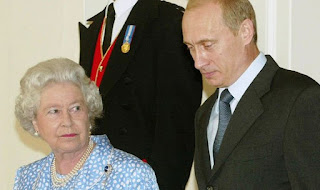
With Elizabeth II (1926-2022; Queen of the UK and other places, 1952-2022).

With Muammar Gaddafi (circa 1942–2011; leader of Libya 1969-2011).

With Yasser Arafat (1929–2004; leader of the PLO (Palestine Liberation Organization) 1969-2004).

With John Paul II (1920-2005; pope 1978-2013).

With Jiang Zemin (1926–2022; General Secretary of the Chinese Communist Party (CCP) (and thus paramount leader) 1989-2002 and President of the People's Republic of China 1993-2003).

With Boris Yeltsin (1931–2007; President of Russia 1991-1999).

With Bill Clinton (b 1946; President of US 1993-2001).

With Rudy Giuliani (b 1944; Mayor of New York City 1994-2001).

With Silvio Berlusconi (1936-2023; prime minister of Italy 1994-1995, 2001-2006 & 2008-2011).

With Kim Jong-Il (Kim II, 1941-2011; Dear Leader of DPRK (Democratic People's Republic of Korea (North Korea)) 1994-2011).

With Jacques Chirac (1932–2019; President of France 1995-2007) & Gerhard Schröder (b 1944; Chancellor of Germany 1998-2005).

With John Howard (b 1939; Prime-Minister of Australian 1996-2007).

With Benjamin Netanyahu (b 1949; prime-minister of Israel 1996-1999, 2009-2021 and since 2022).

With Tony Blair (b 1953; Prime-Minister of UK 1997-2007.

With Yoshirō Mori (b 1937; Prime-Minister of Japan 2000-2001).

With Bashar al-Assad (b 1965; President of Syria 2000-2024).

With Junichiro Koizumi (b 1942; Prime-Minister of Japan 2001-2006).

With Ariel Sharon (1928–2014) Prime Minister of Israel 2001-2006).

With George W Bush (b 1946; President of US 2001-2009).

With Hu Jintao (b 1942; general secretary of the Chinese Communist Party (CCP) 2002 to 2012 (and thus paramount leader), president of the PRC (People's Republic of China) 2003-2013).

With Benedict XVI (1927–2022; pope 2005-2013, pope emeritus 2013-2022).

With Angela Merkel (b 1954; Chancellor of Germany 2005-2021).

With Nicolas Sarközy (b 1955, President of France 2007-2012).

With Barack Obama (b 1961; President of US 2009-2017).

With crooked Hillary Clinton (b 1947; US secretary of state 2009-2013).

With Kim Jong-Un (Kim III, b 1982; Supreme Leader of DPRK (Democratic People's Republic of Korea (North Korea)) since 2011).

With Xi Jinping (b 1953; general secretary of the Chinese Communist Party (CCP) and paramount leader of the People's Republic of China (PRC) since 2012).

With Francis (1936-2025; pope 2013-2025).

With Tony Abbott (b 1957; Prime-minister of Australia 2013-2015).

With Narendra Modi (b 1950; Prime-Minister of Indian since 2014).

With Theresa May (b 1956; Prime Minister of the UK 2016-2019).


With Donald Trump (b 1946; US president 2017-2021 and since 2025).

With Emmanuel Macron (b 1977; President of France since 2017).

With Boris Johnson (b 1964; UK prime-minister 2019-2022).

With Joe Biden (b 1942; President of US 2021-2025).